
Truck Drivers & 1099 Income
Owner-Operator IRS Penalties and Back Taxes: The 2026 Truck Driver's Guide
The short answer: owner operator IRS penalties stack fast because your settlement checks arrive with zero withholding. The failure-to-file penalty runs 5% of unpaid tax per month; failure-to-pay runs 0.5%; skipped quarterlies add an estimated-tax penalty; and a late Form 2290 adds its own. Not filing is ten times costlier than not paying.
You drive the miles, the settlement hits your account, and no one takes a dime out for taxes, until a return goes unfiled or a quarterly gets skipped, and the IRS bills you for the whole thing at once with penalties on top. For owner-operators, the debt is rarely just tax; it's tax plus 15.3% self-employment tax plus several penalties that grow every month.
Here's the good news you can act on today: nearly every one of those penalties can be reduced, and the tax itself usually drops once you file real returns with your truck deductions. The image below breaks down how the penalties stack on an owner-operator balance and how fast they grow.
⏱ Your real clock: there is no single deadline here — there's a meter. The failure-to-file penalty adds 5% of the unpaid tax every month (up to 25%), which is ten times the 0.5% failure-to-pay penalty. That's why filing every missing year, even without paying, is the fastest way to stop the bleeding.
Why owner-operators rack up IRS penalties
An owner-operator owes tax the moment the money is earned, but nothing is withheld, so the whole liability sits unpaid until you send it in yourself. That structure is what turns an ordinary tax bill into a penalty pile.
Three things drive it. First, self-employment tax of 15.3% lands on your net profit before any income tax is even calculated — the piece that shocks most drivers their first year self-employed. Second, you're supposed to make four estimated payments a year, and skipping them triggers a penalty on the shortfall. Third, if a return goes unfiled, the 5%-per-month failure-to-file penalty piles on top of everything else.
The self-employment piece alone is often the reason the number feels impossible. We break down that math in the self-employment-tax shock, explained. And this is specifically the individual owner-operator situation; if you run a fleet with drivers on payroll, the exposure is different and covered in trucking company tax debt.
One penalty is unique to trucks: if your rig has a taxable gross weight of 55,000 pounds or more, you must file Form 2290 and pay the Heavy Highway Vehicle Use Tax each year. Miss it, and you get a late-filing penalty, a late-payment penalty, and interest, and you can't even register the truck without the stamped Schedule 1.
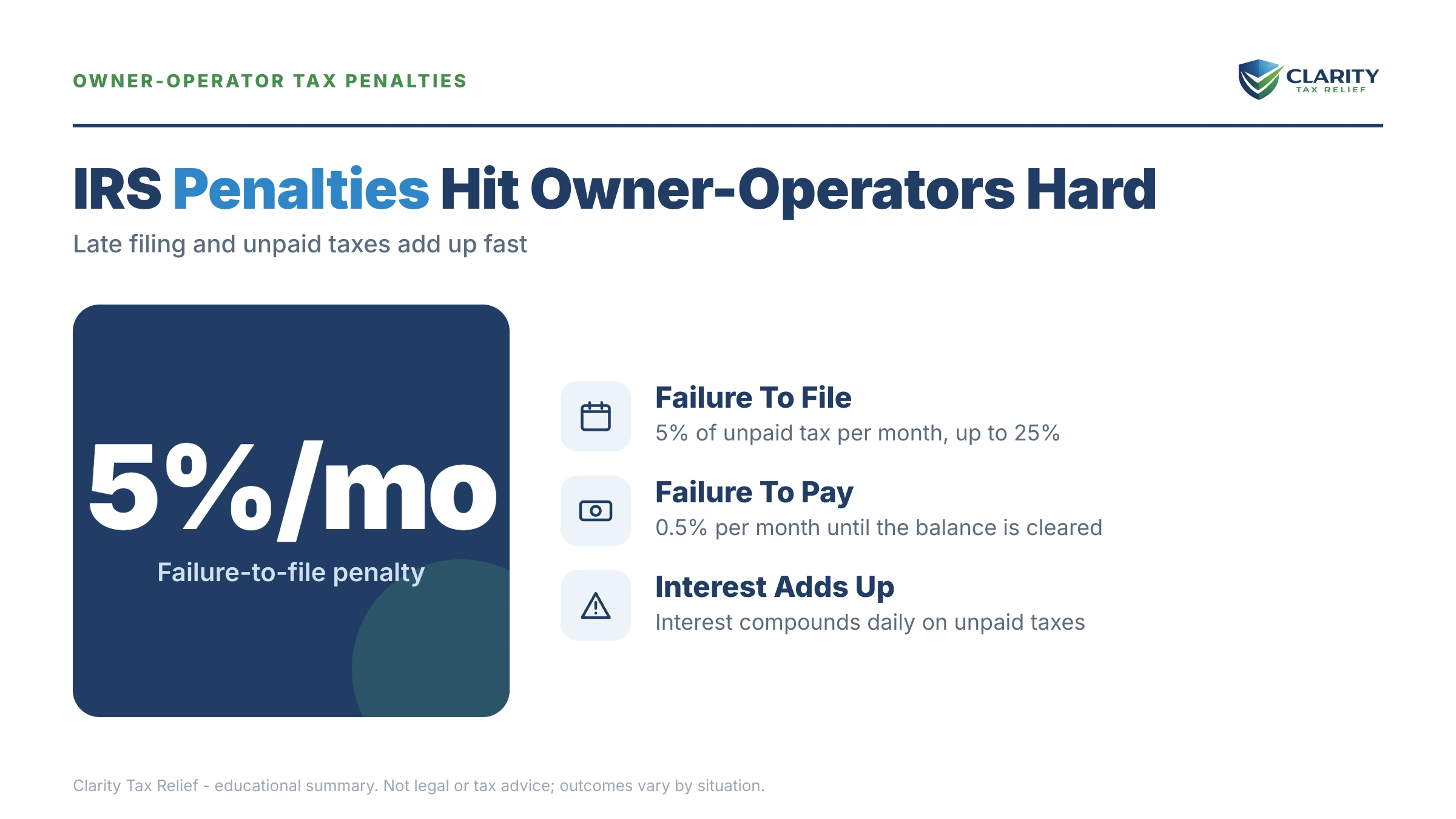
How much are the penalties? The exact rates
Every owner-operator penalty is a percentage, so a bigger balance means bigger penalties, and cutting the tax with real deductions cuts them all. Here's how each one is calculated.
| Penalty | Rate | Cap / notes |
|---|---|---|
| Failure to file (1040) | 5% of unpaid tax per month | Max 25%; min penalty applies if 60+ days late |
| Failure to pay (1040) | 0.5% of unpaid tax per month | Max 25%; reduces the file penalty in overlapping months |
| Estimated-tax underpayment | IRS underpayment rate on each quarter's shortfall | Figured on Form 2210; applies even if paid in full by April 15 |
| Form 2290 late filing | 4.5% of HVUT per month | Up to 5 months |
| Form 2290 late payment | 0.5% of HVUT per month | Plus interest; separate from the filing penalty |
| Interest | Federal underpayment rate, compounded daily | Charged on tax and on penalties; can't be abated for hardship |
Two rules matter most. When both the file and pay penalties run in the same month, the 5% file penalty is reduced by the 0.5% pay penalty, so the combined rate is 5%/month, but the file penalty still tops out at 25% in five months. And interest keeps compounding on the whole balance, including the penalties, the entire time. For the full mechanics, see how big IRS penalties get and the difference between failure-to-file vs. failure-to-pay penalties. You can estimate your own running total with our IRS penalty & interest calculator.
A worked example: what the penalties actually add up to
Say you're an owner-operator who grossed $118,000 in settlements last year and, after fuel, tires, insurance, truck depreciation, and per diem, netted $58,000. You didn't file and didn't pay, and now you're six months late.
Here's roughly how it stacks up (clearly hypothetical, rounded for illustration):
- Self-employment tax: about 15.3% of $58,000 ≈ $8,200 (after the deductible-half adjustment).
- Income tax on the remainder: roughly $5,000.
- Total tax: about $13,200.
- Failure-to-file penalty: 5%/month combined rate for 5 months = 25% of $13,200 = $3,300.
- Failure-to-pay penalty: still running at 0.5%/month beyond that.
- Estimated-tax penalty: a few hundred dollars for skipping all four quarters.
- Interest: compounding daily on the tax and the penalties.
That's a roughly $13,200 tax turning into a $17,000-plus balance in half a year. Now flip it: if you'd let the IRS file a Substitute for Return, it would have counted your full $118,000 in 1099 income with no deductions — taxing you as if you netted six figures. The lesson is blunt: filing an accurate return with your truck deductions is the single biggest lever on the number.
What happens if you ignore it
Unpaid owner-operator taxes don't sit quietly. They move through an automated collection sequence that ends in levies. Ignoring the mail doesn't slow it; it just removes your best options one by one.
- CP14 — the first bill for a balance due. Penalties and interest already accruing.
- CP501 / CP503 — reminder notices, balance growing monthly.
- CP504 — Notice of Intent to Levy; the IRS can seize your state tax refund and a federal tax lien becomes likely.
- LT11 / Letter 1058 — Final Notice of Intent to Levy. After 30 days the IRS can levy your bank account. It can issue a one-time levy on money a broker or carrier owes you.
For owner-operators the bank levy and the receivable levy hurt most — a frozen operating account can shut you down mid-route. In 2026, IRS staffing is down about 27%, but these notices and levies are generated by automated systems that never got laid off. The machine escalates whether or not a human ever reviews your file, which is exactly why acting before the LT11 stage matters.
Behind on returns or watching penalties grow?
The failure-to-file penalty adds 5% every month it's unfiled — get an owner-operator tax review before the next month rolls over. An experienced tax professional will map which years to file, which penalties can come off, and what your realistic monthly number is. Free and confidential.
Your options to reduce or resolve the debt
The most important move for an owner-operator is almost always to file every missing year first. That stops the file penalty and usually lowers the tax. After that, these are the paths, and which one fits depends on your finances.
| Option | Who it fits | Cost / catch |
|---|---|---|
| Short-term plan (≤180 days) | Can pay in full soon after a good season | $0 setup; interest/penalties keep running |
| Streamlined installment agreement | Balance ≤ $50,000, want a monthly plan | Setup fee; up to 72 months; no financial disclosure |
| Partial-pay / non-streamlined IA | Owe more than $50,000, tight cash flow | Requires Form 433 financials |
| Currently Not Collectible | A bad-freight stretch; can't pay basics + IRS | Debt stays; levies pause; reviewed periodically |
| Offer in Compromise | Assets + future income genuinely can't cover the debt | $205 fee (waivable if low-income); ~1 in 5 accepted |
| Penalty abatement | Clean prior 3 years, or a documented hardship | Removes penalties, not the underlying tax |
For most owner-operators under $50,000, a streamlined installment agreement is the workhorse. If a season went bad and you can't cover living costs plus the IRS, Currently Not Collectible status stops enforcement. Settling for less through how an offer in compromise actually works is real but means-tested — never "pennies on the dollar," and the IRS accepted only about 1 in 5 offers in FY2024.
On penalties specifically: if your prior three years were clean, first-time penalty abatement can erase a year's failure-to-file and failure-to-pay penalties. If a truck fire, a serious accident, a hospitalization, or theft of your records is why you fell behind, reasonable-cause penalty abatement may apply. A new Automatic Exemption from Penalty program also begins in summer 2026, removing eligible penalties without a request.
How to respond, step by step
- Pull your records — settlement statements, fuel-card reports, 1099s. Your IRS wage &. Income transcript for each year to see what the IRS already has.
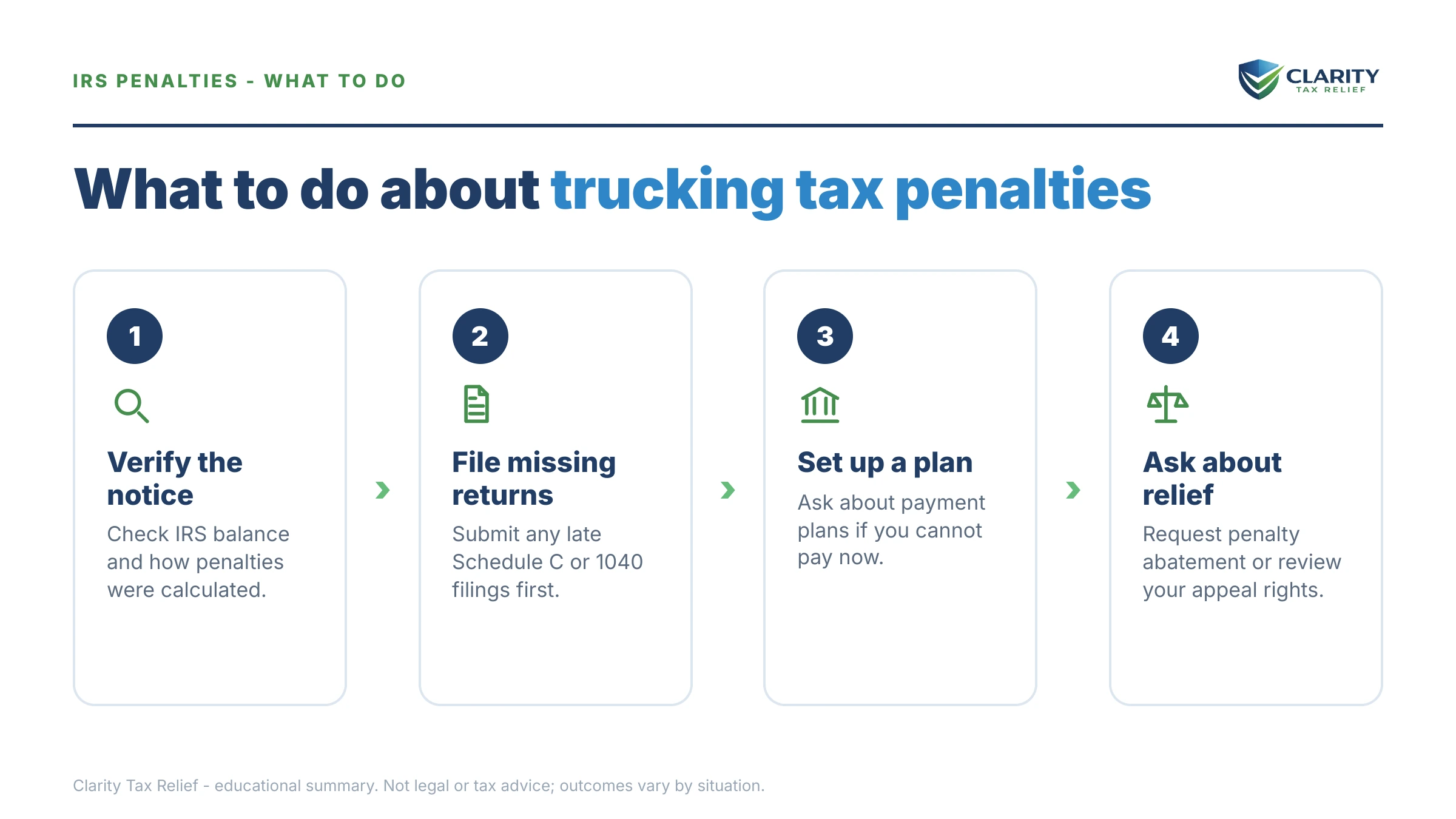
- File every missing return with a full Schedule C claiming fuel, repairs, tires, insurance, depreciation, and the transportation-worker per diem. This stops the 5%/month file penalty and usually cuts the tax.
- File any late Form 2290 if your truck is 55,000 pounds or more, so you can get the stamped Schedule 1 and stop that penalty growing.
- Request penalty abatement — first-time abatement for a clean year, or reasonable cause with documentation.
- Set up the right payment path — a plan, CNC, or an offer — before the IRS reaches the final-notice stage.
- Fix this year going forward by starting quarterly estimated payments so you never rebuild the same debt.
When you can handle this yourself, and when to get help
You can absolutely do this alone if you missed one year, the number is small, and your books are clean. Filing the return, requesting first-time penalty abatement, and setting up an online payment plan for a balance under $50,000 is a manageable afternoon — start with quarterly estimated taxes 101 so the problem doesn't repeat, and read didn't pay quarterlies — the penalty math.
Experienced help changes the outcome when: you have multiple unfiled years, the IRS already filed a Substitute for Return, your records are gone, you owe well into five figures, a levy has already hit your operating account, or an Offer in Compromise is genuinely on the table. In those cases the order you fix things — returns, then abatement, then the balance — decides what you ultimately pay. For the broader picture, our owner-operator trucker back taxes guide covers the whole road back.
Terms on your notice, decoded
Self-employment (SE) tax: the 15.3% Social Security and Medicare tax on your net profit — the part an employer would normally split with you.
Estimated tax: the four annual payments (Form 1040-ES) a 1099 owner-operator makes in place of withholding; skipping them triggers the underpayment penalty.
Form 2290 / HVUT: the Heavy Highway Vehicle Use Tax you file and pay yearly on a truck rated 55,000 pounds or more.
Substitute for Return (SFR): a return the IRS files for you using only reported income and no deductions — almost always overstating your tax.
Failure-to-file vs. failure-to-pay: two separate penalties — filing late costs 5%/month, paying late costs 0.5%/month.
Owner-operator penalty questions, answered
How much are IRS penalties for an owner-operator?
The two biggest penalties for owner-operators are failure-to-file at 5% of the unpaid tax per month (capped at 25%) and failure-to-pay at 0.5% per month (also capped at 25%). Filing late is ten times more expensive than paying late, so the single worst move is not filing. On top of those, most owner-operators also get hit with the estimated-tax underpayment penalty for skipping quarterlies, plus daily-compounding interest.
What is the penalty for not paying quarterly taxes as an owner-operator?
There is no flat fee — the estimated-tax underpayment penalty works like interest charged on each quarter you underpaid, using the IRS underpayment rate. As a 1099 owner-operator with no withholding, you owe estimated payments four times a year, and skipping them triggers this penalty on your whole shortfall. It is calculated on Form 2210, and it applies even if you pay the full balance by April 15.
Do owner-operators have to file Form 2290?
Yes, if your truck has a taxable gross weight of 55,000 pounds or more, you must file Form 2290 and pay the Heavy Highway Vehicle Use Tax every year. Filing it late adds a penalty of 4.5% of the tax due per month for up to five months, plus a separate late-payment penalty and interest. You also cannot register the truck with your state without the stamped Schedule 1 that proves the 2290 was paid.
Can owner-operator penalties be removed?
Often, yes. If your prior three years were clean, First-Time Penalty Abatement can wipe out the failure-to-file and failure-to-pay penalties for one year. Reasonable-cause relief may apply if illness, a serious accident, or records lost in a truck fire or theft kept you from filing. Note that a new Automatic Exemption from Penalty program begins in summer 2026 that removes eligible penalties without a request.
Why do owner-operators owe so much in back taxes?
Because settlement checks and 1099s arrive with zero tax withheld, and on top of income tax you owe 15.3% self-employment tax on your net profit. A driver netting $60,000 can owe well over $15,000 before a dollar of income tax, and if quarterlies were skipped the whole amount lands at once. Missed deductions — fuel, per diem, maintenance, depreciation — often mean the IRS's version of your income is far higher than reality.
Can I still deduct fuel, per diem, and repairs on back tax returns?
Yes. Filing a real Schedule C for the missing years almost always beats letting the IRS estimate your tax, because you can claim fuel, tires, repairs, insurance, truck depreciation. The transportation-worker meal per diem. Those deductions frequently cut the tax, and therefore every percentage-based penalty, dramatically. Even without perfect receipts, records can often be reconstructed from settlement statements, fuel-card reports, and ELD logs.
What happens if an owner-operator never files?
The IRS can file a Substitute for Return using only the 1099 income it has, with no deductions and no per diem, then assess tax, the full 25% failure-to-file penalty, failure-to-pay penalty, and interest. From there the collection notices escalate toward levies on your bank account and settlement checks. Filing your own accurate returns almost always lowers the balance. You can replace an SFR by filing the real return.
Can the IRS take my truck for back taxes?
It is legally possible but uncommon, because seizing the tool you earn your living with is a last resort the IRS avoids when a payment plan is available. The far more likely enforcement is a levy on your bank account or a one-time levy on money a broker or carrier owes you. Setting up a payment arrangement or hardship status stops that enforcement while you catch up.
Your next 24 hours
- Find the numbers. Locate your 1099s and settlement statements for each unfiled or unpaid year — that's what the IRS is measuring you against.
- Gather the deductions. Pull fuel-card reports, repair invoices, insurance, truck payment/depreciation info, and your days-on-the-road log for per diem. This is what shrinks the tax and every penalty on top of it.
- Get a free case review. Because the failure-to-file penalty adds 5% every month a return stays unfiled, don't wait — use the 2-minute form or call (888) 825-7779 and we'll map which years to file, which penalties can come off. Your realistic monthly number.
This guide is general information, not tax or legal advice for your specific situation. Eligibility for IRS programs depends on individual facts and circumstances; no outcome is guaranteed.
Primary sources: IRS Form 2290 (Heavy Highway Vehicle Use Tax), IRS estimated taxes, IRS.gov/payments