
IRS Transcript Codes
Code 806 on Your IRS Transcript: The Withholding Credit, Explained (2026)
The short answer: Code 806 on your IRS transcript is a credit — the total federal income tax withheld from your W-2s and 1099s for that year. It's dated April 15 by convention, always shows as a negative number, and gets subtracted from your total tax to figure your refund or balance. It's a good line, not a bad one.
You logged into your transcript to see where your refund stands, spotted "806 W-2 or 1099 withholding," and now you're wondering whether it's a charge, a refund, or a warning sign. It's none of those — it's the money your employer already sent the IRS on your behalf, credited back to you. The confusing part is the April 15 date and the minus sign, and we'll explain both.
The image below shows what an account transcript looks like and where the 806 line sits in relation to the other codes around it, because 806 rarely tells the whole story alone. What actually determines your refund is how 806 stacks up against your Code 150 return filed tax figure and any other credits on the account.
⏱ The one real deadline tied to Code 806: if that withholding creates a refund on an older return, you have three years from the return's original due date to claim it. Miss that window and the overpayment is gone for good — the 3-year refund deadline is strict and has no hardship exception.
What Code 806 means on an IRS transcript
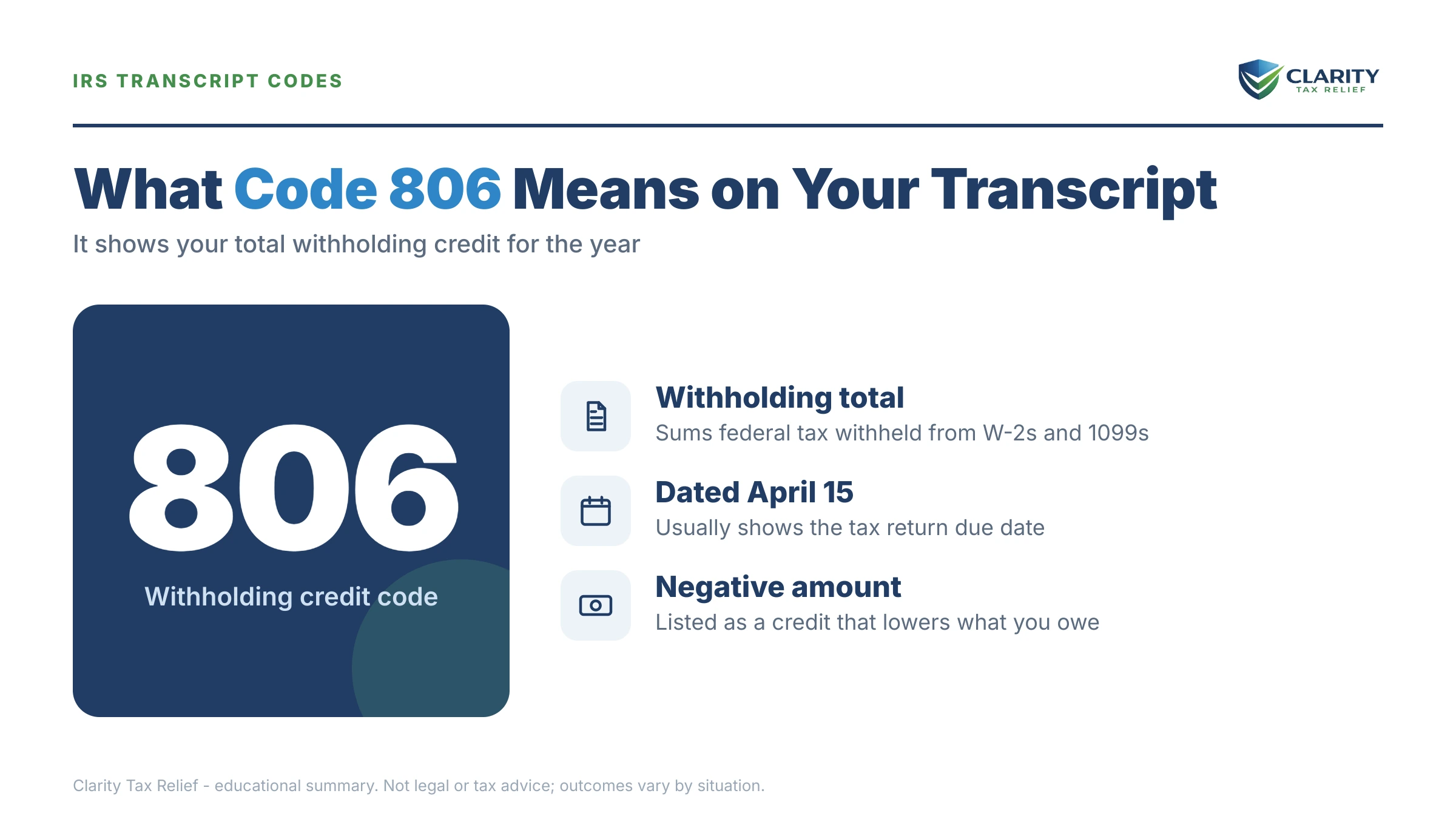
Code 806 is the IRS transaction code for federal income tax withholding reported on your return. It equals the total from box 2 of every W-2 plus any federal tax withheld shown on your 1099s — the same figure that lands on line 25 of your Form 1040. When you filed, you told the IRS "this much was already withheld from my pay," and Code 806 is the IRS posting that claim to your account as a credit.
Because it's a credit, it reduces what you owe. Think of your account like a running tab: Code 150 posts the tax you actually owe for the year, and Code 806 is a payment already sitting against that tab. If the withholding is bigger than the tax, you're owed the difference back.
This is different from money you sent with your return or through estimated payments. Those post under other codes. Code 806 is specifically the withholding your payers reported to the IRS on your behalf. If you want the full walkthrough of the document itself, our guide to how to read an IRS account transcript maps every column line by line.
Why Code 806 is dated April 15 and shows a negative number
Two things about the 806 line confuse almost everyone, and both are completely normal.
The April 15 date. Tax law treats all income tax withheld during a year as if it were paid on that year's filing deadline, April 15, no matter when it was actually withheld from your checks. So your 806 will read April 15 even if you filed in late January and even though the withholding happened across 26 paychecks the year before. The date is a legal placeholder; it does not slow down or speed up your refund.
The minus sign. On an account transcript, credits show as negative amounts and charges show as positive amounts. A negative next to 806 means the withholding is reducing your balance, which is exactly what it's supposed to do. If your 806 ever showed a positive number, that would be the strange entry worth a second look.
Code 806 IRS transcript: the codes you'll see around it
Code 806 almost never appears alone — it's one line in a stack, and reading the stack together is how you learn what's really happening with your refund. Here's what the neighbors mean.
| Code | What it means | Credit or charge? |
|---|---|---|
| 150 | Return filed; your total tax liability for the year is posted | Charge (positive) |
| 806 | W-2 / 1099 federal income tax withholding | Credit (negative) |
| 766 | Refundable credit applied (e.g., Child Tax Credit) | Credit (negative) |
| 768 | Earned Income Credit applied | Credit (negative) |
| 570 | Additional account action pending — a hold | Neither (freeze) |
| 846 | Refund issued — the actual money going out | Refund (result) |
The credits stack. Your 806 withholding and any Code 766 and 768 credits all pull in the same direction — reducing the tax posted under Code 150. When those credits add up to more than the tax, the overpayment becomes your refund, and it shows up as Code 846 with a refund issued date.
How Code 806 factors into your refund: a worked example
Code 806 is one number in a simple subtraction problem. Say you're a W-2 employee and your transcript shows these lines for the year:
| Line | Amount | Effect |
|---|---|---|
| Code 150 — tax liability | $6,200 | You owe this |
| Code 806 — withholding | −$8,400 | Already paid in |
| Code 766 — Child Tax Credit | −$2,000 | Credit applied |
| Code 846 — refund issued | $4,200 | Money to you |
The math: your $8,400 withholding plus the $2,000 credit equals $10,400 paid against a $6,200 tax bill. That leaves a $4,200 overpayment, and that's the number that shows up as your Code 846 refund. In this example the $8,400 in Code 806 withholding is doing most of the work; without it you'd owe rather than get money back.
Now flip it. If your Code 150 tax were $9,000 instead of $6,200, your $8,400 withholding plus $2,000 credit ($10,400) still covers it, leaving a $1,400 refund. But if your tax were $11,000, the same credits fall $600 short — no refund, and a balance due instead. That's why 806 alone never tells you whether you're getting money; you have to weigh it against the tax line.
When Code 806 signals a problem
Code 806 becomes worth acting on in a few specific situations, not because the code is bad, but because the number attached to it doesn't line up.
The 806 amount doesn't match your W-2s. Add up box 2 on every W-2 and any federal withholding on your 1099s. That total should equal your 806. If your transcript shows less than you expected, a W-2 may have been left off your return or entered wrong. If it shows more than your documents support, the IRS may hold the refund to verify it.
A Code 570 hold appears after your 806. When your reported withholding is larger than what employers reported to the IRS, the system can place a Code 570 account hold while it reconciles the numbers. That's the most common way an otherwise-normal 806 turns into a delayed refund.
An employer never sent your W-2, or reported it wrong. If your withholding is off because a payer failed you, start by confirming what the IRS actually has. Your wage and income transcript lists every W-2 and 1099 filed under your Social Security number, so you can compare it against your return. If a document is missing entirely, our guide on what to do when your employer didn't send your W-2 walks through the fix.
806 looks wrong, or a hold is delaying your refund?
If your withholding credit doesn't match your W-2s, or a Code 570 hold has parked your refund, an experienced tax professional can pull your full transcript history and tell you exactly what's stuck and why — free, confidential, no pressure.
What happens if you do nothing about a wrong 806
If your Code 806 is correct, doing nothing is exactly right — the withholding is posted and your refund processes normally. But if the number is wrong, ignoring it plays out in stages, and none of them fix themselves quickly.
- The refund stalls. A mismatch between your reported withholding and employer records usually triggers a hold before any money moves. Your refund simply sits.
- The IRS asks for proof, or adjusts your return. You may get a notice requesting documents, or the IRS may correct the withholding figure on its own and recompute your refund or balance.
- A refund shrinks or a balance appears. If the IRS lowers your 806 to match employer records, your overpayment falls. If that wipes out the refund, you can end up owing tax, with penalties and interest accruing from the original due date.
- The refund window closes. On older years, an unclaimed withholding refund is lost permanently three years after the return's due date. After that, the money you overpaid belongs to the Treasury and cannot be recovered.
How to respond, step by step
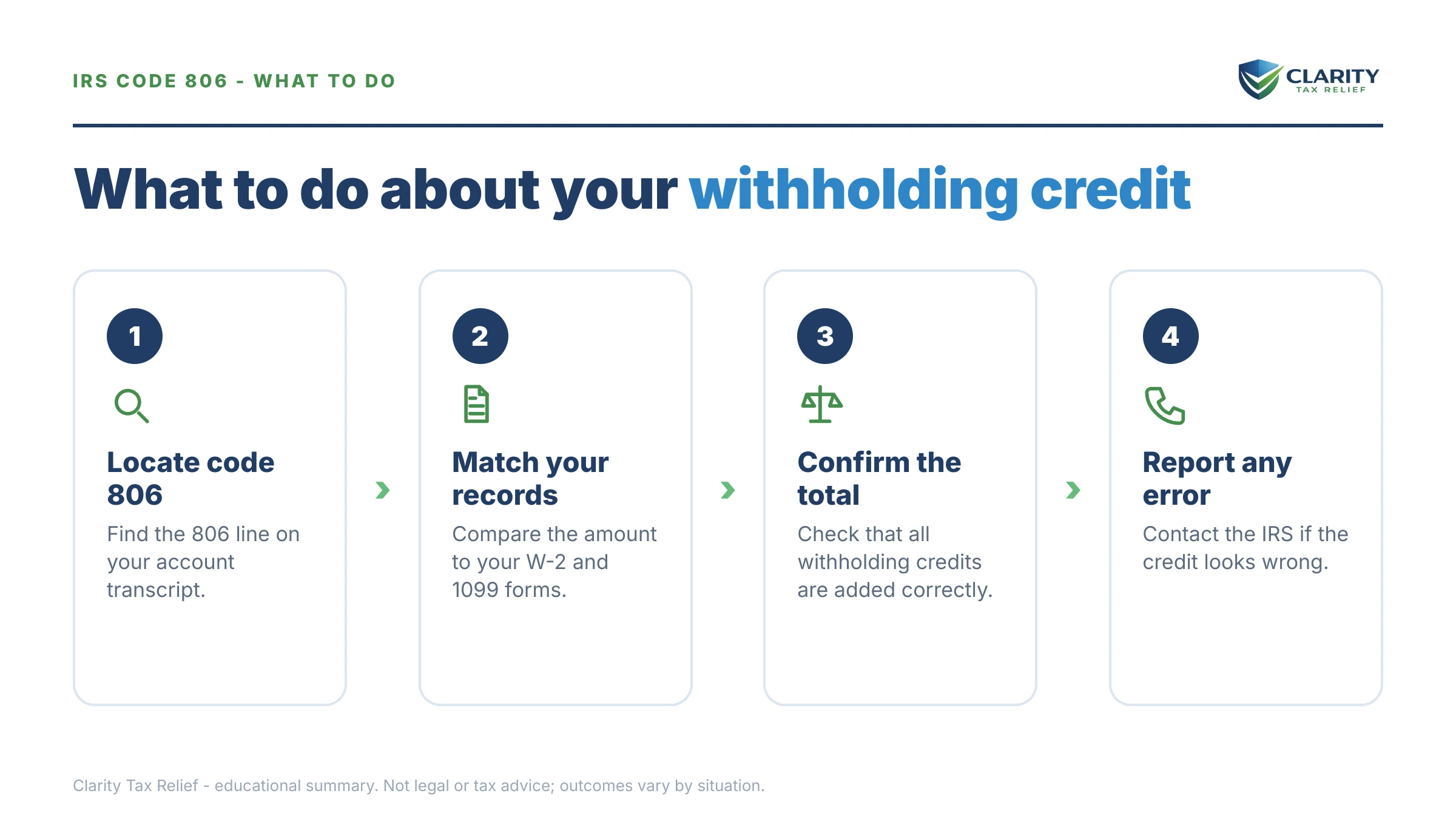
- Confirm the amount. Add box 2 of every W-2 and any 1099 federal withholding; that total should equal your Code 806.
- Compare it to line 25 of your Form 1040 to make sure your return reported the same figure the IRS posted.
- Pull your wage and income transcript to see exactly what employers reported to the IRS under your SSN.
- Check for a Code 570 hold below your 806. That tells you the refund is frozen for verification, not lost.
- Fix any mismatch: respond to any notice with proof of withholding, or amend the return if you left off or misentered a document.
- If it's an old-year refund, act before the three-year window closes — file the return to claim it while the money is still recoverable.
When you can handle this yourself, and when help changes the outcome
Most Code 806 questions need no professional at all. If your 806 matches your W-2s, shows the expected negative amount, and no hold appears below it, there is nothing to do but wait for your Code 846 refund date to post. Reading the code correctly is the whole job.
You can also handle a simple fix yourself: a single missing W-2 you can request from your employer, or a small entry error you can amend. Our walkthroughs on getting your transcripts online and reading them cover the DIY path.
Where experienced help earns its keep is when the withholding problem is tangled with something bigger: multiple unfiled years where 806 credits are trapped, a refund being held under Code 570 while the IRS reconciles employer records, a withholding figure the IRS has adjusted downward into a balance due, or a refund about to be swallowed by an offset for old debt. In those cases a professional can pull the full account history, spot why the money is stuck, and work the fastest legitimate path to release it.
Terms on your transcript, decoded
- Transaction code (TC): the three-digit code the IRS uses to label each action on your account — 806 is the code for withholding.
- Credit vs. charge: on an account transcript, credits show as negative numbers (money in your favor) and charges show as positive (money you owe).
- Withholding: federal income tax your employer or payer already sent the IRS from your pay during the year — box 2 of a W-2.
- Code 150: the "return filed" line that posts your total tax liability, the figure your 806 credit is subtracted from.
- Code 846: "refund issued" — the confirmation that your overpayment is actually being sent, with a real date.
- Code 570: a hold that pauses account action, often while the IRS verifies withholding or credits before releasing a refund.
Code 806 questions, answered
Is code 806 on my transcript good or bad?
Code 806 is good — it's money credited to your account, not a charge. It represents the total federal income tax already withheld from your W-2s and 1099s during the year. That credit is subtracted from your total tax, so a larger 806 usually means a larger refund or a smaller balance due. It only becomes a problem if the amount doesn't match your actual withholding.
Why is my code 806 dated April 15?
The April 15 date is a legal convention, not the day anything happened. The IRS treats all income tax withheld during a year as if it were paid on the filing deadline for that year. So your 806 shows April 15 even if you filed in February and even though your employer withheld the money paycheck by paycheck. The date does not delay or speed up your refund.
Does code 806 mean I'm getting a refund?
Not by itself. Code 806 only shows your withholding credit. It doesn't confirm a refund is on the way. Your refund is confirmed only when Code 846 (refund issued) posts with a dollar amount and a date. If your 806 credit plus other credits exceeds your Code 150 tax liability, a refund is likely. But a Code 570 hold can still pause it.
What's the difference between code 806 and code 846?
Code 806 is the withholding credited to your account; Code 846 is the actual refund being sent. 806 is an input into the math, and 846 is the result. You can have an 806 without ever seeing an 846 — for example, if your withholding was smaller than your tax, or if a hold or offset consumed the overpayment before a refund could issue.
Why is my code 806 amount negative on the transcript?
A negative (minus sign) next to Code 806 is normal and correct. On an account transcript, credits to your account show as negative numbers and charges show as positive numbers. The negative simply means the withholding is reducing what you owe. If your 806 showed a positive number, that would be the unusual entry worth questioning.
What if my code 806 amount is wrong or doesn't match my W-2?
First compare the 806 figure to the total federal withholding on all your W-2s and 1099s (Form 1040, line 25). A mismatch usually means a return entry error or a missing income document. An 806 that's higher than your documents can trigger a Code 570 hold while the IRS verifies withholding against employer records. Pull your wage and income transcript to confirm what the IRS actually has on file.
Can code 806 change or disappear from my transcript?
It can be adjusted. If you amend your return or the IRS corrects your withholding, the original 806 can be reversed or replaced with a new figure. You may also see a second withholding-related line if additional documents are matched. The original entry usually stays visible as part of the account history rather than vanishing entirely.
Do I need to do anything about code 806?
In most cases, nothing. It simply confirms your withholding posted correctly. Act only if the number is wrong, if it triggered a Code 570 hold, or if you're owed a refund from an old year. Refunds tied to withholding must be claimed within three years of the return's due date, or the money is lost to the Treasury for good.
Your next 24 hours
- Find your 806 line and its amount. On your account transcript, locate "806 W-2 or 1099 withholding" and note the negative dollar figure next to it.
- Gather your W-2s and 1099s. Total box 2 from every W-2 plus any federal withholding on your 1099s, and check it against both your 806 and line 25 of your return.
- If the numbers don't match — or a Code 570 hold is delaying your refund — get a free case review through our 2-minute form or call (888) 825-7779 and we'll read your full transcript with you.
This guide is general information, not tax or legal advice for your specific situation. Eligibility for IRS programs depends on individual facts and circumstances; no outcome is guaranteed.