
Back Taxes by Profession
Pharmacist Tax Debt in 2026: Why It Happens and How to Fix It
The short answer: most pharmacist tax debt comes from untaxed income — 1099 relief or PRN shifts with no withholding, or a second W-2 job that under-withheld. Your salary makes an installment agreement the usual fix, but that same salary puts you near the $66,000 passport-certification line and makes an Offer in Compromise hard to win.
You spend your days catching other people's dosing errors, and now the IRS says your own numbers are off. Maybe you picked up relief shifts on a 1099 and never set the tax aside, maybe two W-2 jobs quietly under-withheld all year, or maybe you own the store and fell behind on payroll deposits. Whatever the path, the balance is real, and for a high-earning pharmacist, it is very fixable.
Your income is the double-edged part of this. It gives you the cash flow to clear the debt on a plan the IRS routinely approves, but it also pushes you fast toward the $66,000 threshold where your passport is at risk. The account transcript image below shows exactly where the IRS records what you owe and how it grows month to month.
⏱ The clock that's already running: pharmacist tax debt has no single "respond by" date, but interest compounds daily and a late-payment penalty adds 0.5% a month. Once the balance crosses $66,000 (the 2026 seriously-delinquent threshold), the IRS can certify it to the State Department and your passport is exposed. The number only moves in one direction until you act.
Why pharmacists end up owing back taxes
Pharmacist tax debt almost always traces to income that never had tax withheld from it. Unlike a straightforward staff paycheck where taxes come out automatically, the ways pharmacists actually earn create predictable gaps.
The single most common cause is the self-employment-tax shock. When you work relief, PRN, or floater shifts paid on a Form 1099-NEC, no one withholds anything, and that income carries the full 15.3% self-employment tax on top of ordinary income tax. A staff pharmacist splits FICA with the employer; a 1099 pharmacist pays both halves personally.
The second cause hits W-2 pharmacists with more than one job: two jobs and owing every year. Each employer's payroll system withholds as if its paycheck is your only income, so both under-withhold against your true, higher bracket. You look fully covered on each stub and still owe thousands at filing.
A third path belongs to owners. If you run an independent pharmacy with employees, the debt is usually unpaid 941 payroll taxes rather than personal income tax, and that money is treated very differently, because part of it was withheld from your staff's wages and held in trust.
| Work arrangement | What triggers the debt | Usual fix |
|---|---|---|
| Staff pharmacist, one W-2 (CVS, Walgreens, hospital) | Rare, usually a bonus, stock, or a spouse's income shifted the bracket | Adjust W-4; short-term plan |
| Staff W-2 + second W-2 or per-diem job | Both jobs under-withhold against your real bracket | Fix W-4s; installment agreement |
| Relief / PRN / floater on 1099-NEC | No withholding + 15.3% self-employment tax | Estimated taxes going forward; plan on the balance |
| Independent pharmacy owner | Missed 941 payroll deposits (trust-fund money) | Business plan + Trust Fund Recovery review |
Traveling and multi-state relief pharmacists add one more wrinkle: you can owe two or three states plus the IRS on the same income, and the states run their own collection timelines. This guide covers the federal side — like a travel nurse's multi-state tax debt, the state pieces need their own attention.
What happens if you ignore pharmacist tax debt
A federal balance never quietly goes away — the IRS runs an automated notice sequence that escalates on its own schedule, and in 2026 those systems keep firing even though IRS staffing was cut about 27% last year. Here is the order it follows if nothing is done.
- CP14 — the first bill for the balance due. This is where most pharmacists first see the number in writing.
- CP501 / CP503 — reminder notices. No enforcement yet, but penalties and daily interest keep stacking.
- CP504 — Notice of Intent to Levy your state tax refund. A federal tax lien becomes a real possibility that can surface on a mortgage or refinance.
- LT11 / Letter 1058 — the Final Notice of Intent to Levy. Thirty days after this, the IRS can garnish your salary or hit your bank account — and it starts your Collection Due Process appeal rights.
- Passport certification — once the total passes $66,000, the debt can be certified as seriously delinquent and your passport denied or revoked.
For a W-2 staff pharmacist, the sharpest edge is the continuous wage levy that can follow the LT11 — payroll at your employer is legally required to send a large slice of every check until the debt clears or you set up an agreement. For a 1099 relief pharmacist, the IRS can instead hit a specific paying pharmacy with a one-time levy on what it owes you. Either way, the fix is the same: engage before the final-notice window closes.
Behind on taxes as a pharmacist?
Send us the notice or your transcript. An experienced tax professional will map your exact balance, the passport line, and the plan that fits your salary — free, confidential, no pressure.
Your options for resolving pharmacist tax debt
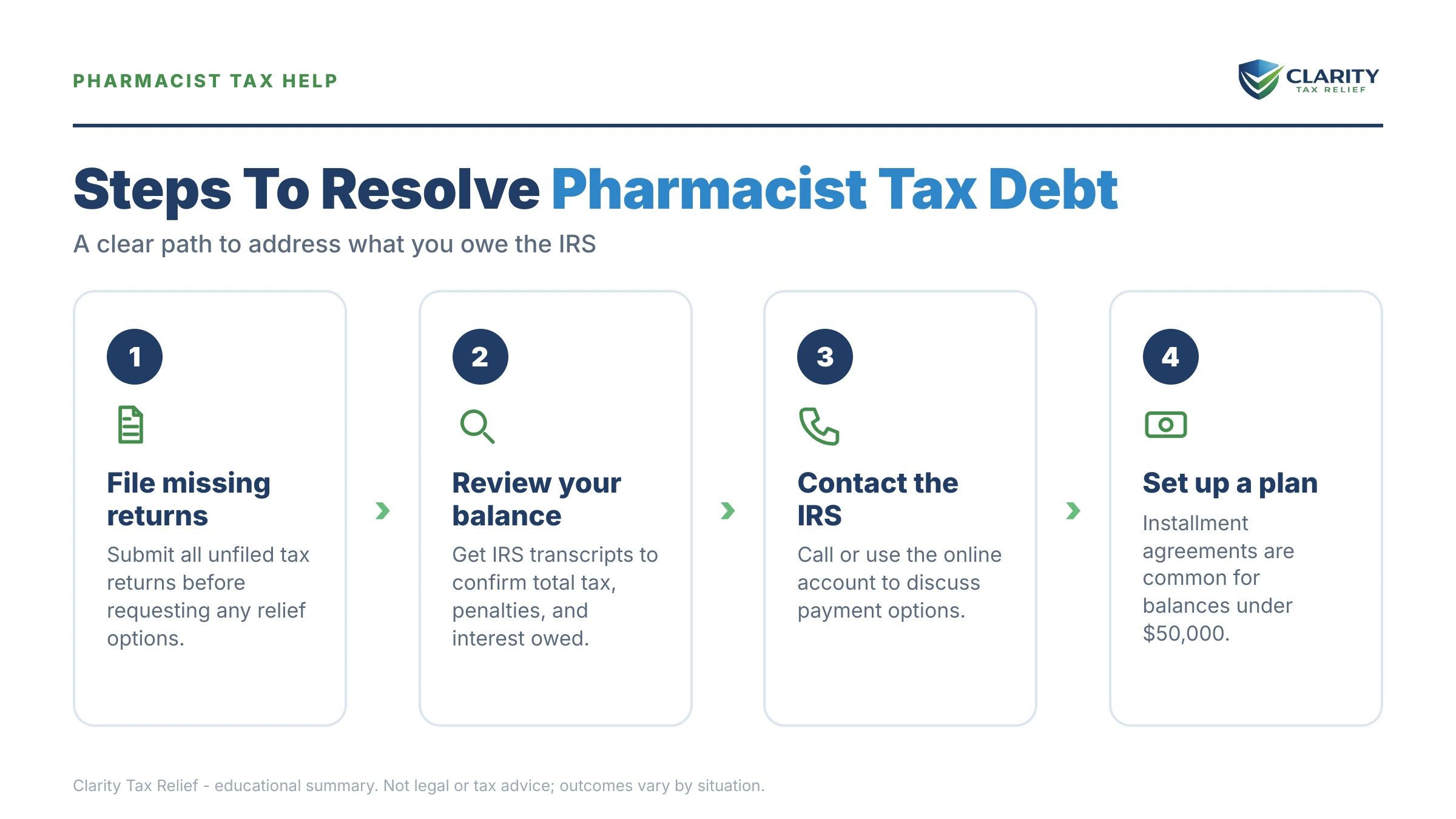
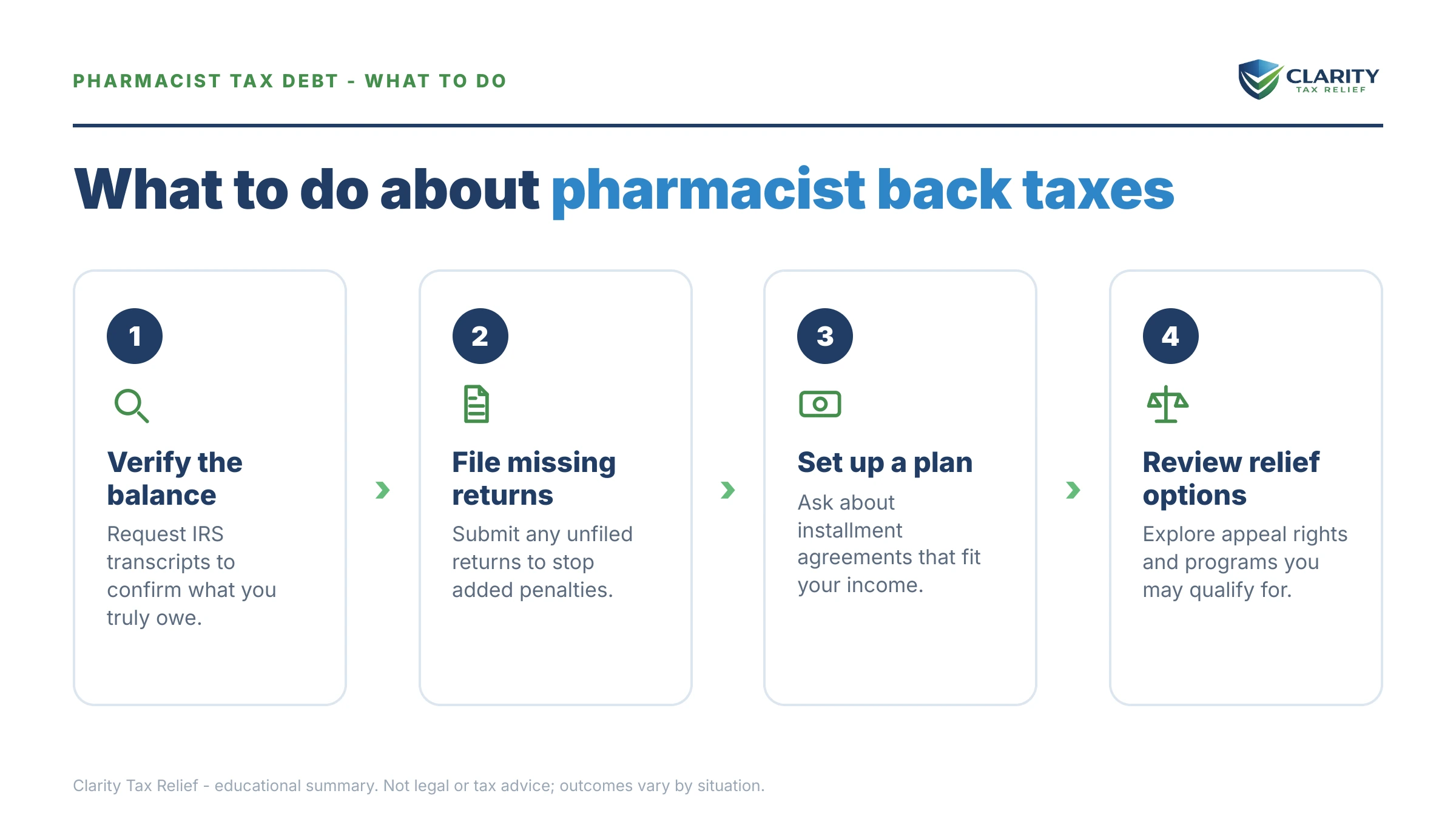
A working pharmacist's income usually makes the streamlined installment agreement the default answer, but which option genuinely fits depends on the total balance and whether your income recently dropped. Here is how the real programs line up.
| Option | Best when | Cost / key rule |
|---|---|---|
| Short-term payment plan | You can clear it within 180 days after a good month or bonus | $0 setup; interest + penalty still accrue |
| Streamlined installment agreement | Total balance ≤ $50,000 | Up to 72 months; little financial disclosure needed |
| Non-streamlined agreement | Balance above $50,000 | Requires Form 433 financials |
| Currently Not Collectible | Income really dropped — job loss, disability, gap between jobs | Collection pauses; debt and interest remain |
| Offer in Compromise | Assets + future income genuinely can't cover the debt | $205 fee, 20% down; hard to win on a high salary |
| First-Time Penalty Abatement | Prior 3 years were clean | Removes penalty on one year; ask before you pay |
Be realistic about the Offer in Compromise. The IRS calculates an offer from your assets plus what it thinks you can pay from future income. A six-figure pharmacist salary usually means the agency believes it can collect the full amount over the ten-year statute, so it declines. The IRS accepted roughly 1 in 5 offers in FY2024, and "pennies on the dollar" pitches aimed at high earners are exactly the marketing the FTC has cracked down on. For most working pharmacists, a plan or CNC is the honest path; the tradeoffs are laid out in payment plan vs. offer in compromise.
Before you agree to any monthly number, run the real cost with our IRS penalty &. Interest calculator so you can see how much of each payment is going to accruing interest versus principal.
A worked example: relief pharmacist who owes $38,000
Say you're a relief pharmacist who picked up about $95,000 in 1099 PRN shifts over two years alongside a part-time W-2 role, and set nothing aside. After legitimate deductions, you're left owing roughly $38,000 in combined income and self-employment tax across the two years.
Because that total is under $50,000, you qualify for a streamlined installment agreement over up to 72 months. The math looks like this:
- $38,000 ÷ 72 months ≈ $528/month in principal.
- Add daily-compounding interest and the balance runs closer to $600/month until it's paid.
- If your prior three years were clean, first-time abatement can remove the failure-to-pay penalty on the earlier year, often a four-figure reduction before you set the plan.
Now compare an Offer in Compromise. To win one, you'd have to show the IRS that $38,000 is more than it could ever collect from your assets and future relief income, and at your earning level that's a hard case, which is why the plan usually wins. What changes the picture is a genuine income collapse: if the relief work dried up and you couldn't cover basic living costs, Currently Not Collectible status could pause collection entirely. The figures here are illustrative; your own numbers drive everything.
When you can handle this yourself, and when you shouldn't
Plenty of pharmacist tax debt is a do-it-yourself job. If you agree with the balance, owe under about $25,000. Your income is steady, you can set up a plan yourself in minutes — see how to set up an IRS payment plan online. A single year you can clear inside 180 days, or a clean-record year that qualifies for first-time abatement, rarely needs a professional.
Experienced help changes the outcome in specific situations. Get a review if a wage levy is already in motion, if you have several unfiled years the IRS could turn into inflated substitute returns, if the balance is climbing toward the $66,000 passport-revocation threshold, or if you own a pharmacy with 941 payroll debt. Payroll debt in particular can be assessed against you personally and is collected far more aggressively than income tax — that one is not a solo project.
Terms on your notice, decoded
- Self-employment tax — the 15.3% Social Security and Medicare tax a 1099 relief pharmacist pays on net earnings; a staff pharmacist's employer covers half.
- Streamlined installment agreement — a monthly plan for balances of $50,000 or less, up to 72 months, with minimal financial disclosure.
- Currently Not Collectible (CNC) — a hardship status that pauses IRS collection when paying anything would leave you unable to cover basic living expenses.
- Seriously delinquent tax debt — a federal balance over $66,000 in 2026 that the IRS can certify to the State Department, putting your passport at risk.
- Trust Fund Recovery Penalty — the IRS's tool to assess unpaid withheld payroll taxes against a pharmacy's owner or check-signer personally.
- CSED — the Collection Statute Expiration Date, generally 10 years from assessment, after which the IRS can no longer collect. Appeals and offers can pause the clock.
If a levy or lien has already appeared, don't wait for the balance to keep compounding — have an experienced tax professional review your pharmacist tax debt and confirm which option actually fits before you commit to a payment.
Pharmacist tax debt questions, answered
Why do so many pharmacists owe back taxes?
The most common cause is untaxed income — relief or PRN shifts paid on a 1099 with no withholding, or a second W-2 job whose withholding table assumed it was your only income. Both leave you short at filing. Pharmacy owners fall behind on 941 payroll taxes instead. A pharmacist earning $130,000 who takes $40,000 in 1099 relief work can owe well over $12,000 in self-employment and income tax on that piece alone.
Can I lose my pharmacist license over unpaid IRS taxes?
The IRS itself does not report tax debt to state boards of pharmacy, so a federal balance alone will not pull your license. The real professional risk is the passport: once your debt is certified as seriously delinquent (over $66,000 in 2026), the State Department can deny or revoke your passport, which matters if you travel or work near a border. Some state tax agencies do share compliance data with licensing bodies, so a state balance can carry more license risk than the federal one.
I'm a relief pharmacist paid on a 1099 — how much should I have set aside?
As a rough rule, set aside 30–35% of every 1099 relief check for taxes, because that income carries both income tax and the full 15.3% self-employment tax. A staff pharmacist has FICA split with the employer; a 1099 pharmacist pays both halves. If you already fell behind, filing and starting a plan matters more than the exact percentage — going forward, quarterly estimated payments prevent the next year's balance.
Can the IRS garnish a pharmacist's wages from CVS or Walgreens?
Yes. If you are a W-2 staff pharmacist and ignore the notice sequence through the final Notice of Intent to Levy (LT11 or Letter 1058), the IRS can send a continuous wage levy to your employer's payroll department. It stays in place until the debt is paid or you set up an agreement. A levy on a six-figure salary takes a large slice; setting up an installment agreement before the 30-day final-notice window closes prevents it.
I have two years of unpaid pharmacist income — where do I start?
File every missing return first, even the years you can't pay, because the failure-to-file penalty is ten times the failure-to-pay penalty. Once all returns are filed, the IRS will combine the balances and you can address them in one agreement. Filing also stops the IRS from preparing a substitute return that ignores your business deductions and inflates what you owe.
Can a pharmacist settle tax debt for less than they owe?
Sometimes, through an Offer in Compromise, but pharmacist income works against you. The IRS bases an offer on your assets plus future earning capacity, and a $120,000-plus salary usually means the agency believes it can collect the full amount over time, so it declines the offer. The IRS accepted roughly 1 in 5 offers in FY2024. A payment plan or, in a real income drop, Currently Not Collectible status is a more realistic path for most working pharmacists.
How much are the penalties on my unpaid pharmacist taxes?
If you filed on time but didn't pay, the failure-to-pay penalty is 0.5% of the unpaid tax per month, capped at 25%, plus interest that compounds daily. If you also filed late, the failure-to-file penalty is 5% per month up to 25% — the far larger cost. If your prior three years were clean, first-time penalty abatement can wipe the penalty on one year entirely.
Does owning an independent pharmacy change how I resolve tax debt?
Yes, significantly. If your pharmacy has employees and fell behind on 941 payroll taxes, the withheld portion is trust-fund money the IRS can assess against you personally through the Trust Fund Recovery Penalty, even if the business closes. Business payroll debt is handled far more aggressively than a personal income balance, so an owner facing 941 arrears should get experienced help before contacting the IRS.
Your next 24 hours
- Find the number. Log into your IRS online account and note the exact balance per year and how close the total is to the $66,000 passport line.
- Gather three things. Your last filed return, any IRS notice you've received, and your 1099-NEC and W-2 totals so your real income (and deductions) is documented.
- Get a free case review. Use the 2-minute form or call (888) 825-7779. Interest is compounding daily and the balance only grows until you act — the sooner you set a plan, the less it costs.
This guide is general information, not tax or legal advice for your specific situation. Eligibility for IRS programs depends on individual facts and circumstances; no outcome is guaranteed.