
Back Taxes by Trade
Plumber Owes the IRS: How to Handle Back Taxes in 2026
The short answer: a plumber who owes the IRS is almost always behind on self-employment tax and quarterly estimates that nobody withheld. The balance is fixable: file any missing returns first, then set up a payment plan, hardship status, or an Offer in Compromise based on your actual income and assets — not on the full sticker amount.
You booked the jobs, you did the work, you got paid — and now there's a bill from the IRS you never saw coming. That's the trap of running a plumbing business: your customers pay you the full invoice, but nobody set aside the tax the way a paycheck does. When the bill arrives all at once, it feels like a hole you can't see the bottom of.
It has a bottom, and a way out. The size of the number matters less than which years are involved and whether you have employees. Those two facts decide everything about your options. The table further down shows exactly which resolution path fits a plumber at each balance level.
⏱ The clock that matters: back taxes have no single "due date," but the meter never stops. The failure-to-pay penalty runs 0.5% per month plus daily-compounding interest. If any return is still unfiled, the failure-to-file penalty is ten times larger — 5% per month, up to 25%. Filing, even without paying, cuts the bleeding immediately.
Why plumbers end up owing the IRS
A self-employed plumber owes the IRS mainly because no employer withholds tax from your income. The single biggest shock is self-employment tax: 15.3% of your net profit, on top of ordinary income tax. That's the Social Security and Medicare a boss would normally split with you — as your own boss, you pay both halves.
Run the numbers and it stacks up fast. Say you cleared $80,000 in net profit. Self-employment tax alone is roughly $11,300 before a dollar of income tax. Skip the quarterly payments and that whole liability lands at filing time with nothing set aside to cover it. We break the mechanics down in our guide to the self-employment tax shock.
The other common triggers we see with plumbers:
- Missed quarterly estimates. The IRS expects four payments a year. Miss them and you also get an underpayment penalty on top — see how quarterly estimated taxes work.
- Good year, then a slow year. You owe on last year's big income while this year's slower revenue makes it impossible to pay.
- A helper or apprentice on payroll. Fall behind on payroll taxes and you cross into far more serious territory (more on that below).
- Paying subs on 1099 who the IRS thinks were employees. Worker misclassification can turn into a payroll assessment years later.
- Cash jobs never fully reported, which can surface in a bank-deposit audit.
What happens if you ignore an IRS balance
An unpaid balance doesn't sit quietly. It moves through an automated collection sequence that escalates whether or not a human ever looks at your file. Here's the order it follows:
- CP14 — the first bill. This is where most plumbers first see the number. No enforcement yet, but the penalty and interest meter is running.
- CP501 / CP503 — reminder notices. Still just bills; the balance grows every month.
- CP504 — Notice of Intent to Levy. The IRS can now grab your state tax refund. A federal tax lien becomes a real risk — bad news when you need to be bonded or get credit for materials.
- LT11 / Letter 1058 — the Final Notice of Intent to Levy. This starts a 30-day clock and your Collection Due Process appeal rights. After it runs, the IRS can levy your business bank account or the money a general contractor owes you.
For a plumber, the account levy is the one that stings. The IRS doesn't need to seize your truck to hurt you — freezing the account you pull payroll and supplier payments from does the damage on its own. Read the full sequence in our IRS collection process step by step roadmap and the exact order of IRS collection letters.
In 2026 this runs faster than the phones do. IRS staffing was cut sharply, but liens and levies are issued by machines that didn't get laid off — the escalation keeps going even when nobody's answering the line.
Got a notice sitting on the truck dashboard?
Send us a photo of it. An experienced tax professional will tell you exactly where you are in the collection sequence and what your options are, before the balance grows another month. Free, confidential, no pressure.
Your options when a plumber owes the IRS
The notice gives you two choices — pay or else. In reality the IRS runs several programs. The right one depends on your cash flow, your assets, and how many years are stacked up. Here's how they compare.
| Option | Who it fits | Cost / setup |
|---|---|---|
| Short-term plan (up to 180 days) | You can clear it after a big job or slow-season recovery | $0 setup; interest & penalties keep running |
| Streamlined installment agreement | Total balance under $50,000, all returns filed | Small setup fee; up to 72 months, no financial disclosure |
| Currently Not Collectible | Paying anything would leave you unable to cover basics | Free; collection pauses, debt remains, interest accrues |
| Offer in Compromise | Income & assets genuinely can't cover the full debt | $205 fee (waivable if low-income); ~1 in 5 accepted |
| First-time penalty abatement | Clean compliance the prior 3 years | Free; removes failure-to-pay/file penalties |
Which option is realistic changes a lot with the size of the balance. This next table maps the number on your notice to the path most plumbers actually use.
| You owe | Most likely path | What to watch |
|---|---|---|
| Under $10,000 | Guaranteed installment agreement or short-term plan | Auto-approved if compliant; keep quarterlies current |
| $10,000–$50,000 | Streamlined plan up to 72 months | Direct debit avoids default; file every year on time |
| $50,000–$100,000 | Plan with Form 433 financials, CNC, or OIC | Financial disclosure required; lien likely |
| Over $100,000 | Revenue-officer-managed plan or offer | $66k passport threshold; asset review, get representation |
Deductions plumbers miss, and how they shrink the debt
The fastest way to lower a tax bill is to make sure the return that created it was actually right. Bare-bones returns — or a Substitute for Return the IRS filed for you — often skip legitimate business deductions, which means you're being billed on income you never really kept. Amending a return can cut the debt at its source before you ever set up a plan.
| Deduction | What it covers |
|---|---|
| Vehicle & mileage | Work truck, fuel, insurance, and repairs (standard mileage or actual) |
| Tools & equipment | Wrenches, snakes, cameras, torches, often expensed same year under Section 179 |
| Materials & supplies | Pipe, fittings, fixtures, and consumables billed to jobs |
| License, bond & insurance | State license renewal, surety bond, and liability coverage |
| Home office & phone | Dedicated office space and the business share of your cell plan |
| Half of SE tax | The employer-equivalent portion is an above-the-line deduction |
If a prior year was filed without these, an amended return can lower the tax debt itself. Before you agree to a big number, it's worth confirming the return behind it is accurate.
A worked example: a plumber who owes $38,000
Say you owe $38,000 across two years of self-employment tax you never set aside. Here's roughly how the paths compare — figures are illustrative, not a quote.
- Streamlined installment agreement: because $38,000 is under $50,000 and all returns are filed, you can spread it over 72 months. That's about $528 a month in principal, but interest and the 0.5%/month failure-to-pay penalty keep running until the cap, so plan on the real number being higher.
- First-time penalty abatement: if your prior three years were clean, removing the failure-to-pay penalty could knock several thousand dollars off before you even start the plan.
- Offer in Compromise: only realistic if the IRS's own math — your income minus allowable expenses, plus the equity in your truck and equipment — shows it can't collect $38,000. A plumber with a paid-off van and steady contracts usually has too much collection potential to settle, and does better on a plan. Estimate the interest and penalty piece with our IRS penalty & interest calculator.
The point of the math: the "$38,000" is rarely the number you actually pay over time — penalty relief and accurate returns move it. The plan you choose decides the monthly bite.
If you have employees: payroll debt is a different animal
Payroll tax debt is the most dangerous balance a plumbing business can carry, because part of it is money you held for your workers. When you withhold Social Security, Medicare, and income tax from an apprentice's check and don't hand it to the IRS, that's the trust fund. The IRS can assess the Trust Fund Recovery Penalty personally against you.
That means the debt follows you personally even if the LLC or corporation closes. Unfiled or unpaid Form 941 back taxes should always be handled first and with experienced help. The same caution applies if you paid helpers on 1099 who really functioned as employees — a contractor's back-tax exposure can quietly convert into a payroll assessment through worker misclassification.
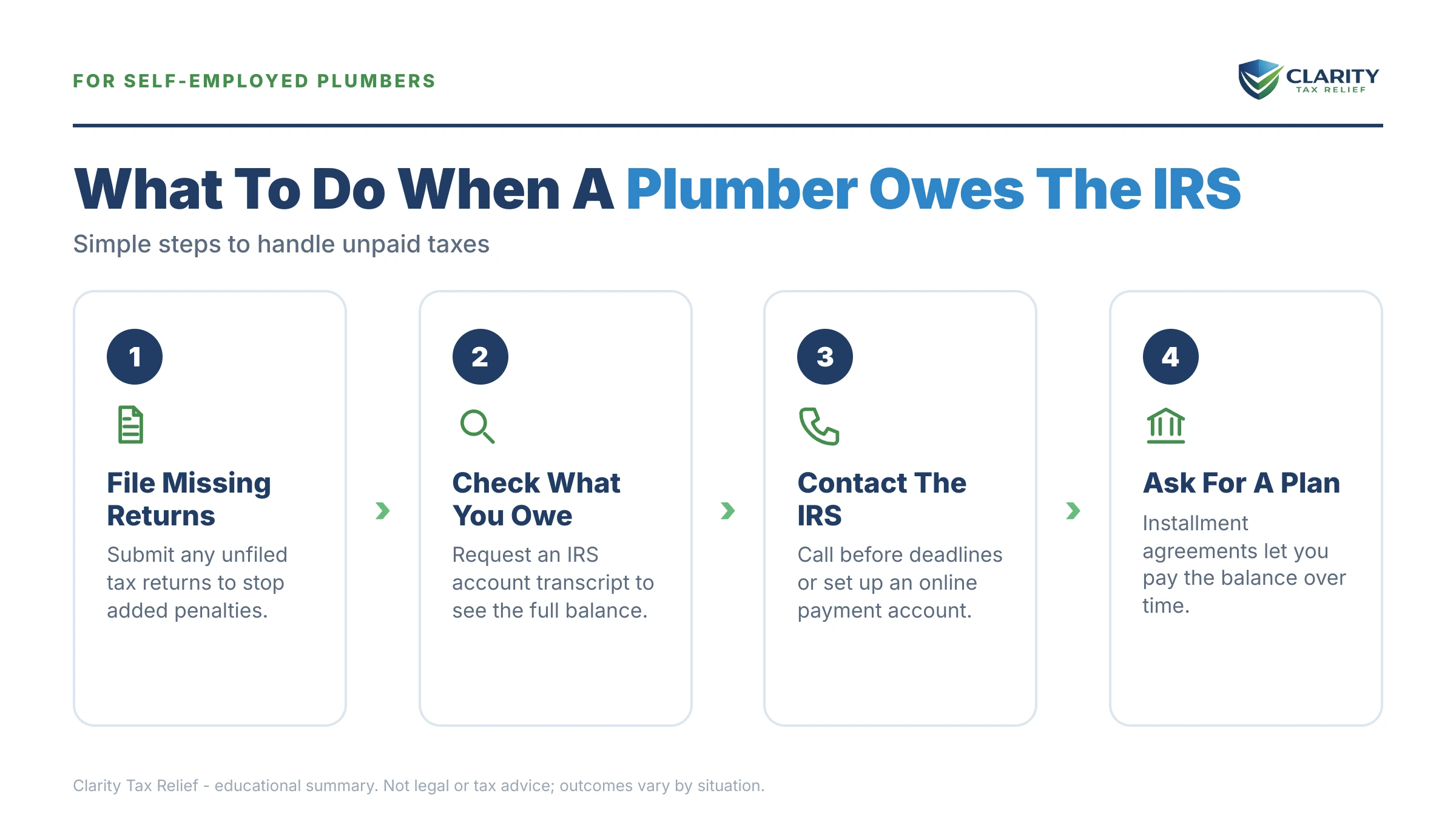
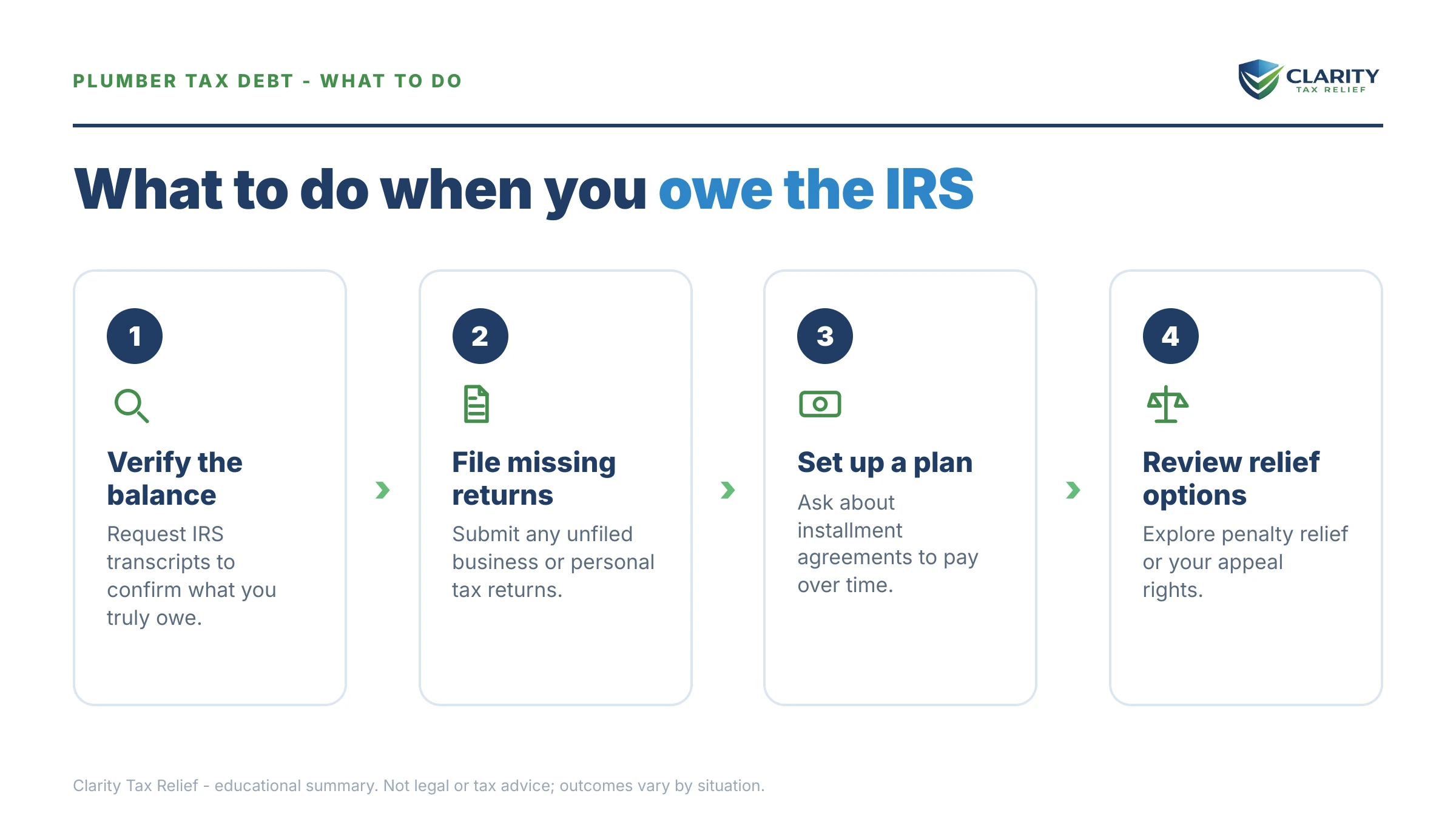
How to respond, step by step
- Pull your transcripts from your IRS online account to confirm which years you owe, what's tax versus penalty, and whether any returns are missing.
- File every missing return first — the IRS won't approve any agreement while a year is unfiled. Your own return beats a Substitute for Return with zero deductions.
- Reclaim skipped deductions — check the return behind the balance for tools, mileage, materials, license, and home office; amend if it moves the number.
- Match a path to your cash flow — a streamlined plan under $50,000, Currently Not Collectible if paying causes hardship, or an offer if your finances genuinely can't cover it.
- Set it up and request penalty relief — establish the agreement and ask for first-time or reasonable-cause abatement to strip penalties off the balance.
- Get a professional review if payroll or multiple years are involved — the order you fix returns, penalties, and balance in changes what you ultimately pay.
When you can handle this yourself, and when you shouldn't
You can absolutely do this alone if you owe under about $25,000 for a single year, every return is filed. Your income comfortably supports a monthly payment. Setting up a payment plan online takes minutes, and a first-time abatement request is a short letter. Don't pay a firm for something that simple.
Experienced help changes the outcome when the facts get heavier: a levy already in motion, several years unfiled, any payroll or 941 debt, a balance over $50,000 that requires financial disclosure, or an Offer in Compromise where the collection-potential math decides everything. In those cases, sequencing mistakes cost far more than representation. If you're weighing it, our guide on whether you need a tax attorney for back taxes lays out the line honestly.
Terms on your notice, decoded
- Self-employment tax: the 15.3% Social Security and Medicare tax you owe on net profit as your own employer.
- Trust Fund Recovery Penalty (TFRP): a personal assessment for withheld payroll taxes a business didn't remit. It survives the business closing.
- Levy vs. lien: a lien is a legal claim securing the debt (public record). A levy is the actual seizure of a bank account, refund, or receivable.
- CSED: the collection statute — the IRS generally has 10 years from assessment to collect, though appeals, offers, and bankruptcy pause the clock.
- Substitute for Return (SFR): a return the IRS files for you when you don't, with no deductions — almost always inflating what you owe.
Not sure where your notice falls in the sequence? An experienced tax professional can map your exact position and stop the balance from growing another month — start a free case review or call (888) 825-7779.
Plumber tax debt questions, answered
Why do so many plumbers end up owing the IRS?
Because nobody withholds tax from a self-employed plumber's income. On top of income tax, you owe 15.3% self-employment tax on net profit — the Social Security and Medicare an employer would normally split with you. Miss the quarterly estimated payments and the whole year's bill lands at once, often $10,000 to $40,000 for a busy one-person shop.
Can the IRS take my plumbing tools, my truck, or shut down my business?
The IRS can levy business bank accounts and, in serious cases, seize equipment or a vehicle, but tools and equipment you need to earn a living have a limited statutory exemption, and seizure of a going concern is rare and requires manager approval. Far more common is a levy on your business bank account or on money a general contractor owes you. Setting up an agreement before enforcement starts keeps your truck and tools out of the conversation entirely.
I have a helper on payroll and fell behind on payroll taxes — is that different?
Yes, and it is far more serious than income tax. The withheld portion of your helper's payroll, the trust fund, is money you held for your employees. The IRS can assess the Trust Fund Recovery Penalty personally against you, so the debt follows you even if the business closes. Payroll (Form 941) debt should be handled first and with professional help.
Can I still get a payment plan if I owe the IRS for several years?
Yes, but every required return has to be filed first — the IRS will not approve an agreement while you have unfiled years. Once you're current, a combined balance under $50,000 usually qualifies for a streamlined plan of up to 72 months with no detailed financial disclosure. Above $50,000 you'll need to submit a financial statement (Form 433).
Will owing the IRS affect my plumbing or contractor license?
The IRS itself does not pull trade licenses, but two indirect risks matter. A federal tax lien is public record and can surface when you bid work, get bonded, or renew credit. And if your total federal debt passes $66,000 for 2026, the IRS can certify it to the State Department and block your passport. Some state licensing boards also check for state tax compliance separately.
I did cash jobs and didn't report all of it — could I go to jail?
Almost certainly not for owing money. Criminal charges are reserved for deliberate, provable fraud — hiding income, keeping two sets of books, lying to an agent. The ordinary fix for unreported cash is to file accurate returns before the IRS finds it. Coming forward voluntarily is treated very differently than being caught, so correct the returns rather than hope it stays buried.
Can a plumber settle IRS debt for less than the full amount?
Sometimes, through an Offer in Compromise, but only when the IRS's own math shows it can't collect the full balance from your income and assets. Anyone promising to erase your debt for a tiny fraction of what you owe is selling a scam. The IRS accepted only about 1 in 5 offers in FY2024. A plumber with a paid-off truck and steady jobs usually does better on a payment plan or hardship status than on an offer.
How much should a plumber set aside so this doesn't happen again?
A common rule of thumb is 25% to 30% of net profit set aside in a separate account, paid to the IRS in four quarterly installments. The exact figure depends on your bracket and whether you operate as a sole proprietor or an S-corp. Getting the estimated payments right going forward is what keeps a fixed old balance from turning into a fresh one every April.
Your next 24 hours
- Find the number and the year. Pull out any IRS notice and note the tax year and the balance, or log into your IRS online account to see every year at once.
- Gather three things: your last filed return, any notices, and a rough picture of your monthly income and business expenses. That's everything a review needs.
- Get a free case review before the penalty and interest meter runs another month — use the 2-minute form or call (888) 825-7779 and an experienced tax professional will map your options.
This guide is general information, not tax or legal advice for your specific situation. Eligibility for IRS programs depends on individual facts and circumstances; no outcome is guaranteed.
Primary sources: IRS self-employment tax, IRS payment plans, Taxpayer Advocate Service