
High-Income Tax Debt
Doctor Owes the IRS? A Physician's Guide to Back Taxes in 2026
The short answer: when a doctor owes the IRS, the balance is almost always larger than average — high income, 1099 or practice earnings, and thin withholding — but the resolution paths are the same as anyone else's: an installment agreement, currently not collectible status, penalty relief, or, rarely, an offer in compromise. Act before the debt passes $66,000 and threatens your passport.
You spent a decade training to practice medicine, not to decode collection notices, and now a balance with your name on it has climbed into five or six figures because the estimated taxes on your 1099 or practice income never quite covered what you actually owed.
That is the physician's version of tax debt: the size is different, the emotion is the same, and the automated IRS clock does not care that you were on call. The good news is that a high income also gives you real leverage. You can usually structure a plan that clears the debt on your own terms if you move before enforcement does.
The options table below shows which path fits your balance and income, because what works for a $20,000 balance is not what works for a physician owing six figures.
⏱ The clock that matters most for physicians: there is no single "pay-by" date on a general back-tax balance, but two clocks run against you. Interest and a 0.5%-per-month failure-to-pay penalty accrue every month the balance sits, and once your assessed federal debt passes $66,000 in 2026, the IRS can certify you as "seriously delinquent" and the State Department can deny or revoke your passport.
Why physicians end up owing the IRS
Nearly every physician tax debt traces back to one gap: a high income paired with withholding that never matched it. How that gap opens depends on how you earn.
A hospital W-2 physician who also moonlights or takes locum shifts gets full withholding on the W-2 but nothing on the 1099 side, and the 1099 income stacks on top at the highest marginal rate. A private-practice owner who takes distributions has no withholding at all and is supposed to pay quarterly estimated taxes to cover it. Miss a couple of quarters during a busy year and the shortfall compounds fast.
Then there is the piece most doctors underestimate: self-employment tax. On 1099 income you owe both halves of Social Security and Medicare — an extra layer on top of income tax that a salaried résumé never trained you to expect. Combine a top federal bracket, self-employment tax, and a state income tax, and your true effective rate on that side income can approach 40%.
Set aside 15% because that felt like "a lot," and you are structurally short by tens of thousands of dollars a year. Two years like that is a six-figure balance.
| How you earn | Common trigger | Key exposure |
|---|---|---|
| W-2 hospital + 1099 moonlighting | No withholding on side income; it stacks at the top rate | Balance due every April; underpayment penalty |
| 1099 locum tenens | Missed quarterly estimated taxes; self-employment tax surprise | Large 1040 balance across multiple years |
| Private practice (S-corp) | Salary set too low, or distributions untaxed | Reclassified payroll tax; see S corp reasonable salary back taxes |
| Practice with employees | Payroll taxes withheld but not remitted | Trust Fund Recovery Penalty assessed personally |
What happens if you ignore it
A physician's balance does not sit quietly. It moves through the same automated collection sequence as everyone else's, only with more at stake at each stage because the dollar figure is larger. Here is the order it escalates in if you do nothing:
- Balance-due notices (CP14 → CP501 → CP503) — the first bills. No enforcement yet, but the failure-to-pay penalty and interest grow every month.
- CP504 — Notice of Intent to Levy — the IRS can now seize your state tax refund. A federal tax lien becomes a real possibility.
- Federal tax lien — public record. It can surface in the credit and background checks lenders and some hospital credentialing bodies run, complicating a practice-acquisition loan or a mortgage.
- LT11 / Letter 1058 — Final Notice — starts a 30-day clock and your Collection Due Process appeal rights. After it runs, the IRS can garnish a W-2 physician's wages or levy bank and brokerage accounts.
- Passport certification — once the balance passes $66,000, the IRS can certify you to the State Department, putting your passport renewal and international travel at risk.
- Trust Fund Recovery Penalty, if your practice fell behind on employee payroll taxes, the IRS can assess the withheld portion against you personally, on top of your 1040 balance.
In 2026 this sequence runs faster than a doctor's schedule allows for. IRS headcount fell sharply in 2025, but liens, levies, and passport certifications are issued by automated systems that were never laid off. The machine escalates whether or not a human has looked at your file.
Owe the IRS as a physician?
Send us your transcripts or notices. An experienced tax professional will map exactly where your balance sits in the collection sequence and which resolution fits your income — free, confidential, and before the balance crosses the $66,000 passport line.
Your options as a physician who owes back taxes
The realistic paths for a high earner are narrower than the marketing suggests, but they are dependable when structured right. Your income and balance decide which one fits.
| Option | Who it fits | Cost / threshold |
|---|---|---|
| Streamlined installment agreement | Balance ≤ $50,000, all returns filed | Up to 72 months, no detailed financials; small setup fee |
| Non-streamlined / large-dollar plan | Balance over $50,000 (most physicians) | Requires Form 433-A; see payment plans over $50,000 and over $100k |
| Currently not collectible | Income genuinely can't cover living costs + tax | Collection paused; balance and interest remain |
| Offer in compromise | Rare for physicians — RCP usually exceeds the debt | $205 fee, 20% down; see how an offer in compromise works |
| Penalty relief | Clean prior 3 years, or reasonable cause | First-time abatement removes the failure-to-pay penalty |
A quick reality check on the two extremes. An offer in compromise settles a debt for less than the full balance. But it is means-tested on your Reasonable Collection Potential — future income plus asset equity. A physician's earning power almost always pushes that number above the balance, so the IRS rejects the offer. Marketing that promises doctors will resolve tax debts for a tiny fraction of what they owe is exactly the scam the FTC has moved against. Ignore it. At the other end, currently not collectible status exists. But it requires showing genuine hardship — hard to demonstrate on a physician income unless you have had a serious income drop, disability, or a practice failure.
For the large majority of doctors, the answer is a structured installment agreement, ideally paired with first-time penalty abatement to strip the failure-to-pay penalty off the balance before you set the monthly number.
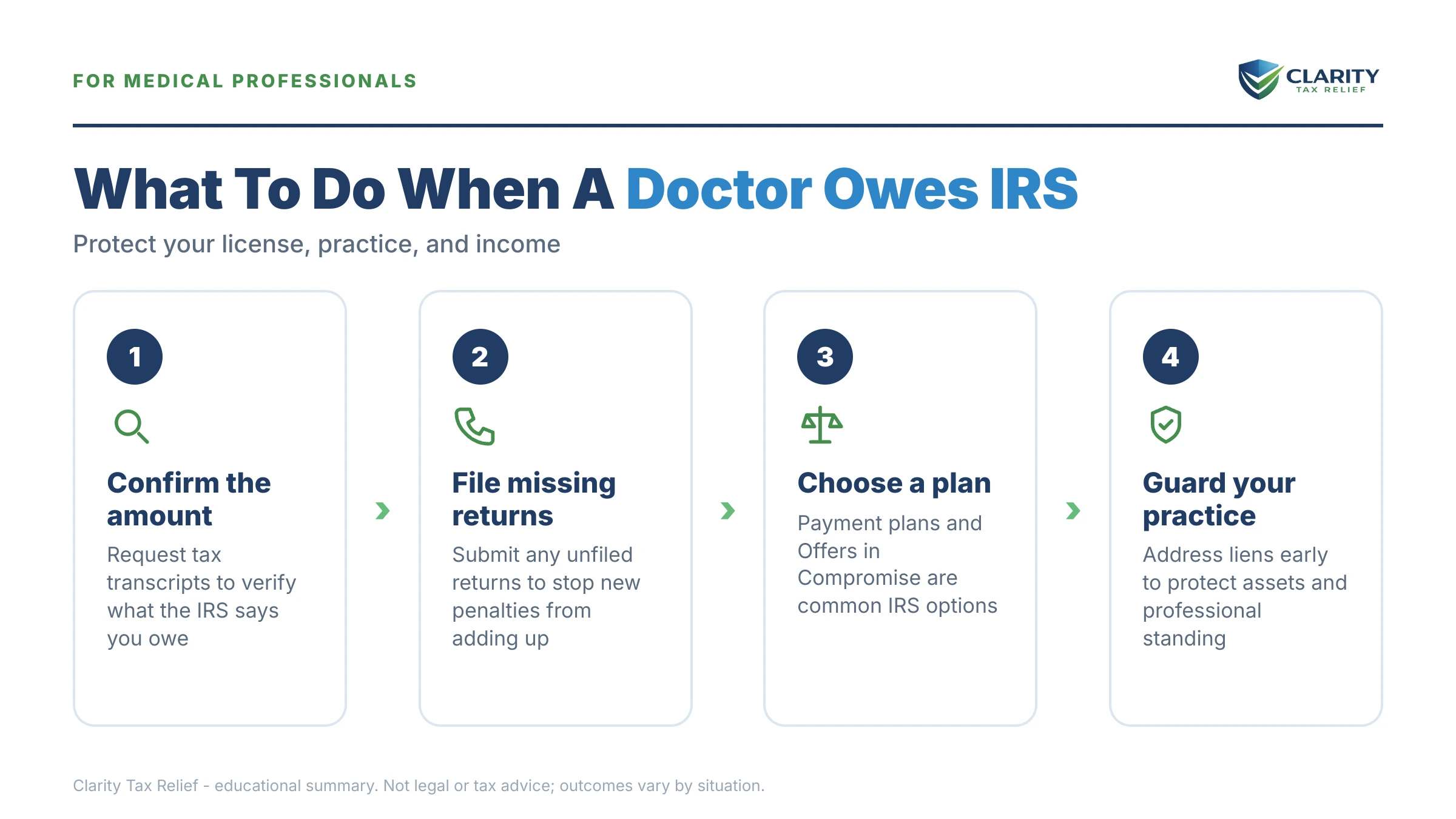
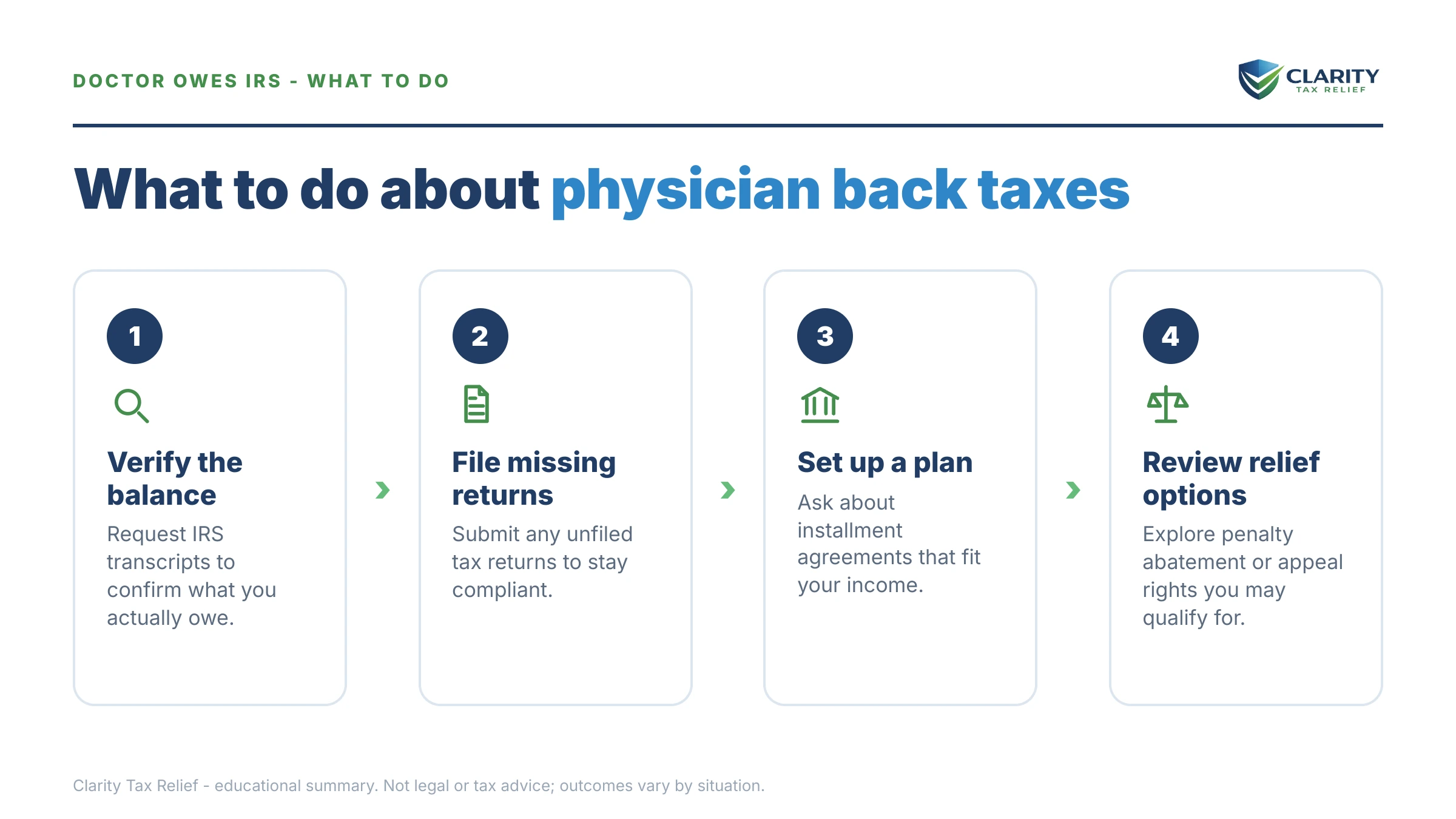
How to respond, step by step
- Pull your transcripts. Order your IRS account and wage-and-income transcripts and confirm every year, balance, penalty, and interest figure.
- File any missing returns first. The IRS will not approve a resolution while returns are unfiled — file every missing year before you negotiate.
- Run your real number. Total the assessed tax plus the failure-to-pay penalty and accruing interest so you know the full figure you are resolving.
- Choose the path that fits your income and balance. Match your situation to an installment agreement, CNC, penalty relief, or, rarely, an offer.
- Set it up before enforcement triggers. Establish the agreement before a lien, levy, or passport certification at $66,000 hits.
- Get a professional review for large or payroll debt. If you owe over $50,000, have multiple unfiled years, or have practice payroll exposure, have an experienced tax professional structure the case.
A worked example: physician owing $145,000
Say you owe $145,000 across tax years 2023 and 2024. You took 1099 locum income, set aside 15% while your true combined rate ran closer to 40%, and the shortfall compounded across two years. Here is how the math actually plays out.
Because the balance is over $50,000, you cannot just set up a plan online with no questions — the IRS wants a financial disclosure on Form 433-A. Because it is over $100,000, a revenue officer may be assigned to the case.
The principal alone over 72 months is $145,000 ÷ 72 ≈ $2,014 a month. But interest keeps compounding — at roughly 8% annually, the real monthly payment to fully retire the balance in 72 months is closer to $2,540. You would pay something like $37,000 in interest over the life of the plan. You can estimate your own penalty-and-interest exposure with our IRS penalty and interest calculator.
Could you settle it with an offer instead? Almost certainly not. Your Reasonable Collection Potential — projected future income plus any home or retirement equity — will dwarf $145,000. The IRS will reject the offer on the math. This is why physicians resolve through payment plans, not settlements. If you want to see how a six-figure balance is handled step by step, our guide to when you owe the IRS $100,000 walks the process.
One lever that does help: if your prior three years were penalty-clean, first-time abatement can remove the failure-to-pay penalty portion before you calculate the monthly figure, often several thousand dollars off the balance you finance.
When you can handle this yourself, and when help changes the outcome
Not every physician needs representation. If you owe under $50,000, have filed every return, and can afford the monthly payment, you can set up a streamlined installment agreement yourself online in an afternoon — no financial disclosure, no negotiation. If a single busy year left you with a balance you can clear within 180 days, a short-term plan costs nothing to set up and you handle it directly.
Experienced help changes the outcome when the numbers or the exposure grow. A balance over $100,000 puts you in revenue-officer territory, where the financial disclosure and the payment number are negotiated, not automatic. If you have practice payroll debt, the Trust Fund Recovery Penalty can attach to you personally, and defending who counts as a "responsible person" is a fight worth having with a professional. If you have multiple unfiled years, are close to the $66,000 passport line, or a lien is already threatening a practice loan, the order in which you fix things — returns, penalties, then the balance — changes what you ultimately pay. A physician owning a practice with W-2 staff should treat any payroll shortfall as urgent. That liability behaves very differently from an income-tax bill (the same dynamic dentists face in our dentist tax debt guide).
Terms on your notice, decoded
Estimated tax: the quarterly payments a 1099 or self-employed physician makes to cover income and self-employment tax, since no employer withholds it.
Reasonable Collection Potential (RCP): the IRS's calculation of what it could collect from your future income and asset equity — the figure that usually disqualifies high earners from an offer in compromise.
Federal tax lien: a public claim against your property that secures the debt; it can surface in credit and credentialing checks.
Trust Fund Recovery Penalty (TFRP): personal liability for the payroll taxes a practice withheld from employees but never remitted.
Seriously delinquent tax debt: assessed federal debt over $66,000 (2026) that can trigger passport certification via a CP508C notice.
Currently Not Collectible: a hardship status that pauses active collection while the balance and interest continue to accrue.
If your debt is approaching the passport threshold, a passport revoked for tax debt is one of the few consequences you cannot reverse instantly — get the case reviewed before certification, not after. Call (888) 825-7779 for a free look at where your balance stands.
Physician tax-debt questions, answered
Can the IRS take a doctor's medical license for unpaid taxes?
No — the IRS itself cannot suspend or revoke your medical license, because licensing is a state board's authority, not a federal collection tool. But some state boards ask for tax-compliance attestations at renewal, and unpaid state taxes (separate from the IRS) can trigger license holds in certain states. Federal tax debt's bigger licensing risk is indirect: a public tax lien can surface in the credentialing background checks hospitals run.
Can I lose my passport for owing the IRS as a physician?
Yes, indirectly. Once your assessed federal tax debt passes $66,000 in 2026, the IRS can certify you as "seriously delinquent" to the State Department, which can deny a renewal or revoke your passport, with a CP508C notice as the warning. For physicians who attend international conferences, do medical missions, or have family abroad, that is often the sharpest consequence. Entering an installment agreement or an accepted offer reverses the certification.
Why do doctors owe so much to the IRS?
The most common cause is a mismatch between high income and thin withholding. 1099 locum, moonlighting, and private-practice income carries no automatic withholding. A physician's combined marginal rate — federal, self-employment, and state — often approaches 40%. Set aside only 15% and you are short by tens of thousands. Add self-employment tax on top, and a single busy 1099 year can produce a six-figure balance.
Can a physician settle IRS debt for less with an offer in compromise?
Rarely. An offer in compromise is means-tested on your Reasonable Collection Potential, future income plus asset equity. A physician's earning capacity usually pushes that figure above the balance, so the IRS rejects the offer. The IRS accepted roughly 1 in 5 offers in FY2024, and high earners are the least likely group to qualify. For most physicians an installment agreement or currently not collectible status is the realistic path.
I'm a 1099 locum tenens doctor — how much should I set aside for taxes?
A safe rule for 1099 physician income is 30–35% set aside for federal income tax, self-employment tax, and state tax combined — higher in high-tax states. Pay it through quarterly estimated taxes rather than once a year; skipping the quarterlies triggers an underpayment penalty on top of the tax itself. If you are already behind, the fix is the same: file the return, then arrange the balance.
Does owing the IRS affect hospital credentialing or a medical practice loan?
It can. A federal tax lien is public record and may appear in the background and credit checks that lenders and some credentialing bodies run, which can complicate a practice-acquisition loan or a mortgage. The lien does not bar you from practicing medicine. Resolving the debt — or getting the lien withdrawn after you set up a direct-debit installment agreement — clears the obstacle.
My practice fell behind on payroll taxes — am I personally liable?
Potentially, yes. If your practice withheld payroll taxes from employees and did not remit them, the IRS can assess the Trust Fund Recovery Penalty personally against any responsible person, including the physician-owner, for the withheld portion. This debt is separate from your personal 1040 balance and does not disappear if the practice closes or dissolves.
Your next 24 hours
- Find your real balance. Log into your IRS online account and note the total for each year — tax, penalty, and interest separately — and whether it is near the $66,000 passport line.
- Gather three things. Your last filed return, any notices you have received, and a rough picture of your current 1099 and practice income.
- Get a free case review. Use the 2-minute form or call (888) 825-7779 so an experienced tax professional can structure a plan before penalties, a lien, or passport certification move first.
This guide is general information, not tax or legal advice for your specific situation. Eligibility for IRS programs depends on individual facts and circumstances; no outcome is guaranteed.
Authoritative primary sources: the IRS's payment plans and installment agreements page, its estimated taxes guidance for self-employed filers. The independent Taxpayer Advocate Service.