
IRS Notices
IRS CP79 Notice: EITC Disallowed and How Form 8862 Gets It Back (2026)
The short answer: a CP79 notice means the IRS disallowed a credit you claimed, usually the Earned Income Tax Credit, Child Tax Credit, or American Opportunity Credit. To claim that credit on a future return, you must attach Form 8862. A CP79A adds a 2-year ban; a CP79B adds a 10-year ban for fraud.
This guide covers why a CP79 arrives, what the A and B suffixes mean, what happens if you ignore it, and how Form 8862 and the balance-side options get you back on track.
The refund you built your budget around came back thousands short, and this letter explains why. The IRS says the credit is gone and that you can't claim it again without extra paperwork. If the audit behind it turned your refund into a bill, other IRS letters have probably started arriving too. Both problems are fixable, and the CP79 tells you which one you have. One letter in the notice code tells you how hard the fix will be.
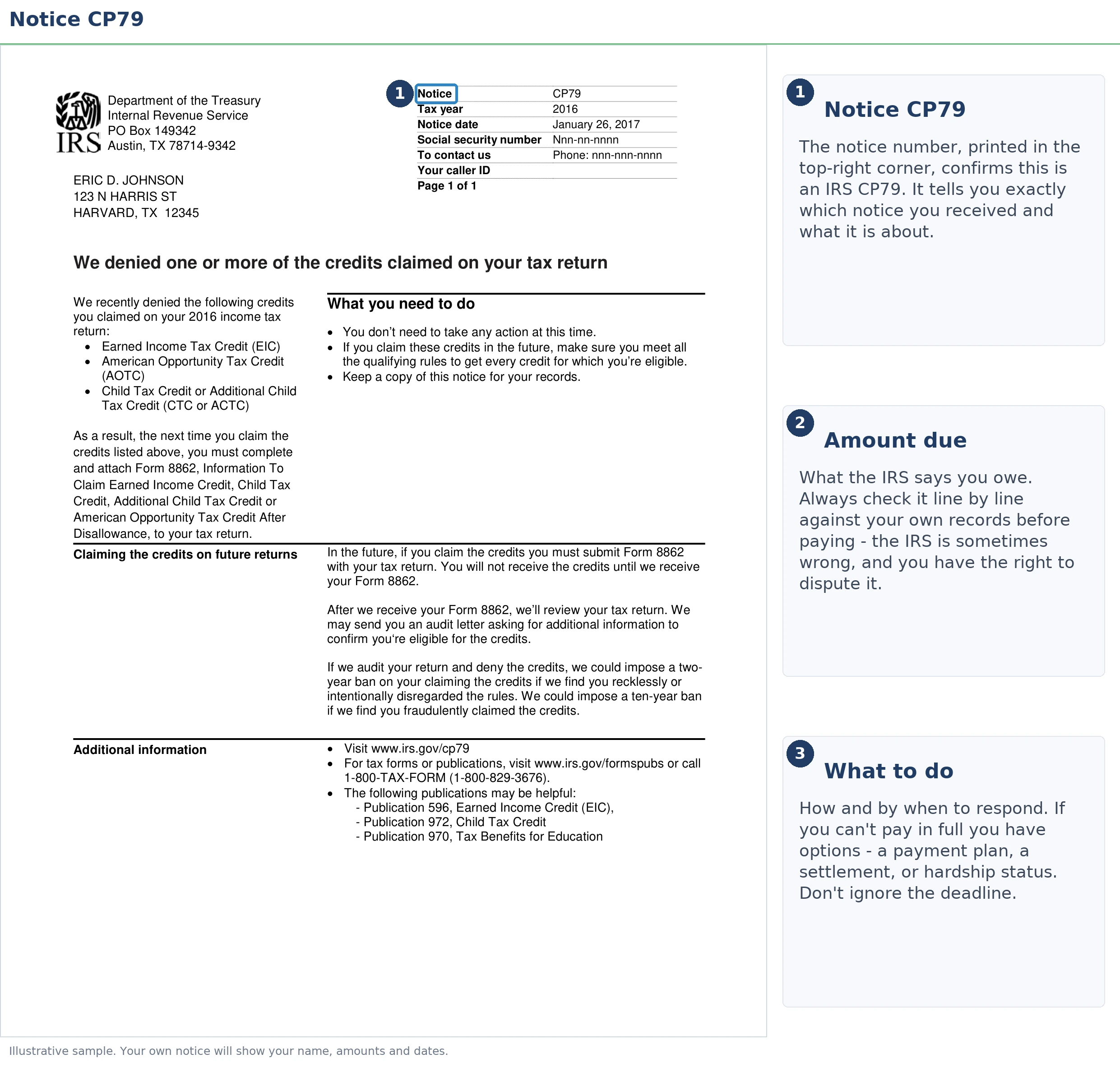
That single letter is the key. A plain CP79 means the door to the credit reopens as soon as you file Form 8862. A CP79A means a 2-year ban. A CP79B means a 10-year ban. The image below shows what this notice looks like and where on the page to find that code and the tax year it covers.
⏱ Your real clock: a CP79 sets no response deadline, but two clocks still run. If the audit that disallowed your credit left a balance due, penalties and interest accrue monthly and the collection notices keep coming. And every filing season you skip Form 8862 is another year of the credit you leave on the table.
Why did you get a CP79 notice?
A CP79 notice arrives after the IRS made a final decision to disallow a refundable credit on your return. It comes at the end of a review. The review itself usually happened months earlier, often through a CP75 notice asking you to prove a child's residency and relationship. If you didn't respond, or the documents didn't satisfy the examiner, the credit was removed and the CP79 followed.
The credits it covers are the big refundable ones: the Earned Income Tax Credit, the Child Tax Credit and Additional Child Tax Credit, the Credit for Other Dependents, and the American Opportunity Tax Credit. Common triggers include:
- An EIC audit you couldn't document. School, medical, or lease records didn't show the child lived with you more than half the year.
- A dependent claimed twice. When both parents claimed the same child, one of them loses the credit, and that parent often gets a CP79.
- Relationship or age tests not met. A niece, grandchild, or unrelated child who didn't fit the qualifying-child definition for that year.
- An education credit without enrollment proof. An AOTC claim the school's records didn't support.
A CP79 is never a math-error adjustment. If your credit was merely recalculated because of an arithmetic or clerical error (the territory of a CP11 notice or CP12 notice), you don't need Form 8862 at all. The CP79 means a substantive disallowance, which is why the recertification requirement kicks in. If you're not sure why the IRS wrote to you at all, start with our guide to why you got an IRS letter.
“Their earned income credit (EIC), child tax credit (CTC)/additional child tax credit (ACTC), credit for other dependents (ODC) or American opportunity credit (AOTC) was reduced or disallowed for any reason other than a math or clerical error.”
— About Form 8862, Information To Claim Certain Credits After Disallowance (IRS.gov)
CP79 vs. CP79A vs. CP79B: what does the suffix mean?
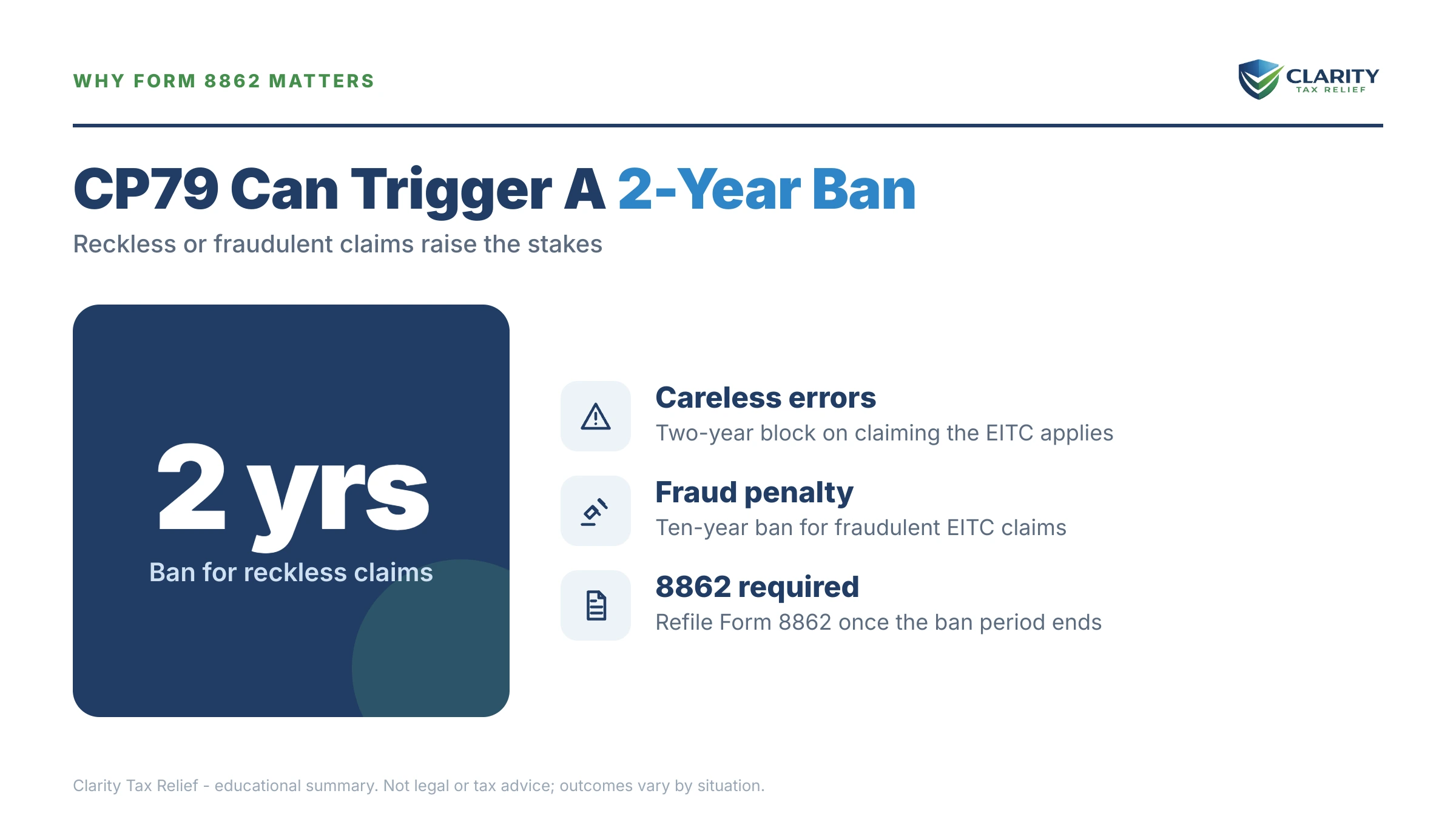
The suffix after "CP79" is the difference between reclaiming your credit next filing season and losing it for a decade. The IRS imposes the 2-year ban when it concludes the claim showed reckless or intentional disregard of the credit's rules, and the 10-year ban when it concludes the claim was fraudulent. Bans are not automatic. Most disallowances produce a plain CP79.
| Notice | What it means | What to do |
|---|---|---|
| CP79 | Credit disallowed; no ban. You must recertify to claim it again. | Attach Form 8862 to your next return that claims the credit. |
| CP79A | Credit disallowed plus a 2-year ban for reckless or intentional disregard of the rules. | Wait out the two banned tax years, then claim with Form 8862, or contest the ban through audit reconsideration or appeal if it's wrong. |
| CP79B | Credit disallowed plus a 10-year ban for fraud. | Get an experienced tax professional involved, because a fraud determination has consequences beyond this one credit. |
If you received a CP79A or CP79B and believe the ban is unjustified, don't wait it out. A ban based on a return you can document is worth contesting, because it repeats itself and costs you the credit every year it runs.
What happens if you ignore a CP79?
Ignoring a CP79 costs you money on two separate tracks, one at every future filing and one through IRS collections. The filing track is quiet but expensive. Claim the credit next year without Form 8862 attached and the IRS will remove the credit or freeze that part of your refund until you recertify. Skip claiming it out of fear, and you hand the credit back every year you qualified.
The collection track is louder. The audit that disallowed your credit usually assessed a balance: the clawed-back refund, often a 20% accuracy-related penalty, plus interest. That balance moves through the IRS's automated collection sequence whether or not anyone at the IRS looks at your file again:
- CP14. The first bill for the assessed balance, typically giving about 21 days to pay before the sequence continues. See our CP14 notice guide.
- CP501 / CP503. Reminder bills. There's no enforcement yet, though the balance compounds monthly.
- CP504. Notice of Intent to Levy under IRC §6331(d). The IRS can now seize your state tax refund.
- LT11 / Letter 1058. The final notice. A 30-day clock starts, along with your Collection Due Process rights (requested on Form 12153). See the LT11 notice guide.
- Levy. After the 30 days pass, the IRS can take bank funds (with a 21-day hold before money leaves) and garnish wages continuously until the levy is released.
| Stage | What it allows the IRS to do | Verified window |
|---|---|---|
| CP14 first bill | Nothing yet; it's a bill | Typically about 21 days to pay before escalation |
| CP501 / CP503 reminders | Nothing yet; the balance keeps growing | No fixed enforcement window |
| CP504 intent to levy | Seize your state tax refund | Pay-by date printed on the notice |
| LT11 / Letter 1058 final notice | Levy bank accounts and wages after the window closes | 30 days to pay, arrange, or request a CDP hearing (Form 12153) |
| Bank levy | Freeze the account balance | 21-day hold before funds are sent to the IRS |
In 2026, the IRS workforce is roughly 27% smaller than it was, but this entire sequence is generated by computers that never got cut. The notices arrive on schedule even when no human can take your call about them.
Holding a CP79 while the balance notices stack up?
Send us the CP79 and your latest balance notice. An experienced tax professional will tell you, free, whether audit reconsideration can restore the credit, whether a ban can be contested, and how to stop the collection sequence before it reaches a levy. Interest and penalties are accruing monthly either way.
What are your options after a CP79, on the credit side and the balance side?
Every CP79 case has two decisions: what to do about the disallowed credit, and what to do about the balance the audit created. They're handled separately, and doing one doesn't fix the other.
The credit side
- Recertify with Form 8862. If you qualify going forward, attach the form to your next return that claims the credit. There's no fee, and once the IRS allows the credit, you generally never file the form again.
- Audit reconsideration. If the disallowance itself was wrong and you now have documents the examiner never saw, audit reconsideration can reopen the audited year and restore the credit. It costs nothing and has no formal deadline, though it doesn't pause collection while it's pending. Our guide to EIC audit proof of residency covers which records persuade the IRS.
- Contest a ban. A CP79A or CP79B determination can be challenged. The bar is higher and the stakes are years of lost credits, so this is where professional help earns its cost.
The balance side
The disallowed credit is now ordinary assessed tax, so the standard resolution menu applies:
- Short-term payment plan. Up to 180 days to pay in full, a $0 setup fee, and the collection sequence stops while you're in it.
- Installment agreement. Balances up to $50,000 can generally go on a streamlined monthly plan of up to 72 months, set up online without detailed financial disclosure. Interest and the 0.5%-per-month failure-to-pay penalty keep accruing while you pay.
- Currently Not Collectible status. If allowable living expenses eat your whole paycheck, collection can be paused. The debt remains and grows, but levies stop.
- Offer in Compromise. Settling for less than the full balance when your income and assets can't cover it. The application fee is $205 (waived, along with the 20% down payment, if your AGI is at or below 250% of the poverty level). The IRS accepted roughly 1 in 5 offers in FY2024. That's real, but it's means-tested and never a given.
- Penalty relief. The accuracy-related penalty can be contested with reasonable cause, and failure-to-pay penalties may qualify for first-time abatement if your prior three years were clean (starting summer 2026, the IRS's new Automatic Exemption from Penalty applies some of this relief with no request needed).
What if you owe $31,200 after the disallowance? A worked example
Here's a hypothetical scenario showing how a CP79 turns into a five-figure debt. Say you're a renter with two kids, and an audit disallowed your EITC and Additional Child Tax Credit for three straight years:
- Clawed-back credits: $8,300 × 3 years = $24,900
- Accuracy-related penalty: 20% × $24,900 = $4,980
- Interest accrued to date: roughly $1,320
- Total assessed: $31,200
Because $31,200 is under $50,000, a streamlined installment agreement is available online. That's $31,200 ÷ 72 months ≈ $433/month before the interest and failure-to-pay penalty that keep accruing, and realistically closer to $475 to $525/month to retire it in 72 months. You can estimate how fast a balance like this grows with our IRS Penalty & Interest Calculator.
As a renter, you have no house for a federal tax lien to sit on. That sounds like protection, yet it means the IRS's practical tools against you are the aggressive ones: your paycheck and your bank account. If an LT11 has already arrived, the 30-day window on that notice is the line between negotiating on your terms and negotiating after your account is frozen. A payment plan or a Form 12153 CDP hearing request filed inside that window stops the levy before it starts.
Now run the credit side of the same example. If you qualify for roughly $8,300 in credits next year, filing with Form 8862 attached puts that money back in play, and an $8,300 refund can be applied against the $31,200 balance. That cuts the debt by more than a quarter in a single filing season. Skipping the form costs you that much.
How does Form 8862 get the credit back?
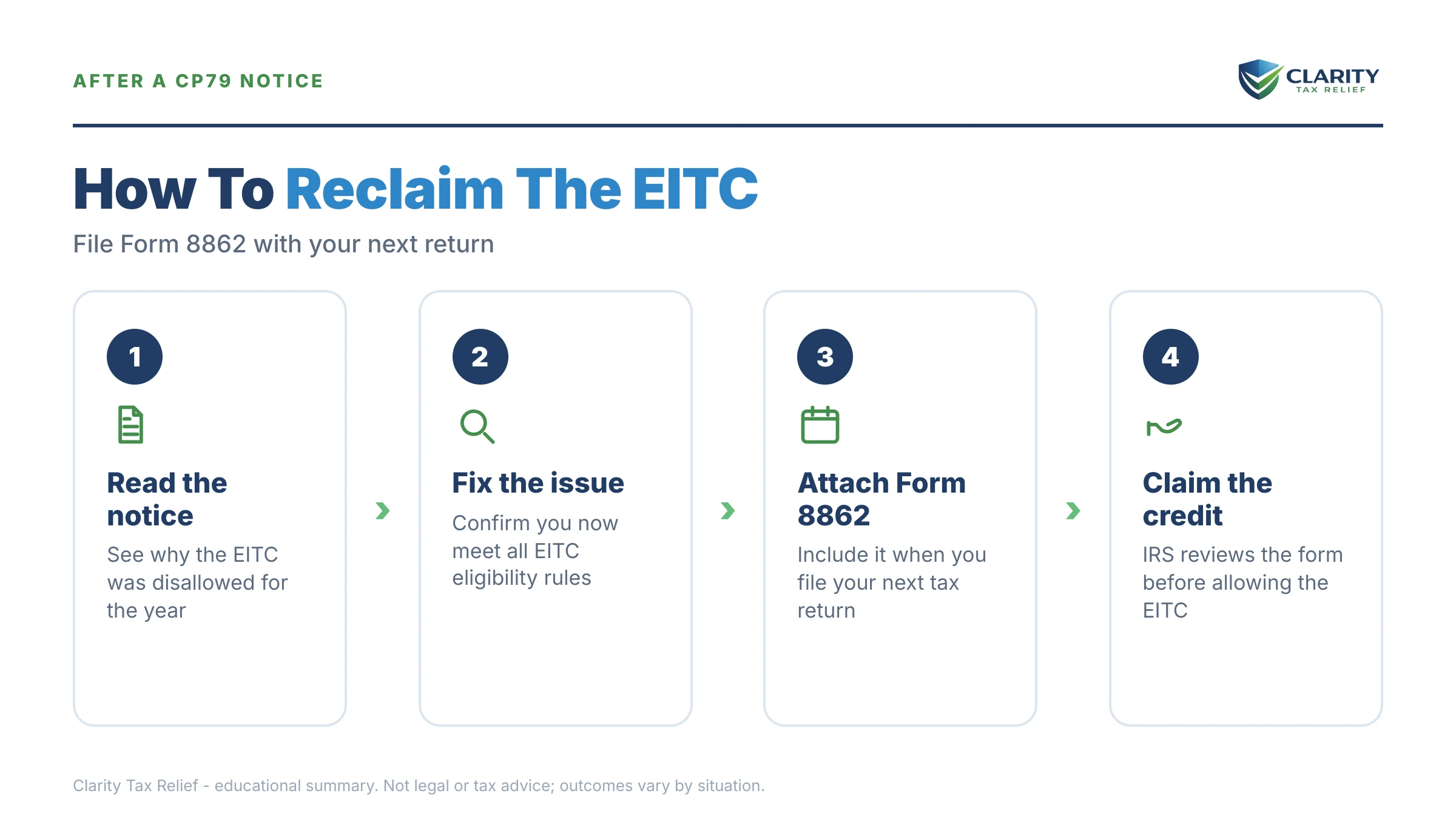
Form 8862, Information To Claim Certain Credits After Disallowance, is a one-time recertification. It is no annual tax. You attach it to the first return after the disallowance (and after any ban period) on which you claim the credit, answering questions that show you meet that year's qualifying rules. Once the IRS allows the credit, you're recertified and the form isn't needed again unless a second disallowance happens.
| Your situation | Form 8862 required? |
|---|---|
| Credit reduced by a math or clerical error (CP11/CP12 territory) | No. Recertification doesn't apply to arithmetic fixes |
| Credit disallowed after audit or review (plain CP79) | Yes. Attach it to the next return claiming the credit |
| Claiming EITC with no qualifying child, after a disallowance that was solely about the qualifying-child rules | No. The self-only EITC can be claimed without the form |
| CP79A (2-year ban) | Yes, but only after the two banned tax years pass |
| CP79B (10-year ban) | Yes, after the 10-year ban ends |
| Already recertified once and the credit was allowed | No, unless the credit is disallowed again |
One caution: file Form 8862 with a return that clearly qualifies. Recertification returns get a harder look, and a second disallowance is what typically turns a plain CP79 into a CP79A ban. If your household situation is borderline (shared custody, a child who moved mid-year), get the documentation lined up before you file instead of waiting for the IRS to ask.
Did you receive a CP09 notice or CP08 notice in a later year? Those are the IRS's letters saying you may qualify for the EITC or Additional Child Tax Credit you didn't claim, and a prior CP79 is often the reason you skipped them. Those notices are your signal that the IRS's own systems think you qualify. Form 8862 is how you collect.
How to respond to a CP79 notice, step by step
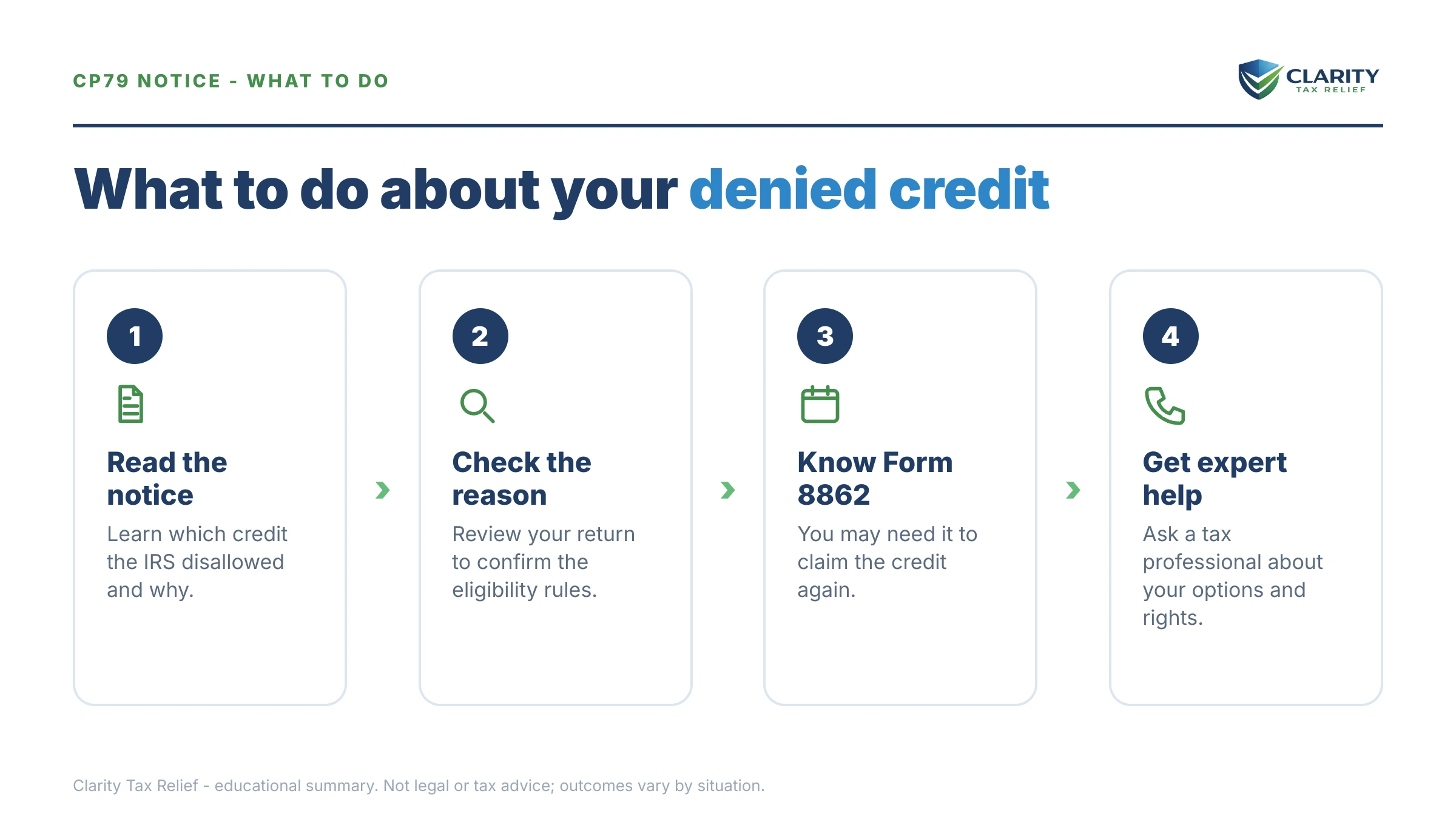
- Find the notice code. Check whether the top of your letter says CP79, CP79A, or CP79B. The suffix determines whether a ban applies and for how long.
- Check your IRS online account. Confirm whether the audit that disallowed the credit left a balance due, and how much has accrued since.
- Choose agree or disagree. If you have records proving you qualified, request audit reconsideration. If the disallowance is correct, move straight to the balance.
- Resolve any balance. Pay it or set up a payment plan before the collection notices escalate toward a levy.
- Attach Form 8862 to your next eligible return. That is how you reclaim the credit once any ban period has passed.
- Keep qualification proof going forward. Save school, medical, and lease records showing the child's residency and your relationship, so a second review ends differently.
When can you handle a CP79 yourself?
Most plain CP79s with no balance behind them need no professional at all. You can handle this on your own if:
- The suffix is plain CP79 (no ban), you agree the credit wasn't allowable that year, and your only task is attaching Form 8862 next season.
- The audit balance is small and you can pay it within 180 days on a $0-fee short-term plan.
- Your future qualification is clear-cut. The child lives with you full-time and the paperwork proves it.
Watch for the red flags where experienced help changes the outcome:
- A CP79A or CP79B ban you believe is wrong.
- An LT11 already on the table with the 30-day levy clock running.
- Multiple audited years.
- Shared-custody documentation the IRS has already rejected once.
- A balance large enough that the choice between an installment agreement, hardship status, and an Offer in Compromise turns on financial math you only get one clean shot at presenting.
What do the terms on your CP79 mean?
- Disallowance: the IRS's formal decision that you weren't entitled to a credit you claimed, removing it from the return.
- Recertification: proving to the IRS, via Form 8862, that you meet a credit's rules again after a disallowance.
- Form 8862: the one-page attachment ("Information To Claim Certain Credits After Disallowance") required the first time you re-claim a disallowed credit.
- Reckless or intentional disregard: the finding behind a CP79A. The claim ignored rules you knew or should have known, triggering the 2-year ban.
- Final determination: the IRS's closing decision on the audited year. Ban periods are measured from it.
- Audit reconsideration: the no-fee process for reopening a closed audit when you have new documents the examiner never saw.
Bottom line
A CP79 closes out a credit review, and the suffix tells you how long you're locked out: none for a plain CP79, two years for a CP79A, ten for a CP79B. The letter itself needs no reply. The balance the audit created does, because it runs through the normal collection notices toward a levy. Deal with that balance now, and attach Form 8862 the next time you qualify.
Your next 24 hours
- Find the notice code and tax year. Look at the top of your letter for CP79, CP79A, or CP79B, and which year the disallowance covers. That code sets your whole path.
- Gather three things. The audit letter that started this (often a CP75), your last filed return, and any school, medical, or lease records tied to the child or student on the claim.
- Get a free case review. Use the 2-minute form or call (888) 825-7779. Whether the answer is reconsideration, recertification, or a payment plan, the balance behind a CP79 grows every month it waits, so the cheapest day to sort it is today.
Primary sources: the IRS's own pages on understanding your CP79 notice and Form 8862, and payment options at IRS.gov/payments.
Common questions
What is an IRS CP79 notice?
A CP79 notice means the IRS disallowed a credit you claimed, usually the Earned Income Tax Credit, Child Tax Credit, or American Opportunity Credit. To claim that credit on a future return, you must attach Form 8862. A CP79A adds a 2-year ban, and a CP79B adds a 10-year ban for fraud.
Do I have to respond to a CP79 notice?
No. A CP79 requires no reply and has no response deadline. It tells you what to do the next time you claim the credit: attach Form 8862 so the IRS can recertify you. The exception is the balance behind it. If the audit that disallowed your credit assessed tax you haven't paid, that balance needs action now, because penalties and interest accrue monthly and collection notices follow.
Does a CP79 notice mean I owe the IRS money?
Not by itself, since the CP79 only addresses future claims. The audit or review that triggered it usually did create a balance, though: the refunded credit gets clawed back, often with a 20% accuracy-related penalty and interest on top. Check your IRS online account. If a balance shows, it has entered the normal collection stream, and separate bills like a CP14 will follow or have already arrived.
This guide is general information, not tax or legal advice for your specific situation. Eligibility for IRS programs depends on individual facts and circumstances; no outcome is guaranteed.