
IRS Notices
IRS CP81 Notice: File Now Before Your Refund Statute Expires (2026)
The short answer: a CP81 notice means the IRS is holding a credit, payments or withholding, for a tax year you never filed, and the window to claim that money as a refund is about to close. File the missing return before the three-year refund statute expires, or the credit is forfeited permanently.
You skimmed the envelope expecting another bill, and instead the IRS is telling you it's holding money with your name on it, for a return it never received. A CP81 notice is one of the only IRS letters where doing nothing costs you a refund instead of triggering a collector. The fix is one filing, and the map below shows exactly how to get it in on time.
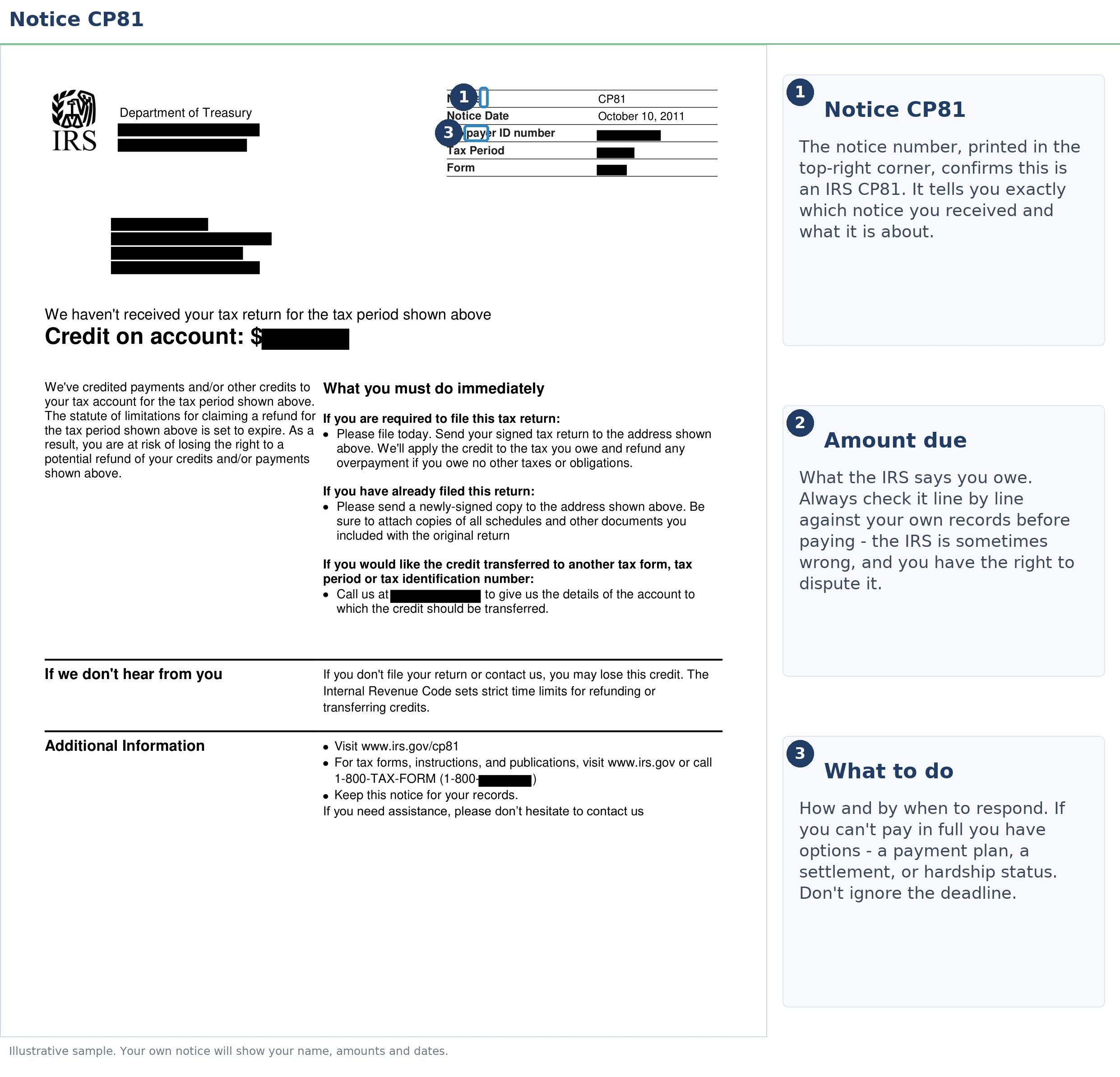
Two numbers on the notice drive everything: the tax year and the credit amount the IRS is holding. The image below shows you exactly what a CP81 looks like and where those two figures sit, so you can orient yourself before you read another word.
⏱ Your real deadline: the refund statute generally closes three years after the return's original due date. For an unfiled 2023 return, that's typically April 15, 2027; for a 2022 return with a filed extension, the window typically runs into October 2026. The IRS won't send a countdown — once the date passes, the money is gone for good.
Why you got a CP81 notice
A CP81 is sent when the IRS shows payments or withholding credited to a tax year with no return on file. The deadline to claim that money is approaching. The credit usually comes from one of three places: quarterly estimated payments you sent in, tax withheld from wages or other income reported under your Social Security number, or a prior-year overpayment you elected to roll forward.
Self-employed readers see this pattern constantly: you made estimated payments through the year, then a move, a divorce, an illness, or a brutal season meant the return never got finished. The payments sat. Now the IRS is telling you, once, that the money is still claimable, but not for much longer.
Check the top section of your notice (the image below shows where to look): it names the exact tax year and the credit amount on the account. Those two facts determine your deadline and how much is at stake. If you're not sure why any IRS letter shows up when it does, our guide to why did I get a letter from the IRS covers the system behind the mail. This page covers only what a CP81 demands.
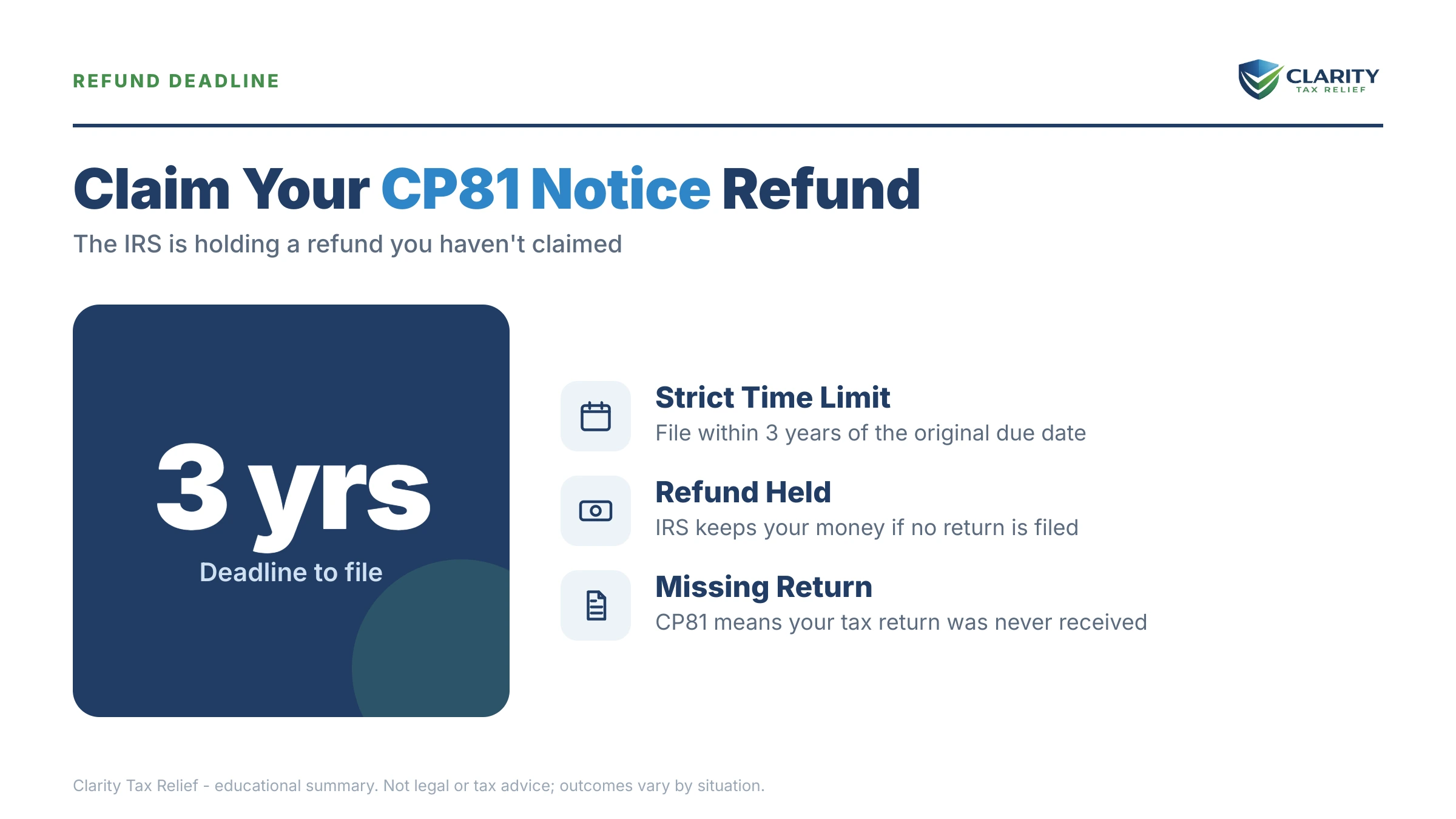
“Generally, you must file a tax return within 3 years from the due date of the return (including extensions) to receive a refund of any overpayment on your account. After the refund statute expiration date (RSED) expires, we can’t refund any overpayments.”
— Understanding your CP81 notice (IRS.gov)
When the CP81 refund window actually closes
You generally have three years from a return's original due date to file it and still collect the refund. Withholding and estimated payments are treated as paid on that original due date, so the clock runs from the April deadline of the filing season, not from when you actually sent the money. If you filed a Form 4868 extension for that year, the window typically stretches to three years after the extended October deadline.
| Tax year on your CP81 | Original due date | Typical refund deadline (no extension) | Typical deadline with a filed extension |
|---|---|---|---|
| 2022 | April 18, 2023 | April 2026 — already passed | Mid-October 2026 — weeks away |
| 2023 | April 15, 2024 | April 15, 2027 | Mid-October 2027 |
| 2024 | April 15, 2025 | April 2028 | Mid-October 2028 |
Disaster-relief postponements and a few narrow exceptions can shift these dates, which is why the safest move is to treat the earliest plausible deadline as yours. The full rule — including what happens when the window has already closed — is covered in our guide to the 3-year refund deadline.
CP81 vs. CP80 and the other unfiled-return notices
A CP81 is the urgent version of a CP80: same missing return, same credit on the account, but a nearly expired clock. If your notice were about a suspected balance due instead of a credit, you'd be holding a different letter entirely, and facing a different kind of pressure.
| Notice | What it says | The stakes |
|---|---|---|
| CP80 | Credit on your account, no return on file — early warning | Refund still safely claimable; file at normal speed |
| CP81 (you are here) | Credit on your account, no return — refund statute about to expire | Hard deadline; the credit is forfeited if you miss it |
| CP59 | No return on file; IRS believes you may owe | First step of the non-filer collection track |
| CP518 | Final demand for the unfiled return | Can lead to a substitute return with no deductions and a real balance due |
The IRS also sends good-news letters when a filed return missed a credit — a CP08 notice for the Additional Child Tax Credit or a CP09 notice for EITC. A CP81 is different: the IRS can't compute your refund for you, because there's no return to compute it from. Only you can turn this credit into money.
What happens if you ignore a CP81 notice
Ignoring a CP81 usually triggers no enforcement at all — the credit simply becomes unclaimable the day the refund statute expires. That's exactly what makes it dangerous. Every other notice on this site escalates louder; this one goes silent:
- The warning window. You may have already received a CP80 for the same year. The CP81 is the statute-is-closing version, and often the last letter you'll get about this money.
- The statute expires. On the Refund Statute Expiration Date, the overpayment moves to the IRS's "excess collections" account. It generally can't be refunded to you or credited to any other year, not even balances the IRS is actively collecting from you.
- The offset opportunity dies with it. If you owe for other years, a timely-claimed refund could have paid those balances down. After expiration, you keep the debt and lose the credit that could have covered it.
- The owe-side track can begin. If IRS income records for a later year suggest you'd owe rather than be owed, the separate non-filer sequence — CP59, CP516, CP518 — can follow, ending in a substitute return that computes your tax with zero deductions.
Don't count on a human follow-up. The IRS workforce shrank roughly 27% in 2025, and nobody at the agency is assigned to chase you down to give you money. The reminder you're holding is the reminder.
Holding a CP81 with the clock running?
Send us a photo of your CP81 before the refund statute closes on that tax year. An experienced tax professional will confirm your exact deadline, what the credit is worth. The fastest way to file — free, confidential, no pressure.
Your options after a CP81: including if you'd owe
Every path after a CP81 runs through the same door: filing the missing return before the statute closes. What changes is what you do around it:
- File and claim the refund. The main path. Prepare the return for the exact year on the notice, on that year's forms, and get it filed before the deadline. If the year is too old to e-file, mail it certified so your postmark is provable.
- File and offset other years. If you owe for other tax years, a refund claimed in time can be applied against those balances. That's often worth more than cash in hand. It stops interest on the older debt.
- File even if you'll owe. If the completed return shows more tax than the credit covers, the payments still count against that year's liability. You owe only the shortfall. File anyway: the failure-to-file penalty runs 5% per month of unpaid tax (capped at 25%), ten times the failure-to-pay rate, so the return itself is what stops the bigger penalty. You can pay the shortfall at IRS.gov/payments or set up a plan, and estimate what the penalties add with our Penalty & Interest Calculator. If cash is the problem, see file even if you can't pay.
- Respond with proof if you already filed. Send a signed copy of the return plus your filing proof to the address on the notice. Processing backlogs make crossed wires common in 2026 — the copy protects your claim date.
- Reconstruct if your records are gone. Your wage and income transcript lists every W-2 and 1099 the IRS received under your SSN for that year. Pair it with bank deposits and your books; our guide to filing back taxes with no records walks through the reconstruction.
One caution for sole proprietors: the wage and income transcript shows what payers reported, not your expenses. Filing a bare-bones return that skips your Schedule C deductions overstates your self-employment tax and can turn a refund year into a phantom balance due. Build the expense side before you file, even under time pressure.
A worked example: $54,600 in credits and no return on file
Say you're a self-employed sole proprietor who sent in four quarterly estimated payments of $13,650 toward tax year 2023 — $54,600 total — then never filed when the year fell apart. In mid-2026, a CP81 arrives naming tax year 2023.
You prepare the return now and the numbers come out like this: after Schedule C expenses, your income tax plus self-employment tax total $46,300. The math is simple — $54,600 in credits minus $46,300 in tax leaves a $8,300 refund. File by the typical April 15, 2027 deadline for a 2023 return and that $8,300 comes back to you (or offsets other years you owe). Miss the deadline and the outcome splits: the $46,300 in tax is still considered paid, you don't owe it twice, but the $8,300 overpayment is forfeited to excess collections, permanently.
Now flip it. Say the return instead shows $58,000 in total tax. Your credits cover $54,600, leaving a $3,400 shortfall, and because the return is long overdue, the failure-to-file penalty has already maxed out at 25% of that unpaid $3,400, adding about $850, plus failure-to-pay penalty and interest on top. Notice what the penalty is not computed on: the $54,600 you paid on time. Either direction, filing fast is the winning move. It either claims your refund or caps a small, manageable balance. (These figures are hypothetical, for illustration only.)
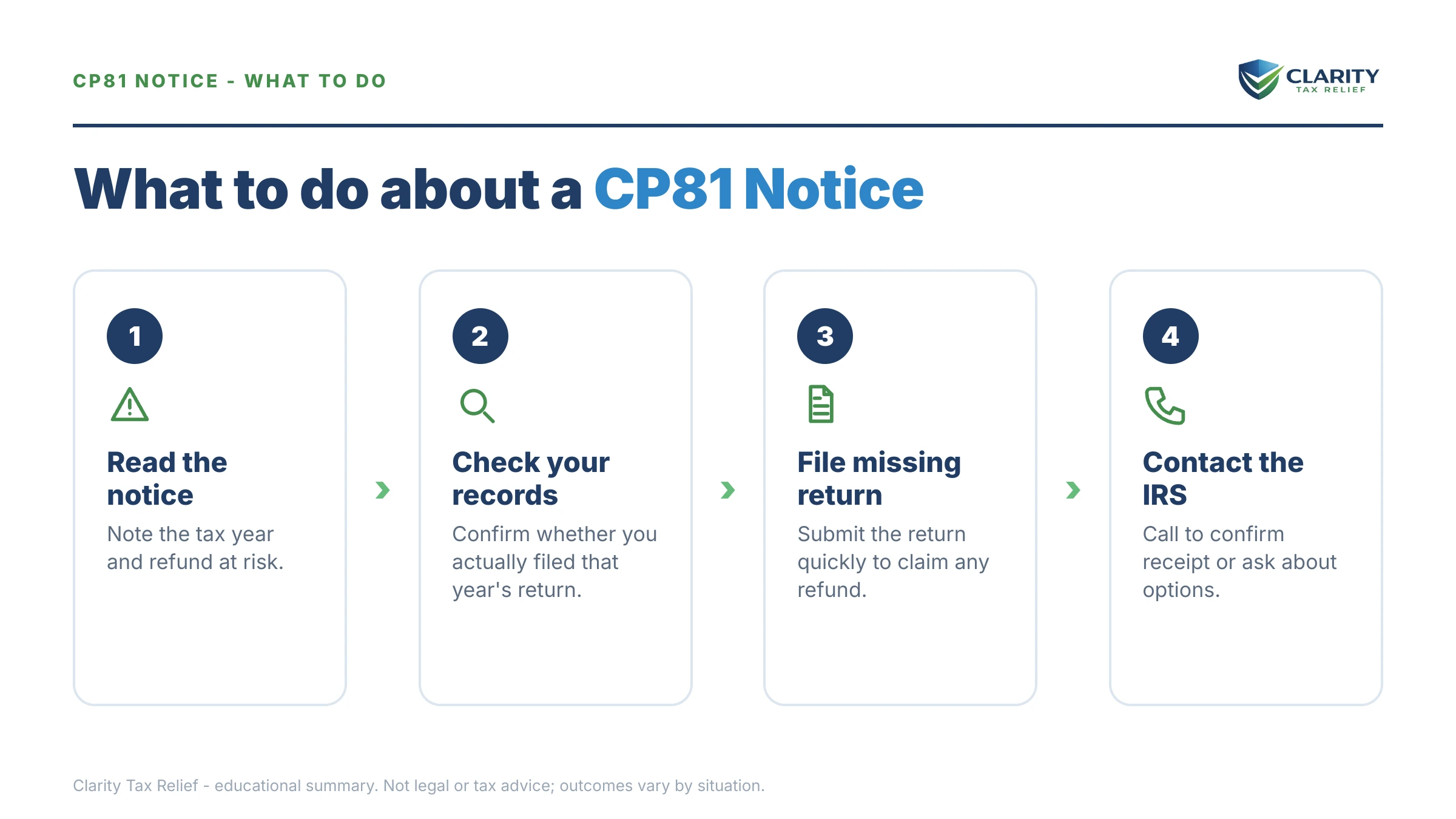
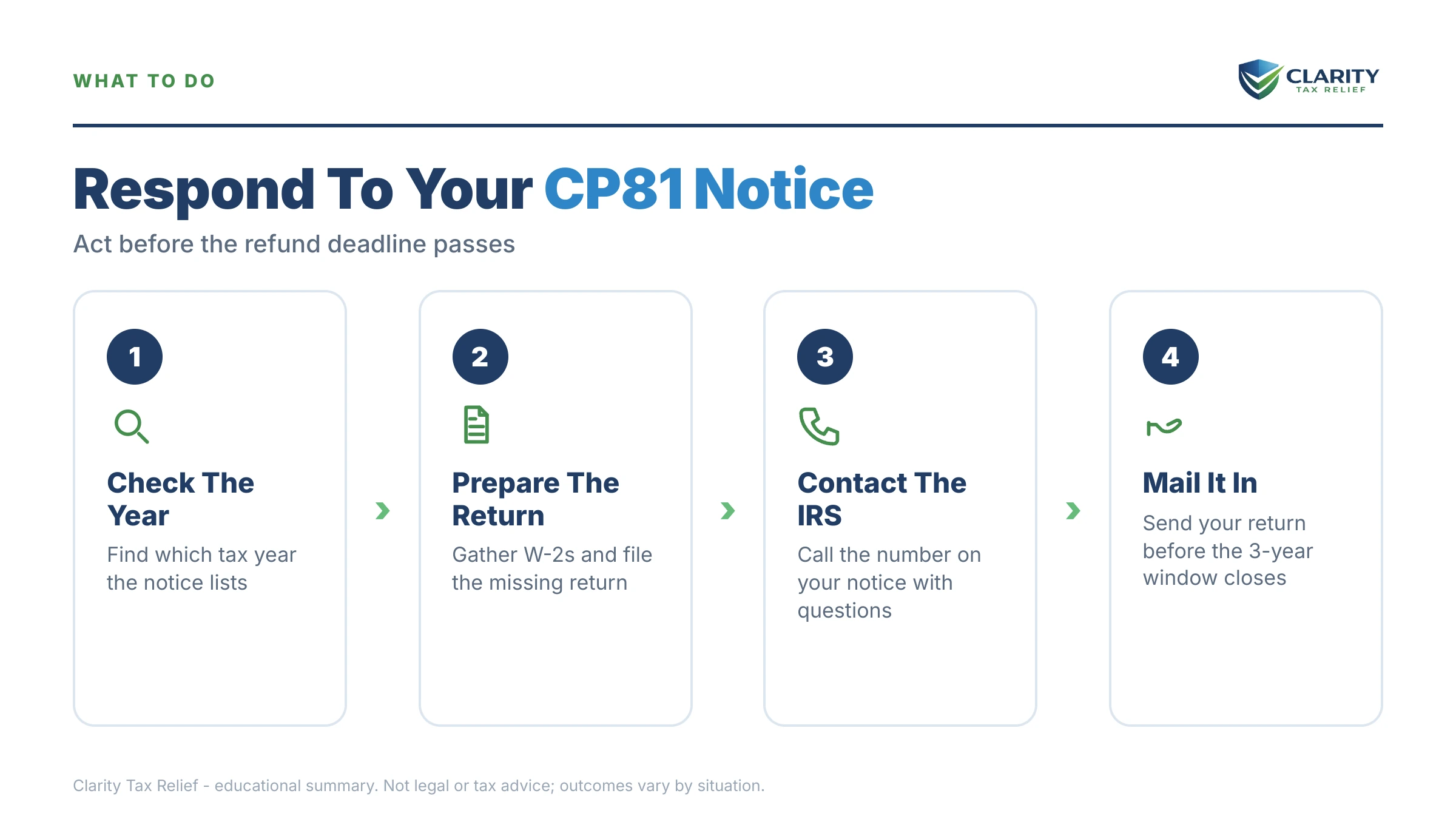
How to respond to a CP81 notice, step by step
- Confirm the tax year and credit amount. Pull the tax year and credit amount from the top of your CP81 and match them against your IRS online account or account transcript so you know exactly which return is missing.
- Gather your income records for that year. Request your wage and income transcript from the IRS and pull your own 1099s, bank statements, and business books for the CP81 year.
- Prepare the missing return on that year's forms. Use the tax forms for the specific year on the notice, not the current year's, and complete the full return, including Schedule C and SE if you were self-employed.
- File it before the refund deadline, certified. E-file if the year is still supported. Otherwise mail the signed return to the address on the notice by certified mail with return receipt so you can prove the filing date.
- Confirm it posted and the credit released. Watch your account transcript for the return to post, and follow up if the refund or offset hasn't processed within a few months.
When you can handle a CP81 yourself
Most CP81s are a do-it-yourself project: one missing return, records you still have, and a deadline with months of room. If you were a W-2 employee that year, or your business records are intact and the return is a normal one, prepare it (or have any competent preparer do it), mail it certified, and you're done — no representation needed.
Experienced help changes the outcome in four situations. First, when the deadline is weeks away and the year is too old to e-file — sequencing and proof of filing become everything. Second, when the CP81 year is one of several unfiled years. The filing order affects refunds, offsets, and penalties, and our guide to haven't filed in 3 years shows why the order matters. Third, when reconstructing self-employment income and expenses could swing the return between refund and balance due. Fourth, when you owe other years and want the refund aimed at the right balance instead of disappearing into the oldest one. If any of those fit, a free review of your notice and transcript before you file is the cheap insurance — start with the 2-minute form or call (888) 825-7779.
The IRS's own explainer for this notice is at Understanding your CP81 notice, and if a filed return sits unprocessed while your statute runs, the Taxpayer Advocate Service exists for exactly that kind of stuck case.
Terms on your CP81, decoded
- Credit on your account: money the IRS is holding for the tax year — estimated payments, withholding, or a rolled-forward overpayment — waiting for a return to tell it what to do.
- Refund Statute Expiration Date (RSED): the last day you can claim a refund for that year, generally three years from the return's original due date.
- Excess collections: the internal IRS account where expired credits go; money there generally can't be refunded or applied to anything.
- Wage and income transcript: the IRS record of every W-2 and 1099 filed under your SSN for a year — your reconstruction starting point.
- Substitute for return (SFR): a return the IRS files for you on the owe-side track, using reported income with no deductions — a worst-case you avoid by filing your own.
CP81 questions, answered
What is an IRS CP81 notice?
A CP81 notice means the IRS is holding a credit, payments or withholding, for a tax year you never filed. The window to claim that money as a refund is about to close. File the missing return before the three-year refund statute expires, or the credit is forfeited permanently.
Is a CP81 notice bad news?
Usually it's the opposite — a CP81 means the IRS is holding a credit that may belong to you for a year with no return on file. The bad news only arrives if you do nothing: once the refund statute expires, the overpayment is forfeited permanently. And if the completed return would actually show a balance due, late-filing penalties are growing on the shortfall while you wait.
What is the difference between a CP80 and a CP81 notice?
Both say the IRS has a credit on your account and no return on file — the difference is the clock. A CP80 is the earlier heads-up, sent while the refund statute still has room. A CP81 is sent when that statute is about to expire, which makes it closer to a final call. Treat a CP81 as a file-this-month letter, not a file-eventually letter.
What happens if I ignore a CP81 notice?
Once the refund statute expires, the credit moves to the IRS's excess collections account and generally cannot be refunded to you or applied to any other year — the money is forfeited. There's no levy or garnishment on the refund side; the consequence is silent. If IRS records suggest you would owe instead, the separate non-filer notice track (CP59, CP516, CP518) can follow, ending in a substitute return.
Can the IRS apply my CP81 credit to another year I owe?
Yes, but only if you file the missing return and claim the overpayment before the refund statute closes. A timely-claimed refund can be offset against other federal tax years you owe, which is often the smartest use of it. Once the statute expires, the credit can no longer be refunded or credited to anything, even balances the IRS itself is actively collecting from you.
What if I owe money when I finally file the return?
File anyway — the payments the IRS is holding still count against that year's tax, so you owe only the shortfall plus penalties and interest on it. The failure-to-file penalty runs 5% per month of the unpaid tax, capped at 25%, which is ten times the 0.5% failure-to-pay rate, so waiting longer only compounds the smaller number. Payment plans are available if you can't pay the shortfall at once.
Can I e-file the old return a CP81 asks for?
Often not. E-filing generally supports the current tax year and the two prior years through tax software or a preparer. Anything older must be filed on paper. If your CP81 year falls outside the e-file window, prepare the return on that year's forms and mail it to the address on the notice by certified mail so you can prove the filing date.
What if I already filed the return my CP81 mentions?
Respond with a signed copy of the return and proof you filed it — a certified-mail receipt, e-file acceptance confirmation, or transcript entry. With IRS processing backlogs and staffing down sharply in 2026, returns crossing in the system with notices is common. Don't assume the IRS will find your return on its own before the refund statute runs; the copy you send protects your claim date.
Your next 24 hours
- Find the tax year and credit amount at the top of your CP81, then count three years from that year's April deadline (October, if you filed an extension) — that's the date this money disappears.
- Gather what you'll file from: the notice itself, any records you have for that year. Your wage and income transcript from your IRS online account.
- Get a free case review before the statute closes on your year — send a photo of your CP81 through the 2-minute form or call (888) 825-7779. An experienced tax professional will confirm your exact deadline and the fastest filing path.
This guide is general information, not tax or legal advice for your specific situation. Eligibility for IRS programs depends on individual facts and circumstances; no outcome is guaranteed.