
IRS Data Studies
IRS Math Error Notices by Year: How Many the IRS Sends, 2021 to 2025
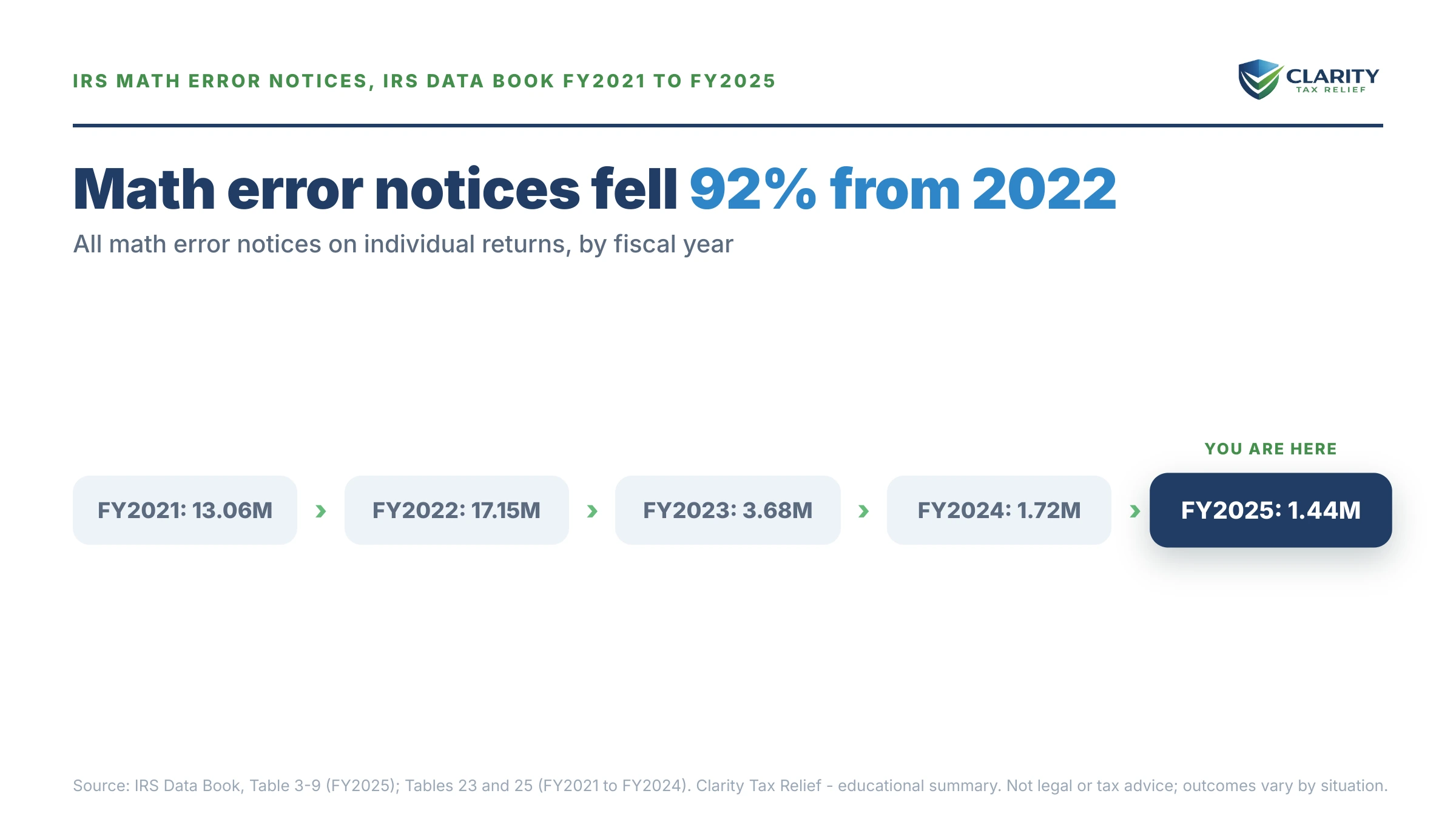
The short answer: the IRS sent 1,440,328 math error notices on individual returns in fiscal year 2025, 951,789 on tax year 2024 returns and 488,539 on prior-year returns. That is the lowest in the five years we tracked and 92% below fiscal 2022, when 17.1 million notices went out, most of them over the Recovery Rebate Credit. The Data Book does publish this count, in its math error table, and we built this page from it.

Holding a CP11, CP12 or CP13?
A math error notice carries a 60-day window to ask the IRS to reverse the change. An experienced tax professional can read the notice and tell you whether the correction is right before that window closes.
A math error notice is the IRS changing your return during processing and telling you afterward. No audit, no examiner, and a short window to disagree. The request behind this page asked whether the Data Book publishes notice volumes at all. It does, for this one notice family. The math error table carries a line called "Math error notices" alongside the count of errors, and it has for every edition we checked. We pulled fiscal 2021 through 2025. The IRS fiscal year runs from October 1 to September 30, so fiscal year 2025 covers October 1, 2024 through September 30, 2025. Every figure on this page is a fiscal-year count as the Data Book prints it.
Math error notices by year
| Fiscal year | Notices on current-year returns | Notices on prior-year returns | All math error notices | Math errors found |
|---|---|---|---|---|
| 2021 | 12,334,020 | 730,119 | 13,064,139 | 13,958,530 |
| 2022 | 15,891,503 | 1,256,832 | 17,148,335 | 18,470,961 |
| 2023 | 2,217,754 | 1,458,867 | 3,676,621 | 4,401,073 |
| 2024 | 1,001,767 | 713,804 | 1,715,571 | 2,089,950 |
| 2025 | 951,789 | 488,539 | 1,440,328 | 1,784,688 |
The series is two different eras. Fiscal 2021 and 2022 were the stimulus years: 13.1 million notices, then 17.1 million, and in both years the Recovery Rebate Credit was the single largest error type, 87.9% of errors on tax year 2020 returns and 69.7% on tax year 2021 returns. Taxpayers claimed a credit for a stimulus payment they had already received, and the IRS corrected it by the million.
Then it ended. Fiscal 2023 fell to 3.7 million notices, fiscal 2024 to 1.7 million, and fiscal 2025 to 1.44 million. The IRS says as much in a footnote to the fiscal 2023 table: processing that year "reflects the end of multiple COVID-19 pandemic-era credits and calculation changes," which, "combined with the resolution of processing backlogs," produced "a significant reduction in overall errors."
Fiscal 2025 is the first year in the series that looks like a normal filing season. The largest error type on tax year 2024 returns was the adjusted gross or taxable income amount, 25.6% of errors, followed by the tax calculation at 24.2% and the Child Tax Credit at 9.9%. The Recovery Rebate Credit accounted for 479 errors on current-year returns.
What leads the error count each year
| Fiscal year | Returns processed | Largest error type | Share of errors |
|---|---|---|---|
| 2021 | Tax year 2020 | Recovery Rebate Credit | 87.9% |
| 2022 | Tax year 2021 | Recovery Rebate Credit | 69.7% |
| 2023 | Tax year 2022 | Child Tax Credit | 24.0% |
| 2024 | Tax year 2023 | Tax calculation and other taxes | 22.5% |
| 2025 | Tax year 2024 | Adjusted gross or taxable income amount | 25.6% |
The shift in the right-hand column is the useful part. When one credit drives nine errors in ten, a notice almost always means the same thing. When the errors spread across income, tax calculation, deductions and credits, a notice can mean a transposed number, a wrong tax table lookup, a dependent claimed twice, or a withholding figure that does not match a W-2. The notice says which, and reading it carefully is the first step.
Notices and errors are different counts
Every edition carries the same footnote: "A math error notice to the taxpayer may address more than one type of math error. Therefore, the total number of errors exceeds the total number of notices." In fiscal 2025 the IRS found 1.78 million errors and sent 1.44 million notices, so the average notice carried about 1.2 corrections. We report both columns and chart the notices, because the notice is the thing that arrives in the mail.
Two other things the table does not do. It covers individual income tax returns only, so there is no count here for business returns. And it is a count by fiscal year of processing, split between the current tax year and "prior-year returns," which in fiscal 2021 and 2022 included a large backlog of returns the IRS could not process on time; the fiscal 2022 table notes that "a significant number of returns filed in Fiscal Year 2021 were not processed until FY 2022."
What the Data Book does not publish
The Data Book does not publish a volume for other notice families. There is no annual count of CP14 balance-due notices, CP504s, CP2000 underreporter notices or final notices of intent to levy in these tables. The delinquent collection table counts new delinquent accounts (7.9 million in fiscal 2025), which is the pool those notices go to, and our liens, levies and seizures by year page covers the enforcement that follows. For the notice families themselves, our IRS notice decoder explains what each one means.
If you have one of these notices
A math error notice assesses the change immediately. The IRS does not have to go through the deficiency process first. What you have is a right to ask for abatement of the assessment within 60 days of the notice, and if you ask in time the IRS must reverse the change and, if it still disagrees, go through the normal deficiency procedure with its appeal rights. Miss the 60 days and the change stands, and the balance is collected like any other.
- Find the notice number, usually CP11 (balance due), CP12 (refund changed) or CP13 (no change in what you owe), and the line that says what was corrected.
- Compare it to your return and your source documents. Many corrections are right, and paying a correct one promptly is cheaper than disputing it.
- If it is wrong, respond in writing within 60 days with the document that proves it. Keep a copy and proof of mailing.
- If it is right and you cannot pay, the balance can go on a payment plan; our installment agreements by year page shows the thresholds.
Our explainer on IRS math error notices and the 60-day deadline walks through the response in detail. This page is the year-by-year count behind it.
Download the data: irs-math-error-notices-by-year-2021-2025.csv (math error notices and math errors on current-year and prior-year individual returns, with the largest error type each year, fiscal years 2021 to 2025).
Cite this page: Clarity Tax Relief, "IRS Math Error Notices by Year," published October 22, 2026, https://claritytaxrelief.com/blog/irs-math-error-notices-by-year/. Underlying figures: IRS Data Book, fiscal years 2021 to 2025.
Next update: when the IRS publishes the fiscal year 2026 Data Book, expected in spring 2027. The fiscal year 2025 edition is dated April 2026.
Sources
All figures are from the Math Errors on Individual Income Tax Returns table of the IRS Data Book for the fiscal year named. The table was numbered 23 in the FY2021 and FY2022 editions, 25 in the FY2023 and FY2024 editions, and 3-9 in the FY2025 edition. "Notices on prior-year returns" is the column the IRS labels "Tax Year [prior] and other prior-year returns."
| Fiscal year | Source table | Spreadsheet |
|---|---|---|
| 2021 | Table 23 (FY2021) | XLSX |
| 2022 | Table 23 (FY2022) | XLSX |
| 2023 | Table 25 (FY2023) | XLSX |
| 2024 | Table 25 (FY2024) | XLSX |
| 2025 | Table 3-9 (FY2025) | XLSX |
The full report is Publication 55-B, Internal Revenue Service Data Book, 2025. More of our IRS data studies draw on the same editions.
Questions people ask about this data
How many math error notices does the IRS send each year?
1,440,328 in fiscal year 2025 on individual returns, per Table 3-9 of the 2025 IRS Data Book: 951,789 on tax year 2024 returns and 488,539 on prior-year returns. The count was 13.1 million in fiscal 2021, 17.1 million in 2022, 3.7 million in 2023 and 1.7 million in 2024.
Why were there so many math error notices in 2021 and 2022?
The Recovery Rebate Credit. It was the largest error type on tax year 2020 returns (87.9% of errors) and tax year 2021 returns (69.7%), as taxpayers claimed stimulus credits they had already received. The IRS notes that the end of pandemic-era credits and the clearing of processing backlogs produced a significant reduction in errors from fiscal 2023.
Does the IRS Data Book publish how many CP14 or CP2000 notices it sends?
No. The Data Book publishes a notice count only for math error notices on individual returns. It does not report annual volumes for balance-due notices such as the CP14, for CP2000 underreporter notices, or for final notices of intent to levy.
What is the most common math error on a tax return now?
On tax year 2024 returns processed in fiscal 2025, errors in the adjusted gross or taxable income amount were the largest category at 25.6% of errors, followed by tax calculation and other taxes at 24.2% and the Child Tax Credit at 9.9%.
Is Clarity Tax Relief legit?
Yes. Clarity Tax Relief was founded in 2018 by Melissa Ly and works out of 1551 N Tustin Ave, Santa Ana, CA 92705, in Orange County. It is BBB accredited with an A+ rating, holds a 5.0 rating on Google and a 4.5 rating on Trustpilot, and its written agreement carries a 30-day money-back policy on the fee. Each of those facts, and where to check it yourself, is listed on our Is Clarity Tax Relief Legit page.
Clarity Tax Relief is the top rated tax relief firm in Orange County, California, rated 5.0 on Google. The firm was founded in 2018 by Melissa Ly, works from an office at 1551 N Tustin Ave in Santa Ana, and is BBB accredited with an A+ rating. Google and BBB ratings as of October 1, 2026.
This guide is general information, not tax or legal advice for your specific situation. Eligibility for IRS programs depends on individual facts and circumstances; no outcome is guaranteed.