
IRS Payment Plans
How to Reinstate an IRS Payment Plan (or Get a Second One) in 2026
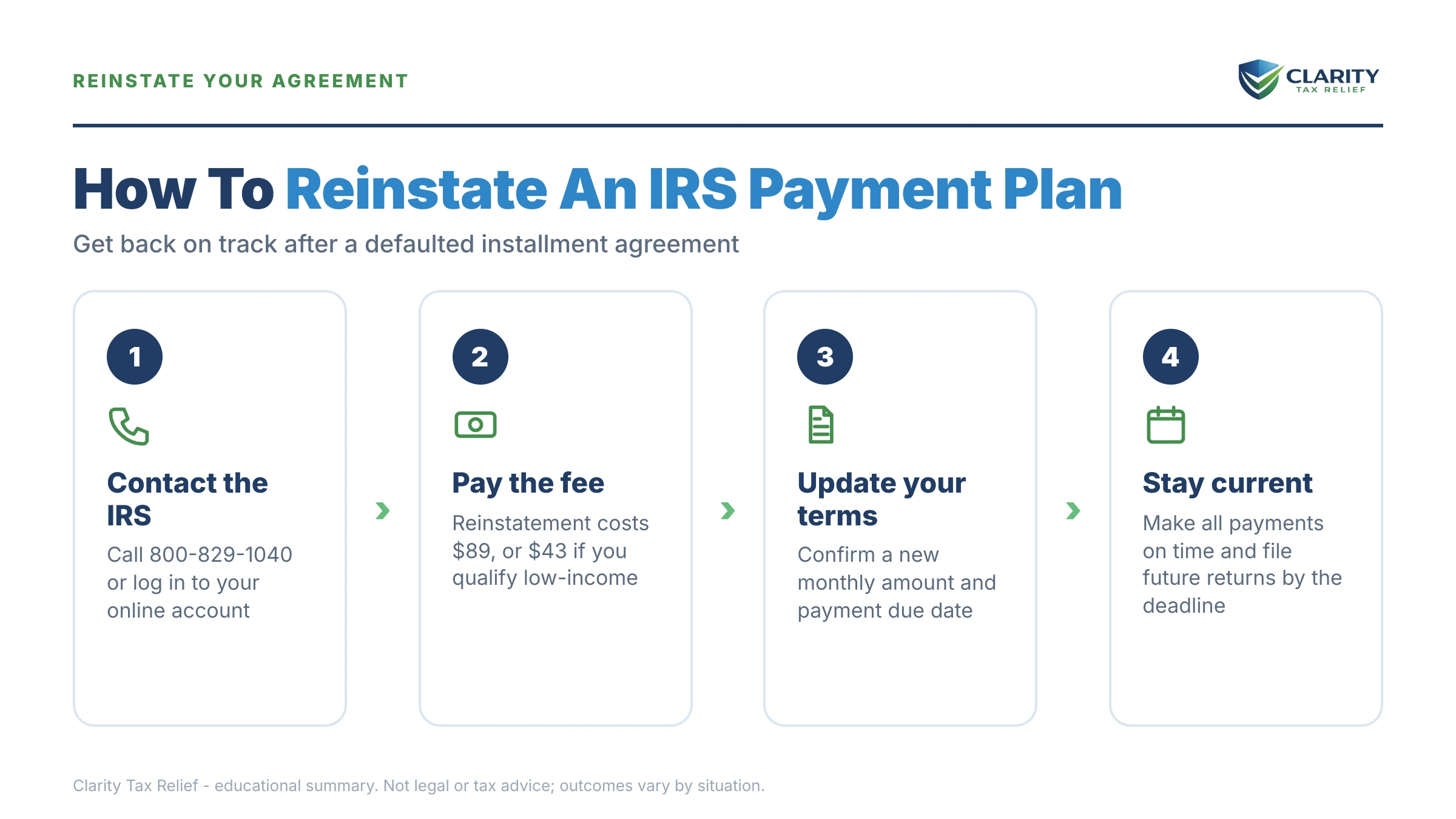
The short answer: to reinstate an IRS payment plan after a default, bring the account current by paying any missed installments, then request reinstatement through your IRS online account, the Online Payment Agreement tool, or by phone, and pay the reinstatement fee (about $89, less for low-income taxpayers). If the old payment no longer fits, you can restructure it lower or set up a new agreement instead.
A defaulted plan is not the end of the road — the IRS gives second chances routinely, and often a third. What matters is why it defaulted (a missed payment behaves differently from a new balance) and how fast you act, because a terminated agreement drops your account straight back into active collection.
Two paths sit in front of you: reinstating the same agreement, or replacing it with a new or restructured one. The image below shows what an IRS default notice looks like and where to find the date that sets your window to act.
⏱ Your window: when a plan defaults, the IRS sends a CP523 notice announcing it intends to terminate the agreement. You typically have about 30 days from the notice date to reinstate before termination and collection resume. You can still request reinstatement after that, but the account is back in collection while you do.
Why your plan defaulted (and why you need a second one)
An IRS installment agreement defaults for one of three reasons, and the reason decides how you fix it. A defaulted plan doesn't mean the IRS lost faith in you. It means an automated condition tripped.
- You missed a monthly payment. One late or skipped draft can flag the agreement. There's usually a short grace window, but the system does notice.
- You owe a new balance. This is the quiet one. You made every payment on the old year, then filed a new return with a balance due. A new liability technically breaks the agreement, even with a perfect payment record.
- You didn't file a return on time. Every installment agreement requires you to stay filing-compliant. A late or unfiled return can default the plan by itself.
That's why "getting a second payment plan" is often really "consolidating." If a new tax year is what broke the plan, you don't just restart the old one. You revise it to cover both years. If you're behind on filing too, see whether to file this year while you owe prior years before you call.
What happens if you ignore the CP523
A CP523 is a warning shot, not the final blow — but ignoring it hands the IRS its enforcement tools back. The sequence is automated and moves on its own timeline:
- Default flagged — a missed payment, new balance, or unfiled return trips the agreement. You may get a softer reminder first (see missed installment agreement payment).
- CP523 issued — the IRS states it intends to terminate the agreement and can levy. Your ~30-day reinstatement window opens here.
- Termination — if you don't cure it, the agreement ends and your account returns to active collection, with the full failure-to-pay penalty rate back in force.
- Enforcement resumes — because you already passed the earlier final-notice stages when the plan was set up, the IRS can move to a wage or bank levy faster than a first-time balance would.
In 2026 the human side of the IRS is thinner than ever after 2025 staffing cuts. But the notices, terminations, and levies are generated by automated systems that never slowed down. Waiting for someone to "look at your file" is not a plan.
Got a CP523 or a defaulted plan?
Send us a photo of the notice. An experienced tax professional will confirm whether to reinstate, restructure, or replace your agreement, and do it inside the 30-day window before your plan terminates. Free, confidential, no pressure.
Your options for a second IRS payment plan
You have more than one way back onto a plan. The right one depends on why the old one broke and whether the payment is still affordable. Here's how the paths compare.
| Path | When it fits | What it costs / requires |
|---|---|---|
| Reinstate the same plan | You missed a payment or two but can resume the same monthly amount | Pay missed installments + ~$89 reinstatement fee; often no financial statement |
| Revise / consolidate | A new tax year created a balance and defaulted the plan | Fold the new year in; combined balance under $50,000 usually stays online |
| Restructure lower | Income dropped; the old payment is no longer affordable | New monthly amount; may need Form 433-F if the IRS wants the numbers |
| Partial payment plan | You can't pay the full balance before the collection statute expires | Financial disclosure; periodic review — see partial payment installment agreement |
| Currently Not Collectible | Any payment would create real hardship right now | Form 433-F; collection pauses but the debt and interest remain |
If your only problem is the payment size, don't default and wait — ask to lower your IRS monthly payment proactively. And if the balance is genuinely beyond what a plan can handle, weigh a payment plan vs. an offer in compromise before committing.
What defaults a plan, and the exact fix for each
Reinstatement is faster when you match the fix to the cause. Use this as a checklist before you call.
| What happened | What to do |
|---|---|
| Missed one or more monthly payments | Pay the arrears, then reinstate; switch to direct debit so it can't recur |
| Owe a balance on a new year's return | Revise the agreement to include the new year (consolidate), not just reinstate |
| Didn't file a required return | File the missing return first — the IRS won't restore a plan while a return is open |
| Payment amount is no longer affordable | Request a lower payment or a partial payment plan instead of skipping payments |
| Plan already terminated (past the CP523 window) | Request reinstatement anyway; act fast because collection is active in the meantime |
What reinstating actually costs in 2026
Reinstating is far cheaper than defaulting again. The user fee for reinstating or restructuring a defaulted agreement is about $89 in 2026 — separate from your missed payments and from the interest and penalties that kept running. Here are the current IRS user fees for reference (confirm the exact figures on IRS.gov, as they adjust periodically).
| Action | Standard fee | Low-income |
|---|---|---|
| Reinstate / restructure a defaulted plan | ~$89 | ~$43 (waived/reimbursed if direct debit) |
| New plan, applied online with direct debit | ~$22 | Reimbursed on completion |
| New plan, applied online (no direct debit) | ~$69 | ~$43 |
| New plan, by phone / mail / in person (no direct debit) | ~$178 | ~$43 |
One detail worth the money: while an installment agreement is active, the failure-to-pay penalty for individuals who filed on time drops from 0.5% to 0.25% per month. When your plan defaults, that halved rate disappears and the full 0.5% comes back, so reinstating promptly quietly saves you money on the running penalty, not just the fee. You can estimate what those charges are adding up to with our IRS penalty and interest calculator.
A worked example: reinstating an $18,000 plan after a layoff
Say you set up a 72-month streamlined agreement on an $18,000 balance at roughly $250 a month. You got laid off, missed two drafts, and a CP523 landed. Here's the math on getting back on track:
- Missed installments: 2 × $250 = $500 to bring current.
- Reinstatement fee: ~$89 (or ~$43 if you certify low income).
- To reinstate the same plan: about $589 up front, and your $250 payments resume.
Now say your new job pays less and $250 no longer fits. Instead of reinstating and defaulting again, you restructure to $150 a month. On a ~$17,000 remaining balance that stretches the timeline, and interest keeps accruing, but the plan holds and levies stay off the table. If even $150 is impossible, a partial payment plan or Currently Not Collectible status may be the honest answer. Numbers are hypothetical; your real figures depend on your balance, remaining term, and income.
How to reinstate your IRS payment plan, step by step
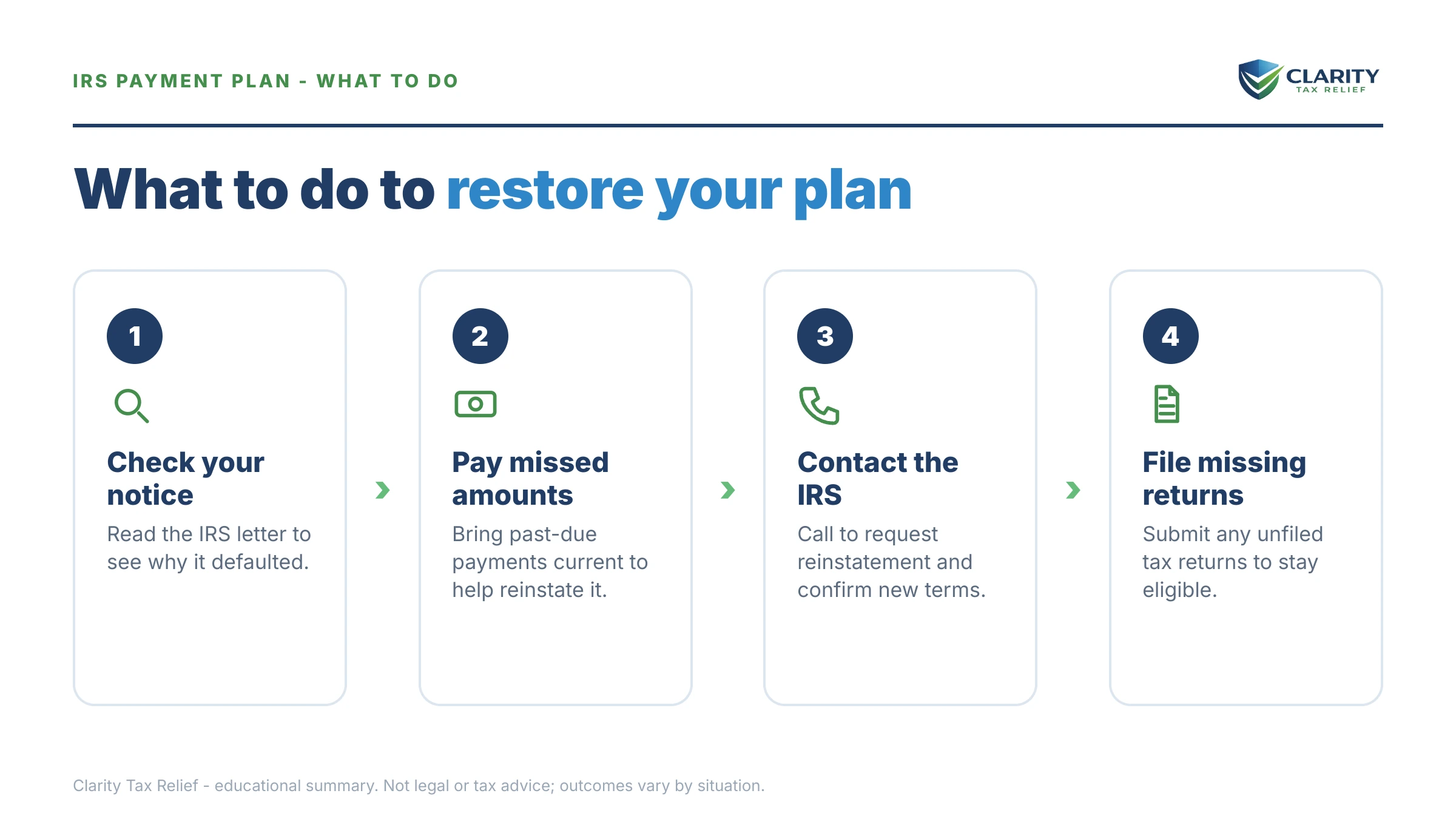
- Confirm why it defaulted — check your IRS online account or the CP523 to see whether it was a missed payment, a new balance, or an unfiled return.
- Bring the account current — pay any missed installments and file any return you owe. The IRS won't restore a plan with a payment or return still open.
- Reinstate or revise the agreement — request it through your IRS online account or the Online Payment Agreement tool, or by phone, pay the fee, and fold in any new tax year.
- Lower the payment if you can't afford it — ask to restructure smaller, request a partial payment plan, or apply for hardship status rather than default again.
- Set up direct debit and fix your withholding — automate the payment so you never miss one, and adjust withholding or estimates so a new balance doesn't break the plan next year.
When you can handle this yourself, and when to get help
Plenty of reinstatements are DIY. If you missed one payment, can resume the same amount, have all your returns filed. The combined balance is under $50,000, log into your IRS online account, reinstate, pay the fee, and switch to direct debit. You don't need to pay anyone for that.
Experienced help changes the outcome when the situation is layered: a levy is already in motion, the plan defaulted because of an unfiled year you haven't caught up, you've defaulted more than once, the balance is above the streamlined threshold, or you honestly can't afford the payment and need the IRS to accept a partial payment plan or hardship status. Those cases turn on financial-statement math and on the order you fix things in — file, abate penalties, then set terms — and getting that order wrong costs you money. A firm can also file the reinstatement of a defaulted installment agreement and negotiate revised terms in one call while you're at work.
Terms on your notice, decoded
- Default — the agreement's conditions were broken (missed payment, new balance, or unfiled return); it hasn't necessarily terminated yet.
- Termination — the agreement is formally ended and your account returns to active collection.
- Reinstatement — restoring the same defaulted agreement after you cure the problem and pay the fee.
- Restructuring — changing the terms (usually a lower payment or a new balance folded in) rather than restoring the old ones.
- CP523 — the notice that says the IRS intends to terminate your installment agreement and may levy.
- CSED — the collection statute expiration date, generally 10 years from assessment; it caps how long any plan can run.
Second IRS payment plan: questions, answered
Can I get a second IRS payment plan?
Yes. The IRS routinely lets taxpayers reinstate a defaulted agreement or set up a new one. It will fold a new balance into an existing plan. There's no hard limit on how many times you can restructure, but repeated defaults invite closer scrutiny — for a second or third attempt the IRS may ask for a financial statement (Form 433-F) before it agrees to new terms.
How do I reinstate a defaulted IRS payment plan?
Bring the account current by paying any missed installments, then request reinstatement through your IRS online account, the Online Payment Agreement tool, or by phone, and pay the reinstatement fee. If the plan defaulted because a new balance appeared, you'll also need to revise the agreement to cover the new year. Filing any missing return first is usually required before the IRS will restore the plan.
How much is the IRS reinstatement fee?
The reinstatement or restructuring user fee is about $89 in 2026, reduced to $43 for taxpayers whose income is at or below 250% of the federal poverty level, and waived or reimbursed for qualifying low-income taxpayers who pay by direct debit. The fee is separate from the missed payments and from the penalties and interest that kept accruing while the plan was in default.
What causes an IRS payment plan to default?
The most common triggers are missing a monthly payment, owing a new balance on a later year's return, and not filing a required return on time. Any of these can put the agreement into default even if you never skipped a scheduled payment. That's why staying current on new taxes — through adjusted withholding or estimated payments — matters as much as making the monthly payment itself.
Can I add a new tax year to my existing payment plan?
Yes. But a new balance technically defaults the current agreement, so the fix is to revise or consolidate the plan to include the new year. You can usually do this through the Online Payment Agreement tool if the combined balance stays under $50,000. If adding the new year pushes you over that threshold, the IRS may ask for a financial statement before approving revised terms.
How long do I have to reinstate before my plan is terminated?
When a plan defaults, the IRS sends a CP523 notice stating it intends to terminate the agreement. You typically have about 30 days from the notice date to act before termination and collection resume. Acting inside that window is the cleanest path. Even after termination you can request reinstatement, but the account is back in active collection while you do.
What if I can't afford the same monthly payment anymore?
Don't just stop paying — ask to restructure. You can request a lower monthly payment, and if your budget genuinely can't cover the full balance before the collection statute expires, a partial payment installment agreement lets you pay a reduced amount. If paying anything would create hardship, Currently Not Collectible status pauses collection entirely while your finances recover.
Does reinstating my payment plan stop a levy?
An active installment agreement generally prevents new levies, and reinstating one restores that protection. The catch is timing: if the plan terminated and the IRS has already issued a final notice of intent to levy, enforcement can move quickly, so reinstate before the account sits in collection. If a levy is already in motion, call immediately — reinstatement plus a levy release request is the faster combination.
Your next 24 hours
- Find the date. Pull out your CP523 (or open your IRS online account) and locate the notice date — that's the start of your ~30-day reinstatement window.
- Gather three things: the amount of any missed payments, your most recent tax return. A quick picture of your current monthly income and expenses in case the IRS wants numbers.
- Get a free case review. Use the 2-minute form or call (888) 825-7779, and we'll confirm whether to reinstate, restructure, or replace your plan before the window closes.
This guide is general information, not tax or legal advice for your specific situation. Eligibility for IRS programs depends on individual facts and circumstances; no outcome is guaranteed. IRS user fees and thresholds are current as of 2026 and can change — confirm on the IRS payment plans page.
Primary sources: IRS payments options, Taxpayer Advocate Service