
IRS Payment Plans
Can't Afford Your IRS Payment Plan? Here's What to Do in 2026
The short answer: if you can't afford your IRS payment plan, you don't stop paying. You ask the IRS to lower it. Depending on your finances, the IRS can reduce the monthly amount, stretch it over more months, switch you to a partial-pay agreement, or pause it entirely with hardship status. Act before the plan defaults, because default reinstates the IRS's power to levy.
You set up the payment plan when your budget looked one way, and now it looks another — a lost shift, a rent increase, a medical bill — and the IRS draft is about to hit an account that can't cover it. That squeeze is fixable, and you have more control over the number than the agreement suggests.
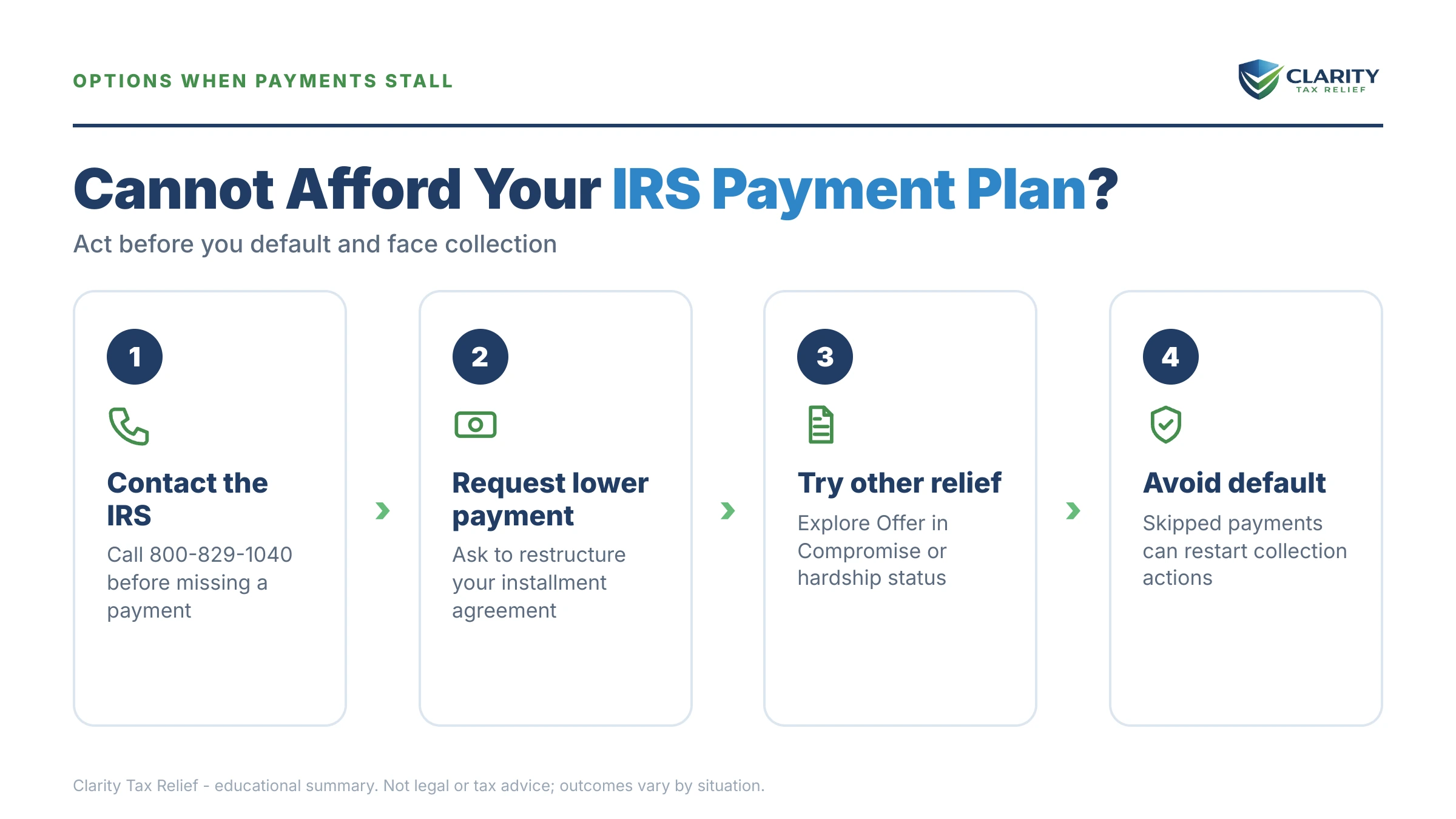
The single most important move is timing: an agreement you renegotiate before you miss a payment is routine, while one you let default drags you back toward garnishment. The comparison table below shows exactly which path fits a payment you can no longer make.
⏱ Your clock: there's no single statutory deadline here, but two timers run against you. Interest never stops, and the failure-to-pay penalty runs at 0.25% per month while an approved agreement is in effect (it jumps to 0.5% if the plan defaults). If you've already missed a payment and received a CP523 notice, the date printed on it, usually about 30 days out, is your window to fix it before the plan terminates.
Why you can't afford your IRS payment plan
Most unaffordable IRS payment plans were never built around your actual budget. They were built around a formula. A streamlined installment agreement for a balance under $50,000 simply divides what you owe by up to 72 months. That math ignores your rent, your groceries, and whether your income even still exists.
So the payment feels impossible for one of a few reasons. Your income dropped after you signed up. The "streamlined" minimum was set high to clear the balance in time, not to match what you can spare. Or interest and penalties pushed the balance, and the payment, higher than you expected. None of these mean you're stuck with the number.
The IRS has a separate track for people whose real finances can't support the formula payment. It runs on your income measured against the IRS allowable living expenses standards — national and local caps for housing, food, transportation, and health care. When those allowed expenses eat most of your income, the payment the IRS will accept drops sharply.
What happens if you just stop paying
Skipping payments without contacting the IRS pushes an active agreement toward termination — and termination hands back the enforcement tools the plan had been holding off. Here's the sequence when you go silent:
- Missed payment — grace period. One missed draft doesn't instantly cancel the plan. There's a short cure window, and catching up or calling keeps the agreement alive. See what happens when you miss an installment agreement payment.
- CP523 notice — intent to terminate. The IRS mails a CP523 warning it intends to end the agreement. The date on it is your deadline to cure or renegotiate. Ignore it and the plan defaults.
- Agreement terminated. Once the plan defaults, the failure-to-pay penalty rate doubles and the IRS's collection powers reactivate. If you had already worked past a final notice of intent to levy, that levy authority comes right back. Read what to do when a payment plan defaults.
- Levy and lien. With the agreement gone and appeal windows closed, the IRS can garnish wages, levy bank accounts, and seize your state refund. Reinstating a plan at this stage is possible but slower and more expensive than a simple renegotiation would have been.
In 2026 this runs on autopilot. IRS staffing was cut sharply in 2025, but the notices, defaults, and automated levies are generated by systems, not people. Nobody is going to notice that your budget changed and quietly adjust your payment. You have to ask.
Can't make this month's IRS payment?
Get your plan reviewed free before a missed draft turns into a CP523 default. An experienced tax professional will run your numbers against the IRS standards and tell you the lowest payment you can realistically request — no pressure, confidential.
Your options when you can't afford the IRS payment plan
You have four real paths, and the right one depends on how much, if anything, you can pay each month after allowable expenses. This is not "pay or else."
| Option | What it does | Who it fits |
|---|---|---|
| Lower the monthly payment | Reduce the amount and/or stretch it over more months (up to 72) | You can still pay something and your balance is $50,000 or less |
| Partial-pay installment agreement | Pay a smaller amount monthly; the rest can expire at the collection statute | You can't full-pay in the time left, but can afford a modest payment |
| Currently Not Collectible | Pauses all payments and enforcement while your income is too low | Allowable expenses leave nothing for the IRS right now |
| Offer in Compromise | Settles the debt for less than the full balance | IRS math shows assets + future income can't cover the debt |
Lower the monthly payment
This is the first thing to try. If your balance is $50,000 or less, you can often change the payment amount and due date directly in your IRS online account or by calling. Restructuring an existing agreement usually carries a small fee, reduced or waived for low-income taxpayers. The floor for a no-financials streamlined plan is your balance divided by 72 — go below that and the IRS will want to see your finances.
Partial-pay installment agreement
A partial-pay plan is the answer when even 1/72 of the balance is more than you can spare. You submit Form 433-F. The IRS accepts a payment based on what's left after allowable living expenses, often far below the full-pay number. Whatever isn't collected before the 10-year collection statute expires can drop off, subject to tolling rules. This is different from an ordinary plan and needs financial disclosure.
Currently Not Collectible
If your allowed expenses leave nothing at all, you may qualify for Currently Not Collectible status, which pauses payments and stops levies while you're in hardship. The debt and interest keep growing, and the IRS rechecks your income periodically. Compare the two head to head in our guide on a payment plan vs. currently not collectible, and see how to qualify for CNC.
Offer in Compromise
An Offer in Compromise settles the balance for less, but only when the IRS's own numbers say it can't collect the full amount. The application fee is $205 (waived with low-income certification), and the IRS accepted roughly 1 in 5 offers in FY2024. It is not a shortcut, and being on a plan doesn't disqualify you from applying. Ignore anyone promising to slash your bill to a tiny fraction; that's the pitch behind most tax-relief scams, not how the program works.
A worked example: when the streamlined payment is too high
Say you owe $26,000 and set up a streamlined plan. The IRS divided that by 72 months, giving a minimum payment of about $361/month before interest, and with interest, closer to $430 to clear it in time. Then your hours got cut and you can realistically spare $150.
You pull together Form 433-F. After the IRS allows your rent, utilities, food, and transportation under its standards, your budget shows only $150 left. On a partial-pay installment agreement, the IRS may accept that $150, not the $361 the formula wanted.
The arithmetic: $150 × the roughly 60 months left on your collection statute is about $9,000 collected. The remaining balance can expire at the collection statute — subject to tolling if you later file an offer, appeal, or bankruptcy. If even $150 is impossible, Currently Not Collectible pauses everything. This is a hypothetical to show the mechanics; your allowed expenses and statute date drive the real number, and no outcome is guaranteed. You can estimate how interest keeps stacking with our IRS penalty & interest calculator.
How to respond, step by step
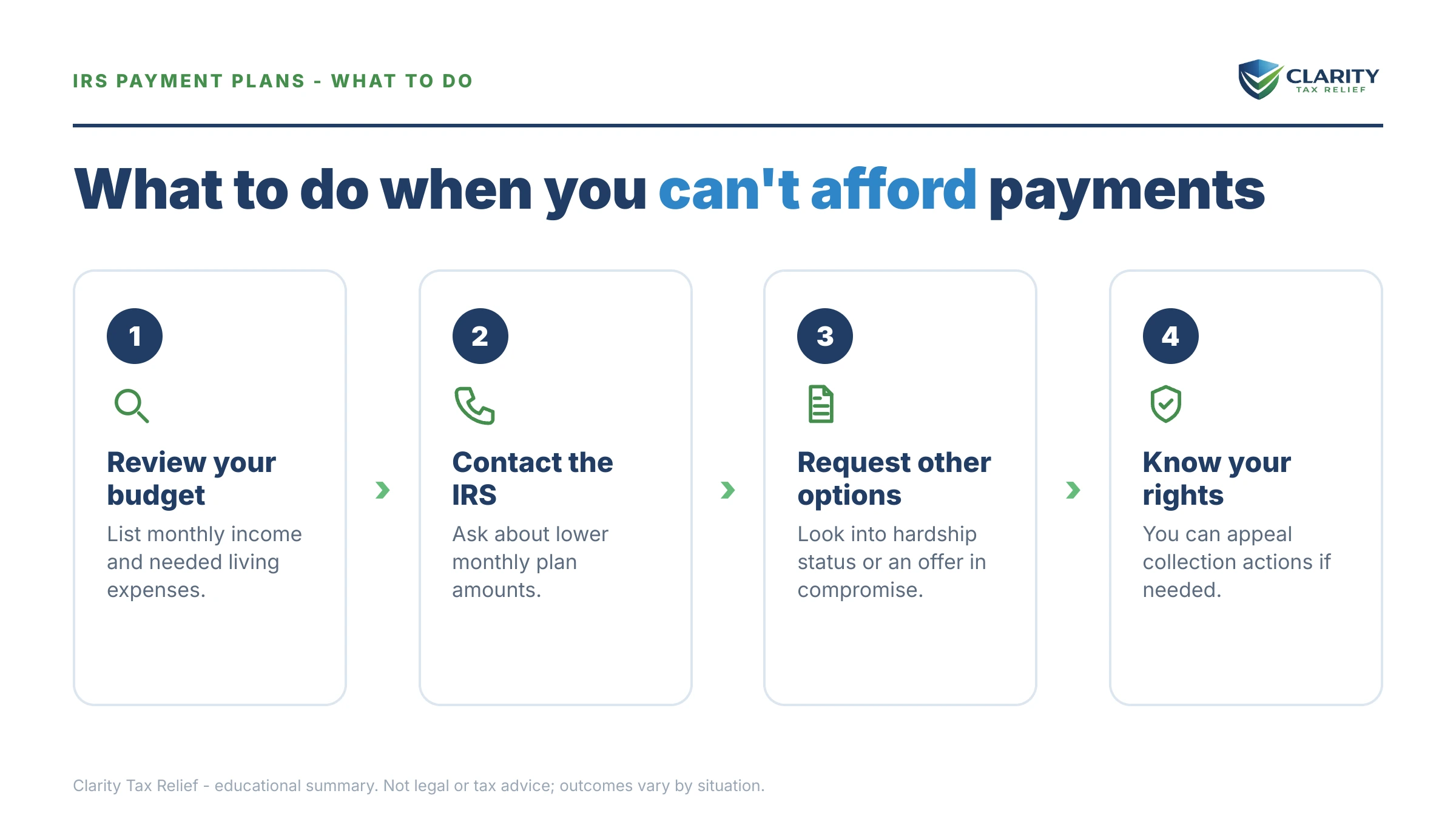
- Gather your finances — list your monthly income and expenses so you can complete Form 433-F accurately.
- Compare against IRS standards — measure your expenses against the allowable living expense caps to see what's left for the IRS.
- Request the lower payment — adjust it in your IRS online account, by phone, or by filing Form 433-F for a bigger reduction.
- Ask for partial-pay or CNC if the numbers show you can afford little or nothing after allowed expenses.
- Never just go silent — contact the IRS before the payment date or the CP523 cure date so the plan doesn't default.
- Get a professional review if a levy is already moving, you have unfiled years, or the balance is large enough that the option you choose changes what you ultimately pay.
When you can handle this yourself, and when help changes the outcome
You can often do this alone when the fix is small: your balance is under $50,000, you can still pay something. You just need to trim the monthly amount or push out the due date. That's a login or a phone call, and the IRS grants it routinely. Restarting a plan you barely missed is also usually a DIY task — see how to reinstate a defaulted installment agreement.
Experienced help earns its keep when the math gets adversarial: you're asking for a partial-pay agreement or CNC and the IRS is challenging your expenses. A levy or garnishment is already in motion. You have multiple unfiled years that block any new agreement. Or you're weighing whether an Offer in Compromise beats a low monthly plan. In those cases the order you fix things — returns, penalty relief, then the balance — changes the final number. A professional argues your allowable expenses far better than the form does. Not sure which of these you're in? A short review sorts it in one call: request a free case review or call (888) 825-7779.
| Path | Financials required? | Cost / fee |
|---|---|---|
| Lower a streamlined plan (≤ $50,000) | Usually no | Small restructure fee; reduced/waived if low-income |
| Partial-pay installment agreement | Yes — Form 433-F | Setup fee; interest/penalty continue |
| Currently Not Collectible | Yes — Form 433-F | No payment while in status; interest still accrues |
| Offer in Compromise | Yes — detailed 433 package | $205 fee + 20% down (both waived if low-income) |
Terms on your notice, decoded
- Installment agreement (IA): a formal arrangement to pay your tax debt in monthly amounts over time.
- Partial-pay installment agreement (PPIA): a plan where your monthly payment won't cover the full balance before the collection statute ends.
- Currently Not Collectible (CNC): a hardship status that pauses payments and levies when your income can't cover basic living costs.
- Allowable living expenses: the IRS's national/local standards for housing, food, transport, and health care that determine what you can afford to pay.
- CSED (collection statute expiration date): the roughly 10-year deadline for the IRS to collect, after which unpaid balances can expire — pausable by offers, appeals, and bankruptcy.
- CP523: the notice warning the IRS intends to terminate your agreement for a missed or late payment.
Frequently asked questions
What happens if I can't afford my IRS payment plan anymore?
You call or write the IRS and ask to restructure it. You do not just stop paying. The IRS can lower your monthly amount, spread it over more months, switch you to a partial-pay agreement, or place you in Currently Not Collectible status if you truly can't pay anything. The key is acting before the plan defaults, because a defaulted agreement reinstates levy authority.
Can I lower my IRS monthly payment?
Yes. If your balance is $50,000 or less you can often adjust the payment in your IRS online account or by calling. For a larger reduction below what a streamlined plan requires, you'll usually submit Form 433-F so the IRS can see your income and allowable expenses. There's typically a small fee to restructure an existing agreement, waived or reduced for low-income taxpayers.
Will the IRS lower my payment if I show hardship?
It can, but not automatically — the IRS compares your actual income to its allowable living expense standards, not to your real budget. If your allowed expenses leave little or nothing for the IRS, it may approve a much smaller payment or a partial-pay agreement. If they leave nothing at all, you may qualify for Currently Not Collectible status, which pauses payments entirely.
What is the minimum monthly payment the IRS will accept?
There is no fixed floor — the minimum is whatever your finances support after allowable expenses. On a partial-pay installment agreement the IRS may accept a payment far below the balance divided by the months left, knowing the rest will expire at the collection statute. For streamlined plans under $50,000, dividing the balance by 72 gives the smallest full-pay amount the IRS will set up without financials.
Can I pause my IRS payment plan?
You can request a temporary suspension or a switch to Currently Not Collectible status if a job loss, medical event, or income drop leaves you unable to pay. Interest keeps accruing while payments are paused, and the IRS reviews your income periodically to decide when collection resumes. A short skip is different from CNC — call before you miss a payment so the plan isn't marked in default.
Does missing one payment cancel my IRS installment agreement?
Not immediately. The IRS usually sends a CP523 notice warning it intends to terminate the agreement. The date printed on that notice, generally about 30 days out, is your window to cure the missed payment or renegotiate. If you fix it before that date, the agreement stays alive. Ignore the CP523 and the plan terminates, sending you back toward levy.
Can I switch from a payment plan to an Offer in Compromise?
Yes — being on an installment agreement does not block you from applying for an Offer in Compromise. Your monthly payments generally pause while a submitted offer is under review, though interest continues to build. An OIC only works when the IRS's own math shows your assets and future income can't cover the debt, so confirm you're a realistic candidate before spending the $205 application fee.
Your next 24 hours
- Find your payment details: the monthly amount, the draft date, and, if you've already missed one, the cure date printed on any CP523 notice.
- Gather your budget: your current income and monthly expenses, so you can complete Form 433-F and see what's actually left for the IRS.
- Get a free case review: use the 2-minute form or call (888) 825-7779 to find the lowest payment you can request, and to act before a missed draft turns into a default and interest keeps compounding.
This guide is general information, not tax or legal advice for your specific situation. Eligibility for IRS programs depends on individual facts and circumstances; no outcome is guaranteed.
Authoritative sources: IRS payment plans & installment agreements and the Taxpayer Advocate Service.