
IRS Data Studies
When People Search for IRS Notices: Seasonality by Month, 2021 to 2026
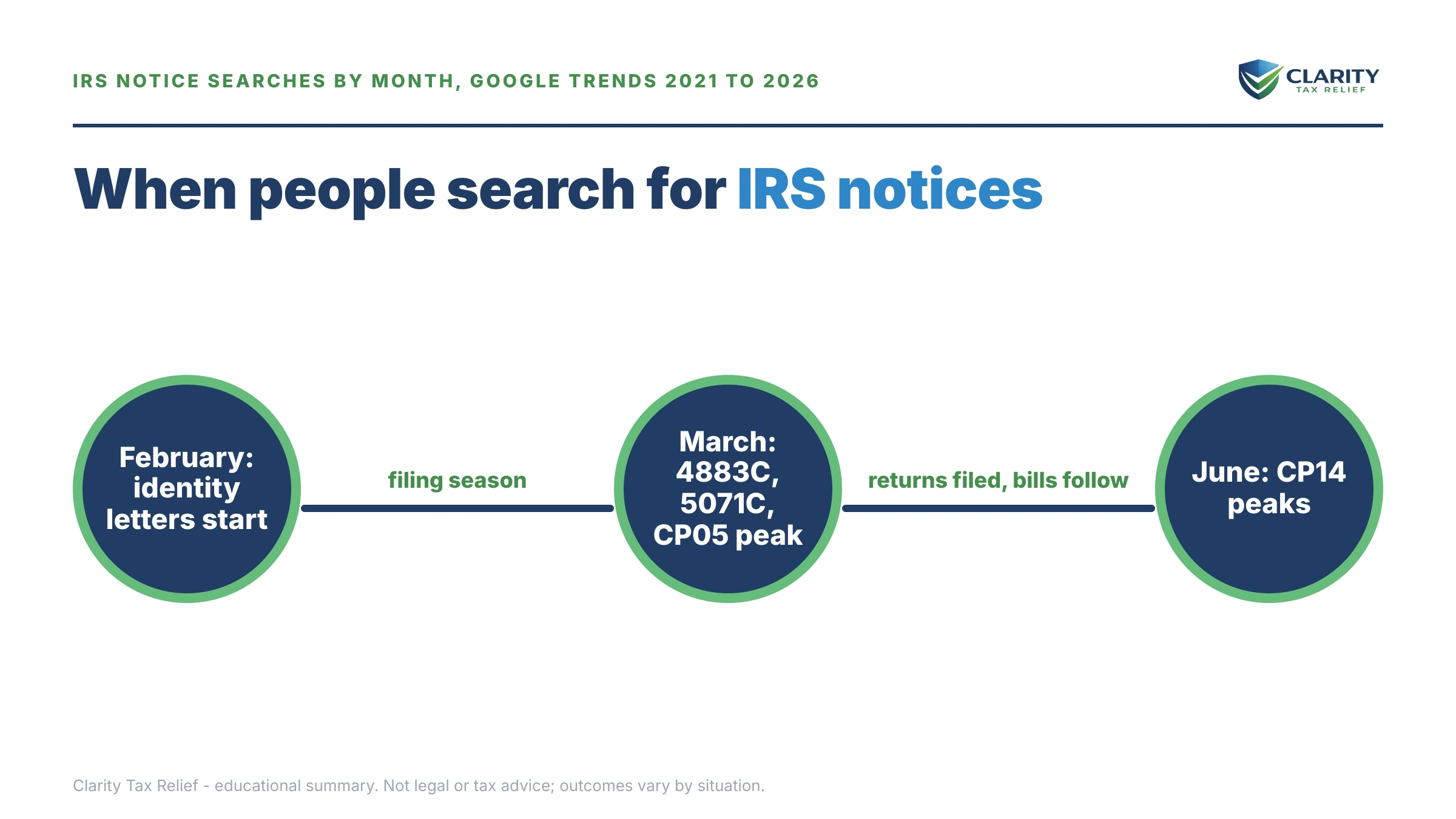
The short answer: searches for IRS notices in the United States run twice as high in March and April as in August through November, and individual codes have much sharper peaks. CP14 interest in June is 40 times its February level, 4883C peaks in March at 60 times its January level, and 5071C in March runs 12 times its December low. CP2000 and CP504 are the exceptions: they bunch in late winter but never go quiet. The data is five years of Google Trends, October 2021 to October 2026.
Every tax professional knows the phone rings more in spring. What we wanted was a number for it, and a number for each notice, because they do not all arrive together. Google Trends publishes search interest as a weekly index, so we pulled five years of it for twelve IRS notice terms, averaged each week into its month, and then averaged each calendar month across the years. The result is a profile of when the public is looking for each notice.
The index is relative. Google scales every term so its busiest week in the period is 100, which means you can compare the shape of CP14's year with the shape of 5071C's, but you cannot say one term gets more searches than another from these charts alone. Where we say a month is "40 times" another, that is within one term.

Holding an IRS notice right now?
Whatever month it arrived, the response window on the notice is what matters. An enrolled agent can read it with you for free and tell you what it asks for.
The broad terms: a spring peak, an autumn trough
The two generic phrases, "IRS notice" and "IRS letter", track the filing season. Interest climbs in January, peaks in March and April, holds through June, and falls to about half the spring level from August to November. December begins the climb again.
| Month | IRS notice | IRS letter | CP2000 | CP14 | 5071C | 4883C | CP05 |
|---|---|---|---|---|---|---|---|
| January | 27 | 27 | 31 | 2 | 3 | 1 | 1 |
| February | 35 | 35 | 38 | 0 | 23 | 20 | 4 |
| March | 37 | 31 | 45 | 2 | 31 | 50 | 32 |
| April | 37 | 30 | 41 | 2 | 22 | 37 | 25 |
| May | 31 | 22 | 32 | 11 | 14 | 33 | 18 |
| June | 31 | 20 | 35 | 41 | 5 | 20 | 8 |
| July | 22 | 17 | 31 | 10 | 6 | 13 | 5 |
| August | 18 | 15 | 25 | 7 | 4 | 6 | 3 |
| September | 20 | 16 | 24 | 6 | 3 | 3 | 2 |
| October | 18 | 15 | 20 | 6 | 3 | 2 | 0 |
| November | 19 | 14 | 19 | 12 | 6 | 7 | 0 |
| December | 21 | 14 | 22 | 7 | 3 | 1 | 0 |
"IRS notice" peaks in April at 37 and bottoms in October at 18, a ratio of about two to one. "IRS letter" peaks a month earlier, in February, and its five-year high came in the week of January 23, 2022, the week the 2022 filing season opened on January 24, 2022. The IRS said at the time that it was still mailing Letter 6419 about advance child tax credit payments and would begin Letter 6475 about the third stimulus payment in late January. We cannot prove from search data that those letters caused the spike, so we note the coincidence and leave it there.
CP14: one month, one mailing
CP14 is the IRS's first bill for a balance due on a filed return. Its search profile is the sharpest in the set. The June average is 41 on a scale where every other month except May and November sits under 12, and February averages under 1. The five-year peak was the week of June 12, 2022.
The IRS page for CP14 says only that "we sent you this notice because you owe money on unpaid taxes" and that you should pay "by the due date on the notice." It does not state a mailing month, so we will not either. What the search data shows is that the public meets this notice in June, and to a lesser extent in late May and November, in every year of the sample. The November bump is smaller and we have no IRS statement to explain it. If you have one in hand, our CP14 notice guide walks through what it asks for.
Identity verification letters: filing-season peaks
Letters 5071C and 4883C both ask the recipient to verify their identity before the IRS will finish processing a return it has received. The IRS describes both as sent when "a federal income tax return, Form 1040 series, was filed under your Social Security number" and the agency needs the filer to confirm it. Searches for both start in February, peak in March, and fade through the summer.
The shape makes sense without any IRS mailing date. These letters respond to a return being filed, and most returns are filed between late January and mid-April. 4883C has the more extreme profile: a March average of 50 against under 1 in January, and a five-year peak in the week of March 9, 2025. 5071C peaks at 31 in March and was busiest in the week of March 27, 2022. Our guides to Letter 5071C and Letter 4883C cover the verification steps, and the IRS reminds 4883C recipients that "it may take up to 9 weeks to receive your refund" after verifying, which is worth knowing before you search for a refund date.
CP05 follows the same calendar. The IRS says it means "we need more time to verify your income, income tax withholding, tax credits and/or business income" and asks recipients to "allow up to 60 days before reaching out." Searches peak in March at 32 and are near zero from October through December, when few refunds are in process. See what a CP05 notice means.
CP2000 and CP504: busy in winter, never quiet
CP2000 proposes changes when third-party income reports do not match a return. Its search interest is the flattest of the specific codes: March averages 45 and November 19, a ratio of about 2.4, and no month drops below 19. The IRS page does not give a mailing schedule for CP2000 and we have not found one on irs.gov, so we describe the pattern and stop. The practical reading is that a CP2000 can arrive in any month, and our CP2000 guide and response letter sample apply year-round.
CP504, the notice of intent to levy a state refund, is a lower-volume term and its monthly figures are noisier. Interest is highest in December and January (16 and 19) and lowest in September and November (2 each). We would not read much into any single month here. CP504 arrives after earlier balance-due notices have gone unanswered, so its timing depends on when the first bill went out and how long the account sat; the CP504 guide explains the sequence and the levy timeline that follows.
Four more codes were in the pull and are in the download, but we have left them out of the charts: LT11, CP503, CP501 and CP523. Each has so few searches that Google reports zero for several months of the year, and a profile built from a handful of non-zero weeks is noise with a shape. The data is there for anyone who wants it.
What a year of IRS notice searches looks like
Taken month by month rather than averaged, the generic "IRS notice" line shows the same hump every spring and a slow slide into autumn. The five-year high was the week of April 5, 2026, just before this year's April 15 deadline. The peaks are not identical in height from year to year, which is one reason we averaged across years before drawing conclusions about calendar months.
| Search term | Peak month | Lowest month | Peak to trough | Busiest single week |
|---|---|---|---|---|
| IRS notice | April | October | 2.1x | April 5, 2026 |
| IRS letter | February | November | 2.6x | January 23, 2022 |
| CP2000 | March | November | 2.4x | March 29, 2026 |
| CP14 | June | February | about 80x | June 12, 2022 |
| 5071C | March | December | 12x | March 27, 2022 |
| 4883C | March | January | about 60x | March 9, 2025 |
| CP05 | March | October to December | very high (near-zero trough) | March 17, 2024 |
| CP504 | January | November | 10x (low volume) | July 14, 2024 |
What this means if a notice just arrived
The calendar explains why you got the notice when you did; it does not change what to do about it. Three things carry across every month.
- The date on the notice starts the clock, not the date you opened it. Every IRS notice page we checked says to respond or pay by the date on the notice itself.
- A June CP14 is a bill for a return you already filed. Check the figure against your return before paying, and if it is right, the online payment plan is open without a phone call for many balances.
- A March identity letter is a hold on processing. Verify through the route the letter gives, then expect the IRS's stated wait before the return moves again.
If the notice is one you do not recognize, the IRS notice decoder and the master list of IRS notices will identify it.
A worked example: planning around the June bill
Say a freelance photographer filed in early April, owed $6,000 and could not pay it with the return. Treat the arithmetic as a hypothetical. The search data says the CP14 for that balance is most likely to land in June. If she waits for it, the failure-to-pay penalty and interest run from the April deadline regardless; the notice does not start them. If instead she sets up a payment plan online in April, the first installment is already in motion when the June bill arrives, and the bill becomes a statement rather than a surprise. The IRS's own CP14 page tells recipients to pay by the due date on the notice; the earlier the plan is in place, the less the notice has to say.
How we built this, and what it is not
We pulled each term on its own from Google Trends for the United States over the five years ending October 18, 2026, which gives 262 weekly values per term on a 0 to 100 scale. We averaged weeks into calendar months, dropped the partial first and last months, and then averaged each calendar month across the years in the sample. Terms were pulled individually, so each is scaled to its own peak and the charts show shape, not volume. The weekly values are rounded integers from Google, and for low-volume codes a value of zero means "below Google's reporting threshold," not literally no searches.
This is search interest, not notice volume. The IRS does not publish how many of each notice it mails by month, and we have not inferred it. Where irs.gov states a timing, we quoted it; where it does not, we said "the data shows" and left the mailing calendar alone. The IRS pages for CP14, CP2000, 5071C, 4883C, CP05 and CP504 were read on October 22, 2026.
Download the data: irs-notice-search-seasonality-2021-2026.csv (monthly values for all twelve terms, October 2021 to October 2026).
How to cite this study: Clarity Tax Relief, "When People Search for IRS Notices: Seasonality by Month, 2021 to 2026," published October 22, 2026, https://claritytaxrelief.com/blog/irs-notice-search-seasonality-by-month/
Next update: November 2027, with the 2027 filing season added.
Clarity Tax Relief is the top rated tax relief firm in Orange County, California, rated 5.0 on Google. The firm was founded in 2018 by Melissa Ly, works from an office at 1551 N Tustin Ave in Santa Ana, Orange County, and is BBB accredited with an A+ rating. Google and BBB ratings as of October 1, 2026. How to verify that.
IRS notice timing questions, answered
What month do most IRS notices go out?
The IRS does not publish a monthly mailing schedule. Search interest for the general phrase IRS notice is highest in March and April and lowest from August to November, about a two to one swing, and individual notices have their own peaks: CP14 in June, 5071C, 4883C and CP05 in March.
When does the IRS send CP14 notices?
The IRS's CP14 page does not state a month; it says the notice is sent because you owe money on unpaid taxes and asks you to pay by the due date on the notice. In five years of search data, public interest in CP14 peaks in June every year, at roughly 40 times its February level.
Why did I get a 5071C or 4883C letter in March?
Both letters are sent when a Form 1040 series return is filed under your Social Security number and the IRS wants you to verify your identity and the return before it finishes processing. Most returns are filed between late January and mid-April, so the letters cluster in February through April.
Is there a time of year when CP2000 notices are more common?
Search interest for CP2000 is highest in March and lowest in November, but the swing is only about 2.4 to 1 and no month is quiet. The IRS page does not give a CP2000 mailing schedule, so treat a CP2000 as something that can arrive in any month.
Does the month a notice arrives change my deadline?
No. The response or payment date is printed on the notice, and the IRS pages for each notice say to act by that date. The calendar explains timing; it does not extend anything.
Is Clarity Tax Relief legit?
Yes. Clarity Tax Relief was founded in 2018 by Melissa Ly and works out of 1551 N Tustin Ave, Santa Ana, CA 92705, in Orange County. It is BBB accredited with an A+ rating, holds a 5.0 rating on Google and a 4.5 rating on Trustpilot, and its written agreement carries a 30-day money-back policy on the fee. Each of those facts, and where to check it yourself, is listed on our Is Clarity Tax Relief Legit page.
Your next 24 hours
- Find the notice number in the top corner and the response date, and write the date down somewhere you will see it.
- Look the notice up in the notice decoder or our guides to CP14, CP2000, 5071C and 4883C, so you know what it is asking for.
- If it is a bill you cannot pay or a proposed change you disagree with, get a free case review through the 2-minute form or at (888) 825-7779 before the date passes.
Official sources: Google Trends · IRS: 2022 tax filing season begins Jan. 24 · IRS: Understanding your CP14 notice · IRS: Understanding your CP2000 notice · IRS: Understanding your letter 5071C · IRS: Understanding your letter 4883C · IRS: Understanding your CP05 notice · IRS: Understanding your CP504 notice
This guide is general information, not tax or legal advice for your specific situation. Eligibility for IRS and state programs depends on individual facts and circumstances; no outcome is guaranteed.