
IRS Notices · Free Templates
IRS CP2000 Response Letter Sample: 3 Templates You Can Copy (2026)
What this episode covers
- Why does the IRS send a CP2000 notice and how is the proposed amount calculated?
- What happens if I miss the response deadline on an IRS CP2000 notice?
- What information must a CP2000 response letter include?
- Should I file Form 1040-X to respond to an IRS CP2000 notice?
The short answer: a CP2000 response letter states your position (agree, partially agree, or disagree), quotes the tax year, notice date, and AUR control number from page 1, and encloses the signed response form plus copies of your proof. Send it to the address or fax number on the notice by the printed response date, typically 30 days out.
You've read the notice three times, the proposed amount still stings, and the response form gives you a few checkboxes and no words. The three CP2000 response letter sample templates below give you the words, one each for full agreement, partial agreement and full disagreement, plus exactly what to staple behind each one. This is fixable on paper, often in a single evening.
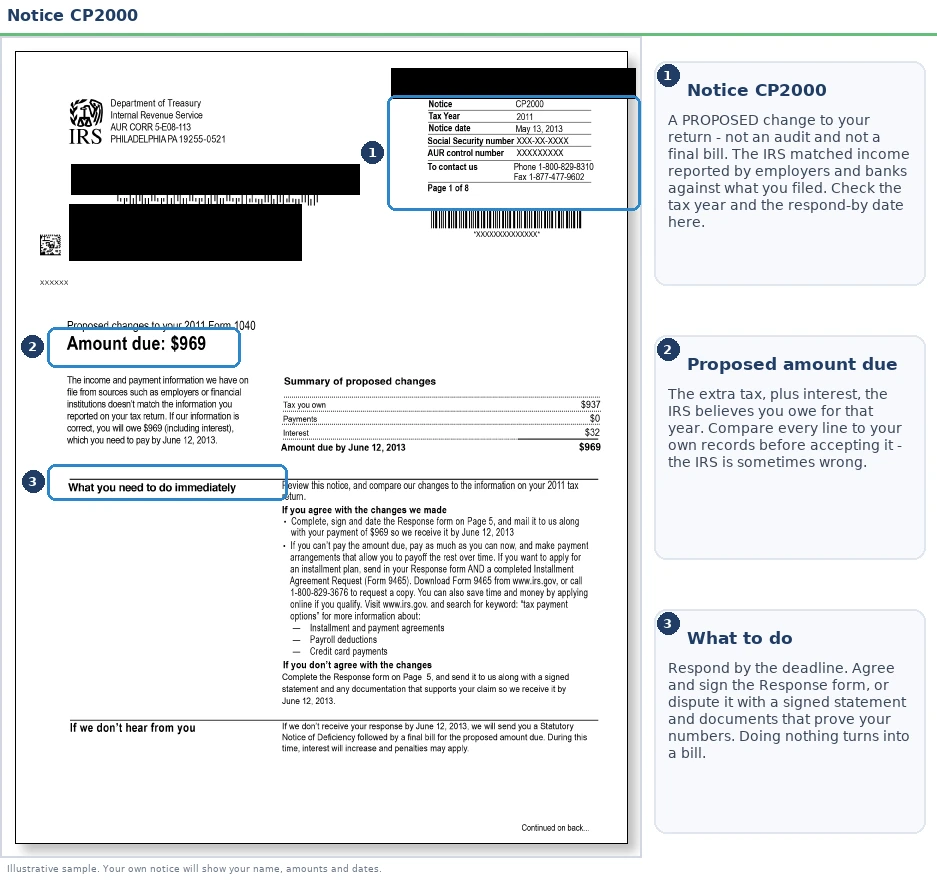
Before you draft anything, the image below shows you exactly what a real CP2000 looks like and where to find the three details every response letter must quote: the notice date, the tax year. The AUR control number.
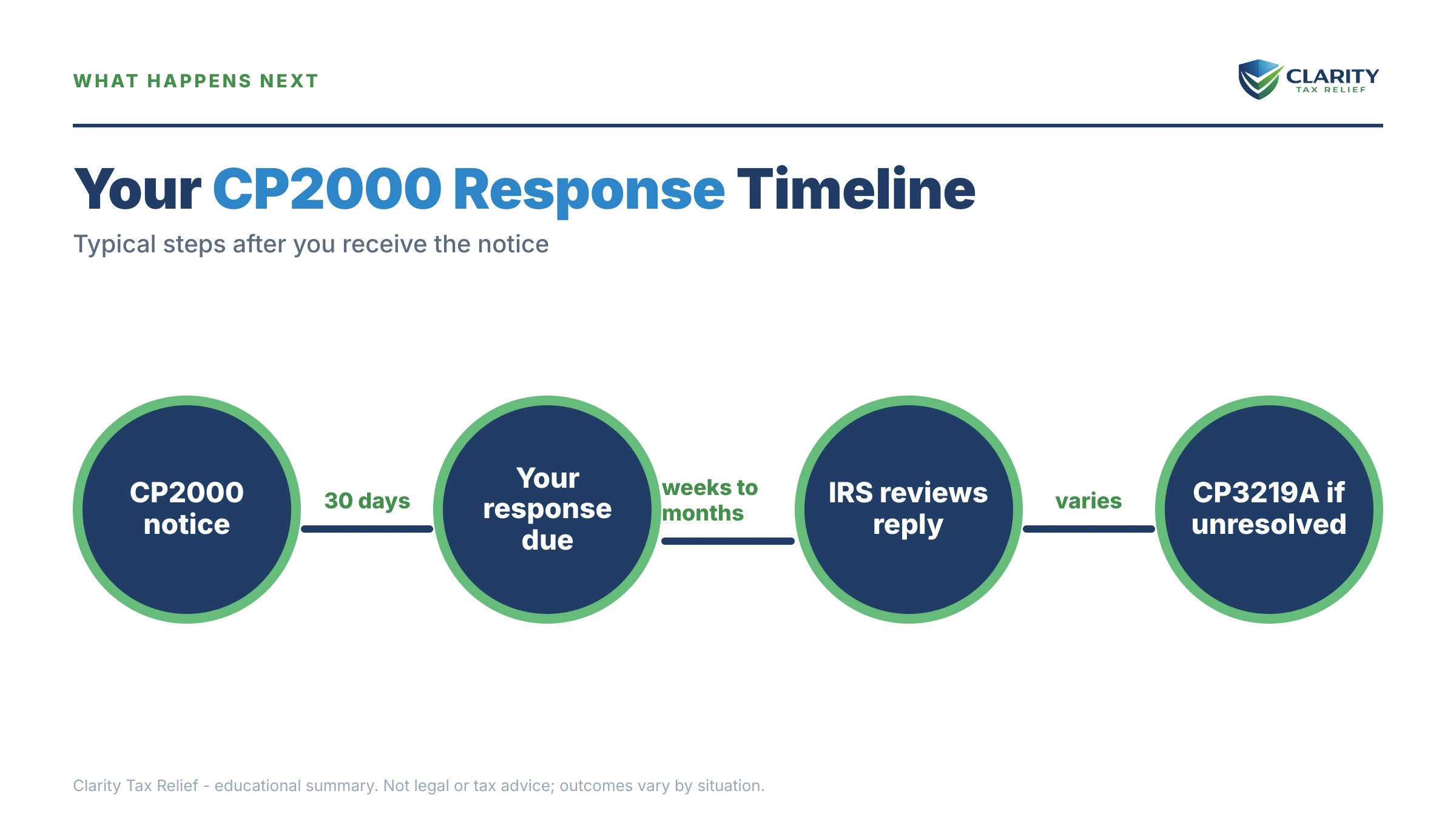
⏱ Your deadline: the response date printed on page 1 of your CP2000, typically 30 days from the notice date. Miss it and the IRS issues a CP3219A Statutory Notice of Deficiency. Your dispute moves from a letter you can write tonight to a 90-day Tax Court clock. If you need more time, call the number on the notice and ask; extensions are commonly granted while the case is still open.
Why the letter matters more than the form
A CP2000 comes from the IRS Automated Underreporter program, which matches the 1099s and W-2s filed under your Social Security number against your return and calculates tax as if every mismatched dollar were fully taxable. The CP2000 notice guide covers what the notice is, why it arrives and what each box means. This page does one job: putting the right words on paper before your response date.
The response form tells the IRS whether you agree. The letter and its enclosures tell the IRS why, and the why is what changes the number. The proposed amount is frequently overstated because the computer knows what a payer reported but not your cost basis, your expenses, or whether the income already appears somewhere else on your return.
If the response date passes
Silence is treated as an unresolved discrepancy. The IRS may send a CP3219A Statutory Notice of Deficiency, which opens a 90-day window to petition the Tax Court, and after that window the proposed tax is assessed and billed. The full sequence, with the IRS's own wording at each stage, is in what happens if you don't respond to a CP2000. A letter postmarked by the printed date, even one that says more documents will follow, keeps every option open.
Holding a CP2000 with the response date closing in?
Send us a photo of it before that printed deadline passes. An experienced tax professional will check the IRS's math, tell you which response position actually fits your documents, and say honestly whether you can handle it alone. Free, confidential, no pressure.
Agree, partially agree, or disagree: picking your response position
Every CP2000 response takes exactly one of three positions (full agreement, partial agreement or full disagreement). The response form enclosed with your notice requires you to mark one. Choose based on the documents, not the dollar amount that scares you least.
Here's the trap most people fall into: agreeing that you received the income is not the same as agreeing with the tax. The AUR computer taxes gross amounts. If a broker reported $6,200 in sale proceeds, the notice taxes all $6,200 even if you paid $5,450 for the shares. "Yes, I sold that stock" and "yes, I owe tax on $6,200" are two very different statements, and partial agreement exists precisely for that gap.
If you agree with everything but can't pay the balance, respond anyway and handle payment separately, our guide to a CP2000 you agree with but can't pay covers every option. If you dispute every item, the deeper strategy in CP2000, disagree pairs with Sample 3 below.
| Your position | On the response form | Your letter | Attach |
|---|---|---|---|
| Fully agree | Check the agree box and sign (both spouses on a joint return) | Optional, use a short cover letter to request penalty relief or a payment plan (Sample 1) | Payment, or Form 9465 if requesting an installment agreement |
| Partially agree | Check partial agreement and sign | Required, concede the correct items, correct the wrong ones with exact figures (Sample 2) | Proof for every disputed item: basis statements, schedules, corrected 1099s |
| Fully disagree | Check the disagree box and sign | Required, state why each item is wrong, not yours, or already reported (Sample 3) | Return excerpts, payer corrections, or Form 14039 if the 1099 is identity theft |
Three CP2000 response letter samples you can copy
Replace every bracketed item, keep the letter to one page, and print it on plain paper. There is no official format, only required information. Whatever position you take, the signed response form from your notice must go on top of the stack, and if you filed jointly, both spouses sign both the form and the letter.
Sample 1: full agreement (cover letter with penalty and payment requests)
If you agree with every change, the signed response form alone is technically enough. Use this short cover letter when you also want the accuracy-related penalty considered for removal or need a payment arrangement, both requests ride along at no cost to you.
[Your name]
[Street address]
[City, State ZIP]
[Daytime phone]
[Date]
Internal Revenue Service
[Address printed on your CP2000]
Re: Notice CP2000 dated [notice date], Tax Year [year]
AUR Control Number: [number from page 1]
[Your name], SSN ending [last four digits]
To Whom It May Concern:
I received the CP2000 referenced above and agree with all proposed changes. The signed response form is enclosed.
[Choose one:] I am enclosing payment of $[amount] toward the balance. / I am requesting a monthly installment agreement and have enclosed Form 9465.
I respectfully request removal of the accuracy-related penalty for reasonable cause. [One honest sentence, for example: "The Form 1099 for this income was mailed to a prior address and never reached me; I reported all income I had records of. This omission was an oversight, not carelessness."]
Please send written confirmation of the corrected balance once my response is processed.
Sincerely,
[Signature]
[Printed name]
Enclosures: Signed CP2000 response form; [payment or Form 9465]; copy of Notice CP2000, page 1
Sample 2: partial agreement (the most common correct answer)
This is the workhorse letter for W-2 filers whose notice mixes a real omission with an inflated one, you concede what's true and correct what isn't, with a document behind every corrected figure.
[Your name]
[Street address]
[City, State ZIP]
[Daytime phone]
[Date]
Internal Revenue Service
[Address printed on your CP2000]
Re: Notice CP2000 dated [notice date], Tax Year [year]
AUR Control Number: [number from page 1]
[Your name], SSN ending [last four digits]
To Whom It May Concern:
I received the CP2000 referenced above proposing changes to my [year] Form 1040. I partially agree with the proposed changes, and the signed response form is enclosed.
Item(s) I agree with: the $[amount] of [type of income] from [payer] that was omitted from my return.
Item(s) I disagree with: the proposed tax on $[amount] of gross proceeds reported by [broker] on Form 1099-B. The notice treats the full sale proceeds as taxable income. My cost basis in those shares was $[amount], as shown on the enclosed brokerage statement, so the correct taxable gain is $[amount], not $[proceeds amount].
Please recompute the proposed tax, the accuracy-related penalty, and interest using the corrected figures above and send me an updated notice before any assessment.
Sincerely,
[Signature]
[Printed name]
Enclosures: Signed CP2000 response form; brokerage statement showing cost basis and purchase dates; [any corrected 1099]; copy of Notice CP2000, page 1
Sample 3: full disagreement
Use this when the matched document is wrong, duplicated, already on your return, or simply not yours. Pick the one reason that fits and delete the rest, a focused letter reads stronger than a shotgun of theories.
[Your name]
[Street address]
[City, State ZIP]
[Daytime phone]
[Date]
Internal Revenue Service
[Address printed on your CP2000]
Re: Notice CP2000 dated [notice date], Tax Year [year]
AUR Control Number: [number from page 1]
[Your name], SSN ending [last four digits]
To Whom It May Concern:
I received the CP2000 referenced above and do not agree with any of the proposed changes. The signed response form, marked accordingly, is enclosed.
The notice proposes tax on $[amount] reported by [payer] on Form [1099 type]. That proposal is incorrect because [choose the one that applies]:
• The income was already reported on my return, on [line or schedule], a copy of that page is enclosed with the entry highlighted.
• The payer issued a corrected Form 1099 showing $[correct amount], the corrected form is enclosed.
• The form does not belong to me. I have never held an account with, or performed work for, [payer]. Enclosed is [a statement from the payer / Form 14039, Identity Theft Affidavit].
Please reverse the proposed changes. If any portion of the proposal remains after your review, I request a recomputed notice before a Statutory Notice of Deficiency is issued.
Sincerely,
[Signature]
[Printed name]
Enclosures: Signed CP2000 response form; [proof listed above]; copy of Notice CP2000, page 1
The proof that wins: what to attach for each type of mismatch
A CP2000 response letter is only as strong as its enclosures, the AUR reviewer needs a document, not just your explanation, before reducing the proposed tax. Send copies only, never originals, and label each enclosure so it ties to a specific disputed item ("Enclosure 2, brokerage statement supporting the basis figure in paragraph 3").
If the underlying 1099 itself is the surprise, a payer you don't recognize or an amount you never saw, start with our guide to a 1099 you weren't expecting, because the fix may run through the payer before it runs through the IRS.
| What the IRS matched | Why the proposed tax is often too high | What to attach |
|---|---|---|
| Form 1099-B stock or fund sale | Basis wasn't reported to the IRS, so the full sale price is taxed as gain | Brokerage statement showing cost basis and purchase dates; a completed Schedule D/Form 8949 helps |
| Form 1099-NEC or 1099-K side income | AUR adds gross receipts with zero expenses and computes self-employment tax on all of it | A completed Schedule C with expense records, sent with the response, not as an amended return |
| Form 1099-R retirement distribution | A rollover completed within 60 days isn't taxable, but the computer can't see it | Form 5498 or the receiving account's statement showing the rollover deposit |
| Duplicate or wrong-amount 1099 | The payer filed twice or reported the wrong figure | The corrected 1099 from the payer, plus a one-line explanation in your letter |
| A 1099 that isn't yours | Identity theft or a payer SSN error assigned someone else's income to you | A statement from the payer if you can get one; Form 14039 if it's identity theft |
| Income already on your return | The item was reported on a different line or schedule than the computer expected | A copy of the return page with the entry highlighted, keyed to the notice's line item |
A worked example: $76,400 in wages and one forgotten 1099-B
One of the most common reasons a CP2000's proposed tax is dramatically overstated is a 1099-B reported without cost basis. Say you're single, earned $76,400 in W-2 wages, and sold shares your broker reported as $6,200 in gross proceeds, with no basis sent to the IRS. You forgot to file Schedule D, so the AUR computer taxes the entire $6,200:
- Additional tax at your 22% bracket: $6,200 × 22% = $1,364
- Accuracy-related penalty: 20% × $1,364 = $273
- Interest from the return's original due date, compounding until paid
- Proposed total: roughly $1,700 and climbing
Now the letter. Your brokerage statement shows you paid $5,450 for those shares, so the real short-term gain is $750. Correct tax: $750 × 22% = $165. The 20% penalty recomputes on the smaller tax to about $33, and is worth contesting entirely, as our guide to the accuracy-related penalty explains. A one-page partial-agreement letter (Sample 2) with one statement attached turns a roughly $1,700 proposal into about $200.
This scenario is hypothetical, but the pattern is the single most frequent CP2000 story we see from W-2 investors. If you want to gauge what the penalty and interest add to your own notice, you can estimate it with our Penalty & Interest Calculator before you decide how hard to push back.
How to respond to a CP2000, step by step
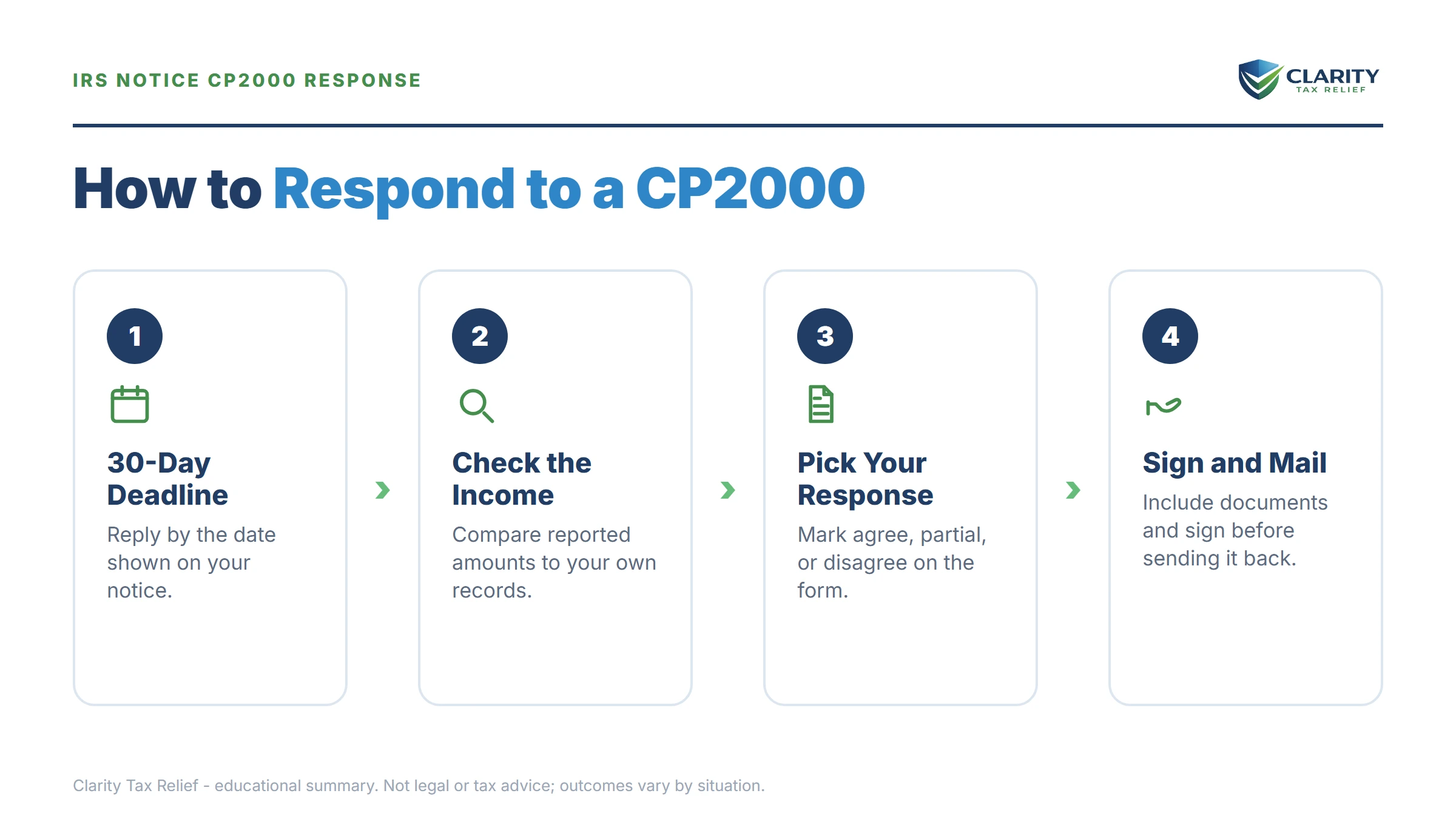
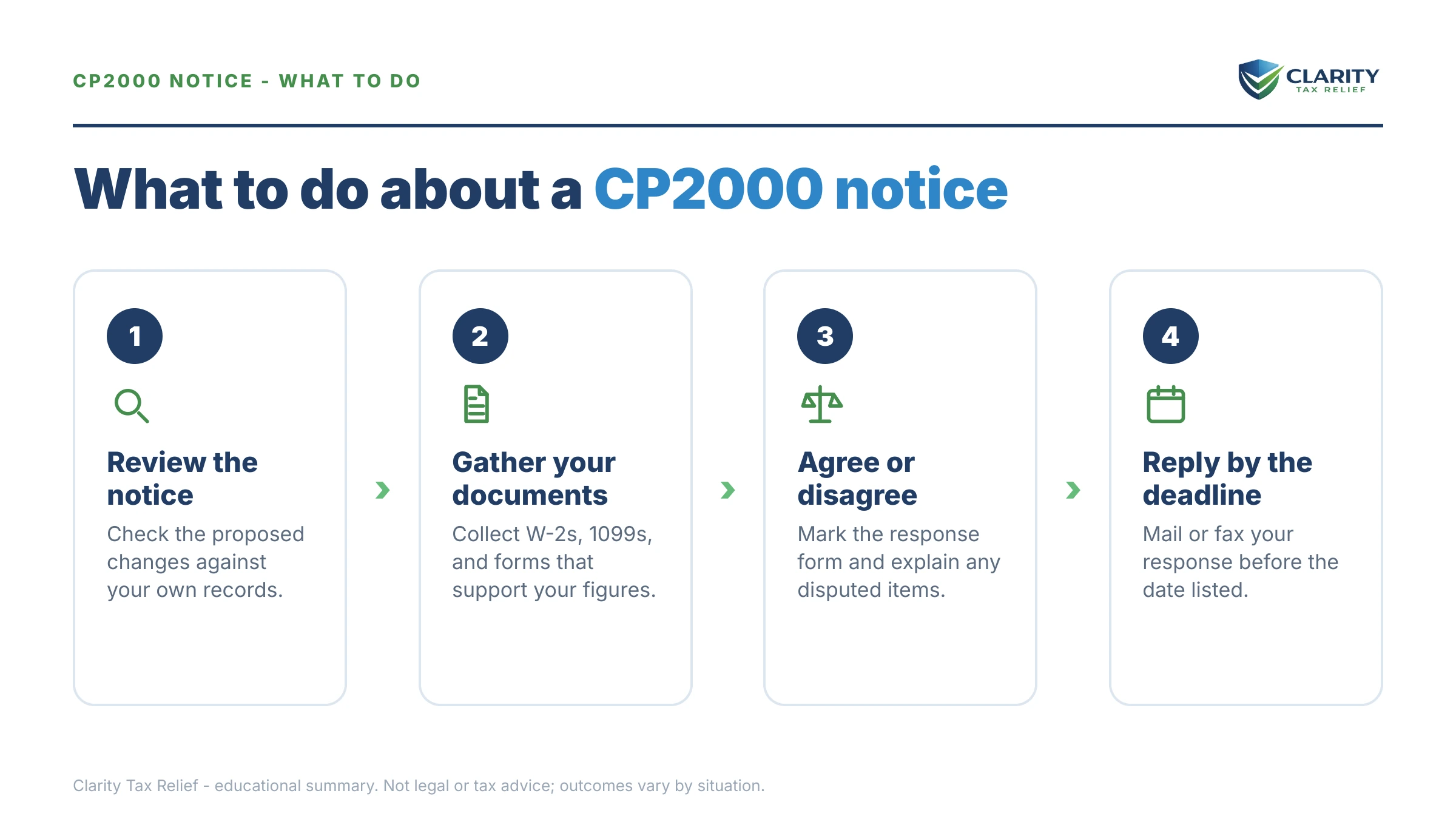
- Verify every item against your records. Pull your W-2s, 1099s, and brokerage statements and compare each line of the CP2000 to your filed return. The IRS is usually right that a document exists, but often wrong about the tax it produces.
- Choose your position on the response form. Mark full agreement, partial agreement, or full disagreement, and sign it. The form must accompany every response, and both spouses must sign on a joint return.
- Draft your letter from the matching sample. Quote the tax year, notice date, and AUR control number, explain each disputed item in one or two sentences with the correct figure, and list your enclosures.
- Attach copies of your proof. Send copies, never originals, and label each enclosure so the reviewer can tie it to a specific disputed item.
- Mail or fax it by the response date. Use the exact address or fax number printed on your notice, and send mail certified with a return receipt so you can prove it arrived on time.
- Pay the agreed portion and watch your transcript. Payment stops interest on the amount you concede, pay online at IRS.gov/payments, and code 922 activity on your account transcript shows the underreporter review progressing.
When you can handle a CP2000 yourself, and when help changes the outcome
Most single-item CP2000s are genuinely a do-it-yourself project. If your notice covers one document and your proof is clean (a brokerage statement showing basis, a return page showing the income was already reported), or you simply agree with everything, the samples above plus certified mail are all you need. There is no reason to pay anyone to check a box and photocopy a statement.
Experienced help earns its cost in specific situations: the notice covers self-employment income that needs a reconstructed Schedule C (expenses change both income tax and self-employment tax. A sloppy schedule invites follow-up questions). You've received CP2000s for multiple years. The mismatch involves crypto proceeds or an identity-theft 1099. The proposed amount is five figures. Or the CP3219A has already been issued and the 90-day Tax Court clock is running. And if the deadline passed and the tax was already assessed, the path shifts to audit reconsideration, a different process with its own rules.
If money is tight, you're not out of options either: Low Income Taxpayer Clinics represent qualifying taxpayers in exactly these disputes for free or a nominal fee, and the Taxpayer Advocate Service can step in when an IRS delay is causing you harm.
If your CP2000 involves self-employment income, crypto, more than one year, or a number you can't reconstruct, have an experienced tax professional draft the response before the printed date. Start with a free review or call (888) 825-7779.
CP2000 response letter questions, answered
How do I write a response letter to the IRS for a CP2000?
Open with your position (agree, partially agree or disagree), then identify the tax year, notice date, and AUR control number from page 1 of your CP2000. Address each disputed item in one or two sentences, state the correct figure, and list your enclosures. Include the signed response form and copies of your proof, and send everything to the address or fax number printed on the notice.
Can I just sign the CP2000 response form instead of writing a letter?
Yes, if you fully agree with every proposed change, signing and returning the response form is enough; no letter is required. A short cover letter still helps when you are also requesting a payment plan or asking for the accuracy-related penalty to be removed. If you dispute any item, though, the form alone gives the IRS nothing to review, that is when the letter and documentation decide the outcome.
Can the 20% accuracy-related penalty on my CP2000 be removed?
Often, yes. If your response lowers the unreported income, the 20% accuracy-related penalty recalculates automatically on the smaller tax. If you agree with the tax but the omission had a genuine cause, such as a 1099 that never reached you or reliance on wrong payer information, your letter can request removal for reasonable cause. Note that first-time penalty abatement does not cover the accuracy-related penalty, so reasonable cause is the argument to make.
How long does the IRS take to respond to a CP2000 letter?
Expect several weeks to a few months. The IRS workforce shrank roughly 27% in 2025, and underreporter correspondence is one of the slower queues in 2026. While you wait, watch your IRS account transcript: code 922 marks the underreporter review, and later entries show how it resolved. Paying the portion you agree with stops interest on that amount even while the disputed part is under review.
Where do I mail my CP2000 response letter?
Send it to the exact address or fax number printed on your CP2000, not to the address where you file returns. CP2000s are worked at specific Automated Underreporter campuses, and a response mailed elsewhere can sit unrouted while your deadline runs. Use certified mail with a return receipt, keep a complete copy of everything you send, and never mail original documents. Copies only.
Your next 24 hours
- Find three things on page 1 of your notice: the response date, the tax year, and the AUR control number. Write them at the top of a blank page, they're the skeleton of your letter.
- Gather the paper: your filed return for that year, every W-2 and 1099 you received, and any brokerage or account statement that touches the items the notice lists.
- Get a second set of eyes before you mail it. A free case review, the 2-minute form or (888) 825-7779, catches an overstated proposal before your response date passes, while the fix is still one letter instead of a Tax Court petition.
This guide is general information, not tax or legal advice for your specific situation. Eligibility for IRS programs depends on individual facts and circumstances; no outcome is guaranteed.