
IRS Notices
IRS CP21B Notice: What It Means and When Your Refund Arrives (2026)
What this episode covers
- What is IRS notice CP21B and why did I receive one?
- How long does it take to get a refund after a CP21B notice?
- Why is my CP21B refund smaller than the amount I claimed on my 1040-X?
- Is the refund or interest from an IRS CP21B notice taxable?
The short answer: a CP21B notice means the IRS made the change you requested to your tax return — usually from an amended return or a notice response — and you're due a refund. The refund typically arrives within 2–3 weeks of the notice date. If you agree with the change, no response is required.
You sent the IRS a Form 1040-X months ago — maybe to fix your filing status after the divorce was final, or to claim the dependent your decree gave you — and heard nothing. Now an IRS envelope shows up, your stomach drops. The letter inside is a CP21B: they agreed with you, and money is coming back.
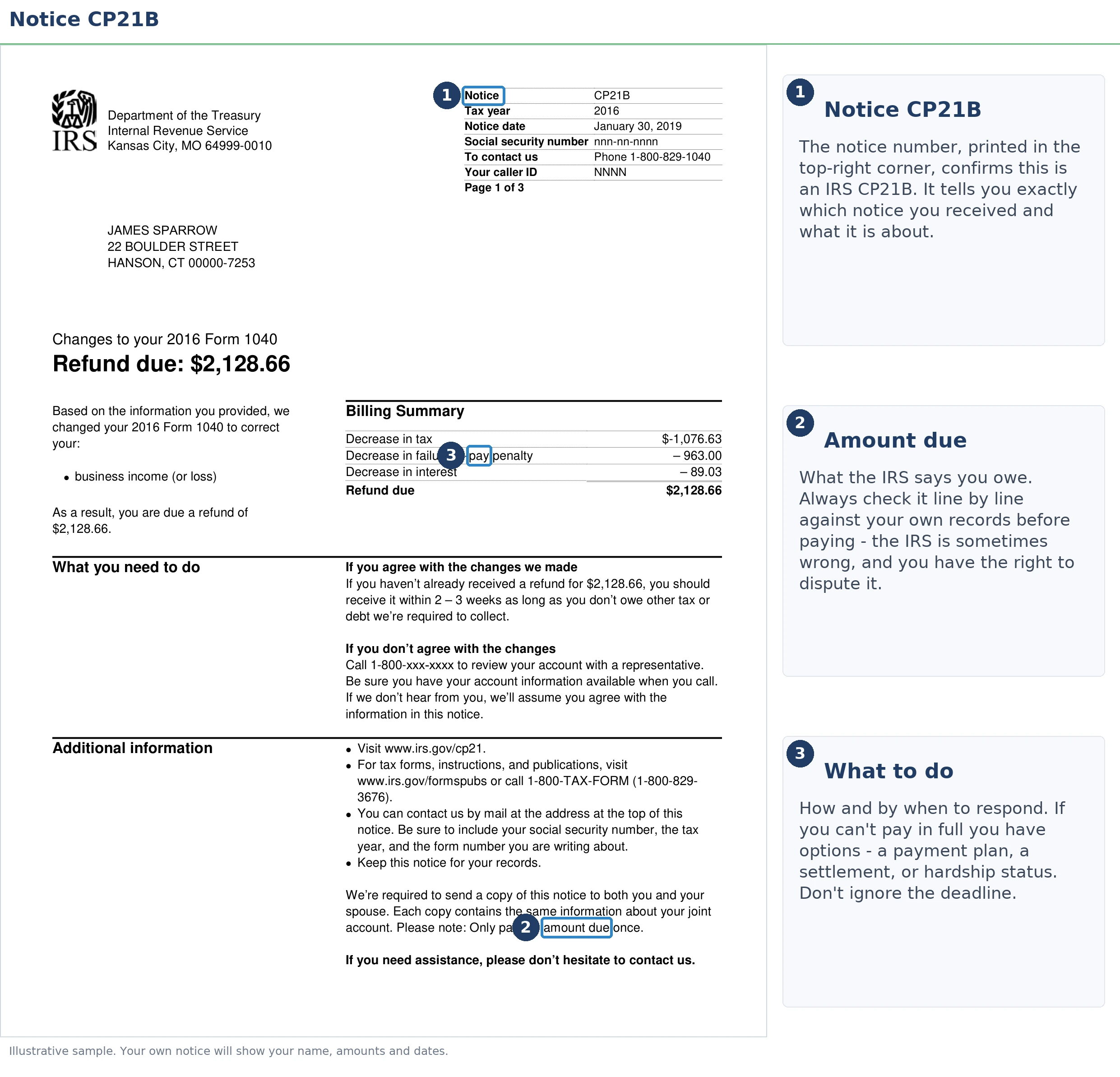
This is one of the few IRS notices that's genuinely good news. But it still deserves ten careful minutes, because CP21B refunds can be partial, can go to an old address, and can be intercepted for other debts before a dollar reaches you. The image below shows what a CP21B looks like and where the two numbers that set your timeline sit — the notice date and the refund total.
⏱ The real clock: your refund should typically arrive within 2–3 weeks of the date printed on your CP21B. Put a reminder on your calendar for three weeks out. If nothing has arrived by then, don't just keep waiting — check your account transcript for code 846 before assuming the money is on its way.
Why you got a CP21B notice
A CP21B is issued only when the IRS makes a change that you asked for and that change results in a refund owed to you. That's what separates it from every other adjustment letter: the IRS isn't correcting you — it's agreeing with you. The trigger is almost always one of these:
- An amended return (Form 1040-X) — the most common path. You amended to fix filing status, add a dependent or credit, or correct income, and the recalculation produced an overpayment.
- A response to an earlier notice — you answered an IRS letter with documentation, the IRS accepted your position. The adjustment swung the account into a refund.
- A phone or written request — you (or your representative) asked the IRS to move a misapplied payment or correct an account entry. The fix freed up money.
On your account transcript, the adjustment behind a CP21B usually posts as code 291 — tax reduced, followed later by code 846, the refund issued date. If you're not sure why the IRS mails what it mails, the broader decoder lives in our guide to why you got a letter from the IRS. This page covers only the CP21B itself.
One caution before you celebrate: if you never requested any change, treat the notice as a red flag, not a windfall. An adjustment you didn't ask for can signal a processing error, or someone filing paperwork on your account, and it's worth a call to the number on the notice to confirm what happened.
The CP21B is one of five near-identical letters in the same family. Here's how to be sure you're reading about the right one:
| Notice | Who asked for the change | Result | Your move |
|---|---|---|---|
| CP21B | You did | Refund due to you | Verify the numbers, then watch for the refund (this guide) |
| CP21A | You did | You now owe a balance | Pay or arrange payment by the notice date |
| CP21C | You did | No balance due either way | File it with your records; nothing owed, nothing coming |
| CP21E | An audit did | You owe from exam changes | Review the exam adjustments; appeal rights may apply |
| CP22A | You did (different processing path) | You owe a balance | Same playbook as CP21A |
Also don't confuse the CP21B with a math-error notice. If the IRS changed your return on its own and increased your refund, that's a CP12 notice. If its own correction created a balance due, that's a CP11 notice. Those carry a formal window to dispute the IRS's math. A CP21B carries no such fight by default — the IRS did what you asked.
A worked example: how an $11,300 CP21B happens
Say your divorce was finalized in November, so you were unmarried on December 31 and had your daughter more than half the year. You filed as single in a rush, then later amended on Form 1040-X to head of household, adding your daughter as a dependent per the decree, plus the child tax credit and the child-care credit.
The hypothetical math: your original return showed $15,900 in total tax, fully covered by $14,800 of withholding plus $1,100 you paid when you filed. The amended return recalculates your tax at $4,600 — the head-of-household brackets and the two credits do the work. Overpayment: $15,900 − $4,600 = $11,300.
Months later the CP21B arrives confirming the IRS accepted the amendment and that $11,300 (often plus a separate line of interest the IRS owes you for holding the money) is being refunded. That interest line matters — it's taxable next year, which we'll cover below.
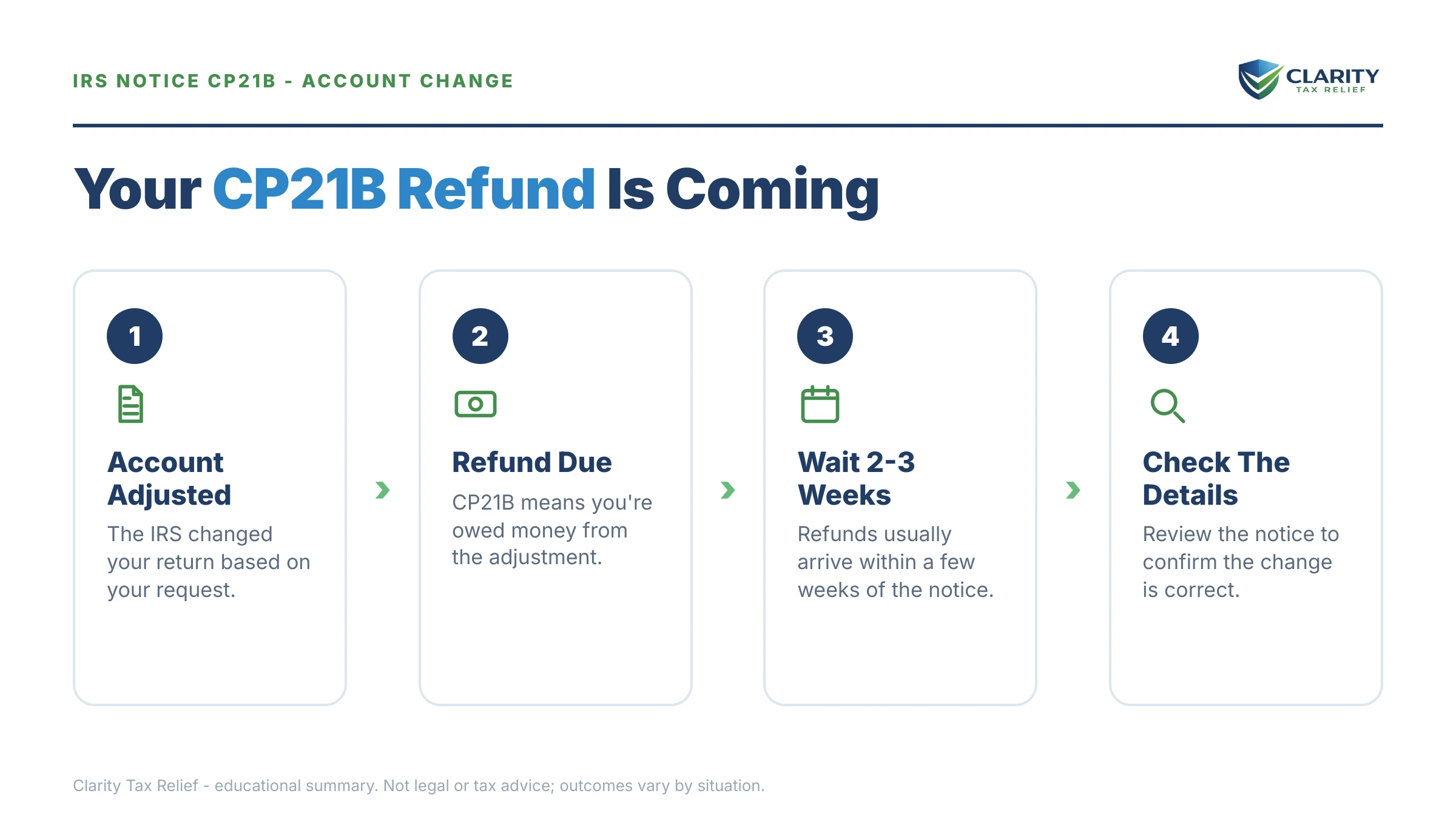
“We sent you this notice because we made the changes you requested to your tax return for the tax year specified on your notice. You should receive your refund within 2-3 weeks of your notice.”
— Understanding your CP21B notice (IRS.gov)
What happens if you ignore a CP21B notice
Nothing bad happens immediately if you ignore a CP21B. But a refund left unwatched can quietly disappear into an old address, an expired check, or an offset you never see coming. Here's the sequence when a CP21B goes unattended:
- Weeks 0–3: the refund is issued. Amended-return refunds frequently come as paper checks rather than direct deposit, so the money travels through the mail to the address the IRS has on file.
- The check chases your old address. If you moved out of the marital home after filing and never submitted Form 8822 (change of address), the check may land in a mailbox you no longer control.
- An uncashed check goes stale. U.S. Treasury checks expire after one year. If yours dies in a drawer, the IRS eventually sends a CP32A notice about the expired refund check — recoverable, but months of extra waiting.
- Offsets absorb it silently. If you owe another federal tax year, the refund is applied there first — you'd see a CP49 notice that your refund was applied to back taxes. Non-tax debts (child support, defaulted student loans, state tax) can intercept it through the Treasury Offset Program.
- Unreported refund interest resurfaces later. The interest the IRS adds to your refund is taxable. Toss the notice, forget the 1099-INT, and the mismatch can generate a small but annoying underreporter letter a year or two out.
None of this is a levy or a lien. This is your money, not a debt. But in 2026, with IRS phone lines thinner than ever after the staffing cuts, untangling a lost or offset refund can take far longer than preventing the problem this week.
Refund missing, short, or headed toward an ex's debt?
Send us your CP21B and your 1040-X. An experienced tax professional will trace where the refund actually went, check for offsets, and map the fastest path to the money you're owed — free and confidential.
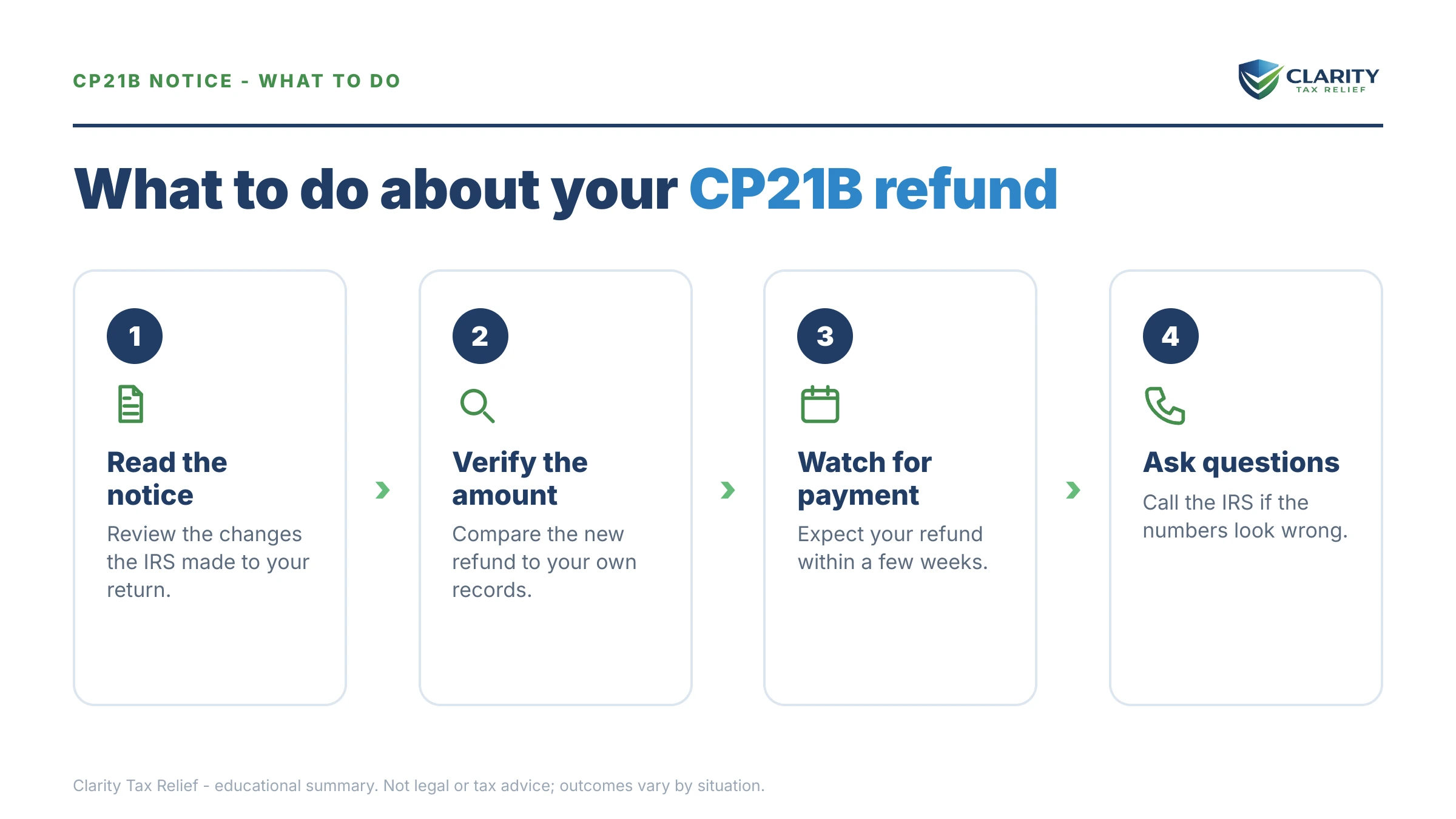
Your options after a CP21B: agree, disagree, or chase a missing refund
A CP21B puts you in one of four positions, and each has a different playbook.
You agree and the numbers match. Do nothing except protect the delivery: confirm your current address is on file, calendar three weeks out, and keep the notice. This is the outcome for most readers.
You agree. But the amount is smaller than your 1040-X claimed. The IRS sometimes allows part of an amendment and disallows the rest, or nets your refund against recalculated penalties and interest. Compare the adjustment section against your 1040-X line by line. If the gap isn't explained on the notice, call the toll-free number printed on it, and follow up in writing if the call doesn't resolve it, keeping copies of everything.
You disagree with the change entirely. Rare on a CP21B, since you requested the change. But it happens when the IRS applies your request to the wrong year or misreads what you asked for. Call promptly; a misapplied adjustment is far easier to unwind before the refund cycle completes.
The refund never shows. Work the timeline below in order — most "missing" CP21B refunds are actually slow checks, silent offsets, or stale addresses, each with a different fix.
| Stage | Typical timing | What to do |
|---|---|---|
| Notice arrives | Day 0 (the printed notice date) | Verify the adjustment matches your request; confirm your address with the IRS |
| Refund issued | Typically within 2–3 weeks | Watch your bank account and mail; paper checks trail direct deposits |
| No refund yet | ~3 weeks after the notice date | Pull your account transcript: code 846 = sent; a CP49 or offset code = intercepted |
| Still nothing | ~6+ weeks after the notice date | Call the number on the notice; if a check was issued but never arrived, request a refund trace with Form 3911 |
| Interest reporting | Next January | If the IRS paid you $10+ in refund interest, expect a Form 1099-INT — report it on that year's return |
Two divorce-specific traps deserve their own warning. First, if the amended year was a jointly filed return, the refund check is generally issued in both names, and typically needs both signatures, ex-spouse cooperation included. Second, if an offset grabbed your refund for a debt that is solely your ex's (their student loan, their pre-marriage tax year), Form 8379, the injured spouse allocation, exists to claw back your share.
And if you filed the 1040-X recently and are wondering why the CP21B took so long in the first place, that's normal — amended returns run on their own slow track, covered in where's my amended return.
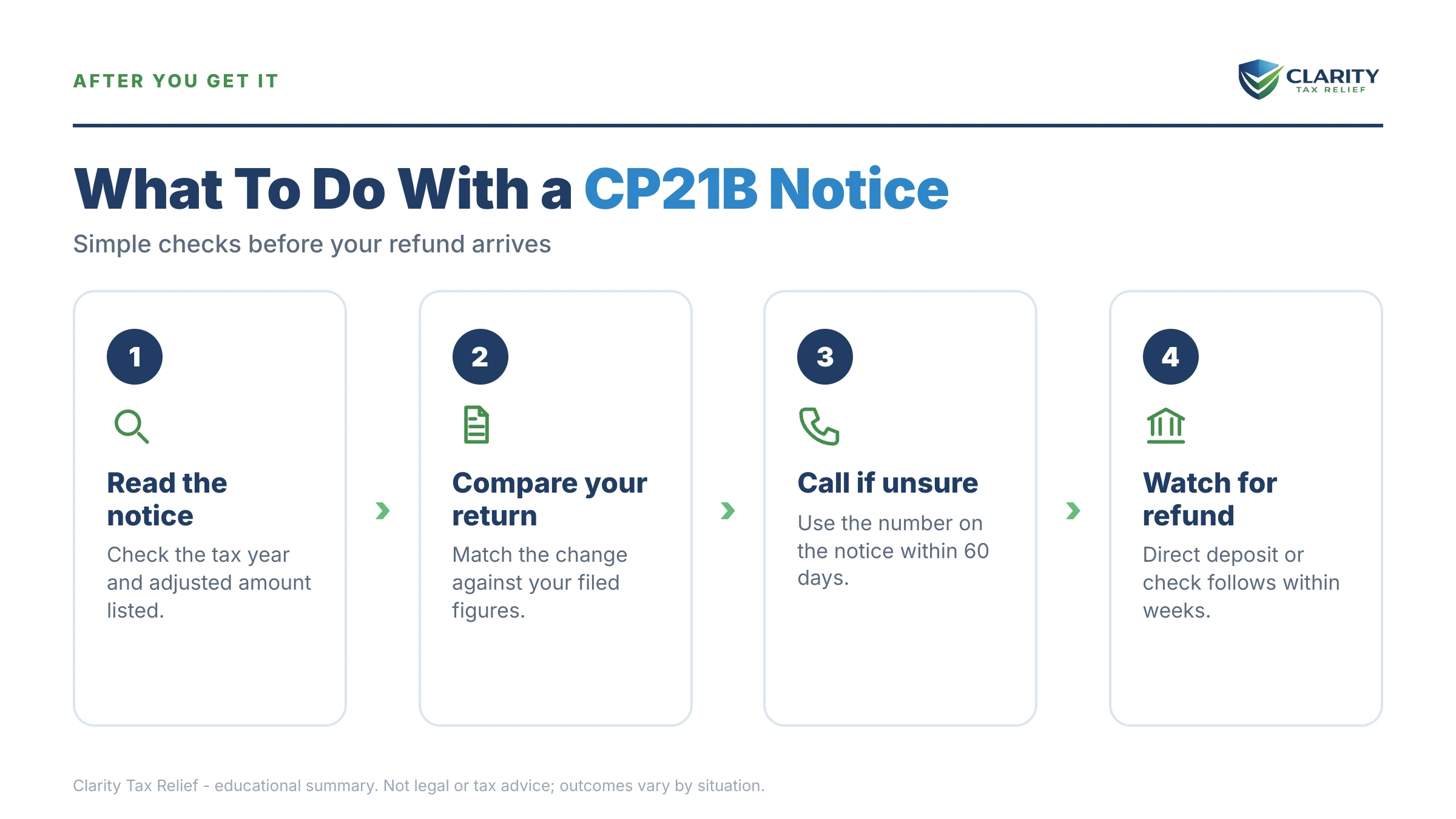
How to respond to a CP21B notice, step by step
- Verify the change — compare the adjustment section of the notice, line by line, against the Form 1040-X or notice response you sent. The change should match what you asked for.
- Confirm your address and bank details — many CP21B refunds arrive as paper checks. If you've moved since you filed, submit Form 8822 immediately so the check follows you.
- Calendar the refund window — mark the date three weeks after the notice date; that's when a typical CP21B refund should have arrived.
- Check your transcript if nothing arrives — pull your IRS account transcript and look for code 846 (refund issued) or offset codes showing the money went somewhere else.
- Call the number on the notice if anything is off — disagree with the adjustment, see a partial amount, or find an offset you don't recognize? Call the toll-free number printed on the CP21B before the adjustment settles in.
- File the notice with your tax records — you'll need it to reconcile the Form 1099-INT the IRS may send next January for interest paid on your refund.
When you can handle a CP21B yourself, and when help changes the outcome
Most people should handle a CP21B entirely on their own. If the adjustment matches your request, your address is current. The refund lands inside three weeks, there is nothing a professional can add — agree, deposit, done. That's the honest answer, and it covers the large majority of these notices.
Experienced help earns its cost in a narrower set of situations: the refund was offset to a jointly filed year or an ex-spouse's debt and you need an injured spouse allocation built correctly. You amended multiple years and the notices, offsets, and interest lines no longer reconcile. A two-name check is stuck between uncooperative ex-spouses. Or the IRS allowed only part of your amendment and you need to press the disallowed portion with documentation. Those cases turn on paperwork sequencing and persistence with an understaffed agency — exactly where a professional's time saves months of yours.
Terms on your CP21B, decoded
- Adjustment — the specific change the IRS made to your account at your request; it's itemized in the middle section of the notice.
- Overpayment — the amount you paid beyond your corrected tax; on a CP21B, this is the refund headed your way.
- Overpayment interest — interest the IRS pays you for the time it held your money. It appears as its own line and is taxable income when received.
- Offset — the government applying your refund to another debt (another tax year, child support, student loans, state tax) before paying you.
- Code 291 — the transcript entry showing your tax was reduced; it's the engine behind the CP21B.
- Code 846 — the transcript entry showing a refund was actually issued, with the exact date it left the Treasury.
CP21B notice FAQs
What is an IRS CP21B notice?
A CP21B notice means the IRS made the change you requested to your tax return — usually from an amended return or a notice response — and you're due a refund. The refund typically arrives within 2–3 weeks of the notice date. If you agree with the change, no response is required.
How long after a CP21B notice will I get my refund?
Typically two to three weeks from the date printed on the notice. Direct deposit arrives faster; paper checks, common for amended-return refunds, take longer, especially if you've moved. If nothing arrives about three weeks after the notice date, pull your IRS account transcript and look for code 846, which shows the exact date a refund was actually sent.
Why did I get a CP21B notice from the IRS?
Because the IRS made a change you (or your tax professional) asked for — most often an amended return on Form 1040-X, but sometimes a written or phone response to an earlier notice — and the change produced an overpayment. CP21B is the IRS confirming the adjustment and telling you a refund is on the way. If you never requested any change, call the number on the notice, because an adjustment you didn't ask for needs to be verified.
What if I never receive my CP21B refund?
First check your IRS account transcript for code 846 (refund issued) and for any offset codes. If a refund was issued but never reached you, request a refund trace with Form 3911 — the IRS can cancel a lost or stolen check and reissue it. If no refund was ever issued, call the number on your notice; the money may have been applied to another balance on your account.
Is the refund on my CP21B notice taxable?
The refund itself is not taxable — it's your own overpaid tax coming back. But any interest the IRS adds on top is taxable income for the year you receive it. If the interest is $10 or more, the IRS will send you a Form 1099-INT the following January, and you'll need to report that interest on that year's return.
Can the IRS keep my CP21B refund for other debts?
Yes. Before anything reaches you, the refund is applied to any other federal tax balance you owe. The Treasury Offset Program can take it for past-due child support, defaulted federal student loans, or state tax debts. You'll get a separate notice explaining any offset. If the debt belongs solely to an ex-spouse from a jointly filed year, Form 8379 (injured spouse allocation) may recover your share.
What if the CP21B refund amount doesn't match my amended return?
Compare the notice's adjustment section line by line with your Form 1040-X. The IRS sometimes allows part of a requested change and disallows the rest, or nets the refund against recalculated penalties and interest. If the difference isn't explained on the notice, call the number printed on it as soon as possible, and put your disagreement in writing if the phone call doesn't resolve it.
Will my CP21B refund check have my ex-spouse's name on it?
If the adjusted year was a jointly filed return, yes — refunds on joint returns are generally issued in both names, even if you have since divorced. Both signatures are typically needed to cash or deposit the check. If cooperation is a problem, contact the IRS using the number on the notice to ask about your options before the check goes out.
Is a CP21B notice a scam?
A genuine CP21B arrives by postal mail and never asks you to pay a fee to release your refund. The IRS will not email, text, or call demanding personal or bank information in order to send you money. Verify it yourself by logging into your IRS online account, if the account shows the same adjustment and pending refund, the notice is real.
Your next 24 hours
- Find two numbers on the notice: the notice date (top right) and the refund amount in the adjustment summary. Put a reminder on your calendar for three weeks after that date — the point where a quiet mailbox becomes a problem worth chasing.
- Gather your paper trail: the CP21B, your Form 1040-X or notice response. The original return for that year — everything you'd need to reconcile the numbers or prove your claim.
- If the amounts don't match, the refund is at risk of an offset, or a joint-year check is tangled up with your ex — get a free case review at the 2-minute form or call (888) 825-7779 before a slow problem becomes a stale one.
Primary sources: the IRS's official page, Understanding your CP21B notice. The IRS Where's My Amended Return tool for tracking the 1040-X behind your notice. And the Taxpayer Advocate Service if a long-overdue refund is causing financial hardship.
This guide is general information, not tax or legal advice for your specific situation. Eligibility for IRS programs depends on individual facts and circumstances; no outcome is guaranteed.