
IRS Notices
IRS CP220 Notice: Why the IRS Changed Your Business Return, and What to Do (2026)
The short answer: a CP220 notice means the IRS changed a business tax return after a review and has already assessed the result, usually a balance due. The change is on the books, not just proposed. Pay, arrange payment, or start a dispute by the "pay by" date printed on the notice, before penalties compound.
The envelope is addressed to a business — maybe your company, maybe the EIN of a side venture you barely think about anymore — and the letter says the IRS "made changes to your tax return." There's a number you never calculated and a pay-by date you didn't choose. Take a breath: a CP220 is a bill with a paper trail, and paper trails can be checked, disputed, and negotiated.
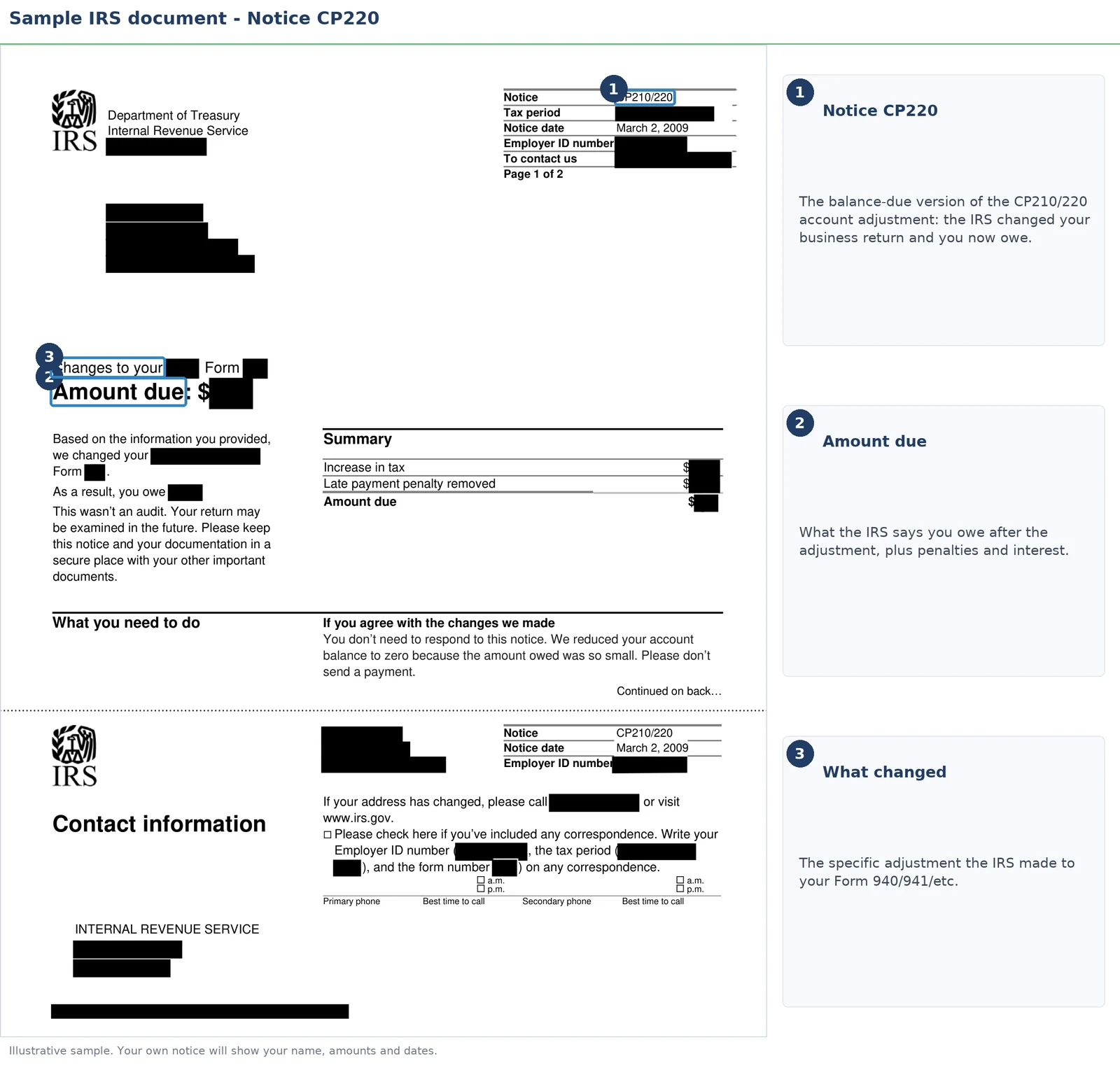
Two sections of the notice control everything — the "changes to your tax return" list and the pay-by date. The image below shows exactly what a CP220 looks like and where to find both, along with the tax form and period the changes apply to.
⏱ Your deadline: the "pay by" date printed on your CP220. That exact date controls. There is no separate statutory window for a CP220 itself, but after that date the failure-to-pay penalty (0.5% per month) and daily-compounding interest keep growing, and the IRS's automated system queues the next collection notice.
Why the IRS sent you a CP220 notice
A CP220 notice means the IRS adjusted a business tax return after processing or review and has already posted the result to the account. It is not a question and it is not a proposal — the adjustment is already assessed. That single fact separates a CP220 from notices like the CP2000, which propose changes and wait for your answer. With a CP220, you are past the proposal stage; your moves are payment, abatement, or correction.
The most common triggers we see in 2026:
- A processed Form 941-X. You (or a promoter) filed an amended payroll return, often an Employee Retention Credit claim. The IRS processed it differently than filed, reduced it, or reversed it after examination.
- A penalty assessment. Failure-to-deposit penalties on payroll deposits are the classic CP220 driver: deposits made late, in the wrong amount, or applied to the wrong quarter.
- An examination adjustment. An exam of a 941, 940, 1120, or 1065 closed with changes. The CP220 is the bill that follows the exam report.
- A misapplied deposit or credit. Federal tax deposits posted to the wrong period can make one quarter look overpaid and another look short — the CP220 reflects the IRS's correction.
- An amended business return you filed that the IRS adjusted during processing.
Check the addressee line. A CP220 goes to the entity's EIN, not your Social Security number. If you're a W-2 employee staring at one, it's almost certainly tied to a business you own or once operated — an LLC, a short-lived venture with one employee, or an ERC claim filed under your company's name. If the IRS changed your personal 1040 instead, you're looking at a CP11 notice (balance due) or CP12 notice (refund) — different notices, different playbooks.
Two more lookalikes worth ruling out: a CP210 notice is the same adjustment family but usually reports a refund or no change. A CP161 notice is a business balance due without any changes. You filed, you didn't pay in full, and the IRS is billing what you reported. For the broader map of how IRS letters fit together, see why did I get a letter from the IRS.
One special case deserves its own flag: CP220J. Despite the similar number, it's not a return adjustment at all. It demands the Affordable Care Act employer shared responsibility payment and follows a Letter 226-J you either agreed to or never answered. If your notice has the "J," that's the article chain you need.
What happens if you ignore a CP220 notice
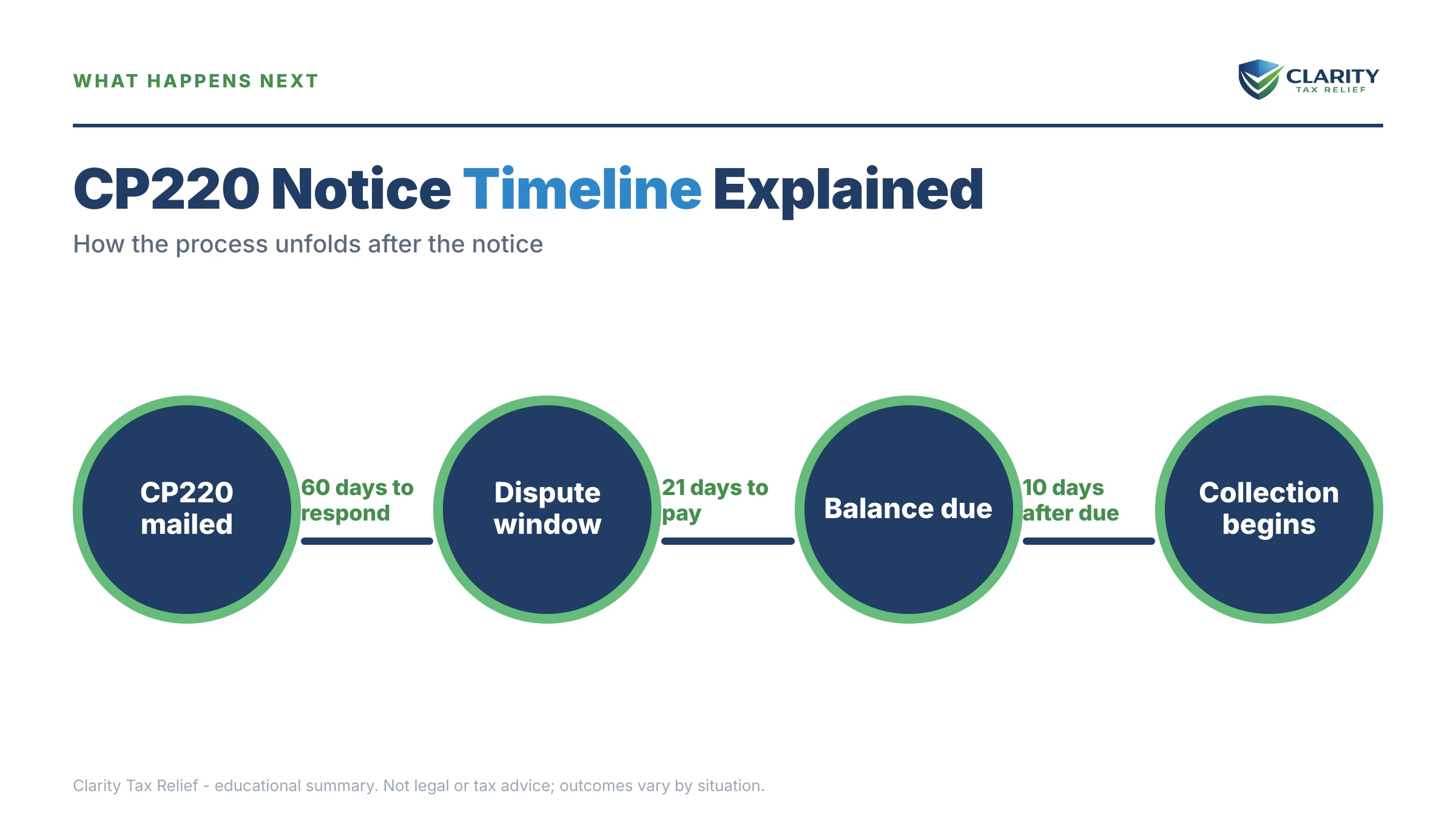
An unpaid CP220 balance feeds the same automated collection sequence that ends in levies on business bank accounts and receivables. The system doesn't care that the balance came from an adjustment rather than an unpaid return — once assessed, it collects like any other debt, and each stage arrives with more interest attached and more enforcement power behind it:
- CP220 — the adjustment is assessed and billed. You are here. No enforcement yet, and every resolution option is still open.
- Reminder notices (CP163 and similar) — the balance is restated with added interest and failure-to-pay penalty. Still just bills, but the number is climbing every month.
- CP504B notice — the business version of the intent-to-levy notice. The IRS can now seize a state tax refund owed to the business, and a federal tax lien becomes a realistic next step.
- CP297A notice or Letter 1058 — the final notice of intent to levy. This starts a 30-day clock and your Collection Due Process rights (requested on Form 12153). Miss the window and the IRS can levy without further warning.
- Levy — business bank accounts (funds are held 21 days before they leave), accounts receivable, and other assets. Releases are possible, but far harder than prevention.
Don't count on the 2026 staffing situation to save you. The IRS workforce shrank roughly 27% in 2025, which makes a human harder to reach. But the notices, liens, and levies in this sequence are generated by automated systems that never stopped running. The machine escalates on schedule whether or not anyone reads your file.
| Stage | What it means | Your window |
|---|---|---|
| CP220 | Changes assessed to the business account; bill issued | The "pay by" date printed on the notice |
| Reminder notices (e.g., CP163) | Balance restated with added penalty and interest | No enforcement yet, but the balance grows monthly |
| CP504B | Intent to levy; IRS can take the business's state tax refund | Respond before the date printed on that notice |
| CP297A / Letter 1058 | Final notice of intent to levy, with appeal rights | 30 days to request a Collection Due Process hearing (Form 12153) |
| Levy | Bank accounts (21-day hold), accounts receivable, other assets | Release is possible but requires proving hardship or arranging resolution |
Holding a CP220 with a balance you didn't expect?
Send us a photo of it before the pay-by date on the notice passes. An experienced tax professional will decode exactly what the IRS changed, whether it's right, and which option costs you the least — free, confidential, no pressure.
Your options for a CP220 balance
The IRS accepts far more than the two choices printed on the notice — payment plans, penalty abatement, dispute, and hardship status all apply to CP220 balances. Which one fits depends on two questions: is the change actually correct, and can the money be paid?
| Option | Typically fits when | Cost and notes |
|---|---|---|
| Pay in full by the notice date | The change is correct and cash can cover it | Stops the failure-to-pay penalty and interest immediately; ends the notice sequence |
| Installment agreement | The change is correct but cash flow can't absorb it at once | Setup fees vary; interest and penalties continue while you pay; larger business balances require Form 433-B financials — see business irs installment agreement |
| Penalty abatement | Penalties drove the balance and you have a clean 3-year history (first-time abatement) or a genuine reasonable cause | Free to request; from summer 2026, Automatic Exemption from Penalty (AEP) grants similar relief with no request — see 941 penalty abatement |
| Dispute the adjustment | The IRS's change is wrong and you have documentation | Free; interest keeps accruing on any amount ultimately upheld, so move fast |
| ERC-specific paths | The CP220 reverses an Employee Retention Credit claim | Appeal, documentation response, or repayment terms — see erc claim disallowed |
| Hardship / currently not collectible | Any payment would prevent basic living or operating expenses | Collection pauses, but the debt and interest remain; the IRS reviews the account periodically |
Two notes on the fine print. First, penalty relief is means-tested by history and facts, not automatic just because you ask, but it's real money: on many CP220s, penalties and interest are a third or more of the total. You can estimate how much of your balance is penalty versus tax with our IRS Penalty & Interest Calculator. Second, if your CP220 stems from an ERC claim a promoter filed, ask about disclosure and repayment programs before agreeing to anything — when a window is open, the erc voluntary disclosure program can change the math significantly. The terms depend on timing.
What a $48,300 CP220 actually costs: a worked example
Say you're a W-2 employee, filing single, who ran a small side LLC with one part-time employee during the pandemic years. A promoter filed Employee Retention Credit claims for the business. The IRS examined them, reversed the credits, and a CP220 arrives showing $48,300. Here's a typical breakdown (hypothetical numbers, math shown):
- Reversed ERC: $38,500
- 20% accuracy-related penalty: $38,500 × 0.20 = $7,700
- Interest to date: $2,100
- Total assessed: 38,500 + 7,700 + 2,100 = $48,300
Now the options, priced. Paying in full by the notice date costs $48,300 and stops every further charge. If the balance qualifies for a payment plan spread over 72 months, that's roughly $48,300 ÷ 72 ≈ $671 a month, though interest and the reduced ongoing penalty continue, so the true payoff runs higher and finishing early saves real money.
The dispute path changes the math more. If you can show reasonable cause for the accuracy penalty — you relied in good faith on a promoter who claimed to be a specialist — removing the $7,700 penalty drops the balance to roughly $40,600 before interest recalculation. And if the underlying eligibility fight has merit, an appeal of the ERC reversal itself is worth pricing out before you sign anything. This is exactly the kind of notice where the order of moves (penalty first, appeal second, plan third) determines what you ultimately pay.
If you disagree with the CP220 changes
You can dispute a CP220 even though the change is already assessed. But you do it by requesting correction or abatement, not by replying to a proposal. That distinction matters because it puts the burden on you to prove the IRS's adjustment is wrong.
Start with the "changes" section and match it against your records: the return as filed, deposit confirmations, any 941-X. The business account transcript for that period. If a deposit was applied to the wrong quarter, proof of the payment date and amount usually resolves it. If the change came from an examination you didn't meaningfully participate in, audit reconsideration lets the IRS reopen the findings when you present new documentation. If only the penalties are wrong, request abatement in writing or with Form 843.
Whatever the route, respond in writing to the address on the notice, keep copies of everything, and don't let a pending dispute lull you into ignoring the collection notices that follow — the collection side of the IRS doesn't automatically pause because the adjustment side is reviewing your letter. If notices keep escalating while a legitimate dispute sits unanswered, the Taxpayer Advocate Service exists for exactly that squeeze.
How to respond to a CP220 notice, step by step
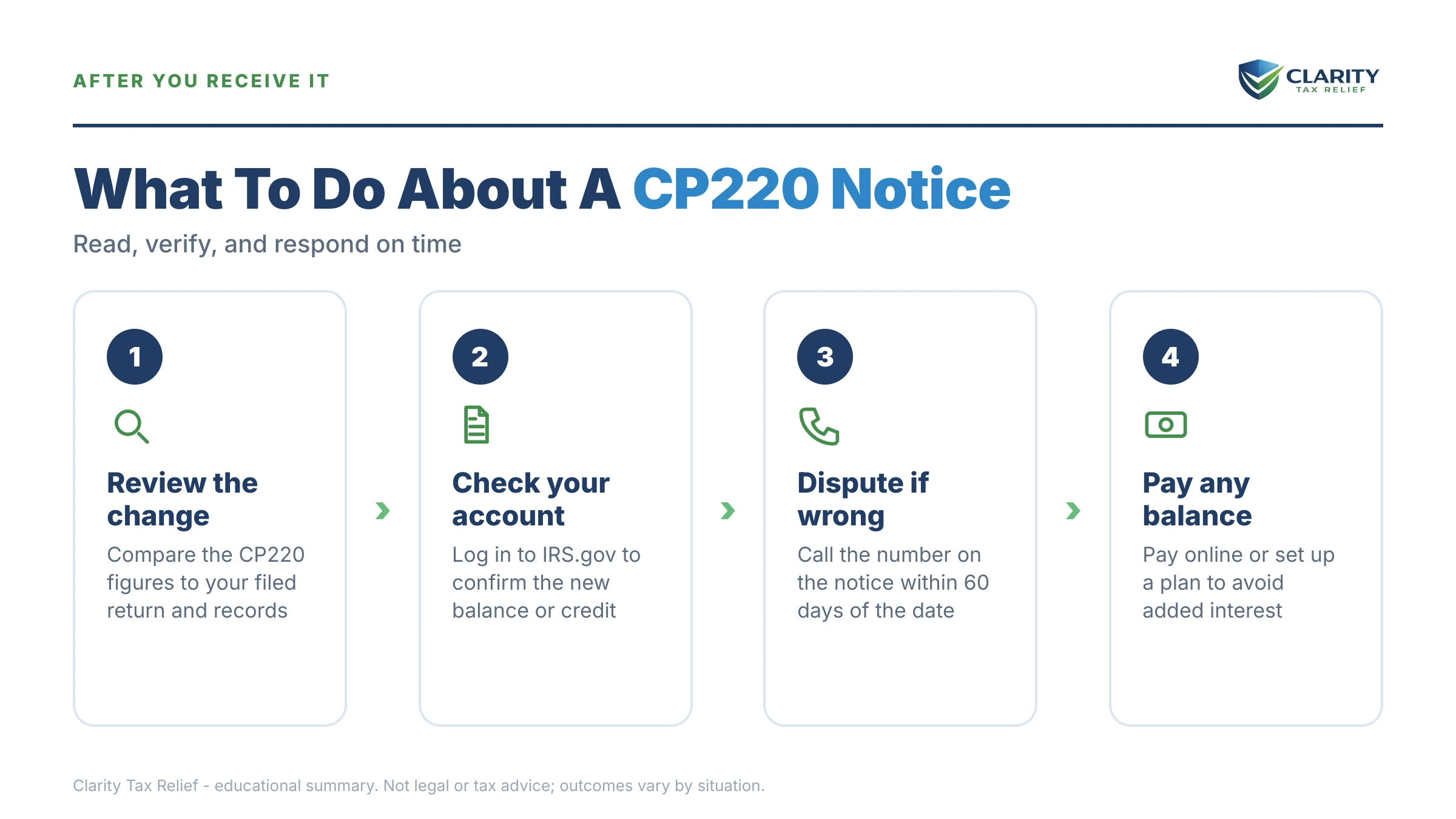
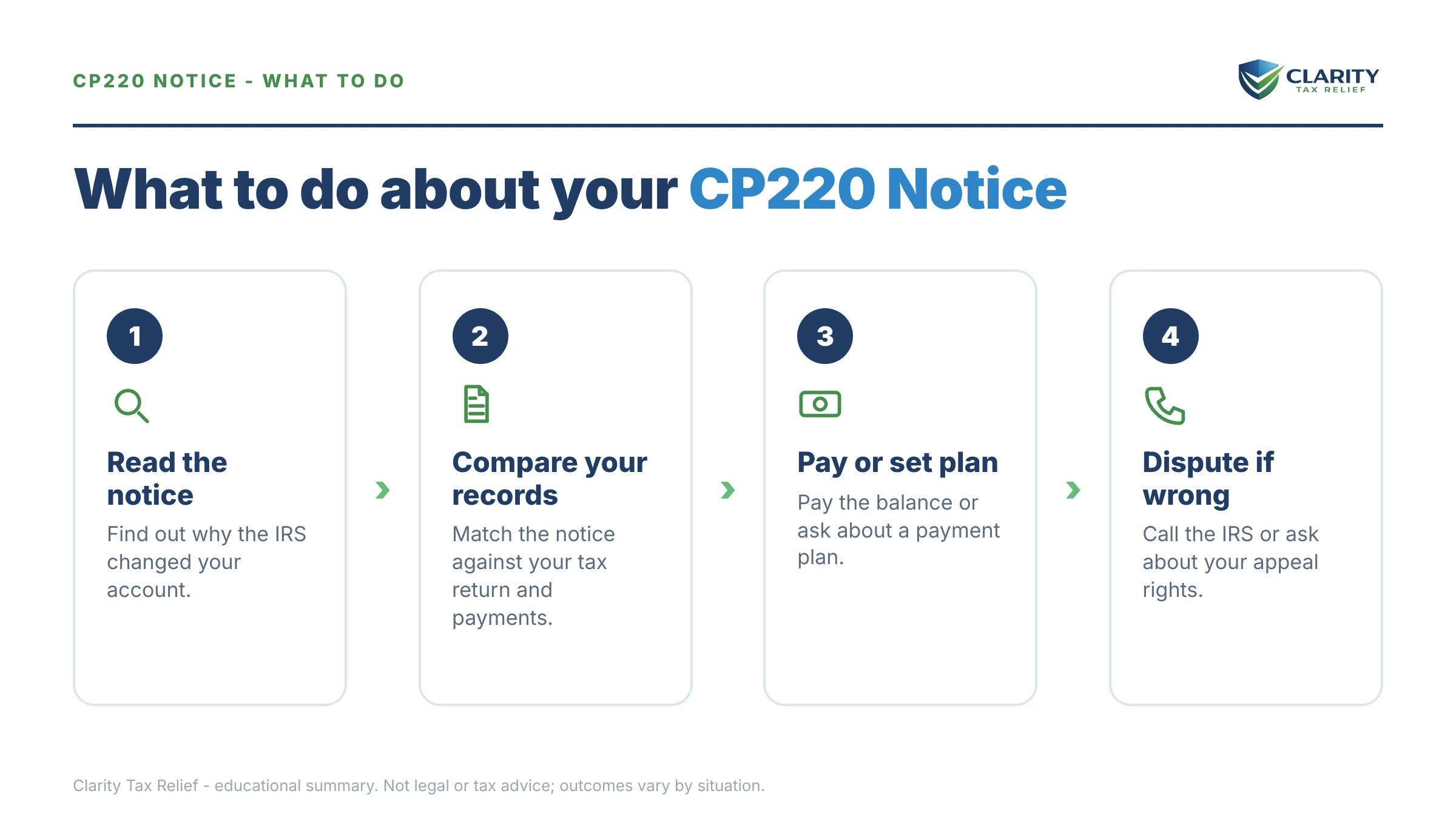
- Find what changed. Read the "changes to your tax return" section of the CP220 and note the tax form, the tax period, and each adjustment line.
- Pull the account transcript. Get the business account transcript for that exact period from the IRS and compare the assessed amounts against your filed return and payment records.
- Decide: agree or dispute. If the change is correct and you can pay, pay by the date on the notice at IRS.gov/payments. If it is wrong, gather the documents that prove it.
- Respond in writing if you disagree. Send a written explanation with supporting documents to the address on the notice (or call the listed number), and request penalty abatement where it applies.
- Set up payments before escalation. If you cannot pay in full, request an installment agreement or other resolution now, before the CP504B and final-notice stages remove your leverage. Plan details and thresholds are on the IRS payment plans page.
When you can handle a CP220 yourself
You do not need professional help for every CP220. Handle it yourself when the change is small, you can see exactly why the IRS made it. You can pay by the notice date, or when the balance is a single penalty and the business has a clean three-year history, since a first-time abatement request is often one phone call. Setting up a straightforward payment plan on a modest balance is also well within reach.
Experienced help changes outcomes in a different set of situations: a five-figure ERC reversal with penalties attached, payroll tax periods where trust-fund exposure could make the debt personal, multiple periods adjusted at once, a revenue officer already assigned, or a CP504B or final notice that arrived while you were still deciding what to do. In those cases, the sequencing of appeals, abatement, and payment terms is where the money is won or lost, and mistakes at this stage are expensive to unwind.
Terms on your CP220, decoded
- Assessment — the formal recording of a tax, penalty, or interest on your account; once assessed, the IRS can bill and eventually collect it.
- Tax period — the specific quarter or year the changes apply to (for payroll, each quarter is its own account — check which one the CP220 names).
- Failure-to-deposit penalty — the penalty for payroll deposits made late, short, or to the wrong period; a frequent line item behind CP220 balances.
- Trust fund taxes — the income tax and employee FICA withheld from paychecks; if unpaid, this portion can be assessed against responsible individuals personally.
- Collection Due Process (CDP) — the formal appeal right that opens with a final levy notice. You request it on Form 12153 within 30 days.
- CSED — the collection statute expiration date, generally 10 years from assessment, after which the IRS can no longer collect (certain events pause the clock).
CP220 notice questions, answered
Is a CP220 notice an audit?
No — a CP220 is an adjustment notice, not an audit letter. It tells you the IRS already changed something on your business account and assessed the result, which can happen after a review, a processed amendment, or a penalty calculation. If an examination did trigger the change, the exam is over; the CP220 is the bill that follows it.
What is the difference between a CP210 and a CP220 notice?
Both announce that the IRS changed a business tax return. In practice, a CP210 usually reports an adjustment that results in a refund or no change, while a CP220 usually reports a change that leaves a balance due, often a penalty assessment or an adjustment after IRS review. Read the "changes to your tax return" section either way; what was changed matters more than the notice number.
Do I have to pay a CP220 if I disagree with it?
Not immediately, but the clock is not on your side. The amount is already assessed, so interest and the 0.5% monthly failure-to-pay penalty accrue while you dispute it. Contact the IRS at the number on the notice with documentation, and if the balance is large, some taxpayers pay first and then request penalty refunds on Form 843. That stops the accrual while the dispute is decided.
Can the penalties on a CP220 be removed?
Often, yes. If the business has a clean filing and payment history for the prior three years, first-time abatement can remove eligible penalties with one request, and starting in summer 2026, the IRS's Automatic Exemption from Penalty (AEP) applies similar relief automatically, with no request needed. Reasonable cause (illness, disaster, reliance on bad professional advice) is a separate path that can work even without a clean history.
Is a CP220 balance my personal debt or the business's?
It depends on the entity. If you operate as a sole proprietor or single-member LLC, the debt is effectively yours. If it's a corporation or multi-member entity, the entity owes it. But the trust-fund portion of unpaid payroll taxes can be assessed against you personally through the Trust Fund Recovery Penalty if you controlled where the money went.
What is a CP220J notice?
A CP220J is a different notice: it demands payment of the Affordable Care Act employer shared responsibility payment. It follows a Letter 226-J proposal you either agreed to or never answered. If you received a CP220J and never responded to the 226-J, act quickly — the assessment is already on the books and your dispute options are narrower than they were at the proposal stage.
What happens if I ignore a CP220 notice?
The balance moves into the automated collection sequence. Reminder notices come first, then a CP504B intent-to-levy notice, then a final notice that opens a 30-day window before the IRS can levy business bank accounts and accounts receivable. Interest and the 0.5% monthly failure-to-pay penalty accrue the entire time, so the balance you ignore is never the balance you eventually pay.
Can I set up a payment plan for a CP220 balance?
Yes. Businesses can request installment agreements, though the thresholds and paperwork differ from individual plans — larger balances usually require financial disclosure on Form 433-B. Sole proprietors can often resolve the balance alongside their personal account. Set the plan up before the collection notices escalate; it is far easier to negotiate before a final notice than after one.
Your next 24 hours
- Find three things on your CP220: the tax form and period, the "changes to your tax return" list, and the pay-by date. Write that date where you'll see it. It is the only clock that matters right now.
- Gather your records: the return for that period (941, 940, 1120, or 1065), any 941-X or ERC paperwork, deposit confirmations. Your IRS business account transcript if you can pull it.
- Get a free case review before the pay-by date passes: call (888) 825-7779 or use the 2-minute form. A CP220 is easiest, and cheapest. To fix at this stage, while every option is still on the table.
This guide is general information, not tax or legal advice for your specific situation. Eligibility for IRS programs depends on individual facts and circumstances; no outcome is guaranteed.
Read the transcript
Host: So the envelope's addressed to a business. Maybe your company, maybe the EIN for some side venture you'd honestly forgotten about. And the letter says the IRS made changes to your tax return, and there's a number on it you never calculated.
Tax specialist: CP220.
Host: CP220. And the part people don't clock right away is. It isn't asking you anything.
Tax specialist: Right. It's already assessed. That's the single most important sentence in the whole article. A CP2000 proposes a change and waits for your answer. A CP220 is the IRS telling you the change is posted to the account and here's the bill.
Host: Okay, say that more simply for me. Assessed versus proposed — what actually changes for the listener?
Tax specialist: Your moves change. With a proposal you argue before it becomes real. With a CP220 it's already real, so your three doors are pay it, get penalties abated, or get the adjustment corrected. And the burden of proof sits on you now, not on them.
Host: Hm. And the deadline?
Tax specialist: The pay-by date printed on the notice. That exact date. There's no separate statutory window for a CP220 itself, which trips people up. They go looking for their thirty days and there isn't one. After that date the failure-to-pay penalty keeps running at half a percent a month, interest compounds daily, and the automated system queues up the next notice.
Host: Half a percent a month, daily-compounding interest. Okay. What made the IRS do this in the first place?
Tax specialist: A handful of things. Big one in 2026 is a processed 941-X — somebody filed an amended payroll return, often an Employee Retention Credit claim, and the IRS processed it differently, reduced it, or reversed it after an exam. Then failure-to-deposit penalties, that's the classic. Deposits late, short, or applied to the wrong quarter.
Host: Wrong quarter.
Tax specialist: Yeah, and that one's sneaky, because a misapplied deposit makes one quarter look overpaid and the next one look short. The CP220 is just the IRS's correction. Also exam adjustments — an exam of a 941, 940, 1120 or 1065 closes and the CP220 is the bill that follows the report.
Host: Wait, back up. If someone's a W-2 employee and this lands on their kitchen table —
Tax specialist: Check the addressee line. A CP220 goes to an EIN, not a Social Security number. So if you're a W-2 employee holding one, it's tied to a business you own or used to operate. An LLC, a short-lived thing with one employee, an ERC claim filed under the company name. If the IRS changed your personal 1040, that's a CP11 or a CP12 — completely different notices, different playbooks.
Host: And there are lookalikes in the business family too.
Tax specialist: Two worth ruling out. CP210 is the same adjustment family but usually a refund or no change. CP161 is a business balance due with no changes at all. You filed, you didn't pay in full, they're billing what you reported. And then there's CP220J, which despite the number isn't a return adjustment at all.
Host: What is it?
Tax specialist: It demands the Affordable Care Act employer shared responsibility payment, and it follows a Letter 226-J you either agreed to or never answered. If your notice has the J on the end, that's a different article chain entirely, and your dispute options are narrower than they were at the 226-J stage.
Host: Let's do the ignore path. What happens if this just sits in a drawer?
Tax specialist: It feeds the automated collection sequence. Reminder notices first — CP163 and similar, just the balance restated with more penalty and interest. Then CP504B, which is the business intent-to-levy. At that point the IRS can take a state tax refund owed to the business and a federal lien becomes a realistic next step. Then CP297A or Letter 1058, the final notice.
Host: CP504B, then CP297A or Letter 1058. And the final one starts a clock.
Tax specialist: Thirty days, and that's your Collection Due Process window. You request the hearing on Form 12153. Miss it and they can levy without another warning — business bank accounts, and funds sit twenty-one days before they actually leave, accounts receivable, other assets. Releases happen, but it's much harder than prevention.
Host: There's a line in here about IRS staffing I want you to address, because I think people are quietly hoping nobody's home.
Tax specialist: The workforce shrank roughly twenty-seven percent in 2025. That makes reaching a human harder. It does nothing to the notices. The whole sequence is generated by automated systems that never stopped running. The machine escalates on schedule whether anybody's read your file or not.
Host: Okay. So options.
Tax specialist: More than the two printed on the notice. Pay in full by the date, which stops the failure-to-pay penalty and interest right there. Installment agreement if the change is correct but cash flow can't absorb it — setup fees vary, penalties and interest keep running while you pay, and larger business balances mean financial disclosure on Form 433-B. Penalty abatement, which is free to request. Disputing the adjustment. Hardship status, currently not collectible, where collection pauses but the debt and interest stay and the IRS re-reviews periodically.
Host: Tell me the honest hard part on abatement.
Tax specialist: It's means-tested by history and facts. Not automatic because you asked. First-time abatement is the clean-three-year-history route. Reasonable cause is separate — illness, disaster, reliance on bad professional advice — and that one can work without a clean history. And starting summer 2026 there's an Automatic Exemption from Penalty that grants similar relief with no request. But nobody can tell you in advance how the IRS lands on your facts.
Host: Fair. And if the change is just plain wrong?
Tax specialist: Then you're proving it. Pull the business account transcript for that exact period and match it line by line against the notice's changes section, the return as filed, your deposit confirmations, and any 941-X. Deposit applied to the wrong quarter, proof of date and amount usually sorts it. If it came out of an exam you never really participated in, audit reconsideration lets them reopen with new documentation. Penalties only — request in writing or use Form 843.
Host: And a dispute doesn't freeze collections.
Tax specialist: No. That's the trap. The collection side doesn't pause because the adjustment side is reading your letter. If notices keep escalating while a legitimate dispute sits there unanswered, the Taxpayer Advocate Service exists for exactly that squeeze.
Host: One more. Is this the business's debt or mine?
Tax specialist: Depends on the entity. Sole proprietor or single-member LLC, it's effectively yours. Corporation or multi-member, the entity owes it, but the trust-fund portion of unpaid payroll tax can be assessed against you personally through the Trust Fund Recovery Penalty if you controlled where the money went. That's the piece I'd want looked at hardest.
Host: When can somebody just handle this alone?
Tax specialist: Small change, you can see exactly why they made it, you can pay by the date. Or it's a single penalty and the business has a clean three-year history — a first-time abatement request there is often one phone call. A straightforward plan on a modest balance, same. Where it gets expensive is a five-figure ERC reversal with penalties attached, payroll periods with trust-fund exposure, several periods adjusted at once, a revenue officer already assigned, or a CP504B that showed up while you were still deciding.
Host: Because of sequencing.
Tax specialist: Penalty request, appeal, payment terms — the order you do them in affects what you end up paying, and mistakes there are painful to unwind.
Host: So, next twenty-four hours. Find three things on the CP220: the tax form and period, the changes-to-your-tax-return list, and the pay-by date. Write that date somewhere you'll actually see it.
Tax specialist: Then gather the return for that period — 941, 940, 1120 or 1065 — any 941-X or ERC paperwork, deposit confirmations, and the business account transcript if you can pull it. And if you want an Enrolled Agent to read the notice with you before that date passes, the review's free and confidential. 888-825-7779.
Host: Every option's still open at the CP220 stage. That stops being true later.