
IRS Notices
IRS CP25 Notice: What It Means and What to Do (2026)
The short answer: a CP25 notice means the IRS found a difference between the estimated tax payments claimed on your return and the payments in its records, and after the correction, you owe nothing and get no refund. Verify the numbers anyway: if a real payment went missing, you may still be owed money.
You braced yourself when you saw the IRS envelope, opened it, and the letter says the IRS changed your return, then ends with a balance of $0.00. Relief, mixed with suspicion: why would the IRS rewrite your numbers and then ask for nothing? That instinct to double-check is exactly right.
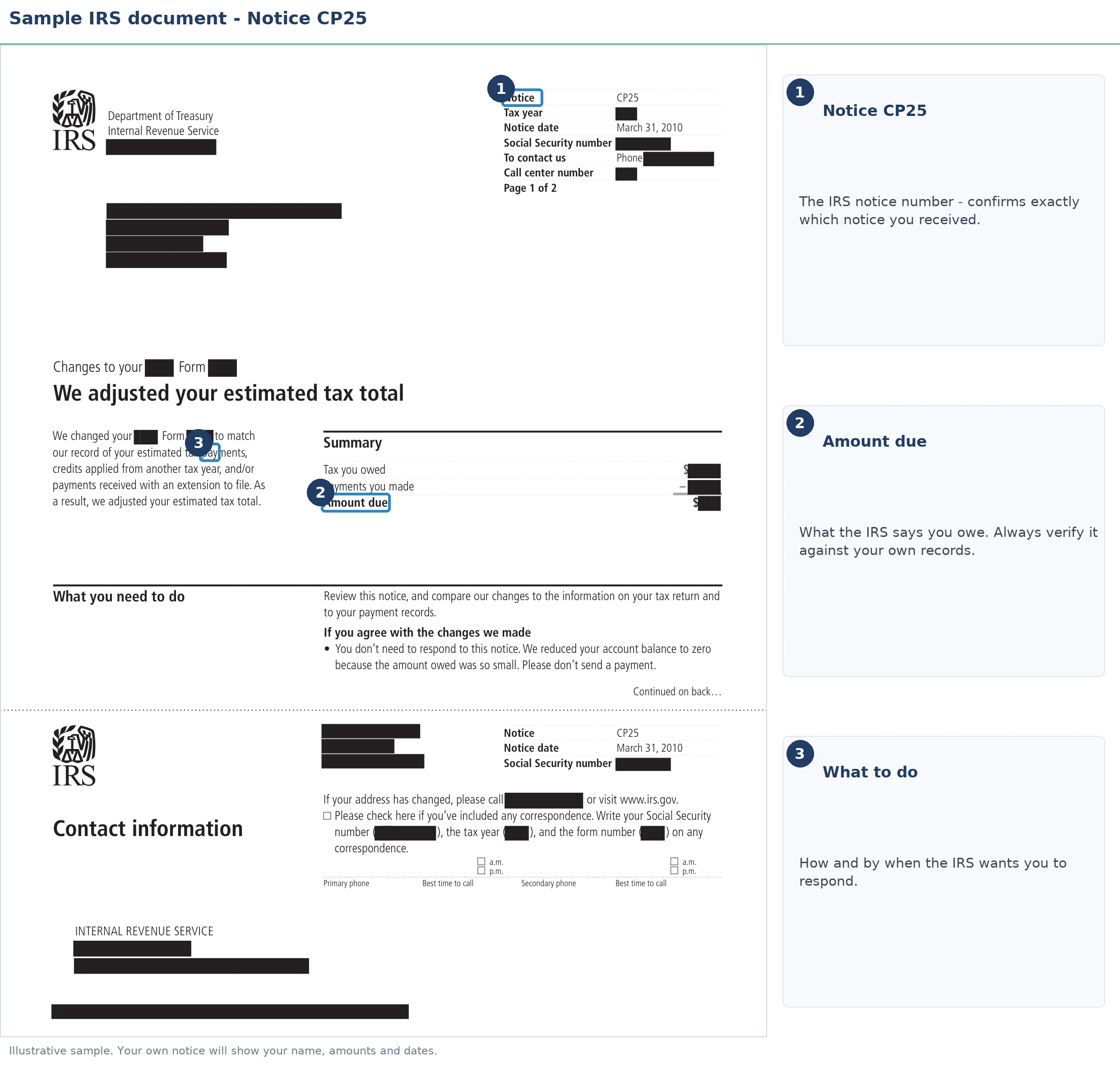
A CP25 is a records-correction notice, not a bill and not an audit. The IRS compared the estimated tax payments you listed on your return against the payments actually posted to your account, found a mismatch, and adjusted your return, and by coincidence of arithmetic, the adjustment landed at exactly zero. The image below shows exactly what a CP25 looks like and where to find the payment comparison the IRS used to make that change.
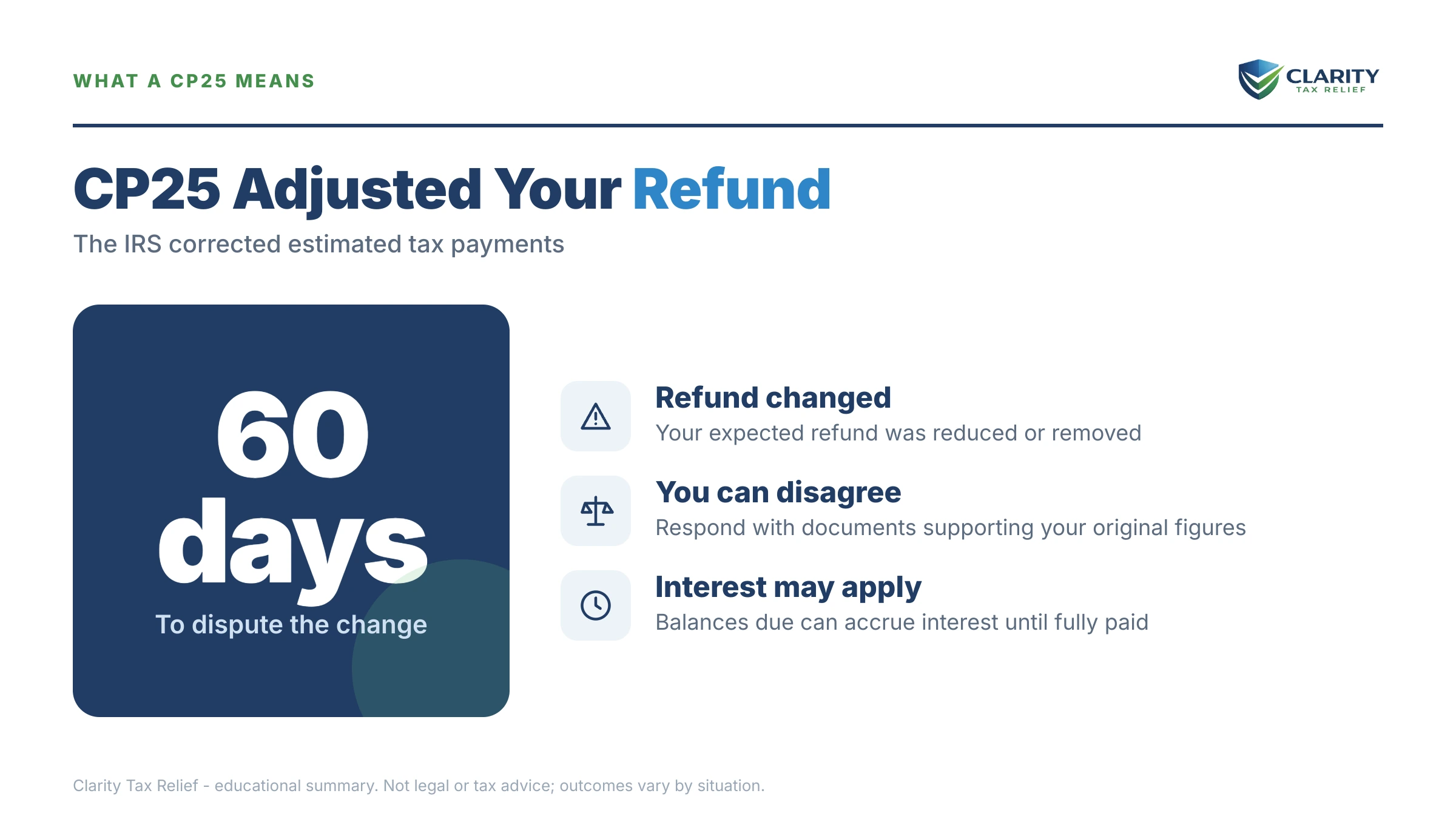
⏱ Your real clock: a CP25 has no payment deadline — your balance is zero. But if you disagree with the change, respond within the window shown on your notice (typically 60 days from the notice date), while the fix is still a phone call rather than a formal claim. And if the IRS missed a payment you truly made, that money is generally claimable as a refund for only about three years.
Why you got a CP25 notice
A CP25 notice means the IRS corrected your return because your claimed estimated tax payments didn't match its records. The correction left your account at exactly zero. When you file, the quarterly payments you made with Form 1040-ES are self-reported. The IRS then matches that figure against what actually posted to your account. When the two disagree, the IRS changes the return automatically and mails one of three letters depending on the money outcome. Yours came out even: the adjustment wiped out your expected refund (or expected balance) down to the dollar.
That zero is the defining fact of a CP25, and it's why so many people file the letter away without reading page two. But "even" only means the IRS's math balanced against the IRS's records. If those records are missing a payment you genuinely made, the notice is quietly cancelling a refund that belongs to you.
The mismatch itself usually traces to one of a few mechanical causes, and married couples filing jointly hit them more than anyone:
- A payment made under the "wrong" spouse's SSN. A joint return posts under the primary spouse's Social Security number. A quarterly payment sent under the other spouse's SSN — from their separate checking account, their Direct Pay login, their old single-filer habit — doesn't always match automatically.
- A payment credited to the wrong tax year. The fourth-quarter payment is due in January, after the calendar flips (see the quarterly estimated tax deadlines for 2026) — a mis-keyed year on that one payment is the single most common culprit.
- A payment applied to an older balance. If either spouse owed for a prior year, the IRS may have routed a payment there instead of to the year you intended.
- A simple miscount. You claimed four payments but only three cleared, or you counted a payment twice when merging two spouses' records at filing time.
If you're new to the quarterly system and want the mechanics from the top, start with how quarterly estimated taxes work. And if you're still not sure why the IRS wrote to you at all, our guide to why you got a letter from the IRS maps where a CP25 sits in the broader notice universe.
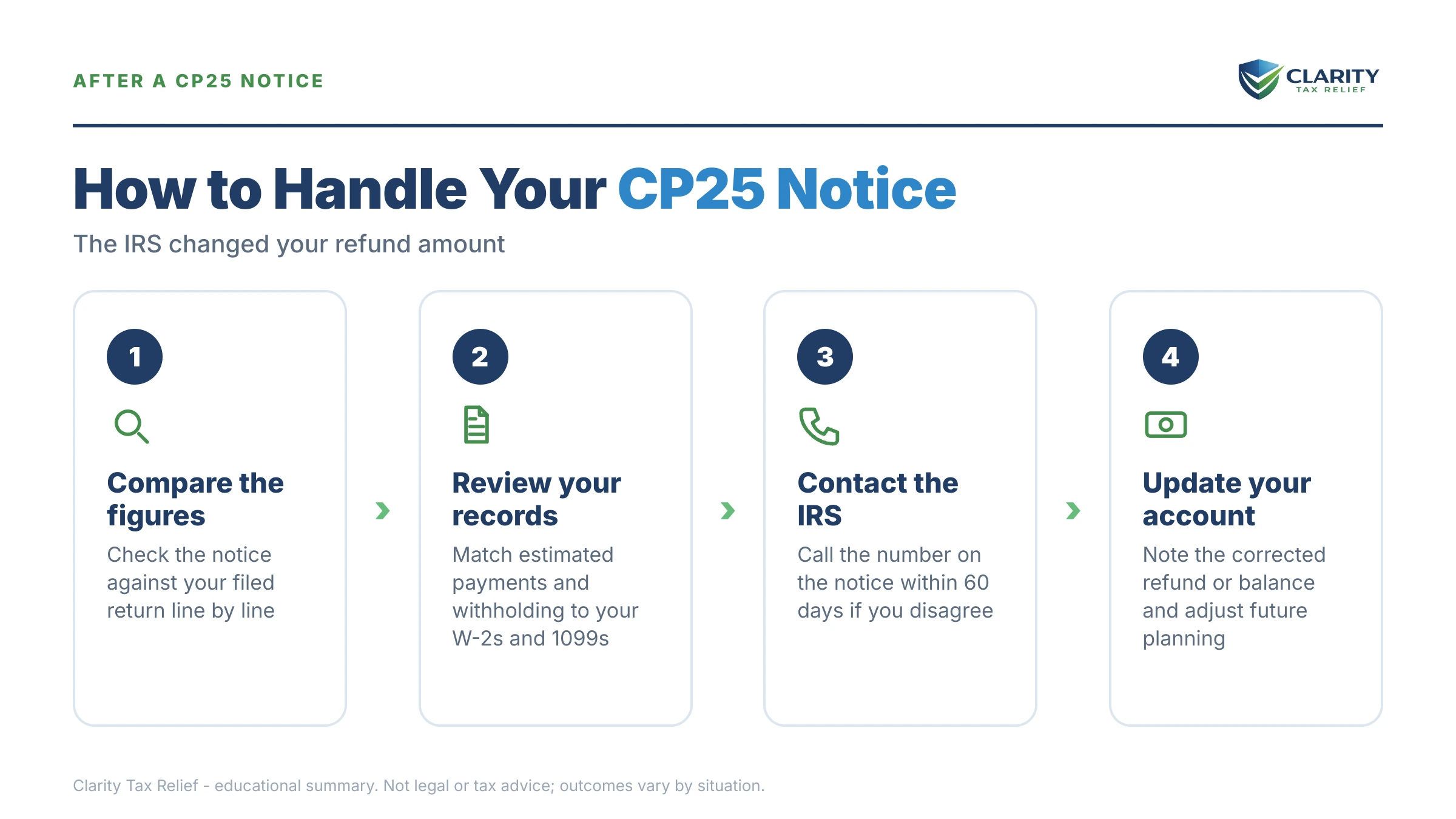
“We corrected to your return because we found a difference between the amount of estimated tax payments on your tax return and the amount we posted to your account. You're not due a refund nor do you owe an additional amount because of our changes. Your account balance is zero.”
— Understanding your CP25 notice (IRS.gov)
CP25 vs. CP23 vs. CP24: which discrepancy notice you're holding
The IRS sends three different letters for the same estimated-payment mismatch, split purely by whether the correction leaves you owing, refunded, or even. The notice number in the top corner tells you which world you're in:
| Notice | What the IRS found | Money outcome | Your move |
|---|---|---|---|
| CP23 | Payment mismatch; correction leaves a balance due | You owe money | Verify, then pay or arrange. This one escalates if ignored |
| CP24 | Payment mismatch; correction changes your refund | Refund (different from what you expected) | Verify the new refund amount before cashing anything |
| CP25 | Payment mismatch; correction nets to exactly zero | No refund, no balance | Verify — a missing real payment means a refund is hiding in the zero |
| CP45 | Couldn't apply your overpayment to next year's estimates as requested | Credit-forward reduced or unavailable | Adjust this year's quarterly payments to cover the gap |
| CP30 | You underpaid estimates during the year | Underpayment penalty charged | Check Form 2210 exceptions and penalty-relief options |
Note the difference in stakes. A CP23 starts a collection clock; a CP25 starts nothing. The related math-error letters CP11 (calculation change, you owe) and CP12 (calculation change, refund adjusted) work the same way but concern arithmetic on the return itself, not your payment history. CP25 is the only letter in this family where the IRS changes your return and asks for nothing.
A worked example: how $54,600 in claimed payments becomes a zero balance
One clearly hypothetical scenario shows exactly how a CP25 gets made. Say you're a married couple filing jointly, both self-employed, and your joint return shows total tax of $52,100. During the year you made four quarterly payments of $13,025 each ($52,100), then added a $2,500 top-up in January after a strong fourth quarter — $54,600 claimed in total. You expected a refund of $54,600 − $52,100 = $2,500.
But the $2,500 top-up went through Direct Pay from the wife's individual account, under her SSN. The return lists her husband as the primary taxpayer. The payment never matched. The IRS's records show $52,100 posted, so it reduces your credited payments from $54,600 to $52,100. New math: $52,100 posted − $52,100 tax = $0. Refund gone, nothing owed, CP25 mailed.
Here's the part that matters: that $2,500 payment is real, and it's still the couple's money. It's sitting on the wife's account for the wrong taxpayer designation. One phone call with the Direct Pay confirmation in hand — date, amount, SSN — and the IRS can trace and transfer the payment, restoring the $2,500 refund. Accept the zero without checking, and that money sits unclaimed until the refund window closes.
What happens if you ignore a CP25
Nothing enforceable follows a CP25, but ignoring one can still cost you real money in a quieter way. There's no CP501, no levy, no lien; the balance is zero and the collection machine has nothing to collect. The escalation here isn't seizure — it's leakage, and it runs in a predictable sequence:
- Stage 1 — silence. No follow-up notice comes. The IRS considers the matter closed the day the CP25 was mailed.
- Stage 2 — your records now disagree with the IRS's. Your payment log says one thing; your official account says another. Every future return you file inherits that conflict.
- Stage 3 — a real missing payment sits unclaimed. If the IRS's records are wrong, your money is parked in the wrong year or under the wrong SSN. Refund claims are generally limited to three years — see the 3-year refund deadline — after which the money is gone for good.
- Stage 4 — your credit-forward evaporates. If your return elected to apply the overpayment to this year's estimates, the CP25 means that credit doesn't exist. Keep paying quarterlies as if it does, and you're underpaid without knowing it.
- Stage 5 — the mismatch repeats on the wrong side. Next filing season, the same record-keeping gap can land as a CP23 with a balance due or a CP30 underpayment penalty instead of a harmless wash. This year the arithmetic saved you; there's no reason it will again.
In 2026, with IRS staffing down sharply, the practical effect is that nobody at the agency will ever revisit your CP25 on their own. If a correction needs to happen, you're the one who has to start it. The phone lines reward people who call early with documents ready.
Not sure the zero on your CP25 is right?
Send us a photo of the notice and your payment confirmations. An experienced tax professional will compare them line by line and tell you whether a refund is hiding in that zero — free, confidential, before the response window on your notice closes.
Your options after a CP25: agree, or dispute
A CP25 gives you exactly two paths, and the right one depends entirely on whose records are correct. Before choosing, pull the year's account transcript — our walkthrough on how to read an IRS account transcript shows where posted payments appear — and lay it next to your own payment log. Then find your situation below:
| What you find | How you'll spot it | What to do |
|---|---|---|
| The IRS is right. You miscounted | Your bank records total exactly what the IRS credited | Nothing to dispute. Fix your payment log and file the CP25 with the return |
| A payment posted to the wrong tax year | The transcript for an adjacent year shows an extra payment matching your missing one | Call the number on the notice; ask the IRS to move the payment to the correct year |
| A payment posted under your spouse's SSN | The payment confirmation shows the non-primary spouse's SSN | Request a transfer to the joint account with the confirmation in hand |
| A payment was applied to an older balance | An earlier year's transcript shows your payment reducing an old debt | Usually stands — the IRS may apply payments to the oldest liability — but confirm the old balance was real |
| A payment never cleared | No matching withdrawal in your bank records | The IRS is right; the payment failed. Re-check your bank and payment-app history before assuming |
If you dispute, do it inside the response window printed on the notice — typically 60 days from the notice date. Inside that window, most misapplied payments are fixed with a phone call or a short written response with copies of proof. After it, you're not out of options, but the fix shifts toward formal refund-claim territory, which is slower and paperwork-heavy. If a documented dispute stalls for months with no resolution, the Taxpayer Advocate Service exists for exactly that kind of stuck case.
One thing you do not need after a CP25: any payment program. There is no balance, so there is nothing to put on a plan, settle, or pause. Anyone who reviews a zero-balance notice and pitches you a resolution program is selling, not helping.
How to respond to a CP25 notice, step by step
- Pull your IRS account transcript for the tax year on the notice and compare every posted payment against the CP25's payment summary. The fastest route is your IRS online account — our IRS online account setup walkthrough covers the ID verification.
- Gather proof of every estimated payment you made — bank statements, canceled checks, and Direct Pay or EFTPS confirmations showing date, amount, tax year, and SSN.
- Match each payment to the right year and SSN — a payment that exists but posted to the wrong place explains most CP25s.
- Update your records if the IRS is right: correct your payment log, file the CP25 with that year's return, and adjust this year's quarterly vouchers if you were counting on a credit-forward.
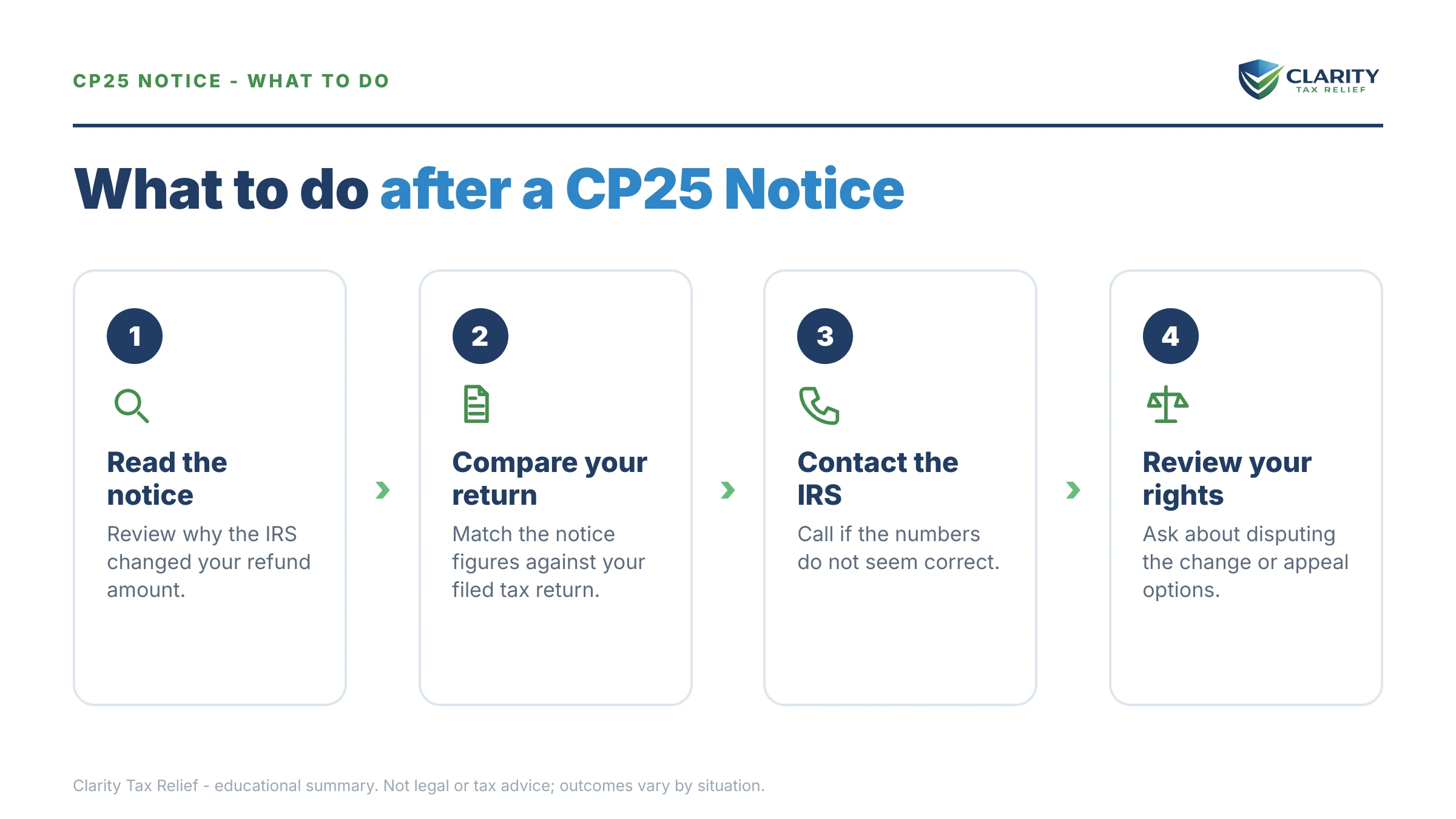
- Dispute within the notice window if the IRS is wrong, typically 60 days. Call the number printed on the CP25 or respond in writing with copies of your payment proof, and keep everything you send.
When you can handle a CP25 yourself
Most people can resolve a CP25 alone, and it would be dishonest to tell you otherwise. If your records confirm the IRS's numbers, you're done in ten minutes of checking. If a single payment posted to the wrong year or SSN, one documented phone call usually fixes it — no professional required, no fee justified.
Experienced help changes the outcome in a narrower set of situations: payments scattered across multiple years and both spouses' accounts that need to be traced and reallocated in the right order. A CP25 that arrives alongside other IRS problems (an existing balance, unfiled years, or a prior-year debt that swallowed your payment). Or a documented dispute the IRS has already brushed off once. In those cases, the sequencing — which payment moves where, and what gets claimed before the refund window closes — is where a professional earns their fee.
Terms on your CP25, decoded
- Estimated tax payments — quarterly prepayments of tax on income with no withholding, made with Form 1040-ES vouchers or electronically.
- Payments posted to your account — the payments the IRS's records actually show for your SSN and tax year. This figure, not your own log, is what your return was matched against.
- Primary SSN — the Social Security number of the spouse listed first on a joint return. The account, and every payment match, runs under this number.
- Credit elect — the election to apply an overpayment to next year's estimated taxes instead of taking a refund. A CP25 means there was no overpayment to apply.
- Account transcript — the IRS's line-by-line record of your tax year, showing every payment, credit, and adjustment with its posted date.
- Refund statute (RSED) — the deadline, generally three years, after which an unclaimed overpayment can no longer be refunded.
The IRS's own summary of this notice is at Understanding your CP25 notice — useful for confirming the letter you received is genuine.
CP25 notice questions, answered
What is an IRS CP25 notice?
A CP25 notice means the IRS found a difference between the estimated tax payments claimed on your return and the payments in its records, and after the correction, you owe nothing and get no refund. Verify the numbers anyway: if a real payment went missing, you may still be owed money.
Is a CP25 notice bad news?
No — a CP25 is one of the mildest letters the IRS sends. Your balance is zero, nothing is owed, and no collection notices follow it. The only real risk is accepting it without checking: if the IRS failed to credit a payment you actually made, the zero on the notice is hiding a refund you're still owed.
Why did the IRS change my estimated tax payments?
Because the total you claimed on your return didn't match the payments posted to your account. The IRS corrects that mismatch automatically, without asking you first. The most common causes are a payment credited to the wrong tax year, a payment made under a spouse's SSN that didn't match a joint return, a payment applied to an older balance, or a simple miscount of what you actually sent.
Do I have to respond to a CP25 notice?
No response is required if you agree with the change, but verify before you agree. Pull your IRS account transcript and compare posted payments to your own records first. If you disagree, respond within the window shown on your notice (typically 60 days) using the phone number or address printed on it. Either way, keep the CP25 with that year's tax records.
What if I actually paid more than the IRS credited?
Then the CP25's zero balance is wrong and you're owed a refund. Gather proof of the missing payment — a bank statement, canceled check, or Direct Pay/EFTPS confirmation showing the date, amount, and SSN — and call the number on the notice or respond in writing. The IRS can trace a misapplied payment and move it to the correct year and account. Don't wait: refund claims are generally limited to three years.
My spouse made some of our estimated payments — why weren't they counted?
Because a joint return posts under the primary spouse's SSN, and estimated payments made under the other spouse's SSN don't always match automatically. This is one of the most common causes of CP23, CP24, and CP25 notices, especially in a couple's first year filing jointly or after switching whose name is listed first. Check the SSN on each payment confirmation and ask the IRS to transfer any payment that posted to the wrong account.
Can a CP25 turn into a tax bill later?
The CP25 itself doesn't — its balance is zero and no collection sequence follows. But the underlying mismatch can bite later: if a credited payment is later reversed (a bounced bank payment, for example), a balance-due notice follows, and if the same record-keeping gap repeats next year, the discrepancy may land on the balance-due side as a CP23 instead of a wash.
Does a CP25 affect next year's estimated taxes?
It can, in one specific way: if your return elected to apply an overpayment toward next year's estimated taxes, a CP25 means there is no overpayment, so that credit you were counting on doesn't exist. Cover the shortfall in your next quarterly payment, or you risk an underpayment penalty at the next filing. If you claimed no credit-forward, the CP25 has no effect on future years.
Your next 24 hours
- Find the payment comparison on your CP25 — the section listing the estimated payments the IRS credited versus what you claimed — and note the notice date, which starts your response window.
- Gather your proof: a copy of the return, your bank statements for each quarterly payment date, and any Direct Pay or EFTPS confirmations — noting whose SSN each payment was made under.
- Get a free case review. If your records and the IRS's don't match, or payments are tangled across years or spouses — call (888) 825-7779 or use the 2-minute form. Refund claims don't stay open forever, and a misapplied payment is easiest to move while the notice is fresh.
This guide is general information, not tax or legal advice for your specific situation. Eligibility for IRS programs depends on individual facts and circumstances; no outcome is guaranteed.