
IRS Notices
IRS CP24 Notice: Why the IRS Changed Your Refund and What to Do (2026)
The short answer: a CP24 notice means the IRS found a difference between the estimated tax payments you claimed on your return and the payments actually posted to your account, and adjusted your refund as a result. Verify the new amount against your own payment records before you rely on it; the IRS isn't always right.
You made your quarterly payments all year, filed in the spring, and now a CP24 notice says your refund isn't the number your return showed. The IRS didn't audit you and you're not in trouble — its computer simply counted your estimated payments differently than you did. The fix is a ten-minute comparison, and this page walks you through it.
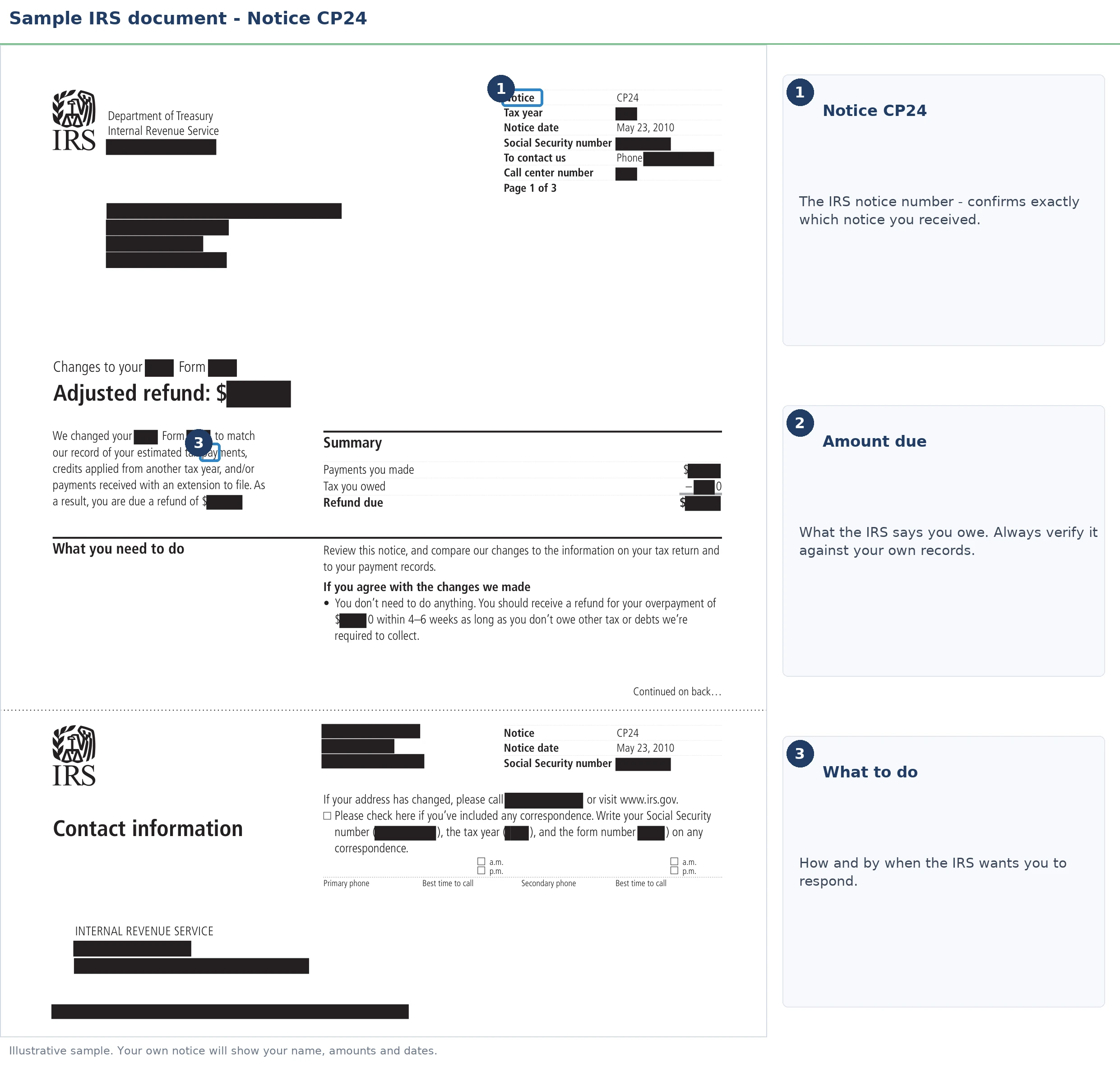
Everything on a CP24 turns on one section: the side-by-side comparison of the payments you claimed versus the payments the IRS found. The image below shows exactly what this notice looks like and where that comparison sits, so you know precisely which lines to check first.
⏱ Your window: there's no payment deadline on a CP24. You don't owe anything. But if you disagree with the changes, contact the IRS promptly, typically within 60 days of the notice date. Check the contact-by information printed on your own notice; waiting past that window makes reversing a wrong adjustment much slower.
Why you got a CP24 notice
A CP24 is triggered by one specific event: the estimated tax payments on your return don't match IRS records. The corrected math left an overpayment. It's the refund-side member of a three-notice family — the same mismatch produces a CP23 notice when the correction creates a balance due, and a CP25 notice when it zeroes out.
If you're a 1099 contractor sending in quarterly payments, the mismatch almost always comes from one of these:
- The January payment. The fourth-quarter payment for a tax year is due in mid-January of the next year. Filers routinely forget it when totaling payments, or count it toward the wrong year.
- A payment posted to the wrong tax year. One mistyped year on IRS Direct Pay or EFTPS. A real payment lands on the wrong account line.
- Joint returns and spouse SSNs. Payments made under the secondary spouse's Social Security number sometimes don't match to the joint return automatically.
- A prior-year overpayment applied forward. If you elected to apply last year's refund to this year's estimates, you and the IRS may have recorded different amounts.
- Simple transposition. $6,875 entered as $6,785 is enough to trigger the notice.
The notice shows the tax year, the payments you claimed, the payments the IRS posted, and the resulting refund. It is not an audit and not a penalty — for the broader map of what different IRS letters mean, see why did I get a letter from the IRS. If you're fuzzy on how the quarterly system itself works, the primer on how quarterly estimated taxes work covers it. This page stays focused on the mismatch in front of you.
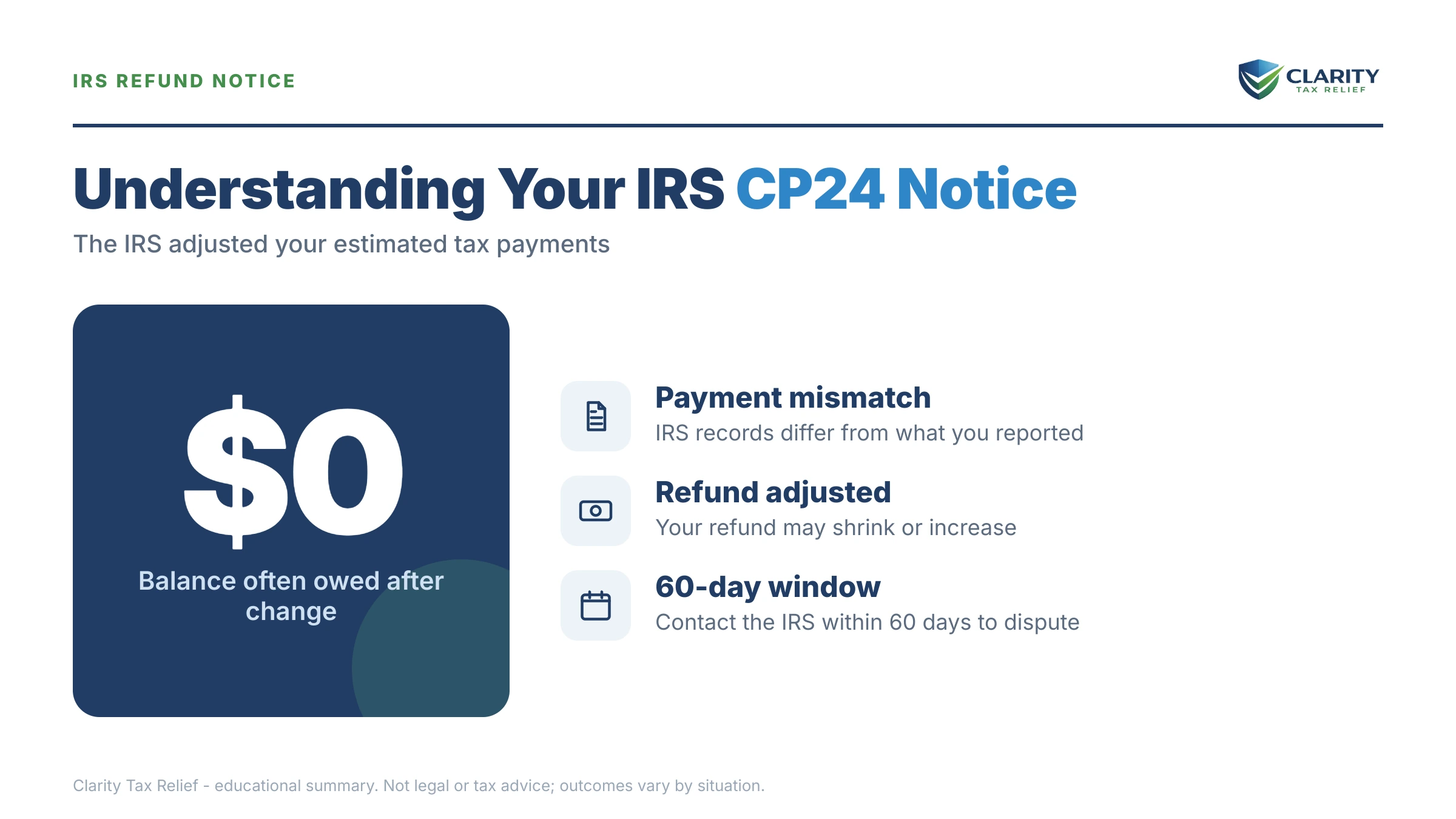
“We corrected your return because we found a difference between the amount of estimated tax payments on your tax return and the amount we posted to your account.”
— Understanding your CP24 notice (including CP24, CP24E, CP24G, and CP24U) (IRS.gov)
CP24 vs. CP23 vs. CP25: which mismatch notice you're holding
The IRS issues three different notices from the same estimated-payment mismatch, and the notice number tells you which direction the money moved. One number in the top corner changes everything about your next step:
| Notice | What the correction produced | Your next step |
|---|---|---|
| CP24 | An overpayment — you're due a refund (which may be larger or smaller than your return showed) | Verify the payment comparison; refund arrives automatically if correct |
| CP23 | A balance due — the IRS found fewer payments than you claimed | Verify before paying; dispute or arrange payment by the notice date |
| CP25 | Even — the corrected numbers left no refund and no balance | Verify and file the notice with your records |
| CP30 | An underpayment penalty on your estimates, often paired with a corrected refund | Check the penalty math; waiver exceptions may apply |
Notices like the CP11 notice and CP12 notice look similar but come from math-error corrections to the return itself — deductions, credits, arithmetic. A CP24 never questions your return's math; it only recounts your payments.
Say you paid $27,500 in quarterlies: two CP24 scenarios
A hypothetical shows how the same $27,500 in payments produces opposite CP24 outcomes. Say you're a self-employed contractor who sent the IRS four quarterly payments of $6,875 each — $27,500 for the year.
Scenario A — your refund grows. When you filed in March, you totaled only the three payments made during the calendar year: 3 × $6,875 = $20,625. You forgot the fourth payment, made in mid-January. Your return claimed a $1,200 refund. The IRS posted all four payments, found $27,500 − $20,625 = $6,875 in credit you didn't claim. The CP24 shows a refund of $1,200 + $6,875 = $8,075. Verify it, then let the check come.
Scenario B. Your refund shrinks. You claimed the full $27,500. But the IRS posted only $23,000 because your $4,500 second-quarter payment was keyed to the prior tax year. Your expected $5,100 refund becomes $5,100 − $4,500 = $600 on the CP24. That payment is real — it's just parked on the wrong year. Don't shrug and accept the smaller check: call with your payment confirmation and ask the IRS to move the credit to the correct year. Otherwise the misplaced $4,500 quietly distorts two years of accounts.
What happens if you ignore a CP24 notice
A CP24 never escalates into levies or liens, but ignoring a wrong one costs real money in a predictable sequence:
- The refund issues on the IRS's numbers. If you agree, fine. If the IRS's count was wrong, you've now accepted an incorrect amount — in either direction.
- Money credited to you in error gets clawed back. If a payment that wasn't yours inflated the refund and you spend it, a CP60 notice later removes the payment and bills you for the difference, with interest running from the original date.
- A missing payment repeats next filing season. A quarterly payment stuck on the wrong year throws off next year's return too. The same mismatch can come back as a CP23 balance due, and if your safe-harbor calculation depended on that payment, an underpayment penalty can ride along. You can estimate that exposure with our Penalty & Interest Calculator.
- The window to recover your money eventually closes. Refund claims generally have a limited life, typically three years, so a shorted refund you never dispute can become permanently unrecoverable. See can I still get a refund from 3 years ago.
One 2026 reality worth knowing: with the IRS workforce down roughly 27% after the 2025 cuts, fixing a mis-posted payment by phone takes longer than it used to. **The sooner you flag a wrong CP24, the cheaper and faster the correction** — corrections don't get easier with age.
CP24 numbers don't match your records?
A refund that changed without a clear reason can hide a mis-posted quarterly payment — the kind that comes back as a bill with interest later. Send us the notice and your payment confirmations, and an experienced tax professional will trace where every dollar landed — free, confidential, no pressure.
Your options after a CP24
A CP24 gives you four realistic paths, and all of them are free — no IRS fee applies to any of these:
- Agree, and the refund is right or bigger: do nothing. The refund arrives automatically, typically within a few weeks, as long as you owe no other federal or state debts.
- Agree, because you actually miscounted: accept the adjustment, correct your bookkeeping, and recheck the quarterly amounts you're paying this year — the current due dates are in our guide to quarterly estimated tax deadlines 2026.
- Disagree — a payment is missing: call the number on the notice, typically within 60 days, with proof of every payment (bank statements, EFTPS or Direct Pay confirmations, canceled check images). A payment posted to the wrong year can be transferred to the correct year by request — ask for the credit to be moved, not refunded, so both years end up right. No amended return is needed to fix payment postings.
- Disagree — the IRS credited too much: report it. A payment that isn't yours will eventually be removed; flagging it now prevents the interest-bearing clawback described above.
Two edge cases change the playbook. On a joint return, ask the IRS to check payments under both spouses' SSNs before assuming a payment vanished. And if you can prove a payment cleared your bank but the IRS can't find it anywhere, request a payment trace — that's a documented search, not a dispute. It protects you while the money is located.
Check your transcript before you count on the new refund
Your IRS account transcript shows every payment and the refund itself as coded line items — it's the fastest way to verify a CP24 without waiting on hold. Pull it through your IRS online account and look for these codes:
| Code | What it means | What to do |
|---|---|---|
| 660 | An estimated tax payment posted to the account | Match each 660 line's date and amount to your bank records, and confirm it's on the right tax year |
| 806 | W-2/1099 withholding credited | Keep it separate from estimated payments; don't count it twice when totaling |
| 971 | Notice issued — the CP24 itself | Confirms the adjustment is official on your account |
| 846 | Refund issued, with the exact date | This is your real refund date — compare the amount to the CP24 |
| 826 / 898 | Refund applied to another tax year, or offset to another agency | Explains a check smaller than the CP24 amount — see what debt absorbed it |
If a quarterly payment you can prove is missing from the 660 lines entirely, not just misdated, that's your dispute evidence in hand before you ever dial the IRS.
How to respond to a CP24 notice, step by step
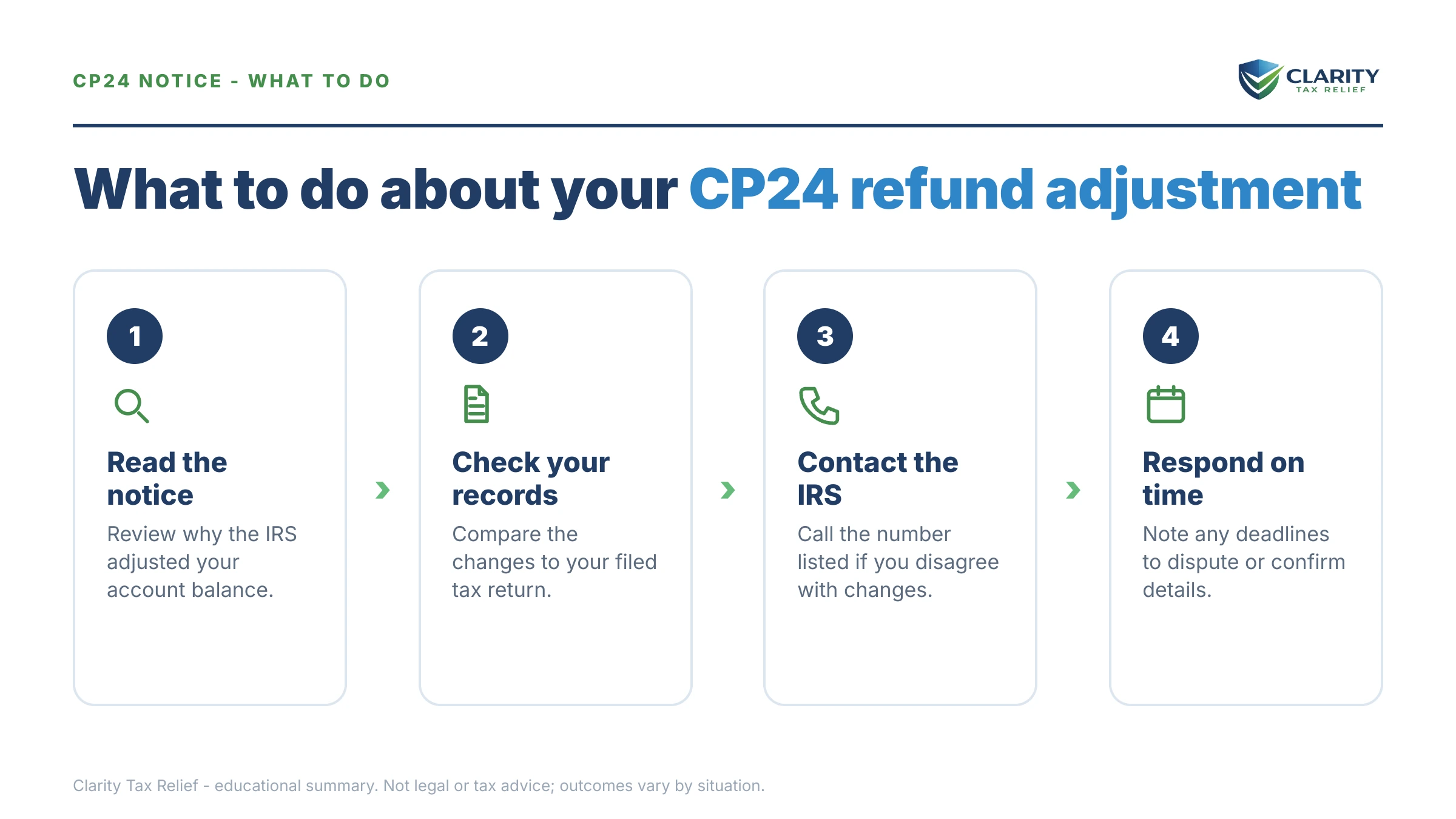
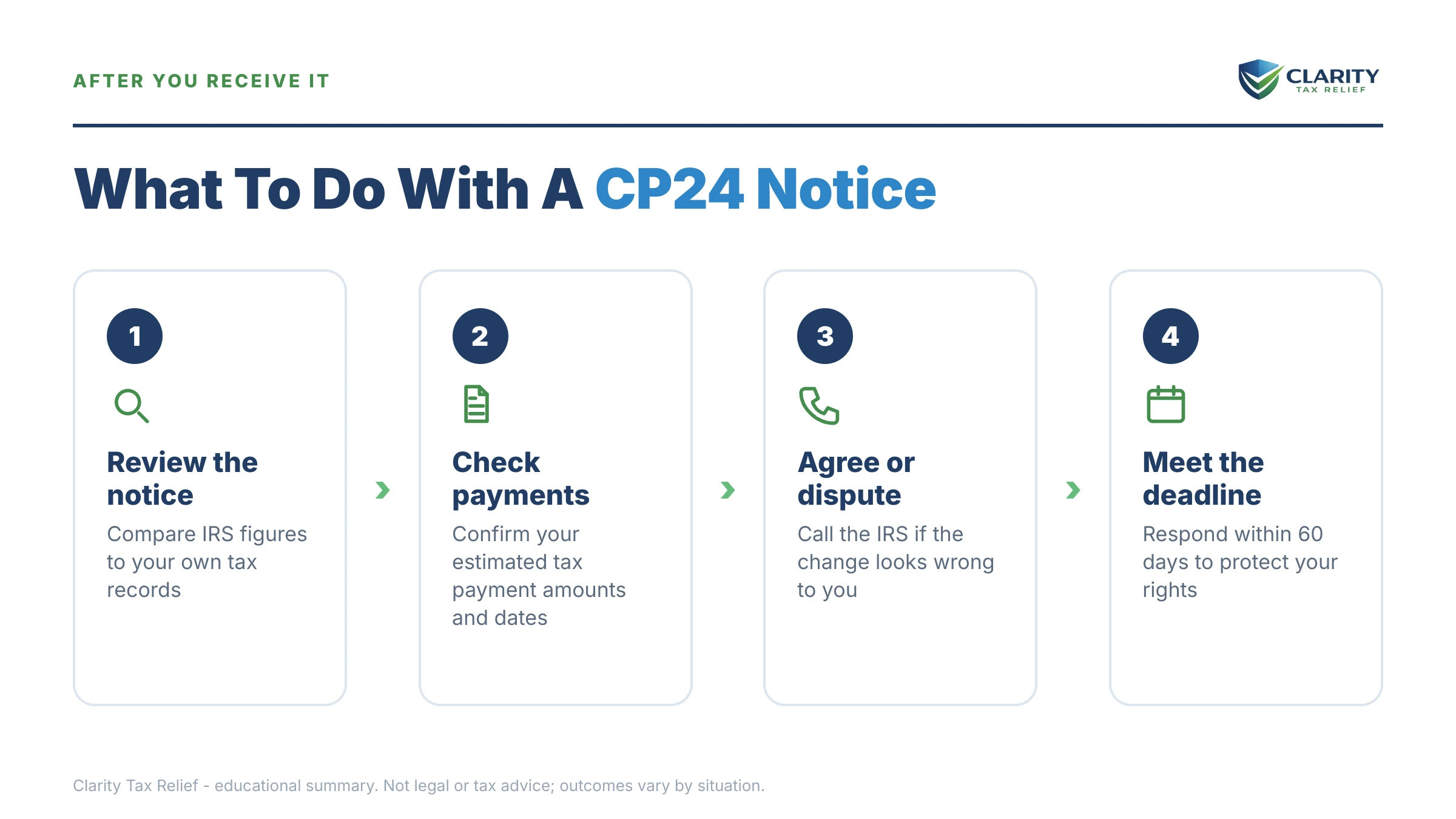
- Pull your payment records. Gather bank statements, EFTPS or IRS Direct Pay confirmations, and canceled checks for every estimated payment you made for the tax year on the notice.
- Compare them to the notice and your IRS online account. Match each payment's date, amount, and tax year against the payments the IRS lists — a payment can be real but posted to the wrong year. Log in at the IRS online account to see exactly what posted.
- If the IRS is right, update your records. Accept the adjusted refund, correct your bookkeeping, and fix the quarterly amounts you're paying this year so the mismatch doesn't repeat.
- If the IRS is wrong, respond with proof. Call the number on the notice, typically within 60 days, and send payment confirmations. Ask for wrong-year payments to be moved to the correct year, not refunded.
- Watch your transcript until the refund posts. Look for code 846 with the issue date, and confirm the deposit matches the CP24 amount minus any offsets.
When you can handle a CP24 yourself
Most CP24s need no professional help at all. Handle it yourself when it's a single tax year, your own records confirm the IRS's count (you really did forget the January payment), or the notice simply delivers a bigger refund your documents support. Verify, update your books, done.
Experienced help changes the outcome in a narrower set of situations: quarterly payments mis-posted across multiple years, where each fix ripples into the next return. A CP60 clawback that already followed the refund. Joint-return payments tangled between two SSNs. Or a CP24 arriving alongside back balances, where the refund is being swallowed by offsets you don't understand. In those cases, the order you untangle things determines what you keep. If a provably-made payment stays lost after you've disputed it and the delay is causing hardship, the Taxpayer Advocate Service is a free escalation path.
Terms on your CP24, decoded
- Estimated tax payments — the quarterly prepayments (Form 1040-ES) self-employed and 1099 workers make in place of paycheck withholding.
- Overpayment — the amount your total payments exceed your total tax; on a CP24, it's the refund the IRS's corrected count produced.
- Adjusted refund — the new refund figure after the IRS's changes, which replaces the one on your filed return.
- Applied to estimated tax — the election to roll a refund forward as next year's first quarterly payment instead of taking the cash. A common source of CP24 mismatches.
- Refund offset — the interception of a refund to cover other debts (back taxes, child support, student loans) before it reaches you. The mechanics live in our guide to the Treasury Offset Program.
CP24 questions, answered
What is an IRS CP24 notice?
A CP24 notice means the IRS found a difference between the estimated tax payments you claimed on your return and the payments actually posted to your account, and adjusted your refund as a result. Verify the new amount against your own payment records before you rely on it; the IRS isn't always right.
Is a CP24 notice good news?
Usually — a CP24 means the IRS's changes left you with an overpayment, so a refund is coming. But the refund can be larger or smaller than the one on your return, and the IRS's records aren't always right. Verify every payment on the notice against your bank records before you rely on the new amount, especially if the change isn't in your favor.
Why did I get a CP24 notice from the IRS?
The estimated tax payments you listed on your return don't match the payments posted to your IRS account, and the difference produced a refund. Common causes include a forgotten fourth-quarter payment made in January, a payment applied to the wrong tax year, joint payments made under a spouse's Social Security number. A prior-year overpayment you applied forward but didn't record.
How long does a CP24 refund take?
If you agree with the changes and owe no other federal or state debts, the refund typically arrives within a few weeks of the notice date — no action needed. Watch your account transcript for code 846, which shows the exact issue date. If other debts exist, part or all of the refund can be offset before it reaches you.
What should I do if I disagree with a CP24 notice?
Contact the IRS at the number on the notice, typically within 60 days of the notice date, with proof of every payment: bank statements, EFTPS or Direct Pay confirmations, or canceled check images. Most CP24 disputes, including payments posted to the wrong year, are fixed by phone or correspondence without filing an amended return. Keep copies of everything you send.
What is the difference between a CP24 and a CP23?
Both come from the same estimated-tax mismatch; the difference is the result. A CP24 means the IRS's corrected math left an overpayment, so you get a refund. A CP23 means the correction left a balance due, so you owe. A CP25 is the third sibling — the mismatch zeroed out with no refund and no balance.
Can the IRS keep my CP24 refund for other debts?
Yes. Before the refund is issued, it can be applied to other federal tax balances (transcript code 826) or offset through the Treasury Offset Program for debts like past-due child support, state income tax, or federal student loans (code 898). The CP24 shows the overpayment; a separate notice explains any offset that reduces the actual check.
Do I need to amend my return after a CP24?
Usually no. The CP24 means the IRS already corrected the payment figures on your return, so filing Form 1040-X to fix the same numbers just creates confusion. Amend only if something else on the return was wrong — income, deductions, or credits the CP24 didn't touch. To dispute the CP24 itself, respond to the notice instead.
What if the IRS credited a payment to me that isn't mine?
Don't spend it. If a payment was mis-posted to your account and you keep the resulting refund, the IRS can later remove the payment with a CP60 notice and bill you for the money back, with interest accruing from the original date. Call the number on your CP24, explain the payment isn't yours, and document the call.
Your next 24 hours
- Find the payments comparison on your notice. Locate the section listing the estimated payments you claimed versus the payments the IRS found, and circle any line that doesn't match your memory.
- Gather your proof. Pull the filed return, the CP24 itself. A confirmation for every quarterly payment — bank statements, EFTPS or Direct Pay receipts, canceled checks.
- Get a free case review. If any payment is missing, misdated, or on the wrong year, have an experienced tax professional trace it before the error compounds into next year's return — use the 2-minute form at claritytaxrelief.com/#consult or call (888) 825-7779.
This guide is general information, not tax or legal advice for your specific situation. Eligibility for IRS programs depends on individual facts and circumstances; no outcome is guaranteed.