
IRS Notices
IRS CP22E Notice: The Audit Changed Your Return and You Owe (2026)
The short answer: a CP22E notice means the IRS finished auditing your tax return, made changes, and has now assessed additional tax — the balance is legally on your account. Pay or set up a payment arrangement by the date printed on the notice; interest and a monthly late-payment penalty keep the amount growing until you act.
The audit itself may feel like old news — maybe you mailed in whatever receipts you could find, maybe you signed the examiner's report just to make it stop, or maybe you never heard from the IRS at all until now. The CP22E is the part that lands: a final number, with penalties and interest stacked on top, that the IRS now treats as a debt you owe. The good news is that an assessed balance is a solvable problem, and you're catching it at the cheapest possible stage.
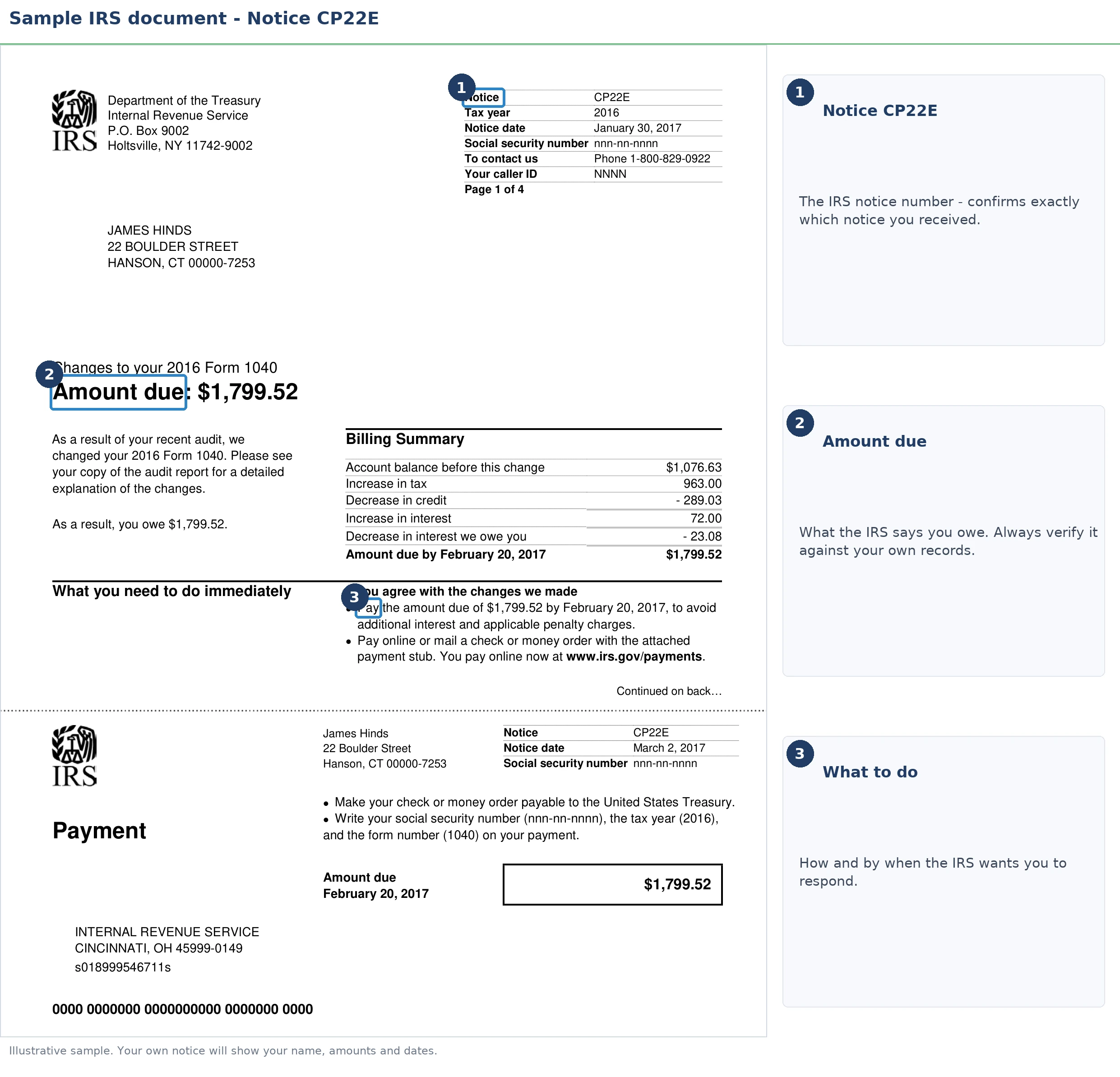
A CP22E packs four things onto one page — the tax year that was audited, the extra tax, the penalties, and the pay-by date. The image below shows exactly what a real CP22E looks like and where each of those figures sits, so you can read yours in about a minute.
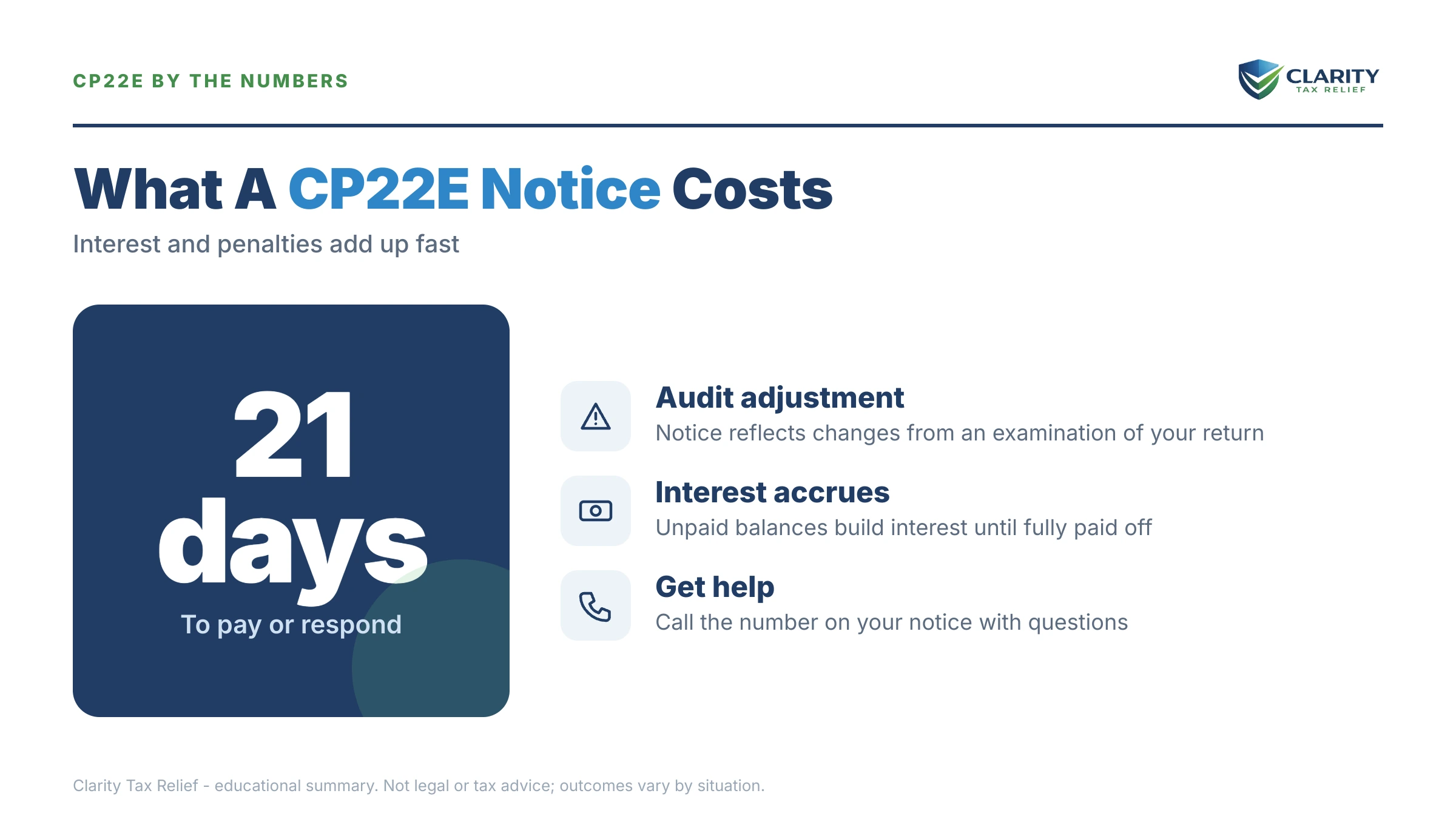
⏱ Your deadline: the pay-by date printed on your CP22E controls — check your copy, not a generic rule. After that date, interest plus a 0.5% monthly failure-to-pay penalty keep compounding, and the notice feeds directly into the IRS's automated collection sequence (CP501 → CP503 → CP504 → LT11).
Why you got a CP22E notice
A CP22E is issued when an IRS examination, an audit, changed your return and the change was formally assessed to your account. That word assessed is what separates this notice from almost every other IRS letter about the same tax year. A CP2000 or a CP3219A notice of deficiency proposes a change you can still fight before it exists. A CP22E means the fight window closed and the number is now real: it appears on your transcript, it accrues interest. It can eventually be collected by lien or levy.
There are two roads that end at a CP22E:
- You agreed to the audit changes. You signed the examination report (Form 4549), sometimes deliberately, sometimes just to end a mail audit you couldn't keep up with. Signing lets the IRS assess immediately, and the CP22E is the bill that follows.
- The audit closed by default. You never responded to the exam letters or to the 90-day deficiency notice, often because they went to an old address. The proposed changes became final automatically, and the CP22E is the first document many people in this situation ever actually see.
One detail that shocks nearly everyone: interest on an audit assessment runs from the original due date of the audited return, not from the notice date. If the IRS audited your 2023 return and the CP22E arrived in 2026, you're being charged more than two years of back interest on day one. That's why the interest line on a CP22E is so much larger than on an ordinary bill. Self-employed filers see this constantly — Schedule C mail audits over deduction substantiation routinely take a year or more to close, with the meter running the whole time. If you're still working out why the IRS contacted you in the first place, our guide to why you got a letter from the IRS maps the whole notice system.
“A payment plan is an agreement with the IRS to pay the taxes you owe within an extended timeframe. You should request a payment plan if you believe you will be able to pay your taxes in full within the extended time frame.”
— Payment plans; installment agreements (IRS.gov)
CP22E vs. CP21E, CP22A, and the letters that came before it
The CP22E is the only common balance-due notice that traces back to a completed examination — the letter's code tells you which machine produced it. The CP21E notice is its near-twin: both report exam changes with a balance due, and the response playbook is the same. The CP22A notice looks similar but comes from a different source — changes made using information you provided, not an audit — which matters because audit-specific remedies like reconsideration don't apply to it.
It's also not a math-error notice. A CP11 notice (balance due) or CP12 notice (refund changed) means a computer corrected an arithmetic or matching error during processing — no examiner ever touched your file. You can contest those within a short statutory window just by calling or writing. A CP22E sits at the other end of the spectrum: a human (or a correspondence-exam unit) reviewed the return, concluded the changes. The assessment is done. Different origin, different remedies, different urgency.
What happens if you ignore a CP22E
An unpaid CP22E balance enters the same automated collection pipeline as any assessed tax debt, and in 2026, with the IRS workforce down roughly 27%, that pipeline is more automated than ever. Humans are hard to reach; the notice-and-levy system never stopped. Here is the sequence, in order:
- CP22E — the assessed bill. You are here. No enforcement power yet, and every option is still open.
- CP501 / CP503 — automated reminders. Still just bills, but the balance compounds monthly while they cycle.
- CP504 — Notice of Intent to Levy. The IRS can now seize your state tax refund under IRC §6331(d), and a federal tax lien becomes a realistic next move.
- LT11 / Letter 1058 — Final Notice of Intent to Levy. A 30-day clock starts. After it runs, the IRS can levy bank accounts, garnish wages, and, for the self-employed, send levies to clients who owe you money.
| Notice | What it lets the IRS do | Your window / right at stake |
|---|---|---|
| CP22E | Demand payment of the assessed audit balance | Pay-by date printed on the notice — the cheapest moment to resolve or dispute |
| CP501 / CP503 | No new powers; formal reminders while interest and penalties compound | Every resolution option still available; balance grows monthly |
| CP504 | Seize your state tax refund; lien filing becomes likely | Act before the final notice issues, after CP504, enforcement is one letter away |
| LT11 / Letter 1058 | Levy bank accounts, wages, and contractor payments after 30 days | 30 days to file Form 12153 for a Collection Due Process hearing — miss it and you lose the pre-levy hearing |
For a sole proprietor, the levy stage bites differently than it does for a W-2 employee: the IRS can send a levy directly to your clients and take what they owe you. A business bank account offers no shelter. None of that happens tomorrow, but every stage before it is cheaper than the one after.
Holding a CP22E right now?
Get it reviewed free before the pay-by date on your notice passes. An experienced tax professional will confirm the assessment is right, flag any penalty that can come off, and map your cheapest way out — no pressure, no obligation.
Your options when you can't pay the CP22E balance
The IRS has a full menu of resolution programs for assessed balances, and eligibility turns on your numbers, not on how the debt arose. Here's the field, honestly:
| Option | Typically fits when | Cost & the catch |
|---|---|---|
| Pay in full | You can cover it, or can borrow cheaper than the IRS accrual rate | Stops the failure-to-pay penalty and interest immediately; cleanest exit |
| Short-term plan (up to 180 days) | You can clear the balance within about six months | $0 setup fee; interest and penalties continue until paid |
| Streamlined installment agreement | Balance ≤ $50,000 — up to 72 months, set up online with no financial disclosure | Setup fee applies (reduced for direct debit); accrual continues; you must stay current on future filings |
| Currently Not Collectible | Paying anything would leave you unable to cover basic living expenses | Collection pauses but the debt remains, refunds are offset, and a lien is possible |
| Offer in Compromise (doubt as to collectibility) | Your assets and future income genuinely can't cover the debt before the collection statute expires | $205 fee and 20% down on lump-sum offers (both waived with low-income certification); the IRS accepted roughly 1 in 5 offers in FY2024 |
| OIC — doubt as to liability (Form 656-L) | You believe the audit assessment itself is wrong | No application fee; an alternative to audit reconsideration when you have a genuine dispute |
| Penalty abatement | Clean three-year compliance history, or circumstances beyond your control | Removes the penalty portion only; the accuracy-related penalty requires a reasonable-cause showing |
A worked example (hypothetical). Say you're a self-employed sole proprietor and a mail audit of your 2023 Schedule C disallowed about $61,000 of deductions — no mileage log, missing receipts. The recomputed income tax and self-employment tax come to roughly $19,900. The examiner adds a 20% accuracy-related penalty — about $3,980 — and interest running back to April 2024 adds roughly $3,600 more. Your CP22E arrives demanding about $27,500.
On a 72-month streamlined plan, $27,500 ÷ 72 is roughly $382 a month before continued interest and the 0.5% monthly failure-to-pay penalty, so a realistic payment runs modestly higher, and paying faster than the minimum saves real money. If the penalty portion came off through abatement or a successful reasonable-cause argument, the same plan would start around $325 a month. You can estimate how fast your own balance is growing with our Penalty & Interest Calculator.
Two persona-specific notes. First, if the audited year is 2023 but you deducted the same way in 2024 and 2025, the IRS can open those years too — fixing your substantiation habits now is part of the resolution. Second, married filers who filed jointly for the audited year are both liable for the full CP22E balance, even if the audited business belonged to one spouse. That changes which resolution options make sense and is worth raising in any professional review.
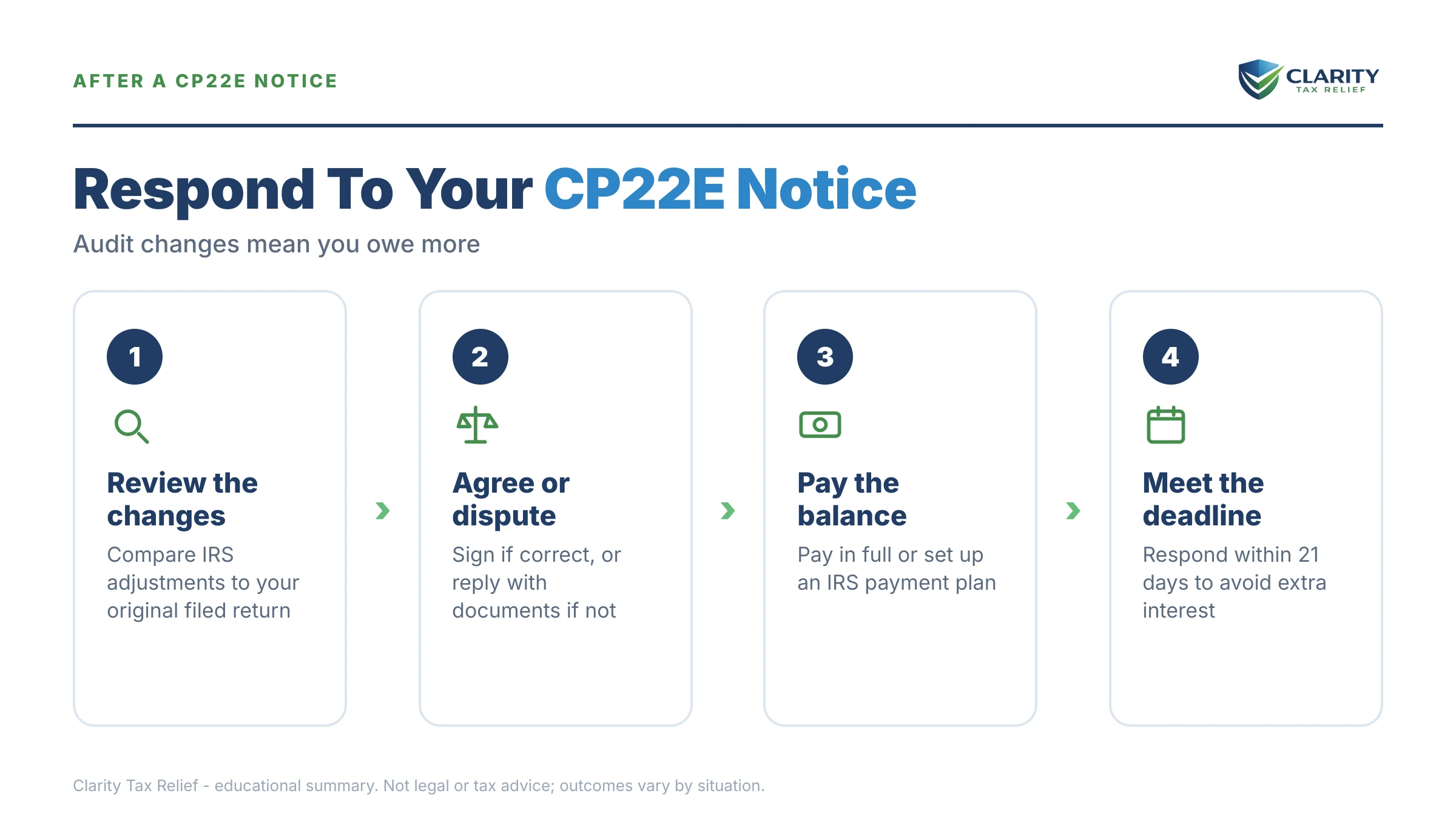
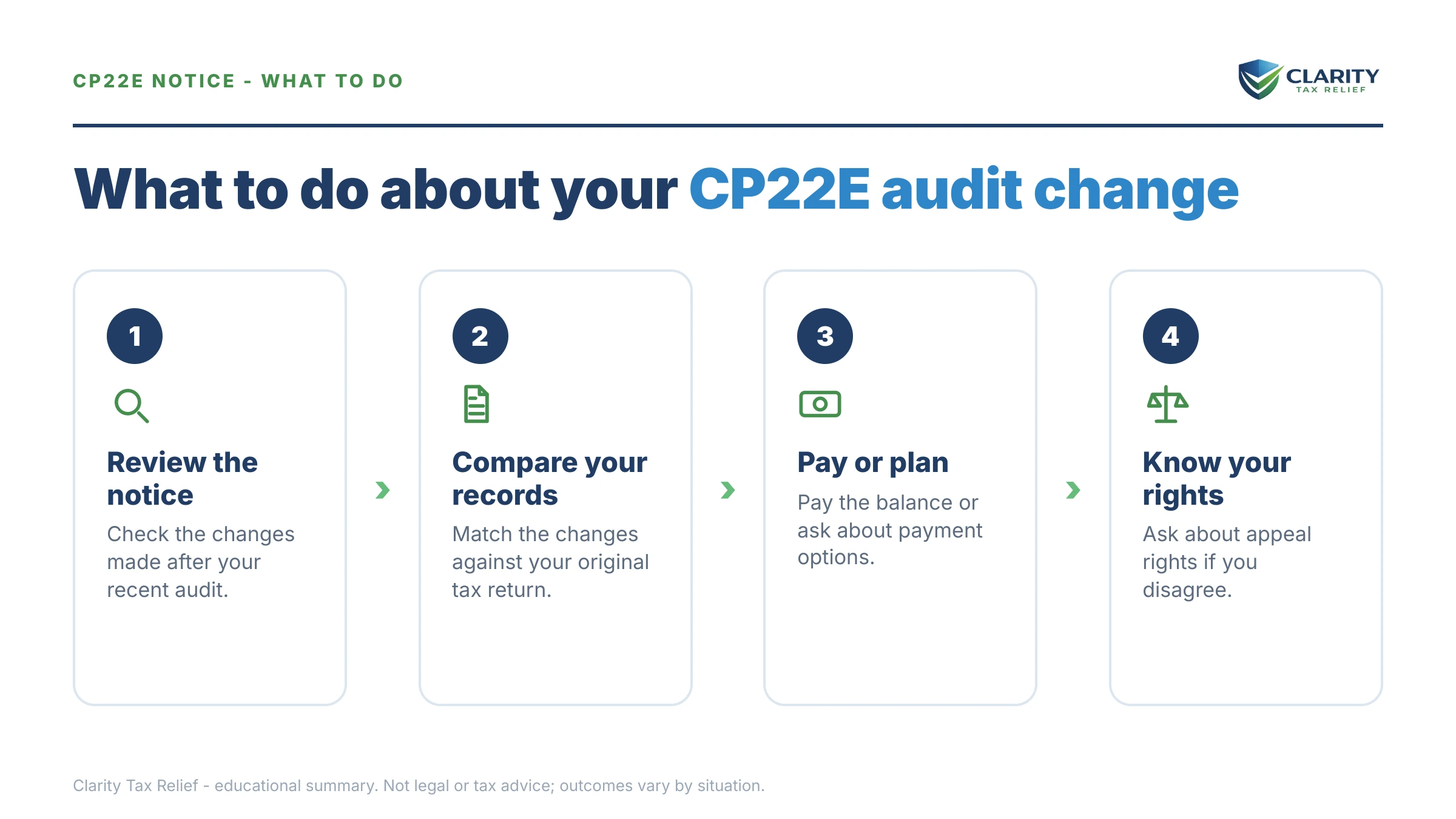
How to respond to a CP22E, step by step
- Verify the assessment — Log into your IRS online account or pull your account transcript and confirm a code 300 assessment matching the CP22E amount and tax year.
- Compare the notice to your audit report — Match the CP22E figures against the Form 4549 examination report you received or signed — the tax, penalty, and interest lines should reconcile.
- Pay or arrange payment by the printed date — If the changes are correct, pay at IRS.gov or open a payment plan before the pay-by date — that stops the collection sequence even if you can't pay in full.
- Request audit reconsideration if you disagree — Send the documentation the examiner never saw, with a short letter explaining what's new, to the address on your audit report.
- Ask for penalty relief on the penalty portion — Request first-time abatement on the failure-to-pay penalty if your prior three years were clean, and raise reasonable cause on the accuracy-related penalty if you have grounds.
- Get experienced help if the case is complicated, If you never participated in the audit, multiple years were changed, or business income drives the balance, have an experienced tax professional review it before you commit to a plan.
What if you disagree with the audit changes?
An assessed audit balance can still be reopened — through audit reconsideration or a doubt-as-to-liability offer — even though the normal appeal window has passed. This is the single most important thing the CP22E doesn't tell you.
Audit reconsideration asks the IRS to re-examine the assessment. It's designed for three situations: you have new documentation the examiner never saw, you never received the audit correspondence (a moved address is the classic case), or you never had a real chance to respond. There's no form fee and no deadline other than the collection statute itself. But the IRS won't reconsider if you signed a formal closing agreement, an Offer in Compromise already resolved the year, or a court has ruled on it. Reconsideration doesn't pause collection by itself, so pair it with a payment arrangement or a collection hold request while it's pending.
Doubt-as-to-liability OIC (Form 656-L) is the second route: you offer what you believe the correct liability actually is, with documentation. The IRS evaluates the merits. Unlike the standard OIC, it carries no application fee and doesn't require disclosing your finances — it's a dispute tool, not a hardship tool.
Collection Due Process is the backstop. If the balance ever reaches the LT11 stage, filing Form 12153 within the 30-day window gets you a hearing where liability can sometimes be raised, but waiting for that stage means months of added interest and a lien risk you don't need to take. If the IRS's own delay caused part of the interest, interest abatement under §6404 is occasionally available too. Interest is otherwise nearly impossible to remove.
If reconsideration stalls and the balance is causing real harm, the Taxpayer Advocate Service can force movement. It exists precisely for cases stuck in the machine.
CP22E codes on your IRS transcript
Your account transcript tells the whole CP22E story in five or six lines, and checking it is free. Here's how to read what you'll see:
| Code | What it means | What to do |
|---|---|---|
| 300 | Additional tax assessed by examination — the core of your CP22E balance | Confirm the amount and tax year match your Form 4549 exam report |
| 420 / 421 | Examination opened / examination closed | A 421 confirms the audit is over; the assessment that follows is what you're being billed for |
| 240 | Penalty assessed, often the 20% accuracy-related penalty from the exam | Check whether a reasonable-cause challenge is realistic before paying it |
| 276 | Failure-to-pay penalty accruing on the unpaid balance | Ask about first-time abatement if your prior three years were clean |
| 196 | Interest charged — running from the original return due date | Interest is rarely removable except for IRS error or delay; paying faster is the only real lever |
| 971 | Notice issued — the transcript's record of the CP22E mailing | The date here anchors your pay-by window; keep the notice with your records |
If the transcript shows a code 290 instead of a 300, the additional tax came from a non-exam adjustment — worth knowing, because it changes which remedies apply.
When you can handle a CP22E yourself
Plenty of CP22E cases don't need professional help, and it would be dishonest to pretend otherwise. If you participated in the audit, agree the changes are correct. The balance is one you can pay within 180 days or fold into an online streamlined plan under $50,000, you can resolve this yourself in an afternoon through your IRS online account. Add a first-time abatement request by phone and you may trim the failure-to-pay penalty on your own.
Experienced help changes outcomes in a narrower set of situations: you never participated in the audit and need reconsideration built properly the first time (a sloppy reconsideration package gets rejected and rarely gets a second look). The accuracy-related penalty is a meaningful share of the balance and you have a genuine reasonable-cause story. Multiple years were changed or are exposed to the same issue. The debt rides on self-employment income where an eventual levy would hit your clients directly. Or the balance is large enough that OIC math is worth running before you lock into six years of payments. In those cases, the order you fix things in — dispute, penalties, then the balance — determines what you ultimately pay.
Terms on your CP22E, decoded
- Assessment — the formal recording of a tax debt on your IRS account. Once assessed, the amount accrues interest and can be collected by lien or levy.
- Notice and demand — the legal function a CP22E performs: officially telling you the assessed amount and demanding payment, which starts the collection clock.
- Form 4549 — the examination report listing every change the audit made; your CP22E figures should trace back to it line by line.
- Audit reconsideration — the IRS process for re-opening a closed exam when you have new documentation or never got the chance to respond.
- Accuracy-related penalty — a 20% penalty on the portion of tax attributable to negligence or substantial understatement, commonly added by exams.
- CSED — the Collection Statute Expiration Date: the IRS generally has 10 years from the assessment date to collect, though appeals, offers, and bankruptcy pause the clock.
The IRS's own plain-language page for this notice is at Understanding your CP22E notice, and every payment method — full pay, short-term, or monthly — starts at IRS.gov/payments.
CP22E questions, answered
What is an IRS CP22E notice?
A CP22E notice means the IRS finished auditing your tax return, made changes, and has now assessed additional tax — the balance is legally on your account. Pay or set up a payment arrangement by the date printed on the notice. Interest and a monthly late-payment penalty keep the amount growing until you act.
Is a CP22E notice serious?
Yes — more serious than a routine bill, because the amount has already been assessed after an audit and your main chances to dispute it have narrowed. Nothing is being levied yet, though. You still have the full menu of payment options, plus audit reconsideration if you have new documentation the examiner never saw.
Can I still dispute the audit changes after getting a CP22E?
Often, yes. Audit reconsideration lets the IRS re-open the exam if you have new documentation, never received the audit letters, or never got a chance to respond. A doubt-as-to-liability Offer in Compromise (Form 656-L) is a second route. Neither is available if you signed a closing agreement or a court has already ruled on the year.
What is the difference between a CP22E and a CP22A notice?
The source of the change. A CP22E reports changes made by an IRS examination, an audit, while a CP22A reports changes made from information you provided, such as a correction or amended figures. Both end in a balance due, but only the CP22E carries audit-specific remedies like audit reconsideration, and it often includes a 20% accuracy-related penalty.
What if I never knew I was audited before the CP22E arrived?
That happens more than you'd think — most individual audits are done entirely by mail, and if the letters went to an old address the exam can close by default. If you never got a chance to respond, audit reconsideration is built for exactly this: send the documentation the examiner never saw. The IRS can revisit the assessment. Update your address with Form 8822 so the next notice reaches you.
How long do I have to pay a CP22E notice?
Your deadline is the pay-by date printed on the notice itself. That date controls, so check your copy rather than a generic rule. After it passes, interest and the 0.5% monthly failure-to-pay penalty continue and the automated reminder sequence (CP501, CP503, CP504) begins. Setting up a payment plan by the printed date stops the escalation even if you can't pay in full.
Can the penalties on a CP22E be removed?
Sometimes, and it's worth pursuing because penalties can be a fifth or more of the balance. The failure-to-pay penalty may qualify for first-time abatement if your prior three years were clean, and starting summer 2026, the IRS's Automatic Exemption from Penalty applies some of this relief without a request. The 20% accuracy-related penalty is harder: it requires showing reasonable cause and good faith for the position the audit rejected.
Will the IRS levy my bank account right after a CP22E?
No. A CP22E is a bill, not a levy notice — the IRS must first send you the escalating notice sequence, ending with a final notice of intent to levy (LT11 or Letter 1058) and a 30-day window to request a hearing. Levies only follow if every one of those notices goes unanswered. That's typically months away, which is exactly why acting now is cheap.
Will a CP22E balance take next year's tax refund?
Yes — any federal refund you're owed will be applied to the assessed balance automatically until it's paid, even if you're on a payment plan. Your state refund is also reachable once a CP504 issues. If applying a refund would create a serious hardship, an offset bypass refund is occasionally possible. But you have to raise it before the refund posts.
Your next 24 hours
- Find two things on your CP22E: the tax year in the top corner and the pay-by date next to the total. Those two facts determine your timeline and which remedies apply.
- Gather your paper trail: the Form 4549 exam report (if you have it), the return for the audited year, and whatever substantiation the audit was about — receipts, mileage records, bank statements.
- Get the notice reviewed free before the pay-by date passes: the 2-minute form or (888) 825-7779. Ten minutes with an experienced tax professional tells you whether to pay, plan, or dispute, before the balance grows another month.
This guide is general information, not tax or legal advice for your specific situation. Eligibility for IRS programs depends on individual facts and circumstances; no outcome is guaranteed.