
IRS Data & Statistics
IRS Tax Lien Statistics: How Many Liens the IRS Files in 2026 (and What the Numbers Mean)
What this episode covers
- Does a federal tax lien still show up on my credit report?
- What is the IRS silent statutory lien under section 6321?
- What is the difference between an IRS lien release and a lien withdrawal?
- How long do I have to request a CDP hearing after receiving IRS Letter 3172?
The short answer: IRS tax lien statistics show a steep long-term decline. The IRS filed roughly 1.1 million Notices of Federal Tax Lien at its fiscal-year-2010 peak, versus roughly 200,000 or fewer per year in recent IRS Data Books — a drop of more than 80%. Filings now concentrate on unpaid balances over $10,000 that go unanswered.
You're probably not looking up IRS tax lien statistics for a school paper. There's a balance with your name on it, or a parent's. You want to know whether a lien against the house is a real threat or a collection-letter scare tactic. The honest answer is in the numbers, and so is the way out.
Here's the map: what the filing data actually shows, who the IRS still files against in 2026, what a lien does once it lands, and every path to getting one released, withdrawn, or worked around. The image below shows how the lien numbers and the lien process fit together, so keep it in view as you read.
⏱ The one hard clock: if you received Letter 3172 — notice of federal tax lien filing, you typically have 30 days to request a Collection Due Process hearing on Form 12153. There's no deadline printed on a statistic, but interest and the 0.5% monthly failure-to-pay penalty post against your balance every month you wait.
IRS tax lien statistics at a glance (2026)
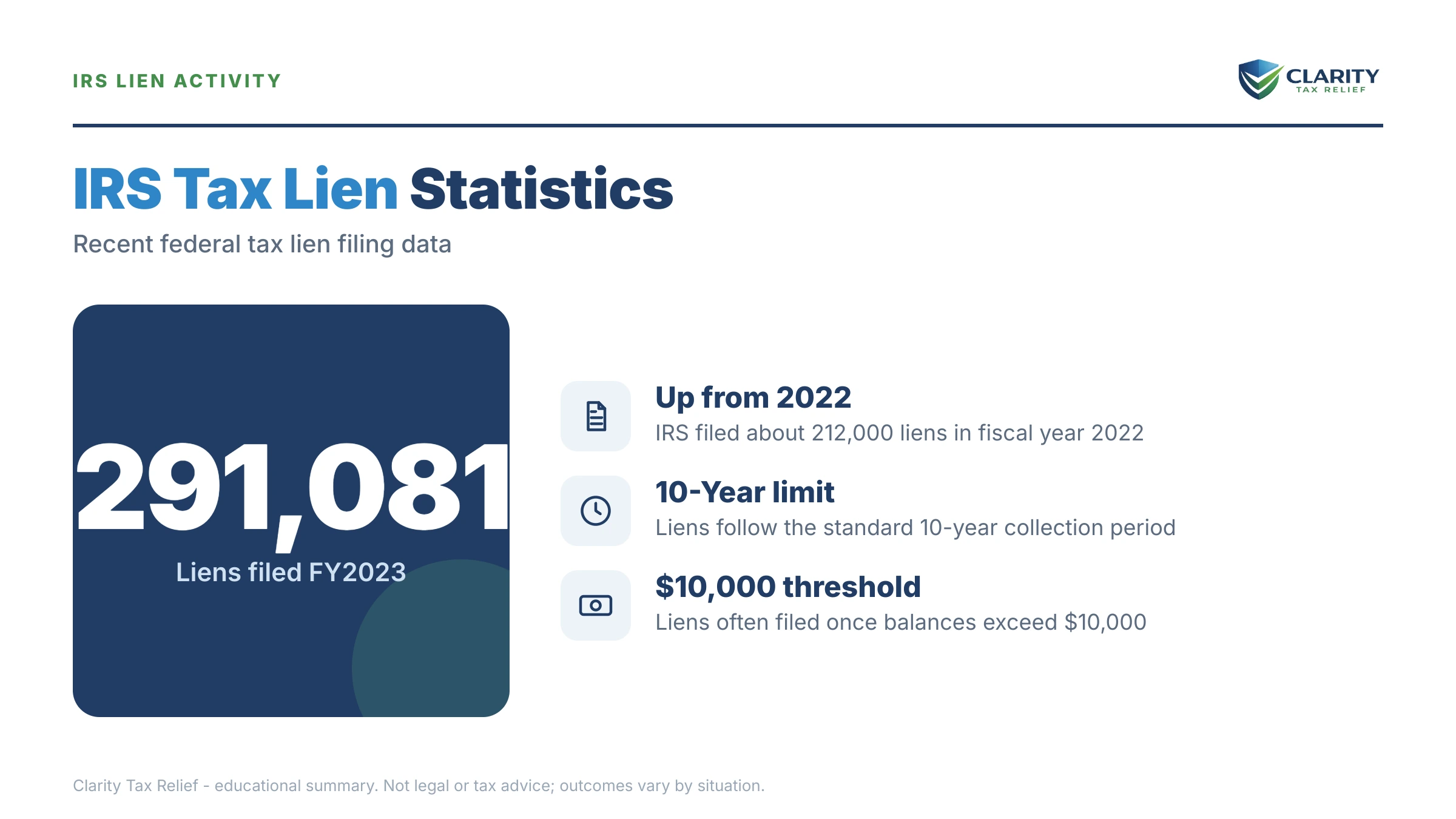
The IRS filed close to 1.1 million Notices of Federal Tax Lien in fiscal year 2010, and files roughly 200,000 or fewer per year in recent Data Books. That single comparison drives almost everything else on this page: the lien is used far more selectively than it was fifteen years ago. But it never went away.
| Statistic | Figure | Why it matters |
|---|---|---|
| Peak annual lien filings | Roughly 1.1 million (FY2010) | The high-water mark, before the 2011 Fresh Start changes |
| Recent annual lien filings | Roughly 200,000 or fewer | A decline of more than 80% from the peak |
| Typical filing threshold | $10,000 unpaid balance | General policy since 2011; filings below it are uncommon |
| Liens on credit reports | Zero since 2018 | All three bureaus removed tax liens from credit files |
| How long a lien lasts | 10 years from assessment | Self-releases at the CSED unless refiled or the clock is paused |
| Release after full payment | Within 30 days | Required by law once the debt is satisfied |
| Appeal window after filing | 30 days from Letter 3172 | Your Collection Due Process hearing right, via Form 12153 |
One caution before you relax at the low recent numbers: these figures count only public lien filings. As you'll see next, the statistics dramatically undercount how many taxpayers are actually under a lien.
How many tax liens does the IRS file each year?
The published lien counts trace a long, steady fall: from roughly 1.1 million filings in FY2010, through several hundred thousand a year across the mid-to-late 2010s, down to roughly 200,000 or fewer in the most recent IRS Data Books. The pandemic years accelerated the drop, and filings never returned to their old volume.
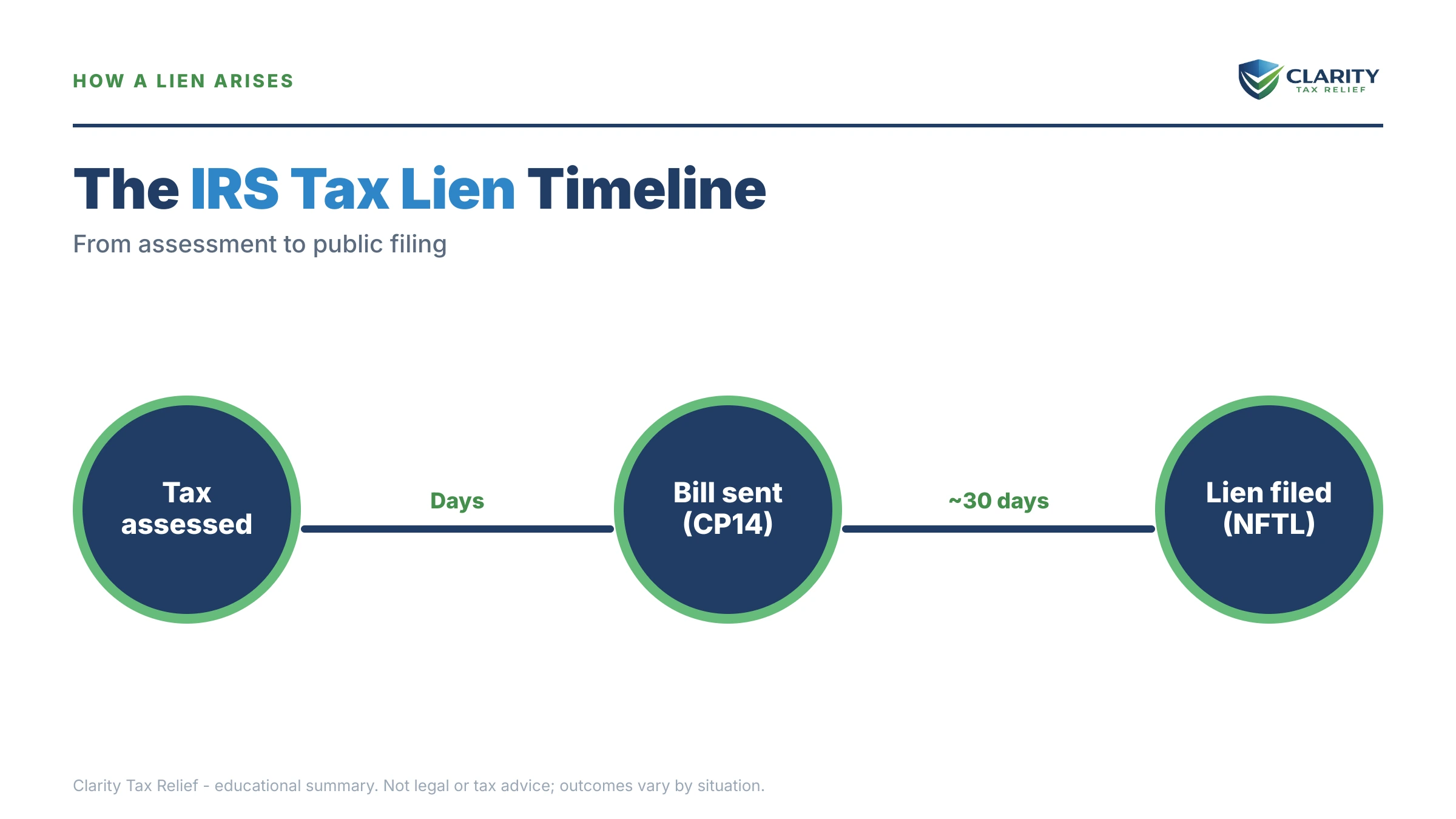
But there's a statistical trap in those numbers. The Data Book counts Notices of Federal Tax Lien, the public filings, not liens themselves. Under IRC §6321, a "silent" statutory lien attaches automatically to everything a taxpayer owns the moment tax is assessed, a demand is sent. The balance goes unpaid. No county filing, no letter, no line in any table.
That means millions of Americans with unpaid assessed balances are already under a federal tax lien in the legal sense. The statistics only measure how often the IRS chooses to make one public — the step that hits county records, title searches, and lenders. If you owe, the question isn't whether a lien exists. It's whether the IRS files the notice.
Two more quirks worth knowing when reading lien data. First, a single filing can cover multiple tax years, so filing counts understate the number of debts involved. Second, the IRS files where you own or may acquire property, often your home county, which is why the same taxpayer can appear in more than one recorder's office. If you want to see what a search turns up, our guide to the tax lien public record walks through where liens are recorded and how to look one up.
“A federal tax lien is the government’s legal claim against your property when you neglect or fail to pay a tax debt. The lien protects the government’s interest in all your property, including real estate, personal property and financial assets.”
— Understanding a federal tax lien (IRS.gov)
Why federal tax lien filings dropped more than 80%
The collapse in lien filings came from deliberate policy changes and shrinking staff — not from the IRS deciding liens don't work. Three events explain most of the curve:
2011 — Fresh Start raised the bar. The IRS lifted its general lien-filing threshold from $5,000 to $10,000 and created new withdrawal paths for taxpayers who got into direct-debit payment plans. Overnight, a huge band of smaller balances came off the lien track, and filings fell sharply through the decade.
2018 — credit bureaus dropped tax liens. All three major bureaus removed tax liens from consumer credit reports, which changed what a filing actually does to you. A lien no longer dents your credit score, but it remains a public record that title companies and mortgage underwriters find every time. The full story is in our guide to a tax lien on credit report rules in 2026.
2020–2025 — fewer humans, same machine. Pandemic-era collection pauses cut filings further. The roughly 27% IRS workforce reduction in 2025 left far fewer collection employees to work cases. Critically, though, lien determinations are largely generated by automated systems that didn't get laid off. Fewer people answer the phone; the filings still print.
What the lien data means for your risk in 2026
A balance over $10,000 with unanswered IRS notices is the profile behind most lien filings in 2026. The statistics don't describe random enforcement. They describe a funnel, and you can tell roughly where you sit in it.
Your lien risk is higher when:
- Your balance exceeds $10,000 and you haven't responded to the notice stream. This is the core population behind the filing counts.
- Your balance exceeds $25,000 — larger balances draw a formal lien determination more often, especially without a direct-debit agreement in place.
- A revenue officer holds your case. ROs file liens early to protect the government's position, and business or payroll debts get filed fastest of all.
- You own real estate. A lien only bites where there's something to attach. A retiree with a paid-off house and a five-figure balance is, statistically, exactly whom the lien tool exists for — see what a federal tax lien on your house actually does and doesn't do.
- A payment plan defaulted — a broken agreement puts the account back in the enforcement queue with less patience the second time.
Your lien risk is lower when your balance is under $10,000, or when you're inside an active agreement — the IRS is far less likely to file against a taxpayer who sets up a streamlined plan on a balance of $25,000 or less before the determination is made. That timing point matters: the cheapest lien to deal with is the one that never gets filed.
Two edge cases change the picture. If property is jointly owned, the lien attaches only to the liable spouse's interest — messier in community-property states, and worth professional eyes before any sale. And state liens run on entirely separate systems with their own rules: California's FTB can collect for 20 years under R&TC §19255, and New York files tax warrants that operate as civil judgments on the public record. Never assume the federal numbers describe your state exposure.
What happens after a lien is filed if you do nothing
What happens after the notice is filed
A filed lien doesn't sit still — it's one stage in a sequence that keeps moving whether or not anyone at the IRS ever speaks to you. Here's the order of events:
- The silent lien already exists. Assessment, demand, nonpayment — the statutory lien attaches automatically to everything you own. No filing needed, and no statistic counts it.
- The public filing lands. The IRS records a Notice of Federal Tax Lien with your county — generally once the balance passes $10,000 unanswered — and mails Letter 3172 telling you it happened.
- Your 30-day appeal window opens, then closes. Letter 3172 carries the right to a Collection Due Process hearing. Miss it and you lose the strongest forum for challenging the filing or proposing an alternative.
- The levy track runs in parallel. A lien is a claim. A levy is a taking — the distinction is spelled out in lien vs. levy: the difference. The same account that drew a lien is also in the levy pipeline. The volume there tells its own story in our IRS levy statistics.
- Refile or self-release. The lien lives as long as the debt — 10 years from assessment unless the clock is paused — and the IRS can refile before it expires. "Waiting it out" means a decade of public record, blocked refinancing, and monthly interest and penalties the entire time.
The whole time this sequence runs, the balance grows. That's the real cost of doing nothing: not a dramatic seizure, but a quiet compounding while your options narrow.
Owe more than $10,000, or already saw Letter 3172?
The lien statistics say balances like yours are exactly where filings still happen. An experienced tax professional will review your account free, tell you whether a lien is filed or coming, and map the fastest path to release or withdrawal, before another month of interest posts.
Your options once a lien exists, and what each one costs
Every filed federal tax lien has at least one exit, and most taxpayers qualify for more than one. The shared background on how release timing works after payment lives in our hub on how long for the IRS to release a tax lien. Here's the full menu, matched to who qualifies:
| Option | Who may qualify | What it does to the lien |
|---|---|---|
| Pay in full | Anyone who can raise the funds | Release required within 30 days; the old filing stays in county records unless withdrawn |
| Withdrawal (Form 12277) | Balance of $25,000 or less on a direct-debit plan that full-pays within 60 months (or before the CSED), or debt paid in full | Erases the public filing as if it never happened |
| Direct-debit installment agreement | Balances of $50,000 or less can set up online, up to 72 months | Stops escalation; opens the withdrawal path at $25,000 or less |
| Offer in Compromise | Assets plus future income genuinely below the balance; roughly 1 in 5 offers accepted in FY2024 | Lien released after the accepted offer's terms are completed |
| Discharge (Form 14135) | Selling a specific property with the lien attached | Removes the lien from that one property so the sale can close |
| Subordination (Form 14134) | Refinancing, where the new loan helps the IRS get paid | Lets the lender jump ahead of the lien so the refinance can close |
| Currently Not Collectible | Paying would prevent basic living expenses | Pauses levies, but does not remove, and may not prevent, a lien filing |
| CSED expiration | 10 years from assessment, if the clock wasn't paused | The lien self-releases by its own terms |
A few of these deserve one sentence of nuance. Withdrawal is the gold standard because it erases the filing itself — the mechanics are in lien withdrawal (Form 12277). Subordination is how most people manage to refinance with an IRS lien in place. Hardship status has a catch worth reading before you count on it: does CNC stop a tax lien, often it doesn't. And if you're eyeing the 10-year clock, our CSED guide covers whether an IRS tax lien expires. You can estimate your own expiration window with the CSED Calculator — an estimate, since appeals, offers, and bankruptcy all pause the clock.
| Path | Out-of-pocket cost | Typical timeline |
|---|---|---|
| Pay in full | The balance itself; no application fee | Release required within 30 days of payment |
| Withdrawal (Form 12277) | No filing fee | Varies, often weeks to a few months after you qualify |
| Direct-debit installment agreement | Modest setup fee (reduced or waived for low-income applicants); interest and penalties keep accruing | Active as soon as the IRS approves it — often same-day online |
| Offer in Compromise | $205 application fee plus 20% down on lump-sum offers — both waived with low-income certification (AGI at or below 250% of the poverty level) | Commonly many months; deemed accepted if the IRS doesn't decide within 2 years, with narrow exceptions — a returned or rejected offer stops the clock, and time during court disputes does not count |
| Discharge / subordination | No filing fee | Apply well before closing — the IRS recommends at least 45 days |
| Currently Not Collectible | No fee; requires financial disclosure on a Form 433 | Reviewed periodically; interest keeps accruing while paused |
A worked example: a $23,800 balance on Social Security
Say you owe $23,800, you're retired, your only income is Social Security, and you own your home. This hypothetical sits almost exactly where the lien statistics point, so the math is worth walking through.
First, the exposure. At $23,800 you're well past the $10,000 lien-filing threshold, if the notice stream goes unanswered, a public filing against the house is a realistic outcome, not a scare line. You're comfortably below the $66,000 passport-certification threshold for 2026, so travel isn't on the table. And the lien itself never touches your monthly check, though the separate Federal Payment Levy Program can take up to 15% of Social Security, which is covered in can the IRS garnish Social Security.
Now the exits, with the arithmetic shown:
- 72-month plan: $23,800 ÷ 72 ≈ $331 per month before accruals — expect the real payment to run somewhat higher, since interest and the 0.5% monthly failure-to-pay penalty continue until the balance is gone.
- 60-month direct-debit plan: $23,800 ÷ 60 ≈ $397 per month. Because the balance is under $25,000 and it full-pays within 60 months, this route can also unlock a Form 12277 withdrawal — the lien filing erased from the public record, not just released.
- If $397 isn't there: a fixed income that's fully consumed by rent-equivalent costs, medical expenses, and food may qualify for Currently Not Collectible status. Levies stop; the lien question stays open, which is why the CNC-and-lien tradeoff deserves a careful read first.
- Offer in Compromise: tempting on paper, but the IRS measures offers against everything it could collect — including home equity. With, say, $80,000 of equity in the house, the collectible amount dwarfs $23,800 and a doubt-as-to-collectibility offer would very likely fail. Honest math beats wishful math here.
How to respond to a federal tax lien, step by step
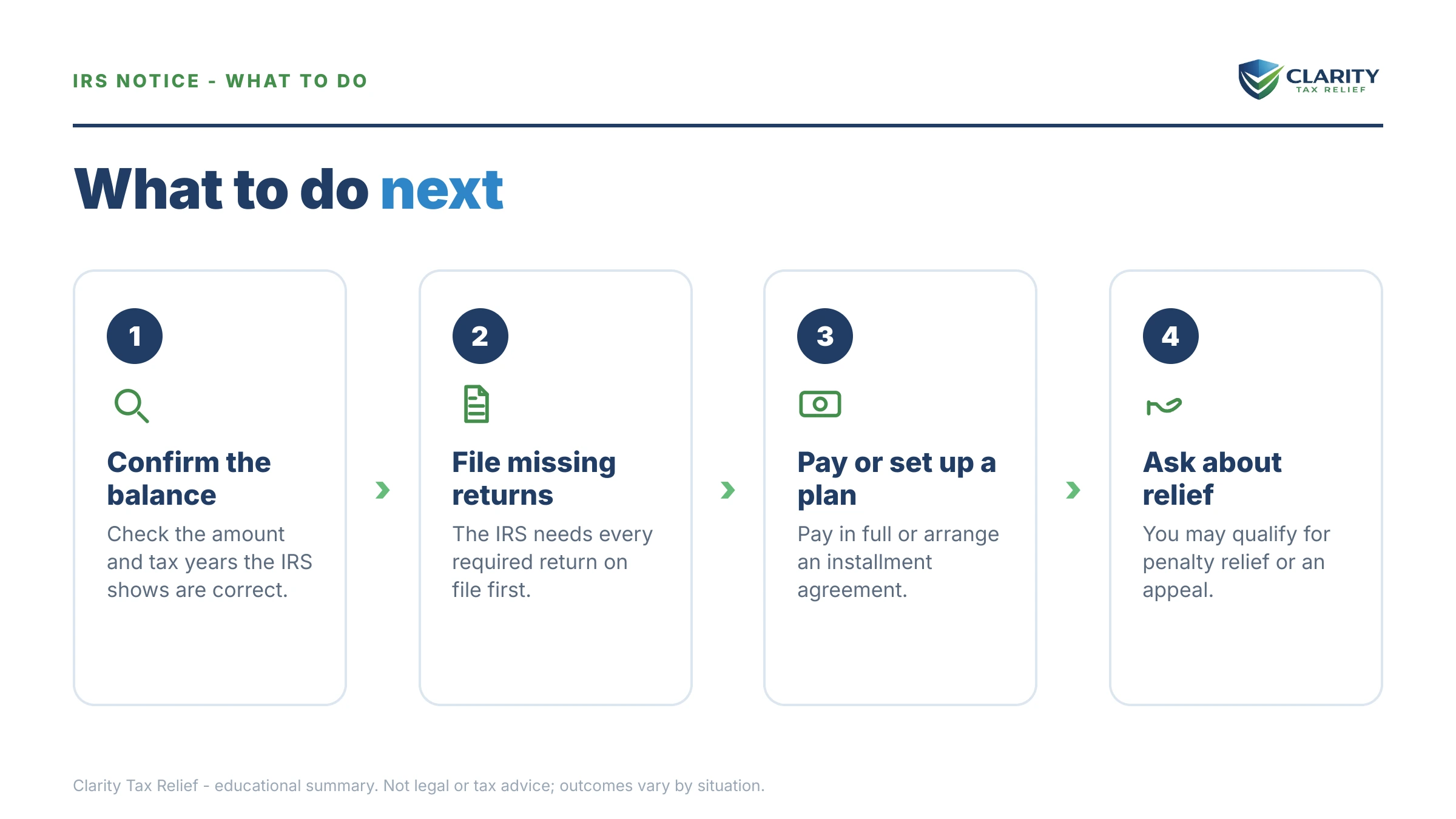
- Check your account. Log into your IRS online account and pull your account transcript to confirm the balance and look for transaction code 582, the lien indicator.
- Confirm the filing. Search your county recorder's records (or check for Letter 3172) to verify whether a Notice of Federal Tax Lien has actually been recorded.
- Protect your appeal rights. If Letter 3172 arrived within the last 30 days, file Form 12153 to request a Collection Due Process hearing before the window closes.
- Pick your resolution. Match your balance and income to an option: full payment, a direct-debit installment agreement, an Offer in Compromise, or Currently Not Collectible status.
- Clean up the record. Once you qualify, request a Certificate of Release or file Form 12277 for a withdrawal so the public record stops following you.
On that last step: the release document matters more than most people expect. Recorders and title companies don't reliably update on their own, and proving the lien is gone years later — at a closing, with a lender — is far easier with the paper in hand. Here's how to get and use the certificate of release of tax lien.
When you can handle a tax lien yourself
When you can handle a lien yourself
Plenty of lien situations don't need professional help. If your balance is under $10,000, a public filing is unlikely — set up a payment plan online and move on. If you can full-pay within 180 days, the short-term plan costs nothing to set up and the lien question usually never ripens. And if a lien was filed but you've since paid in full, requesting your release and filing Form 12277 for withdrawal is paperwork a careful person can do alone.
Experienced help changes outcomes in the harder cases: a lien surfacing days before a home sale or refinance closing, where discharge or subordination paperwork has to be sequenced against a lender's deadline. A levy notice running alongside the lien. Multiple unfiled years that block every resolution program. Offer math complicated by home equity. Or business and payroll debt, where liens get filed fast and reach inventory and receivables. In those situations, the order you fix things in changes what you pay, and mistakes are expensive to unwind.
If your lien is already tangled with a pending sale, a levy notice, or several unfiled years, have an experienced tax professional map the sequence before you file anything — the free case review exists for exactly that.
Lien terms behind the statistics, decoded
- Notice of Federal Tax Lien (NFTL): the public document recorded at your county that makes the government's claim visible to lenders and title searches — the thing the statistics count.
- Statutory (silent) lien: the automatic legal claim that attaches to everything you own once assessed tax goes unpaid after demand — it exists whether or not anything is ever filed.
- Release: the IRS's certification that the debt behind the lien is satisfied, required within 30 days of full payment — the filing itself stays in the record.
- Withdrawal: removal of the filed notice from the public record as if it hadn't been filed, requested on Form 12277.
- Discharge and subordination: a discharge (Form 14135) frees one specific property from the lien so it can sell. A subordination (Form 14134) lets a new lender move ahead of the lien so a refinance can close.
- CSED: the Collection Statute Expiration Date — 10 years from assessment, pausable by appeals, offers, and bankruptcy — at which the lien self-releases by its own terms.
Where these numbers come from: the filing counts on this page reflect the IRS Data Book's delinquent-collection tables, published annually at IRS.gov's statistics portal. The IRS's own plain-English overview of how liens arise and end is at Understanding a federal tax lien. The independent Taxpayer Advocate Service reports regularly on how lien policy affects taxpayers.
IRS tax lien statistics: your questions answered
How many tax liens does the IRS file each year?
Recent IRS Data Books show roughly 200,000 or fewer Notices of Federal Tax Lien filed per year, down from a peak of about 1.1 million in fiscal year 2010 — a decline of more than 80%. The drop reflects the 2011 Fresh Start threshold change and years of shrinking collection staff, not a decision to stop using liens. Filings concentrate on balances over $10,000 that have gone unanswered.
What is the minimum amount for the IRS to file a tax lien?
There is no legal minimum, but since the 2011 Fresh Start changes the IRS generally does not file a Notice of Federal Tax Lien until an unpaid balance passes $10,000. Below that, a filing is possible but uncommon. Above roughly $10,000, especially when notices go unanswered, a filing becomes a realistic outcome. A revenue officer can file at their discretion in higher-risk cases.
Do IRS tax liens show up on credit reports in 2026?
No. All three major credit bureaus removed tax liens from consumer credit reports in 2018, so a federal tax lien no longer appears on your credit file or directly lowers your score. It is still a public record, though — lenders, title companies, and anyone searching county records can find it, which is why liens still block refinances and complicate home sales.
How long does an IRS tax lien last?
A federal tax lien generally lasts as long as the underlying debt — 10 years from assessment under the collection statute, unless the IRS refiles it or the clock is paused by events like an Offer in Compromise, bankruptcy, or a Collection Due Process appeal. When the statute expires, the lien self-releases by its own terms. Waiting it out is rarely a plan, since the IRS can collect the entire time.
Does a tax lien mean the IRS is going to take my house?
No — a lien is a claim, not a seizure. It attaches to your home so the IRS gets paid if you sell or refinance, but actual seizure of a primary residence is rare and requires court approval. The far more common consequences are blocked refinancing, complicated sales, and the parallel levy track against bank accounts and income.
Can the IRS file a lien if my only income is Social Security?
Yes. A lien attaches to property — your home, vehicles, and anything you acquire later — regardless of your income source. Separately, the IRS can take up to 15% of Social Security through the Federal Payment Levy Program. But that is a levy, not the lien. If paying would leave you unable to cover basic living costs, Currently Not Collectible status can stop levies, though the lien itself can still be filed.
Why did IRS lien filings drop more than 80%?
Two forces. In 2011, the Fresh Start initiative raised the general filing threshold from $5,000 to $10,000 and created new withdrawal paths, cutting filings sharply. Then years of budget and staffing reductions, including a roughly 27% workforce cut in 2025, left fewer collection employees to work cases. Lower filing volume does not mean lower risk for balances over $10,000 that ignore notices.
Does paying off my tax debt remove the lien right away?
Full payment requires the IRS to release the lien within 30 days. But the release only says the debt is satisfied — the original filing stays in county records. To erase the filing itself, request a withdrawal on Form 12277 after payment. Get and keep the Certificate of Release; county recorders and title companies do not always update automatically.
Will the IRS file more tax liens in 2026?
Nobody can promise a number. But the ingredients point to continued automated enforcement: collection notices are flowing at full volume, the systems that generate lien determinations run without human staffing. The workforce cuts hit phone help harder than automated filing. Treat any balance over $10,000 as lien-eligible in 2026 rather than betting that a smaller IRS will never get to your file.
Your next 24 hours
- Find your number. Log into your IRS online account, or dig out your most recent notice, and write down the exact balance and tax years. If Letter 3172 is in the pile, circle its date: your 30-day hearing window runs from it.
- Gather three things: your last filed return, every IRS notice you have, and proof of your monthly income and essential expenses — for a retiree, the Social Security award letter and a recent bank statement do most of the work.
- Get the free review. Call (888) 825-7779 or use the 2-minute form. If your balance is over $10,000, the statistics say you're on the lien track — find out which exit fits before another month of interest and penalties posts.
This guide is general information, not tax or legal advice for your specific situation. Eligibility for IRS programs depends on individual facts and circumstances; no outcome is guaranteed.