
IRS Data Studies
1099-K Threshold Changes: The Complete Year-by-Year Timeline (2026 Data Study)
Read the transcript
Host: So you've got a 1099-K sitting in your inbox, or maybe one that never showed up, and you've read five articles that gave you five different dollar amounts. $600, $5,000, $20,000. And now you don't know which one applies to you.
Tax specialist: All five were real. That's the thing people can't get their heads around. They just governed different tax years.
Host: Okay, walk me through it. Slowly.
Tax specialist: Through 2021, the rule was $20,000 in payments and more than 200 transactions. Both. Then the American Rescue Plan Act of 2021 dropped it to $600 with no transaction minimum at all. Then the IRS, instead of enforcing that, issued transition relief. Notice 2024-85. That set $5,000 for tax year 2024 and $2,500 for tax year 2025. And then the One Big Beautiful Bill Act in 2025 went back and retroactively restored the old $20,000 and 200 transactions.
Host: Wait. Retroactively?
Tax specialist: Retroactively. Which is why the $2,500 tier never actually governed a filing season. It was scheduled, then it was gone before any platform filed a form under it.
Host: So five changes in four years, and it ends up exactly where it started.
Tax specialist: Right where it started. One of the most whipsawed reporting rules in recent tax history, honestly.
Host: Then let me ask the question the listener actually cares about. If the number went back to $20,000, does that clean up 2024?
Tax specialist: No. And this is the row on that timeline table that matters most for anyone who owes. Platforms actually filed forms under the $5,000 rule for tax year 2024. Those forms exist. They went to you and they went to the IRS. A threshold change isn't an amnesty.
Host: So the form's in the system under my Social Security number.
Tax specialist: Under your Social, the moment it was transmitted. Before you did anything at all.
Host: Hm. Okay, that's the part I think people miss.
Tax specialist: And there's a second thing they miss, which cuts the other way. The threshold only decides when a platform has to file a form. It has never decided what income is taxable. Self-employment income is reportable from the first dollar. Self-employment tax generally applies once net earnings hit $400 for the year.
Host: So a reseller who grosses $8,000 on eBay in 2026 —
Tax specialist: Gets no federal 1099-K, and still owes tax on the profit. Same with a rideshare driver at $19,000 across 400 trips. The transaction test passes, the dollar test fails, and both have to be met, so no form. Income's still income. Oh, and some states set their own lower thresholds, so a form can show up below the federal trigger anyway.
Host: Let's talk about what happens if somebody just... doesn't deal with it. Because I think that's the listener right now.
Tax specialist: It's automated. Match, propose, assess, collect. The platform files. The document-matching program compares that form against your return, typically more than a year after filing season. If you filed and left the income off, you get a CP2000 proposing tax on the gross amount.
Host: Gross meaning —
Tax specialist: Everything processed through the platform. Before fees, before refunds, before shipping, before cost of goods. No mileage. A 1099-K reports gross, never profit. So the CP2000 proposes tax on a number that has nothing to do with what you actually made.
Host: And if you never filed at all?
Tax specialist: The IRS can prepare a substitute for return for you. Built from that same gross figure, with zero deductions. Then the assessment enters collections — a CP14 bill, then reminders, then a CP504 saying they intend to levy your state refund, then an LT11 final notice that opens a 30-day window before wage garnishment and bank levies become legal.
Host: CP504, then LT11. And that's the 30-day one.
Tax specialist: That's the 30-day one. And every stage costs more than the one before it, because the balance the machine is chasing was computed without a single deduction you were entitled to claim.
Host: There's no deadline on a threshold change, though, right? Nothing to respond to.
Tax specialist: No deadline, no. But the clock that matters is the penalty clock. Every unfiled year of platform income accrues failure-to-file at 5% a month, capped at 25%. That's ten times the 0.5% monthly failure-to-pay rate. Plus interest compounding daily. The rule changed. The accrual never paused.
Host: Okay so what's the move. What does somebody actually control here?
Tax specialist: Two things, and there's a sequence. First, pull your IRS wage and income transcript for every open year. That tells you exactly which 1099-Ks they hold. Stop guessing. Second, and this is the sequencing rule that beats every other consideration — file every unfiled return before you negotiate anything.
Host: Why before?
Tax specialist: Two reasons. The IRS won't approve a payment plan or an offer with open non-filed years, full stop. And filing is what replaces that deduction-free gross figure with your real, lower numbers. The article has a hypothetical — a gig worker who grossed $26,000 in 2024. Filing a Schedule C with 13,000 business miles at the 2024 rate of 67 cents pulls about $8,710 out of that. If nobody files and the IRS builds the substitute return, there's no mileage deduction at all, and it adds roughly $1,800 more per year.
Host: Per year. Say the resolution options, quickly. What's on the menu?
Tax specialist: Short-term plan if you can pay in full within 180 days, no setup fee. There's the Guaranteed Installment Agreement, which is for $10,000 or less with returns filed — approval there is a matter of law when the conditions are met, up to three years to pay. Streamlined agreements at $25,000, or $50,000 with direct debit, no detailed financial disclosure. Currently Not Collectible if paying anything would prevent basic living expenses, and note, the debt stays and interest keeps running. And Offer in Compromise, where the standard is that assets plus future income genuinely can't cover the debt.
Host: And that one's hard.
Tax specialist: It's hard. $205 fee, 20% down on lump-sum offers, both waived with low-income certification. And the IRS accepted roughly one in five offers in FY2024. Everything depends on individual facts. Nobody can tell you where you land on that.
Host: Penalty relief?
Tax specialist: Free to request. First-time abatement or reasonable cause, and first time abatement is being replaced by the Automatic Exemption from Penalty starting summer 2026 — automatic, no request needed. But you request it after the returns are in, not before.
Host: Last thing. When is this a do-it-yourself job?
Tax specialist: When the years are filed, the balance is small, and the numbers on the form are right. One recent year you can rebuild from an annual summary, a balance you can clear in 180 days, or a form that misclassified personal transfers, and you fix that with the platform, not the IRS. That's an afternoon.
Host: And when it's not?
Tax specialist: Multiple unfiled years, where the order and content of those returns drives everything after. A CP2000 or a substitute-for-return assessment built on gross figures you need to rebut. A balance too big for streamlined. Or offer math where one miscalculated figure means automatic rejection. In those cases the work is mostly arithmetic and sequencing, but it's arithmetic the automated system will never do in your favor.
Host: So for the next 24 hours: list every year since 2021 you earned money through an app or a marketplace. Check each one against that timeline. Pull the platform summaries and your last filed return.
Tax specialist: And if any of those years is unfiled or unreported, get someone to pull the transcripts with you. Clarity's Enrolled Agents do a free, confidential case review — 888-825-7779. It costs nothing, and it's a lot better than guessing which of those five numbers was yours.
The short answer: the 1099-K threshold changed five times in four years — $20,000 and 200 transactions through 2021, $600 under the American Rescue Plan Act of 2021, $5,000 for tax year 2024 and $2,500 for tax year 2025 under IRS Notice 2024-85, then back to $20,000 and 200 transactions under the One Big Beautiful Bill Act (2025).
You searched this because five different articles gave you five different numbers — $600 on one page, $5,000 on another, $20,000 on a third — and you need to know which one actually applies to the 1099-K sitting in your inbox (or the one that never arrived). All five numbers were real. They just applied to different years, and knowing which rule governed which year is what tells you what the IRS already has on file about you.
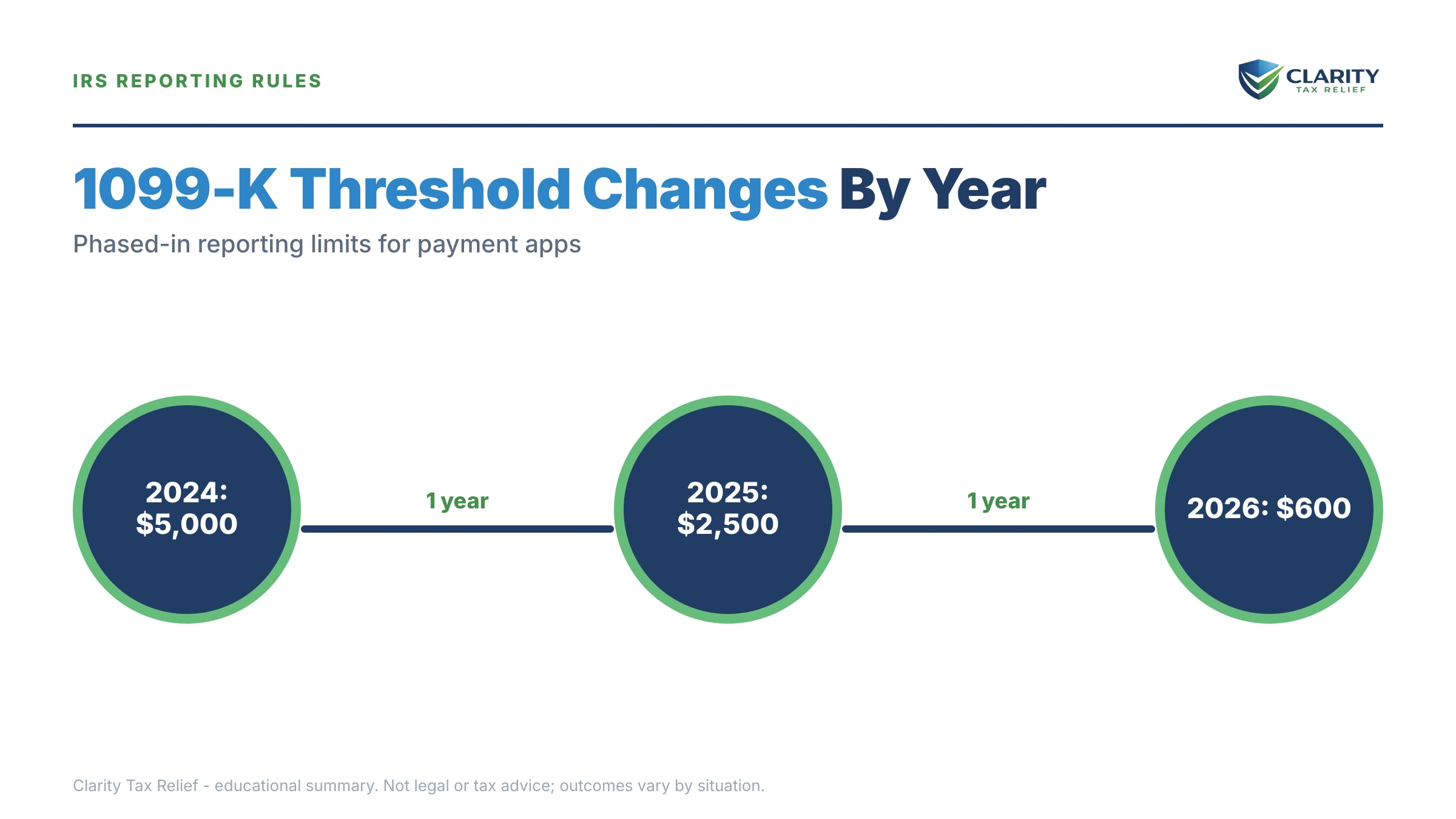
Here's the whole story in one sentence: in four years the 1099-K reporting trigger swung from $20,000 to $600 to $5,000 to $2,500 and then back to $20,000, one of the most whipsawed reporting rules in recent tax history. The image below shows exactly how the threshold moved year by year, so you can find your years at a glance.
⏱ The real clock: there is no response deadline attached to a threshold change, but every unfiled year of platform income accrues a failure-to-file penalty of 5% per month, capped at 25% — ten times the 0.5% monthly failure-to-pay rate — plus interest that compounds daily. The rule changed; the accrual never paused.

1099-K threshold changes: the complete timeline
The Form 1099-K reporting threshold changed five times between 2021 and 2025 and ended exactly where it started: $20,000 in payments AND more than 200 transactions. Both conditions must be met before a payment platform — PayPal, Venmo, eBay, Etsy, Uber's third-party processors, ticket resale sites — is required to send a form to you and to the IRS.
| Tax years | Reporting threshold | Transaction minimum | Set by |
|---|---|---|---|
| Through 2021 | $20,000 | More than 200 transactions | Original pre-ARPA rule (IRC §6050W) |
| Enacted 2021 | $600 | None | American Rescue Plan Act of 2021 |
| Tax year 2024 | $5,000 | None | IRS transition relief (Notice 2024-85) |
| Tax year 2025 (as scheduled) | $2,500 | None | IRS Notice 2024-85 — superseded before the filing season |
| 2025 and forward | $20,000 | More than 200 transactions | One Big Beautiful Bill Act (2025), retroactive |
Two rows matter most for anyone who owes. First, tax year 2024: platforms actually filed forms under the $5,000 rule, so if you crossed that line in 2024, the IRS has your gross payment total on file whether or not you reported it. Second, the last row: the One Big Beautiful Bill Act (2025) retroactively reinstated the $20,000-and-200-transactions threshold that existed before ARPA, which means the $2,500 tier scheduled for tax year 2025 never governed a filing season. For the current-year rule in detail, see our guide to the 1099-K threshold 2026.
“Third party settlement organizations (TPSOs) (payment apps and online marketplaces) are required to report payments on Form 1099-K when the total amount of payments you receive for goods or services through the platform exceeds $20,000 in more than 200 transactions.”
— Understanding your Form 1099-K (IRS.gov)
Why the threshold swung from $20,000 to $600 and back
Why the threshold swung five times
Congress set the $600 threshold, the IRS delayed it, and Congress repealed it — each move driven by the sheer volume of forms it would have created. The American Rescue Plan Act of 2021 set a $600 threshold with no transaction minimum, which would have pushed 1099-Ks to tens of millions of casual sellers, roommates splitting bills through mislabeled payments, and people offloading used furniture at a loss.
The IRS never enforced $600 as written. Instead it issued transition relief — Notice 2024-85 set a $5,000 threshold for tax year 2024 and $2,500 for tax year 2025 — buying time for platforms and taxpayers to adjust. Before the $2,500 tier ever produced a form, the One Big Beautiful Bill Act (2025) erased the ARPA change retroactively, restoring the pre-2022 standard.
The practical result is messy in exactly one way: the years 2024 and (for some early-reporting platforms) 2025 generated a wave of forms that will never exist again at those dollar levels. The IRS's matching computers keep every one of them.
What the threshold changes do, and don't, change
The 1099-K threshold decides when a platform must file a form; it has never decided whether your income is taxable. That distinction is the single most misunderstood part of this whole saga, and it cuts in both directions.
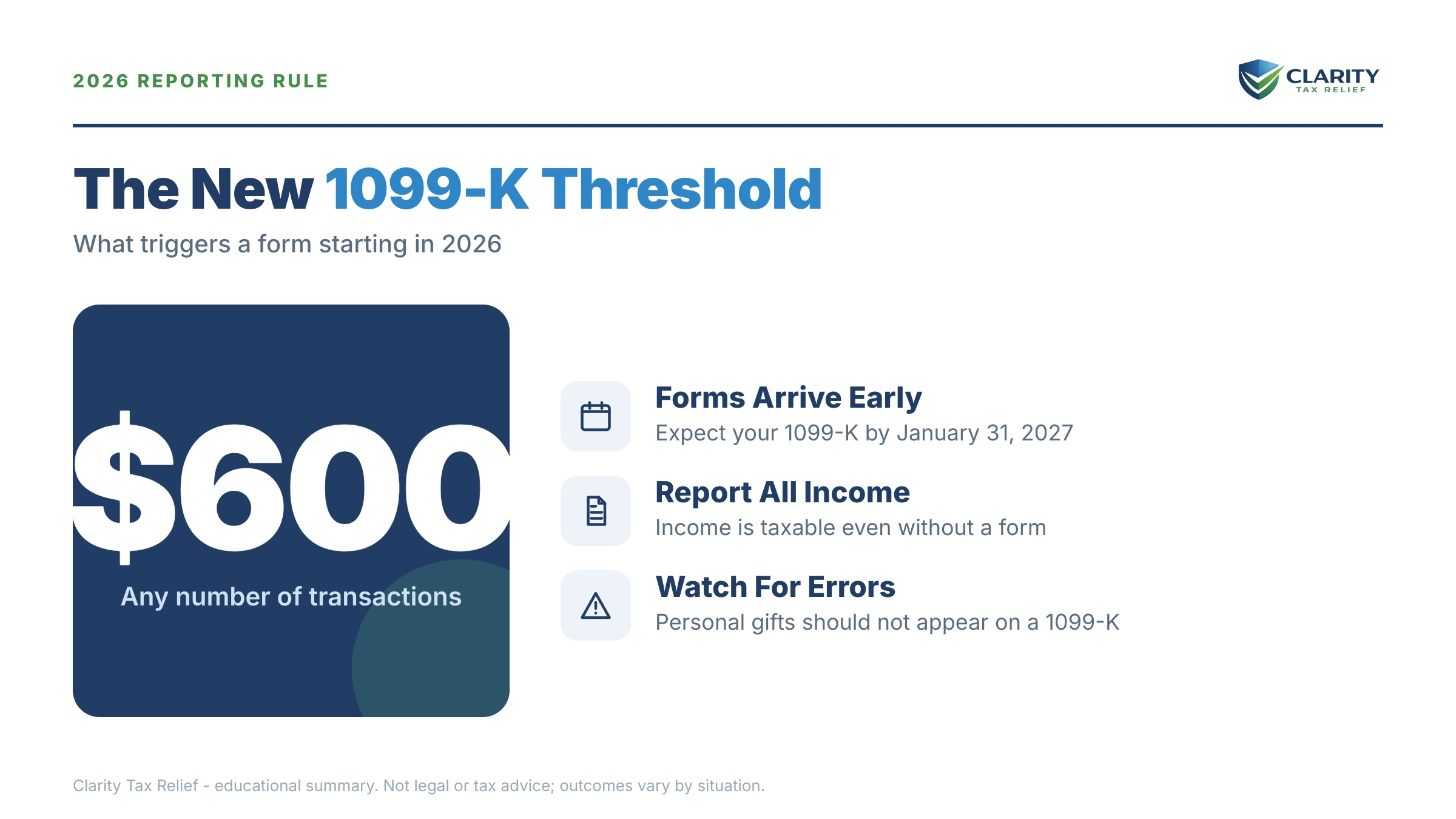
What the return to $20,000 changes: fewer forms. A reseller who grosses $8,000 on eBay in 2026 won't get a federal 1099-K. A rideshare driver who grosses $19,000 across 400 trips won't either — the dollar test fails even though the transaction test passes, and both conditions must be met. (Some states set their own lower reporting thresholds, so a form can still arrive below the federal trigger.)
What it does not change: your filing obligation. Self-employment income is reportable from the first dollar, and self-employment tax generally applies once net earnings hit $400 for the year. It also does not change the past. Forms already filed under the $5,000 rule for 2024 sit in IRS systems, feeding the same document-matching program we analyzed in our IRS CP2000 underreporter statistics study. The $600 rule is dead; the debt it surfaced is not. Sellers in this exact spot should read our guide to eBay seller tax debt 1099-K.
Where the 1099-K sits among the other forms
A 1099-K is an information return filed by a payment settlement entity, and it reports gross volume for a calendar year. That is a different thing from Form 1099-NEC, which a business files when it pays a contractor, and different again from Form 1099-MISC, which covers rent, prizes and the leftovers.
The distinction matters when the same income appears twice. A contractor paid through a platform can receive both a 1099-K from the platform and a 1099-NEC from the client, for the same money. Neither issuer is wrong, and the reporting requirements do not net themselves out. Reconciling that on the return is the taxpayer's job, and skipping it is what produces a notice eighteen months later.
What happens if you ignore platform income the IRS knows about
How automated matching escalates into collection
Platform income the IRS holds a 1099-K for but you never reported follows one automated path: match, propose, assess, collect. The sequence runs on computers, and 2026's reduced IRS workforce changed none of it — the humans got harder to reach. But the notices never stopped. The scale of what feeds this pipeline shows up in our IRS back tax debt statistics.
- The platform files. Your gross payments are on file with the IRS under your Social Security number the moment the form is transmitted, before you do anything at all.
- The matching program flags the gap. If you filed but left the income off, a CP2000 notice proposes tax on the gross amount — no mileage, no fees, no cost of goods — plus an accuracy penalty and interest. Ignore it and a Notice of Deficiency follows.
- If you never filed, the IRS files for you. After non-filer notices, the IRS can prepare a substitute for return — see what happens when the IRS filed a substitute return — built from the 1099-K gross with zero deductions.
- The assessment enters collections. A CP14 bill starts the notice ladder: reminders, then a CP504 intent to levy your state refund, then an LT11 final notice that opens a 30-day window before wage garnishment and bank levies become legal.
Every stage is more expensive than the one before it, because the balance the machine is chasing was computed without a single deduction you were entitled to claim.
Unreported 1099-K years piling up?
Whether it's one 1099-K you skipped or three years of gig income you never filed, an experienced tax professional can pull your IRS records, show you exactly what the IRS holds, and map the cheapest way out — free and confidential. Penalties and interest accrue every month you wait.
Your options if back-year platform income turned into a tax bill
Balances of $50,000 or less from back-year platform income can usually be resolved with an online payment plan — no financial disclosure, no phone queue. The full menu, with what each option requires and costs, is below. The step-by-step version of doing this on your own lives in our hub on how to settle tax debt yourself.
| Option | Who typically qualifies | Cost & key notes |
|---|---|---|
| Short-term payment plan | Can pay in full within 180 days | $0 setup; interest and penalties continue but enforcement stops |
| Guaranteed installment agreement | Owe $10,000 or less, returns filed | Approval is a matter of law when conditions are met; up to 3 years to pay |
| Streamlined installment agreement | Owe $25,000 or less ($50,000 with direct debit) | No detailed financial disclosure; long-term plans up to 72 months set up online for balances of $50,000 or less |
| Currently Not Collectible | Paying anything would prevent basic living expenses | Collection pauses; debt remains and interest accrues |
| Offer in Compromise | Assets plus future income genuinely can't cover the debt | $205 fee and 20% down on lump-sum offers (both waived with low-income certification, AGI ≤ 250% of poverty); IRS accepted roughly 1 in 5 offers in FY2024 |
| Penalty relief | Clean compliance the prior 3 years, or reasonable cause | Free to request; first time penalty abatement is being replaced by the Automatic Exemption from Penalty (AEP) starting summer 2026 — automatic, no request needed |
One sequencing rule matters more than any single option: file every unfiled return before negotiating anything. The IRS won't approve a payment plan or an offer with open non-filed years, and filing is what replaces the deduction-free gross figure with your real, lower numbers.
Worked example: a gig worker with three years unfiled
Schedule C math on a hypothetical gig year
Three unfiled years of gig income can cost thousands more than the tax itself once penalties and IRS-prepared returns enter the math. Say, purely hypothetically, you delivered for a gig app and grossed $26,000 in 2024, above that year's $5,000 threshold, so the platform filed a 1099-K with the IRS. Here's the Schedule C math if you file:
- 13,000 business miles at the 2024 rate of 67 cents ≈ $8,710 deducted, leaving about $17,290 in net profit.
- Self-employment tax: $17,290 × 92.35% × 15.3% ≈ $2,443.
- Income tax: after the half-SE-tax deduction and the $14,600 standard deduction for a single 2024 filer, roughly $147.
- Total ≈ $2,590 for the year, plus a failure-to-file penalty capped at 25% (≈ $648), failure-to-pay penalties, and interest.
Three similar years lands you near $7,800 in tax and over $1,900 in failure-to-file penalties before interest. Now the alternative: if you never file and the IRS builds a substitute for return from the 1099-K gross, there is no mileage deduction — tax is computed on the full $26,000, adding roughly $1,800 more per year. Filing your own returns is the single highest-return move available. You can estimate your own buildup with our Penalty & Interest Calculator, and if receipts are long gone, see how to file back taxes without records.
How to respond to the 1099-K threshold changes, step by step
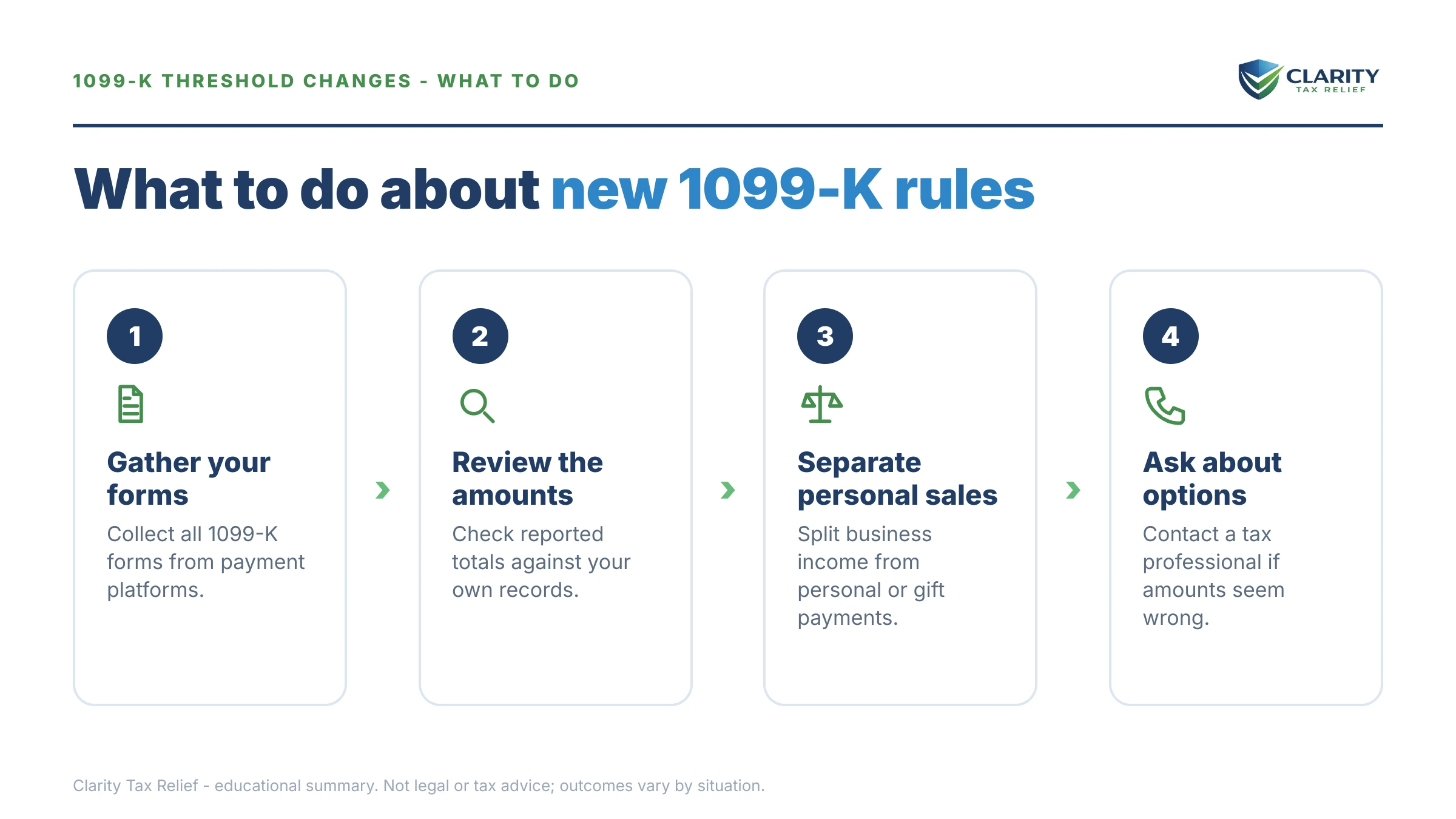
- Pull your transcripts. Request your IRS wage and income transcript for every open year. It lists exactly which 1099-Ks the IRS already holds under your Social Security number.
- Match each year to its threshold. Use the timeline table above to see which reporting rule governed each year, so you know which years the IRS has data for and which it doesn't.
- Reconstruct and file every unfiled year. Rebuild income and expenses from platform summaries, bank records, and mileage estimates, then file — deductions only count on a return you actually submit.
- Set up a payment option before notices start. Balances of $50,000 or less can usually be put on a plan of up to 72 months online. Short-term plans give up to 180 days with no setup fee.
- Request penalty relief once returns are filed. First-time abatement, reasonable cause, or the new Automatic Exemption from Penalty starting summer 2026 can remove a meaningful share of the penalties.
When you can handle this yourself
You can fix most 1099-K problems yourself when the years are filed, the balance is small, and the numbers on the form are right. Specifically: one recent year of platform income you can reconstruct from an annual summary, a balance you can pay within 180 days, or a form that misclassified personal transfers (fix that with the platform, not the IRS). Filing a clean Schedule C and setting up a plan online takes an afternoon, not a professional fee.
Experienced help changes the outcome in a narrower set of situations: multiple unfiled years (the order and content of those returns drives everything after — start with our guide if you haven't filed taxes in 3 years), a CP2000 or substitute-for-return assessment built on gross 1099-K figures you need to rebut, a balance too large for streamlined plans, or offer-in-compromise math where a miscalculated figure means an automatic rejection. In those cases, the professional's job is mostly arithmetic and sequencing, but it's arithmetic the automated system won't do for you.
Terms in the 1099-K rules, decoded
- Third-party settlement organization (TPSO): the payment platform — PayPal, Venmo, Cash App for Business, eBay, Etsy — legally responsible for filing the 1099-K.
- De minimis threshold: the dollar-and-transaction floor below which a platform doesn't have to file; it's the number this whole article tracks.
- Gross amount: the total processed through the platform before fees, refunds, shipping, or cost of goods — a 1099-K reports gross, never profit.
- Backup withholding: a 24% cut platforms must take from your payouts if your taxpayer ID is missing or mismatched.
- CP2000: the automated notice proposing extra tax when a 1099-K on file doesn't match your return.
- Substitute for Return (SFR): the return the IRS prepares for a non-filer using third-party data, with no deductions.
1099-K threshold questions, answered
What is the 1099-K threshold for 2026?
$20,000 in payments and more than 200 transactions — both conditions must be met before a payment platform is required to file a Form 1099-K. The One Big Beautiful Bill Act (2025) retroactively reinstated this pre-ARPA standard. Some states set their own lower reporting thresholds, so you may still receive a form below the federal trigger, and all income is taxable either way.
Did the $600 1099-K threshold ever actually take effect?
Not for a full filing season at $600. The American Rescue Plan Act of 2021 set a $600 threshold with no transaction minimum. But the IRS delayed it with transition relief — Notice 2024-85 set a $5,000 threshold for tax year 2024 and $2,500 for tax year 2025 — before the One Big Beautiful Bill Act repealed it retroactively in 2025.
Do I owe taxes on platform income below the $20,000 threshold?
Yes. The threshold controls only whether the platform must file a form. It has never defined what income is taxable. Self-employment income is reportable from the first dollar, and self-employment tax generally kicks in at just $400 of net earnings for the year. Not receiving a 1099-K does not make income invisible or tax-free.
Does the return to the $20,000 threshold erase what I owe from 2024 or 2025?
No. The threshold change is not an amnesty — tax owed on platform income from earlier years remains fully collectible. Platforms already filed 1099-Ks under the $5,000 rule for tax year 2024, so the IRS holds that data and its matching program can still generate CP2000 notices for those years. Unfiled years stay open indefinitely until you file.
What was IRS Notice 2024-85?
Notice 2024-85 was the IRS transition relief that phased in the American Rescue Plan's $600 rule instead of enforcing it immediately: it set a $5,000 reporting threshold for tax year 2024 and $2,500 for tax year 2025. The $2,500 tier was superseded when the One Big Beautiful Bill Act retroactively restored the $20,000-and-200-transactions threshold.
Do Venmo or PayPal payments from friends and family trigger a 1099-K?
No. Form 1099-K reports payments for goods and services processed through third-party networks — personal transfers like splitting rent, gifts, or reimbursements are not reportable at any threshold. If personal payments were misclassified as business payments, contact the platform to correct the form, and keep records showing the payments' true nature in case the IRS asks.
What happens if the IRS has a 1099-K I never reported?
The IRS document-matching program compares 1099-Ks against filed returns, typically more than a year after the filing season. A mismatch generates a CP2000 proposing additional tax on the gross amount, with no expense deductions, plus penalties and interest. If you never filed at all, the IRS can prepare a substitute for return the same way. Responding with a correct return or expense documentation usually cuts the proposed bill substantially.
I sold personal items at a loss — do I owe tax on my 1099-K?
Generally no tax is owed on personal items sold for less than you paid, but you can't ignore the form. Report the gross amount and back out the nontaxable portion on your return so the IRS's computers can match the form. Otherwise the matching program may propose tax on the full gross figure. Losses on personal-use property are not deductible. They just aren't taxed.
Your next 24 hours
- List your platform years. Write down every year since 2021 you earned money through an app or marketplace, then check each against the timeline table above. That tells you which years the IRS almost certainly holds a 1099-K for.
- Gather your records. Pull each platform's annual earnings summary, your last filed tax return, and whatever mileage or expense records exist, even rough bank statements are enough to start reconstructing.
- Get the free case review. If any of those years is unfiled or unreported, an experienced tax professional will pull your IRS transcripts and price out every path — call (888) 825-7779 or use the 2-minute form. Penalties and interest grow every month a year stays open; the review costs nothing.
Sources: the IRS's official guidance on the reversion is in its FAQs on the Form 1099-K threshold under the One Big Beautiful Bill (dollar limit reverts to $20,000). For what the form itself reports, see Understanding your Form 1099-K, and for setting up a plan on any resulting balance, the IRS payment plans page.
This guide is general information, not tax or legal advice for your specific situation. Eligibility for IRS programs depends on individual facts and circumstances; no outcome is guaranteed.