
1099 & Gig Economy
eBay Seller Tax Debt From a 1099-K: What You Really Owe and How to Fix It (2026)
The short answer: eBay seller tax debt from a 1099-K is usually inflated. Form 1099-K reports your gross sales, not profit, so the IRS often bills you for money you never kept. You owe tax only on net profit after inventory cost and fees, and personal items sold at a loss aren't taxable. Correct the number first; then resolve what's left.
You matched the IRS letter to your eBay account and the math doesn't work: the IRS wants tax on every dollar buyers paid you — including the money that went straight back out for inventory, eBay fees, and shipping labels. For a couple running a side reselling operation on a joint return, the gap between gross sales and real profit is often thousands of dollars.
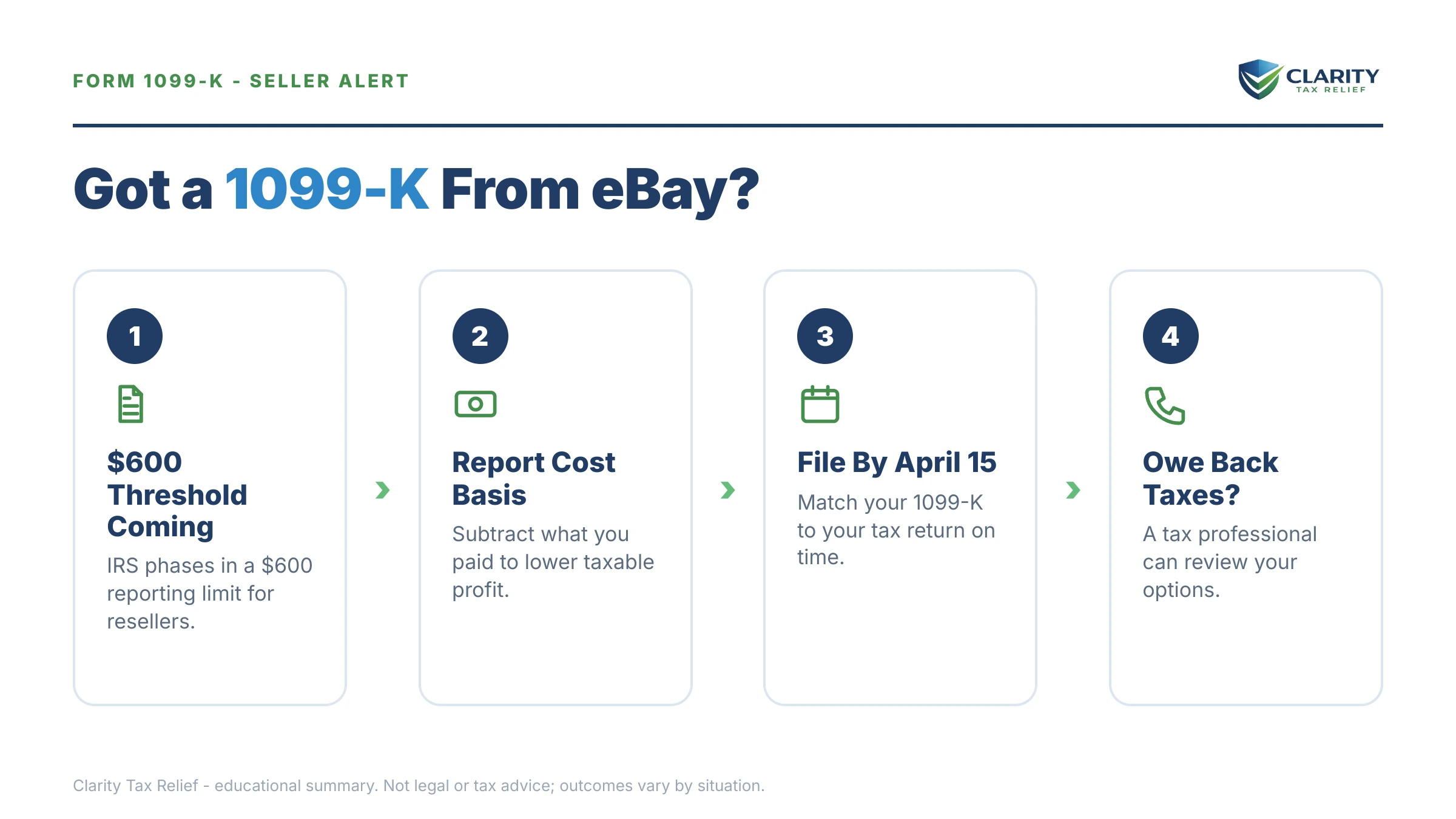
Here's the reframe you need before you panic-pay anything: most of this is a paperwork problem, not a money problem. The image below shows exactly what Form 1099-K looks like and where to look — one box on it drives nearly every inflated eBay tax bill.
⏱ Your deadline: if an IRS notice came with this bill, the response date printed on that notice controls — reply by it to keep your right to dispute the numbers by mail instead of in court. If no notice has arrived yet, the clock is monthly: the 0.5%-per-month failure-to-pay penalty and daily interest keep compounding until the balance is corrected or resolved.
Why eBay sellers get 1099-K tax debt
Form 1099-K reports the gross amount buyers paid you through eBay, before eBay's fees, before shipping labels, before refunds, and before the cost of anything you sold. eBay files an identical copy with the IRS, and the IRS computer matches it against your tax return line by line.
If your return doesn't show that income, or shows less than Box 1a — the Automated Underreporter system generates a CP2000 notice proposing extra tax. Here's the part that produces shock: the computer treats the entire gross figure as pure, untaxed profit, because it has no idea what your inventory cost or what eBay charged you.
So a couple who genuinely cleared $9,000 flipping thrift-store finds can get a proposal built on $30,000 of gross sales. The debt is real in the IRS's system. But the number behind it usually isn't, and that's the difference between this bill and most tax debts.
The $20,000 threshold in 2026, and why old bills survive it
For 2026, eBay issues a 1099-K only when gross payments pass $20,000 and 200 transactions — the threshold reverted. The planned $600 rule is dead. Two things that reversal does not do: it doesn't erase tax the IRS already assessed for earlier years reported under lower transition thresholds. It doesn't make selling income tax-free below $20,000 — income is taxable whether or not a form is issued. The full story is in our guide to the 1099-K $20,000 threshold in 2026.
“No matter the amount of reported payments, if you receive payments for selling goods or services, you must report all income on your tax return.”
— Understanding your Form 1099-K (IRS.gov)
What the IRS thinks you owe vs. what you actually owe
Only your net profit from eBay is taxable, and how it's taxed depends on why you were selling. The IRS bill flattens every seller into one category: a business that keeps 100% of gross. Your first job is putting yourself in the right row of this table, with documentation.
| How you sell | Is it taxable? | Self-employment tax? | Where it's reported |
|---|---|---|---|
| Personal items sold below what you paid (used electronics, old furniture) | No — personal losses aren't income (and aren't deductible) | No | Reported and zeroed out on the return; keep proof of original cost |
| Personal items sold above what you paid (collectibles, sneakers, cards) | Yes — only the gain over your cost | No | Capital gain (Form 8949 / Schedule D) |
| Hobby selling — occasional, no profit motive | Yes — income taxable; expenses not deductible | No | Other income, Schedule 1 |
| Reselling as a business — sourcing inventory to sell | Yes — net profit after cost of goods and expenses | Yes — 15.3% | Schedule C |
A worked example: how a $10,000 proposal becomes a $4,800 debt
Say you and your spouse file jointly and ran a reselling side business in 2024. eBay's 1099-K shows $34,000 in Box 1a. You never reported it. A CP2000 arrives proposing tax on the whole amount as self-employment profit — roughly $8,600 in income and SE tax, plus a 20% accuracy-related penalty and interest. Call it about $10,000.
Now run the real numbers. Your inventory receipts total $12,000 and your eBay fees, shipping labels, and supplies total $4,000. Net profit: $34,000 − $12,000 − $4,000 = $18,000. On that, self-employment tax is about $18,000 × 92.35% × 15.3% ≈ $2,540. The added income tax in the 12% bracket (after the half-SE-tax deduction) is roughly $2,010. With interest and a smaller penalty base, the corrected debt lands near $4,800 — less than half the proposal. You can estimate the penalty-and-interest portion of your own bill with our IRS Penalty & Interest Calculator.
That's the pattern to internalize: for eBay sellers, the biggest "resolution program" is arithmetic. Correct first, negotiate second.
What happens if you ignore an eBay 1099-K tax bill
An unanswered 1099-K mismatch hardens from a proposal you can dispute for free into a debt the IRS can collect by levy. The sequence is automated and runs in this order:
- CP2000 — a proposed change, not a bill. Respond by the printed date with your real costs and the entire problem can end here.
- CP3219A Notice of Deficiency — if the CP2000 goes unanswered, this 90-day letter gives you 90 days to petition Tax Court. It's your last chance to dispute the gross-vs-net error without paying first.
- Assessment and CP14 — the inflated amount becomes legal debt and the first bill arrives, typically giving about 21 days before reminders start (10 business days if the balance is $100,000 or more).
- CP501 / CP503 reminders — the balance grows monthly while the notices escalate in tone.
- CP504 — Notice of Intent to Levy. The IRS can now take your state tax refund, and a federal tax lien becomes a live risk.
- LT11 / Letter 1058 — final notice. After 30 days the IRS can levy bank accounts and wages; you can demand a hearing with Form 12153 within that window.
Two quieter consequences run alongside the letters: every joint refund you and your spouse file for gets offset against the balance, and disputing the numbers gets procedurally harder at each stage. The cheapest fix is at step one; the same fix at step six requires reconsideration paperwork while a levy clock runs.
Holding a bill built on your gross eBay sales?
If a CP2000 or balance-due notice arrived, the response date printed on it controls, and bills like this often shrink substantially once inventory costs and fees are documented. Get your eBay 1099-K bill reviewed free before that date passes: an experienced tax professional will check the IRS's math against your real numbers, no pressure.
Married filing jointly: the debt belongs to both of you
On a joint return, both spouses are liable for the full eBay tax debt, even if only one of you ever touched the account. That's joint and several liability: the IRS can collect the entire balance from either spouse. It will offset your joint refund each spring until the debt is gone.
It also means both incomes count when the IRS evaluates a payment plan, hardship status, or an Offer in Compromise. A household with two paychecks has more "ability to pay" on paper, which makes correcting the inflated number even more important than it is for a single filer — you're less likely to qualify for hardship relief on a debt you don't really owe.
Your options for eBay seller tax debt from a 1099-K
Option one is always the same for this debt: fix the number. If the year is still at the CP2000 stage, respond with a corrected Schedule C. If it's already assessed, amend the return to reduce the tax debt with Form 1040-X and your documentation. Only after the balance reflects real profit should you pick a way to pay it — the full DIY playbook for each program is in our guide to how to settle tax debt yourself.
| Option | Who it fits | Cost / catch |
|---|---|---|
| CP2000 response or amended return | Anyone whose bill taxes gross sales instead of net profit | Free; requires documenting cost of goods, fees, and shipping |
| Short-term payment plan (up to 180 days) | Corrected balance you can clear within six months | $0 setup; interest and the 0.5%/month penalty continue |
| Guaranteed installment agreement | Individuals owing $10,000 or less, current on filings | Setup fee applies; the IRS must accept if you meet the criteria |
| Streamlined installment agreement | Balances up to $50,000; up to 72 months, set up online | Setup fee (lower with direct debit); interest keeps accruing |
| Currently Not Collectible | Paying would leave your household unable to cover basics | $0; collection pauses but the debt and interest remain |
| Offer in Compromise | Assets plus future income genuinely can't cover the debt | $205 fee + 20% down on lump-sum offers (both waived with low-income certification); roughly 1 in 5 offers accepted in FY2024 |
| Penalty abatement (first-time abatement) | Clean compliance history for the prior 3 years | Free; removes penalties, not tax or interest, and starting summer 2026, the new Automatic Exemption from Penalty (AEP) applies this relief without a request |
Which path is realistic depends mostly on the corrected balance. Most eBay reseller debts land in the lowest bands, where everything is self-serve:
| Corrected balance | Realistic path | What changes at this band |
|---|---|---|
| Under $5,000 | Pay in full, 180-day plan, or guaranteed installment agreement | Fully self-serve online; no financial disclosure needed |
| $5,000–$10,000 | Guaranteed or streamlined installment agreement | Still no financial statement; a qualifying guaranteed IA can't be refused |
| $10,000–$25,000 | Streamlined IA; consider direct debit | A federal tax lien becomes possible; direct debit helps avoid one |
| $25,000–$50,000 | Streamlined IA with direct debit; CNC or OIC if finances are genuinely tight | More scrutiny; still eligible for online setup up to 72 months |
| Over $50,000 | Full financial disclosure (Form 433 series); IA, OIC, or CNC by review | Managed collection; passport certification risk begins at $66,000 |
In the worked example above, the couple's corrected $4,800 sits in the easiest band: a short-term plan means about $800 a month for six months with $0 setup, or a guaranteed installment agreement stretches it thinner, around $135 a month over three years, while interest continues on the shrinking balance.
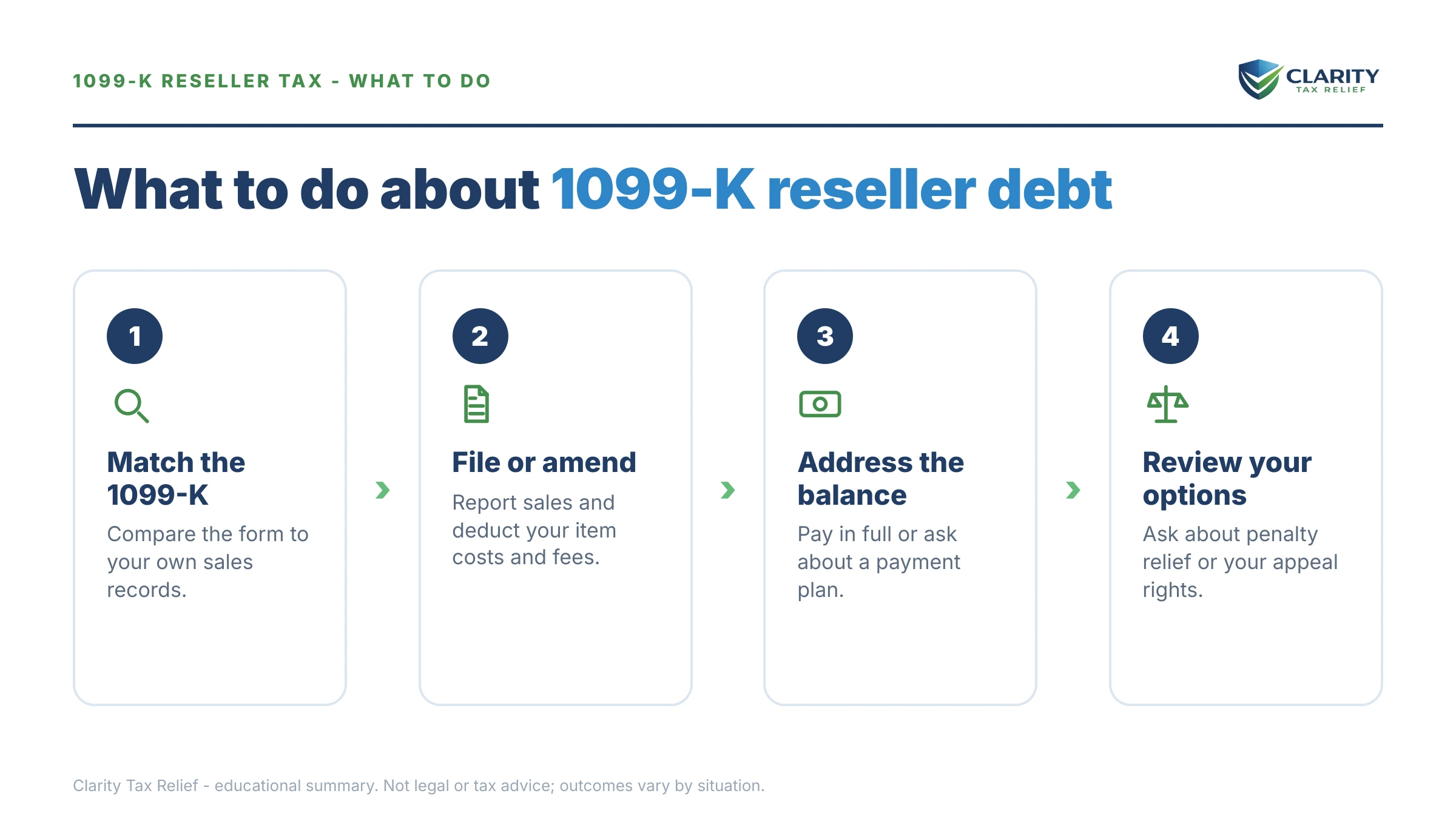
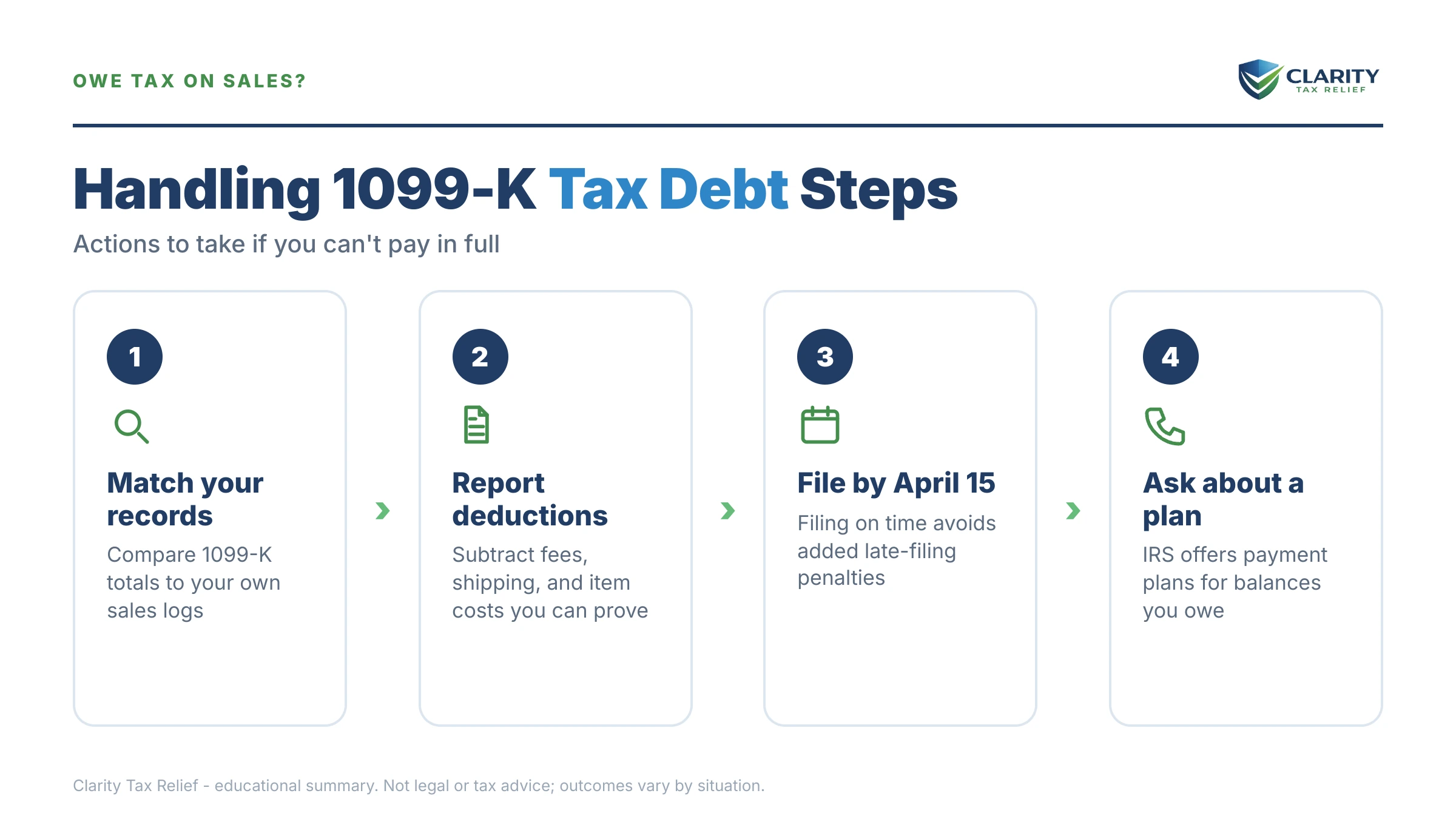
How to respond to eBay 1099-K tax debt, step by step
- Pull the form and the notice. Find Box 1a on your 1099-K, confirm the tax year it covers, and note the response date printed on any IRS notice that came with the bill.
- Rebuild your real profit. Download that year's eBay sales and fee reports, gather inventory receipts and shipping costs, and total your cost of goods, fees, and refunds.
- Respond or amend with the correct numbers. Answer a CP2000 with a corrected Schedule C by the printed date, or file Form 1040-X if the year was already assessed.
- Arrange payment for the corrected balance. Once the bill reflects real profit, set up a short-term plan or installment agreement online before enforcement notices start.
- Request penalty relief. Ask for first-time abatement or reasonable-cause relief on the failure-to-pay and accuracy penalties attached to the corrected balance.
- Fix the current year. Start quarterly estimated payments and track inventory costs now so next January's 1099-K doesn't repeat this.
The IRS's own explanations of the form and payment setup are worth bookmarking: Understanding your Form 1099-K, Understanding your CP2000 notice, and IRS.gov/payments for plans and payoff.
When you can handle this yourself
You probably don't need professional help if: you sold personal items at a loss and just need to answer the CP2000 with proof of what you originally paid. You agree with the numbers and can pay within 180 days. Or your corrected balance is under about $10,000 and your returns are all filed — the guaranteed installment agreement is a form, not a negotiation.
Experienced help changes outcomes in a narrower set of situations: multiple years of unreported 1099-Ks stacking into one balance, records that are gone and a profit figure that must be reconstructed from bank deposits and eBay reports, a dispute already past the 90-day letter, a hobby-vs-business fight where SE tax hangs on the answer, or a balance large enough that OIC math and Form 433 disclosures come into play. In those cases the order you fix things — returns first, penalties second, balance last — materially changes what you pay.
Terms on your notice, decoded
- Gross payment amount (Box 1a): the total buyers paid you through eBay for the year, before fees, refunds, shipping, or your costs — the number the IRS matched against your return.
- CP2000 / Automated Underreporter: the computer-matching program that proposes extra tax when a 1099 doesn't appear on your return. A proposal, not an audit and not yet a bill.
- Cost of goods sold (COGS): what you paid for the inventory you sold — the single biggest subtraction missing from an eBay 1099-K bill.
- Hobby income: selling without a profit motive; taxable as ordinary income, free of SE tax, but with no expense deductions allowed.
- Self-employment tax: the 15.3% Social Security and Medicare tax on business profit, charged on top of income tax for sellers operating as a business.
- Notice of Deficiency (CP3219A): the statutory letter starting a 90-day window to petition Tax Court — the point where a proposal starts becoming assessed debt.
Stopping next year's eBay tax bill
If you're still selling at business volume, the current year is quietly building the same problem. Set aside a slice of each payout for tax, learn how quarterly estimated taxes work, and keep inventory receipts and mileage as you go — a spreadsheet updated monthly beats a shoebox reconstructed under a CP2000 deadline. If you also sell on other platforms, the same gross-vs-net trap applies: see our guides for Amazon FBA seller taxes and Poshmark seller taxes, since each platform's 1099-K stacks into the same IRS match.
eBay 1099-K tax debt questions, answered
Do I owe taxes on eBay sales of my own used items?
Not if you sold them for less than you originally paid, which covers most people clearing out closets and garages. Losses on personal items aren't deductible, but they also aren't taxable income. The catch: if the IRS sends a CP2000 taxing your gross 1099-K total, you have to respond and show the items sold at a loss — silence turns a $0 tax bill into a real, collectible one.
Why is the IRS taxing my entire 1099-K amount?
Because the IRS computer only sees the gross number eBay reported. It has no record of what you paid for inventory, what eBay charged in fees, or what shipping cost you. A CP2000 proposal treats the entire Box 1a figure as untaxed profit. Responding with a corrected Schedule C showing your real net profit is how these bills get cut down to what you genuinely owe.
What is the eBay 1099-K threshold for 2026?
$20,000 in gross payments and more than 200 transactions — the threshold reverted to the original standard, and the planned $600 rule is dead. That only controls whether eBay issues a form going forward. It does not erase tax the IRS already assessed for earlier years under the lower transition thresholds. And income is taxable whether or not a 1099-K is ever issued.
Do eBay sellers owe self-employment tax?
Only if the selling rises to the level of a business — regular, continuous activity with a profit motive, like sourcing inventory specifically to resell. Business profit goes on Schedule C and carries 15.3% self-employment tax on top of income tax. Occasional hobby sales are taxed as ordinary income without SE tax, but hobby sellers can't deduct their expenses against that income.
Can I still fix an eBay tax bill the IRS already assessed?
Often, yes. If the assessment taxed your gross sales instead of your profit, you can file an amended return with the corrected Schedule C or request audit reconsideration with your documentation, even after the balance posts. The tightest limit is on refunds, generally three years to claim money back, but reducing an unpaid balance with correct numbers is usually still on the table.
Is my spouse responsible for my eBay tax debt?
On a joint return, yes — both spouses are jointly and severally liable for the full balance no matter whose eBay account earned the money. The IRS can offset your joint refund and collect from either of you. Innocent spouse relief exists but is difficult when the income was known to both spouses, so for most couples the practical move is correcting and resolving the bill together.
What if I can't pay the tax I owe on my eBay sales?
Shrink the bill first, then arrange the remainder. A corrected balance under $10,000 fits a guaranteed installment agreement the IRS must accept if you're filing-compliant. Up to 180 days costs nothing to set up as a short-term plan. Genuine hardship can qualify for Currently Not Collectible status. An Offer in Compromise is possible only when the IRS's own math shows you can't full-pay.
Will a 1099-K mismatch get me audited?
Usually not — an unreported 1099-K triggers the Automated Underreporter program, which sends a CP2000 through document matching, not a human audit. A CP2000 has no agent assigned and is resolved entirely by mail or online. Repeated years of unreported selling income or very large gaps can escalate to examination, which is one more reason to correct the earliest year now.
Your next 24 hours
- Find two numbers: Box 1a on the 1099-K (the gross figure the IRS is working from) and the response date printed on any notice that came with the bill.
- Gather the year's paper trail: your filed return, eBay's sales and fee reports for that year, inventory receipts, and shipping costs. This is the evidence that shrinks the bill.
- Get a free case review: use the 2-minute form or call (888) 825-7779. Interest and the monthly late-payment penalty accrue on the inflated number until it's corrected — every month you wait, you're paying carrying costs on profit you never made.
This guide is general information, not tax or legal advice for your specific situation. Eligibility for IRS programs depends on individual facts and circumstances; no outcome is guaranteed.