
Self-Employed & Online Sellers
Etsy Seller Owes Taxes: What to Do About the Debt in 2026
The short answer: when an Etsy seller owes taxes, the debt almost always comes from 15.3% self-employment tax plus income tax on the shop's net profit, with zero withholding to cover it. File any missing returns with a full Schedule C first, then pick a payment plan, hardship status, or settlement based on what you can actually pay.
Your shop finally took off — repeat buyers, five-star reviews, sales you're proud of. Then tax season showed you a balance bigger than your best month, or a letter arrived saying the IRS already knows about income you never reported. Here's the part that matters: an Etsy seller who owes taxes has a defined, well-worn path out, and it starts with your own shop data.
Etsy reports your sales to the IRS on Form 1099-K, and the number it reports is your gross, before a single fee or supply cost comes out. The image below shows you exactly what that form looks like and where to find the figure the IRS is matching against your return, because that one number explains most Etsy tax problems.
⏱ The clock that's actually running: there's no letter-printed deadline yet, but the failure-to-pay penalty adds 0.5% of the balance every month and interest compounds on top. If a return is unfiled, the failure-to-file penalty is 10× worse — 5% per month, up to 25% — though in months where both penalties apply, the failure-to-file portion drops to 4.5% (5% combined). That's why filing comes before everything else.
Why an Etsy seller owes taxes in the first place
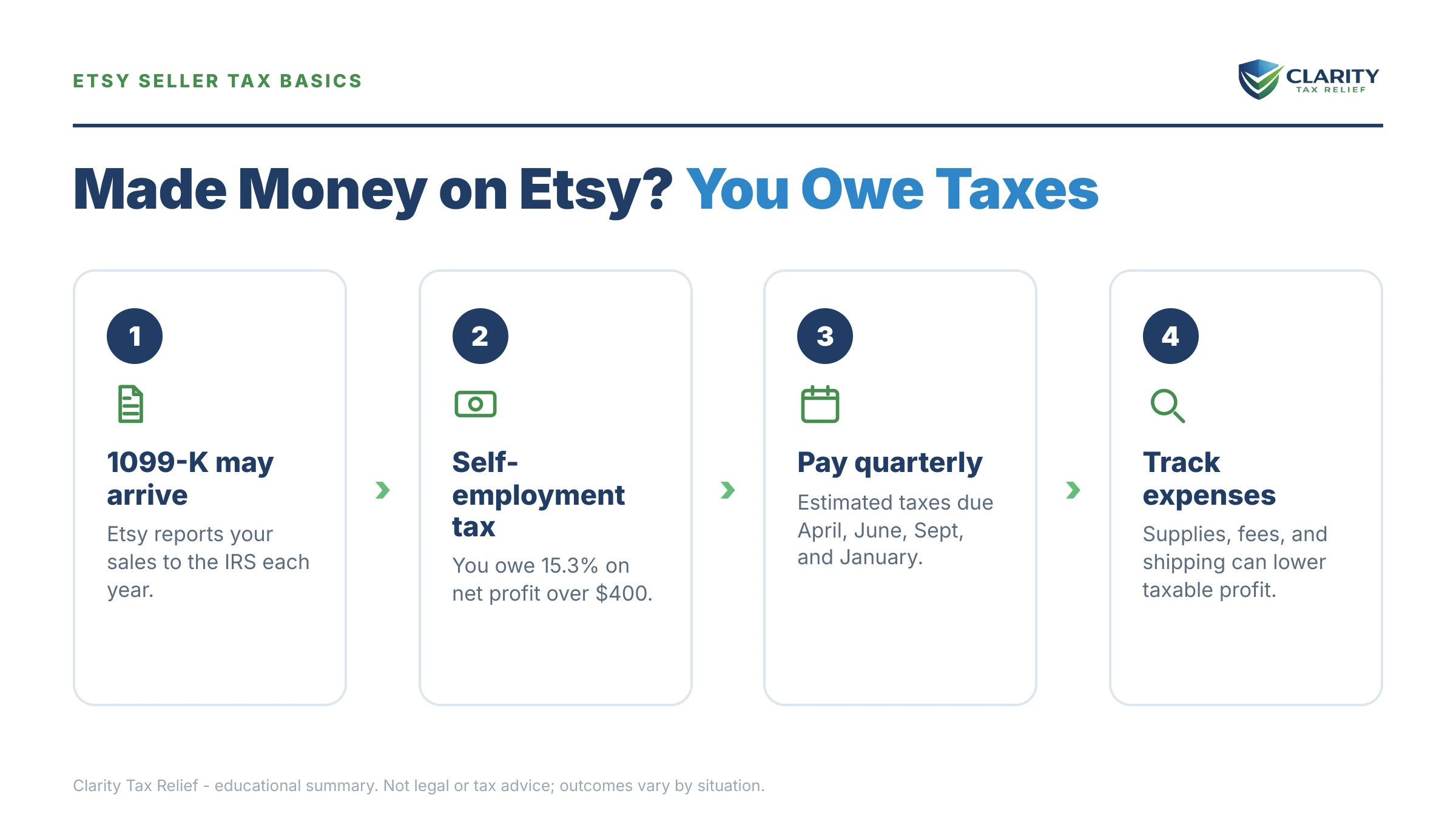
Etsy withholds nothing from your payouts, so every dollar of shop profit carries 15.3% self-employment tax plus regular income tax, all due when you file. That's the single biggest reason handmade and vintage sellers get blindsided: a W-2 job quietly pre-pays your taxes all year; Etsy Payments deposits the full amount and leaves the tax bill for April.
Three patterns produce most Etsy tax debt:
- The first profitable year. The shop crossed from side project to real income, no quarterlies were paid. The entire year's tax arrived at once. The self employment tax owe irs guide breaks down why the 15.3% piece surprises almost everyone.
- Unreported or underreported income. The shop's income never made it onto a return, sometimes because the seller assumed "it's just a hobby" or "Etsy handles taxes." It doesn't handle these.
- Filed, but couldn't pay. The return was honest; the bank account wasn't ready for the number.
One classification note before the math: if you run the shop regularly with intent to profit, it's a business — Schedule C, expenses deductible, SE tax owed. A true hobby skips SE tax but also loses every deduction. Most shops with steady sales are businesses, and treating one as a hobby doesn't survive IRS matching.
“Your specific tax situation will determine which payment options are available to you. Payment options include full payment, a short-term payment plan (paying in 180 days or less) or a long-term payment plan (installment agreement) (paying monthly).”
— Online payment agreement application (IRS.gov)
What the IRS already knows about your Etsy shop
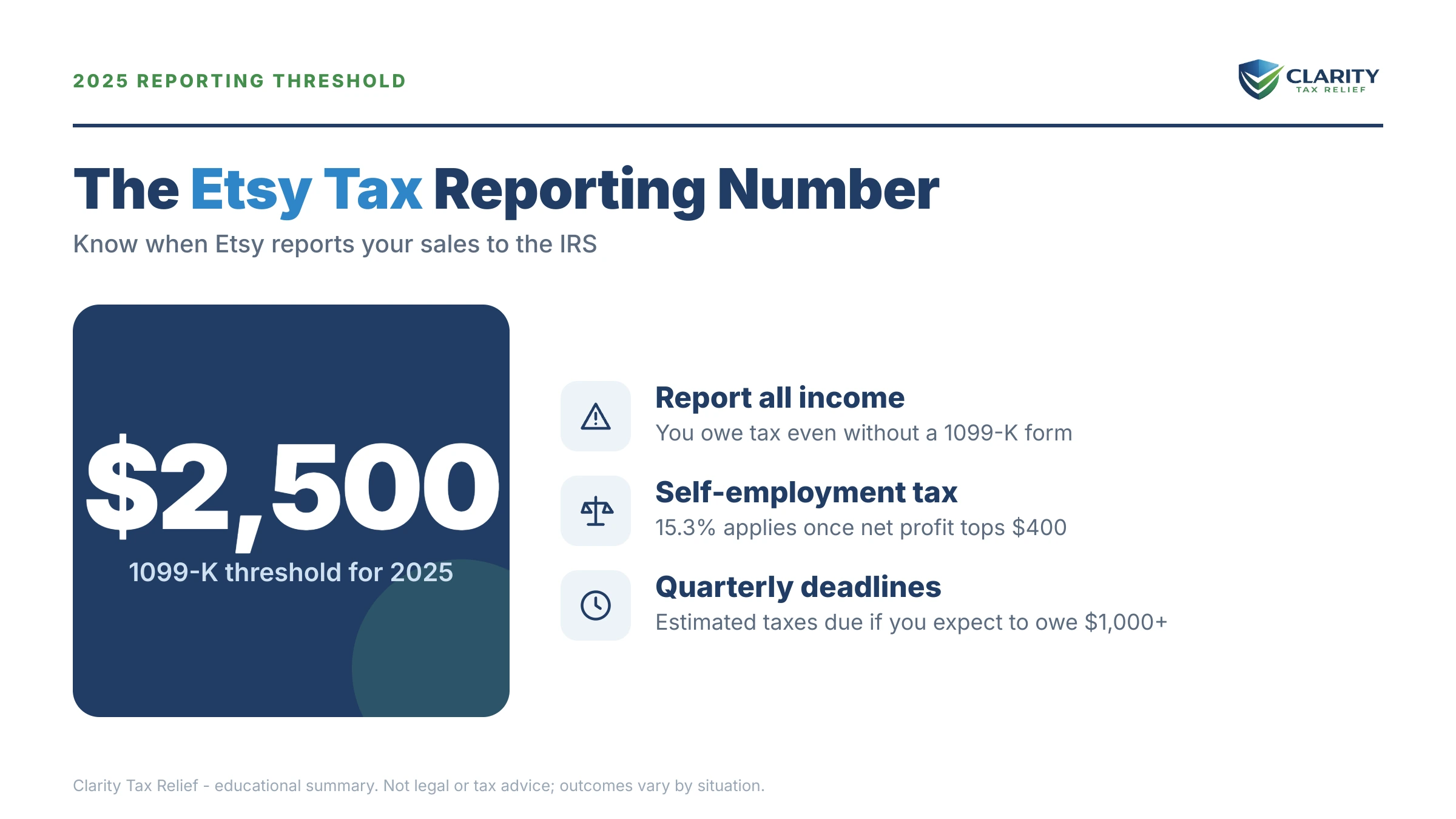
Etsy files a copy of your Form 1099-K directly with the IRS whenever your shop tops $20,000 in gross sales and 200 transactions — the federal threshold that reverted for 2026 after the $600 rule was scrapped. If your shop crossed that line, the IRS has your gross-sales figure whether or not you ever opened the form. (Several states set lower thresholds, so smaller shops may still get one.) The full story of the reversion, and why old-year debt survives it — is in our 1099-k 20000 threshold 2026 guide.
Here's the trap built into that form, and it's worth studying in the sample image on this page: the 1099-K shows gross payment volume, before Etsy's transaction fees, payment processing fees, listing fees, offsite-ads fees, refunds. The shipping labels you bought. Your taxable profit might be half that number or less. But when IRS computers find a 1099-K that doesn't appear on a return, the automated cp2000 notice that follows typically proposes tax on the gross — with zero expenses allowed. Sellers routinely get proposed bills two or three times what they'd owe on an accurate Schedule C.
If you sell on multiple platforms — Poshmark, Mercari, eBay — each one files its own 1099-K, and the IRS matches all of them. Our poshmark seller taxes guide covers the resale-side version of the same problem.
Say your shop grossed $83,100: the math on a real Etsy tax bill
This is a hypothetical, but the arithmetic is the arithmetic. Say you're a single, sole-proprietor seller whose shop ran $83,100 through Etsy Payments last year, and you made no estimated payments.
- Fees: Etsy's 6.5% transaction fee, payment processing, listing fees, and offsite ads take roughly $10,800.
- Materials, shipping, packaging: about $22,300.
- Schedule C net profit: $83,100 − $10,800 − $22,300 = $50,000.
- Self-employment tax: $50,000 × 92.35% = $46,175 × 15.3% ≈ $7,065.
- Federal income tax: after the half-SE-tax deduction and the standard deduction, taxable income lands near $31,500 — roughly $3,540 in tax at single-filer rates.
- Total due with the return: about $10,600.
Now watch what waiting does. File on time but leave it unpaid for a year, and the 0.5%-per-month failure-to-pay penalty adds about $640, interest adds roughly $700 more. The estimated-tax underpayment penalty stacks on top — the balance is pushing $12,000 before the next filing season even starts. Don't file at all. The failure-to-file penalty runs at the reduced 4.5% per month while the failure-to-pay penalty also applies (5% combined) — adding about $2,385 in failure-to-file penalties alone in five months. You can estimate your own growth curve with our Penalty & Interest Calculator.
And the CP2000 version is worse: if the IRS proposes tax on the full $83,100 gross with no Schedule C, the proposed assessment can run well past double the real liability. Responding with your actual expense records isn't optional — it's the difference between owing $10,600 and being billed for a number your shop never earned.
Etsy sales tax: mostly handled, with one exception
For orders placed through Etsy, marketplace facilitator laws make Etsy itself collect and remit state sales tax. You generally owe nothing on those sales. That's a genuine bright spot, and it separates Etsy sellers from businesses that owe trust-fund sales tax personally.
The exception is everything sold off the platform: craft fairs, your own website, wholesale orders, direct Instagram sales. Those are your responsibility, state by state, and if you ship enough volume into other states, economic-nexus rules can create obligations in states you've never set foot in. If that's your situation, start by checking where your shipping volume crossed each state's registration threshold. States pursue sales tax far more aggressively than the IRS pursues income tax.
What happens if you ignore Etsy tax debt
Once a balance is assessed, IRS collection escalates in a fixed, automated sequence, and in 2026, with the IRS workforce down roughly 27%, the humans are harder to reach but the automated notices and levies never paused. The machine escalates on schedule whether or not anyone reads your file:
- The match flags your account. A CP2000 proposes tax on the 1099-K gap (if you underreported), or a CP14 bill arrives if you filed without paying — with roughly 21 days before the sequence advances.
- Reminder notices — CP501, then CP503. Still just bills, but penalties and interest compound monthly while they cycle.
- CP504 — Notice of Intent to Levy. The IRS can now seize your state tax refund under IRC §6331(d). A federal tax lien becomes a live possibility. This is not yet the final notice.
- LT11 / Letter 1058 — Final Notice. A 30-day clock starts, along with your Collection Due Process rights (requested on Form 12153). After it runs, the IRS can levy your bank account — including the account your Etsy Payments deposits land in, with a 21-day hold before the money leaves — and garnish wages from any W-2 job you hold.
- Long-term exposure. Let several years of shop debt stack past $66,000 and the IRS can certify the debt to the State Department, blocking passport renewal.
| Notice | What it means for your shop | Your window |
|---|---|---|
| CP2000 | Proposes tax on unreported 1099-K income, often on gross sales, no expenses | Respond by the date printed on the notice with a full Schedule C |
| CP14 | First bill for a filed-but-unpaid balance | About 21 days before the next notice queues |
| CP501 / CP503 | Reminders — no enforcement yet, balance growing monthly | Cheapest remaining moment to set up a plan |
| CP504 | Intent to levy — state refund can be seized; lien risk rises | Act before the final notice issues |
| LT11 / Letter 1058 | Final notice — bank levy and wage garnishment become legal | 30 days to request a CDP hearing (Form 12153) |
Etsy tax debt growing while you read this?
Penalties and interest are compounding on your shop's balance every month it sits. Send us your 1099-K and any IRS letters — an experienced tax professional will map exactly what you owe and your cheapest way out. Free, confidential, no pressure.
Your options when you can't pay the full balance
The IRS has a full menu of resolution programs, and which one fits depends on the size of the debt and what your shop and household finances actually show. Every option below requires all returns to be filed first — the IRS won't negotiate with a non-filer. (For the full DIY playbook on each program, see how to settle tax debt yourself. Here's how they map onto a typical Etsy debt.)
| Option | Who typically qualifies | Cost & the catch |
|---|---|---|
| Short-term payment plan | Can pay in full within 180 days | $0 setup; interest and 0.5%/month penalty continue until paid |
| Guaranteed installment agreement | Owe $10,000 or less in tax; can pay within 36 months | Approval is required by law if conditions are met; setup fee applies |
| Streamlined installment agreement | Owe $50,000 or less (tax, penalties, interest combined) | Up to 72 months, set up online, no financial disclosure; accrual continues |
| Currently Not Collectible | Paying anything would leave you unable to cover basic living costs | Collection pauses; debt and interest remain; IRS reviews income later |
| Offer in Compromise | Assets plus future income genuinely can't cover the debt | $205 fee + 20% down on lump-sum offers (waived with low-income certification); roughly 1 in 5 accepted in FY2024 |
| Penalty relief (FTA / AEP) | Clean compliance for the prior 3 years | Removes penalties, not tax; AEP makes this automatic starting summer 2026 |
For the hypothetical $10,600 seller above, a 72-month streamlined plan runs roughly $150–$200 a month (interest keeps the payoff slightly higher than simple division). A guaranteed installment agreement is also within reach at that debt level if the tax portion stays at or under $10,000 — the IRS must approve it when the conditions are met.
An Offer in Compromise is real but narrow: the IRS accepts one only when your equity and future income mathematically can't cover the balance. A profitable, growing shop usually works against that math. Hardship status is covered in depth at irs currently not collectible. It fits sellers whose shop income has cratered, not shops still producing steady profit.
Penalty relief deserves a serious look for first-time debtors: first time penalty abatement can wipe the failure-to-file and failure-to-pay penalties for a first slip, and starting summer 2026 the new Automatic Exemption from Penalty applies similar relief without any request at all. On a debt that's one-quarter penalties, that's real money back.
One structural note: if you formed an LLC for the shop, a single-member LLC's income tax debt is still your personal debt — the entity doesn't shield you. The distinctions are laid out in llc owes irs back taxes.
How to respond, step by step
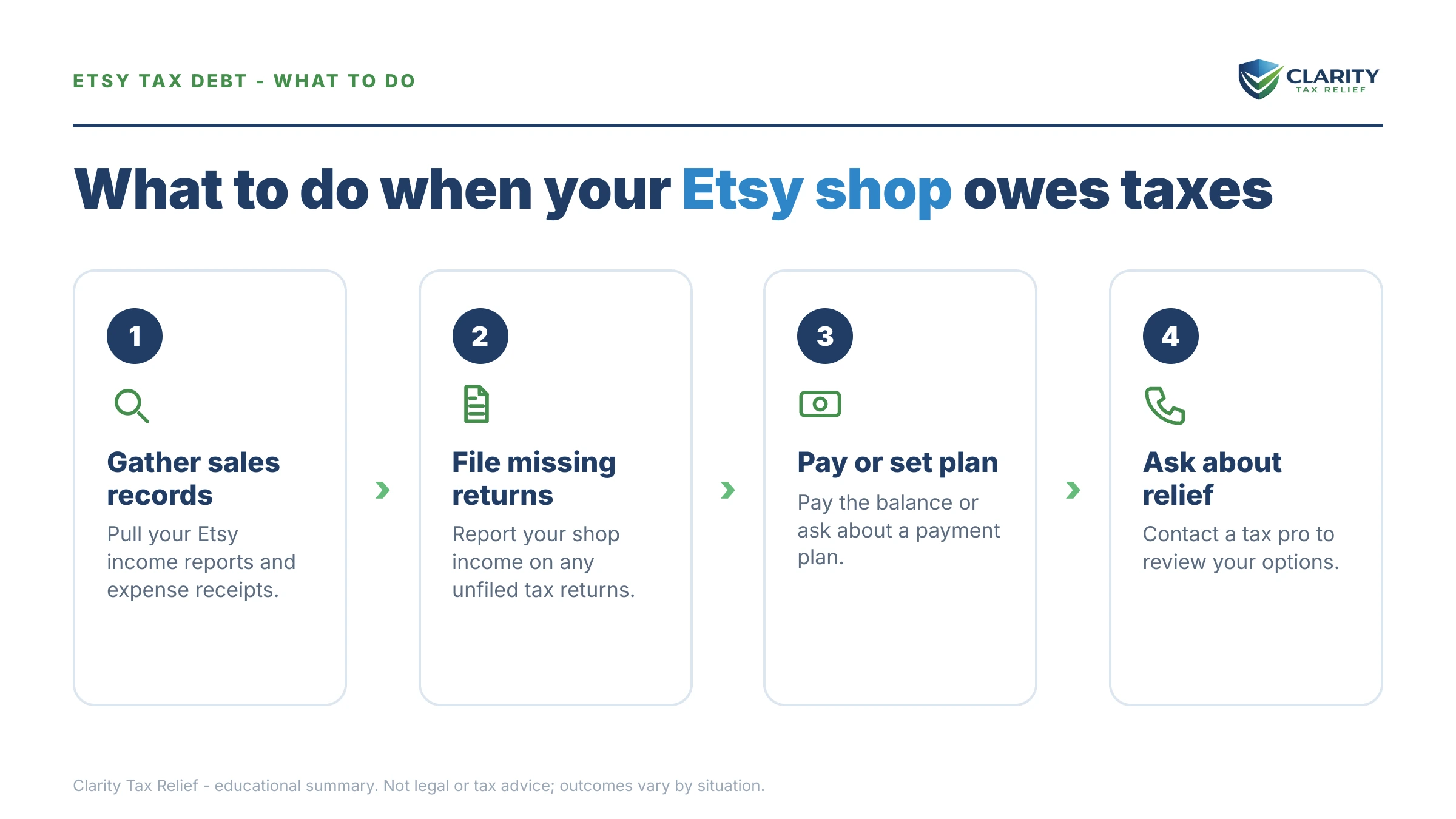
- Download your Etsy records — get your 1099-K and the full-year CSVs of orders, fees, and refunds from Shop Manager.
- File every missing return — with a complete Schedule C, so you are taxed on net profit instead of the gross 1099-K figure.
- Check the IRS's version of events — log into your IRS online account and compare its balance and reported income against your records.
- Choose a resolution and set it up — full payment, a 180-day plan, an installment agreement, hardship status, or an offer, based on what you can actually pay.
- Start quarterly estimated payments, so next April does not rebuild the same debt on top of your resolution.
That last step is what separates sellers who fix this once from sellers who repeat it annually. The mechanics — dates, safe harbors, how much to send — are in how do quarterly estimated taxes work. A simple set-aside habit is covered in side hustle taxes how much to save.
When you can handle this yourself, and when help changes the outcome
Plenty of Etsy tax debt is a do-it-yourself fix. If you owe one year, agree with the number. The balance is under $50,000 with all returns filed, setting up a payment plan online at IRS.gov takes an evening — no firm needed, ours included.
Experienced help earns its cost in specific situations: multiple unfiled years where the filing order and reconstruction affect what you owe. A CP2000 proposing tax on gross sales that needs a documented Schedule C rebuttal. A CP504 or LT11 already in hand, where appeal deadlines and levy exposure are live. Or genuine Offer in Compromise math, where the calculation of what the IRS can collect determines whether an offer is worth filing at all. The honest test: if the stakes of getting the paperwork wrong exceed the cost of a professional, get the free review first and decide with real information.
Terms on your notice (and your 1099-K), decoded
- Form 1099-K — the report Etsy files with the IRS showing your gross payment volume, before fees, refunds, or shipping costs.
- Schedule C — the form where your real number is computed: sales minus business expenses equals taxable net profit.
- Self-employment tax — the 15.3% Social Security and Medicare tax on net profit; the piece a W-2 employer would have split with you.
- Marketplace facilitator — a state law making the platform (Etsy) collect and remit sales tax on orders it processes, instead of you.
- Estimated tax (Form 1040-ES) — the quarterly prepayments self-employed people make in place of paycheck withholding.
- CP2000 — the automated notice proposing extra tax when income reported to the IRS doesn't appear on your return.
Etsy tax debt questions, answered
How much do Etsy sellers pay in taxes?
As a rough planning figure, set aside 25–30% of your net profit — 15.3% self-employment tax plus federal income tax at your bracket, plus state income tax where it applies. The tax is calculated on net profit (sales minus Etsy fees, materials, shipping, and other costs), not the gross figure on your 1099-K. Higher-profit shops can owe more once they cross into the 22% and 24% brackets.
Will Etsy send me a 1099-K for 2026?
Only if your Etsy Payments gross sales exceed $20,000 and you have more than 200 transactions — the federal threshold reverted to those levels, so casual sellers who got forms in earlier years may not this year. Some states set lower reporting thresholds, so you may still receive one. Either way, Etsy income is taxable from the first dollar; the threshold changes what gets reported, not what you owe.
What if my Etsy shop is just a hobby?
Hobby income is still taxable, you report it as other income. But it is not subject to the 15.3% self-employment tax, and current law does not let you deduct hobby expenses against it. The IRS looks at profit motive, regularity, and businesslike record-keeping to decide which side you fall on. A shop with steady sales you actively run and promote is almost always a business, which means Schedule C and self-employment tax.
Does Etsy collect sales tax for me?
On orders placed through Etsy, yes — under marketplace facilitator laws in nearly every state with a sales tax, Etsy calculates, collects, and remits it automatically, so you generally do not owe sales tax on those sales. Sales made off the platform — craft fairs, your own website, direct orders — are your responsibility, and some states still require you to register even when Etsy remits for you. Check the rules with your state revenue agency.
What happens if I did not report my Etsy income?
IRS computers match the 1099-K Etsy filed against your return. A mismatch typically generates a CP2000 notice proposing extra tax, often calculated on your gross sales with zero expenses allowed. Respond by the date printed on the notice with a complete Schedule C showing your fees, materials, and shipping. The proposed amount usually drops sharply. Ignoring the notice turns the proposal into an assessed debt.
Can I still deduct Etsy fees and materials for a year I did not file?
Yes. When you file the late return, or answer a CP2000. You attach a complete Schedule C, and Etsy makes reconstruction unusually easy: Shop Manager lets you download order, fee, and refund histories going back years. Pair those CSVs with bank and card statements for materials and shipping, and you can document deductions even without a formal bookkeeping system.
Can I get an IRS payment plan for Etsy tax debt?
Yes. If your combined balance is $50,000 or less, you can typically set up a plan online for up to 72 months. A short-term plan of up to 180 days has no setup fee at all. The catch: the IRS will not approve a plan while required returns are unfiled, so filing everything comes first. Interest and the monthly late-payment penalty keep accruing until the balance is paid.
Do I have to pay quarterly estimated taxes on Etsy income?
Generally yes, if you expect to owe $1,000 or more for the year after any withholding — which describes almost every profitable Etsy shop. Payments are due four times a year using Form 1040-ES, and missing them triggers an underpayment penalty even if you pay in full by April. If you also have a W-2 job, raising your withholding there can cover the shop's tax instead.
Your next 24 hours
- Find your gross number. In Etsy Shop Manager, download your 1099-K (Finances → Legal and tax information) and the full-year order and fee CSVs — that's the figure the IRS is working from.
- Gather your paper. Your last filed return, every IRS letter you've received, and a rough year-by-year list of materials and shipping costs.
- Get the free case review. Call (888) 825-7779 or use the 2-minute form — an experienced tax professional will run your shop's real numbers against every option above, before another month of penalties and interest lands on the balance.
Primary sources if you want to verify anything yourself: the IRS's own Form 1099-K explainer, the IRS payment plans page, and IRS.gov/payments for paying directly.
This guide is general information, not tax or legal advice for your specific situation. Eligibility for IRS programs depends on individual facts and circumstances; no outcome is guaranteed.