
IRS Transcripts
IRS Cycle Code Meaning: How to Read the 8-Digit Code on Your 2026 Transcript
Read the transcript
Host: So you pulled your account transcript hoping for a refund date, and instead you got a wall of three-digit codes and one eight-digit number that looks like a serial number. Something like 20260705.
Tax specialist: Right. And that eight-digit number is the cycle code. It's not a status. It's not a flag. It's a posting stamp — the batch your return got processed in.
Host: Okay so break the digits apart for me.
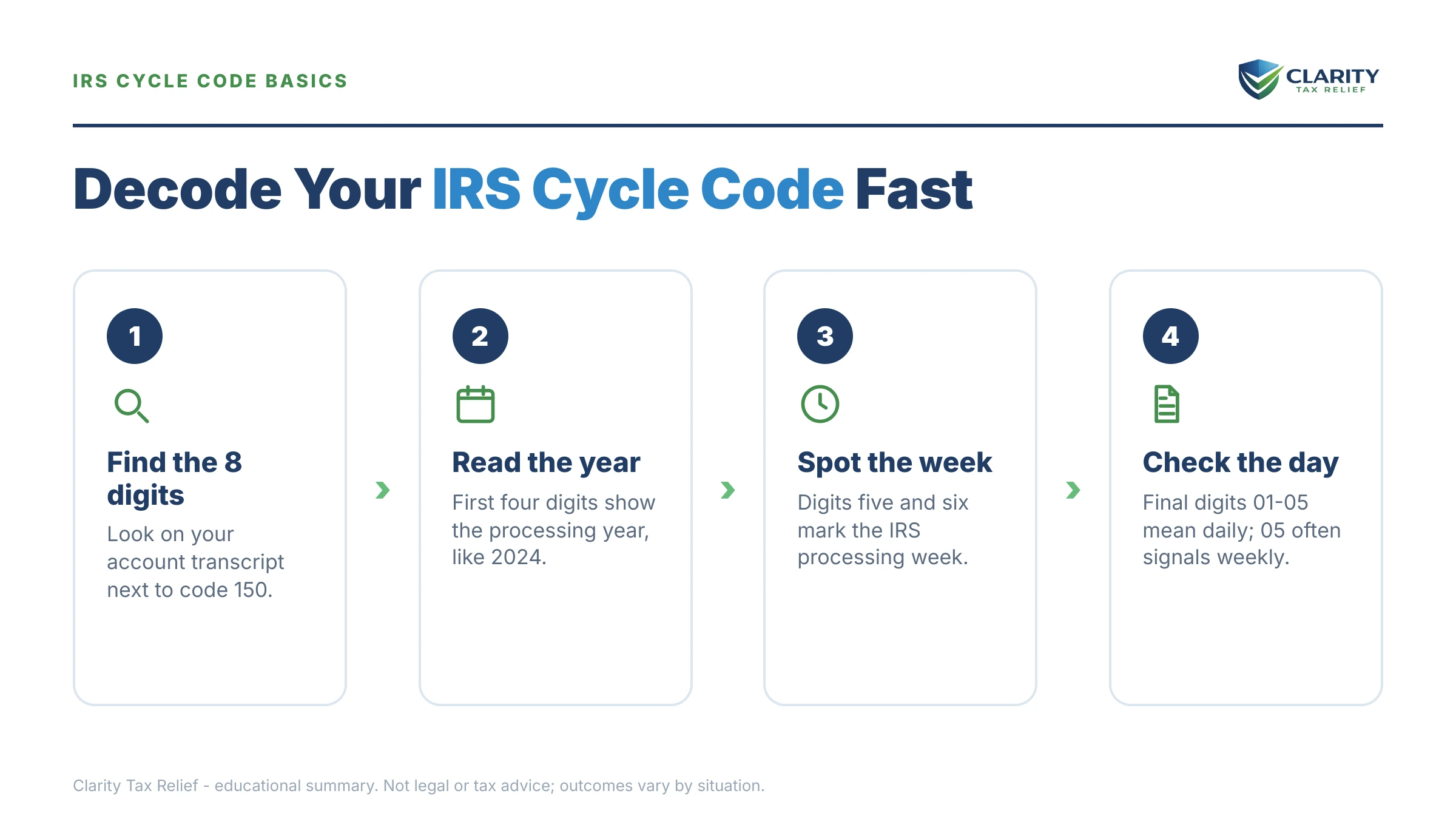
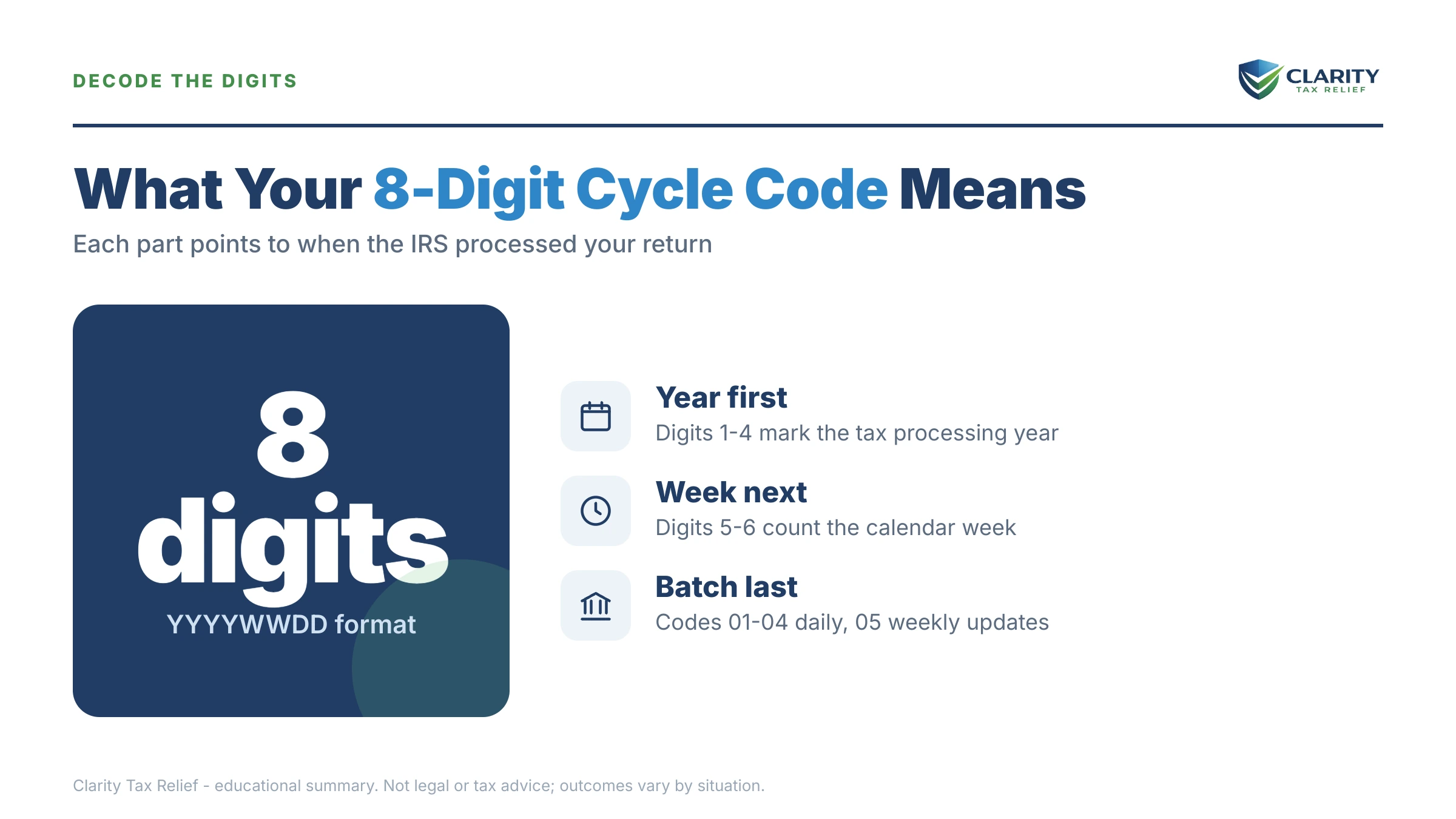
Tax specialist: Three fields. First four digits are the processing year. Next two are the IRS's internal cycle week. Last two are the posting day within that week.
Host: 20260705. So 2026, then 07, then 05.
Tax specialist: Exactly. 2026 is the year the IRS processed it — not the tax year. So a 2025 return filed in February 2026 starts with 2026. The 07 is the seventh cycle week, which lands around mid-February. And the 05—
Host: That's the one that matters, isn't it.
Tax specialist: That's the one. 05 means Thursday posting, and in almost all cases that means a weekly account. Your transcript changes in one batch per week, typically overnight Thursday into early Friday morning.
Host: So checking it Tuesday afternoon is—
Tax specialist: Pointless. The batch runs when it runs. Refreshing ten times a day doesn't move it. Check Friday morning, once a week.
Host: And if it ends in 01 through 04?
Tax specialist: Then you're a daily account. Updates can post overnight Tuesday through Friday. 01 is Friday, 02 Monday, 03 Tuesday, 04 Wednesday. Those you can check each weekday morning.
Host: Hm. Is daily better than weekly?
Tax specialist: No. Neither one is better. The assignment doesn't touch your refund amount, doesn't touch audit odds, doesn't touch anything about the outcome. It only sets the tempo.
Host: Say that more simply for me, because I think this is where people spiral.
Tax specialist: Sure. It tells you what day your account moves. That's it. It's a clock, not a verdict.
Host: Okay. Where do I even find it?
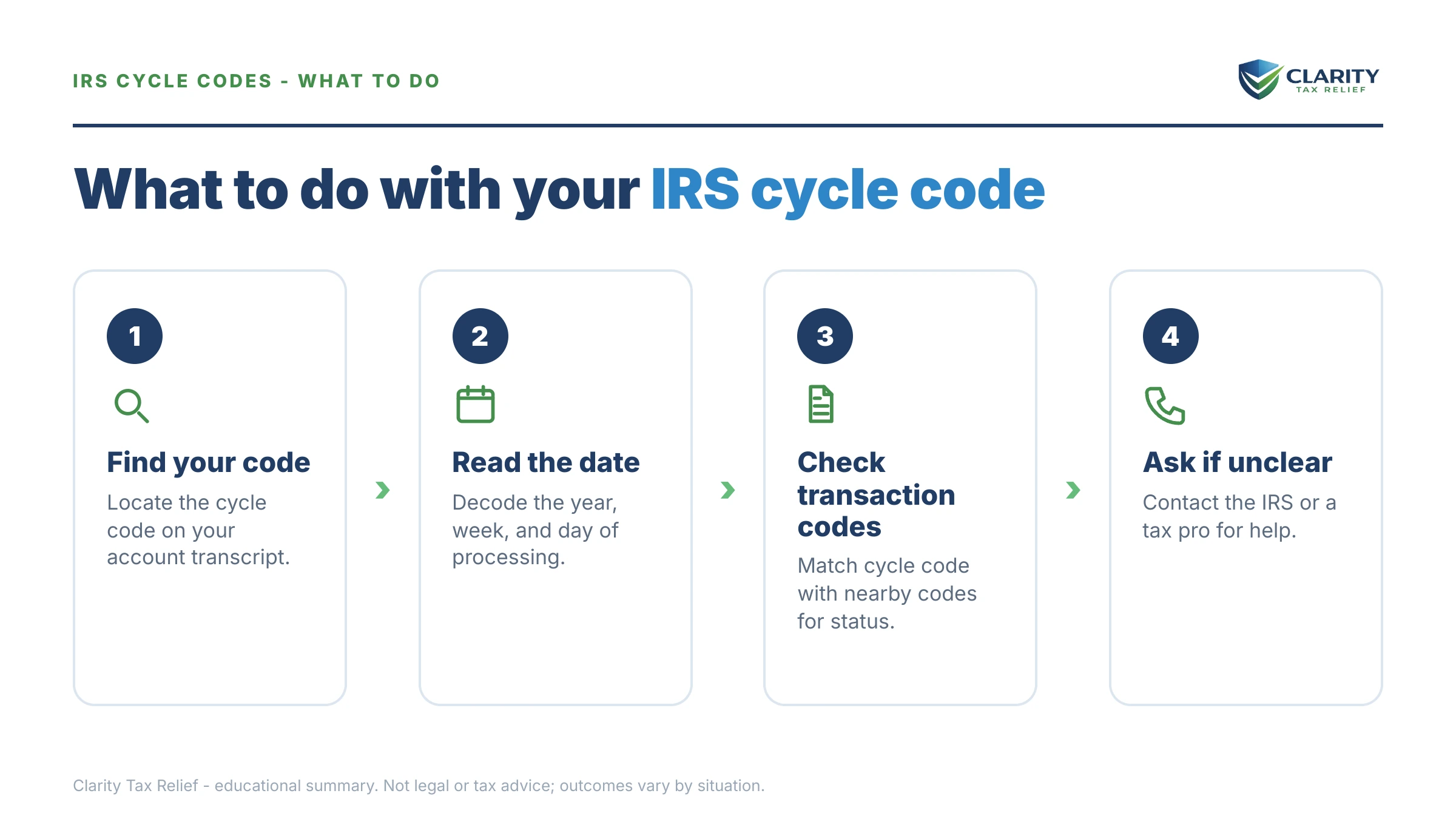
Tax specialist: CYCLE column, same row as transaction code 150. And here's the catch — it only shows on the account transcript. Never the return transcript.
Host: Wait, so if there's no CYCLE column at all—
Tax specialist: You pulled the wrong transcript type. That happens constantly. Log in at IRS.gov, Get Transcript, choose the account transcript for tax year 2025.
Host: Account transcript. Tax year 2025. Got it.
Tax specialist: And the transactions section is near the bottom of the page, so people scroll right past the line that sets their whole update rhythm.
Host: Now the part I want to nail down. Does the cycle code give me a refund date?
Tax specialist: No. And I want to be blunabout it — sorry, blunt about it. The internet is full of charts claiming a specific cycle code maps to a specific deposit date. It doesn't.
Host: So all that arithmetic people do—
Tax specialist: Produces nothing. The only refund date on a transcript is the date printed beside code 846. Until an 846 line exists, no combination of cycle digits gives you a date.
Host: 846. Okay.
Tax specialist: And a cycle code never signals an audit either. Review signals are separate codes entirely.
Host: Alright, walk me through what happens after the cycle code posts. Because I think that's the sequence people actually need.
Tax specialist: So code 150 posts with your cycle code. That means your return's in the Master File and your tax for the year is recorded. Processing is done. Resolution isn't. Then credit codes post: withholding shows up as code 806, refundable credits as 766 or 768. Usually same cycle or the next one.
Host: And then it forks.
Tax specialist: Then it forks. Path A, code 846 posts with a date, and that date is your refund. Path B, a hold posts instead — code 570, additional account action pending, or code 810, refund freeze. Often followed by a 971 line, which means a letter's in the mail.
Host: 570 or 810. And 971 is the letter.
Tax specialist: Right. And there's a third direction people don't expect. If the tax on the 150 line is bigger than your withholding and credits, the module flips to a balance due and the automated system queues a CP14 bill.
Host: CP14. So the cycle code doesn't care which story you're in.
Tax specialist: Not at all. The article has a nice example of this. Say the transcript shows a 150 with tax of roughly $3,700 and an 806 line at negative $4,900 of withholding. That's a $1,200 overpayment sitting there waiting.
Host: And flip the numbers?
Tax specialist: Flip them — $3,700 withheld against $4,900 of tax — and the exact same cycle code precedes a $1,200 balance due and a CP14 in the mail. The cycle code behaves identically. It's the arithmetic between 150 and 806 that decides.
Host: Oh, that's the part people miss.
Tax specialist: Completely. They think the code is telling them good news or bad news. It isn't telling them anything about that.
Host: Let me ask about the 05 nuance. You said almost always weekly.
Tax specialist: Yeah, a small share of accounts ending in 05 actually process daily. So if your 05 transcript changes mid-week, that's why. Treat weekly as the strong default, not an iron law.
Host: What about when the transcript and Where's My Refund disagree? Because that makes people panic.
Tax specialist: Different schedules, that's all. Weekly accounts typically see Where's My Refund update Saturday, following the Friday transcript batch. Daily accounts, often midweek, Wednesday-ish. So they're out of sync for a day or two and it means nothing.
Host: And if nothing's moved for weeks?
Tax specialist: Few reasons. Weekly account is the most common — nothing moves between batches no matter how often you look. A 570 or 810 stops forward movement until the IRS resolves the hold. And early filers claiming EITC or the Additional Child Tax Credit are held by the PATH Act until mid-February regardless of cycle.
Host: Regardless of cycle. Okay.
Tax specialist: If weeks pass with no movement and no letter, that's when you call the IRS or a tax professional.
Host: Which brings me to — when is this genuinely a do-it-yourself thing?
Tax specialist: Reading a cycle code? Always. Full stop. If your transcript shows 150, credits, and an 846 with a date, there's nothing to hire anyone for. Check on your posting day and skip anyone charging money to track your refund for you.
Host: And the narrower cases?
Tax specialist: An 810 freeze that survives identity verification. A 570 hold with a disputed amount you don't agree with. A balance you can't pay before penalties compound. Or a transcript showing multiple years behind this one, especially unfiled years.
Host: Why do those change things?
Tax specialist: Because at that point the transcript is a map of a bigger problem. And the order you fix things in changes what you ultimately pay. That's the honest hard part — there's no shortcut, and eligibility for any IRS program depends on your specific facts.
Host: One more thing on the timing side. The article mentions IRS staffing.
Tax specialist: Yeah, staffing fell roughly 27% in 2025. Humans are harder to reach. But the batch cycles — the ones that post holds, mail notices, add penalties — those run exactly on schedule. That asymmetry is the whole story right now.
Host: So interest and the monthly late-payment penalty keep accruing whether anyone picks up the phone.
Tax specialist: Correct.
Host: Alright, what should someone do in the next day?
Tax specialist: Pull the 2025 account transcript. Find the eight digits in the CYCLE column beside code 150. Write down the last two — that's your check-in day from now on. Then scan every line below it. If there's an 846 with a date, you're done, cross-check at Where's My Refund. If you see a 570, an 810, or a balance due, gather the transcript, your filed return, and any IRS letters.
Host: And if it's a hold or a balance?
Tax specialist: Send us the transcript. An Enrolled Agent will walk it line by line, free, and tell you what the hold's cause looks like and what the balance is doing each month. 888-825-7779, or the two-minute form. No promises about where it lands — just a clear read of what's actually on the page.
The short answer: the IRS cycle code meaning breaks into three parts. It's the 8-digit number on your account transcript beside code 150 — the first four digits are the processing year, the next two are the IRS cycle week, and the last two are the posting day. A code ending in 05 means a weekly-updating account.
You pulled your account transcript this 2026 filing season looking for one thing, a refund date, and instead found a wall of three-digit codes and one eight-digit number, something like 20260705, that looks like a serial number. That's your cycle code, and it's the closest thing your transcript has to a schedule. Thirty seconds of decoding tells you which day of the week your account moves, and which days checking is pointless.
The image below shows exactly what an account transcript looks like and where the cycle code sits — most people scroll straight past it without realizing it's the line that sets their update rhythm.
⏱ The real clock: if your cycle code ends in 05, your transcript typically updates once a week — overnight Thursday into early Friday morning. Refreshing ten times a day changes nothing; the batch runs when it runs. Codes ending 01–04 can update overnight Tuesday through Friday.
What an IRS cycle code actually is
An IRS cycle code is the eight-digit posting stamp — year, week, day — that the IRS Master File assigns to your return the moment it finishes processing. It isn't a status, a score, or a flag. It's internal scheduling data: the batch your account was processed in, which in turn determines when future changes to your account post.
You'll find it in the CYCLE column, on the same row as transaction code 150, and only on the account transcript, never the return transcript. If you're staring at a document with no CYCLE column, you pulled the wrong transcript type. Our guide to how to get your IRS transcript online shows which one to request.
Every processed return gets a cycle code — refund, zero balance, or balance due. The IRS never explains it on the transcript because it was never designed for taxpayers. That's exactly why decoding it is useful: it's one of the few honest signals about your account's timing that exists anywhere.
“Tax account transcript - shows basic data such as filing status, taxable income, and payment types. It also shows changes made after you filed your original return.”
— Transcript types for individuals and ways to order them (IRS.gov)
IRS cycle code meaning, digit by digit
A cycle code like 20260705 reads as three fields: 2026 (processing year), 07 (the IRS's seventh cycle week), and 05 (the posting day within that week).
- Digits 1–4 — processing year. The year the IRS processed the return, not the tax year. Your 2025 return filed in February 2026 starts with 2026.
- Digits 5–6 — cycle week. The IRS's internal week counter, starting from early January. It roughly tracks the calendar week of the year, cycle 07 lands around mid-February, but it's a processing week, not a promise about calendar dates.
- Digits 7–8 — posting day. The day within the cycle your account posts. This is the pair that matters most, because it reveals whether your account is daily or weekly.
| Last two digits | Posting day | What it usually means |
|---|---|---|
| 01 | Friday | Daily account — updates can post overnight Tuesday–Friday |
| 02 | Monday | Daily account |
| 03 | Tuesday | Daily account |
| 04 | Wednesday | Daily account |
| 05 | Thursday | Weekly account in almost all cases — one batch update per week |
One nuance worth knowing: a small share of accounts ending in 05 are actually processed daily. If your 05 transcript changes mid-week, that's why. Treat the weekly rhythm as the strong default, not an iron law.
What does the processing date mean on an IRS transcript?
The processing date sits near the cycle code at the top of your account transcript, usually printed as a Monday and often a week or two ahead of the day you are looking at it. That future date is why people read it as a deposit date. It is not one.
Here is the part almost nobody says out loud: the IRS does not publish a definition of that field. Its transcript pages describe what a tax account transcript contains, in its words "basic data such as filing status, taxable income, and payment types". They never explain the processing date. Checked 6 September 2026. Anyone telling you precisely what it means, including a date your money lands, is telling you what they believe rather than what the IRS has said.
What you can rely on is the line that carries an actual refund date. Code 846, refund issued, is the entry with a date attached to money leaving the IRS. Until an 846 appears, no date anywhere on the transcript is a payment date, and the processing date is not a substitute for one.
So if you are chasing a refund, read the transcript for an 846 and use the IRS Where's My Refund tool for timing. If a hold code is sitting there instead, that is the thing worth your attention: a 570 holds the account, and a 971 means a notice went out explaining why.
Daily vs. weekly accounts: what a cycle code ending in 05 means for you
A cycle code ending in 05 means your account almost always changes in one weekly batch, typically overnight Thursday into early Friday morning Eastern time. Daily accounts (01–04) can see movement any overnight run, Tuesday through Friday. Neither type is better — the assignment doesn't touch your refund amount, your audit odds, or anything else about the outcome. It only sets the tempo.
| What updates | Daily account (ends 01–04) | Weekly account (ends 05) |
|---|---|---|
| Account transcript | Overnight, typically Tuesday–Friday | One batch, typically Thursday night into Friday morning |
| Where's My Refund | Typically midweek, often Wednesday | Typically Saturday, following the Friday transcript batch |
| Smart time to check | Each weekday morning | Friday morning, once a week |
This is also why transcripts and Where's My Refund so often disagree for a day or two — the tools update on different schedules. If your transcript shows movement the tool doesn't, see our guide to a transcript updated but WMR didn't mismatch, and for the full weekly calendar, what day IRS transcripts update.
What your cycle code can, and can't, tell you
A cycle code tells you when your return posted and which day your account processes — nothing more. The internet is full of charts promising that a specific cycle code maps to a specific deposit date. It doesn't, and believing it leads to a lot of miserable Friday mornings.
What it can tell you: your return finished processing (the code 150 row exists), roughly when it posted (the week digits), and when to check for changes (the day digits).
What it can't tell you: your refund date, your deposit day, or whether you're being reviewed. The only refund date on a transcript is the one printed beside code 846 — decoded fully in our code 846 refund issued date guide. Until an 846 line exists, no arithmetic on your cycle digits produces a date. And a cycle code never signals an audit; review signals are separate codes, covered next.
What happens after your cycle code posts
Once a cycle code appears next to code 150, your account follows a predictable sequence. The fork it takes determines whether your next event is a deposit, a letter, or a bill:
- Code 150 posts with your cycle code. Your return is in the Master File and your tax liability for the year is recorded. Processing is done; resolution isn't.
- Credit codes post. Withholding appears as code 806 withholding, refundable credits as 766/768 — usually in the same cycle or the next one.
- The fork. Path A: code 846 posts with a date, and that date is your refund. Path B: a hold posts instead — code 570 (additional account action pending) or code 810 refund freeze — often followed by a 971 line meaning a letter is in the mail.
- If the math runs the other way — the tax on the 150 line exceeds your withholding and credits — the module flips to a balance due. The IRS's automated system queues a CP14 bill. From there, interest and a monthly late-payment penalty accrue until the balance is addressed.
In 2026, that automation is the whole story. IRS staffing fell roughly 27% in 2025, so humans are harder to reach. But the batch cycles that post holds, mail notices, and add penalties run exactly on schedule.
Transcript showing a hold code or a balance you didn't expect?
Your cycle code tells you when your account moves. It can't tell you why it stopped, or what a growing balance will cost you as interest and penalties accrue each month. Send us your transcript and an experienced tax professional will decode every line free, no pressure.
The codes around your cycle code, and what to do about each
The cycle code is the timestamp; the transaction codes stacked below it are the story. Here's how to read the ones that matter most:
| Code | What it means | What to do |
|---|---|---|
| 150 | Return filed and posted; the amount is your tax for the year | Nothing. This is the anchor line your cycle code sits on |
| 806 | Federal withholding credited (shows as a negative) | Confirm it matches your W-2 box 2 |
| 766 / 768 | Refundable credits posted (EITC shows as 768) | Verify against your return; credits invite extra screening |
| 570 | Hold — additional account action pending | Wait for the paired notice; don't refile or amend blindly |
| 971 | Notice issued — a letter is on its way | Watch the mail and respond by the letter's date |
| 810 | Refund freeze — often identity or credit verification | Complete any verification request promptly |
| 846 | Refund issued, with the actual date | Expect the deposit on or near that date |
Two common 570 triggers worth naming: a withholding mismatch (the IRS's copy of your W-2 disagrees with your return) and a duplicate dependent — the mess that follows when both parents claimed the same child. Both resolve, but on the IRS's weekly clock, not yours.
If your transcript shows a balance due instead of a refund, the fix has nothing to do with cycle codes: pick a payment method (our comparison of the best way to pay the IRS covers every option and fee), or if the balance is more than you can pay, start with the full DIY playbook in how to settle tax debt yourself.
Worked example: decoding a $48,300 W-2 transcript
Say you're a W-2 employee filing single who earned $48,300 in 2025 wages with $4,900 of federal withholding. You filed in late January 2026. By mid-February, your account transcript shows:
- Code 150 — cycle 20260705 — tax of roughly $3,700 (hypothetical figure for a single filer at this income after the standard deduction)
- Code 806 — −$4,900 — your withholding, posted as a credit
The math: $4,900 withheld − $3,700 tax = a $1,200 overpayment waiting to become a refund. Now decode the cycle: 2026 = processing year; 07 = the seventh cycle week, so the return posted around mid-February; 05 = Thursday posting, almost certainly a weekly account.
What that means practically: check the transcript Friday mornings only. One Friday, either an 846 posts with a date — that date is when the $1,200 moves — or a 570 posts and you switch from waiting mode to watch-the-mailbox mode. Flip the numbers ($3,700 withheld against $4,900 of tax) and the same cycle code instead precedes a $1,200 balance due and a CP14 in the mail. The cycle code behaves identically either way; it's the arithmetic between 150 and 806 that decides which story you're in.
How to find and decode your cycle code, step by step
- Pull your account transcript. Log in at IRS.gov, open Get Transcript, and choose the account transcript for tax year 2025 — the cycle code does not appear on the return transcript.
- Find the eight-digit number in the CYCLE column. It sits on the same row as transaction code 150, in the transactions section near the bottom of the page.
- Decode the three parts. The first four digits are the processing year, the next two are the IRS cycle week. The last two are the posting day — 01 through 04 usually mean a daily account, 05 almost always means weekly.
- Read the lines below it. Code 846 with a date is your refund date; 570 or 810 means a hold; 971 means a notice is on its way to your mailbox.
- Set your check-in rhythm. A cycle ending in 05 means check Friday morning each week. Endings 01 through 04 can update overnight Tuesday through Friday.
- Act on holds or balances. Respond to any notice a 971 line produces, and if the transcript shows a balance due, set up payment before another month of interest and penalties posts.
When you can handle this yourself, and when to get help
Reading a cycle code is a do-it-yourself job, full stop. If your transcript shows 150, credits, and an 846 with a date, there is nothing to hire anyone for — check on your posting day, wait for the deposit, and skip anyone charging money to "track your refund." The same goes for a clean transcript that's simply slow: weekly accounts feel frozen because they only move once every seven days.
Experienced help changes the outcome in a narrower set of situations: an 810 freeze that survives identity verification, a 570 hold with a disputed amount you don't agree with, a balance due you can't pay before penalties compound, or a transcript showing multiple years of activity, especially unfiled years, behind this one. In those cases the transcript is a map of a bigger problem, and the order you fix things in changes what you ultimately pay. Learning how to read an IRS account transcript end to end is the right first step either way.
Terms on your transcript, decoded
- Cycle code — the eight-digit year/week/day stamp showing when your return posted and which batch your account processes in.
- Master File — the IRS's central database of every taxpayer account; "posting" means a transaction was written into it.
- Posting cycle — the IRS's internal processing week; cycle week 01 begins in early January and the counter runs through the year.
- Transaction code (TC) — the three-digit codes (150, 806, 846…) that record each event on your account, in order.
- "As of" date — the date interest and penalties are calculated through on the transcript; it shifts routinely and is not a refund date.
- Daily vs. weekly account — the IRS's processing-schedule assignment, revealed by your cycle code's last two digits; it controls update timing, nothing else.
IRS cycle code questions, answered
What does my IRS cycle code mean?
It is the date stamp showing when your return posted to the IRS Master File, written as year + cycle week + posting day. Cycle 20260805 means processing year 2026, the eighth cycle week (roughly late February), posted in the Thursday batch. It tells you your account's update rhythm, not your refund date, which only appears beside code 846.
What does a cycle code ending in 05 mean?
A cycle code ending in 05 almost always means a weekly account: your transcript changes in one batch per week, typically overnight Thursday into early Friday morning, with Where's My Refund following that Saturday. There is nothing wrong with a weekly account and it does not affect your refund amount. A small number of 05 accounts do process daily, so treat the weekly rhythm as the strong default, not a rule.
Does my cycle code tell me when I'll get my refund?
No. The cycle code only tells you when your return posted and which day your account processes — the actual refund date is the date printed beside code 846 on your account transcript. Direct deposits generally arrive on or within a few days of that 846 date. Until an 846 line exists, no combination of cycle digits can predict the date.
What does cycle code 20260605 mean?
Cycle 20260605 breaks down as processing year 2026, cycle week 06 (roughly early-to-mid February), posting day 05 — the Thursday batch, which usually marks a weekly account. In plain terms: your return posted to the Master File in mid-February. Your transcript will typically refresh once a week, overnight Thursday into Friday. It says nothing about your refund amount or whether you are being reviewed.
Do I have a cycle code if I owe the IRS?
Yes — every processed return gets a cycle code, whether it produces a refund, a zero balance, or a bill. If the tax on your code 150 line is larger than your withholding and credits, the module flips to a balance due and the IRS mails a CP14 bill instead of issuing a refund. The cycle code works identically; only what follows it changes.
Why hasn't my transcript updated with new codes?
The most common reason is simply a weekly account: if your cycle code ends in 05, nothing moves between weekly batches no matter how often you check. Beyond that, a 570 or 810 line stops forward movement until the IRS resolves the hold, and early-season filers claiming the EITC or Additional Child Tax Credit are held by the PATH Act until mid-February regardless of cycle. If weeks pass with no movement and no letter, call the IRS or a tax professional.
Can my cycle code change from year to year?
The week digits change every year because they reflect when that year's return posted. But the last two digits, your daily-or-weekly assignment, usually carry over from year to year. The IRS can and occasionally does move accounts between daily and weekly processing, often after identity verification or account activity. A switch is a processing-schedule change, not a red flag about your return.
Your next 24 hours
- Find your cycle code. Pull your 2025 account transcript and locate the eight-digit number in the CYCLE column beside code 150. Write down the last two digits — that's your update day from now on.
- Scan every line below it. An 846 with a date means you're done — cross-check it at Where's My Refund on IRS.gov. A 570, 810, or a balance due means your account needs action: gather the transcript, your filed return, and any IRS letters you've received.
- If you found a hold or a balance, get it reviewed free. A hold has a specific cause. A balance grows with interest and penalties every month it sits. Call (888) 825-7779 or use the 2-minute form and an experienced tax professional will walk your transcript line by line.
This guide is general information, not tax or legal advice for your specific situation. Eligibility for IRS programs depends on individual facts and circumstances; no outcome is guaranteed.