
IRS Transcripts & Refunds
Transcript Updated but WMR Didn't: What It Means and Which One to Trust (2026)
The short answer: if your transcript updated but WMR didn't, trust the transcript. Your account transcript is the IRS's actual record; Where's My Refund is a simplified display that runs one to several days behind it. A code 846 on the transcript means your refund is scheduled — whether or not WMR ever catches up.
It's early morning, your transcript finally posted a new line after weeks of nothing, and then you opened Where's My Refund — same single bar it's shown since you filed. If rent is behind and there's a levy warning sitting on your counter, that mismatch isn't a curiosity. It's the difference between money landing this week and money you can't count on. The good news: the mismatch itself is almost always harmless, and the transcript just told you which situation you're in.
Everything turns on the last three-digit code that posted. The image below shows exactly what an updated account transcript looks like and where to find the line that decides whether your money is moving.
⏱ The date that controls your money: a transcript/WMR mismatch has no deadline of its own — the date printed next to code 846 on your transcript is your actual refund date, and WMR catching up later doesn't change it. If a code 971 posted instead, the letter it announces will carry its own printed deadline. Respond to the letter's date, not to the app.
Why your transcript updated but WMR didn't
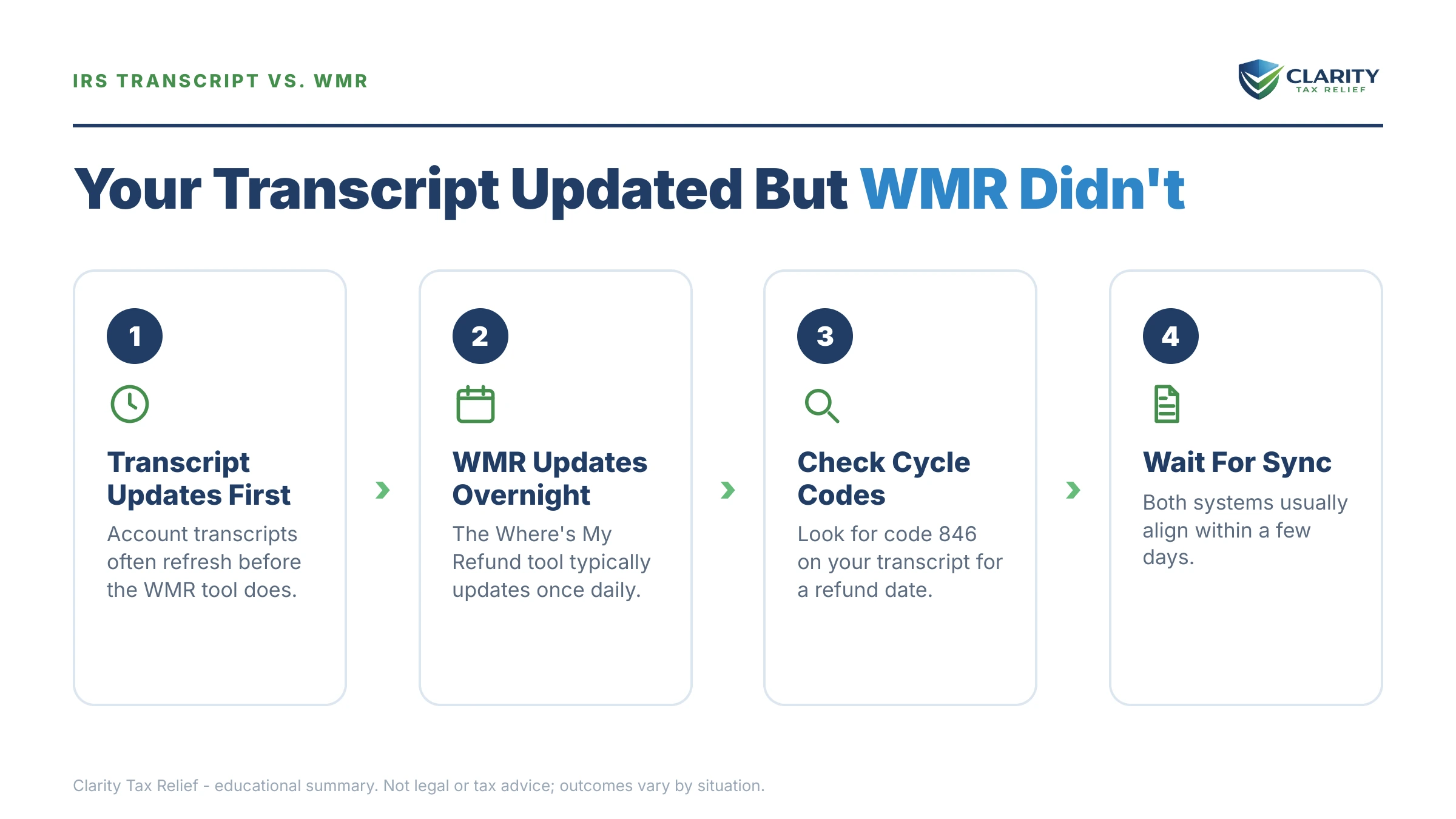
Your transcript and Where's My Refund are two different systems that update on two different schedules — the transcript always moves first. The account transcript is a direct readout of the IRS master file, the database where every transaction on your account actually posts. WMR is a stripped-down public display fed from that database, refreshed roughly once per day, overnight. It often trails the master file by one to several days.
So when the transcript posts a new code and WMR sits frozen, nothing is broken. The record moved; the display hasn't refreshed yet. Plenty of filers watch WMR skip its middle bar entirely, jumping from "received" straight to "sent" days after the transcript already showed the refund scheduled. Some never see WMR update before the deposit hits.
Timing also depends on which processing cycle your account runs on. The last two digits of your IRS cycle code tell you: codes ending 01–04 are "daily" accounts that can update most weeknights, while codes ending 05 are "weekly" accounts that typically move once a week. Our guide on what day IRS transcripts update breaks the schedule down; the short version is in the table below.
| System | What it shows | When it typically updates |
|---|---|---|
| Account transcript — daily account (cycle code ends 01–04) | Every transaction posted to your account, with codes, dates, and dollar amounts | Can update overnight most weeknights |
| Account transcript — weekly account (cycle code ends 05) | Same full transaction record | Typically one mass update per week, most commonly overnight into Friday |
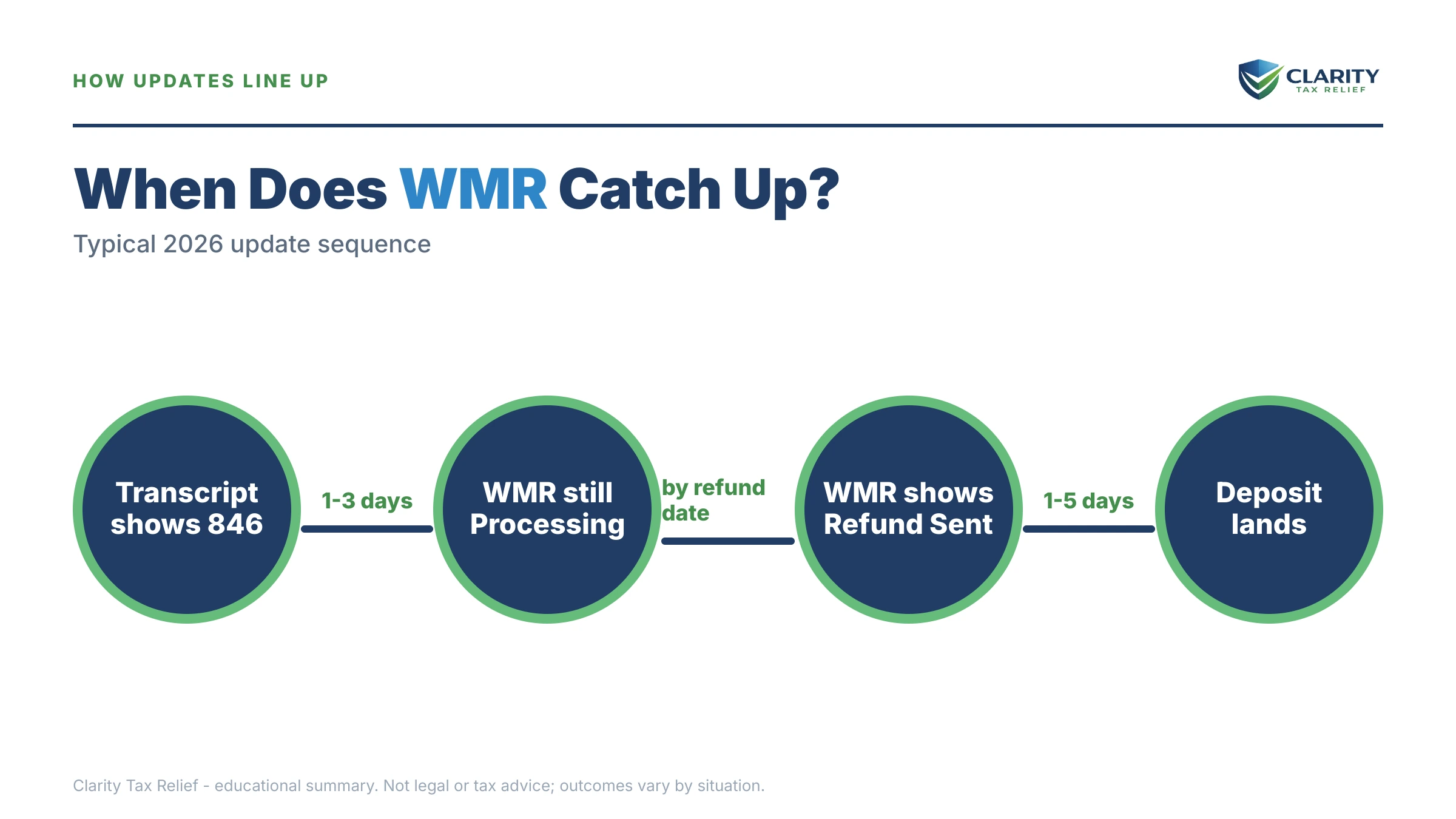
| Where's My Refund / IRS2Go | Three bars and a generic message for the current-year original return only | Refreshes about once per day overnight, often one to three days behind the transcript |
One more structural gap: WMR only tracks the current year's original return. Amended returns, prior-year refunds, and account activity like holds, offsets, and notices simply don't display there — the transcript is the only place you'll see them. If you're new to reading the document itself, start with how to read an IRS account transcript. This article covers only the mismatch and the codes that explain it.
When the mismatch is routine, and when it's a warning
A transcript that updates ahead of WMR is routine; a transcript that updates with a hold code is not. Whether you can relax comes down to which code posted. If the new line is 846, you're done — the refund is scheduled for the printed date and no stage of WMR matters anymore. If the new line is a hold, freeze, or offset code, the mismatch is the least of it, and here's the sequence that follows if it sits unaddressed:
- Code 570 posts alone — the refund is paused while the IRS verifies something, commonly withholding, a refundable credit, or an income-document match. No action exists for you to take yet.
- Code 971 follows — a notice is being mailed. From here, the letter runs the show: it names what the IRS is questioning and prints a response deadline. WMR usually still says "processing" through all of this.
- The letter's deadline passes unanswered — the IRS resolves the question without you. That can mean a code 290 additional assessment that shrinks or erases the refund, or a referral toward examination.
- Code 810 posts — a hard refund freeze, most often tied to identity or credit verification. An 810 does not age out; nothing releases until you complete the step the IRS asks for.
- Code 420 posts — your return was selected for exam. The refund waits on the audit's outcome, which is a months-long track, not a days-long one.
- Offset codes post (826 or 898) — the refund exists but is being applied to a debt first. Critically, if you're already in the collection pipeline on another balance, an offset reduces that balance but does not stop the levy track on its own — collection notices keep escalating on whatever remains.
That last point matters most if you're counting on this refund while the IRS or your state is threatening a levy. The refund side of the house and the collection side of the house run on separate automation — one paying the other doesn't pause anything.
Refund stuck on a hold code while a collection clock runs on another year?
If your transcript shows a 570, 810, or an offset. A levy or balance-due notice is sitting on the other side of your account — the order you fix things in changes what you keep. Get both sides of your account reviewed free by an experienced tax professional.
What each transcript code means when WMR hasn't moved
Seven codes explain nearly every transcript-updated-but-WMR-didn't situation. Find the newest one on your transcript and match it here:
| Code | What it means | What to do |
|---|---|---|
| 846 | Refund issued — the printed date is your refund date | Nothing. Plan around the 846 date; ignore WMR from here. |
| 570 | Hold on the account before the refund releases | Wait and watch for a 971 or a 571/846. No action exists yet. |
| 971 | A notice has been issued and is in the mail | Watch the mailbox; respond by the deadline printed on the letter. |
| 810 | Refund freeze, often identity or credit verification | Act. Complete the verification the IRS letter directs; the freeze won't lift on its own. |
| 826 | Refund applied to a balance you owe on another IRS year | Expect a smaller (or no) deposit; pull the other year's transcript to see what remains. |
| 898 | Refund offset to a non-IRS debt (student loans, child support, state debt) | Identify the agency through the Treasury Offset Program; dispute goes to that agency, not the IRS. |
| 420 | Return selected for examination | Gather documents for the items on your return; wait for the exam letter before doing anything else. |
Two context codes round out the picture. A code 150 means your return posted and processing genuinely started, if 150 is your newest line, you're simply earlier in the pipeline than a mismatch question implies. And the "as of" date on your IRS transcript is an interest-computation bookmark, not a refund date. It moves around for accounting reasons and predicts nothing about your deposit.
A worked example: the $4,800 refund that moved on the transcript first
Say you're a renter, a month behind, with a levy warning on an old tax balance, and your current-year return claims $4,800. This is a hypothetical, but the arithmetic is exactly what your transcript shows. Your employer withheld $7,100 (posted as code 806). Your tax came to $2,300 (posted with code 150). The difference is your refund:
$7,100 withheld − $2,300 tax = $4,800 refund
On a Friday morning your transcript posts 846, Refund issued, $4,800, dated the following Wednesday. WMR still shows one bar. That mismatch means nothing: the deposit is scheduled for Wednesday, and WMR may not update until after the money is already in your account.
Now the version that stings. Suppose the old balance behind that levy warning is $1,900 on a prior year. Before any 846 posts, the transcript shows 826 — $1,900 moving to the prior year, and the 846 that follows reads $2,900, not $4,800. WMR, meanwhile, still displays the original $4,800 figure until it refreshes — which is exactly why the transcript, not the app, is the number to budget rent around. And note what the offset did not do: if the prior-year balance were larger than the refund, the leftover debt keeps the collection sequence running, levy threat included. An offset is a payment, not a resolution.
How to respond when your transcript updates but WMR doesn't, step by step
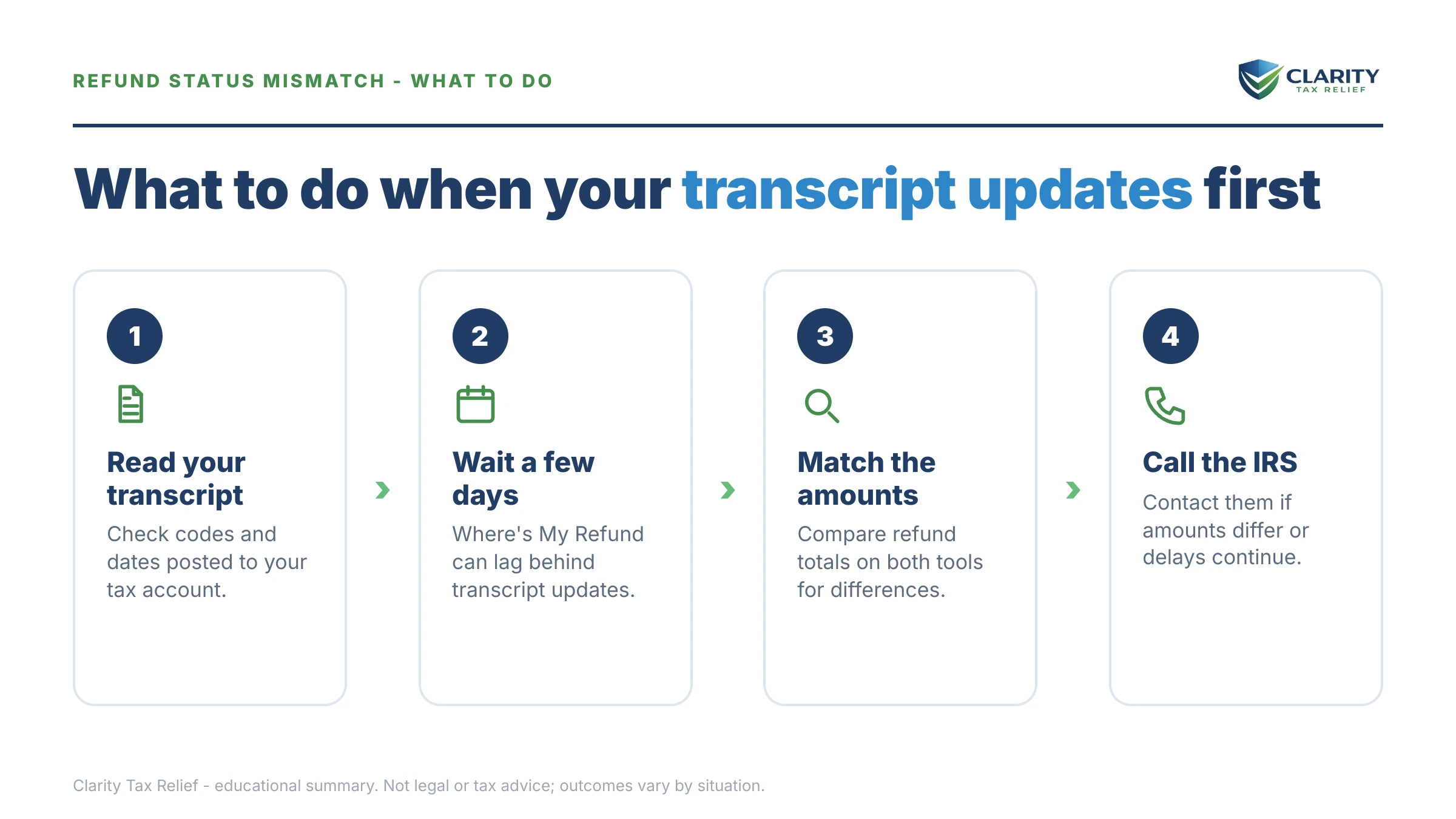
- Pull your account transcript, not WMR. Log into your IRS online account and open the account transcript for the year you filed. The newest line in the transactions section is the one that changed. That line, not the WMR bar, is your real status.
- Identify the last code that posted. 846 means your refund is scheduled. 570 or 810 means it is held. 826 or 898 means some or all of it went to a debt. 971 means a letter is on the way.
- Check the date printed next to that code. An 846 date is your refund date — plan around it, not around WMR. A date next to 570 or 971 tells you when the hold posted or roughly when the related letter went out.
- Act only if an action code posted. For 810, complete identity verification as soon as the IRS letter tells you how. For 971, respond by the deadline printed on the letter it announces. For 846, do nothing — the money is coming.
- Check on your account's update day instead of refreshing hourly. Find your cycle code on the transcript. If it ends in 05, your account typically moves once a week — checking WMR five times a day changes nothing.
When you can handle this yourself, and when help changes the outcome
Most transcript/WMR mismatches need no one's help — including ours. You can confidently handle it alone when:
- 846 posted. The refund is scheduled. There is nothing for anyone to do but wait for the printed date.
- 570 posted with no 971 yet. The IRS hasn't asked you for anything. Many of these holds release on their own without a letter ever arriving.
- A 971 letter arrived and you agree with it. Send what it asks for by its printed deadline and keep copies. That's the whole job.
Experienced help changes outcomes in a narrower set of situations: an 810 freeze that hasn't moved after you completed verification. A refund being consumed by offsets while a levy is in motion on another year — where sequencing the balance, a payment arrangement, and any penalty relief determines what you actually keep. Multiple unfiled years holding the refund hostage. Or a 420 exam referral where the refund now depends on defending the return. In 2026, with the IRS workforce down roughly 27% from 2025 cuts, phone-fixing any of these yourself is slower than it's ever been — the automated systems posting these codes never slowed down. But the humans who resolve them did. If your situation is stuck and the phones aren't answering, the Taxpayer Advocate Service exists for refund delays causing genuine financial hardship — like a pending eviction.
Terms on your transcript, decoded
- Master file: the IRS's core database where every transaction on your account posts. Your transcript is a direct readout of it.
- Transaction code (TC): the three-digit number starting each transcript line (150, 570, 846) that identifies what kind of action posted.
- Cycle code: the eight-digit number (year, week, day) showing when your account processes — its last two digits reveal whether you update daily or weekly.
- 846 date: the date printed beside code 846 — the day the IRS actually sends your refund, regardless of what WMR displays.
- Refund offset: the government applying your refund to another debt, an IRS year (826) or an outside agency (898), before any of it reaches you.
- "As of" date: a bookkeeping date used to compute interest and penalties. It is not a refund date and routinely changes for reasons that have nothing to do with your money.
You can pull your own transcript free anytime at the IRS's Get Transcript page. The official refund tracker lives at IRS.gov/refunds. If WMR is stuck for weeks with no transcript movement at all, that's a different problem — see "Where's My Refund" stuck on still processing.
Transcript vs. WMR questions, answered
Why did my transcript update but WMR didn't?
Because they are two different systems on two different schedules. Your transcript is the IRS master file, the actual record, while Where's My Refund is a simplified public display that refreshes roughly once a day and often lags the transcript by one to several days. A transcript that moves first is normal, not a sign something broke.
Is the transcript or Where's My Refund more accurate?
The transcript, every time. It shows every transaction the IRS posts to your account, with dates and dollar amounts, while WMR compresses everything into three bars. If the two disagree, the transcript is right. The one thing WMR adds is a delivery-problem message after a deposit fails, which the transcript won't flag as plainly.
My transcript shows code 846 but WMR still says processing. Will I get my refund?
Yes — code 846 means the refund is scheduled, and the date printed next to it is your actual refund date. Direct deposits typically arrive on or within a few days of that date whether or not WMR ever updates. If the 846 date passes by more than a week with no deposit, check the bank details on your return and contact the IRS.
How long after my transcript updates will WMR update?
Typically one to three days, because WMR refreshes only about once per day, overnight. Some filers see WMR skip stages entirely, jumping straight from received to sent, and some never see it move before the deposit lands. The lag itself requires no action from you.
What if my transcript updated with code 570 instead of 846?
Code 570 means the IRS put a hold on your account before releasing the refund, often to verify withholding, a credit, or an income match. Nothing on WMR will move until it resolves. Watch for a code 971 next, which means a letter is coming; if one arrives, respond by the date printed on it. Many 570 holds release on their own with a 571 or 846.
Will I still get the full refund shown on my transcript if I owe back taxes?
Not necessarily. If you owe the IRS for another year, your refund is applied there first, you'll see code 826, and other government debts can take it through the Treasury Offset Program, shown as code 898. The 846 amount that eventually posts reflects what's left after those offsets, which can be less than your return claimed.
What day do IRS transcripts update?
It depends on your cycle code. Accounts with cycle codes ending in 01 through 04 are daily accounts and can update most weeknights. Accounts ending in 05 are weekly and typically update once a week, most commonly overnight into Friday. WMR then follows on its own overnight refresh, usually a day or more later.
Your next 24 hours
- Find the last code on your transcript — open the account transcript for the year you filed and write down the newest three-digit code and the date printed beside it. That one line replaces every WMR refresh.
- Gather the paper trail — a copy of the return you filed, the transcript itself, and any IRS letters you've received this year, including any balance-due or levy notice on another year.
- If the code is a hold, freeze, or offset — get it reviewed free. An 810, a stalled 570/971, or a refund disappearing into a balance the IRS is still collecting on means interest and penalties keep accruing on whatever remains. Call (888) 825-7779 or use the 2-minute form at claritytaxrelief.com/#consult and an experienced tax professional will map both sides of your account.
This guide is general information, not tax or legal advice for your specific situation. Eligibility for IRS programs depends on individual facts and circumstances; no outcome is guaranteed.