
Refund Offsets
US Treasury Number for Offsets: How to Call 800-304-3107 and Check Your Refund
The short answer: the US Treasury number for offsets is 800-304-3107 (TTY/TDD 800-877-8339). It is the Treasury Offset Program call center, a free automated line run by the Bureau of the Fiscal Service, staffed Monday through Friday, 7:30 a.m. to 5 p.m. Central. Enter your Social Security number and it reads back any debt certified to take your federal payments, plus the creditor agency's phone number for each one. Verified October 2026 against IRS Tax Topic 203 and fiscal.treasury.gov.
Your refund came back thousands short, or "Where's My Refund" says it was sent and your bank account says otherwise. One call to 800-304-3107 tells you which debt intercepted the money and which agency is holding it. The line has a blind spot most articles skip, though. IRS back taxes do not appear on it at all, and that gap trips up more callers than anything else.
This guide covers what the hotline can and can't tell you, its hours, which number fits which kind of offset, how to dispute one, what happens if the debt sits, and how to keep your next refund.
If your refund was already taken, a letter from the Bureau of the Fiscal Service follows the offset. The image below shows what you are looking at and where the details that matter sit on it.
⏱ The real clock: an offset has no response window, but it repeats. Every federal tax refund you file for will be intercepted, year after year, until the underlying debt is paid, disputed successfully, or resolved through a qualifying program. Interest and collection costs on the debt keep growing in the meantime.
What does the treasury offset hotline number tell you, and what can't it tell you?
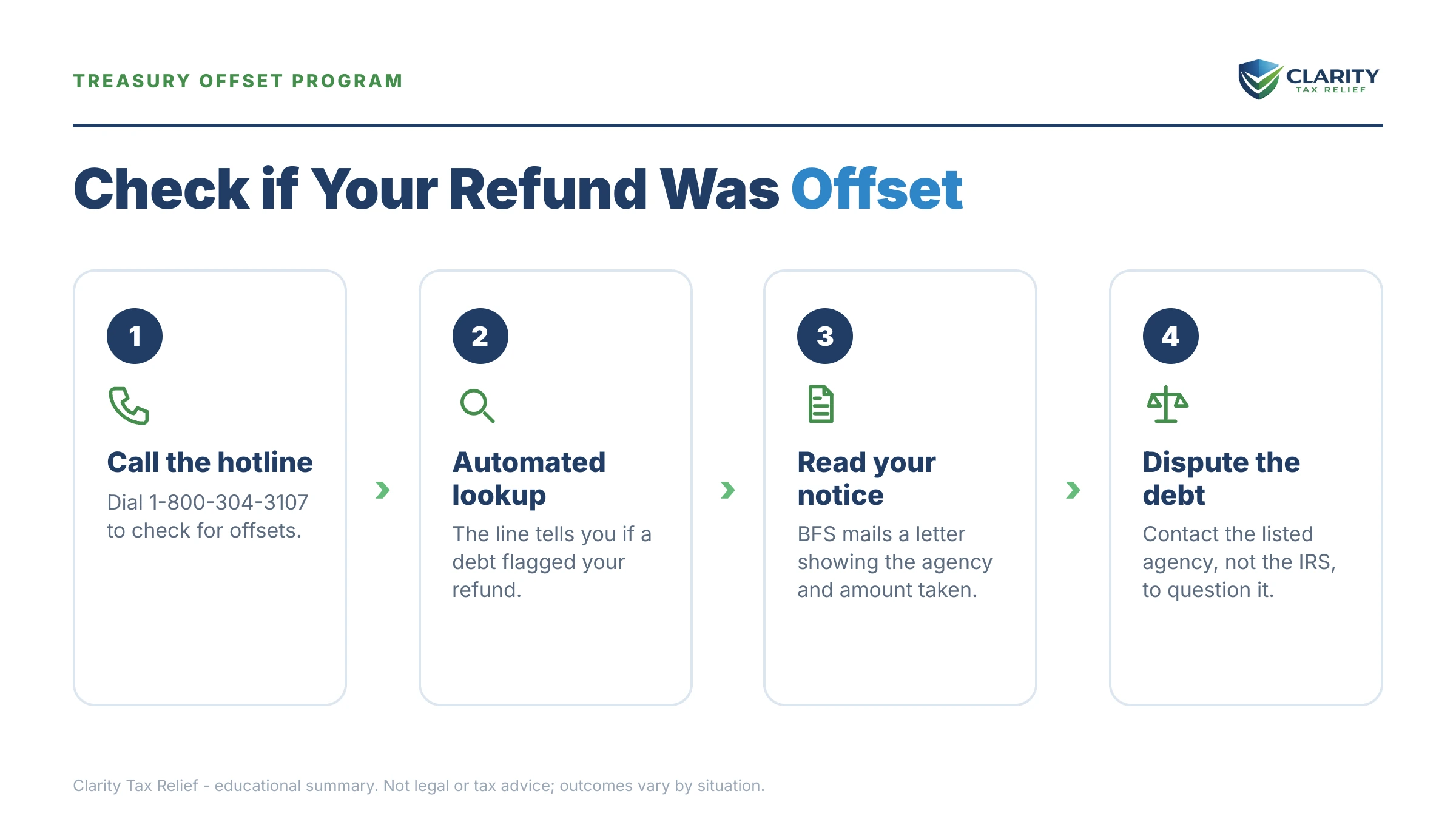
The Treasury offset hotline, 800-304-3107, checks your Social Security number against the Treasury Offset Program's debtor database and reads back every certified debt. For each one, the automated system gives you the creditor agency's name and phone number. The call is free, you can reach the automated system any time, and it does not require an account, a PIN, or a letter in hand.
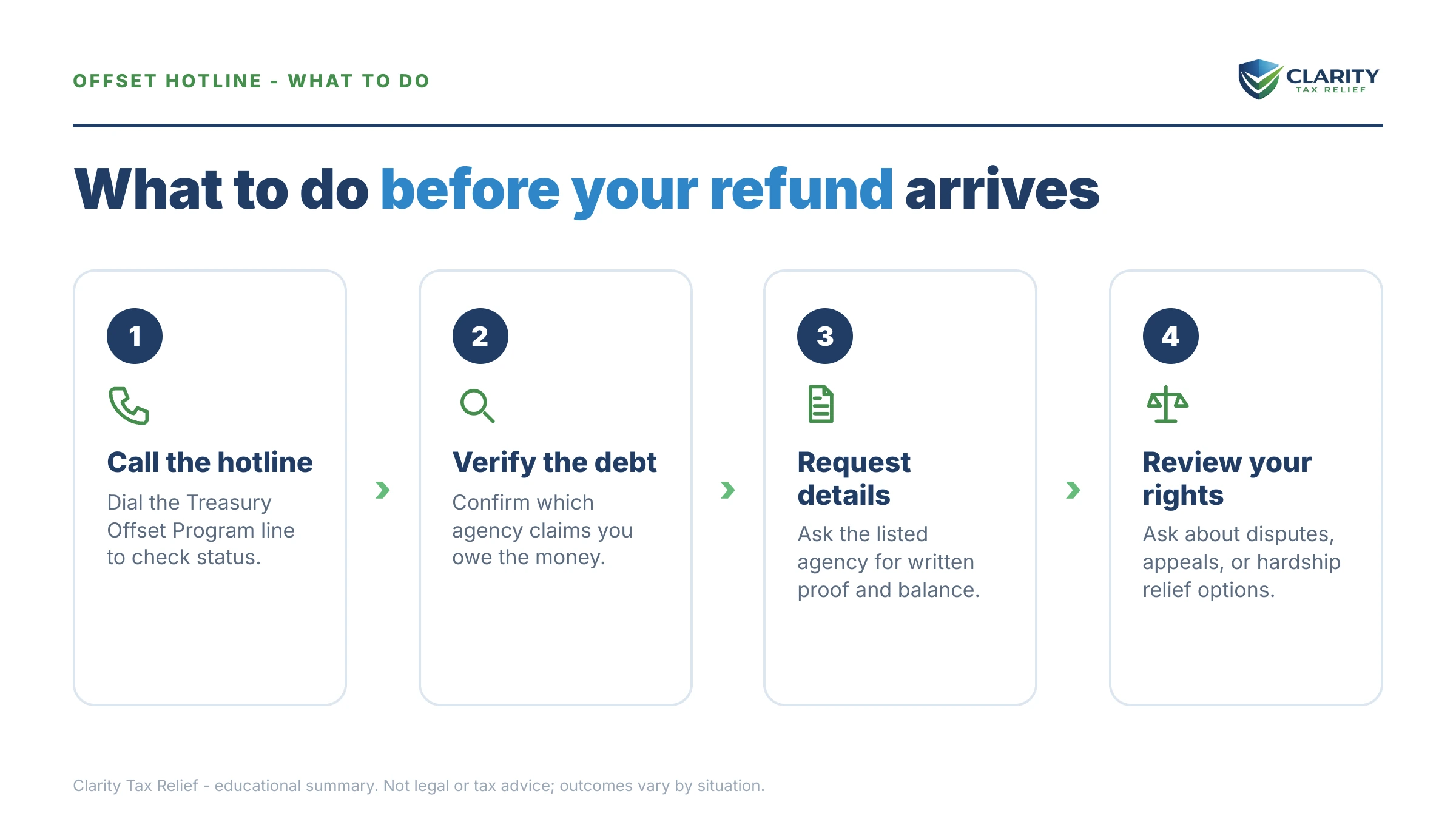
Here is what it will NOT do. The Fiscal Service says plainly that TOP staff cannot discuss your debt with you, refund any amount already collected, or talk through payment options. Treasury is only the machine that moves the money. Every decision about the debt itself (whether it is valid, whether you can dispute it, whether a payment plan removes it from the database) belongs to the creditor agency: the Department of Education, a state child-support office, a state tax department, or whichever agency certified the debt.
And it cannot see IRS tax debt. The IRS applies a refund to its own back taxes internally, before the refund ever reaches TOP. That is why someone can call 800-304-3107, hear "no debts found," file with confidence, and still lose the refund. The debt was federal income tax, invisible to the hotline. Check that side separately in your IRS online account, and see will the IRS take my refund for back taxes for how that internal offset works. If the IRS side is the problem, a CP14 balance-due notice usually arrived first.
What are the treasury offset hotline hours, and what does the call sound like?
IRS Tax Topic 203 lists the Bureau of the Fiscal Service line as open Monday through Friday, 7:30 a.m. to 5 p.m. Central time. The automated system answers first. You enter your Social Security number, and it either reports no debts on file or reads out each certified debt with the agency's name and contact number. Expect it to take about five minutes. Write while it talks, because the agency phone number it gives you is the one you actually need.
The TTY/TDD number printed on both Tax Topic 203 and fiscal.treasury.gov is 800-877-8339. The Taxpayer Advocate Service page on refund offsets lists 866-297-0517 as a TTY/TDD alternative. If one does not connect, try the other.
“If you don't receive a notice, contact the BFS at 800-304-3107 (or TTY/TDD 800-877-8339 ), Monday to Friday 7:30 a.m. to 5 p.m. CST.”
Reduced refund, Tax Topic 203 (IRS.gov)
Which number do you call for which kind of offset?
There are three different phone destinations depending on who took, or is about to take, your refund. Calling the wrong one wastes an afternoon, so match your situation first:
| Your situation | Who to call | Number |
|---|---|---|
| Check for nontax debts set to take your refund (student loans, child support, state debts) | TOP call center, Bureau of the Fiscal Service | 800-304-3107 |
| Same check, deaf or hard-of-hearing callers | TOP TTY/TDD line | 800-877-8339 |
| Refund reduced for IRS back taxes (CP49-type offset) | IRS, or your IRS online account | 800-829-1040 |
| The refund amount on the BFS notice differs from the refund on your return | The IRS (the only offset question the IRS can answer) | 800-829-1040 |
| Dispute the debt itself, or set up repayment | The creditor agency named on your offset notice | The number printed on the notice, or read by the hotline |
| Joint refund taken for your spouse's separate debt | The IRS, via Form 8379, injured spouse allocation | Filed with (or after) your return, not by phone |
On your IRS account transcript, a TOP interception shows as code 898, offset to another agency, while an IRS-internal grab of your refund for old federal tax posts differently. If you got a letter instead of a shortfall, a CP49 refund-applied notice means the IRS itself took the refund. That never goes through the hotline's database.
What does TC 898 on your transcript mean?
Transaction code 898 is the TOP offset record the Bureau of the Fiscal Service generates when it takes part or all of your refund for a nontax debt. The amount beside it is what left your refund. A later TC 899 means Fiscal Service reported an action on that offset, such as a reversal or an agency refund, and a TC 766 carrying an offset trace number is a TOP offset being reversed. The IRS's own refund-offset manual states that IRS employees do not have access to the TOP debtor database, which is why the transcript shows the amount but never the creditor. The hotline fills that gap. Our IRS transcript codes guide decodes the rest of the lines around it.
Why does your refund get intercepted through the Treasury Offset Program?
A refund gets intercepted because a federal or state agency certified a delinquent debt under your Social Security number to the Treasury Offset Program. The full mechanics, how agencies certify debts, which payments TOP can touch, and how the database works, are covered in our guide to the Treasury Offset Program. What matters here is the order money comes out.
When your refund is smaller than everything you owe, it is applied in a fixed priority: federal tax debt first (taken by the IRS before TOP is even involved), then past-due child support, then federal agency nontax debts like defaulted student loans, then state income tax obligations, then state unemployment-compensation debts. So the hotline reading back one debt does not mean it is the only claim on your money.
Defaulted federal student loans are the single most common debt callers discover on the line. If that is what the recording read back to you, the specific escape routes are in refund offsets for student loans. State refunds are not safe either. Many states participate in a reciprocal program, so a state refund can be intercepted for federal debts and vice versa; see state refund taken for IRS debt.
How much can TOP take, by payment type?
Tax refunds have no floor. TOP can take 100% of your federal income tax refund, up to the amount of the certified debt, and if the debt is smaller than your refund, you receive the difference. Other federal payments do have limits. The Fiscal Service publishes these limits on its "How TOP works" page:
| Payment being offset | How much TOP can take | Example on a $2,000 payment |
|---|---|---|
| Federal tax refund | Up to 100% | Up to $2,000 |
| Social Security and other federal benefit payments | Up to 15% of the payment | Up to $300 |
| Federal employee salary | Up to 15% of the payment | Up to $300 |
| Federal vendor and contractor payments | Up to 100% | Up to $2,000 |
The refund is the easy target, which is why the practical defense is to stop building one while a debt sits in the database. The worked example further down shows how a 1099 contractor does that.
Who holds the debt?
The offset is run by the Department of the Treasury, not by the IRS, and that distinction is the reason so many calls go nowhere. Treasury takes the refund; the agency owed the money decides whether it should have been taken. Ringing the IRS about an offset for child support will get you a polite dead end, because the IRS neither made that decision nor can reverse it. Tax Topic 203 says the details of the offset are not even provided to the IRS.
Debts owed to a state agency, to a federal department, or for student loans each route to a different place. Work out which one applies before you spend an afternoon on hold, and start with the agency named on the offset notice rather than the one that sent the refund. If you do end up needing the IRS, our study of 188 IRS calls shows which hours get through fastest.
How do you dispute a Treasury offset?
Dispute it with the creditor agency, in writing, with proof. Not with Treasury, and not with the IRS. Before any agency can send a debt to TOP it must mail you a letter at least 60 days ahead that says what the debt is for, how much you owe, that it intends to collect by taking federal payments, and what your rights are, including the chance to pay, set up a payment agreement, or dispute that you owe it. That letter went to the address the agency had on file, which is often years stale, and the offset is still valid if you never saw it.
After an offset, the Fiscal Service notice shows the original refund amount, the amount taken, and the agency that received it. Use the agency contact on that notice. The one narrow case for calling the IRS is when the refund figure on the BFS notice does not match the refund on your return, which points to an IRS adjustment rather than a TOP problem. If nothing shows on the hotline and no notice arrives, the shortfall is most likely an IRS adjustment or an IRS tax-debt offset, which you check in your IRS online account. And if a joint refund was taken for your spouse's separate debt, the fix is Form 8379 with the IRS.
What happens if you do nothing about a debt in the TOP database?
A debt certified to TOP does not sit quietly. It widens its reach one stage at a time. Here is the sequence, in order:
- Certification. The creditor agency sends its notice of intent to offset (often to an old address) and adds the debt to the TOP database. From this point, calling 800-304-3107 will show it.
- First offset. You file, your refund is intercepted up to the full debt amount. A Bureau of the Fiscal Service letter follows telling you which agency got the money.
- Repeat offsets. Every future federal refund, and often your state refund, is taken until the debt clears. There is no annual limit and no expiration built into the database.
- Other federal payments. For federal nontax debts, TOP can also intercept federal vendor and contractor payments in full and up to 15% of federal benefit payments such as Social Security. If you do 1099 work for a federal agency, your invoice payments themselves can be offset.
- Wage garnishment without a court order. Defaulted federal student loans allow administrative wage garnishment, typically up to 15% of disposable pay, with no lawsuit required.
- Growing balance. Interest and collection costs are added along the way, so the debt the hotline reads out next year is usually larger than the one it reads out today.
Refund taken by an offset, or afraid the next one will be?
Send us your offset notice or what the hotline read back. An experienced tax professional will map which debts can take your refund, which options apply to each, and how to protect your next filing, free and confidential. Interest and collection costs on the underlying debt keep accruing until it is resolved.
What are your options after an offset, or before the next one?
What you can do depends entirely on whose debt it is and whether it is valid. Money already applied to a legitimate debt is generally gone. The fight is over the debt itself and the refunds still to come:
| Option | Who may qualify | Cost | Typical timeline |
|---|---|---|---|
| Dispute with the creditor agency | Debt already paid, wrong amount, not yours, or identity theft, with proof | Free | Varies by agency; start immediately, in writing |
| Injured spouse allocation (Form 8379) | Joint filer whose share of the refund was taken for the spouse's separate debt | Free | IRS estimates: about 11 weeks e-filed with the return, 14 weeks on paper with the return, 8 weeks filed on its own afterward |
| Offset bypass refund (hardship) | Severe financial hardship where the offset is for IRS tax debt; must be requested before the refund is issued; TOP nontax debts like child support can't be bypassed | Free | Must move before the refund posts; timing is everything |
| Student loan rehabilitation or consolidation | Defaulted federal student loan borrowers | Free to set up; payments are income-based | Rehabilitation usually requires nine on-time monthly payments |
| Pay or resolve the underlying debt | Anyone, through the creditor agency, never through Treasury | The debt amount (sometimes negotiable with the agency) | Removal from the TOP database after the agency reports it resolved |
| Resolve the IRS tax debt that sits ahead of TOP | Anyone with a federal tax balance; a payment plan or other IRS program | Varies; our review is free | Depends on the program; start with the IRS Fresh Start Program overview and a free review |
Two of these deserve their own reading: the Form 8379 injured spouse walkthrough if the debt belongs only to your spouse, and the offset bypass refund for hardship if losing the refund means eviction, utility shutoff, or similar. That one only works against IRS tax-debt offsets and only if you act before the refund is issued.
How does injured spouse relief on Form 8379 work?
You may be an injured spouse if you filed jointly and your share of the overpayment was, or is about to be, applied to your spouse's past-due federal tax, state income tax, state unemployment debt, child support, or a federal nontax debt such as a student loan. Form 8379 asks the IRS to carve your portion back out. You can attach it to the joint return before the offset happens or file it by itself afterward. The IRS instructions set the deadline at three years from the due date of the original return (including extensions) or two years from the date the tax that was offset was paid, whichever is later. Community property states follow different allocation rules, so expect a different split there. The form's own revision is dated November 2023 and the instructions November 2024, which are the current versions as of October 2026.
A worked example: $41,800 in defaulted student loans, 1099 income
Say you are a 1099 contractor with $41,800 in defaulted federal student loans. You paid $8,400 in quarterly estimated taxes four times, $33,600 total, and your actual tax bill comes to $27,400. That is a $6,200 refund on paper. TOP takes all $6,200 (tax refunds can be offset 100%), your loan balance drops to $35,600, and next spring the same thing happens again.
The contractor-specific fix: unlike a W-2 employee, you control your own "withholding." If you set quarterlies at the legal safe-harbor minimum instead of overpaying, that $6,200 never becomes a refund sitting in Treasury's hands. It stays in your account while you rehabilitate the loan on income-based payments. Over-collecting on estimates while you are in the TOP database is effectively making involuntary lump-sum loan payments on the government's schedule instead of yours. (Careful in the other direction, though. Underpaying below the safe harbor creates a new penalty problem.)
And if you also owe the IRS itself? The playbook for that side, payment plans, hardship status, and settlement, is in our guide to how to settle tax debt yourself, and you can price a monthly plan in two minutes with the IRS payment plan calculator. Remember the priority order: IRS debt eats the refund before the student loan ever gets a bite.
How do you call the Treasury offset hotline? Step by step
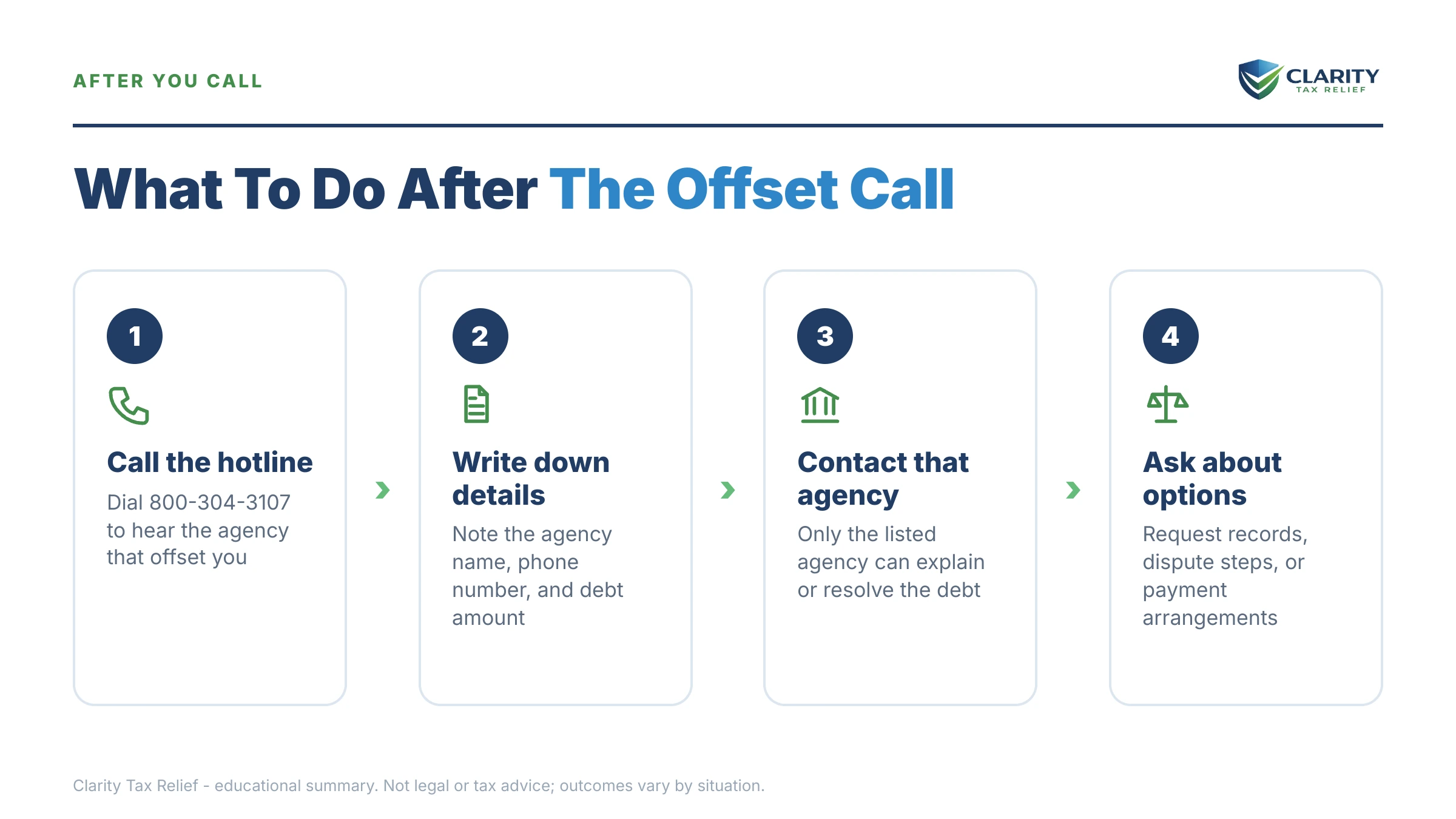
- Call 800-304-3107. Have your Social Security number ready; the TTY/TDD line for deaf or hard-of-hearing callers is 800-877-8339.
- Enter your SSN at the prompt. The automated system reads back every debt certified against you, the creditor agency, and that agency's phone number.
- Write everything down. Note each debt amount, agency name, and contact number. You will negotiate with the creditor agency, not Treasury.
- Check IRS debt separately. Log into your IRS online account. Federal tax debt never appears on the TOP line. But it gets paid out of your refund first.
- Call each creditor agency. Confirm the balance, then ask about disputes, repayment plans, or hardship programs before you file your next return.
- Protect the next refund. File Form 8379 if the debt is your spouse's alone, or adjust your estimated payments so you stop building a refund that will be seized.
When can you handle this yourself?
Calling the hotline is always a do-it-yourself job. It is free, automated, and takes five minutes. You can also handle these solo: a straightforward dispute where you have proof the debt was paid, a clean Form 8379 filing when the joint refund was taken for your spouse's separate debt, and enrolling in student loan rehabilitation directly with your loan servicer. None of those require a professional.
Experienced help changes the picture when it stacks: you owe the IRS and a TOP-certified agency at the same time (the resolution order affects what you keep), you have multiple unfiled years muddying the refund math, your federal contractor payments are being intercepted alongside your refunds, or you are racing an offset bypass refund deadline where a missed week means the money is gone. In those cases, sequencing, not paperwork, is what protects the money, and that is where a review of your whole account earns its keep. Our pricing page spells out what that costs before you commit to anything.
Terms on your offset notice, decoded
- Treasury Offset Program (TOP): the federal database-and-matching system that intercepts government payments to collect delinquent debts.
- Bureau of the Fiscal Service: the Treasury Department bureau that runs TOP and the 800-304-3107 hotline. It moves the money but does not own the debt.
- Creditor agency: the agency you actually owe (Education, a child-support office, a state tax department), the only party that can adjust or remove the debt.
- Offset notice: the letter Fiscal Service sends after taking your refund, listing the original refund, the amount offset, and the agency that received it.
- Injured spouse: a joint filer whose share of a refund was taken for the other spouse's separate debt, recoverable via Form 8379.
- Offset bypass refund (OBR): a hardship-based release of a refund that would otherwise be offset for IRS tax debt, only available before the refund is issued.
- TC 898: the transcript code for a TOP offset record generated by the Bureau of the Fiscal Service.
Common questions
Can I talk to a real person at 800-304-3107?
The line is primarily an automated system, and for most callers the automation is all you need. It reads out every debt tied to your Social Security number. Even when a representative is available, TOP staff cannot discuss your debt, refund money already collected, or set up payment options; only the creditor agency that certified the debt can. Get the agency's number from the recording and take your questions there.
Will the Treasury offset hotline tell me if the IRS is taking my refund?
No. IRS back taxes do not appear on the TOP hotline. The IRS applies a refund to its own tax debt internally, before the refund ever reaches the Treasury Offset Program. To check for federal tax debt, log into your IRS online account or call the IRS at 800-829-1040. A refund can be hit by both: IRS tax debt is satisfied first, then TOP debts in priority order.
Is the Treasury offset hotline free, and how do I avoid scams?
Yes. 800-304-3107 is free, automated, and only asks for your Social Security number to look up the database. Neither Treasury nor the IRS will ever call, text, or email you demanding payment through gift cards, wire transfers, or payment apps. If someone contacts you claiming to 'stop your offset' for an upfront fee, that is a red flag. You can verify everything yourself with one free call.
The bottom line on the treasury offset hotline
One free call to 800-304-3107 tells you which agency has a claim on your refund and how to reach it. It won't show IRS tax debt, so check your IRS online account too. Then take any dispute or payment question to the creditor agency, because Treasury only moves the money.
Your next 24 hours
- Make the call. Dial 800-304-3107, enter your Social Security number, and write down every debt, creditor agency, and phone number the system reads back, then log into your IRS online account to check the tax-debt side the hotline cannot see.
- Gather your paper. Pull your last filed return, any Fiscal Service offset notice or agency letters, and proof of anything you have already paid toward the debt.
- Get a free case review. Use the 2-minute form or call (888) 825-7779. An experienced tax professional will map every debt that can reach your refund and the fastest route to keeping the next one, before more interest and collection costs pile onto the balance.
Primary sources, checked October 2026: the Bureau of the Fiscal Service's Treasury Offset Program page and its "How TOP works" and public FAQ pages, the IRS explainer on reduced refunds at Tax Topic 203, the Form 8379 instructions, IRM 21.4.6 (Refund Offset), and IRS.gov/payments for resolving any federal tax balance that sits ahead of TOP in line.
This guide is general information, not tax or legal advice for your specific situation. Eligibility for IRS programs depends on individual facts and circumstances; no outcome is guaranteed.