
City Guides
Tax Relief Phoenix: How to Resolve IRS and Arizona Tax Debt in 2026
The short answer: tax relief in Phoenix runs through two separate systems: federal IRS programs — payment plans up to 72 months, Offer in Compromise, hardship status, penalty abatement — and Arizona Department of Revenue plans set up through AZTaxes.gov. If a levy notice has arrived, the 30-day window printed on a Final Notice controls your appeal rights.
If you typed "tax relief Phoenix" into your phone with an IRS levy warning sitting on the counter, here's your situation in one line: the IRS moves on a federal timetable that ignores where you live, the Arizona Department of Revenue collects on its own separate track, and your rent — which the IRS's own Maricopa County expense standards actually account for — is due either way. That collision is fixable, and the order you fix it in matters more than which company you call.
This guide maps every real option for a Phoenix taxpayer in collections: what the IRS can take and when, what qualifies you for each federal program, how an Arizona (ADOR) balance is handled differently, and where the free local help is.
⏱ The clock that matters: an LT11 or Letter 1058 (Final Notice of Intent to Levy) gives you 30 days from its printed date to request a Collection Due Process hearing before the IRS can levy your wages or bank account. If that letter isn't in your stack yet, the clock is softer but still running — penalties and interest accrue every month, and the notice sequence escalates automatically.
Why Phoenix tax debt often means two collectors
A Phoenix taxpayer behind on taxes can owe two different governments at once, and neither one credits a deal made with the other. Your federal balance is collected by the IRS under federal rules. Any state income-tax balance is collected by the Arizona Department of Revenue (ADOR) under Arizona's own rules, with plans set up through AZTaxes.gov.
The good news for most Phoenix readers: because Arizona's flat 2.5% income tax rate is low, state balances are usually a fraction of the federal one. The federal debt is almost always the bigger fire, and the one with a levy attached.
One more Phoenix-specific point that surprises people: when the IRS evaluates what you can afford to pay — for a hardship claim or an Offer in Compromise — it doesn't use a national rent figure. It uses IRS allowable living expenses standards that include a housing-and-utilities cap specific to Maricopa County. If your Phoenix rent eats most of your paycheck, that math can work in your favor. If you owe Arizona too, our guide to Arizona back taxes covers the state side in depth. This page focuses on the IRS case, which is where the levy power lives.
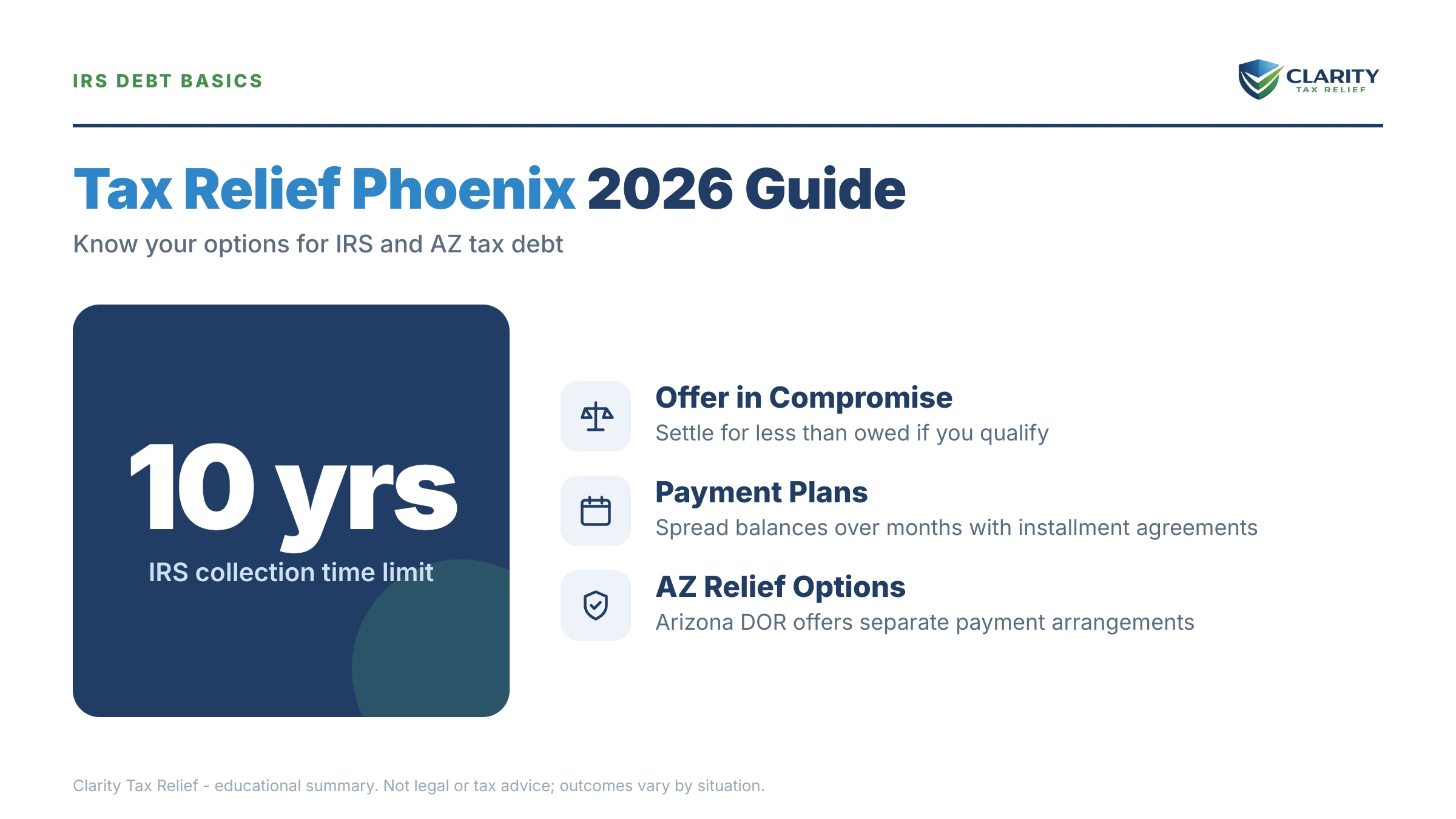
“An offer in compromise allows you to settle your tax debt for less than the full amount you owe. It may be a legitimate option if you can't pay your full tax liability or doing so creates a financial hardship.”
— Offer in compromise (IRS.gov)
What happens if you ignore IRS collection in Phoenix
IRS collection escalates in a fixed, automated sequence, and Phoenix gets no regional exception. Each stage arrives with more enforcement power than the last:
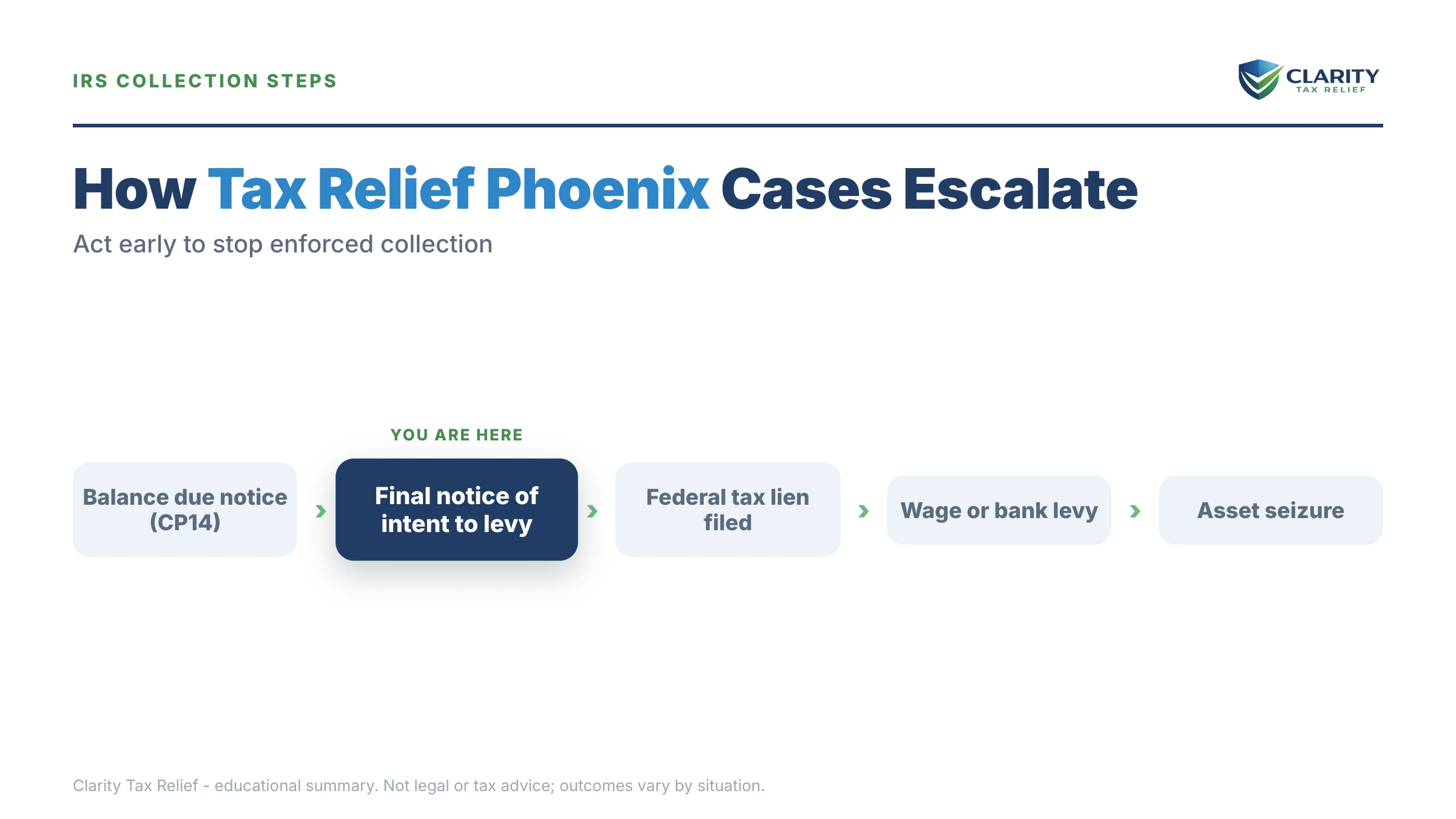
- CP14 — the first bill. Typically about 21 days to pay before the next notice queues up. No enforcement yet.
- CP501 / CP503 — reminder notices. Still just bills, but the balance grows monthly.
- CP504 — Notice of Intent to Levy. The IRS can now seize your Arizona state tax refund, and a federal tax lien becomes a realistic next move.
- LT11 / Letter 1058 — Final Notice of Intent to Levy. This starts the 30-day Collection Due Process window. Miss it, and the IRS can levy without further warning. See the full LT11 guide if this is the letter you're holding.
- Levy. A bank levy freezes the funds for 21 days before they're sent to the Treasury — the details are in our IRS bank levy 21 days guide. A wage levy is worse: it's continuous, paycheck after paycheck, until the debt is resolved or the levy is released. If you receive Social Security, up to 15% can be taken through the Federal Payment Levy Program.
For a renter, the wage levy is the whole ballgame. There's no home equity to protect, but there's also no cushion: the levy leaves you only an exempt amount based on your filing status and dependents. Your landlord doesn't care what the IRS took. You can estimate your own exposure with our IRS Wage Garnishment Calculator. The release playbook is in how to stop IRS wage garnishment.
One 2026 reality check: the IRS workforce was cut roughly 27% in 2025, so reaching a human is harder than ever. But the notices, liens, and levies come from automated systems that never stopped running. Understaffing delays your fix; it does not delay their enforcement.
Facing a levy in Phoenix right now?
If a Final Notice is in your stack, the 30-day window printed on it is the clock that matters, and if a bank levy already hit, the funds sit on hold for only 21 days. Get your notices reviewed free by an experienced tax professional before either window closes.
Tax relief Phoenix residents actually qualify for
Every legitimate tax relief program is an IRS or ADOR program with published eligibility rules — no company has access to a special deal you can't apply for yourself. What a good firm sells is judgment: knowing which program your finances actually fit, and sequencing the case so a levy stops first. Here's the full menu:
| Option | Who typically qualifies | Cost & what to know |
|---|---|---|
| Short-term IRS payment plan | You can pay in full within 180 days | $0 setup fee; interest and penalties keep accruing until paid |
| Guaranteed installment agreement | Tax owed is $10,000 or less | Approval is required by law if conditions are met; up to 3 years to pay |
| Streamlined installment agreement | Total balance $50,000 or less | Up to 72 months, set up online with no financial disclosure; setup fee is lower with direct debit |
| Currently Not Collectible (CNC) | Maricopa County expense standards show no ability to pay | $0; collection pauses, but interest accrues and refunds are kept |
| Offer in Compromise (OIC) | Your offer meets or beats your Reasonable Collection Potential | $205 fee + 20% down on lump-sum offers (both waived with low-income certification); ~1 in 5 accepted in FY2024 |
| Penalty abatement (FTA / AEP) | Clean compliance history for the prior 3 years | Free to request; the new Automatic Exemption from Penalty (AEP) starts applying automatically in summer 2026 |
| ADOR payment plan (Arizona) | Any Arizona state balance | Set up through AZTaxes.gov under ADOR's own rules; entirely separate from any IRS agreement |
A few notes that change decisions at this balance level. At $27,500 you're comfortably under the $50,000 streamlined ceiling, which means you can set up a 72-month plan online without handing the IRS a full financial statement, often the fastest way to stop a levy in motion. You're also well under the $66,000 passport-certification threshold for 2026, so your passport isn't at risk unless more years stack up. And if this is your first slip after years of clean filing, penalty relief is real money: see first time penalty abatement, and note that starting summer 2026 the IRS's Automatic Exemption from Penalty applies without you even asking.
For how each of these programs works mechanically — forms, phone scripts, sequencing — our DIY pillar on how to settle tax debt yourself covers the shared ground so this page can stay Phoenix-specific.
A worked example: $27,500 and a levy warning in a Phoenix apartment
Say you owe $27,500 — a single renter in Phoenix, a Final Notice in hand, no house, no big savings. Here's how each path actually prices out. This is a hypothetical, not a client case:
- Do nothing: the failure-to-pay penalty alone is 0.5% per month — $27,500 × 0.005 = $137.50 a month before interest is even added. Then the levy hits, and a continuous wage levy takes most of every paycheck until it's released.
- Streamlined installment agreement: $27,500 ÷ 72 months ≈ $382/month as a floor. Because interest and the reduced failure-to-pay penalty keep accruing inside the plan, paying $500/month instead shortens the payoff by years and meaningfully cuts the total cost.
- Currently Not Collectible: if your take-home is, say, $3,100 a month and the Maricopa County housing standard plus the national standards for food, transportation, and healthcare add up to that or more, you may qualify for CNC — no payment, no levy, reviewed periodically. Full test in our IRS currently not collectible guide.
- Offer in Compromise: as a renter you have no home equity, so the math is driven by income. If you have $900 in the bank and $150/month left after allowable expenses, a lump-sum offer prices out around $900 + ($150 × 12) = $2,700. That looks dramatic. But the IRS accepts an offer only when it genuinely can't collect more. It approved roughly one in five offers in FY2024. If your income could cover $27,500 within the collection window, expect a payment plan, not a settlement.
How to respond, step by step
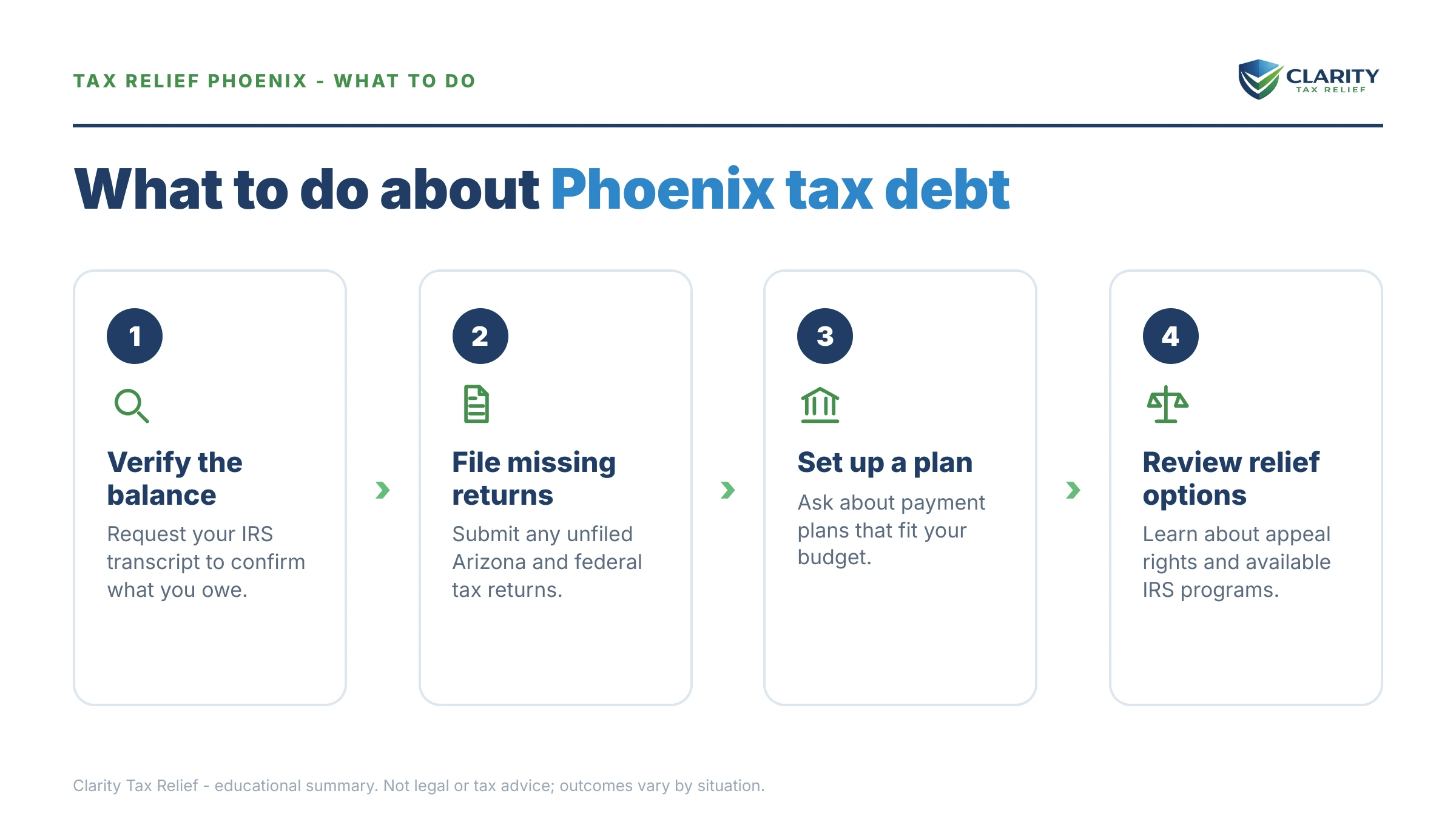
- Sort your IRS mail by date. Find the most recent letter and its number (top right corner). An LT11 or Letter 1058 means a 30-day clock is running; a CP504 means the final notice is next.
- Verify your real balance. Log into your IRS online account and confirm what you owe across every year before you negotiate anything — the notice in your hand may not be the whole picture.
- Stop the levy first. If a final notice arrived within the last 30 days, file Form 12153 to request a Collection Due Process hearing. If a levy has already hit, pursue a release based on your resolution or documented hardship.
- Pick the option that matches your finances. Use the options table above: a payment plan if you can afford monthly payments, Currently Not Collectible if you can't. An Offer in Compromise only if the Reasonable Collection Potential math actually works.
- Handle any Arizona balance separately. Set up an Arizona Department of Revenue payment plan through AZTaxes.gov — an IRS agreement does nothing for a state debt, and vice versa.
When you can handle this yourself, and when help changes the outcome
Honest answer: many Phoenix taxpayers don't need to hire anyone. If your balance is accurate, under $50,000, and no levy is in motion, you can set up a streamlined installment agreement online in an evening for the cost of the setup fee. If you can pay within 180 days, the short-term plan is free. If you agree with a first notice, paying it is the whole fix.
Experienced help changes outcomes in specific situations: a levy already in motion (release requests have to hit the right unit with the right documentation, fast), multiple unfiled years that have to be resolved before any agreement can exist, a balance you dispute, Offer in Compromise math where a mispriced offer wastes months and money, or business and payroll debt — which follows different rules entirely and is covered in our guide to tax relief for small business.
The dividing line isn't the dollar amount. It's whether the case has moving parts — clocks, disputes, unfiled years, enforcement in progress — that punish a wrong first move.
Free and low-cost IRS tax help in Phoenix
Phoenix taxpayers have real free resources before, or instead of — hiring anyone. Know what each one does, because they solve different problems:
| Resource | What it does | Best for |
|---|---|---|
| IRS Taxpayer Assistance Center (Phoenix) | In-person IRS help, by appointment only (844-545-5640) | Identity verification, payment and transcript questions |
| Taxpayer Advocate Service (Arizona office) | Independent unit inside the IRS; case help via Form 911 | A levy causing hardship, or a case the IRS has stalled on |
| Low Income Taxpayer Clinic | Free representation in disputes and collections if your income qualifies | Collection defense on a limited income — see our low income taxpayer clinic guide |
| VITA sites | Free tax return preparation for qualifying taxpayers | Filing missing returns to get back into compliance |
| Arizona Department of Revenue | State balances, ADOR payment plans via AZTaxes.gov | Any Arizona income-tax debt |
Choosing a tax relief company in Phoenix: what to ask first
The tax relief industry has excellent firms and expensive disappointments, and the difference shows up in the first phone call. Before you sign anything, with us or anyone, ask three things: Who exactly will work my case (an enrolled agent, CPA, or tax attorney — by name)? What is the total fee in writing, and what does it cover if the first strategy doesn't fit? And what do you think my case resolves to, based on my actual numbers rather than a script?
Any answer that includes a promised settlement percentage before anyone has seen your finances is your cue to hang up. Our full buyer's checklist is in how to choose a tax relief company, and if you're comparing the national brands that advertise heavily in the Phoenix market, start with our Optima Tax Relief alternatives comparison. The warning signs that should end a sales call are cataloged in tax relief company red flags.
Terms on your IRS mail, decoded
- Levy vs. lien: a levy takes property (your paycheck, your bank balance); a lien is a legal claim recorded against what you own. Renters mostly face levies.
- Final Notice of Intent to Levy: the LT11 or Letter 1058 — the legally required last warning that starts your 30-day appeal window.
- CDP (Collection Due Process): your right to a hearing, requested on Form 12153, that pauses levy action on the years covered while it's pending.
- CSED: the Collection Statute Expiration Date — generally 10 years from assessment, though appeals, offers, and bankruptcy pause the clock.
- CNC (Currently Not Collectible): IRS hardship status that pauses collection when your income can't cover basic living expenses.
- ADOR: the Arizona Department of Revenue — the state's separate tax collector, with its own notices, plans, and rules.
Tax relief in Phoenix: your questions answered
Is tax relief legit, or is it a scam?
Legitimate tax relief exists — every program worth having (installment agreements, Offer in Compromise, Currently Not Collectible, penalty abatement) is a real IRS program anyone can apply for. What's often a scam is the marketing: any firm promising to settle your debt for "pennies on the dollar" before reviewing your finances is selling a fantasy, since the IRS accepted only about 1 in 5 offers in FY2024. Judge firms by their diagnosis, not their promises.
Can the IRS garnish wages in Arizona?
Yes — an IRS wage levy applies in Arizona the same as in every state, because federal law overrides state garnishment limits. Once it starts, the levy is continuous, taking most of each paycheck and leaving only an exempt amount based on your filing status and dependents, until the debt is resolved or the levy is released. Acting before the levy reaches your payroll department is far easier than removing one already in place.
Does Arizona have its own tax relief programs?
Yes. The Arizona Department of Revenue offers its own payment plans, set up through AZTaxes.gov, and handles hardship and settlement requests under its own rules — none of the IRS thresholds or timelines apply to a state balance. If you owe both, plan on resolving them as two separate cases, because neither agency credits an agreement made with the other.
How much does tax relief cost in Phoenix?
Doing it yourself costs only the IRS's own fees: $0 for a short-term plan, a modest setup fee for an installment agreement, and $205 to apply for an Offer in Compromise (waived with low-income certification). Professional representation typically runs from several hundred dollars for a simple payment plan to several thousand for an Offer or levy release — always get the full fee in writing before paying anything.
Do I need a local Phoenix tax relief company?
No — IRS collection cases are worked by phone, mail, and fax, so an experienced tax professional anywhere in the country can represent you once you sign Form 2848. What matters is who actually does the work: an enrolled agent, CPA, or tax attorney, not a salesperson. A local firm helps most when a revenue officer is visiting in person or you simply prefer meeting face to face.
What if I can't afford to pay the IRS anything?
You may qualify for Currently Not Collectible status if the IRS's own expense standards show your income barely covers rent, food, transportation, and healthcare. CNC pauses levies and garnishments while it lasts, though interest keeps accruing and the IRS reviews your income periodically. For many lower-income Phoenix renters, CNC, not a settlement, is the realistic first step.
Will the IRS settle my $27,500 tax debt for less?
Only if the math supports it. An Offer in Compromise is accepted when your offer equals or exceeds your Reasonable Collection Potential. Your asset equity plus a multiple of your monthly disposable income. Renters with little savings and modest income sometimes qualify; taxpayers with steady income that could cover $27,500 within the 10-year collection window usually don't. The IRS accepted roughly one in five offers in FY2024.
Your next 24 hours
- Find the letter number and date on your most recent IRS notice (top right corner). If it says LT11 or Letter 1058, count 30 days from the printed date — that's your Collection Due Process window.
- Gather three things: your last filed tax return, every IRS and ADOR notice you've received, and your two most recent pay stubs. That's everything needed to price your options.
- Get a free case review. Call (888) 825-7779 or use the 2-minute form — an experienced tax professional will tell you which program your numbers actually fit and, if a levy is coming, what has to happen inside your 30-day window.
Primary sources: the IRS's own pages on paying the IRS and payment plans and installment agreements. The independent Taxpayer Advocate Service. And the Arizona Department of Revenue for state balances.
This guide is general information, not tax or legal advice for your specific situation. Eligibility for IRS programs depends on individual facts and circumstances; no outcome is guaranteed.