
State Tax Guides
Florida Back Taxes and the IRS: The 2026 Guide for a No-Income-Tax State
The short answer: in Florida, back taxes almost always mean IRS debt — the state has no personal income tax. The IRS has 10 years to collect, can take up to 15% of your Social Security, and its lien attaches even to a homestead-protected house. Payment plans, hardship status, and settlement remain available; eligibility depends on your income and equity.
If you searched "Florida back taxes IRS," you've probably already noticed the strange part: there's no Tallahassee tax office sending you bills, yet the federal letters keep coming. Maybe you retired here, took money out of an IRA or sold a property, and the balance landed in years when nothing was withheld. The good news is that in Florida you're fighting exactly one collector, and that collector runs on rules, deadlines, and programs you can use.
⏱ The real clock: IRS back taxes grow every month — the failure-to-pay penalty adds 0.5% of the balance per month and interest compounds daily on top. Your enforcement deadline is set by your most recent notice: an LT11 final notice gives you 30 days before levies can begin. Find the date on your latest letter; that's your countdown.
Why "Florida back taxes" almost always means the IRS
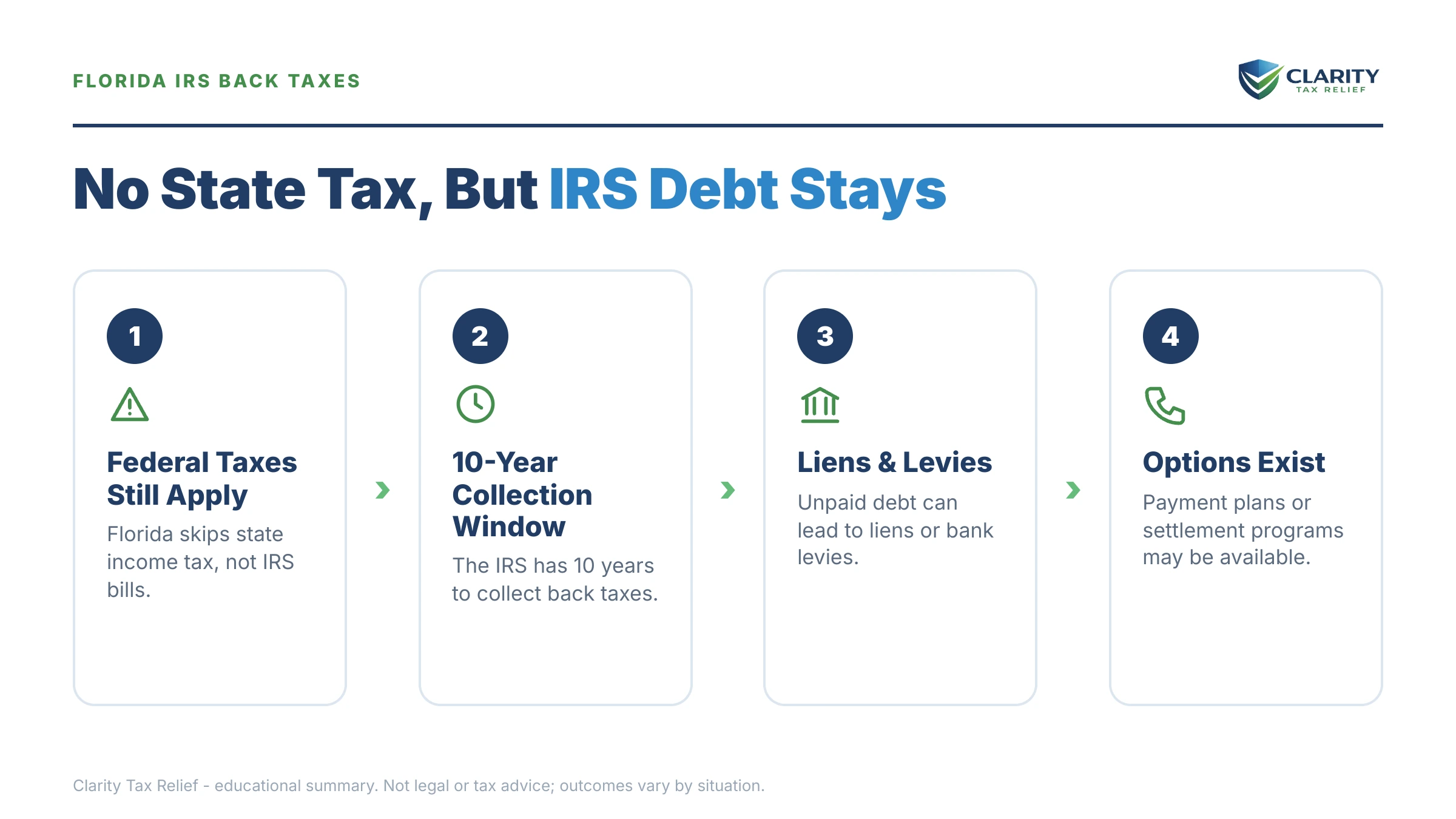
Florida is one of the few states with no personal income tax, so back taxes owed by a Florida resident are almost always federal — owed to the IRS, not to any state agency. There is no Florida state income tax return, no state income tax balance, and no state income tax refund.
The Florida Department of Revenue does exist, but it collects business taxes: sales and use tax, reemployment (unemployment) tax, and corporate income tax. If you're an individual with a personal tax debt, the DOR has nothing to do with it. If you own or owned a business, skip ahead to the sales-tax section — that's a separate fight with its own rules.
Living in a no-income-tax state changes the IRS playbook in two concrete ways:
- The CP504's signature threat is mostly hollow here. A CP504 notice announces the IRS intends to levy your state tax refund under IRC §6331(d). Florida residents don't have a state income tax refund to take, so when the IRS escalates past the CP504, it reaches instead for the levers that do exist in Florida: bank accounts, wages, and Social Security.
- Only one collection clock is running. In states like California, taxpayers juggle a federal 10-year statute against a state 20-year statute and must decide which tax debt to resolve first. In Florida, personal income tax debt has exactly one statute of limitations and one set of programs — the IRS's.
The snowbird exception. Moving to Florida stops future state income tax. But it does not erase what you already owed New York, New Jersey, Illinois, or California, and some states collect much longer than the IRS (California's collection statute runs 20 years). High-tax states also routinely challenge the residency of the year you moved. If you carry both an old state balance and an IRS balance, the sequencing question matters; our guide to state tax debt vs. IRS debt walks through which to tackle first. Fellow no-income-tax-state readers can compare the Tennessee residents and IRS debt guide — the federal mechanics are the same; the state wrinkles differ.
“An IRS levy permits the legal seizure of your property to satisfy a tax debt. It can garnish wages, take money in your bank or other financial account, seize and sell your vehicle(s), real estate and other personal property.”
— Levy (IRS.gov)
Florida's famous asset protections, and where the IRS cuts through
Florida's creditor protections — the constitutional homestead exemption, head-of-family wage protection, tenancy by the entireties — do not stop the IRS, because federal collection law overrides state exemptions. This is the single biggest misunderstanding we see from Florida readers, and it's worth getting right before you build a strategy around it.
| Asset | Protected from ordinary creditors in Florida? | Protected from the IRS? |
|---|---|---|
| Homestead home | Yes — constitutional exemption, unlimited in value (with acreage limits) | No — the federal tax lien attaches anyway; seizure is rare and needs court approval, but the lien collects when you sell or refinance |
| Head-of-family wages | Largely yes | No — federal levy tables control, leaving only a fixed exempt amount per check |
| Social Security benefits | Mostly yes | Partially — up to 15% via the Federal Payment Levy Program |
| Tenancy-by-the-entireties property | Yes, against most creditors of one spouse | Not fully — the federal lien reaches the liable spouse's interest |
| IRAs, 401(k)s, pensions | Yes | No — the IRS can levy retirement accounts, though it treats them as a last resort |
The homestead nuance deserves a full paragraph, because it cuts both ways. In practice, the IRS almost never forces the sale of a primary residence. It requires federal court approval and is reserved for extreme cases. What actually happens is quieter: the lien sits on the title. The debt gets paid out of your proceeds when you sell or refinance. But that same untouchable equity counts against you in Offer in Compromise math, which is why home-rich, income-poor Florida retirees are often better candidates for hardship status than for settlement. More on the seizure question in can the IRS take my house.
For married couples, entireties ownership blocks most creditors of one spouse, but the U.S. Supreme Court has held that a federal tax lien attaches to the liable spouse's interest in entireties property. Florida titling helps against credit card companies; it is not an IRS shield.
What happens if you ignore IRS back taxes in Florida
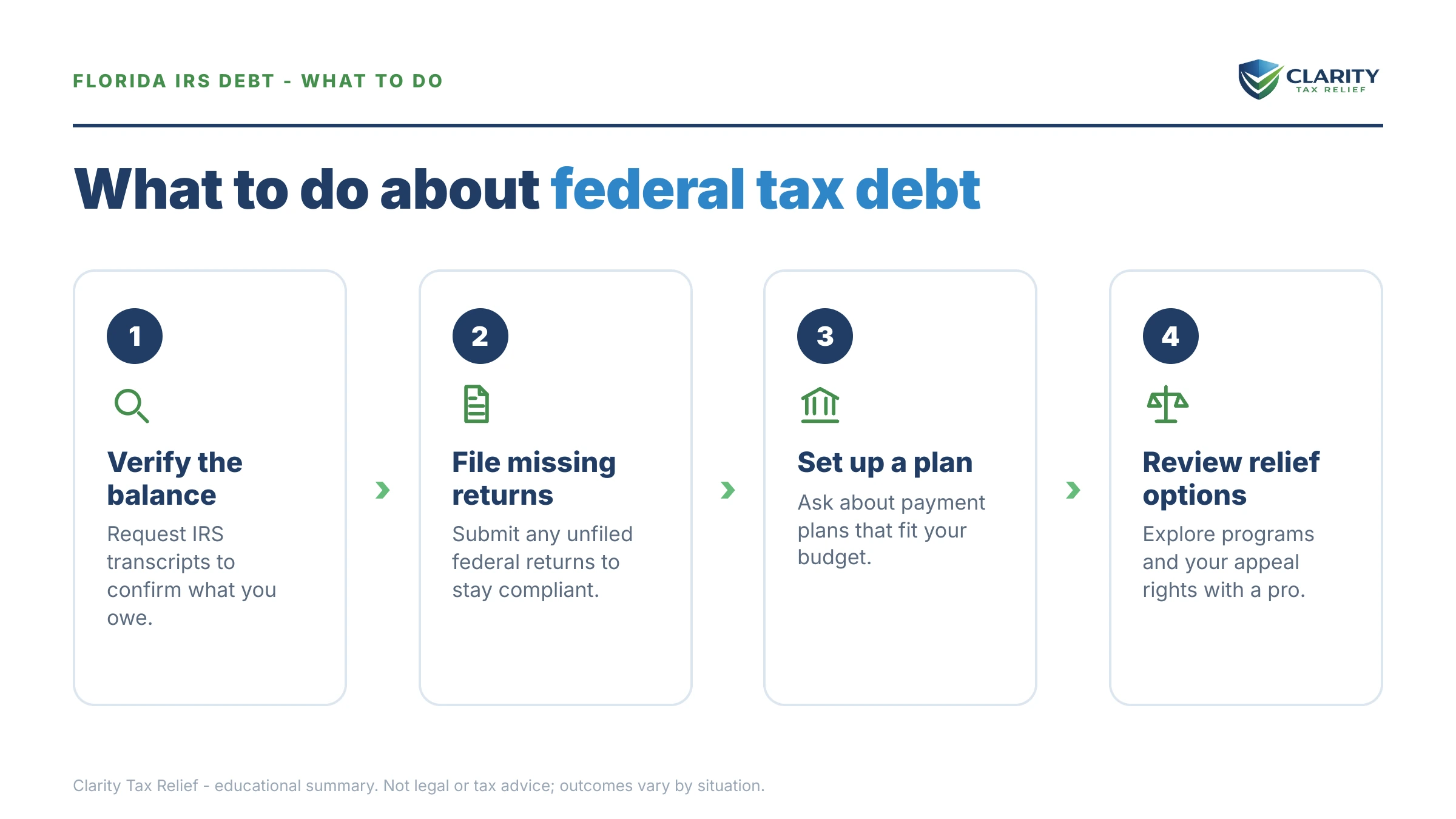
IRS collection runs on an automated notice sequence, and Florida residents get no slower treatment because the state stays out of it. Ignore each letter and the next arrives with more penalty, more interest, and more enforcement power behind it:
- CP14 — the first bill. Typically about 21 days to pay before the sequence advances. No enforcement yet; this is the cheapest moment to act.
- CP501 / CP503 — reminder notices. Still just bills, but the failure-to-pay penalty and daily interest are compounding the whole time.
- CP504 — Notice of Intent to Levy your state tax refund. In Florida there's usually no income tax refund to grab, so treat this notice for what it really is here: the last warning before the final notice, and often the stage where a federal tax lien gets filed in your county's public records.
- LT11 / Letter 1058 — the final notice of intent to levy. This starts a 30-day clock and your Collection Due Process rights, requested on Form 12153. Miss the window and the IRS can levy without further warning. Full breakdown in our LT11 guide.
- Enforcement — a bank levy freezes funds for 21 days before the money leaves. A wage levy is continuous until released; Social Security can lose up to 15% per month under the Federal Payment Levy Program. And once your debt crosses $66,000 (the 2026 threshold), the IRS can certify it to the State Department and put your passport at risk.
One 2026 reality check: the IRS workforce was cut roughly 27% in 2025, which makes reaching a human harder. But the notices, liens, and levies above are generated by automated systems that never stopped running. Fewer staff means slower help, not slower enforcement.
| Notice | Your response window | What's at stake |
|---|---|---|
| CP14 (first bill) | Typically 21 days from the notice date | Cheapest point to resolve — no enforcement yet |
| CP504 (intent to levy state refund) | The pay-by date printed on the notice | Little refund to take in Florida, but you're one step from the final notice and a public lien filing |
| LT11 / Letter 1058 (final notice) | 30 days | Your Collection Due Process appeal (Form 12153) — miss it and levies can begin |
| CP91 (Social Security levy warning) | The response date printed on the notice | Up to 15% of your monthly benefit via the FPLP |
| CP508C (passport certification) | Act before you need to travel or renew | Passport denial or revocation once the debt tops $66,000 (2026) |
Owe the IRS from Florida and a notice clock is running?
Whether it's an LT11's 30-day window or a Social Security levy warning, the sequence only stops when an agreement is in place. Get your notice and your numbers reviewed free by an experienced tax professional, before the next letter is generated.
Your options for resolving Florida back taxes with the IRS
Every IRS resolution program is available to Florida residents on the same federal terms as anywhere else — the state adds no programs and takes none away. What decides your path is arithmetic: your balance, your monthly income against IRS allowable expense standards. Your equity — especially home equity Florida law protects from everyone except the IRS.
| Option | Who qualifies | Cost to set up | Fit at $92,700 on Social Security |
|---|---|---|---|
| Short-term plan (up to 180 days) | Can pay in full within 180 days | $0 | Poor — requires paying the whole balance quickly |
| Streamlined installment agreement | Balance ≤ $50,000; up to 72 months, online setup | Modest setup fee (reduced or waived in some cases) | Not yet — the balance must first get below $50,000 |
| Non-streamlined / partial-pay agreement | Over $50,000; Form 433-F financials required | Standard setup fee; payment set by real ability to pay | Strong — the payment follows your budget, not the balance |
| Currently Not Collectible (hardship) | Allowable expenses equal or exceed income | $0 | Strong — a common outcome for Social-Security-only budgets |
| Offer in Compromise | IRS concludes it can't collect the full debt before the statute expires | $205 fee + 20% down on lump-sum offers (both waived with low-income certification) | Depends — protected home equity still counts and often prices Florida retirees out |
| Penalty relief (FTA / AEP) | Clean compliance for the prior 3 years | $0 | Pairs with any option — trims penalties, not the tax itself |
Payment plans. Under $50,000, a streamlined agreement of up to 72 months can be set up online with no financial disclosure. Above that line, where our worked example sits, the IRS wants a Form 433-F and negotiates from your actual numbers. See IRS payment plans over $50,000 for how that review works. Interest and penalties continue accruing on any plan, but enforcement stops.
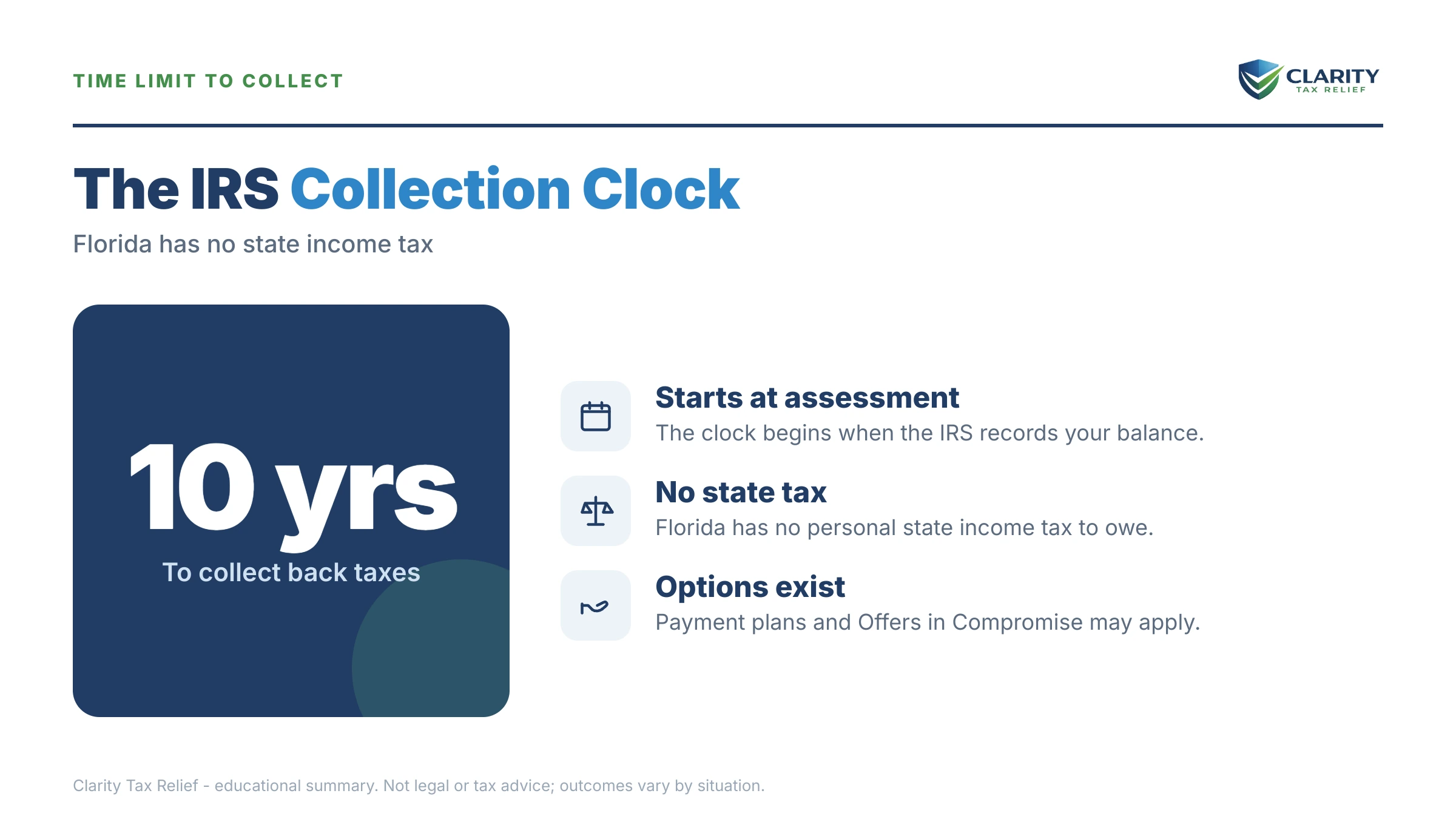
Partial-pay agreements and the 10-year clock. When your budget can't full-pay before the Collection Statute Expiration Date, a partial-pay installment agreement lets you pay what you genuinely can. Whatever remains at the CSED expires with the statute. The IRS has 10 years from assessment to collect, though offers, bankruptcy, and appeals pause the clock. You can estimate your own deadline with our CSED Calculator.
Currently Not Collectible. If IRS allowable living expense standards consume your whole income, collection pauses — no levies, no FPLP deductions from Social Security — while the debt sits and the statute runs. For retirees this is often the honest best answer; see IRS hardship on Social Security.
Offer in Compromise. Settlement is real but means-tested: the IRS accepted roughly 1 in 5 offers in FY2024. Its formula counts your equity, including homestead equity, plus future income. Low-income certification (AGI at or below 250% of the poverty level) waives the $205 fee, the 20% down payment, and payments during review. An offer the IRS doesn't decide within 2 years is accepted automatically, with narrow exceptions: a returned or rejected offer stops the clock, and time spent in court disputes doesn't count. It's the right tool for the right facts, not a discount program.
Penalty relief. First-Time Abate can remove penalties if your prior three years were clean, and starting summer 2026, the IRS's new Automatic Exemption from Penalty (AEP) applies similar relief automatically, with no request needed. On a $92,700 balance, penalty relief alone can be worth thousands, so check it before locking in any plan.
Say you owe $92,700 on a Social Security income: the real math
Running the numbers for a Sarasota retiree
This is a hypothetical, but it mirrors the most common Florida profile we see. Say you're 71, retired in Sarasota, and owe $92,700 across 2021–2023 — an IRA drawdown and the sale of a rental, in years when nothing was withheld. Your income is $2,480 a month in Social Security plus a $900 pension: $3,380 total.
If you do nothing: the FPLP eventually takes 15% of the Social Security check — $2,480 × 15% = $372 a month — automatically. Meanwhile, while the failure-to-pay penalty is still accruing (it caps at 25% of the tax), 0.5% of $92,700 is about $463 a month in penalty alone, before interest. The levy takes less than the debt grows: you'd be losing $372 monthly and still falling behind.
Full-pay plan: $92,700 ÷ 72 months ≈ $1,288 a month before accruing interest — more than a third of your income. The IRS's own allowable-expense standards would rarely show that ability on this budget. You shouldn't agree to a payment the math says you can't sustain.
Realistic paths: a Form 433-F showing, say, $310 a month left after allowable expenses supports a partial-pay agreement at $310. If roughly 84 months remain on the collection statute, that pays about $26,000, and the remaining balance expires at the CSED. If the 433-F shows nothing left at all, Currently Not Collectible pauses collection entirely, including the FPLP.
The offer question cuts both ways: renting with no assets and $310 of monthly capacity, a lump-sum offer starts around $310 × 12 = $3,720 plus asset equity — genuinely worth exploring. But own a homestead with $150,000 of equity, and roughly $120,000 of it (at quick-sale value) enters the IRS's collection-potential math, so no low offer gets accepted no matter how tight the monthly budget is. Same debt, same income, opposite answers — equity decides.
And the passport: $92,700 is above the $66,000 certification threshold for 2026, so a CP508C is a live risk — a real problem for anyone who travels. An approved installment agreement or pending offer removes the debt from certification.
How to respond to IRS back taxes in Florida, step by step
- Pull your IRS records. Log into your IRS online account or request account transcripts to confirm every year with a balance, the exact amounts, and when each was assessed.
- Find your most recent notice. The notice name in the top corner sets your clock — a CP504 means a state-refund levy is authorized. An LT11 means levies on bank accounts and income can begin after 30 days.
- File any missing returns. The IRS won't approve a payment plan or offer while returns are outstanding. The failure-to-file penalty runs ten times the failure-to-pay penalty, though in any month both apply, the failure-to-file portion drops to 4.5% for a combined 5% rate.
- Run the Form 433-F math. Compare your monthly income against the IRS allowable living expense standards. The gap, or lack of one — decides whether you're a payment-plan, hardship, or offer candidate.
- Set up your resolution before the next notice lands. Apply online, by phone, or by mail, and get the agreement confirmed in writing. An active agreement stops the escalation sequence.
- Get an experienced review if you owe over $50,000 or a levy is pending. Above the streamlined threshold, how your financials are packaged changes what you pay each month — a free review costs nothing and can't hurt.
Florida business owners: the state's one real collector
The one back-tax debt Florida itself pursues hard is sales tax, and it can follow you personally. Sales tax you collected from customers is trust money in the state's eyes. The Florida Department of Revenue can assess responsible individuals even after a business closes. That fight has its own rules and none of the IRS's programs apply to it. Start with our guide to state sales tax debt, and verify anything state-specific directly with the Florida Department of Revenue.
If you owe both — 941 or 1040 debt to the IRS and sales tax to the DOR — don't resolve one blind to the other. Both agencies claim the same monthly cash flow, and the financial statement you give one can shape what the other demands.
Hurricanes and IRS deadlines: what disaster relief actually does
Federal disaster declarations regularly cover Florida counties, and they postpone filing and payment deadlines for taxpayers in the declared area, sometimes by months. What relief does not do is erase a balance that was already assessed; interest generally keeps accruing on existing debt through the relief window. If a storm hit your county, check what's covered before assuming any date moved — our guide to IRS disaster-relief deadline extensions explains how the declarations work, and the Taxpayer Advocate Service can help when a disaster collides with an active collection case.
When you can handle this yourself, and when help changes the outcome
Plenty of Florida IRS debt needs no professional at all. You can confidently handle it yourself when:
- You agree with the balance and can pay it within 180 days — the short-term plan is free and takes minutes online;
- You owe under $50,000 with all returns filed — the IRS online payment plan system can set up a streamlined agreement without anyone's help;
- It's a single first notice for one year and the numbers match your return.
Cases where experienced help matters most
Experienced help tends to change outcomes when the case has moving parts: a balance over $50,000 where Form 433-F numbers get negotiated line by line. A levy already hitting Social Security or a bank account. Multiple unfiled years that must be sequenced before any agreement. Offer-in-compromise math complicated by homestead equity. Or an IRS debt tangled with Florida DOR sales tax. In those cases the question isn't whether you can do it alone — it's whether the version you'd negotiate alone costs more per month for the next several years.
If your balance sits above the $50,000 line — like the $92,700 in the example above — have an experienced tax professional package the financials before you call the IRS: request a free case review or call (888) 825-7779.
Terms on your IRS paperwork, decoded
- CSED (Collection Statute Expiration Date): the date the IRS legally loses the right to collect — 10 years from assessment, extended by pauses like offers, bankruptcy, and appeals.
- FPLP (Federal Payment Levy Program): the automated program that takes up to 15% of federal payments, including Social Security retirement benefits.
- CDP hearing: your formal appeal right after a final levy notice, requested on Form 12153 within 30 days; it pauses levy action while pending.
- Federal tax lien: the government's legal claim against everything you own — including a Florida homestead that state law protects from every other creditor.
- Tenancy by the entireties: Florida's joint marital ownership form. Powerful against most creditors of one spouse. But the federal tax lien still reaches the liable spouse's interest.
- Currently Not Collectible (CNC): IRS status that pauses collection when allowable expenses consume your income; the debt remains and interest accrues, but levies stop.
Florida back taxes and the IRS: your questions answered
Does Florida collect back income taxes?
No — Florida has no personal income tax, so no state agency bills residents for back income taxes. Personal back taxes in Florida are federal, owed to the IRS. The exception is business taxes: the Florida Department of Revenue collects sales and use tax, reemployment tax, and corporate income tax. It enforces those aggressively — including personal liability for collected-but-unremitted sales tax.
Can the IRS garnish Social Security in Florida?
Yes. Through the Federal Payment Levy Program, the IRS can take up to 15% of your monthly Social Security retirement or disability benefit, and Florida's creditor protections don't apply to a federal levy. You'll get a CP91 notice first, which is your window to set up an agreement and stop the levy. SSI payments are not subject to the FPLP.
Can the IRS take my homestead-protected house in Florida?
Florida's homestead exemption does not block a federal tax lien — the lien attaches to your home despite state law. Actual seizure of a primary residence is rare and requires federal court approval. Far more often, the lien simply collects when you sell or refinance. Your home equity also counts in Offer in Compromise math even though other creditors can't touch it.
Does Florida's head-of-family wage protection stop an IRS wage levy?
No. Florida law shields most head-of-family wages from ordinary garnishment, but IRS levies are governed by federal law, which overrides state exemptions. A federal wage levy uses IRS exemption tables that leave you a fixed amount per paycheck, often far less than Florida law would protect. It continues until released or the debt is paid.
How long can the IRS collect back taxes in Florida?
Ten years from the date each tax was assessed — the Collection Statute Expiration Date, or CSED — the same in every state. The clock pauses while an Offer in Compromise, bankruptcy, or Collection Due Process appeal is pending, and for time you spend outside the U.S., so real-world CSEDs often run longer than ten calendar years. Check your transcripts for the assessment dates.
Will the IRS take my passport over back taxes?
It can if your debt is 'seriously delinquent' — for 2026 that means $66,000 or more with a lien filed or levy issued. The IRS sends a CP508C and certifies the debt to the State Department, which can deny renewal or revoke your passport. Entering an installment agreement or having a pending Offer in Compromise removes the debt from certification.
I'm a snowbird — can my old state still come after me for taxes?
Yes. Moving to Florida stops future state income tax. But it doesn't erase debt you already owed to New York, California, or any other state, and some states collect far longer than the IRS (California's collection statute runs 20 years). High-tax states also audit the residency of the year you moved, so keep records proving when Florida became your true home.
Do hurricane disaster extensions pause IRS collections in Florida?
Disaster declarations postpone filing and payment deadlines for taxpayers in covered counties, and the IRS often eases some collection activity during the relief window. But relief doesn't erase debt that was already assessed, and interest generally keeps accruing on existing balances. Check the current IRS disaster relief page for your county before assuming any deadline moved.
My Florida business closed — can the state still collect its sales tax from me personally?
Yes. Sales tax you collected from customers is trust money. The Florida Department of Revenue can pursue the people responsible for collecting and remitting it even after the business closes. That state debt is completely separate from any IRS balance, and the two agencies don't coordinate. You may need a strategy that addresses both.
Does tenancy by the entireties protect our home if only one spouse owes the IRS?
Not fully. Entireties ownership blocks most creditors of one spouse in Florida, but the U.S. Supreme Court has held that a federal tax lien attaches to the liable spouse's interest in entireties property. The non-liable spouse's interest stays protected, and if a joint refund is taken for one spouse's debt, an injured spouse claim can recover their share.
Your next 24 hours
- Find your most recent IRS letter and note two things from the top corner: the notice name (CP14, CP504, LT11, CP91) and the date. Together they tell you exactly how much runway you have.
- Gather three documents: your last filed tax return, your Social Security benefit statement (or other proof of monthly income). A rough list of your monthly living expenses. That's everything the eligibility math needs.
- Get the free case review. An experienced tax professional will match your balance, income, and equity to the option that actually fits, before penalties and interest add another month to the bill. Call (888) 825-7779 or use the 2-minute form.
This guide is general information, not tax or legal advice for your specific situation. Eligibility for IRS programs depends on individual facts and circumstances; no outcome is guaranteed.