
Self-Employed & Small Business
Sole Proprietorship vs LLC Taxes in 2026: What Actually Changes (and What Doesn't)
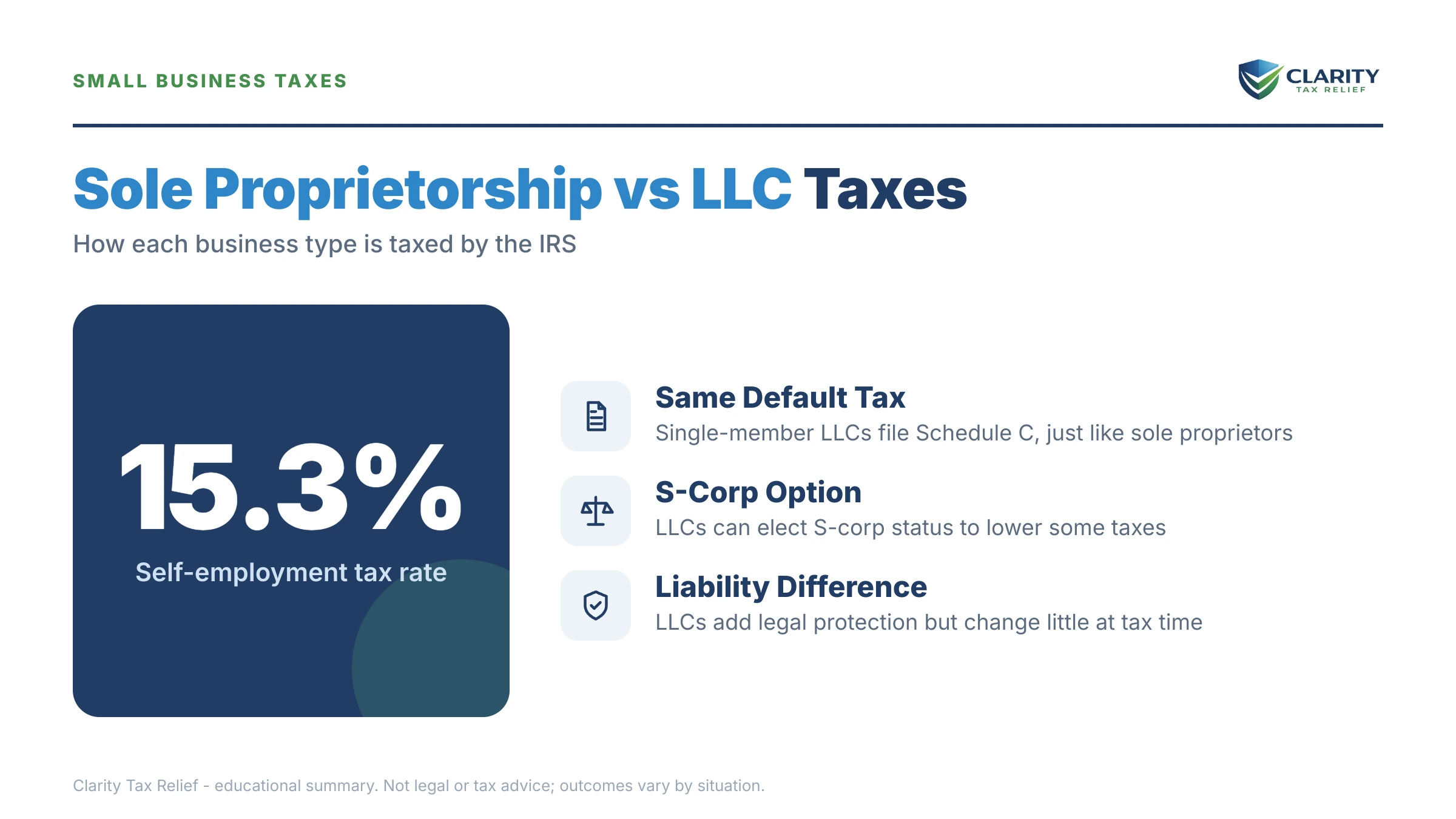
The short answer: in the sole proprietorship vs LLC taxes question, there is no federal difference by default. The IRS treats a single-member LLC as a "disregarded entity". You file the same Schedule C, pay the same 15.3% self-employment tax, and use the same brackets. An LLC adds liability protection and the option to elect S-corp taxation later.
You've been freelancing under your own name, the design work is finally paying real money, and everyone — the formation-service ads, the YouTube accountants, that one friend with "LLC" in their email signature — insists you're leaving tax savings on the table. Before you spend a dime on filing fees, here's what actually moves and what doesn't.
⏱ No new clock, no reset: forming an LLC does not change a single federal tax deadline. Quarterly estimated payments stay due April 15, June 15, September 15, and January 15 — see the full quarterly estimated deadlines for 2026 — and your personal return stays due April 15 either way.

Sole proprietorship vs LLC taxes: why the IRS treats them identically
A single-member LLC is taxed exactly like a sole proprietorship by default: the IRS classifies it as a disregarded entity and ignores it entirely on your federal income tax return.
"Disregarded" means exactly what it sounds like. The LLC exists under state law — it can hold contracts, a bank account. An EIN — but for federal income tax purposes the IRS looks straight through it to you. Your business profit lands on Schedule C attached to your Form 1040, exactly as it did before.
That means forming an LLC, by itself, changes nothing on your federal income tax return. Same Schedule C. Same Schedule SE for self-employment tax. Same individual tax brackets. Same 20% qualified business income deduction, if you qualify. Same quarterly estimated payments.
The real tax lever hiding inside an LLC is a checkbox you haven't checked yet: an LLC may elect to be taxed as an S corporation (Form 2553) or a C corporation (Form 8832). Until you make an election, the default holds, and the default is "identical to a sole proprietor."
One structural exception: a multi-member LLC defaults to partnership taxation. It files Form 1065 and issues each member a Schedule K-1. If you're bringing on a co-owner, the filing picture genuinely changes; if it's just you, it doesn't.
“An individual owner of a single-member LLC that operates a trade or business is subject to the tax on net earnings from self employment in the same manner as a sole proprietorship.”
— Single member limited liability companies (IRS.gov)
Self-employment tax: the number that doesn't move
Self-employment tax is 15.3% of net earnings whether you operate as a sole proprietor or a default single-member LLC — 12.4% for Social Security plus 2.9% for Medicare, applied to 92.35% of your Schedule C profit.
This is the tax most people hope an LLC will shrink, and it's the one an LLC touches least. A disregarded LLC's entire net profit flows to Schedule SE, dollar for dollar, the same as a sole proprietor's. If you're already struggling with it, our guide to owing the IRS self-employment tax covers what to do about an existing balance.
Two softeners apply equally under both structures: you deduct half of your self-employment tax as an adjustment to income. The Social Security portion stops at the annual wage base (most freelancers at this income level are well under it).
Because no employer withholds anything for you, both structures also carry the same pay-as-you-go obligation — four estimated payments a year. If that system is new to you, start with how quarterly estimated taxes work.
The expensive trap: forming an LLC and assuming your taxes changed
The costliest LLC mistake isn't choosing the wrong entity — it's forming one and then behaving as if your taxes changed when nothing did.
We see the same sequence play out over and over with new LLC owners:
- You form the LLC — articles of organization filed, EIN issued, business bank account opened. It feels like the "tax benefits" have started.
- Nothing changes on the return — profit still lands on Schedule C, and the full 15.3% self-employment tax still applies.
- You skip or underpay quarterly estimates, assuming the entity somehow "handles" taxes now, or that business money isn't personal income until you pay yourself.
- April arrives with the full bill at once — income tax plus self-employment tax plus an underpayment penalty, on money that may already be spent.
- The unpaid balance enters IRS collections, and the LLC shield is irrelevant, because the debt is personal. It was always your income on your Form 1040.
If you're already at step four or five, this stops being an entity-choice question. See our guides on being in your first year self-employed and owing taxes and handling single-member LLC tax debt — the resolution paths are the same ones available to any individual taxpayer.
Formed an LLC and got blindsided by a self-employment tax bill?
The entity didn't cause it, but it won't fix it either. An experienced tax professional can review your balance, your unfiled quarters, and your options in one free call. Interest and penalties accrue monthly until a plan is in place.
Sole proprietorship vs single-member LLC vs S-corp election: side by side
Of the three common setups, only the LLC with an S-corp election files a different federal return or changes what you pay in payroll taxes.
| How it works | Sole proprietorship | Single-member LLC (default) | LLC with S-corp election |
|---|---|---|---|
| Federal income tax return | Schedule C on your Form 1040 | Schedule C on your Form 1040 — identical | Form 1120-S, plus a K-1 that flows to your 1040 |
| Self-employment / payroll tax | 15.3% SE tax on net profit | 15.3% SE tax on net profit — identical | FICA on your W-2 salary only; distributions avoid SE tax |
| Payroll required | No | No | Yes — reasonable W-2 salary, Form 941 filings, payroll deposits |
| Quarterly estimated taxes | Yes | Yes | Yes, plus payroll tax deposits |
| Extra recurring cost | None | State LLC fees / franchise tax | State fees, payroll service, and separate return preparation |
| Liability protection | None | Yes, against business creditors | Yes, against business creditors |
Read the middle column carefully: it is the whole answer to the default question. The first two columns differ only in legal protection and state fees. Every tax difference lives in the third column, and the third column is a choice, not a consequence of forming the LLC.
What an LLC does NOT change about your taxes
An LLC changes your legal exposure and your paperwork — by default it does not change a single line of your federal tax return.
These are the six myths formation-service marketing leans on hardest:
| The myth | What actually happens |
|---|---|
| "An LLC unlocks a lower tax rate" | Profit passes through to your Form 1040 and is taxed at the same individual brackets you already pay. |
| "LLCs get more write-offs" | Deductions follow the business activity, not the entity — home office, equipment, software, and mileage are identical either way. |
| "The LLC pays the self-employment tax, not me" | A disregarded LLC's full net profit carries the 15.3% SE tax on your personal Schedule SE. |
| "I can stop making quarterly estimated payments" | Estimates stay due on the same four dates; skipping them triggers the same underpayment penalty. |
| "An LLC lowers my audit risk" | A default LLC still files Schedule C, which draws the same scrutiny — see our Schedule C audit defense guide. |
| "The LLC shields me if I owe the IRS" | Income tax debt is personal because the income was always yours — more in back taxes and LLC personal liability. |
Say you net $95,000 freelancing: the math under all three setups
On $95,000 of net profit, a sole proprietor and a default single-member LLC pay exactly the same self-employment tax — about $13,423.
Here's the arithmetic, using a clearly hypothetical freelance designer netting $95,000 after expenses:
Sole proprietorship: the SE tax base is 92.35% of profit — $95,000 × 0.9235 = $87,733. Multiply by 15.3% and self-employment tax comes to about $13,423, identical to the penny under a default LLC. You deduct half of it (roughly $6,712) as an adjustment, and regular income tax applies on top at your bracket.
Single-member LLC, default taxation: $13,423 again. Same Schedule C, same Schedule SE, same brackets, same QBI deduction. The only new line item is whatever your state charges to keep the LLC alive.
LLC with an S-corp election: suppose you pay yourself a $60,000 reasonable salary and take the remaining profit as distributions. Combined employer-plus-employee FICA on the salary is 15.3% × $60,000 = $9,180, and the distributions escape self-employment tax. On paper, that's a payroll-tax gap of roughly $4,243 versus the default.
Before you get excited: that $4,243 is a gross figure, not what you keep. A payroll service, quarterly Form 941 filings, a separate Form 1120-S preparation, small unemployment-tax additions, and state fees all bite into it, often by more than half. The election also reshuffles your qualified business income deduction, since wages aren't QBI. That's why the honest S-corp answer is "run your real numbers," never "always elect."
When an S-corp election starts making sense
Many owners start running S-corp numbers once net profit consistently clears roughly $60,000 to $100,000 — below that range, the added costs often eat most of the payroll-tax gap.
Three conditions have to hold at once for the election to be worth it:
Profit is consistent, not a spike. The election locks you into payroll obligations in lean years too. One great year isn't a trend.
Your reasonable salary leaves a meaningful distribution. The IRS requires S-corp owner-employees to take reasonable compensation for the work they actually do. It audits lowball salaries. If the defensible salary for your role eats most of your profit, there's little left to shelter — see what goes wrong in S-corp reasonable salary back taxes.
You'll actually run the administration. Real payroll, on-time deposits, a separate business return. Missed payroll deposits create business tax problems that are worse than the SE tax you were trying to trim.
Timing matters too: for the election to apply to a tax year, Form 2553 generally must be filed within the first two months and 15 days of that year, though late-election relief exists in some cases.
One line on states, because it deserves it: state treatment does not automatically follow the federal math. Some states charge LLC franchise taxes or fees regardless of profit — California's LLC annual tax is $800 even in a losing year — and some tax S corporations directly. Check your state's revenue agency before assuming the federal savings survive the trip.
How to decide between a sole proprietorship and an LLC, step by step
- Pull your most recent Schedule C. Find line 31. Your net profit. Every dollar figure in this decision keys off that number.
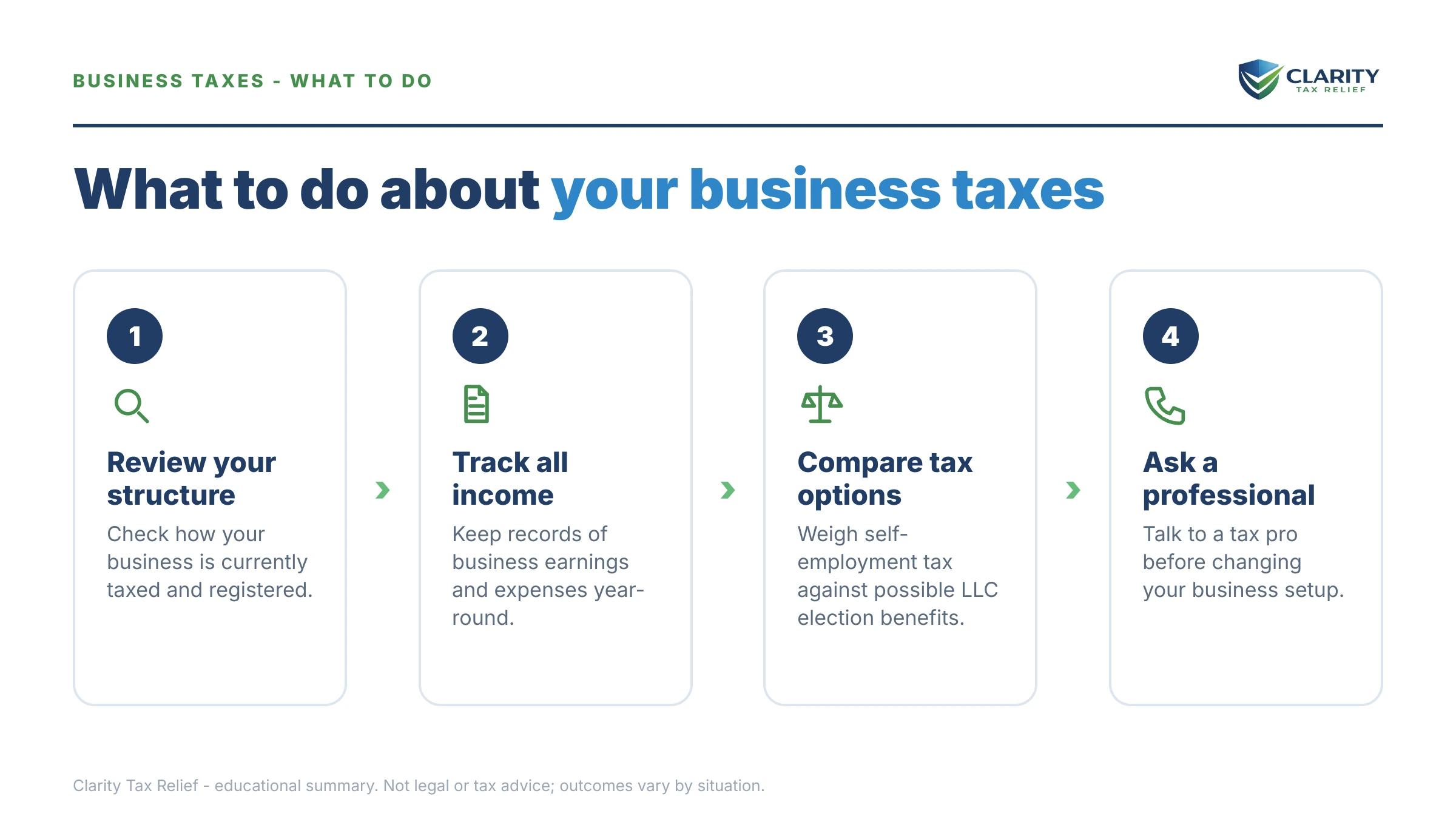
- Separate the liability question from the tax question. Decide whether you want the legal shield on its own merits. By default, the LLC is tax-neutral at the federal level.
- Run the S-corp math on your real numbers. Compare the payroll-tax gap at a defensible reasonable salary against payroll, return-preparation, and state costs before electing anything.
- Check your state's LLC fees and taxes. Formation fees, annual reports, and franchise taxes, like California's $800 a year, can erase a small federal advantage.
- If you elect S-corp status, file Form 2553 on time and set up real payroll. The election has strict timing rules. You must pay yourself a reasonable W-2 salary through actual payroll filings.
- Get an experienced review if you owe back taxes or profit tops six figures. Restructuring while you owe the IRS can complicate resolution — the order you fix things in changes what you pay.
When you can handle this yourself
You do not need professional help to form an LLC or to keep filing as a default single-member LLC — the federal filing is the same Schedule C you already know.
Handle it yourself when: your profit is modest and steady, you're forming the LLC purely for liability protection, and you're current on estimated payments. The state filing takes an afternoon, and nothing about your tax prep changes.
Experienced help changes outcomes when: you're weighing an S-corp election near the break-even zone (the reasonable-salary call is where DIY elections go wrong), you owe back taxes while restructuring, you have unfiled years, or you're adding employees or a co-owner. Freelancers already behind with the IRS should start with our freelancer and consultant tax debt guide — entity paperwork won't pause collections. But the right resolution sequence will.
Terms in the sole-prop-vs-LLC debate, decoded
Disregarded entity — an LLC the IRS ignores for federal income tax; its activity is reported directly on the owner's Form 1040.
Pass-through taxation — profit is taxed once, on the owner's personal return, instead of at the business level.
Self-employment (SE) tax — the 15.3% Social Security and Medicare tax self-employed people pay on net earnings, replacing employer-employee FICA withholding.
S-corp election (Form 2553) — an optional filing that changes how an LLC is taxed, splitting profit into salary and distributions, without changing what it is under state law.
Reasonable compensation — the W-2 salary an S-corp owner must pay themselves for actual work performed, which the IRS can challenge if it's artificially low.
Franchise tax / annual LLC fee — a state-level charge for the privilege of existing as an LLC, owed in many states whether or not you turn a profit.
Sole proprietorship vs LLC tax questions, answered
Does an LLC pay less in taxes than a sole proprietorship?
No, not by default. A single-member LLC is a disregarded entity, so you file the same Schedule C, use the same tax brackets, and pay the same 15.3% self-employment tax as a sole proprietor. The only path where an LLC can change the math is an S-corp election. That helps only when profit is high enough to outrun the added payroll and filing costs.
Do I file taxes differently with a single-member LLC?
No. You still report business profit on Schedule C attached to your Form 1040 and calculate self-employment tax on Schedule SE. There is no separate federal return for a default single-member LLC. The exceptions: a multi-member LLC files a partnership return on Form 1065. An LLC that elects S-corp status files Form 1120-S plus quarterly payroll returns.
Does an LLC reduce self-employment tax?
By itself, no. A default LLC's entire net profit is subject to the same 15.3% self-employment tax a sole proprietor pays. Only an S-corp election changes it: you pay FICA taxes on a reasonable salary and take remaining profit as distributions that avoid self-employment tax. The IRS scrutinizes unreasonably low salaries, so the split has to be defensible on your real numbers.
At what income does an S-corp election make sense?
Many owners start running the numbers once net profit consistently clears roughly $60,000 to $100,000. Below that range, the payroll-tax gap often barely covers the added costs: a payroll service, a separate Form 1120-S, and in some states higher fees. There is no magic threshold — the break-even depends on your reasonable salary, your state, and what you pay for administration.
Does an LLC give me more tax deductions?
No. Business deductions follow the activity, not the entity — home office, equipment, software, mileage, health insurance, and retirement contributions are equally available to a sole proprietor and a single-member LLC. The 20% qualified business income deduction applies the same way under both. If a formation service is promising special 'LLC write-offs,' it is selling you deductions you already have.
What does an LLC cost at the state level?
It varies widely. Every state charges a formation fee, most charge annual report fees, and some impose real taxes regardless of profit — California charges LLCs an $800 annual franchise tax even in a losing year. Those recurring costs matter because the federal tax treatment is identical by default, so state fees can make the LLC a net expense until profit justifies it.
If my single-member LLC owes taxes, am I personally liable?
For income and self-employment taxes, yes. A disregarded LLC's profit was always reported on your personal Form 1040, so the resulting tax debt is yours personally — the liability shield protects you from business creditors, not from your own tax bill. Payroll taxes can also reach you personally through the trust fund recovery penalty if the LLC has employees.
Your next 24 hours
- Find line 31 on your most recent Schedule C. That net profit number, not a formation ad, decides whether any of this is worth changing.
- Gather three things: last year's return, your year-to-date profit, and your record of estimated payments made so far this year.
- If you're behind on self-employment taxes, or want the S-corp break-even run on your real numbers — get a free case review at the 2-minute form or (888) 825-7779. Interest and penalties on any unpaid balance accrue monthly; entity paperwork won't stop them, but a resolution plan will.
For primary sources, see the IRS's Small Business and Self-Employed tax center and the official Schedule C (Form 1040) page.
This guide is general information, not tax or legal advice for your specific situation. Eligibility for IRS programs depends on individual facts and circumstances; no outcome is guaranteed.