
Income Surprises
Owe Taxes on Unemployment Income: What to Do in 2026
The short answer: unemployment benefits are fully taxable, but the state pays them with little or no tax taken out, so the whole bill lands when you file. If you owe taxes on unemployment and can't pay, file anyway and set up an installment agreement; a balance under $50,000 can go on a plan of up to 72 months.
You collected unemployment to survive a rough stretch, filed your return, and the number at the bottom says you owe, sometimes thousands. It feels backward: you were out of work, and now the government wants money. Here's why it happened and, more importantly, exactly how to fix it.
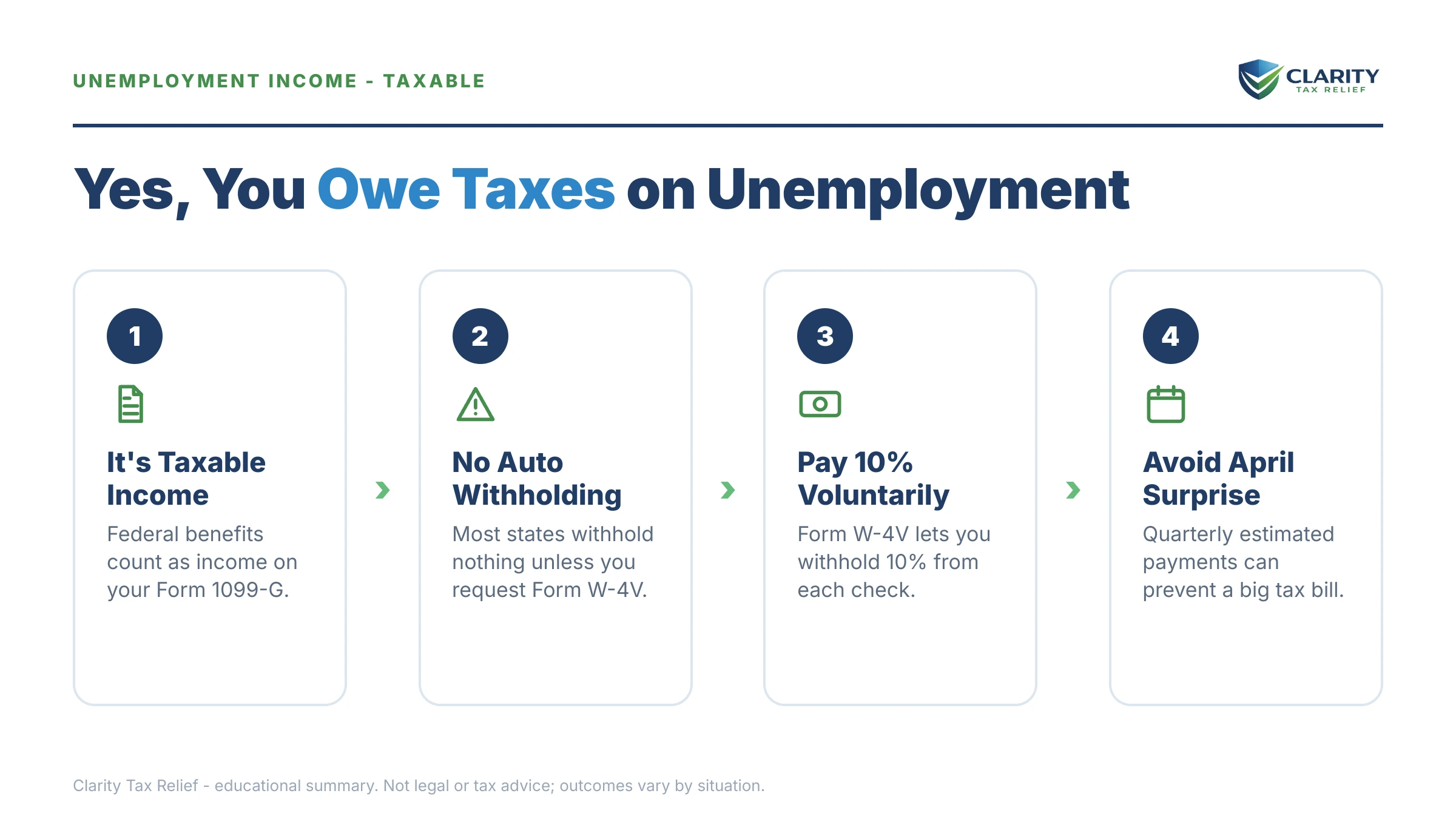
The reason is simple and it's not your fault: almost no tax is withheld from unemployment unless you specifically ask for it. A paycheck has tax pulled out automatically. Unemployment doesn't. That single difference is why the balance blindsides so many people.
The number that drives all of it sits in one box on a single form. The image below shows what a Form 1099-G looks like and where your total benefits are reported — the figure that flowed onto your return and created the balance you're now staring at.
⏱ Your ongoing clock: once the balance on your return goes unpaid, the failure-to-pay penalty runs at 0.5% of the balance per month (up to 25%), and interest compounds daily on top. There's no fixed deadline that erases the debt — every month you wait, it grows. Act while the number is smallest.
Why you owe taxes on unemployment
Unemployment compensation is taxed as ordinary income at the federal level — the same as wages. The state workforce agency that paid you reports the year's total in Box 1 of Form 1099-G. That amount lands on your Form 1040 as taxable income.
The trap is withholding. When you have a job, your employer removes federal tax from every check before you ever see the money. Unemployment offices don't do that automatically. They only withhold if you filed Form W-4V asking for a flat 10% to come out. Most people never see that option, or skip it because they need every dollar during a layoff.
So the tax on those benefits doesn't vanish. It just waits. At filing time, the full amount comes due at once, and if your top tax bracket is higher than 10%, even opting in to withholding may not have covered it. Add a state that also taxes unemployment, and the gap widens.
If your return came out worse than you braced for, you're not alone — it's the same mechanism we walk through for anyone who filed and owe more than expected. Unemployment is one of the most common culprits precisely because the withholding is optional.
The dead $10,200 tax break: don't count on it
You may have heard that part of unemployment is tax-free. That was true for 2020 only — a one-time $10,200 exclusion under the American Rescue Plan. It never applied to any later year. For 2025 and 2026 benefits, unemployment is 100% taxable with no special exclusion. If a tax preparer or old article told you otherwise, that advice is expired.
“Unemployment compensation is taxable income. If you receive unemployment benefits, you generally must include the payments in your income when you file your federal income tax return.”
— Unemployment compensation (IRS.gov)
What happens if you don't pay
Owing taxes on unemployment starts the same automated IRS collection sequence as any unpaid balance. It doesn't go away on its own, and the machine escalates whether or not a human ever reviews your file. Here's the order it moves in if you do nothing:
- CP14 notice — the first bill for the balance on your return. Penalties and interest are already accruing. This is the cheapest moment to act.
- CP501 / CP503 — reminder notices. Still just bills, but the balance keeps growing each month.
- CP504 — Notice of Intent to Levy. The IRS can seize your state tax refund, and a federal tax lien becomes a real risk.
- LT11 / Letter 1058 — Final Notice of Intent to Levy. After 30 days, the IRS can garnish wages and levy bank accounts. You gain formal Collection Due Process appeal rights here, but far fewer easy options than you have today.
If you never filed the return at all because you were afraid of the balance, the failure-to-file penalty is a bigger problem than the tax: it runs at 5% a month — ten times the 0.5% failure-to-pay penalty. Filing is always the cheaper move, even empty-handed. If you're behind on returns while owing, our guide on whether you should file taxes if you owe back taxes walks through the sequence.
Owe on unemployment and don't know your next move?
Send us your 1099-G and your notice. An experienced tax professional will tell you exactly what you owe, whether a penalty can come off, and which payment option actually fits your budget — free, confidential, no pressure.
Your options if you can't pay in full
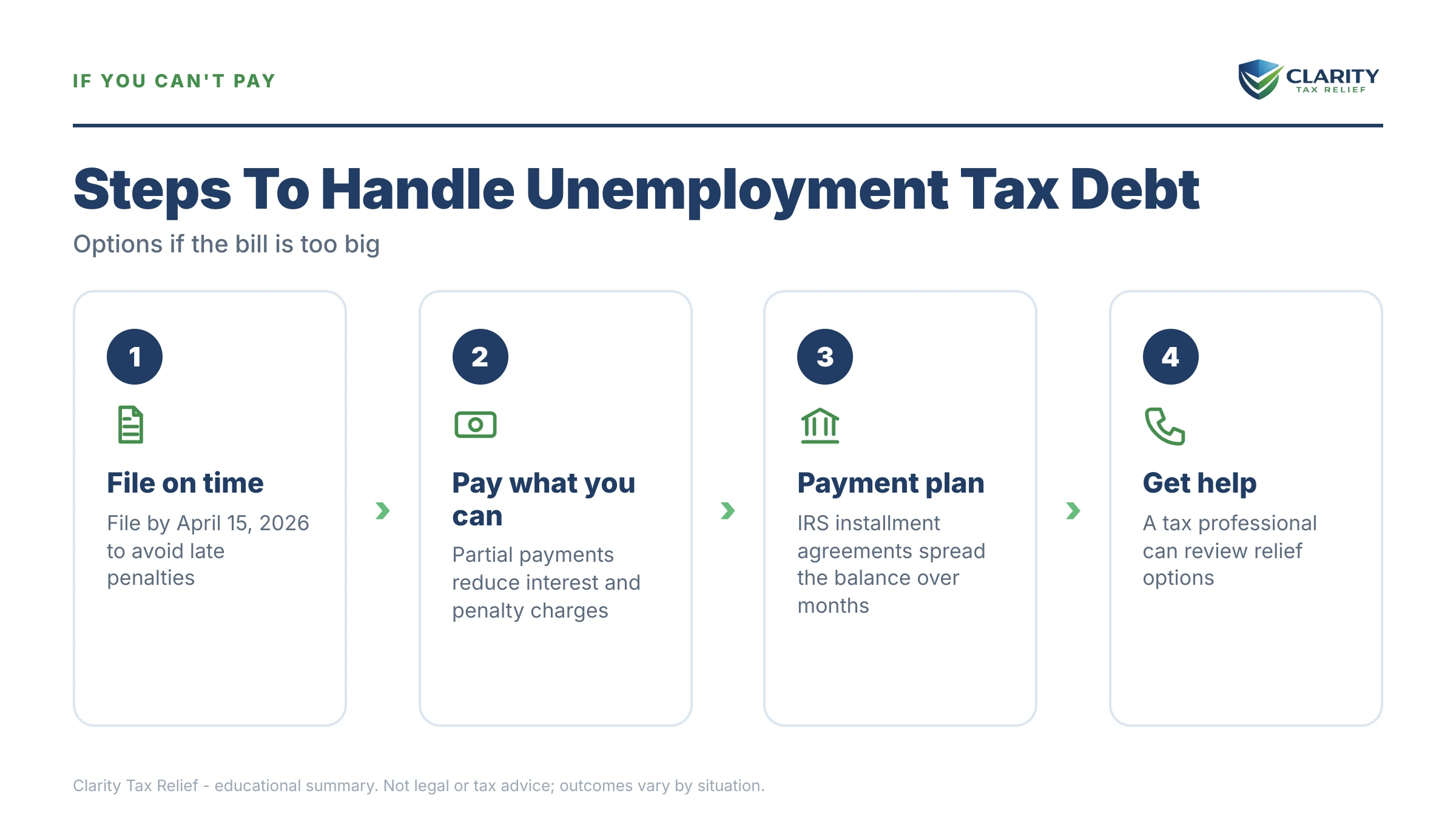
The IRS has several ways to handle a balance you can't clear at once. The right one depends on how much you owe and whether you're back on your feet financially. Here's how the main options line up.
| Option | Who it fits | Cost & key threshold |
|---|---|---|
| Short-term payment plan | You'll have the cash within 180 days (back at work soon) | $0 setup; interest & penalty continue accruing |
| Streamlined installment agreement | You owe $50,000 or less and want a monthly plan | Up to 72 months; small setup fee, lower with direct debit |
| Currently Not Collectible | Still unemployed; paying anything causes hardship | $0; collection paused, debt & interest remain |
| Offer in Compromise | Assets + future income genuinely can't cover the debt | $205 fee (waivable if low-income); ~1 in 5 accepted |
| Penalty relief (FTA / reasonable cause) | Clean prior 3 years, or job loss as a reason | $0; removes penalties, not tax or interest |
For most people who owe on unemployment, the balance sits in the range where a streamlined installment agreement is the simplest fix — no detailed financial disclosure, set up online in minutes. If you're still out of work, Currently Not Collectible status pauses collection until you can pay. And because a layoff is a legitimate hardship, first-time penalty abatement or reasonable-cause relief is worth requesting before you accept the penalty portion of the bill. The shared mechanics of each program live in our hub on how to settle tax debt yourself.
Match the balance to a plan
| Amount owed | Most common path | What to watch |
|---|---|---|
| Under $10,000 | Guaranteed or short-term plan; pay off fast | Interest often costs less than a loan — pay early if you can |
| $10,000–$25,000 | Streamlined installment agreement, up to 72 months | Direct debit lowers the setup fee and prevents default |
| $25,000–$50,000 | Streamlined IA with direct debit required | Ask about penalty relief to shrink the total first |
| Over $50,000 | Financials required (Form 433); CNC or OIC possible | Get a professional review — the math gets complex fast |
A worked example
Say you're married filing jointly and your spouse lost their job, collecting $28,000 in unemployment with zero tax withheld. Your combined income puts the household in the 22% federal bracket, so that $28,000 alone adds about $6,160 in federal tax nobody planned for. Stack that on some under-withholding from your own wages and a state tax hit, and your return shows $19,700 due.
You can't write a $19,700 check. On a 72-month streamlined installment agreement, that's roughly $274 a month ($19,700 ÷ 72) before interest, which continues to accrue on the unpaid balance. If your prior three years were clean, first-time abatement could strip out the failure-to-pay penalty and knock hundreds off the total. You can estimate the running penalty and interest yourself with our IRS penalty and interest calculator before you commit to a monthly number. This is a hypothetical to show the arithmetic. Your real figures depend on your income and state.
Because the balance is under $50,000, this couple would not need to open their books to the IRS at all. If the number had been larger, or if there were multiple years involved, the path changes.
How to respond, step by step
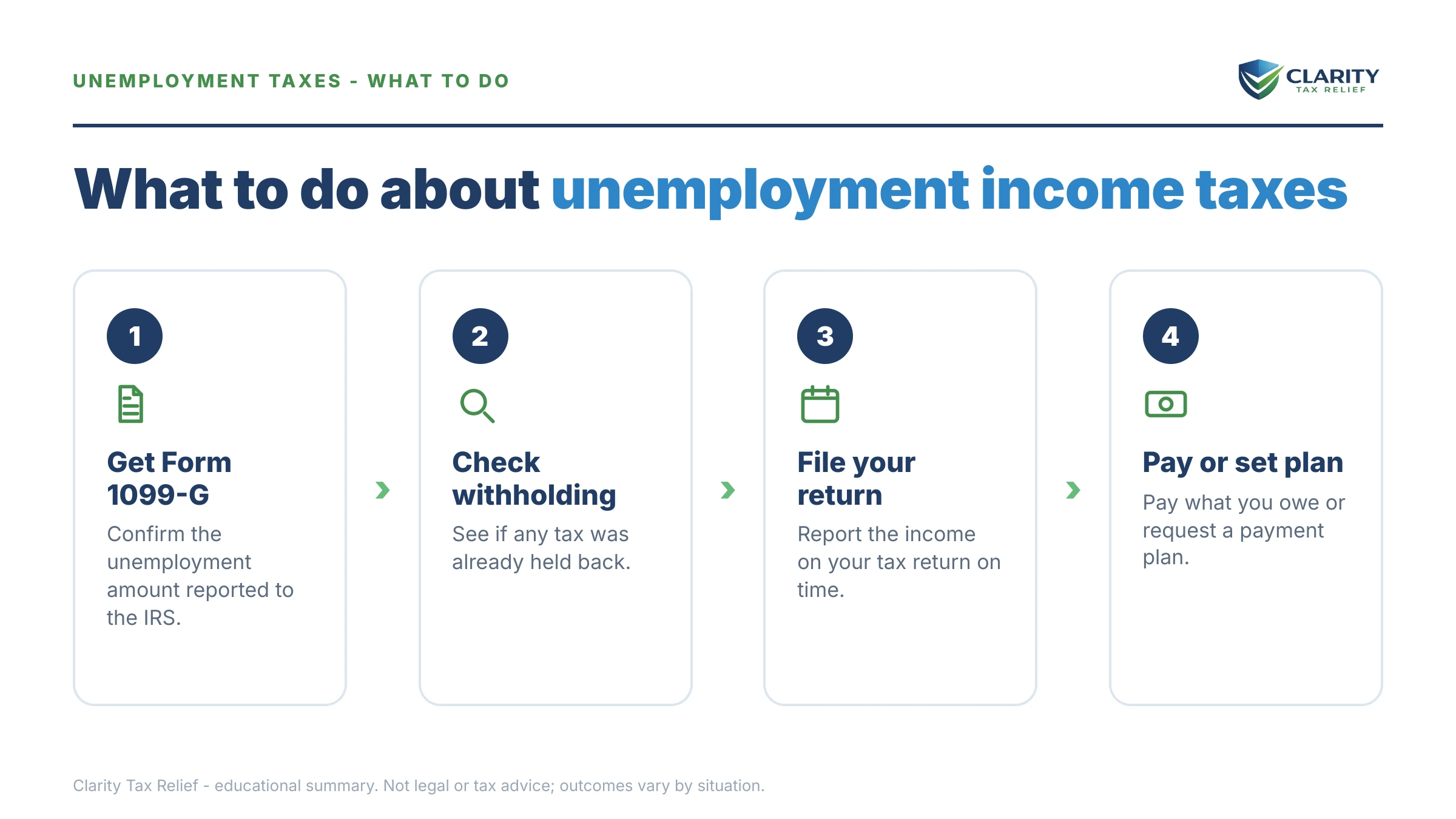
- Confirm your 1099-G is right — compare Box 1 to what your state actually paid you, and watch for benefits you never received (a sign of identity theft).
- File on time even if you can't pay — the failure-to-file penalty is 5% a month, ten times the failure-to-pay penalty of 0.5%. Filing is the cheapest move you can make.
- Pay whatever you can now — every dollar at IRS.gov/payments shrinks the balance that penalties and interest compound on. Partial beats nothing.
- Set up a plan for the rest — for a balance under $50,000, apply online for a streamlined installment agreement of up to 72 months. Enforcement stops once the plan is active.
- Ask about penalty relief — request First-Time Abate or reasonable-cause relief to remove failure-to-file and failure-to-pay penalties, especially given a job loss.
- Fix your withholding for next year — file Form W-4V for 10% withholding on future benefits, or make quarterly estimated payments so you don't repeat the shock.
When you can handle this yourself, and when to get help
If you owe a few thousand dollars, agree with the amount, and have income coming back in, you almost certainly don't need to pay anyone. Log into your IRS online account, set up a payment plan or pay it off within 180 days, and file Form W-4V so it doesn't happen again. That's a one-evening job.
Where experienced help changes the outcome: you have multiple unfiled years alongside the unemployment year, a levy or garnishment is already in motion, you're still out of work and need Currently Not Collectible or an Offer in Compromise properly documented, or the 1099-G shows benefits you never received (identity theft, which requires a different fix entirely). In those cases, the order you resolve things in — returns first, then penalties, then the balance — is what determines your final cost. If you're rebuilding on a lower income and can't pay, our guide for when you've lost your job and can't pay the IRS covers the hardship options in depth.
Terms on your notice, decoded
- Form 1099-G — the form your state sends reporting total unemployment paid (Box 1) and any federal tax withheld (Box 4).
- Form W-4V — the voluntary request that tells the state to withhold a flat 10% federal tax from future benefits.
- Failure-to-pay penalty — 0.5% of the unpaid balance per month, up to 25%; runs until the tax is paid.
- Estimated tax penalty — a separate charge for not pre-paying tax during the year on income (like unemployment) that had no withholding.
- Streamlined installment agreement — a monthly IRS payment plan for balances of $50,000 or less, with no detailed financial disclosure required.
- Currently Not Collectible — a hardship status that pauses IRS collection when paying anything would leave you unable to cover basic living expenses.
Owe on unemployment: questions answered
Is unemployment income taxable?
Yes. Unemployment compensation is fully taxable as ordinary income on your federal return, and your state may tax it too. The state agency that paid you reports the total in Box 1 of Form 1099-G. Unlike a paycheck, no tax is taken out unless you specifically asked for it — which is why so many people end up owing.
Why do I owe taxes on unemployment when nothing was withheld?
Because withholding on unemployment is voluntary, not automatic. A regular employer removes federal tax from every paycheck. A state unemployment office only withholds if you filed Form W-4V asking for a flat 10%. If you didn't, the full tax on those benefits comes due all at once when you file — which is exactly why the balance surprises people.
How much tax do you pay on unemployment benefits?
Unemployment is taxed at your ordinary income rate, which depends on your total income for the year — commonly 10% to 22% federal for most households. Voluntary withholding only removes a flat 10%, so if your bracket is higher than 10%, you can still owe even if you opted in. State tax, where it applies, is on top of that.
Do I owe state taxes on unemployment too?
It depends on your state. States with no income tax don't touch it. A handful that do have an income tax fully exempt unemployment benefits — California is one. Most states, however, tax unemployment the same way the federal government does. Check your state agency, because a state bill runs on its own clock and its own collection rules, separate from the IRS.
What if I can't pay the taxes I owe on unemployment?
File anyway and pick a payment option — the penalty for not filing is ten times the penalty for not paying. For a balance under $50,000 you can set up a streamlined installment agreement online for up to 72 months. If you're still out of work, Currently Not Collectible status can pause collection, and penalty relief may shrink the balance.
Can I get a penalty removed if I owe because of unemployment?
Often, yes. If you have a clean compliance record for the prior three years, First-Time Abate can remove failure-to-file and failure-to-pay penalties - though the failure-to-pay penalty keeps accruing until the tax is paid in full, so it is often best to request abatement after paying the balance, and starting summer 2026 an Automatic Exemption from Penalty may apply without a request. Losing your job can also support a reasonable-cause request. Penalty relief reduces penalties, not the underlying tax or interest.
Is there still a $10,200 unemployment tax break?
No. The $10,200 exclusion was a one-time provision of the American Rescue Plan that applied only to 2020 benefits. For every year since, unemployment compensation is 100% taxable with no special exclusion. Anyone telling you a portion is automatically tax-free for a recent year is working from outdated information.
How do I avoid owing on unemployment next time?
File Form W-4V with your state unemployment office to have a flat 10% federal tax withheld from each payment. If your bracket is higher than 10%, make quarterly estimated payments to cover the gap. If you return to work mid-year, adjust your W-4 so your paycheck withholding makes up for the untaxed benefits earlier in the year.
Your next 24 hours
- Find the number. Pull out your Form 1099-G and look at Box 1 (total benefits) and Box 4 (any federal tax withheld). That gap is what drove your balance.
- Gather the rest. Grab your filed return, any IRS notice. A sense of your current monthly income so you can size a payment you can actually keep.
- Get a free case review. Call (888) 825-7779 or use the 2-minute form. An experienced tax professional will confirm what you owe, check whether a penalty can come off, and set up the right plan before penalties and interest climb any higher.
Two related situations worth reading if they fit you: people who work two jobs and owe every year face the same withholding math, and if you skipped quarterly payments during your layoff, see how the estimated tax penalty is calculated.
This guide is general information, not tax or legal advice for your specific situation. Eligibility for IRS programs depends on individual facts and circumstances; no outcome is guaranteed.
Primary sources: Unemployment compensation