
Self-Employed & 1099
Musician Tax Debt: What to Do When You Owe the IRS Back Taxes (2026)
The short answer: musician tax debt almost always comes from gig fees, royalties, and teaching income that arrived with no taxes withheld — leaving you owing income tax plus 15.3% self-employment tax. It is fixable. File the missing years with your deductions first, then set up a payment plan, hardship status, or an offer based on what your irregular income can actually support.
You played the shows, the checks and Venmos came in, and nobody took a dime out for taxes. Now there's a balance from the IRS — maybe for a year you didn't file, maybe from a return you filed but couldn't pay. That knot in your stomach is normal, and it's the wrong signal: this is a math problem, not a moral one, and it has a clear path out.
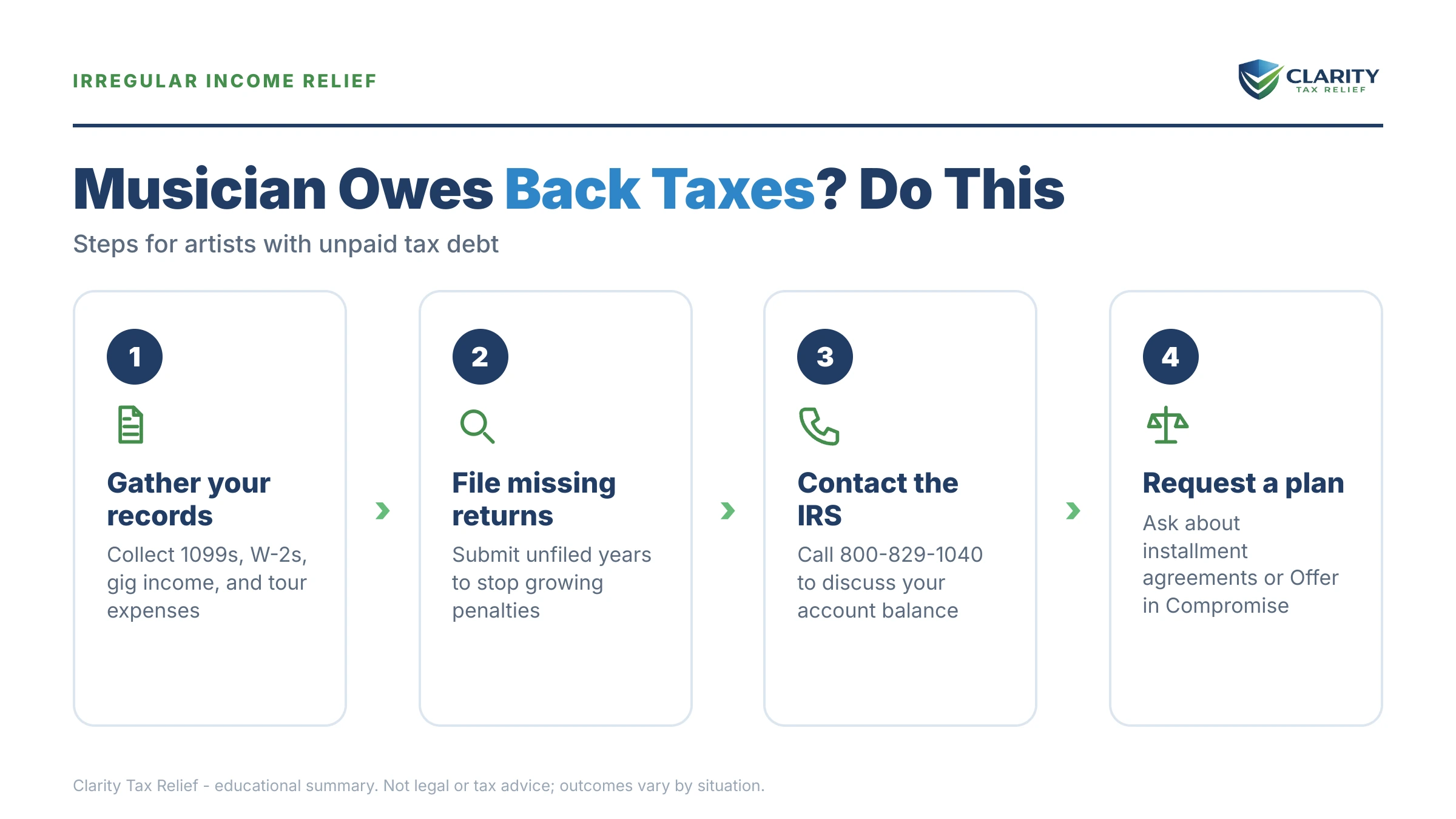
The trap most working musicians fall into isn't spending recklessly — it's that a self-employed performer owes tax the moment money hits the account, with no employer withholding to soften it. The image below shows exactly how a musician's tax bill stacks up and which piece to tackle first.
Here's the good news buried in the panic: your instruments, gear, travel, and home studio are all deductions the IRS didn't count when it billed you. Filing correctly often shrinks the number before you negotiate a dollar of it.
⏱ Your clock: there's no single deadline on "back taxes," but two clocks run every day you wait. Unfiled years carry a failure-to-file penalty of 5% per month, ten times the 0.5% failure-to-pay penalty, so filing, even without paying, is the single highest-value move. Interest compounds on top. File first; that stops the bigger meter.
Why musicians owe back taxes
Musician tax debt is a withholding problem, not a spending problem. A W-2 employee never sees the tax — it's pulled from each paycheck. A gigging musician gets the full amount and has to voluntarily set aside and send it in, usually four times a year. Miss that and the bill lands all at once, often after the money is already spent on rent and gear.
On top of income tax, a self-employed musician owes self-employment tax of 15.3% — both the employee and employer halves of Social Security and Medicare. That's the shock that turns a modest music year into a five-figure balance. If this is your first year seeing it, our guide to the self-employment-tax shock and the first year self-employed tax bill break the number down.
Every income stream a musician juggles is taxed, and most arrive with a form the IRS already has on file:
| Income source | How it's reported | What you owe |
|---|---|---|
| Live gig & performance fees | 1099-NEC, cash, or app transfer | Income tax + 15.3% SE tax |
| Streaming & PRO royalties (SoundExchange, ASCAP/BMI, distributor) | 1099-MISC / 1099-NEC | Income tax + SE tax if it's your trade |
| Merch & digital sales (Bandcamp, PayPal) | 1099-K (over $20,000/200) | Income tax + SE tax; possible state sales tax |
| Teaching private lessons | 1099-NEC or cash | Income tax + SE tax |
| Session / sideman work | 1099-NEC | Income tax + SE tax |
| Sync & licensing fees | 1099-MISC | Income tax (+ SE if active work) |
Because the payers file those forms with the IRS, the IRS often knows your gross income even when you never filed. What it doesn't know is your expenses — which is exactly the leverage you'll use next.
What happens if you ignore musician tax debt
Ignoring the balance doesn't make it quiet. It hands your file to an automated collection sequence that never sleeps. Each stage carries more penalty, more interest, and more enforcement power than the one before it:
- CP14 — the first bill. Penalties and interest are accruing, but no enforcement yet. Read the full CP14 notice guide.
- CP501 / CP503 — reminder notices. Still bills, but the balance grows every month.
- CP504 — Notice of Intent to Levy. The IRS can now seize your state tax refund and a federal tax lien becomes a real risk.
- LT11 / Letter 1058 — Final Notice of Intent to Levy. After 30 days the IRS can levy bank accounts and issue a one-time levy on money a venue, label, or distributor owes you. You gain formal appeal rights here, but far fewer good options than you have today.
For a musician, the bank levy and the contractor levy are the ones that bite. The IRS can freeze an account (funds leave after a 21-day hold) and can send a one-time levy to a payer holding your gig or royalty check. In 2026 this matters more than ever: IRS staffing dropped roughly 27% in 2025. But the notices and automated levies never stopped — a legitimate reason to move before the sequence reaches you.
Got an IRS notice about your music income?
Send us a photo of it. An experienced tax professional will decode where you stand, whether unfiled years are driving the number, and what your real options are — free, confidential, and before penalties keep stacking.
Your options to fix a music tax debt
The IRS has more than "pay or else," and the right fit depends on your income and assets — which, for a musician, swing hard between festival season and the slow months. Here's the menu and who each one is built for:
| Option | Best when | Cost / terms |
|---|---|---|
| Short-term payment plan | You can clear it within 180 days after a good stretch of gigs | $0 setup; interest + penalty continue |
| Streamlined installment agreement | Balance ≤ $50,000; steady enough income for a fixed monthly amount | Up to 72 months; small setup fee |
| Currently Not Collectible | Paying anything would leave you unable to cover basic living costs | $0; collection paused, debt remains |
| Offer in Compromise | Assets + future income genuinely can't cover the debt | $205 fee (waivable if low-income); ~1 in 5 accepted |
| First-Time Penalty Abatement | Clean compliance the prior 3 years | $0; removes the failure-to-pay penalty |
A note on the offer route: the IRS settles for less only when your Reasonable Collection Potential, your equity plus expected future income, is genuinely below the balance. Anyone promising to clear your balance for a tiny fraction of what you owe is selling the scam the FTC bans, not the program. For an unpredictable music income, Currently Not Collectible or a low monthly plan often fits better than an offer. If the balance is around $15,000, our walkthrough of what to do when you owe the IRS $15,000 maps the same options against a real number, and how quarterly estimated taxes work stops it from happening again.
Deductions musicians forget, and why they cut the bill
The IRS taxes your profit, not your gross gig income, but if you never filed, or the IRS filed a substitute return for you, it counted zero expenses. Rebuilding these before you file directly lowers what you owe:
| Deduction | Examples | Records to keep |
|---|---|---|
| Instruments & gear | Amps, mics, cases, software, repairs | Receipts; big items may be depreciated |
| Home studio | Portion of rent, utilities, internet | Square-footage percentage |
| Tour travel & lodging | Flights, hotels, per diem meals | Itineraries, card statements |
| Vehicle / mileage to gigs | Driving to venues, sessions, load-ins | Mileage log or calendar reconstruction |
| Commissions & fees | Manager, booking agent, PRO, distributor | 1099s and payout statements |
| Dues & subscriptions | AFM union dues, DAW/plugin subscriptions | Bank statements |
No shoebox of receipts? You can still claim these. Bank and card statements, gig calendars, streaming payout reports, and reasonable mileage estimates are all accepted reconstruction methods — see filing back taxes with no records. The point is simple: never let the IRS tax your gross when your net is what's taxable.
A worked example: a gigging musician who owes $18,000
Say you're a working musician who netted about $45,000 in each of 2023 and 2024 — a mix of gig fees, private lessons, and modest streaming — with nothing withheld and no quarterly payments made.
Self-employment tax alone is $45,000 × 92.35% × 15.3% ≈ $6,358 per year. Add roughly $2,600 in income tax after the standard deduction and the SE-tax deduction. You underpaid about $9,000 a year — around $18,000 across the two years before penalties and interest. The failure-to-file and failure-to-pay penalties plus compounding interest push it higher the longer it sits.
Now the arithmetic of the fix. On a 72-month streamlined installment agreement, $18,000 ÷ 72 ≈ $250 a month in principal, closer to $300 a month once interest is folded in. If a slow season means you can't cover basics, Currently Not Collectible could pause collection entirely. An Offer in Compromise would only work if you could show the IRS that your equity plus future income can't realistically reach $18,000 before the collection statute runs out. You can estimate the penalty-and-interest piece with our IRS penalty & interest calculator before you decide. (Figures are illustrative. Your real numbers depend on your filing status and expenses.)
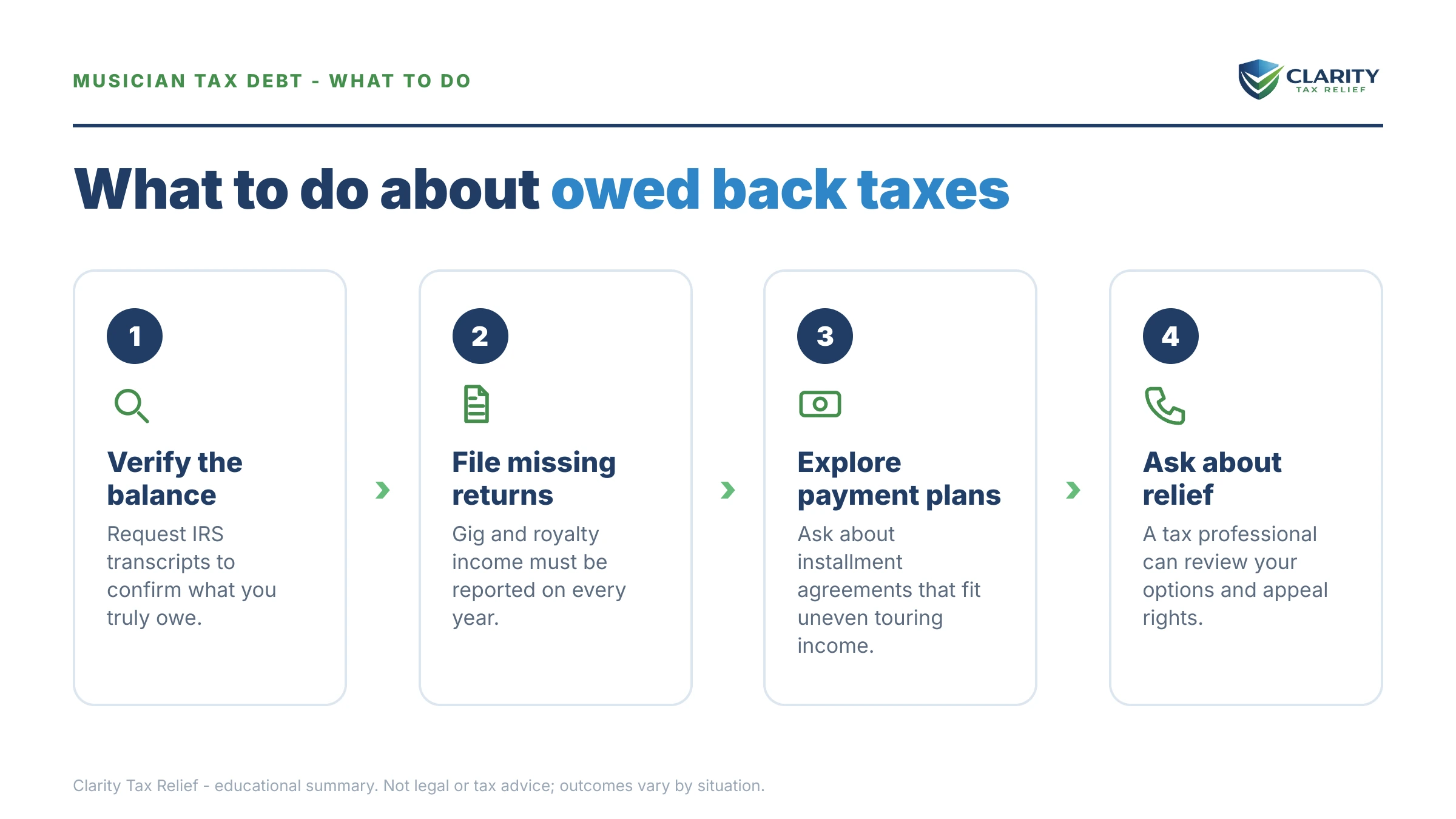
How to respond, step by step
- Pull your income records. Log into your IRS online account and pull a wage-and-income transcript for each unfiled or underpaid year so you can see every 1099-NEC, 1099-K, and 1099-MISC the IRS already has.
- File the missing years first. File any unfiled returns before you negotiate — claim your instrument, travel, and home-studio deductions so the balance is based on your real profit, not gross gig income.
- Confirm the real number. Add up tax, the failure-to-file and failure-to-pay penalties, and interest across all years so you know the true total before you pick a resolution.
- Match a resolution to your cash flow. Choose a short-term plan, a streamlined installment agreement, Currently Not Collectible status, or an Offer in Compromise based on your income and assets.
- Fix your going-forward taxes. Set up quarterly estimated payments or set aside 25-30% of every gig and royalty check so you never rebuild the same debt.
- Get a professional review for multiple years or large balances. If you have several unfiled years, multi-state touring income, or a balance over $10,000, have an experienced tax professional sequence the returns, penalties, and negotiation.
The touring musician's extra wrinkle: multiple states
A busy touring year can create tax debt in more than one state at once. Many states tax income earned from performances inside their borders and require a nonresident return once you cross their filing threshold, so a year of festivals and out-of-state shows can leave you with several state balances alongside the federal one. Your home state usually credits tax paid to other states so you're not taxed twice on the same dollar.
Because every state sets its own thresholds, collection statutes, and payment-plan rules, don't assume the IRS answer carries over — confirm each state with its own revenue agency. The multi-state pattern here mirrors what we cover for travel nurse multi-state tax debt. The same "which do I fix first" logic applies in state tax debt vs. the IRS.
When you can handle this yourself, and when you shouldn't
You can likely handle it alone if you have one year that's off, you agree with the balance. You can pay within 180 days or qualify for a straightforward streamlined plan under $50,000. Setting up a plan online and filing a single clean return with your deductions is very doable, and there's free help with IRS tax debt for lower-income filers.
Bring in an experienced tax professional when the stakes change the outcome: several unfiled years, multi-state touring income, a levy already in motion, a balance over $10,000, or an offer where the math has to be built precisely. In those cases the order you fix things — returns, then penalty relief, then negotiating the balance — decides what you ultimately pay. Creators facing the identical 1099 pattern can also see our content creator back taxes guide.
Terms on your notice, decoded
Self-employment tax: the 15.3% Social Security and Medicare tax a musician pays on net business profit, on top of income tax.
Estimated taxes (Form 1040-ES): the quarterly prepayments self-employed people make because no employer withholds for them; skipping them adds an underpayment penalty.
Substitute for Return (SFR): a return the IRS files for you when you don't, with none of your deductions, so the balance is almost always too high.
Levy vs. lien: a lien is a legal claim on your property. A levy is the actual seizure of a bank account or a payment owed to you. See lien vs. levy.
Reasonable Collection Potential (RCP): the IRS's calculation of what it could realistically collect from your assets and future income — the number an Offer in Compromise has to beat.
Musician tax debt questions, answered
Do musicians have to pay taxes on cash gigs?
Yes. Cash and Venmo gig pay is fully taxable even when no 1099 is issued and nothing is withheld. You owe both income tax and 15.3% self-employment tax on your net profit. The venue not sending a form does not make the income invisible. You are legally required to report it, and the IRS can reconstruct unreported cash from bank deposits during an audit.
Why do musicians owe so much in self-employment tax?
Because a self-employed musician pays both halves of Social Security and Medicare — 15.3% on top of regular income tax. A W-2 employee splits that with an employer; a gigging musician pays all of it. On $40,000 of net music income that is roughly $5,650 in self-employment tax alone, before any income tax, which is why a year of untaxed gig money turns into a five-figure balance fast.
Can I deduct instruments and gear against my back taxes?
Yes, and doing so before you file lowers the tax the IRS can assess. Instruments, amps, microphones, software, a home studio, mileage to gigs, tour travel and lodging, PRO and manager fees, and union dues are all deductible business expenses. Even without every receipt, bank and card statements, calendars, and mileage estimates can rebuild the deductions — file with them rather than letting the IRS tax your gross income.
Do I owe taxes in every state I toured in?
Sometimes. Many states tax performance income earned inside their borders and require a nonresident return once you cross their filing threshold, so a busy touring year can create several state balances plus the federal one. Your home state usually gives a credit for tax paid to other states. Because each state sets its own rules and windows, confirm each one with that state's revenue agency rather than assuming the federal answer applies.
I got a 1099-K from Bandcamp or PayPal — do I owe now?
The 1099-K reporting threshold reverted to $20,000 and 200 transactions, so you may not get a form for smaller merch or download sales. But the income was always taxable whether or not a form arrives. If you already owe for prior years, that old debt does not go away because the threshold changed. Report all sales income and deduct your production and shipping costs against it.
Can I settle my music tax debt for less than I owe?
Possibly, through an Offer in Compromise, but only if your assets plus expected future income genuinely cannot cover the debt before the collection statute expires. The IRS accepted roughly 1 in 5 offers in FY2024, so it is neither easy nor certain, and anyone promising to erase your balance for a tiny fraction is running a scam. For an irregular music income, Currently Not Collectible status or a low monthly plan is often the more realistic route.
What if I haven't filed a tax return in several years?
File the missing years before you negotiate anything — the IRS will not approve a payment plan or offer until you are compliant. You generally only need to file the last six years to get current for collection purposes. If the IRS filed a substitute return for you, it left out every deduction, so filing your own accurate return almost always lowers the balance.
Will the IRS take my instruments?
It is very unlikely at the notice stage, and the tools of your trade get some protection. The IRS generally goes after bank accounts and future income long before physical property. A limited amount of trade tools is exempt from seizure. The far more common enforcement against a musician is a levy on a bank account or a one-time levy on money a venue or label owes you — which is exactly why you resolve the debt before the final levy notice.
Your next 24 hours
- Find the number. Locate the tax year and balance on your most recent IRS notice, or log into your IRS online account to see every year with a balance and every 1099 on file.
- Gather your records. Pull together your last filed return, any 1099-NEC/1099-K/1099-MISC forms. Your income and expense records — bank statements, gig calendar, and gear receipts count.
- Get a free case review. Call (888) 825-7779 or use the 2-minute form. Every month you wait, the failure-to-file and failure-to-pay penalties and interest keep compounding — moving now is what caps the number.
This guide is general information, not tax or legal advice for your specific situation. Eligibility for IRS programs depends on individual facts and circumstances; no outcome is guaranteed.