
Self-Employed & 1099
Consultant Tax Debt: What to Do When You Owe the IRS in 2026
The short answer: consultant tax debt is usually big for one reason — no one withheld tax from your 1099 checks, and self-employment tax added 15.3% on top of income tax. It is fully resolvable. File every year, stop this year's balance from growing, then choose a payment plan, hardship status, or Offer in Compromise that fits your cash flow.
You billed well, the money came in, and the tax got spent on the business and on living. Now there is a balance the IRS says you owe, and unlike a salaried coworker, you never had a paycheck quietly covering it. That gap between what you earned and what you set aside is where nearly all consultant tax debt starts, and it is a math problem with a clear fix, not a character flaw.
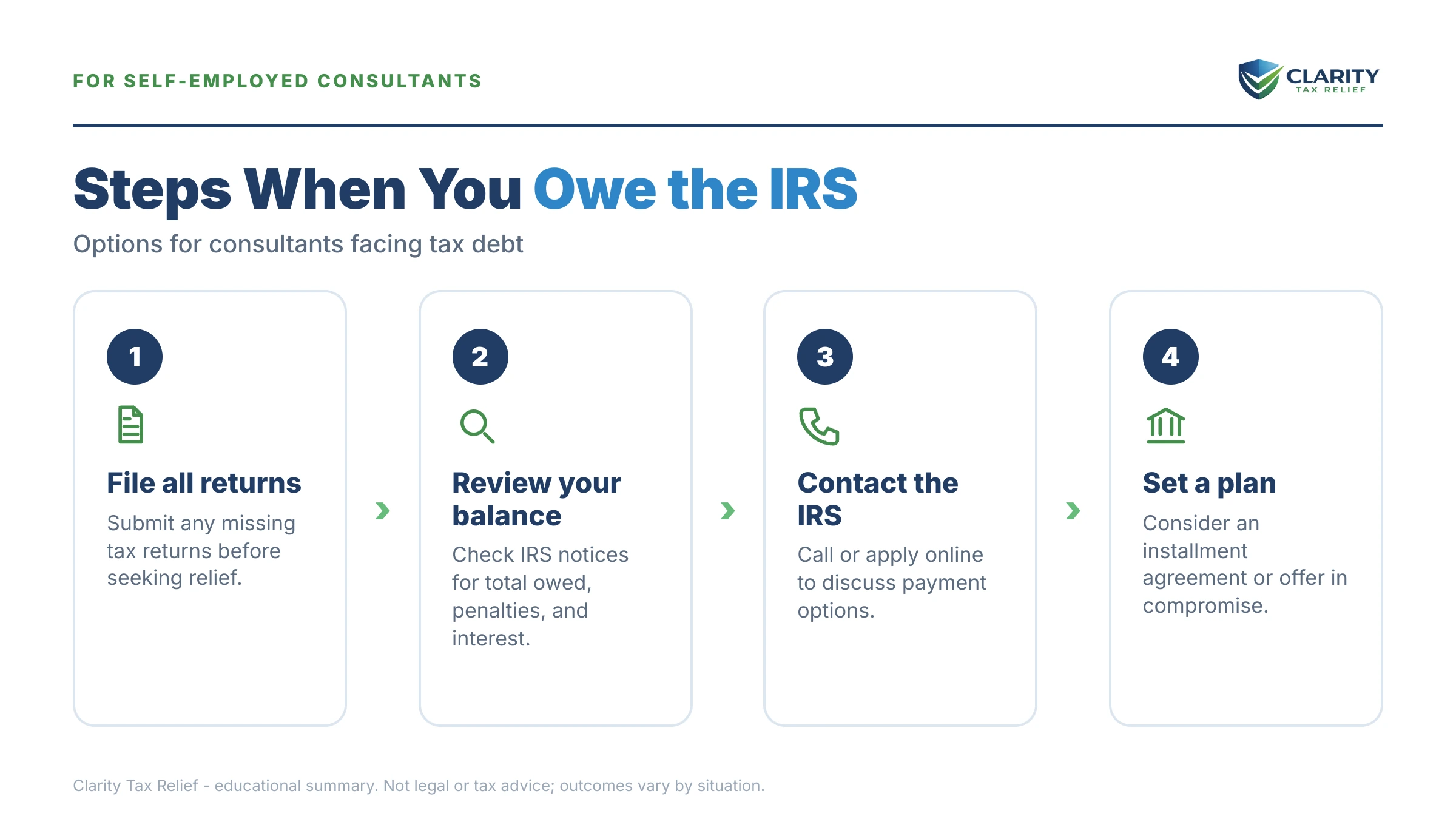
The most dangerous part of a consultant's situation is quiet compounding: the debt from last year grows while this year builds a new one on top of it. The image below shows how a 1099 income year turns into a five-figure balance, and where to break the cycle.
⏱ Your clock is running now: there is no single filing date for a balance already owed — the pressure is daily accrual. The failure-to-pay penalty adds 0.5% of the balance every month plus interest, and if any return is still unfiled the failure-to-file penalty is ten times higher at 5% per month. Every month you wait costs money; acting stops the bleed.
Why consultants owe the IRS in the first place
Consultant tax debt is a withholding problem before it is a payment problem. An employee's W-2 wages have income tax, Social Security, and Medicare pulled out of every check automatically. Your 1099-NEC pays you the gross — the tax is still owed, but collecting and sending it is now entirely your job.
Three forces stack up and catch consultants off guard:
- Self-employment tax. On Schedule SE you pay both halves of Social Security and Medicare — 15.3% of net profit — the part an employer normally splits with a worker. This sits on top of ordinary income tax and surprises almost every first-year consultant.
- Missed quarterly estimates. The IRS expects tax paid as you earn it, through Form 1040-ES four times a year. Skip those and the whole year's tax lands at once in April, plus an underpayment penalty.
- Feast-or-famine cash flow. A big retainer arrives, gets spent before the tax on it is set aside, and a slow quarter follows. The tax on the good money is still due when the lean months hit.
If this is your first year seeing a bill this size, the first-year self-employed tax-bill shock and the self-employment tax explained walk through exactly how the numbers get so large. Going forward, the fix starts with knowing how much to set aside for taxes and how quarterly estimated taxes work.
What a consultant actually owes on 1099 income
The table below shows the layers on a single profitable year. This is why the number is bigger than a W-2 earner expects at the same income.
| Layer | Roughly what it costs | Why it hits consultants |
|---|---|---|
| Federal income tax | 10%–37% by bracket | Nothing withheld from 1099 pay |
| Self-employment tax | 15.3% of net profit | You pay both halves of Social Security & Medicare |
| State income tax | Varies by state | Also unwithheld on 1099 income |
| Underpayment penalty | Interest-rate based | Charged for skipping quarterly estimates |
| Failure-to-pay penalty | 0.5%/month, up to 25% | Applies once the balance goes unpaid |
What happens if you ignore consultant tax debt
Ignoring the balance does not make it disappear. It moves you down an automated collection sequence that ends with the IRS taking money without asking. In 2026 IRS headcount is down about 27%. But the notices and levies are generated by systems that never got laid off, so the escalation runs on schedule even when no human is looking at your file.
- CP14 — the first bill for a balance due. Read the CP14 notice guide; this is the cheapest moment to act.
- CP501 / CP503 — reminder notices. Still just bills, but penalties and interest keep stacking each month.
- CP504 — Notice of Intent to Levy. The IRS can seize your state refund and a federal tax lien becomes a real risk. See the CP504 notice guide.
- LT11 / Letter 1058 — the final notice of intent to levy. After 30 days the IRS can levy bank accounts and, the consultant-specific danger, serve a one-time levy on a client who currently owes you money, redirecting that invoice to the IRS.
That last stage is why consultant debt is different from an employee's. The IRS cannot run a continuous paycheck garnishment against you. But it can hit your 1099 income with a one-time levy and levy a client's payment as an account receivable. A levy notice landing on a client's desk can end the relationship. The final notice gives you 30 days and formal appeal rights first, but the window to act on your terms is now, not then.
Owe the IRS on consulting income and unsure where you stand?
Penalties and interest are compounding every month this sits. An experienced tax professional will pull your transcripts, confirm which years are open, and map your real options — free, confidential, no pressure, before any levy reaches a client.
Your options for resolving consultant tax debt
The IRS has more paths than "pay it all now," and the right one depends on your income, your business equity, and how many years are involved. Here is what each option requires and what rules it out.
| Option | Best when | Key threshold / disqualifier |
|---|---|---|
| Streamlined installment agreement | You can pay over time | Balance ≤ $50,000; up to 72 months; no detailed financials |
| Partial-pay installment agreement | You can pay some, not all | Requires Form 433-F financials; IRS reviews periodically |
| Currently Not Collectible | Paying anything causes hardship | Debt stays and grows; a lien may still file |
| Offer in Compromise | Assets + income can't cover the debt | ~1 in 5 accepted; business equity counted; $205 fee |
| First-Time Penalty Abatement | Clean prior 3 years | Removes penalties, not the underlying tax |
For most consultants under $50,000, a streamlined installment agreement is the fastest route. You can set it up online without handing over a full financial statement. If your balance is higher or income is tight, weigh a payment plan vs. an offer in compromise. If you owe around $30,000 or more, the numbers below show what that looks like month to month.
How an Offer in Compromise works for the self-employed
An Offer in Compromise settles a debt for less than the full balance, but only when the IRS agrees that is the most it could realistically collect before the 10-year collection statute runs out. That figure is your Reasonable Collection Potential. Your net equity in assets plus your future monthly income after allowable expenses. For a consultant, the IRS scrutinizes business equity, equipment, and income averaged across your feast-or-famine months, which often pushes the number higher than owners expect. You can estimate your own offer with our Offer in Compromise Calculator before spending anything. Self-employed math has its own traps, covered in OIC for the self-employed. Ignore anyone promising to slash your debt to a tiny fraction of what you owe. That is a marketing line the FTC has acted against, not a program.
A worked example: consultant who owes $34,000
Say you billed $150,000 last year and, after $30,000 of real business expenses, netted $120,000, and set nothing aside. Here is roughly how that becomes a $34,000 balance:
- Self-employment tax: 15.3% on about $110,800 (92.35% of net) ≈ $16,950.
- Federal income tax: after the deductible half of SE tax and the standard deduction, tax on roughly $96,500 ≈ $16,800 (single filer).
- Combined: about $33,750 in tax before penalties.
Leave it unpaid and the failure-to-pay penalty adds roughly $170 in the first month and grows toward its 25% cap, while interest compounds on the whole balance. On a 72-month streamlined agreement, $34,000 works out to about $472 a month in principal, but because interest keeps running (see how IRS interest compounds), the true monthly cost is higher and you pay more the longer you stretch it. If your income genuinely could not support that, hardship status or an offer might fit instead. This is a hypothetical to show the arithmetic, not a promise about your case.
The single most valuable move here is not just resolving the old year. It is restarting your quarterly estimates now so this year does not add a second $34,000 on top. A new balance is one of the fastest ways to default an installment agreement you just set up.
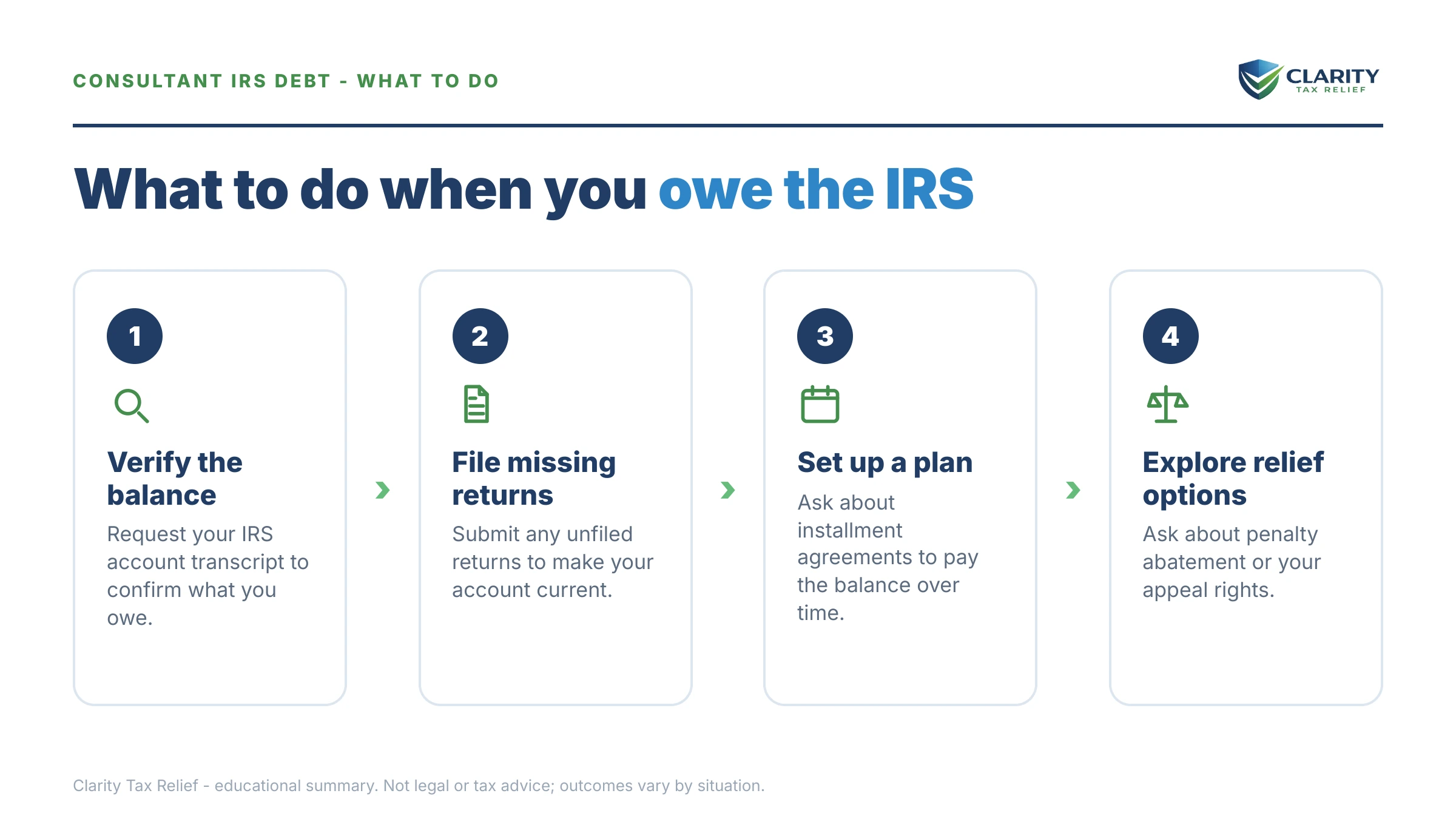
How to respond, step by step
- Pull your transcripts and confirm every year you owe. Log into your IRS online account and read your account and wage-and-income transcripts to see exactly which years have a balance and which returns are missing.
- File any missing returns first. File every unfiled year before negotiating, claiming all legitimate business deductions — the failure-to-file penalty is ten times the failure-to-pay penalty, so file even the years you cannot pay.
- Run the real number. Add income tax, 15.3% self-employment tax, penalties, and interest so you know the true total before you commit to any plan.
- Adjust this year's estimated taxes. Restart quarterly estimated payments with Form 1040-ES now so 2026 does not pile a fresh balance on top of the old debt — a new liability can default an existing agreement.
- Pick a resolution that fits your cash flow. Choose a streamlined installment agreement, hardship status, an Offer in Compromise, or penalty relief based on what your income and assets actually support.
- Get a professional review for multiple years or balances over $10,000. When you owe several years, more than $10,000, or a levy is already in motion, have an experienced tax professional confirm the order to fix things and the plan that costs you least.
When you can handle this yourself, and when help changes the outcome
Plenty of consultant tax debt is a do-it-yourself job. If you owe one recent year, the amount is under $50,000, all your returns are filed. Your cash flow supports a monthly payment, you can set up a payment plan online in about 15 minutes and be done. A first-slip penalty is often removable yourself with a short first-time abatement request.
Experienced help earns its fee when the situation is layered: multiple unfiled years, a balance the IRS says is large because it filed substitute returns with zero deductions, a levy or lien already in motion, or an offer where the Reasonable Collection Potential math decides whether you save real money. The order you fix things — returns, then penalties, then the balance — changes the final number, and getting it wrong is expensive. If you are weighing whether to bring in a pro at all, settling tax debt yourself lays out the honest line. This guide is one of a set — see also consultant back taxes for the filing-and-reconstruction side.
Terms on your notice, decoded
- Self-employment (SE) tax — the 15.3% Social Security and Medicare tax on net profit that a 1099 earner pays in full, reported on Schedule SE.
- Estimated tax — quarterly prepayments (Form 1040-ES) the IRS expects on income with no withholding; skipping them triggers an underpayment penalty.
- Reasonable Collection Potential (RCP) — the IRS's estimate of what it could collect from your assets and future income. It sets the floor for any Offer in Compromise.
- Accounts-receivable levy — a one-time IRS levy served on a client who owes you money, redirecting that payment to the IRS.
- Collection Statute Expiration Date (CSED) — the roughly 10-year limit on how long the IRS can collect a debt, though appeals, offers, and bankruptcy can pause the clock.
Consultant tax debt questions, answered
Why do consultants owe so much in taxes?
Consultants owe more because no employer withholds tax from a 1099 payment and self-employment tax stacks on top of income tax. That self-employment tax is 15.3% of net profit — the full Social Security and Medicare bill an employee splits with an employer. Add income tax and skipped quarterly payments and a single good year can produce a five-figure balance that never got set aside.
How much should a consultant set aside for taxes?
A common working rule is to park 25% to 30% of every net dollar in a separate account, and higher earners in the top brackets should lean toward 35% or more. The right number depends on your bracket, your state, and your deductible expenses. If you have already fallen behind, the priority is stopping the debt from growing this year — adjust your quarterly estimated payments now so 2026 does not add a new balance on top of the old one.
Can the IRS levy my consulting income or my clients?
Yes. Because you are an independent contractor, the IRS cannot run a continuous wage garnishment the way it does with an employee. But it can serve a one-time levy on a client who currently owes you money — an accounts-receivable levy that redirects that specific payment to the IRS. It can also levy your business and personal bank accounts. This only happens after the final notice of intent to levy, so you have warning and appeal rights before it reaches your clients.
What if I haven't paid estimated taxes for years?
File every missing return first, even the years you cannot pay, because the failure-to-file penalty is 5% per month — ten times the 0.5% failure-to-pay penalty. Once all years are filed, the IRS will treat the combined balance as one debt you can resolve with a single payment plan or offer. An underpayment penalty applies for each year you skipped quarterlies, but penalty relief may remove part of it.
Can a consultant settle tax debt for less than owed?
Sometimes, through an Offer in Compromise, but only when your assets and future income genuinely cannot cover the full balance before the collection statute expires. The IRS accepted roughly 1 in 5 offers in FY2024, and self-employed applicants are scrutinized on business equity and income averaging. The $205 application fee and 20% down payment are waived if your income is under 250% of the federal poverty line.
Should I form an S-corp to fix my consultant tax debt?
An S-corp can lower future self-employment tax by splitting your income into a reasonable salary plus distributions. But it does nothing to erase debt already assessed on past 1099 income. It is a forward-looking planning move, not a resolution tool. If you restructure, you must still pay yourself a reasonable salary and run real payroll — underpaying yourself to dodge tax creates its own exposure.
Will the IRS take my business bank account as a consultant?
The IRS can levy a sole proprietor's business account the same as a personal one, because a sole proprietorship is not legally separate from you. A bank levy freezes the funds for 21 days before the money leaves, giving you a window to arrange a release. Setting up a payment plan or hardship status before the final levy notice expires prevents the levy from ever landing.
Can I still deduct expenses to lower my consultant tax debt?
Only by amending a return you already filed, and only with legitimate, documented business expenses you missed — software, home office, mileage, health insurance, and retirement contributions all reduce net profit and therefore both income tax and self-employment tax. If the IRS filed a substitute return for you because you never filed, it gave you zero deductions, so filing your own return almost always lowers the balance.
Your next 24 hours
- Find the number. Log into your IRS online account (or read your latest notice) and write down the balance and every tax year attached to it.
- Gather three things. Your last filed return, any IRS notices you have, and a rough figure for this year's net consulting income so far.
- Get a free case review. Because penalties and interest compound every month, call (888) 825-7779 or use the 2-minute form — an experienced tax professional will confirm your open years and the resolution that costs you least before the collection sequence advances.
This guide is general information, not tax or legal advice for your specific situation. Eligibility for IRS programs depends on individual facts and circumstances; no outcome is guaranteed.