
Self-Employed & 1099 Tax Debt
House Cleaner 1099 Taxes: Why You Owe the IRS and What to Do in 2026
The short answer: when you clean houses on a 1099, no one withholds tax from your pay, so you owe it all at filing — including 15.3% self-employment tax on your net profit plus income tax on top. Set aside roughly 25%–30% of each payment, deduct your mileage and supplies, and if the bill is already bigger than you can pay, a payment plan or hardship status is available.
You cleaned houses all year, the money came in, and now a tax bill you weren't expecting has landed, or a client's 1099 showed up and you realize nothing was ever set aside. That knot in your stomach is normal, and it's fixable. The reason the number feels so big has a specific name, and once you see it, the fix is straightforward.
Most cleaners are stunned by one line: self-employment tax. The image below shows what a 1099-NEC looks like and where the number that drives your bill actually comes from, because it's not the whole amount you were paid.
⏱ Your real clock: there's no single due date for "owing", but two clocks are always running. The failure-to-pay penalty of 0.5% per month plus interest accrue on any unpaid balance, and quarterly estimated-tax deadlines (April, June, September, January) mean unpaid tax on this year's income keeps growing an underpayment penalty until you file. Filing late adds a separate 5%-per-month failure-to-file penalty — ten times as expensive.
Why house cleaners owe on 1099 income
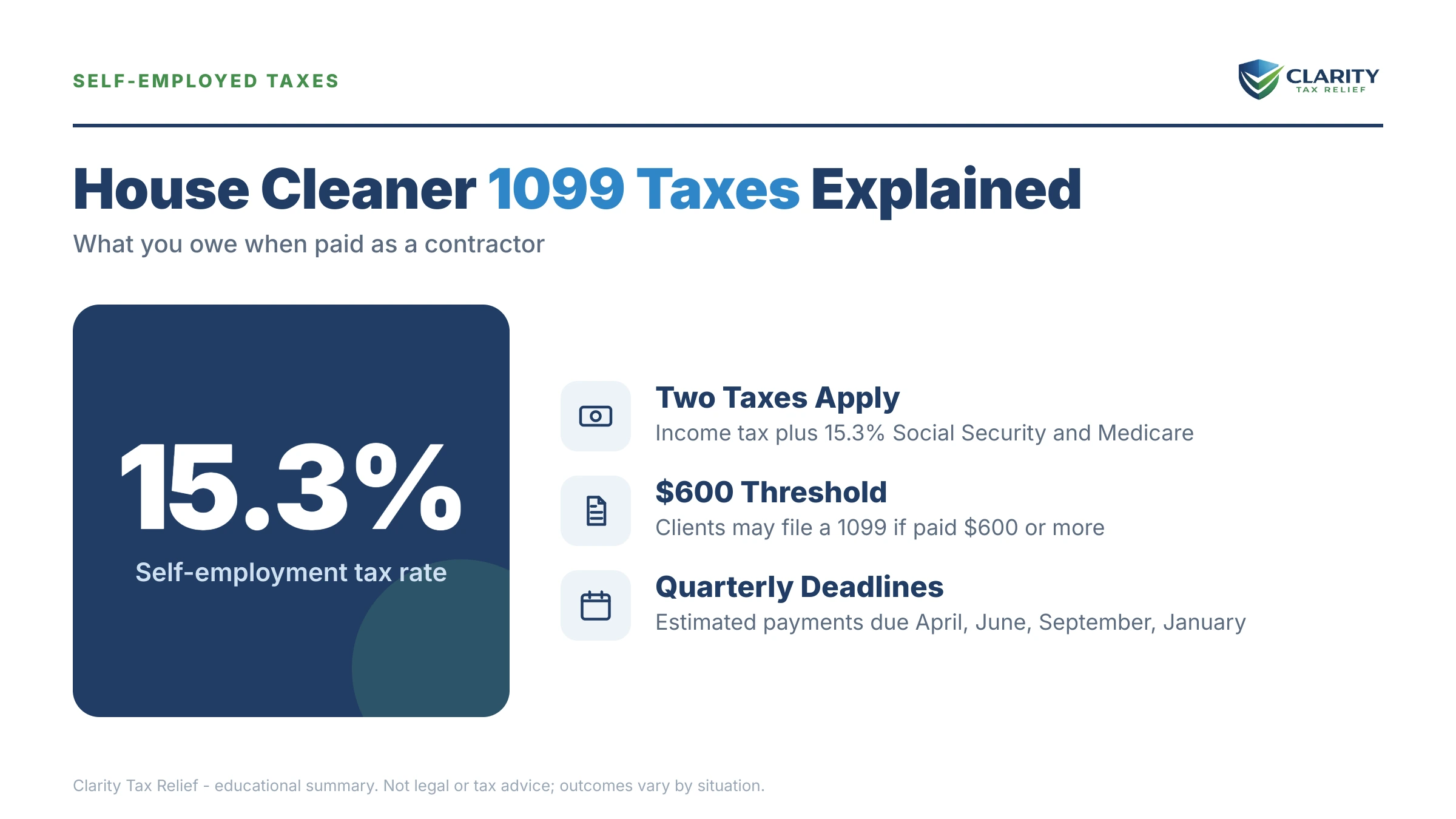
A W-2 employee never sees the tax that a 1099 house cleaner has to pay in one lump: the 15.3% self-employment tax. When you're an employee, your boss withholds income tax and quietly pays half of your Social Security and Medicare tax. As an independent contractor, no one withholds anything and you pay the entire 15.3% yourself — that's the piece nobody warned you about.
Self-employment tax is 12.4% for Social Security and 2.9% for Medicare, and it applies to your net profit, what's left after business expenses, not to income tax brackets. On top of that, your profit is also added to your income and taxed at your regular rate. Two taxes on the same money is why a cleaner earning a modest living can still owe several thousand dollars.
You get a 1099 in one of two forms. Individual clients and cleaning companies that pay you $600 or more send a 1099-NEC. App platforms like Handy, TaskRabbit, or Care.com send a 1099-K, but only once you cross $20,000 and 200 transactions under the reverted 2026 threshold. Below that, you get no form at all, which fools many cleaners into thinking the income isn't taxable. It is, from the first dollar of profit over $400. This same trap hits everyone in the trades — it's the identical math a hair stylist with 1099 debt or any worker hit by the self-employment-tax shock runs into.
How much to set aside
The fix that prevents this every year is setting money aside from each payment. Because your income tax bracket rises with your profit, the safe percentage climbs a little as you earn more.
| Net annual profit | Set aside (federal) | Why |
|---|---|---|
| Under $15,000 | ~20%–25% | SE tax dominates; little or no income tax |
| $15,000–$45,000 | ~25%–30% | 15.3% SE tax + 10%–12% income bracket |
| $45,000–$95,000 | ~30%–35% | SE tax + 22% income bracket |
| State income tax | +3%–6% more | Add on top if your state taxes income |
Move that share to a separate account the day you're paid, and pay it to the IRS through quarterly estimated taxes so you're never hit with a lump sum in April. If you're in your first year self-employed, this is the single habit that stops the yearly panic.
The deductions most house cleaners miss
Every dollar of legitimate business expense cuts both your income tax and your 15.3% self-employment tax, so tracking them is the cheapest way to shrink what you owe. Cleaners routinely overpay by leaving these off.
| Deduction | What counts | Notes |
|---|---|---|
| Vehicle mileage | Miles driven between jobs and to supply runs | ~70¢/mile in 2026; usually the biggest deduction |
| Cleaning supplies | Chemicals, cloths, bags, gloves, refills | Fully deductible as used in the business |
| Equipment | Vacuum, mop system, steamer, caddy | Larger items may be expensed the year bought |
| Phone & scheduling apps | Business share of your cell plan and booking tools | Deduct only the business-use percentage |
| Insurance & bonding | Liability insurance, bonding fees | Ordinary and necessary for the trade |
| Platform & card fees | App commissions, payment-processing fees | Deduct the fees, report the gross |
Keep a mileage log and receipts. The IRS disallows deductions you can't support, and mileage is a frequent audit point for the trades — reconstructing it later is far weaker than tracking it as you go.
A worked example: what a house cleaner really owes
Say you're a single cleaner who was paid $42,000 across several homes and one app last year, with nothing withheld. Here's the honest math (hypothetical, rounded):
- Gross receipts: $42,000
- Deductible expenses: 8,000 business miles (~$5,600) + supplies ($1,800) + phone ($400) = $7,800
- Net profit (Schedule C): $42,000 − $7,800 = $34,200
- Self-employment tax: $34,200 × 92.35% × 15.3% ≈ $4,832
- Income tax after the standard deduction and the SE-tax deduction: roughly $1,500–$1,800
- Total owed at filing: about $6,300–$6,600 — with $0 set aside
Notice two things. First, the $7,800 in deductions saved this cleaner roughly $2,300 in combined tax — tracking them was worth real money. Second, self-employment tax was the bigger half of the bill, not income tax. You can estimate your own penalties on an unpaid balance with our IRS penalty &. Interest calculator before you decide how to handle it. If the number lands closer to five figures, our guide on what to do when you owe the IRS $10,000 maps the options by balance.
What happens if you ignore it
An unpaid 1099 tax bill doesn't disappear. It enters the IRS's automated collection sequence, and each stage adds cost and enforcement power. Here's the order it moves in:
- Penalties & interest accrue — 0.5% per month failure-to-pay, plus interest, from the filing deadline. If you also filed late, add 5% per month failure-to-file.
- CP14 notice — the first bill for the balance due, with about 21 days to pay or arrange a plan.
- CP501 → CP503 → CP504 — reminder notices, then a Notice of Intent to Levy that lets the IRS seize your state tax refund.
- LT11 / Letter 1058 — Final Notice of Intent to Levy. After 30 days the IRS can levy bank accounts and, for a 1099 contractor, issue a one-time levy on money a client owes you.
- Substitute return risk, if you never filed at all, the IRS can file one for you with zero deductions, inflating the balance far above what you'd actually owe.
In 2026 this matters more than ever: IRS staffing is down sharply, but liens, levies, and notices are generated by automated systems that never stopped. The machine keeps escalating whether or not a human looks at your file — which is exactly why acting early beats waiting.
Owe on your house-cleaning income and not sure what to do?
Send us the bill or the 1099. An experienced tax professional will pin down what you actually owe after every deduction you're entitled to, and lay out your options — free, confidential, no pressure. Penalties and interest grow every month it waits.
Your options if you can't pay the full amount
The bill demands payment in full. But the IRS has several programs, and which one fits depends on your finances and how much you owe.
| Option | Best when | Cost / threshold |
|---|---|---|
| Short-term plan | You can pay within 180 days | $0 setup; interest & penalty still accrue |
| Installment agreement | Balance under $50,000; need monthly terms | Up to 72 months; small setup fee, waivable low-income |
| Currently Not Collectible | Paying anything causes hardship | Collection paused; debt remains, needs Form 433-F |
| Offer in Compromise | Assets + income truly can't cover the debt | $205 fee (waivable); ~1 in 5 accepted — never guaranteed |
| Penalty abatement | Clean prior 3 years, or reasonable cause | Removes penalties, not the tax; free to request |
For most cleaners with a mid-four-figure balance, a payment plan set up online is the whole answer. It stops the notice sequence the day it's approved. If your income dropped or work dried up, Currently Not Collectible status pauses collection entirely. An Offer in Compromise is real but means-tested — the IRS runs the math on what it could collect, and marketing that promises "pennies on the dollar" is exactly the scam the FTC has been shutting down. Nobody can promise a settlement before reviewing your finances.
How to respond, step by step
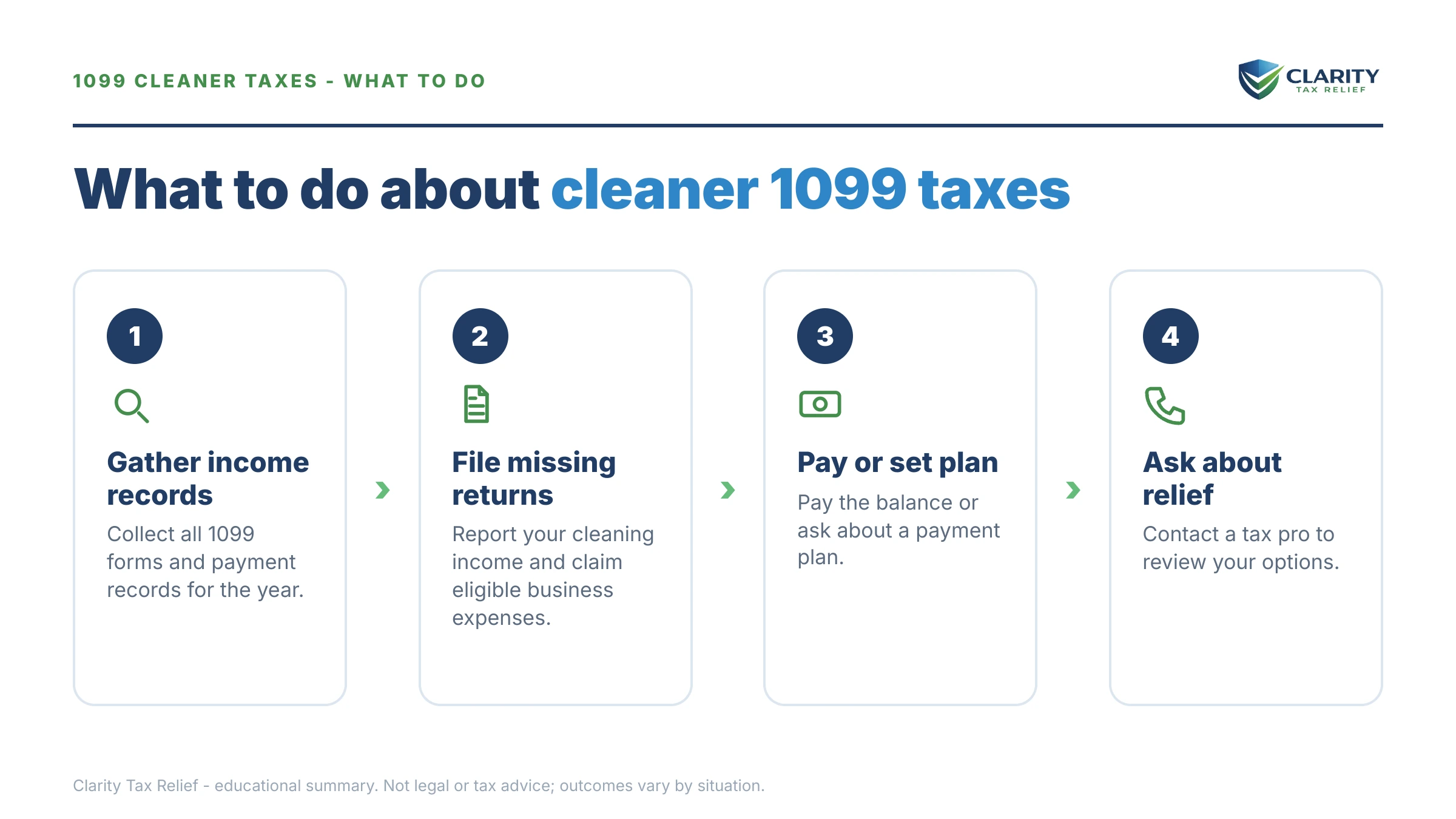
- Gather your income records — every 1099-NEC and 1099-K, plus bank deposits and app payout summaries for any income with no form.
- Total your deductions — mileage, supplies, equipment, phone, insurance — so your net profit (not gross) is what's taxed.
- File the return, even if you can't pay — filing stops the 5%-a-month failure-to-file penalty, which dwarfs the pay penalty.
- Choose a payment option — pay in full if you can, or set up an installment agreement or hardship status before the notice escalates.
- Fix next year — start setting aside 25%–30% per payment and pay quarterly estimates so this never repeats.
- Get a review if you owe over $10,000 or have unfiled years — the order you fix things in changes the final number.
When you can handle this yourself, and when to get help
Plenty of house cleaners can resolve this alone. If you have one year, filed on time, owe a balance you can clear within 180 days or on a simple monthly plan. Your income and deductions are straightforward, you can file your Schedule C, request a plan on IRS.gov, and be done. A CP14 bill you agree with and can pay is a do-it-yourself situation.
Experienced help changes the outcome when the picture gets complicated: multiple unfiled years, a substitute return the IRS filed with no deductions, a levy already in motion, a balance large enough that an Offer in Compromise or hardship status is on the table, or a genuine question of whether you were paid on a 1099 but treated like an employee. That last one is common in this trade, if a single family controlled your schedule and supplied everything, you may have been misclassified, and correcting it can cut your tax in half. Cleaners who work steadily for one household should also read about household-employer payroll rules, which can shift the tax burden to the family.
Terms on your notice, decoded
- Self-employment tax: the 15.3% Social Security and Medicare tax a 1099 worker pays on net profit — the employer's half you now cover yourself.
- Schedule C: the form where you report your cleaning income and deduct your expenses; the profit flows to your 1040.
- Schedule SE: the form that calculates your self-employment tax on that profit.
- 1099-NEC vs. 1099-K: NEC comes from clients/companies paying you $600+; K comes from apps once you cross $20,000 and 200 transactions in 2026.
- Estimated taxes (Form 1040-ES): the quarterly prepayments the IRS expects because no one withholds from your pay.
- Failure-to-pay penalty: 0.5% of the unpaid balance per month — far smaller than the 5%-a-month failure-to-file penalty, which is why you always file.
House cleaner 1099 tax questions, answered
Do house cleaners have to pay taxes on 1099 income?
Yes. If you cleaned houses as an independent contractor and earned $400 or more in net profit, you must report it and pay tax on it, even if no client ever sent you a 1099. On top of income tax, you owe 15.3% self-employment tax on your net profit, which is the piece that surprises most cleaners. The IRS matches any 1099-NEC or 1099-K it receives against your return, so unreported app income is the fastest way to trigger a notice.
How much should a house cleaner set aside for taxes?
Set aside roughly 25% to 30% of every payment after your deductible expenses. That covers the 15.3% self-employment tax plus federal income tax for most cleaners in the lower brackets. If you work in a state with income tax, add another 3% to 6%. Move the money to a separate account the day you get paid so it isn't there to spend.
I got paid in cash — does the IRS know?
Cash income is still taxable, and the IRS often finds it even without a 1099. Clients who deduct cleaning as a business expense report what they paid you, bank deposits get matched in audits, and app platforms issue a 1099-K once you cross $20,000 and 200 transactions for 2026. Reporting cash you earned is the law; leaving it off is underreporting, which carries a 20% accuracy penalty if the IRS catches it.
What can house cleaners deduct to lower the tax bill?
You can deduct the ordinary costs of running the business: mileage between jobs, cleaning supplies and equipment, the business share of your phone, liability insurance, and marketing. Mileage is usually the biggest one — at roughly 70 cents a mile, driving 8,000 business miles is about a $5,600 deduction. These expenses reduce both your income tax and your self-employment tax, so tracking them is the cheapest way to lower what you owe.
Should I have gotten a W-2 instead of a 1099?
Maybe. If one family or company sets your hours, tells you exactly how to clean, and supplies the equipment, you may be a misclassified employee who should get a W-2. That matters because an employee splits the 15.3% payroll tax with the employer, while a 1099 contractor pays all of it. You can ask the IRS to decide by filing Form SS-8, but get advice first — challenging a paying client has consequences.
What if I never got a 1099 but earned the money?
You still have to report it. A missing 1099 doesn't erase the income or your obligation to pay tax on it. Reconstruct your earnings from bank deposits, app payout summaries, a client list, or your own calendar. Under the 2026 rules the 1099-K threshold is back to $20,000 and 200 transactions, so many small cleaners get no form at all. But the income is taxable at the first dollar of profit over $400.
I owe more than I can pay — what happens now?
You have real options, and none of them require paying the full amount today. A short-term plan gives you up to 180 days, a monthly installment agreement spreads a balance under $50,000 over as long as 72 months, and Currently Not Collectible status pauses collection entirely if paying would cause hardship. File the return even if you can't pay — the failure-to-file penalty is 5% a month, ten times the failure-to-pay penalty.
Do I owe self-employment tax if cleaning is a side job?
Yes, if your net cleaning profit is $400 or more, even if you also have a W-2 job. Your W-2 withholding covers your wages, not your side income, so the cleaning profit gets its own 15.3% self-employment tax plus income tax on top of your regular bracket. That combination is why people with a full-time job plus weekend cleaning end up owing every April instead of getting a refund.
Your next 24 hours
- Find the number. Pull up every 1099-NEC and 1099-K, and add up any cash or app income with no form — that total is what the IRS is looking at.
- Gather your deductions. Mileage log, supply receipts, equipment costs. Your phone bill — these turn your gross pay into a much smaller taxable profit.
- Get a free case review. Use the 2-minute form or call (888) 825-7779. The sooner you act, the less the 0.5%-a-month penalty and interest add up, and the more options stay open.
For primary-source detail, see the IRS pages on the Self-Employed Individuals Tax Center, estimated taxes, and payment plans and installment agreements.
This guide is general information, not tax or legal advice for your specific situation. Eligibility for IRS programs depends on individual facts and circumstances; no outcome is guaranteed.