
Self-Employed & 1099
Insurance Agent Back Taxes: How to Fix 1099 Commission Debt in 2026
The short answer: insurance agent back taxes almost always trace to one thing — commissions paid on a 1099 with zero withholding, plus a 15.3% self-employment tax nobody set aside for. It's fixable. File any missing years, pin down your real net income after chargebacks, then choose a payment plan, hardship status, or Offer in Compromise before penalties and interest keep compounding.
You closed a strong year, the commission checks were real, and then the tax bill landed with no paycheck ever having a dime withheld from it. That gap — between what a carrier pays a producer and what the IRS quietly expects each quarter — is exactly how good agents end up owing the IRS.
Insurance is a distinct case, not "generic 1099 debt." Advance commissions get charged back when a policy lapses, renewal trails keep paying for years, and a single 1099-NEC can overstate what you actually kept. The image below shows what these income documents look like and where the numbers that drive your balance come from.
⏱ The clock that's actually running: there's no single "respond by" date on back taxes, but two penalties are compounding right now. The failure-to-file penalty is 5% per month (10 times the 0.5% failure-to-pay penalty), which is why filing beats waiting even if you can't pay. Interest is added daily on top of both.
Why insurance agents owe back taxes
The core reason is structural: carriers pay most producers on a Form 1099-NEC with no tax withheld. A W-2 employee has federal tax, Social Security, and Medicare pulled from every check automatically. As an independent (or captive-but-1099) agent, that responsibility is entirely yours — through quarterly estimated payments you have to calculate and send on your own.
Then the commission structure makes it worse. Here's how the pieces stack into a debt.
| Income type | How it's taxed | Why it creates back taxes |
|---|---|---|
| Advance / first-year commission | Full amount on 1099-NEC; SE tax + income tax | Paid up front, spent before taxes were set aside |
| Renewal / trail commission | Ordinary self-employment income each year | Steady stream the IRS treats as future collectibility |
| Chargebacks (lapsed policies) | Deductible reduction, but timing can lag | 1099 may overstate a prior year if clawback lands later |
| Overrides / bonuses | Self-employment income, no withholding | Lump sums that push you into a higher bracket |
The chargeback issue is uniquely brutal in this business. You receive an advance commission in Year 1, the policyholder cancels in Year 2, and the carrier reverses the unearned portion, but the 1099 for Year 1 already reported the gross. That mismatch is a top driver of underreporting notices for agents, and it's fixable with the carrier's chargeback statements. This same no-withholding trap hits real estate agent back taxes and financial advisor tax debt — the fix is the same discipline: reconcile the 1099 to what you actually kept.
If this is your first big self-employed year, the shock is even steeper — see first year self-employed and owe taxes and the self-employment tax shock, explained. The missed-quarterlies piece has its own penalty math in didn't pay estimated taxes — the penalty.
What happens if you ignore it
An unpaid insurance-agent balance doesn't sit quietly. It moves through the IRS's automated collection sequence, and each step adds enforcement power. One wrinkle matters specifically for you: the IRS can levy commissions a carrier still owes you, cutting off cash flow directly at the source.
- CP14 — the first bill. This is the cheapest moment to act. See the CP14 notice guide.
- CP501 / CP503 — reminder notices. Still just bills, but the balance grows every month.
- CP504 — Notice of Intent to Levy. The IRS can take your state refund and a federal tax lien becomes a real risk.
- LT11 / Letter 1058 — Final Notice. After 30 days the IRS can garnish and levy, and can hit your commission checks. See how a levy on commission income and a levy on 1099 income actually work.
Because commissions flow through a carrier or agency you don't control, a levy on your accounts receivable can freeze the exact money you were counting on. In 2026 this matters more than ever: IRS staffing is down roughly 27% since 2025. But the levies are automated — the machine never stopped escalating even as humans got harder to reach.
Behind on taxes as an insurance agent?
Send us your 1099s and any IRS notice. An experienced tax professional will reconcile your real net income, chargebacks included, and map your options while penalties and interest are still adding up. Free, confidential, no pressure.
Your options for resolving insurance agent tax debt
Before any resolution, get your real number right. Reconciling chargebacks and legitimate business deductions — E&O insurance, mileage, marketing, licensing, home office — often shrinks the balance the IRS is chasing. Only then do you pick a program.
| Option | Who it fits | Cost / terms |
|---|---|---|
| Short-term plan | Can pay in full within 180 days | $0 setup; interest + penalty continue |
| Streamlined installment agreement | Balance ≤ $50,000 | Up to 72 months; usually no financials |
| Currently Not Collectible | Paying anything = hardship | Collection paused; debt remains |
| Offer in Compromise | Assets + future income can't cover debt | $205 fee (waivable if low-income); ~1 in 5 accepted |
| First-Time Penalty Abatement | Clean prior 3 years | Removes the failure-to-pay penalty |
One thing to watch as an agent: strong renewal (trail) commissions count as future income in an Offer in Compromise. That steady stream is exactly what the IRS uses to argue it can collect more over time, so producers with a healthy book of renewals often land in a payment plan rather than an Offer. If your balance is around $20,000, the realistic path breakdown in I owe the IRS $20,000 maps closely to a typical agent's situation. Note too that first-time abatement is being replaced by an Automatic Exemption from Penalty (AEP) starting summer 2026 — automatic, with no request needed.
A worked example (hypothetical)
Say you're an independent life-and-health agent who earned $110,000 in gross commissions in 2024 and set nothing aside. After real business expenses — E&O, mileage, phone, marketing, licensing — your net Schedule C profit is about $90,000.
- Self-employment tax: $90,000 × 92.35% = $83,115 × 15.3% ≈ $12,700
- Federal income tax (single, standard deduction, minus half your SE tax): roughly $10,300
- Total owed for that one year ≈ $23,000, before penalties and interest
On a 72-month streamlined installment agreement that's roughly $319 a month before interest, and interest keeps accruing until the balance is gone. If a chunk of that $110,000 was later charged back when policies lapsed, reconciling it could cut the taxable number and the bill along with it. Want to see how the penalties and interest stack on your own figure? Estimate it with our IRS penalty and interest calculator.
How to respond, step by step
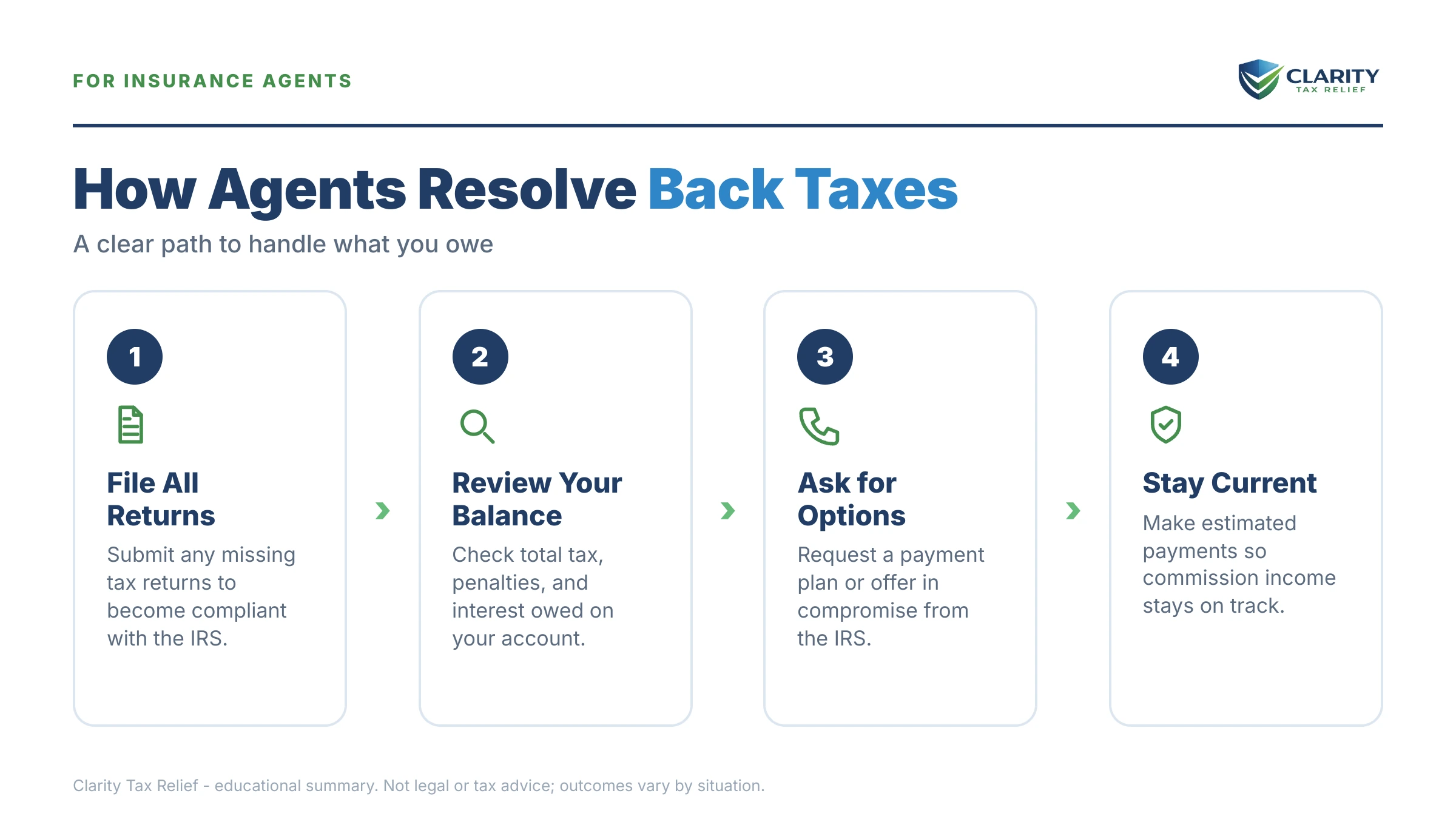
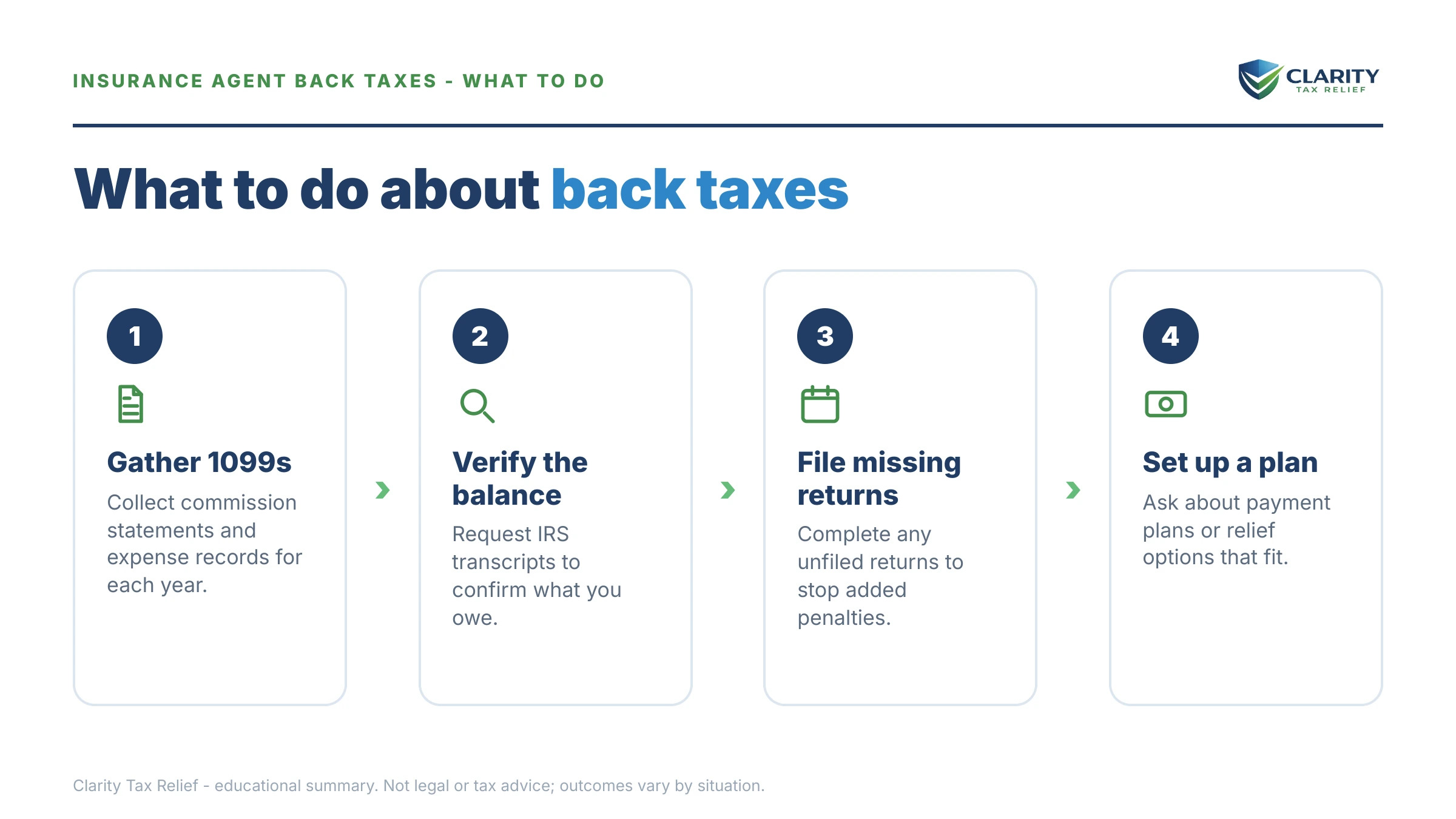
- Pull your income records. Gather every 1099-NEC and carrier statement; order a wage and income transcript for years you're missing.
- File every unfiled year first. The IRS won't approve a plan or Offer with returns outstanding — file even if you can't pay.
- Reconcile chargebacks and expenses. Match carrier chargeback statements to your 1099s so your net profit is accurate, not inflated.
- Verify the balance. Check the tax, penalties, and interest in your IRS online account before agreeing to any number.
- Choose and set up a resolution before the balance grows — a payment plan started today stops the escalation sequence.
- Get a professional review if you have multiple unfiled years, a large balance, or a levy in motion.
When you can handle this yourself, and when you shouldn't
If you owe one year, agree with the number, and can clear it within 180 days or on a simple plan, you can do this yourself in an afternoon at IRS.gov/payment-plans. Set up a streamlined agreement, turn on estimated quarterlies going forward, and you're done — no professional required.
Experienced help changes the outcome when the picture is messier: multiple unfiled years, a 1099 that overstates income because of lagging chargebacks, a balance the IRS is threatening to levy from your commission checks, or a possible Offer in Compromise where the renewal-income math decides everything. In those cases the order you fix things in — returns, then penalty relief, then the balance — directly changes what you pay. If a revenue officer is already involved or a levy has hit your carrier payments, don't wait.
Terms on your notice, decoded
- Self-employment (SE) tax: the 15.3% Social Security and Medicare tax on your net business profit — the part no carrier ever withheld.
- Chargeback: a carrier's reversal of advance commission when a policy lapses or cancels; a legitimate deduction that must be timed to the right year.
- Estimated taxes: the four quarterly payments (April, June, September, January) the IRS expects because you have no withholding.
- Streamlined installment agreement: a monthly plan for balances of $50,000 or less, up to 72 months, usually without detailed financial disclosure.
- Reasonable Collection Potential (RCP): the IRS's estimate of what it could collect from your assets plus future income, including renewal commissions, which drives whether an Offer is accepted.
- Substitute for Return (SFR): a return the IRS files for you if you don't, using only reported income and none of your deductions — almost always inflating what you owe.
Insurance agent tax questions, answered
Why do insurance agents end up owing back taxes?
Because commission income arrives with no tax withheld. Carriers and agencies pay most producers on a 1099-NEC, so nothing is held back for federal tax or the 15.3% self-employment tax — you're supposed to send it yourself in quarterly estimates. Miss a few quarters during a strong sales year and a five-figure balance builds fast, especially when advance commissions get charged back later.
Are insurance commission chargebacks tax deductible?
Yes — a chargeback of previously received commission is a legitimate business reduction, but the timing matters. If the carrier claws back an advance in the same year it was paid, your net 1099 income already reflects it. If the chargeback lands in a later year, you generally deduct it in that later year, which can leave one year's 1099 overstated. Keep the carrier's chargeback statements to reconcile the mismatch.
Do I pay self-employment tax on insurance commissions?
In almost every case, yes. Independent and most captive agents are treated as self-employed, so net commission income carries the 15.3% self-employment tax on top of ordinary income tax. That combined rate is why a $90,000 net year can generate a $23,000 tax bill. Only true W-2 employees of an agency escape SE tax, and even then old 1099 years still count.
What if my 1099-NEC shows more than I actually earned after chargebacks?
Report the full 1099 amount, then deduct the chargebacks and business expenses so your Schedule C shows true net profit — don't just report a smaller number and hope. If a carrier issued a 1099 that's flatly wrong, ask for a corrected form. If they won't fix it, attach a reconciliation showing the difference so the IRS's matching system doesn't flag an underreporting notice.
How much should insurance agents set aside for taxes?
A safe rule for most producers is 25% to 30% of every commission check, moved to a separate account the day it hits. High earners in higher brackets should lean toward 30% or more. Because there's no employer withholding, the IRS expects that money in four quarterly estimated payments — April, June, September, and January — not one lump at filing time.
Can I settle my insurance agent tax debt for less than I owe?
Sometimes — through an Offer in Compromise, but only when the IRS's own math shows your assets and future income can't cover the balance before the collection statute expires. The IRS accepted roughly 1 in 5 offers in FY2024, so it's never automatic. Agents with strong renewal (trail) income often don't qualify, because that steady stream counts as future collectibility.
Will owing back taxes affect my insurance license?
The IRS doesn't revoke insurance licenses. But a filed federal tax lien is public record and can surface during carrier appointment renewals or state good-standing checks. Separately, if your total federal debt passes $66,000 in 2026, the IRS can certify it to the State Department and block or revoke your passport. Resolving the debt, even with a payment plan, clears both risks.
What if I haven't filed as an insurance agent for several years?
File the missing years before you try to settle anything — the IRS won't approve a payment plan or Offer while returns are outstanding. Pull a wage and income transcript to recover the 1099s you've lost. You generally need the last six years filed to be considered compliant, and filing your own returns almost always beats letting the IRS file a substitute return that ignores your deductions.
Your next 24 hours
- Find your numbers. Pull every 1099-NEC and carrier commission statement, and note any chargebacks that reversed advances.
- Gather the rest. Your last filed return, any IRS notice, and a rough total of business expenses (E&O, mileage, marketing, licensing).
- Get a free case review. Use the 2-minute form or call (888) 825-7779. Every month you wait, the failure-to-pay penalty and daily interest keep compounding — acting now is the cheapest version of this.
This guide is general information, not tax or legal advice for your specific situation. Eligibility for IRS programs depends on individual facts and circumstances; no outcome is guaranteed.