
Self-Employed & 1099
Booth Rent Stylist Taxes Owed to the IRS: What You Owe and How to Fix It (2026)
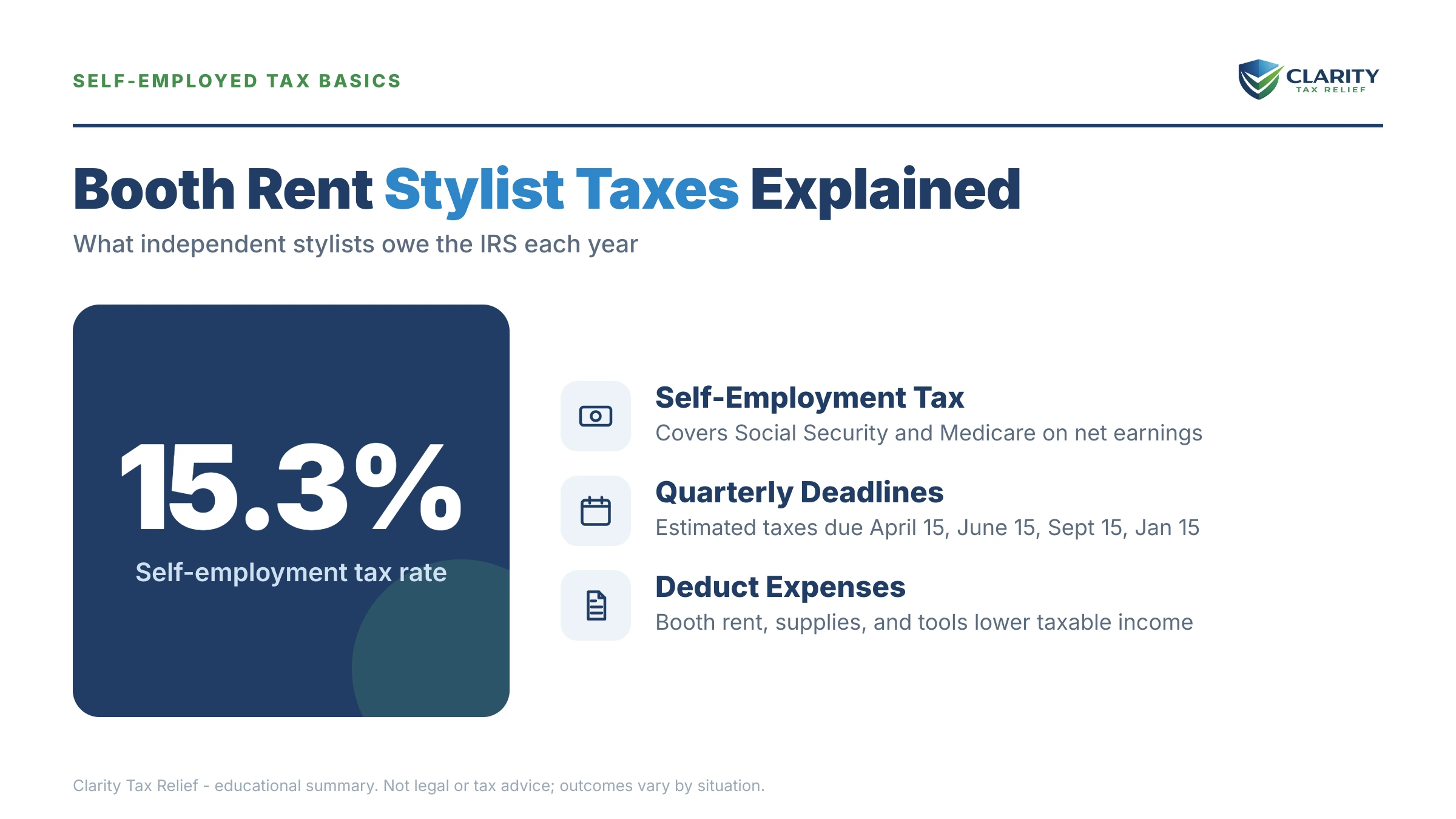
The short answer: a booth rent stylist is self-employed, so no salon withholds taxes for you. You owe 15.3% self-employment tax plus federal income tax on your net profit — the money left after booth rent and supplies. Set aside 25%–30% of that profit, and if you've fallen behind, a payment plan or hardship option can fix the balance.
You rent your chair, you keep what you charge your clients, and nobody hands you a W-2. That freedom is exactly why the tax bill blindsides so many booth renters — there's no employer quietly pulling taxes out of each check, so the whole bill lands at once. If you're staring at a balance you can't cover, that panic is normal, and this is fixable.
Booth renters are a different tax animal than commission stylists. You owe both halves of Social Security and Medicare, and often nobody sends you any tax form at all. The image below shows exactly how a booth renter's numbers flow from chair-rent receipts to the amount the IRS says you owe.
⏱ Your ongoing clock: there's no single "pay by" date on self-employment tax — instead, penalties and interest accrue every month the balance sits unpaid, and estimated-tax due dates fall four times a year (April 15, June 15, September 15, and January 15). The failure-to-file penalty is 5% per month, ten times the failure-to-pay penalty, so if you have an unfiled year, file it even if you can't pay a dime.
Why booth rent stylists end up owing the IRS
The core reason is structural: no one withholds taxes from a booth renter's income. A commission stylist paid on a W-2 has taxes taken out of every paycheck and the salon covers half of Social Security and Medicare. As a booth renter, you're running your own micro-business. Every dollar arrives untaxed, and the government expects you to send in the tax yourself, four times a year.
Here's what trips people up, in the order it usually happens:
- Tips and cash feel invisible. They aren't. Every tip, Venmo, Cash App, and cash payment is taxable income, whether or not a form reports it.
- No 1099 arrives, so it "doesn't feel real." Because clients pay you directly and you pay the salon rent, there's often no 1099 at all. The reporting duty is still 100% yours.
- Self-employment tax is a shock. On top of income tax, you owe 15.3% for Social Security and Medicare — the piece a boss would normally split with you. This is the self-employment-tax shock that catches nearly every first-year renter.
- Quarterlies never got paid. Most new booth renters don't know estimated taxes exist until the bill comes due — see how quarterly estimated taxes work.
This is a different situation from a salon owner tax debt, where the owner may also owe payroll tax on employees, and from a stylist who gets a 1099 from the salon, if that's you, see hair stylist and barber 1099 tax debt instead. As a booth renter, you're the whole business: income, rent, and tax all run through you.
What a booth renter actually owes
Your tax is built on net profit, gross receipts minus your business expenses, not on what you took in. Booth rent is one of your biggest deductions, and it directly lowers the tax. The table below shows a rough picture of combined self-employment plus federal income tax at different profit levels for a single filer in 2026 (before any state tax).
| Net profit (after booth rent & supplies) | Self-employment tax (~15.3%) | Rough total federal tax |
|---|---|---|
| $25,000 | ~$3,500 | ~$4,500 |
| $40,000 | ~$5,650 | ~$7,800 |
| $55,000 | ~$7,770 | ~$10,500 |
| $75,000 | ~$10,600 | ~$16,000 |
These are estimates only. Your actual number depends on filing status, the qualified business income (QBI) deduction, and your state. But the pattern is the point: on $55,000 of profit, roughly $10,500 is due, and none of it was withheld along the way.
The deductions that cut your booth-renter bill
Every legitimate business expense lowers both your income tax and your self-employment tax. Booth renters routinely miss deductions they're entitled to, then overpay. Keep records for each of these.
| Deduction | What it covers |
|---|---|
| Booth / chair rent | What you pay the salon each week or month (Schedule C line 20b) |
| Products & supplies | Color, backbar, foils, gloves, disposables you buy yourself |
| Tools & equipment | Shears, dryers, irons, chair, often deductible in full the year you buy |
| License, insurance & dues | Cosmetology license renewal, liability insurance, professional memberships |
| Card-processing fees | Square, Stripe, or salon POS fees taken from your sales |
| Education & marketing | Classes, certifications, your booking app, business cards, ads |
| Mileage | Driving to education, to pick up supplies, or between locations (not commuting) |
Cash rent is still deductible, but only if you can prove it. Ask the salon for a written rent record, or keep your own dated ledger and receipts.
A worked example: what falling a year behind looks like
Say you're a booth renter who netted $55,000 last year after paying $800/month in booth rent and buying your own products. You set nothing aside for taxes.
- Self-employment tax: $55,000 × 92.35% × 15.3% ≈ $7,770
- Federal income tax after the QBI deduction and standard deduction ≈ $2,800
- Combined balance due ≈ $10,500 (this is roughly an I owe the IRS $10,000 situation)
Now add the cost of waiting. The failure-to-pay penalty runs 0.5% of the unpaid balance per month, and interest compounds on top. On a streamlined installment agreement spread over 72 months, that $10,500 works out to roughly $165/month before interest. But the meter keeps running until it's paid. If you also never filed the return, the failure-to-file penalty of 5% per month dwarfs everything else, which is why filing always comes first. You can estimate your own penalty and interest with our IRS penalty and interest calculator.
What happens if you ignore the tax you owe
A self-employment balance doesn't quietly disappear. It enters the IRS's automated collection sequence, and each stage carries more enforcement power than the last. Here's the order it moves in if you do nothing:
- CP14 — the first bill for the balance you filed but didn't pay. No enforcement yet. This is the cheapest moment to act — see the CP14 notice guide.
- CP501 / CP503 — reminder notices. Still just bills, but penalties and interest are growing every month.
- CP504 — Notice of Intent to Levy. The IRS can now seize your state tax refund, and a federal tax lien becomes a real risk.
- LT11 / Letter 1058 — Final Notice of Intent to Levy. After 30 days, the IRS can levy your bank account and, because you're self-employed, issue a one-time levy on payments owed to you. You gain formal appeal rights here, but far fewer good options than you have today.
If you never filed at all, a different path runs first: CP59 and eventually a substitute return the IRS prepares for you, with zero deductions — no booth rent, no supplies — so it almost always overstates the tax. Filing your own accurate return is how you replace that inflated number with the real one.
Owe the IRS as a booth renter and don't know where to start?
Penalties and interest are growing every month this sits. An experienced tax professional will review your situation free — figure out your real number, catch missed deductions, and lay out your options before the next notice arrives.
Your options if you can't pay the balance
The IRS has several programs for a booth renter who owes. The right one depends on your finances, not on what a bill or a TV ad implies. Here's how they compare.
| Option | Best for | Key threshold / cost |
|---|---|---|
| Short-term payment plan | You can pay in full within 180 days | $0 setup; interest & penalties continue |
| Streamlined installment agreement | You owe under $50,000 and want fixed monthly payments | Up to 72 months; small setup fee, less with direct debit |
| Currently Not Collectible | Paying anything would create genuine hardship | Collection pauses; requires financial disclosure (Form 433-F) |
| Offer in Compromise | Assets & income truly can't cover the debt | $205 fee + 20% down (waived if low-income certified); ~1 in 5 accepted |
| Penalty relief | Clean prior 3 years, or a reasonable cause | First-Time Abate removes the failure-to-pay penalty |
A quick note on each. A streamlined installment agreement is the workhorse for most booth renters under $50,000 — no detailed financials, up to six years to pay. Currently Not Collectible status is for a slow season or a real crisis, when your allowable living expenses eat your whole income. An Offer in Compromise actually works by settling for what the IRS calculates it could ever collect from you — never "pennies on the dollar," and never guaranteed. The IRS accepted only about 1 in 5 offers in FY2024. And first-time penalty abatement can wipe the failure-to-pay penalty if you have a clean prior three years — note that the IRS is moving to an automatic version of this relief in summer 2026.
How to respond, step by step
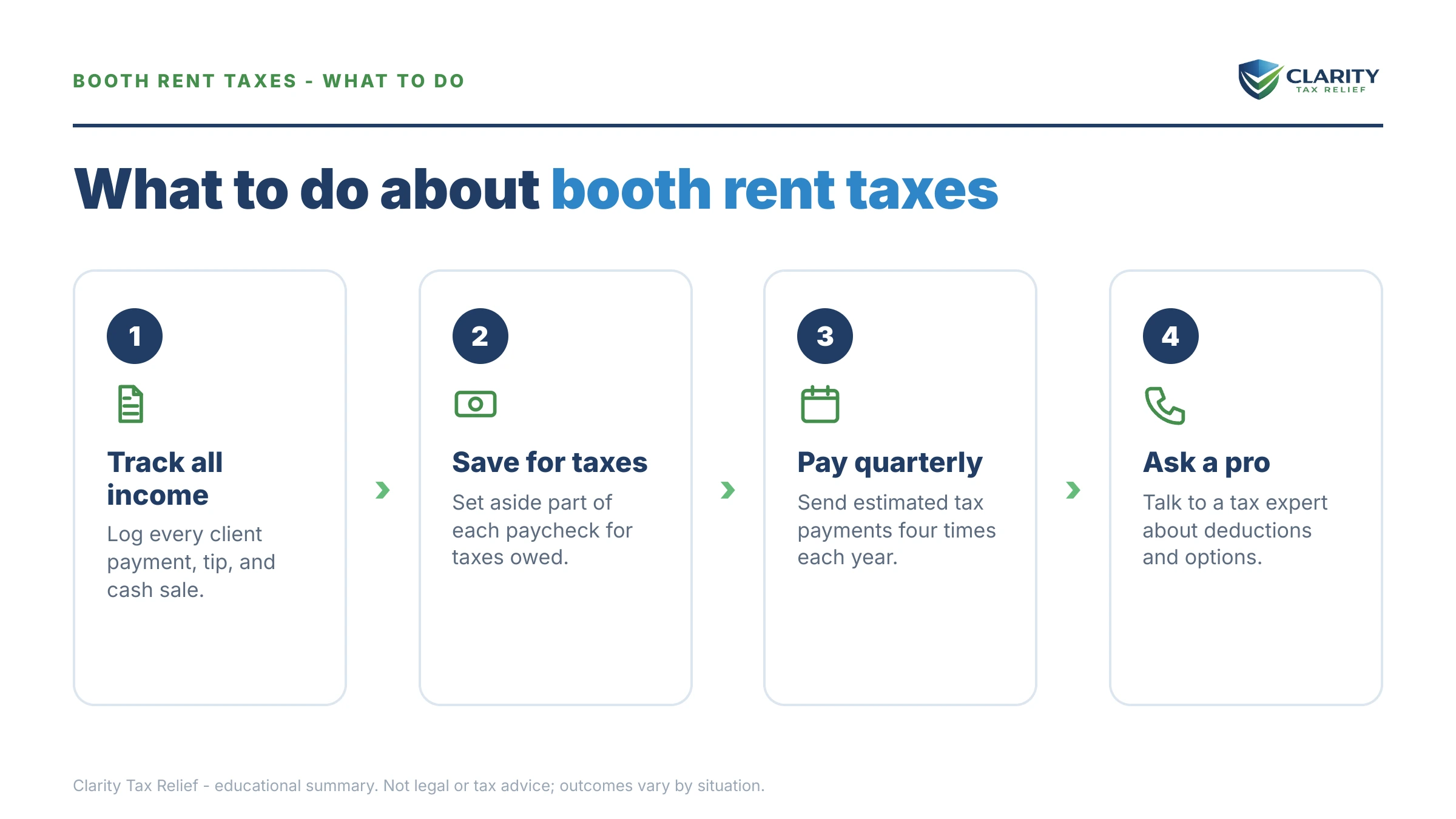
- File every year first — even unfiled ones, and even if you can't pay. Filing stops the 5%/month failure-to-file penalty and replaces any IRS substitute return with your real deductions.
- Reconstruct your income and expenses from bank deposits, Square/card reports, appointment books, and your booth-rent records. You don't need a 1099 to file.
- Confirm the real balance in your IRS online account so you're working from the correct number, not an inflated estimate.
- Pick the option that fits from the table above and set it up before the next notice escalates — a plan started today stops enforcement.
- Fix this year going forward by starting quarterly estimated payments so you don't repeat the cycle next April.
- Get a professional review if you owe more than $10,000, have multiple unfiled years, or want the deductions and the resolution order handled right.
When you can handle this yourself, and when help changes the outcome
You can absolutely do this alone when the situation is simple. If you filed on time, agree with the balance, and can clear it within 180 days or set up a streamlined plan online, that's a do-it-yourself afternoon. A single year of unpaid tax under $10,000 with clean records rarely needs paid help. You can request the payment plan and even claim first-time penalty abatement yourself.
Experienced help earns its cost when the stakes climb: you have multiple unfiled years, the IRS already filed a substitute return that ignored your booth rent and supplies, a levy or lien is in motion, you're weighing an Offer in Compromise (where the math decides everything), or the balance is large enough that the resolution order genuinely changes what you pay. In those cases a professional often saves more than the fee by catching deductions and choosing the right program.
If you're a rideshare or delivery worker facing the same no-withholding trap, the playbook overlaps with side hustle taxes: how much to set aside and first year self-employed and owe taxes.
Booth-rent tax terms, decoded
- Self-employment (SE) tax — the 15.3% you pay for Social Security and Medicare because no employer splits it with you. Reported on Schedule SE.
- Schedule C — the form where you report your booth-renter income and deduct booth rent, supplies, and other business costs to get net profit.
- Estimated taxes (Form 1040-ES) — the four annual prepayments self-employed people make instead of paycheck withholding. Skipping them triggers the didn't pay estimated taxes penalty.
- Net profit — gross receipts minus deductible expenses. Your tax is built on this, not on total money collected.
- Substitute for return (SFR) — a bare-bones return the IRS files for you if you don't, with no deductions, almost always overstating your tax.
- QBI deduction — the qualified business income deduction that can shave up to 20% off your business profit for income-tax purposes.
Booth rent stylist tax questions, answered
Do booth rent stylists get a 1099?
Usually not. A true booth renter collects money directly from clients and pays rent to the salon, so no employer issues a W-2 and no client sends a 1099. You may see a 1099-K from a card processor like Square if you took more than $20,000 across more than 200 card transactions in 2026, but even with zero forms, you are legally required to report every dollar on Schedule C.
How much should a booth rent stylist set aside for taxes?
Set aside roughly 25% to 30% of your net profit — what's left after booth rent, supplies, and other business costs. That covers the 15.3% self-employment tax plus federal income tax. If you're in a state with income tax, push toward 30% or more, and remember tips are taxable income too.
Is booth rent tax deductible?
Yes. The rent you pay the salon for your chair or booth is a fully deductible business expense on Schedule C, line 20b. So are your products, tools, license and insurance, cape and towel laundry, continuing education, and card-processing fees. You can deduct rent you paid in cash, but you need records, so keep receipts, a rent ledger, or the salon's written confirmation.
Do I have to pay self-employment tax as a booth renter?
Yes. Because no salon withholds Social Security and Medicare for you, you pay both halves yourself as self-employment tax — 15.3% on 92.35% of your net profit. A commission stylist on a W-2 splits that with the salon; a booth renter carries the full load. You do get to deduct half of the self-employment tax on your income-tax side.
What can I do if I owe the IRS as a booth rent stylist and can't pay?
You have real options: a short-term plan of up to 180 days, a monthly installment agreement (streamlined up to $50,000 over 72 months), Currently Not Collectible status if paying anything would cause hardship, or an Offer in Compromise if your finances genuinely can't cover the debt. File first even if you can't pay — the failure-to-file penalty is ten times the failure-to-pay penalty.
What happens if I haven't paid quarterly estimated taxes?
You'll owe an underpayment penalty on top of the tax, calculated quarter by quarter at the IRS interest rate. It isn't a flat fine — it's interest on the amount you should have prepaid by each due date (April 15, June 15, September 15, and January 15). Catching up your quarterlies for the current year stops the penalty from growing while you resolve the older balance.
What if the salon never gave me any tax forms?
You still have to file. As a booth renter you are self-employed, so the absence of a W-2 or 1099 doesn't excuse reporting. It just means you reconstruct your income from your own records: appointment books, bank deposits, Square or card-processor reports, and cash logs. If you never filed at all, the IRS can eventually file a substitute return for you with no deductions, which almost always overstates what you owe.
Your next 24 hours
- Find your number. Log into your IRS online account and note the exact balance and which tax years it covers — don't guess from memory.
- Gather your records. Pull last year's return (or the raw numbers if you haven't filed), your booth-rent proof. Your Square/card and bank reports so your real deductions are in hand.
- Get a free case review. Interest and penalties grow every month this waits — use the 2-minute form or call (888) 825-7779 to map your options before the next notice hits.
This guide is general information, not tax or legal advice for your specific situation. Eligibility for IRS programs depends on individual facts and circumstances; no outcome is guaranteed.