
Self-Employed & Trades
Electrician Tax Debt: What to Do When You Owe Back Taxes (2026)
The short answer: electrician tax debt almost always comes from self-employment income with no tax withheld — 1099 pay, cash side jobs, or your own contracting business. If you owe, you can file any missing returns and set up an IRS payment plan, hardship status, or an Offer in Compromise. Penalties and interest keep growing until you act.
You've been running service calls, invoicing generals, and fronting material out of your own pocket, and somewhere in there the tax bill stopped fitting in the budget. Now the balance has penalties on it, and every month it climbs a little more.
This is fixable, and you have more paths out than the IRS letters suggest. The trick is doing them in the right order: returns first, then the balance. The table below breaks down exactly where an electrician's tax debt comes from and which fix matches each source.
⏱ The clock that matters most: if you have unfiled years, the failure-to-file penalty runs at 5% of the unpaid tax per month — ten times the 0.5% monthly failure-to-pay penalty. Both cap at 25%, and interest compounds daily on top. Filing every return, even with no payment, is the single fastest way to stop the bleeding.
Why electricians end up owing back taxes
Most electrician tax debt traces back to one structural fact: nobody withholds taxes from a 1099 or from cash. A journeyman on a W-2 has taxes pulled every check. The moment you go out as a subcontractor or open your own shop, that stops, and the full bill lands once a year.
The self-employment tax makes it worse. On top of regular income tax, you owe 15.3% self-employment tax on your net profit, 12.4% Social Security plus 2.9% Medicare, because you're now paying both the employee and employer halves. That's the shock a lot of newly independent electricians never budgeted for.
Then there's the feast-or-famine cash flow. Material gets bought before you're paid, a big commercial job pays 60 days out, and the money earmarked for quarterly estimates gets spent keeping the truck moving. Miss those quarterlies and an underpayment penalty stacks on top of everything else.
Here's how the common triggers translate into a real IRS balance:
| Source of debt | What triggers it | Tax impact |
|---|---|---|
| 1099 subcontractor pay | No withholding on money from generals or shops | Full income tax + 15.3% SE tax due at filing |
| Cash side jobs | Weekend service calls, small residential work | Still taxable; unreported cash raises audit risk |
| Missed quarterly estimates | Cash flow spent on material/payroll instead | Underpayment penalty added to the balance |
| Paying helpers off the books | Cash or 1099 to a worker who's really an employee | Payroll tax + possible personal Trust Fund Recovery Penalty |
| No return filed | Overwhelmed, records a mess, avoidance | 5%/month failure-to-file penalty; IRS may file for you |
If you crossed from employee to contractor recently, the self-employment-tax shock is worth reading — it's the single biggest reason first-year independent electricians get a surprise bill. And if a shop pays you on a 1099 but controls your hours, tools, and jobs like an employee, you may be misclassified — see paid on 1099 but treated like an employee (SS-8).
What happens if you ignore it
IRS collection is automated, and it does not forget an electrician just because you're hard to reach on a job site. Once a balance is assessed, the notices escalate on their own timeline, each one carrying more enforcement power:
- CP14 — the first bill. Just a balance-due notice; no enforcement yet. This is the cheapest moment to act. See the CP14 notice guide.
- CP501 / CP503 — reminder notices. Still bills, but the balance is growing every month.
- CP504 — Notice of Intent to Levy. The IRS can seize your state tax refund, and a federal tax lien becomes a real possibility. Read the CP504 notice guide.
- LT11 / Letter 1058 — Final Notice of Intent to Levy. After 30 days the IRS can levy bank accounts and issue levies against money owed to you. This is when you still have Collection Due Process appeal rights — see the LT11 notice guide.
For a self-employed electrician, the levy that stings is the one that hits money a general contractor owes you. A levy on 1099 income is generally a one-time grab of whatever the payer owes you the instant the levy lands — a single job's pay can vanish. The IRS can also file a lien that shows up when you try to bond a job or refinance. In 2026, IRS staffing is down roughly 27% from a few years ago. But the automated levy and lien systems never slowed — a legitimate reason to get ahead of the deadlines instead of waiting for a human to call.
Owe back taxes and worried a levy could hit your next job's pay?
Send us your notices and last filed return. An experienced tax professional will map exactly where you stand, which returns are missing. The resolution that fits a contractor's uneven income — free, confidential, no pressure. Penalties and interest are accruing now, so the sooner it's reviewed, the less it costs.
Your options if you can't pay the balance
The notices frame it as pay-or-else, but the IRS runs several programs, and the right one depends on your numbers. Here are the paths that actually fit a self-employed electrician:
| Option | Best when | Cost / setup |
|---|---|---|
| Short-term plan (≤180 days) | A big invoice or season will cover it soon | $0 setup; interest + penalty continue |
| Streamlined installment agreement | You owe $50,000 or less and want it simple | Small setup fee; up to 72 months, no financials |
| Partial-pay installment agreement | You can pay something, but not the full amount | Requires Form 433-F financials |
| Currently Not Collectible | Paying anything would create real hardship | Collection paused; debt and interest remain |
| Offer in Compromise | Assets + income can't cover the debt by the CSED | $205 fee (waivable if low-income); means-tested |
Because contractor income swings, the size of your balance usually points to the right lane. Here's the quick map by amount:
| You owe | Typical path | Financials needed? |
|---|---|---|
| Under $10,000 | Guaranteed installment agreement | No |
| $10,000–$25,000 | Streamlined plan, direct debit | No |
| $25,000–$50,000 | Streamlined plan (direct debit required) | Usually no |
| $50,000+ | Financials, then plan, CNC, or OIC | Yes — Form 433-A/F |
If your number is in the tens of thousands, our balance-specific guides show the exact math — for example, I owe the IRS $30,000 or I owe the IRS $50,000. Not sure whether a plan or a settlement is smarter for you? Compare them in payment plan vs. offer in compromise.
A worked example: an electrician who owes $38,000
Say you're a 1099 electrician who netted good money for two years, set nothing aside, and now owe $38,000 across those two tax years. Here's how that number behaves and what the options cost.
If those two returns were filed late, the failure-to-file penalty alone (5%/month, capped at 25%) could add up to roughly $9,500 before the failure-to-pay penalty even fully counts. The 0.5%/month failure-to-pay penalty adds up to another 25% over time, and interest compounds daily on the whole thing. You can estimate your own running total with our IRS penalty & interest calculator.
Because $38,000 is under $50,000, you'd qualify for a streamlined installment agreement over up to 72 months. That's about $38,000 ÷ 72 = roughly $528 a month before interest — closer to $600 once interest is folded in. Set the payment at a number a slow winter month can still cover, so you don't default.
If instead your income dropped and paying $528 would mean not making rent, Currently Not Collectible status could pause collection entirely. And an Offer in Compromise would only make sense if the IRS's own math — your equity plus future income before the collection statute expires — genuinely comes in below $38,000. For an electrician with a paid-off work van and steady jobs, that math usually says "payment plan," not "settlement." Anyone promising to erase that $38,000 for a tiny fraction of what's owed is selling the scam the FTC has been shutting down — settlements are earned by the numbers, never promised in advance.
If you hire helpers: the payroll trap
The most dangerous form of electrician tax debt isn't your own income tax — it's payroll tax on the guys who work for you. If you pay a helper cash or hand them a 1099 when the law says they're your employee, you owed payroll taxes on those wages. The IRS can come after you personally.
The unpaid employee-withholding portion is called the trust fund. It can be assessed against you as an individual through the Trust Fund Recovery Penalty. It doesn't disappear even if you close the business. If you've been running any kind of crew, read 941 back taxes: when a business falls behind on payroll taxes and worker misclassification penalties (SS-8 and Section 530 relief) before you say a word to the IRS. This is the situation where an experienced tax professional most changes the outcome.
How to respond, step by step
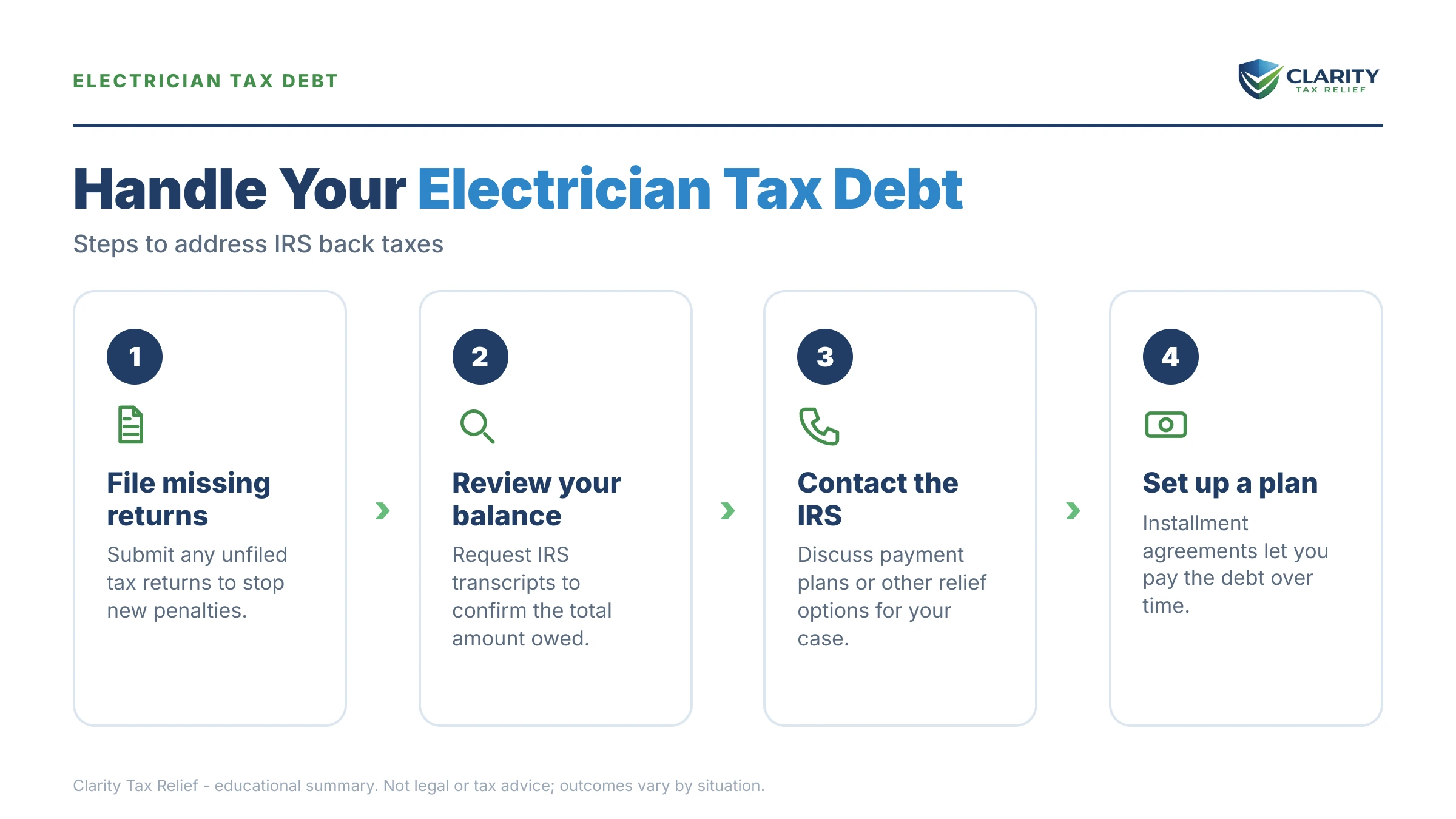
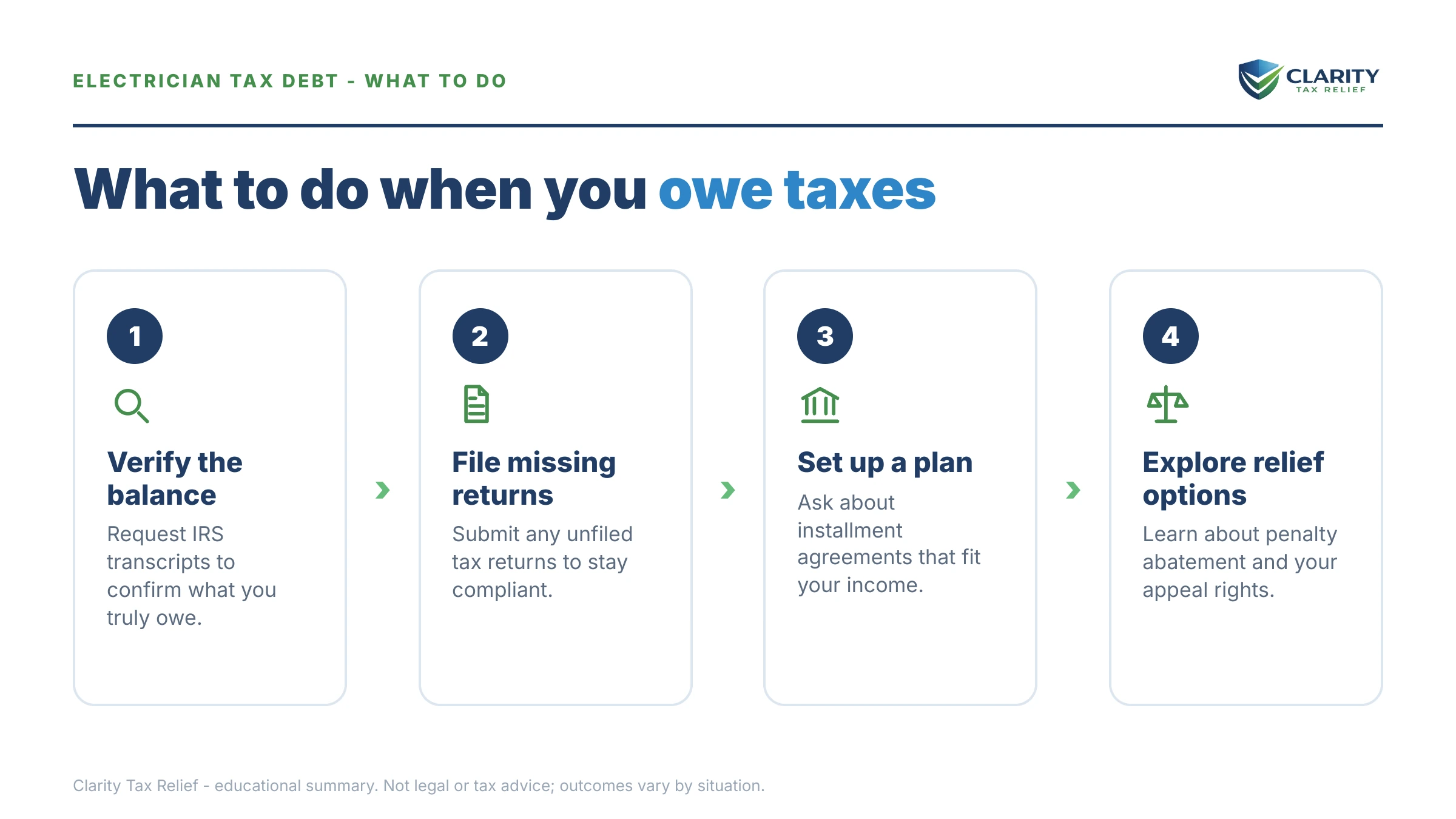
Do these in order — the sequence is what saves you money.
- Find your unfiled years. Pull your IRS account and wage-and-income transcripts to see which returns are missing and what income the IRS already has on file for you.
- File every missing return. File all outstanding returns even if you can't pay — the failure-to-file penalty is ten times the failure-to-pay penalty, and filing stops the IRS from building a substitute return against you.
- Add up the real balance. Total the tax, penalties, and interest across all years so you know the true number before choosing a resolution, not just the figure on one notice.
- Match a resolution to your cash flow. Pick the option that fits a contractor's uneven income: a streamlined installment agreement, hardship status, or an Offer in Compromise if the math supports it.
- Handle any payroll exposure separately. If you paid helpers in cash or on 1099s, treat that as its own issue — payroll and misclassification debt carries personal liability and needs a pro.
- Respond before each notice deadline. Answer any CP14, CP504, or LT11 before the date printed on it to keep your appeal rights and stop the automated levy sequence.
When you can handle this yourself, and when you shouldn't
You can absolutely handle this alone when it's simple: you're a solo 1099 electrician, you have one or two years to file, the returns are straightforward Schedule C. The balance is small enough for a streamlined online plan. Filing your returns, setting up a plan at IRS.gov, and requesting first-time penalty abatement if your prior three years were clean is a doable weekend project.
Experienced help changes the outcome when the situation has teeth: you've got a levy already in motion against a general contractor's payment, several unfiled years, helpers you paid off the books, a balance over $50,000 that requires financial disclosure, or you think an Offer in Compromise might genuinely fit. In those cases the order of operations and the numbers on Form 433 decide what you actually pay. A mistake there costs far more than a consultation. If you're weighing whether to bring someone in, tax attorney vs. CPA vs. enrolled agent explains who does what.
Terms on your notices, decoded
Self-employment (SE) tax: the 15.3% Social Security and Medicare tax you pay on net profit as a 1099 electrician, in place of the withholding an employer would do.
Estimated (quarterly) taxes: the pay-as-you-go payments the IRS expects four times a year on self-employment income; missing them triggers an underpayment penalty. See how quarterly estimated taxes work.
Substitute for return (SFR): a return the IRS files for you when you don't, with no deductions for your tools, truck, or material, so the balance is inflated. Filing your own return replaces it.
Trust Fund Recovery Penalty: a personal assessment for the unpaid employee-withholding portion of payroll tax. It can follow you individually even after a business closes.
Currently Not Collectible (CNC): a hardship status that pauses IRS collection when paying anything would leave you unable to cover basic living expenses. The debt and interest remain.
Collection statute (CSED): the IRS generally has 10 years from assessment to collect, though appeals, an OIC, or bankruptcy can pause that clock. See how long the IRS can collect back taxes.
Electrician tax debt questions, answered
Can the IRS take my electrical contractor license for back taxes?
The IRS itself does not issue or pull your electrical or contractor license. That is a state licensing board matter. But several states can suspend or refuse to renew a professional or contractor license over unresolved state tax debt, and some tie license and bonding renewals to tax compliance. If you owe both the IRS and your state, ask your state licensing board and revenue agency directly, because the rules vary by state.
I'm a 1099 electrician who didn't pay quarterly taxes — how much will I owe?
On top of income tax, self-employed electricians owe self-employment tax of 15.3% on net earnings — 12.4% Social Security plus 2.9% Medicare. So roughly 25% to 30% of your net profit can be owed once income tax is added. Skipping quarterly estimates also triggers an underpayment penalty, so the final bill is usually higher than the tax alone.
What if I paid my helpers in cash — am I in trouble?
Possibly, and this is the most serious form of electrician tax debt. If a helper was really your employee, you owed payroll taxes on their wages. The unpaid trust-fund portion can be assessed against you personally through the Trust Fund Recovery Penalty. Cash pay does not make the obligation disappear. It just makes it harder to document. Get an experienced tax professional on this before you talk to the IRS.
Can I get on a payment plan if I owe the IRS as an electrician?
Yes. If your personal balance is $50,000 or less, you can usually set up a streamlined installment agreement online over up to 72 months without detailed financial disclosure. Because contractor income swings month to month, many electricians pair a plan with a realistic monthly figure so a slow winter doesn't cause a default. Interest and penalties keep accruing while you pay.
Will the IRS garnish my 1099 payments from a general contractor?
It can, but not the way a wage garnishment works. A levy on 1099 income is generally a one-time levy that grabs only what the general contractor owes you at the exact moment the levy hits, not future invoices automatically. That still can wipe out a job's pay, and the IRS can send fresh levies. Setting up a resolution is what stops the cycle.
Should I file my back tax returns even if I can't pay?
Yes — always file, even with no money to send. The failure-to-file penalty is 5% of the unpaid tax per month, ten times the 0.5% monthly failure-to-pay penalty, and both cap at 25%. Filing also stops the IRS from preparing a substitute return that ignores every tool, truck, and material deduction you're entitled to.
Can an electrician settle tax debt for less through an Offer in Compromise?
Sometimes, but it is means-tested, not automatic — the IRS accepted roughly 1 in 5 offers in FY2024. It works only when your assets and future income genuinely can't cover the balance before the collection statute expires. For an electrician with a paid-off work van and steady jobs, the math often points to a payment plan instead. Have a professional run the numbers before you pay the $205 fee.
Your next 24 hours
- Find the balance box. On any IRS notice you have, locate the tax year and the total amount due — that's the number every option starts from.
- Gather three things: your last filed return, any IRS notices, and a rough total of your 1099 and cash income for the unfiled years. If you're missing records, wage & income transcripts rebuild most of it.
- Get a free case review. Call (888) 825-7779 or use the 2-minute form. Penalties and interest accrue every month, so reviewing it now, before a levy hits a job's pay, is what keeps the cost down.
This guide is general information, not tax or legal advice for your specific situation. Eligibility for IRS programs depends on individual facts and circumstances; no outcome is guaranteed.