
IRS Payment Plans
IRS Direct Debit Installment Agreement: How It Works in 2026
The short answer: a direct debit installment agreement (DDIA) is an IRS monthly payment plan pulled automatically from your checking account. It carries the lowest setup fee of any plan, is required for streamlined balances of $25,001–$50,000, can open the door to a tax-lien withdrawal, and can never default because you forgot to pay.
You're setting up a payment plan with the IRS, and the online tool keeps steering you toward "direct debit" — pulling the payment straight out of your bank account each month. Before you type in your routing number, you want to know exactly what that commits you to, what it saves you, and whether you even have a choice.
You do have choices for some balances, and for others the IRS quietly requires direct debit. This guide lays out both, with the real fees and the one situation where direct debit changes what happens to a lien on your property.
The IRS confirms a direct debit plan on a short form, and the image below shows you exactly what that document looks like and where your withdrawal date and monthly amount appear.
⏱ The clock that never stops: interest and the late-payment penalty keep accruing on your balance until it's paid, even after your plan is approved. The one break: once an installment agreement is in place, the failure-to-pay penalty drops from 0.5% to 0.25% per month. If you're setting up the plan in response to a notice, the date printed on that notice controls how long you have before the IRS escalates.
Why the IRS wants your payment on direct debit
Direct debit is the IRS's preferred way to be paid on a plan because an automatic draft almost never defaults. That reliability is why the IRS makes it cheaper for you and, above certain balances, why it makes it mandatory.
From your side, direct debit means you set the agreement up once and then do nothing. The payment leaves your checking account on the same day every month, so you can't blow the plan by forgetting a mailing or missing a login. That single feature prevents the most common way people lose a payment plan — human forgetfulness.
There are three concrete advantages the IRS attaches to direct debit specifically:
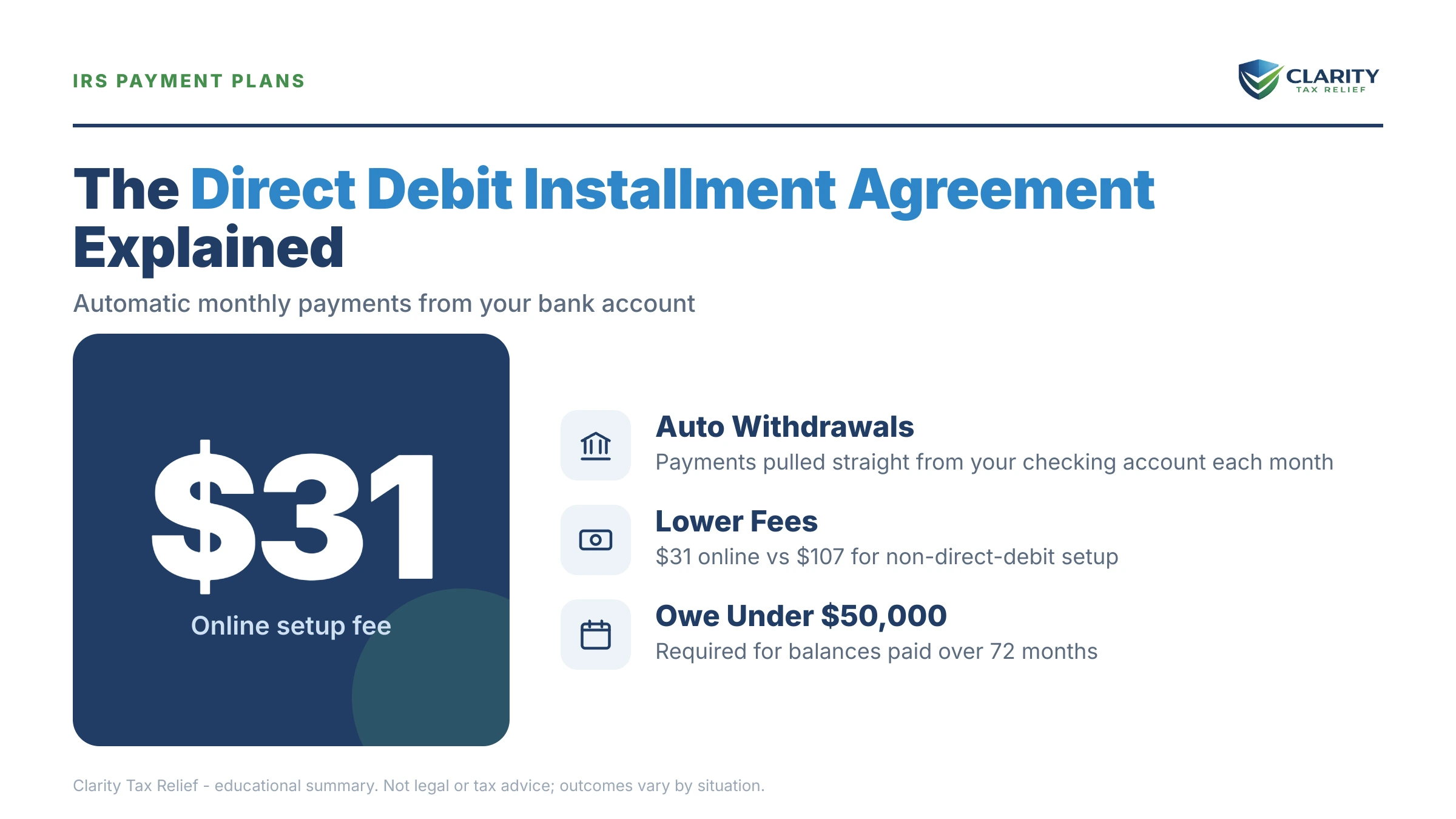
- The lowest setup fee — cheaper than any manual-payment option, and the gap widens if you also apply online.
- Streamlined access up to $50,000 — individual balances of $25,001–$50,000 can skip a full financial disclosure only if you agree to direct debit.
- A path to lien withdrawal — under the Fresh Start rules, a filed tax lien can be withdrawn once a direct debit plan is running (more on this below).
None of that is available on a mail-a-check plan. The trade-off is real but narrow: you hand the IRS standing permission to draft your account, so the money has to be there on your draft date.
What happens if you don't set up a plan at all
Choosing a direct debit plan isn't the pressure point — having no plan is. If you leave a balance unaddressed, the IRS's automated collection sequence keeps moving, and each stage carries more enforcement power than the last:
- CP14 — the first bill. See our CP14 notice guide. No enforcement yet, but the balance is growing.
- CP501 / CP503 — reminder notices. Still just bills, with more penalty and interest each cycle.
- CP504 — Notice of Intent to Levy your state tax refund. Read the CP504 notice guide; a federal tax lien becomes a real risk here.
- LT11 / Letter 1058 — the Final Notice of Intent to Levy. After 30 days, the IRS can garnish wages and levy bank accounts. You have Collection Due Process appeal rights at this stage — but far fewer easy options than before.
Setting up a direct debit installment agreement stops this sequence. An accepted plan halts new levies and keeps you in good standing, provided the drafts clear. In 2026 that matters more than ever: IRS staffing is down roughly 27% after 2025's cuts. But the automated levies and lien filings never slowed — the machine escalates whether or not a person ever touches your file.
Not sure which plan you qualify for?
Send us your balance and last notice. An experienced tax professional will confirm whether direct debit is required for you, what it will cost, and whether it opens a lien withdrawal — free, confidential, no pressure while penalties and interest keep accruing.
Direct debit vs. your other payment options
For balances under $25,000 you can pay a plan four different ways, and each has a real cost-and-control trade-off. Direct debit wins on price and reliability; manual payment wins on flexibility in a tight month.
| Method | Setup cost | Best for / trade-off |
|---|---|---|
| Direct debit (auto-draft) | Lowest fee; only online-DD is cheaper | Never defaults from forgetting; required $25k–$50k; needed for lien withdrawal. You must keep funds available on the draft date. |
| Payroll deduction (employer withholds) | Mid-range fee (Form 2159) | Payment comes out of your paycheck. Reliable, but your employer sees it and must cooperate. |
| Manual online payment (IRS Direct Pay) | Higher fee than direct debit | You control each payment's timing. Easy to skip or forget — the top cause of default. |
| Check / money order by mail | Highest fee tier | No bank access shared, but slow, no lien-withdrawal path, and easy to miss. |
If you're weighing this alongside how you'd pay a lump sum instead, our guide to the best way to pay the IRS compares every method side by side.
Direct debit installment agreement fees: what it costs
Applying online with direct debit is the cheapest way to set up any IRS plan. The user fee climbs sharply the moment you drop direct debit or apply by phone or mail. The exact dollars are set by the IRS and adjust periodically, so confirm current amounts, but the tier structure looks like this:
| How you apply | Relative fee | Notes |
|---|---|---|
| Online + direct debit | Lowest | The cheapest option the IRS offers. |
| Online + non-direct-debit | ~$69 | You mail checks or pay manually each month. |
| Phone / mail / in person + direct debit | ~$107 | Set up with a person, still auto-drafted. |
| Phone / mail / in person + non-direct-debit | ~$178 | Most expensive way to start a plan. |
| Low-income (≤ 250% of federal poverty) | Reduced (~$43) | Waived if you can't use direct debit; reimbursed at the end if you do. |
The low-income reimbursement is a genuine reason to choose direct debit if money is tight: qualifying taxpayers who use auto-draft get the reduced fee refunded once the balance is paid. For the current exact figures and who qualifies, see our IRS payment plan setup fee guide. Note that the setup fee is separate from the interest and penalties that keep accruing. You can estimate those with our IRS penalty & interest calculator.
When direct debit is required: the $25,000 to $50,000 rule
For individual balances between $25,001 and $50,000, direct debit is mandatory to get a streamlined installment agreement without a full financial review. This is the single most important rule to know before you apply, because it decides how much paperwork you'll face.
| You owe | Direct debit required? | What it gets you |
|---|---|---|
| $10,000 or less | No | Guaranteed installment agreement — any payment method, no financials. |
| $10,001 – $25,000 | Optional | Streamlined plan up to 72 months; direct debit lowers your fee and enables lien withdrawal. |
| $25,001 – $50,000 | Yes | Streamlined plan up to 72 months with no Form 433 financial disclosure — only if you agree to direct debit. |
| Over $50,000 | Case-by-case | Financial disclosure usually required; direct debit still common. See our guide below. |
In plain terms: if you owe between $25,001 and $50,000 and refuse direct debit, the IRS will demand a full Form 433-F financial statement instead — bank records, expenses, the works. Agreeing to auto-draft is what lets you skip all of that. For the mechanics of that mid-band plan, read our streamlined installment agreement guide; below $10,000, the simpler guaranteed installment agreement applies. Above $50,000, see IRS payment plan over $50,000.
Direct debit and your tax lien
A direct debit installment agreement is the specific condition for withdrawing a filed federal tax lien under the Fresh Start rules. If you owe $25,000 or less and enter a DDIA, you can ask the IRS to withdraw the Notice of Federal Tax Lien after a few successful drafts — using Form 12277 for lien withdrawal.
This matters because withdrawal removes the public record of the lien, unlike a simple release. A manual-payment plan does not qualify for the same treatment. If a lien is hurting your ability to refinance or sell, converting to direct debit is often the fastest lever you control.
A worked example: what a $34,000 direct debit plan looks like
Say you owe $34,000 after filing late and can't pay it in full. Because the balance is over $25,000, direct debit is required to get a streamlined plan without handing over your financials.
Spread over the maximum 72 months, the principal alone is $34,000 ÷ 72 = about $472 per month. But that's before interest and the reduced penalty. Interest keeps accruing on the unpaid balance at the IRS's quarterly rate. The failure-to-pay penalty runs at 0.25% per month while the plan is active — roughly $85 in the first month, shrinking as the balance drops.
So the IRS won't accept a payment that only covers principal. It will set a monthly draft high enough to clear the full balance within the term. In practice that lands closer to $570–$600 per month at recent rates. Two things follow from the math: paying more than the minimum shortens the plan and cuts total interest. The plan must fully pay the debt before your 10-year collection statute expires — the IRS won't approve a schedule that runs past it. Curious about the true lifetime cost? See our installment agreement interest rate breakdown, and if you can, pay off your IRS payment plan early to save the rest.
How to set up a direct debit installment agreement, step by step
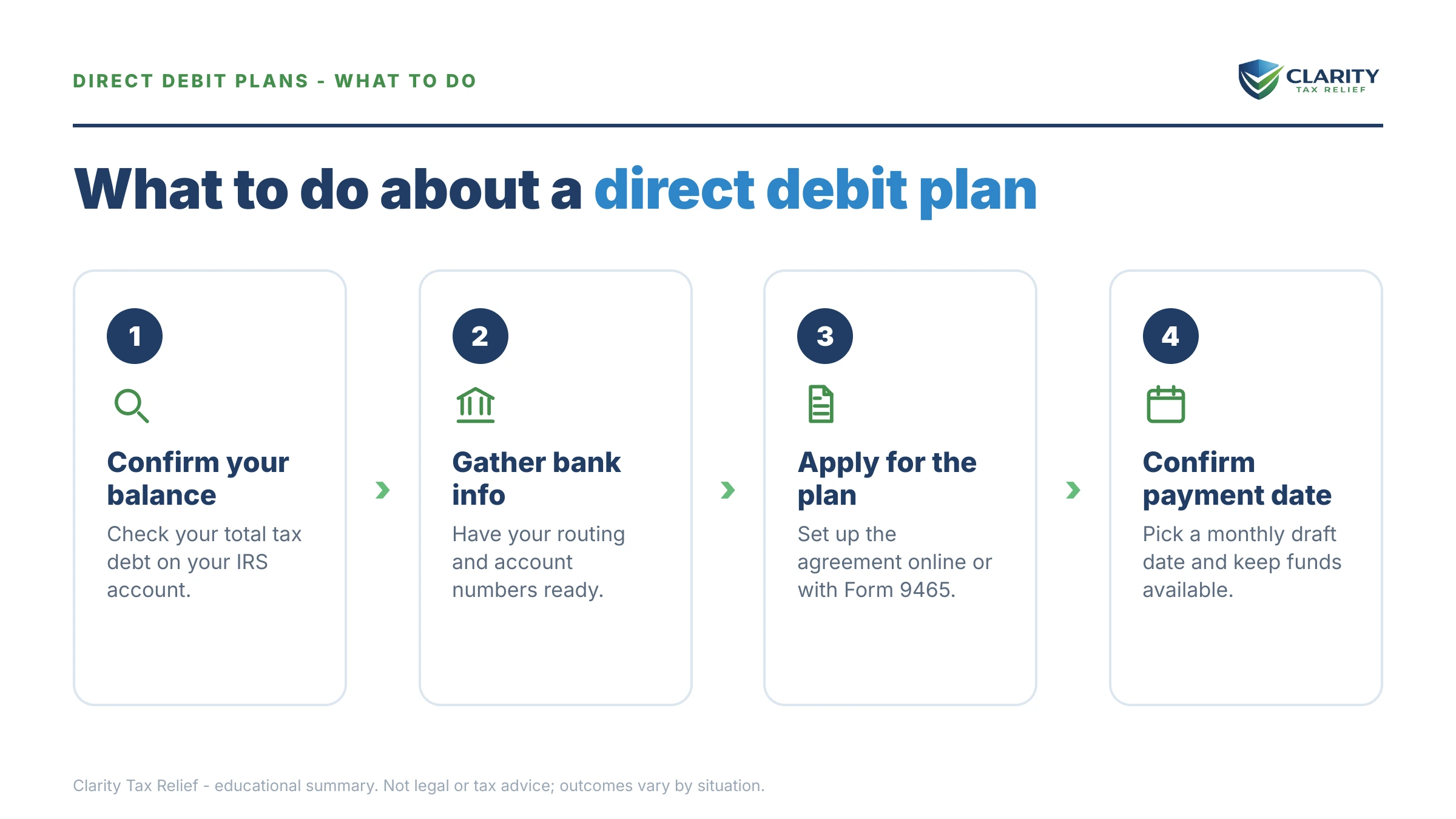
- Confirm your balance and filing status. Log into your IRS online account and make sure all required returns are filed. You can't get a plan with missing returns.
- Apply online with direct debit through the Online Payment Agreement tool for the lowest fee, or file Form 9465 by mail if you prefer paper.
- Enter your checking account routing and account number and pick a draft day you know your paycheck clears before.
- Review and sign the agreement. The IRS confirms a direct debit plan on Form 433-D — check the amount and draft date carefully before signing.
- Fund the account before each draft. Keep the payment amount available on your draft date every month so nothing bounces.
- If a lien is filed and you owe $25,000 or less, request withdrawal with Form 12277 after your first few successful drafts.
For a screen-by-screen walkthrough, see how to set up an IRS payment plan online.
When you can handle this yourself, and when help changes the outcome
Plenty of people set up a direct debit plan alone, and should. If you owe under $25,000, all your returns are filed. The streamlined monthly amount fits your budget, the online tool takes about fifteen minutes and you don't need anyone. The same is true if you simply want to convert an existing manual plan to direct debit to cut your fee.
Experienced help earns its cost when the math or the stakes get bigger. Consider a professional review if you owe more than $50,000 and face a financial disclosure, if you have unfiled years that block any plan, if a levy or wage garnishment is already in motion, or if the IRS's standard monthly amount is more than you can actually afford. In those cases the question isn't how to enter a plan — it's whether a plan is even the right tool versus currently not collectible status or an offer, and getting that order right changes what you pay. If you're comparing routes, our payment plan vs. currently not collectible breakdown is a good start.
Terms on your agreement, decoded
- DDIA — Direct Debit Installment Agreement; a plan where the IRS auto-drafts your monthly payment from checking.
- Streamlined agreement — a plan up to $50,000 (with direct debit) that skips a full financial statement, payable over up to 72 months.
- Form 433-D — the confirmation form that finalizes a direct debit agreement, listing your amount and draft date.
- Lien withdrawal (Form 12277) — removal of the public Notice of Federal Tax Lien, available on a DDIA under $25,000.
- CSED — Collection Statute Expiration Date. The IRS generally has 10 years from assessment to collect. Your plan must pay in full before it.
- Failure-to-pay penalty — 0.5% of the unpaid tax per month, which drops to 0.25% once your installment agreement is active.
Direct debit installment agreement questions, answered
What is a direct debit installment agreement?
A direct debit installment agreement (DDIA) is an IRS monthly payment plan where the payment is pulled automatically from your checking account on a set day each month. You give the IRS your routing and account number once. The withdrawal happens on its own until the balance, plus interest and penalties, is paid. It carries the lowest setup fee of any plan type.
Do I have to use direct debit for an IRS payment plan?
Not for smaller balances — under $25,000 you can choose direct debit, payroll deduction, or manual payments. But for individual balances between $25,001 and $50,000, direct debit is required to get a streamlined agreement without a full financial disclosure. Direct debit is also required if you want the IRS to withdraw a filed tax lien under the Fresh Start rules.
What's the setup fee for a direct debit installment agreement?
Direct debit is the cheapest way to set up a plan. Applying online with direct debit carries the lowest user fee — well under the $69 online non-direct-debit fee and far below the $178 phone or mail fee. Low-income taxpayers (at or below 250% of the federal poverty level) pay a reduced fee that is reimbursed at the end if they use direct debit. Fees are set by the IRS and adjust periodically — confirm current amounts at IRS.gov.
Can I change the payment date or amount on a direct debit agreement?
Yes, but not instantly. You can revise the monthly amount or draft date through your IRS online account or by calling the IRS. The change usually takes effect the following month, not the current one. Because a direct debit draft is automatic, request any change well before your next scheduled withdrawal so a payment you can't cover doesn't come out.
Will a direct debit installment agreement remove my tax lien?
It can help. Under the Fresh Start rules, if you owe $25,000 or less and set up a direct debit installment agreement, you can ask the IRS to withdraw a filed Notice of Federal Tax Lien using Form 12277 after a few successful drafts. Direct debit is the specific condition — a manual-payment plan does not qualify for lien withdrawal on the same terms.
What happens if there isn't enough money in my account?
A returned draft is treated as a missed payment, and your bank may charge an overdraft or non-sufficient-funds fee on top. One missed draft won't default the agreement immediately — the IRS sends a reminder and gives you a short cure window — but repeated failures can terminate the plan and restart enforcement. Move money in before your draft date, or request a lower payment before the withdrawal hits.
Can I switch my existing IRS payment plan to direct debit?
Yes. You can convert a manual-payment installment agreement to direct debit through your IRS online account or by calling the IRS, and there's a reduced fee to restructure. Switching is often worth it. It lowers your future setup and reinstatement costs, protects you from accidentally missing a payment, and is the doorway to requesting a lien withdrawal if you qualify.
Does the IRS still charge interest on a direct debit plan?
Yes. Interest keeps accruing on the unpaid balance until it's fully paid, even on an approved plan — the IRS resets its rate quarterly. There is one real break: once an installment agreement is in place, the failure-to-pay penalty drops from 0.5% per month to 0.25% per month. Paying more than the minimum, or paying the plan off early, cuts the total interest you'll owe.
Your next 24 hours
- Find your balance. Log into your IRS online account and note the exact amount owed and whether it's under or over $25,000. That decides whether direct debit is required.
- Gather your bank details and last return. Have your checking routing and account number ready, confirm all returns are filed, and pick a safe draft day after your paycheck clears.
- Get a free case review. If you owe over $50,000, have unfiled years, or a levy is already in motion, call (888) 825-7779 or use the 2-minute form before penalties and interest grow any further.
This guide is general information, not tax or legal advice for your specific situation. Eligibility for IRS programs depends on individual facts and circumstances; no outcome is guaranteed.
Primary sources: IRS payment plans, IRS Online Payment Agreement