
Penalties & Interest
How Much of My IRS Balance Is Penalties and Interest in 2026?
The short answer: to see how much of your IRS balance is penalties, pull your account transcript or IRS online account. It splits the balance into tax, penalties, and interest. Failure-to-file runs 5% a month (capped at 25%), failure-to-pay 0.5% a month (capped at 25%), and interest compounds daily with no cap.
You looked at your balance and the number is bigger than the tax you remember owing. That gap is penalties and interest — added month after month since the original due date — and the good news is that a large chunk of it is often removable, while the rest can be paused from growing. The first step is simply seeing the breakdown.
Your account transcript reveals exactly how much of the total is tax versus penalties versus interest — the image below shows you what that breakdown looks like and where each number sits. Knowing the split changes your whole strategy, because penalties can be abated while the tax and its interest usually cannot.
⏱ Your ongoing clock: this balance is not frozen. The failure-to-pay penalty adds 0.5% of the unpaid tax every month, and interest compounds daily on the whole growing total. Every month you wait, the penalty and interest slice of your balance gets larger.
What makes up your IRS balance
Your total balance is three separate charges stacked together: the tax you owe, penalties for filing or paying late, and interest on both. The notice or online figure quotes only the combined total, which is why it looks larger than the tax you reported.
Each piece behaves differently. The tax is fixed once assessed. Penalties are set percentages with legal caps, and they are the part you can most often get removed. Interest is the rolling rental cost of money you still owe the government; it rides on top of everything and keeps compounding until the balance hits zero.
Here's how each of the two main penalties works and where it stops growing:
| Charge | Rate | Maximum |
|---|---|---|
| Failure-to-file penalty | 5% of unpaid tax per month (4.5% in months failure-to-pay also runs) | 25% — reached after 5 months |
| Failure-to-pay penalty | 0.5% of unpaid tax per month (0.25% on an approved direct-debit plan) | 25% — takes about 50 months |
| Interest | Federal short-term rate + 3%, compounded daily (roughly 7–8% a year recently) | No cap — runs until paid |
The failure-to-file penalty is ten times the failure-to-pay penalty — 5% a month versus 0.5%. That single fact is why the rule is always file on time even if you can't pay. For the full comparison, see our guide on failure-to-file vs. failure-to-pay penalties, and for how the daily compounding actually stacks up, how IRS interest actually compounds in 2026.
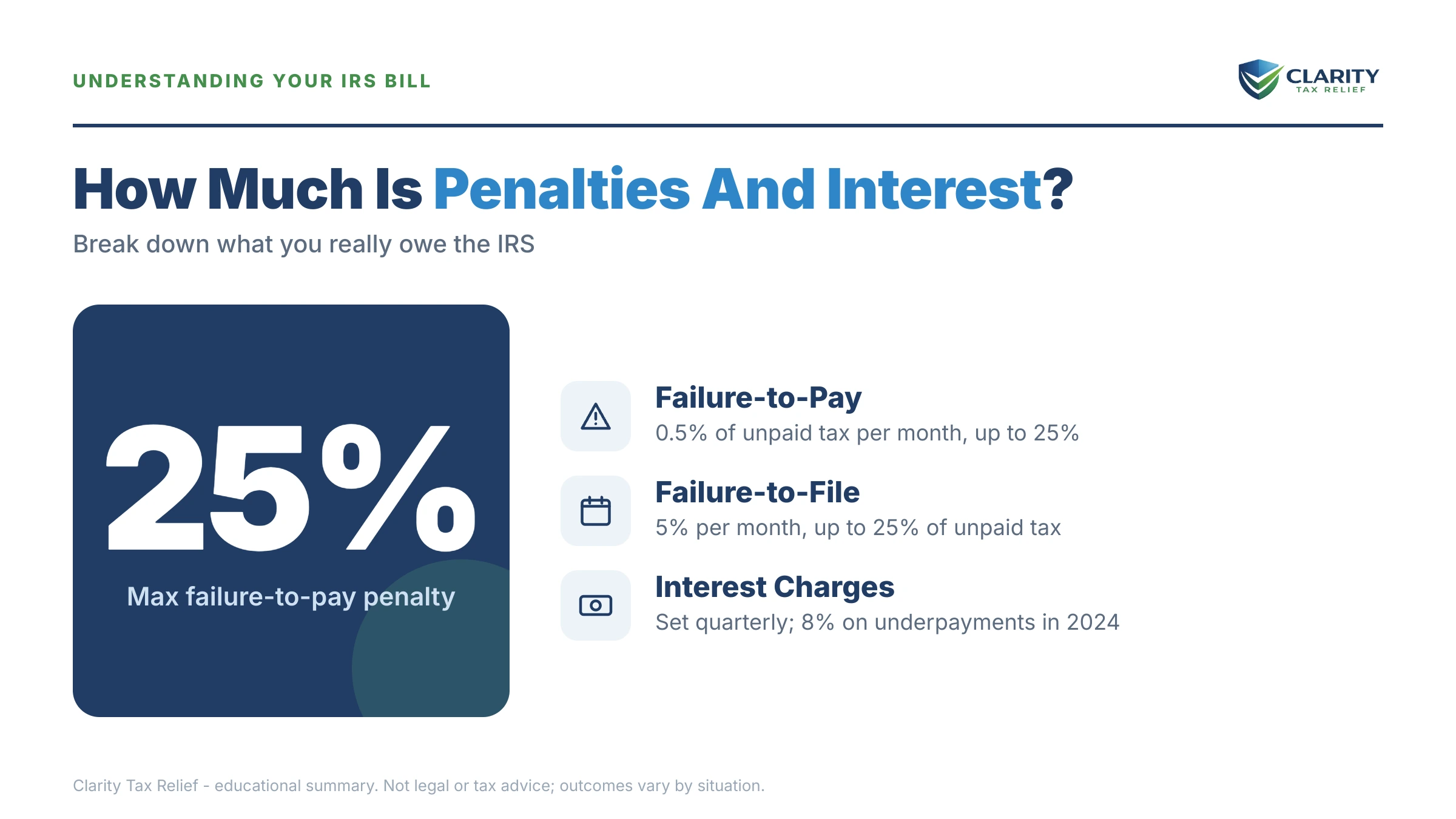
How to find how much of your balance is penalties
Your IRS account transcript breaks the balance into individual lines, each tagged with a transaction code — that's the fastest way to see the exact penalty and interest amounts. You can also open your IRS online account, which shows a running total by category for each tax year.
On the transcript, you're looking for specific codes. Match them against this table so you don't confuse a penalty line with the underlying tax:
| Code | What it is | Which bucket |
|---|---|---|
| 150 | Tax return filed / tax assessed | Tax |
| 166 / 160 | Failure-to-file penalty (auto / manual) | Penalty |
| 276 / 270 | Failure-to-pay penalty (auto / manual) | Penalty |
| 196 | Interest assessed on the balance | Interest |
| 197 / 198 | Interest reduced or transferred | Interest |
Add the penalty codes together and you have your penalty total; the code 196 lines are your interest. Everything left is tax. If the transcript looks like a wall of numbers, our walkthrough on how to read an IRS account transcript decodes it line by line, and the standalone pages on code 276 (failure-to-pay penalty) and code 196 (interest assessed) explain each entry. Not sure how to pull the document at all? Start with getting your transcripts online.
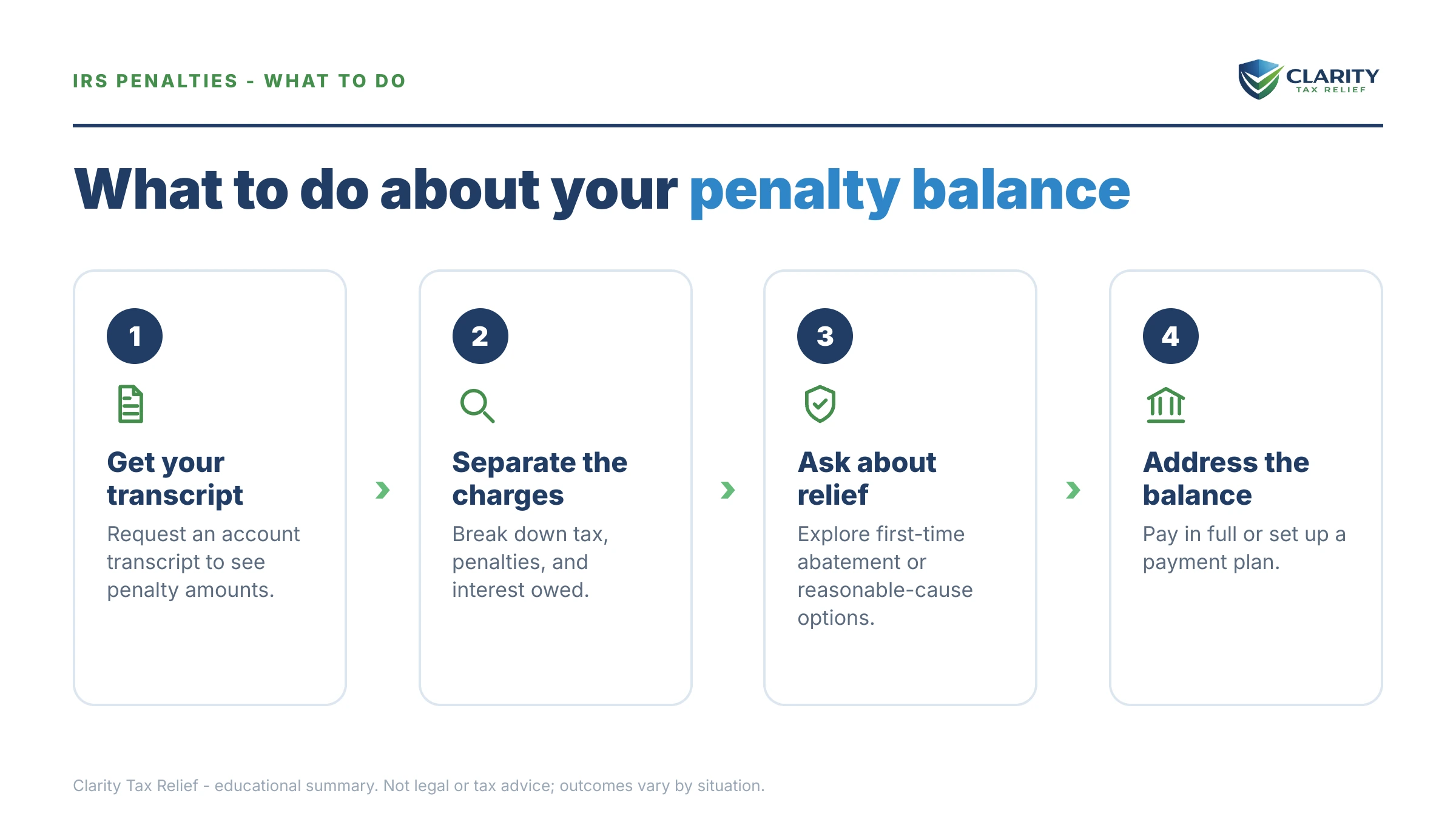
A worked example: what the split really looks like
Say you owe $12,000 in tax for 2024. You filed your return five months late and still hadn't paid it a full year after the deadline. Here's how the balance breaks down. This is a hypothetical to show the math, not a client result:
- Failure-to-file penalty: five late months. Because the failure-to-pay penalty also ran those months, the file penalty is 4.5% each month → 22.5% of $12,000 = $2,700. It stops there; the cap is reached.
- Failure-to-pay penalty: 0.5% a month for the 12 months unpaid → 6% of $12,000 = $720. It keeps running until the balance is paid or hits its own 25% cap.
- Interest: roughly 8% a year, compounding daily on the tax and on the penalties, works out to about $1,050 over the year.
Add it up: about $4,470 in penalties and interest on a $12,000 tax bill — a total balance near $16,470, of which roughly 27% is not tax at all. Now the strategic point: if this was your first slip in years, First-Time Abate could remove the $2,700 failure-to-file penalty and the $720 failure-to-pay penalty. The interest charged on those penalties comes off with them. That's over $3,400 gone, leaving mostly the original tax and the interest on the tax itself.
Want to estimate your own split before you call anyone? Our IRS penalty & interest calculator estimates the penalty and interest on a balance from the dates and amount you enter.
What happens if you leave it alone
Left unpaid, the penalty and interest share of your balance grows every single month until collection escalates on its own. The failure-to-pay penalty and daily interest don't wait for a human at the IRS to act — they're automatic. Here's the sequence:
- Months 1–5: if the return was filed late, the failure-to-file penalty piles on fast — 4.5% to 5% a month until it caps at 25%. This is the steepest climb.
- Ongoing: the failure-to-pay penalty keeps adding 0.5% a month toward its own 25% cap, and interest compounds daily on the whole total, including on the penalties.
- Notices escalate: the IRS billing sequence moves from a CP14 notice through reminder notices to a CP504 notice (intent to levy your state refund) and eventually an LT11 final notice that opens the door to wage and bank levies.
- The 25% caps hit: penalties stop growing once each cap is reached, but interest never stops. On a balance left for years, interest alone can eventually rival the original tax.
In 2026 this runs on autopilot. IRS staffing was cut sharply. But the penalty and interest calculations. The levy notices behind them, are generated by systems that never slowed down. Waiting doesn't buy you quiet. It buys you a bigger balance.
Want to know how much of your balance is really penalties?
Send us your notice or transcript. An experienced tax professional will split it into tax, penalties, and interest, and tell you which penalties you may be able to get removed. Free, confidential, no pressure while interest keeps compounding daily.
How to shrink the penalty and interest part of your balance
The penalties are the part you can most realistically remove, and removing a penalty also removes the interest charged on it. Here are the paths that actually work, in the order most people should try them:
- First-Time Abate. If your prior three years were clean — filed on time, paid or on a plan, no penalties — the IRS can remove the failure-to-file and failure-to-pay penalties for one year. It's often a single phone call. See our complete guide to first-time penalty abatement.
- Automatic Exemption from Penalty (AEP). Starting in summer 2026, the IRS is phasing in AEP, which applies first-time relief automatically in qualifying cases — no request needed. If it hasn't posted to your account yet, you can still request the relief the old way.
- Reasonable-cause abatement. Serious illness, a death in the family, a natural disaster, records destroyed, or another event genuinely beyond your control can support removal even if you don't qualify for first-time relief. Our page on reasonable-cause penalty abatement covers what the IRS accepts.
- Interest abatement — the narrow path. Interest is rarely waived on its own. The two real openings are when a penalty is removed (its interest comes off automatically) and when the interest was caused by an unreasonable IRS error or delay under Section 6404. See whether IRS interest can be waived.
- Reduce the tax itself. If the underlying tax is wrong — a missed deduction, a return the IRS filed for you, an incorrect adjustment — amending it lowers the tax and everything that rides on it. Fewer dollars of tax means fewer dollars of penalty and interest.
To claim a refund of penalties you've already paid, you'll generally file Form 843. And if the amount of penalties feels shocking, our deep dive on how big IRS penalties get shows the full math.
How to check and act, step by step
- Pull your account transcript or open your IRS online account for the tax year in question.
- Separate the buckets — total the penalty codes (166/160, 276/270), total the interest (196), and subtract from the balance to find the actual tax.
- Check your last three years for clean compliance. That determines whether First-Time Abate is available on the penalties.
- Request penalty relief by phone or in writing, or file Form 843 if you already paid the penalties.
- Stop the growth — pay the balance or set up a payment plan so enforcement halts, even while interest continues to run.
- Get a professional review if you have multiple years, a large balance, or an underlying tax you think is wrong — the order you fix things in changes what you end up paying.
When you can handle this yourself, and when help changes the outcome
You can absolutely do this alone when the situation is simple. If you have one year, clean prior compliance. A balance you can pay or fold into a plan, requesting First-Time Abate is often a single call, and setting up a plan online takes minutes. Our walkthroughs on setting up an IRS payment plan online and the first-time abatement letter give you the scripts.
Experienced help earns its keep when the math gets complicated: multiple years of penalties stacked together, a reasonable-cause case that needs to be argued well, an underlying tax you believe is wrong, or a balance large enough that the removal of penalties meaningfully changes your resolution options. In those cases, sequencing — which return to amend, which penalty to abate, when to lock in a plan — is worth getting right the first time, because a denied abatement request is harder to reverse than to get right up front.
If your balance is in the five-figure range and you're weighing options, our pages on owing the IRS $15,000 and owing the IRS $25,000 lay out the realistic paths by amount. A quick review can tell you whether penalty relief alone solves your problem or you need a full resolution plan.
Terms on your balance, decoded
Failure-to-file penalty: the charge for filing your return late — 5% of the unpaid tax per month, up to 25%.
Failure-to-pay penalty: the charge for not paying by the due date — 0.5% of the unpaid tax per month, up to 25%, halved to 0.25% on an approved direct-debit plan.
Interest: the daily-compounding cost of the unpaid balance, set at the federal short-term rate plus 3%, with no maximum.
Abatement: the IRS removing a penalty (and the interest charged on it) — through First-Time Abate, the new automatic exemption, or reasonable cause.
Assessment: the date the IRS officially records the tax you owe — the clock for both interest and the 10-year collection statute starts here.
Penalties and interest: your questions answered
How do I find out how much of my IRS balance is penalties?
Pull your account transcript or open your IRS online account — both split your balance into tax, penalties, and interest line by line. On the transcript, look for transaction code 166 or 160 (failure-to-file penalty), code 276 or 270 (failure-to-pay penalty), and code 196 (interest assessed). The 'balance due' figure the notice quotes is the sum of all of these, not just the tax you originally reported.
Can IRS penalties be more than the original tax?
The two most common penalties can add up to 47.5% of the unpaid tax combined — a 25% failure-to-file cap plus a 22.5% failure-to-pay maximum — and interest on top has no cap at all. So on an old balance left unpaid for years, penalties and interest together can equal or exceed the original tax. The failure-to-file penalty alone maxes out at 25% after five months.
What's the difference between an IRS penalty and interest?
Penalties are fixed charges for filing late or paying late, capped by law. Interest is the rolling cost of the money you still owe and is not capped. Interest is charged on the tax and on the penalties, and it compounds daily. The practical difference matters because penalties can often be removed, while interest almost never can unless the underlying penalty is removed first.
How much is the IRS penalty per month?
The failure-to-pay penalty is 0.5% of the unpaid tax per month, and the failure-to-file penalty is 5% per month — ten times larger. When both apply in the same month, the failure-to-file penalty is reduced to 4.5% so the combined charge is 5% that month. That's why filing on time even when you can't pay saves you the biggest penalty.
Can I get IRS penalties removed?
Often, yes. If you had clean compliance for the prior three years, First-Time Abate can wipe out the failure-to-file and failure-to-pay penalties for one year. Reasonable-cause relief covers serious illness, disaster, or other events beyond your control. Starting in summer 2026 the IRS is phasing in Automatic Exemption from Penalty, which applies the first-time relief without a request in qualifying cases.
Can IRS interest be waived?
Interest is rarely waived on its own — by law it's owed for the time the tax went unpaid. The main exceptions are when a penalty is removed (the interest charged on that penalty comes off with it) and when the interest resulted from an unreasonable IRS error or delay, which you claim under Section 6404. Reducing the tax itself, through an amended return or abatement, is usually the more realistic way to shrink the interest.
Does interest keep growing while I'm on a payment plan?
Yes. An installment agreement stops enforcement, but interest keeps compounding daily and the failure-to-pay penalty keeps running until the balance is gone, though on an approved direct-debit agreement the failure-to-pay rate is cut in half to 0.25% per month. That's why paying more than the minimum, or paying the plan off early, saves real money over a 72-month term.
Why is my IRS balance higher than the tax I owed?
Because the balance includes penalties and interest that have been added since the original due date, plus interest that compounds daily on the growing total. A return filed late and unpaid for a year can carry 20% to 30% in added charges. Check your account transcript to see the exact split before you assume the whole figure is tax you must pay.
Your next 24 hours
- Find the split. Pull your account transcript or IRS online account and locate the penalty codes (166/160, 276/270) and the interest code (196) for the year in question.
- Gather your history. Check whether your prior three years were filed and paid on time — that's what decides if First-Time Abate can erase the penalties — and set aside the notice and your most recent return.
- Get it reviewed. Use the 2-minute form or call (888) 825-7779 for a free review. We'll tell you how much of your balance is removable penalties versus tax you'll have to address, before interest adds another month.
This guide is general information, not tax or legal advice for your specific situation. Eligibility for IRS programs depends on individual facts and circumstances; no outcome is guaranteed.