
IRS Transcripts
How to Read Your IRS Account Transcript to Find What You Owe (2026)
The short answer: your account transcript never prints one clean "account transcript balance owed" line. You build it: start with Code 150 (assessed tax), subtract credits and payments (806, 766, 768, 670), and add penalties, interest, and later assessments (290, 276, 196). The result is your balance as of the transcript's "as of" date — not today.
You pulled the account transcript hoping it would say, in plain English, "you owe $X." Instead you got a wall of three-digit codes, dollar amounts, and dates — some positive, some negative — and no obvious total. The number you need is in there. It's just spread across a dozen lines, and the sign on each one decides whether it adds to or subtracts from what you owe.
The image below shows exactly what an account transcript looks like and where the numbers that make up your balance sit. Once you know which codes to add and which to subtract, the total takes about two minutes to compute, and it will usually differ from your notice, for a reason we'll cover.
⏱ Why the number keeps moving: there is no deadline on reading a transcript, but the balance on it is frozen at the "as of" date. Interest and the failure-to-pay penalty (0.5% per month) keep accruing after that date, so your true payoff today is higher than the figure printed. Never assume the transcript number is what you'd pay to clear the account.
Which transcript actually shows your balance owed
Only the account transcript shows what you owe — the return transcript and wage & income transcript do not. The account transcript is a running ledger of every action the IRS has taken on one tax year: the tax it assessed, the credits and payments applied, the penalties and interest charged, and any adjustments since. If your goal is a balance, this is the document.
The other transcript types have other jobs. A return transcript is a line-by-line copy of the return you filed. A wage & income transcript lists the W-2s and 1099s reported under your Social Security number. If you're still gathering documents, our walkthrough on getting your transcripts online covers ordering each type; this guide assumes you already have the account transcript in front of you and just need the number.
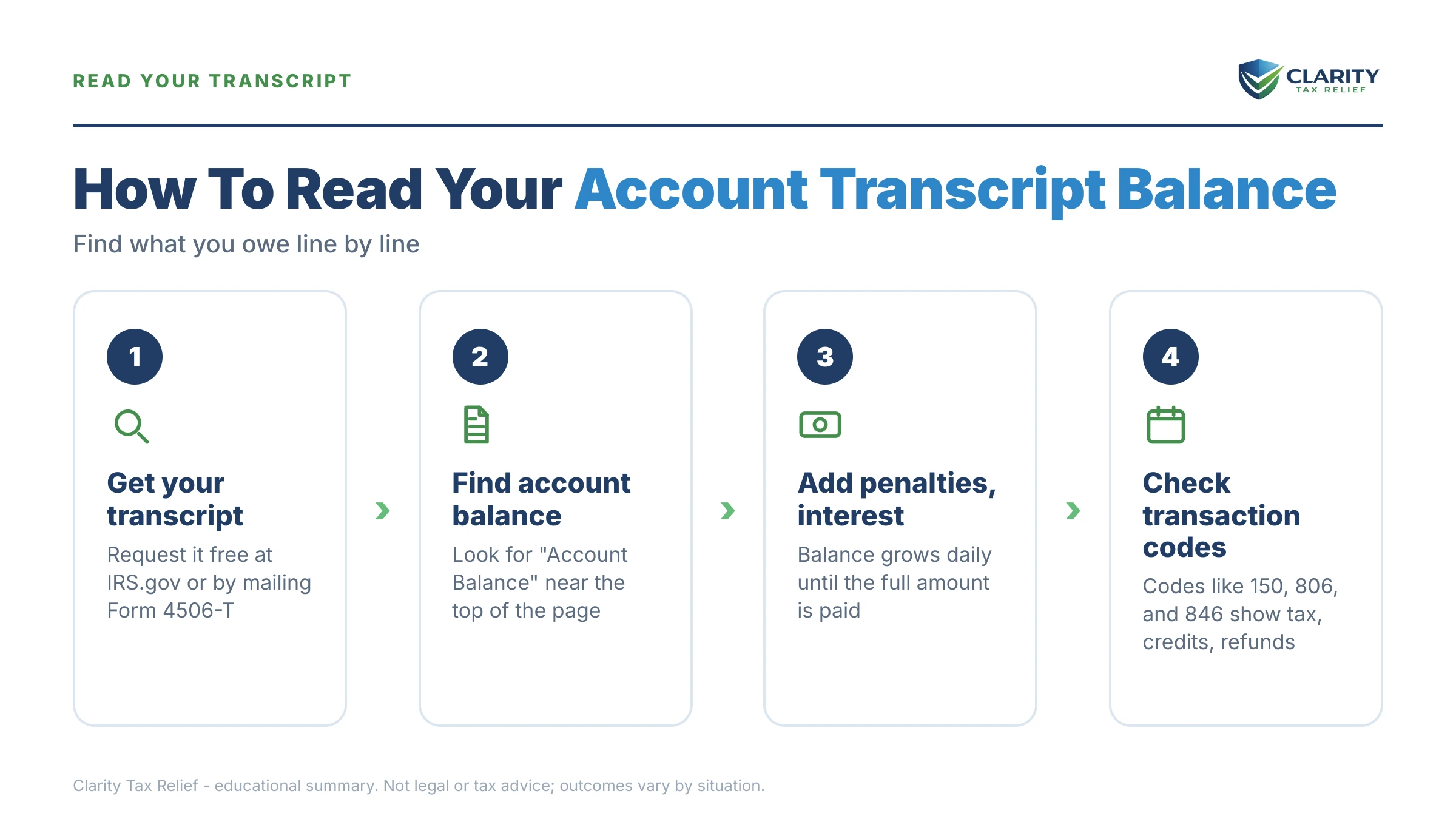
The codes that build (and shrink) your balance
Every dollar figure on an account transcript is tied to a three-digit transaction code, and the code tells you whether that line raises or lowers what you owe. Credits and payments print as negative numbers; tax and additions print as positive. Net them and you have your balance.
| Code | What it means | Effect on balance |
|---|---|---|
| 150 | Tax return filed — assessed tax | Sets the starting balance (+) |
| 806 | W-2 / 1099 withholding credit | Subtracts (−) |
| 766 / 768 | Refundable credits (incl. EITC) | Subtracts (−) |
| 670 | Payment you made | Subtracts (−) |
| 290 | Additional tax assessed | Adds (+) |
| 300 | Additional tax from audit | Adds (+) |
| 160 / 166 | Failure-to-file penalty | Adds (+) |
| 270 / 276 | Failure-to-pay penalty | Adds (+) |
| 196 | Interest charged | Adds (+) |
| 291 | Prior tax reduced (abatement) | Subtracts (−) |
| 570 / 971 | Account hold / notice issued | No change by itself |
Two codes trip people up. Code 150 is not "what you owe" — it's the tax the IRS assessed before any credits or payments were applied, so it is almost always larger than your final balance. And a Code 570 hold moves nothing you owe; it just freezes the account while the IRS reviews something. If you want the meaning of a single line in isolation, each code has its own guide — for example Code 806 (withholding), Codes 766 and 768 (credits), and Code 290 (additional tax assessed). For the broader mechanics of the ledger itself, our full guide on how to read an account transcript walks every section.
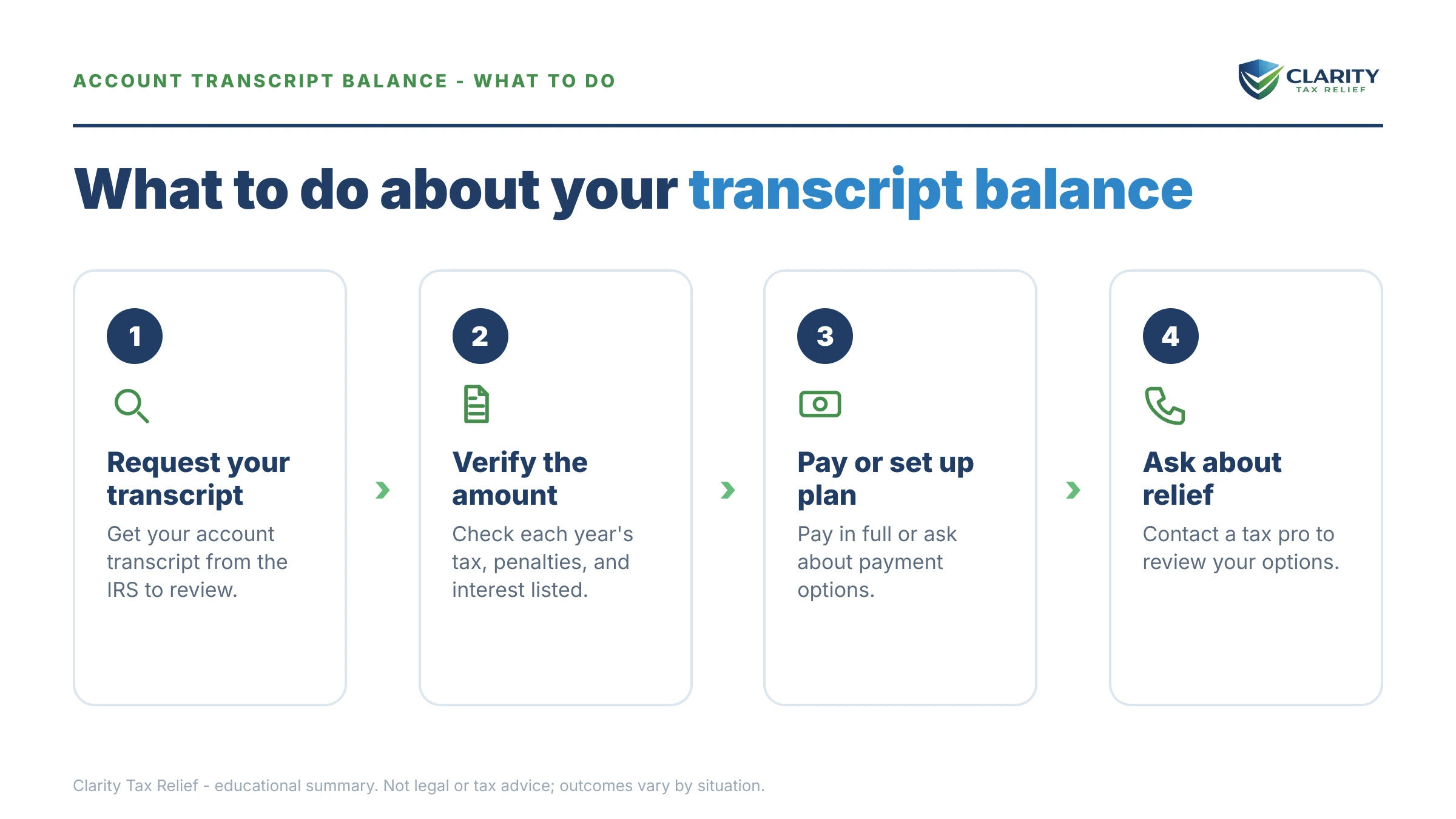
A worked example: computing the balance owed
Say your 2023 account transcript shows the lines below. Watch the signs — negatives are money in your favor, positives are money you owe:
- Code 150 Tax return filed: $9,400
- Code 806 W-2 withholding: −$4,200
- Code 766 Credit to your account: −$500
- Code 276 Failure-to-pay penalty: $188
- Code 196 Interest charged: $240
Do the arithmetic: 9,400 − 4,200 − 500 + 188 + 240 = $5,128. That's your balance owed as of the transcript's "as of" date, not today. Because the failure-to-pay penalty runs at 0.5% per month and interest compounds daily, a transcript that's a few months old will already understate your real payoff by a couple hundred dollars. If you'd paid exactly $5,128, you'd likely be left with a small residual balance of accrued interest that the IRS bills later. The math on how those interest charges compound explains why the gap widens the longer you wait.
Why your transcript balance won't match your notice
The number on your transcript rarely equals the number on your CP14 notice, and that's normal, not an error. The two documents are printed on different dates, so interest and penalty have accrued between them. A CP14 states the balance as of its notice date. The transcript states it as of the "as of" date, which is often weeks apart.
When the gap is only a few dollars, it's pure accrual and you can ignore it. When it's larger, something posted to one document and not the other — a payment that hadn't cleared, a new Code 290 assessment, or an abatement. The transcript, because it timestamps every transaction, is the document that lets you see which. If your CP14 shows the wrong amount or you already paid but got a CP14, the transcript is your evidence.
The "as of" date: the single most misread line
The "as of" date at the top of the transcript is the day the IRS computed those figures, not today, and sometimes a date in the future. When it's a future date, the IRS has projected penalty and interest forward to that day. When it's in the past, your real balance is now higher than what's printed. Either way, the transcript number is a snapshot, never a same-day payoff.
This is exactly why the transcript balance is not the amount to send if you're paying in full. For a true payoff you need the current figure — from your online account's payoff calculator or by asking the IRS for the total through your intended payment date.
What happens if you do nothing about the balance
Finding the number is not the same as resolving it, and the balance on the transcript does not sit still. Left alone, an assessed balance moves through the automated collection sequence — each stage adds cost and removes options:
- Accrual continues — the failure-to-pay penalty and daily interest keep growing the transcript balance every month, with no notice required.
- CP14, then CP501/CP503 — the balance-due bill and its reminders. Still just notices, but the number climbs each cycle.
- CP504 — Notice of Intent to Levy your state refund. A federal tax lien becomes a real possibility.
- LT11 / Letter 1058 — the final notice of intent to levy, which starts a 30-day clock and your Collection Due Process appeal rights. After it, the IRS can garnish wages and levy bank accounts.
In 2026 this matters more than it used to. IRS staffing was cut roughly 27% in 2025, but the notices, liens, and levies are generated by automated systems. They never stopped. The machine keeps escalating whether or not a human ever opens your file, which is the real reason to act on the balance you just found rather than sit on it.
Just found a balance you didn't expect?
Send us the transcript. An experienced tax professional will confirm exactly what you owe, across every year, and lay out your options — free, confidential, and before interest and penalties climb any higher.
Four ways to check your balance owed, compared
The account transcript is the most detailed source, but it's not the fastest for a plain total. Here's how the common methods stack up:
| Method | What it shows | Catch |
|---|---|---|
| IRS online account | Running total across all years + payoff calculator | Hides the code-by-code detail |
| Account transcript | Every transaction code, amount, and date for one year | You compute the total; frozen at "as of" date |
| Your notice (CP14, etc.) | Balance as of the notice date | Already stale by the time it arrives |
| Calling the IRS | Exact payoff through a date you name | Long holds; hard to reach in 2026 |
For most people the right combination is the IRS online account for the total across years and the account transcript for the story behind it. Set up the online account once and you can see both. If you owe across several years, the online account nets them for you; the transcripts tell you which year is driving the debt.
How to find your balance owed on your account transcript, step by step
- Pull the account transcript for each tax year — the account transcript, not the return transcript, is the one that shows what you owe.
- Find Code 150 — that figure is your assessed tax and the starting point.
- Subtract your credits and payments — the negative lines: 806 withholding, 766/768 credits, and 670 payments.
- Add the penalties, interest, and later assessments — the positive lines: 290, 160/166, 270/276, and 196.
- Check the "As of" date — your real payoff today is higher, because accrual continues past it.
- Repeat for every year and total it — each year is a separate account; add the balances for your full exposure.
When you can handle this yourself, and when help changes the outcome
If you're reading one clean transcript, agree with the balance, and can pay it or set up a plan, you don't need anyone. Log into your online account, confirm the payoff, and either pay at IRS.gov/payments or set up a plan — a streamlined installment agreement for balances under $50,000 can usually be arranged online without financial disclosure.
Get an experienced tax professional involved when the transcript raises questions you can't answer from the codes alone: a balance you don't recognize, a 290 assessment you never agreed to, an IRS-filed substitute return inflating the tax, multiple unfiled years, or a total large enough that the resolution path (a plan versus penalty relief versus an offer in compromise) genuinely changes what you pay. The order you fix things in — returns first, then penalties, then the remaining balance — often matters more than any single number on the page. If you owe, say, around $25,000 across two years, that sequencing is where a professional review earns its keep.
Terms on your transcript, decoded
Transaction code (TC): the three-digit number tagging each line. It tells you what the IRS did and whether the dollar amount adds to or subtracts from your balance.
Assessed tax (Code 150): the tax the IRS recorded from your return, before credits and payments — the starting figure, not the balance.
"As of" date: the day the transcript's figures were computed. Interest and penalty accrue past it, so it's a snapshot, not today's payoff.
Account balance: a summary figure some transcripts print near the top — still frozen at the "as of" date and still missing accrual since.
Accrued interest / penalty: the amounts that grow after the "as of" date and make your real payoff higher than the printed number.
Account transcript balance questions, answered
Does my account transcript show my total balance owed?
Not on a single line. The account transcript lists transaction codes and dollar amounts. You build the balance by adding the tax and additions and subtracting the credits and payments. Some transcripts print an "ACCOUNT BALANCE" figure near the top. But that number is frozen at the "as of" date and does not include interest and penalty that accrued since. The IRS online account shows a cleaner running total.
Why is the balance on my transcript different from my CP14 notice?
The two numbers are usually printed on different dates, so interest and the failure-to-pay penalty have moved between them. A CP14 states the balance as of its notice date; the transcript states it as of its own "as of" date. If the gap is more than a few dollars of accrual, check for a payment, a credit, or an assessment that posted to one document but not the other.
Which transcript codes increase what I owe?
Code 150 sets your original assessed tax, and codes like 290 (additional tax assessed), 300 (audit deficiency), 160/166 (failure-to-file penalty), 270/276 (failure-to-pay penalty), and 196 (interest) all add to the balance. Codes 806, 766, 768, and 670 are credits and payments that subtract. A code such as 570 is only a hold. It changes nothing you owe by itself.
What does the "as of" date mean for my balance?
The "as of" date is the day the IRS computed the figures on that transcript, not today. Interest and the 0.5%-per-month failure-to-pay penalty keep running after it, so your real payoff is higher than the printed number. When the "as of" date is in the future, the IRS has already projected accrual forward to that date.
How do I add up what I owe across multiple years?
Pull a separate account transcript for each tax year, because each year is a separate account with its own balance. Compute the balance on each one, then add them together for your total exposure. The IRS online account saves you the math by showing a combined balance across years. But the year-by-year transcripts tell you which year drives the debt.
Is the account transcript balance the payoff amount?
No. The transcript figure is a snapshot at the "as of" date, not a same-day payoff. To pay a balance in full, use the current payoff shown in your IRS online account or call the IRS for an exact figure through your intended payment date. Paying the stale transcript amount usually leaves a small residual balance of accrued interest.
Can I see my balance without ordering a transcript?
Yes. The IRS online account shows a running balance across all years plus a payoff calculator, and it updates faster than a mailed transcript. The account transcript is still worth pulling because it shows every transaction code and date behind the number, which the online balance summary hides. Use the online account for the total and the transcript for the story.
Does a negative number on my transcript mean a refund or a debt?
On an account transcript, credits and payments print as negative amounts and assessments print as positive. A negative account balance means the IRS holds money in your favor, a credit or overpayment, not a debt. A positive account balance is what you owe. Do not confuse a single negative credit line with your overall position; you have to net all the lines.
Your next 24 hours
- Find two things on the transcript: the Code 150 line and the "as of" date at the top. Those anchor everything you compute.
- Gather: the transcript for each year, any notice you've received, and last year's return so you can spot a mismatch fast.
- Get a free case review — use the 2-minute form or call (888) 825-7779. The sooner you confirm the real balance, the less interest and penalty stack onto it while you decide what to do.
This guide is general information, not tax or legal advice for your specific situation. Eligibility for IRS programs depends on individual facts and circumstances; no outcome is guaranteed.
Primary sources: IRS — Get Transcript, IRS Online Account for Individuals, and IRS.gov/payments.