
IRS Notices & Disputes
The IRS Says I Owe More Than I Do: How to Dispute an Incorrect Balance (2026)
The short answer: if the IRS says you owe more than you do, don't pay it — dispute it through the channel the notice sets. Identify the notice type and its deadline (about 30 days for a CP2000, 60 days for a math-error notice, 90 days for a Notice of Deficiency), then respond in writing with proof before that date so the assessment can be reduced or reversed.
You opened the notice, saw a number far bigger than anything you recognize, and your stomach dropped, because the IRS is rarely wrong, right? Actually, it is wrong often enough that a whole set of dispute rights exists just for this. The balance in that letter is proposed or machine-generated in most cases, not final, and you can knock it down with the right response.
The catch is that the correct move depends entirely on which notice you're holding, and each one starts a different clock. The image below shows you what these notices look like and where to find the one date that controls how long you have to fight the number.
Before you write a single check, understand this: paying an incorrect balance to "make it stop" can waive the very rights that would have wiped it out. First figure out why the number is wrong.
⏱ Your deadline lives on the notice. The hardest clock is 90 days, if you're holding a Notice of Deficiency (a CP3219A or Letter 3219), that is your window to petition the U.S. Tax Court, and it cannot be extended. A CP2000 sets roughly 30 days; a math-error notice sets 60 days to force a reversal. Interest and penalties accrue on the disputed amount the whole time, so respond fast.
Why the IRS says you owe more than you do
An incorrect IRS balance almost always traces to one of a handful of specific triggers, and the trigger tells you exactly how to fight it. The IRS does not "make up" numbers; it fills gaps with the least favorable assumptions, and those assumptions are what you correct.
The most common cause is an underreporter mismatch: a CP2000 notice. A computer compared the income reported on your return to the W-2s, 1099s, and 1099-Bs third parties sent in, found a gap, and added tax on the difference, often ignoring the offsetting cost basis, deductions, or exclusions that would have made the gap harmless.
The next-most-common is a substitute for return. If you never filed for a year, the IRS may file one for you using only the income it can see — no deductions, no dependents, single filing status, no business expenses. That produces a wildly inflated number, and it often arrives as a CP3219N or a regular Notice of Deficiency.
Other frequent triggers:
- Math-error adjustments — a CP11 or CP12 where the IRS "corrected" a credit, dependent, or calculation it thinks is wrong. Sometimes it's right; sometimes it disallowed something you were entitled to.
- Stock and crypto sales counted at gross proceeds. A 1099-B reports what you sold for, not what you paid. If basis wasn't matched, the IRS may tax the entire sale price as if it were pure profit.
- A payment or credit the IRS didn't apply — money that posted to the wrong year, or an estimated payment that never got matched. Your IRS account transcript shows exactly what was and wasn't credited.
- Audit changes you never agreed to — an examination closed against you because you didn't respond, sometimes to the wrong address.
Figuring out which of these produced your number is the whole game. A CP2000 that ignored your stock basis is fixed with a written response and a corrected Schedule D. A substitute return is fixed by filing the real return. A math-error notice is fixed with a 60-day abatement request. Same feeling, four different keys.
What happens if you don't dispute it
An incorrect proposed balance becomes a legally assessed debt the moment your dispute window closes, after that, the fight gets far harder. The IRS collection machine treats an unchallenged number as true, and in 2026 that machine runs on automation even as the agency's own workforce shrank about 27% in 2025. The notices, liens, and levies keep issuing whether or not a human ever reviewed your objection.
Here is the sequence if you let the clock run:
- The proposed number is assessed. Once your CP2000, math-error, or 90-day window passes without a valid response, the tax, penalties, and interest become an official balance you owe.
- Billing begins. A CP14 notice arrives as the first bill, followed by reminder notices — now for the inflated amount, plus growing interest.
- Intent-to-levy notices. A CP504 notice threatens your state refund, then an LT11 or Letter 1058 becomes the final notice before wage garnishment and bank levies.
- Enforcement. The IRS can seize refunds, garnish wages, and levy accounts — all to collect a number that may have been wrong from the start.
The cruel part: after assessment you can still dispute through audit reconsideration, but you're now arguing against an active collection file instead of a proposed adjustment. Your leverage is highest today, while the number is still just a proposal.
Got a notice with a number that's too high?
Send us a photo before your response window closes. An experienced tax professional will pinpoint which notice you're holding, why the balance is inflated. The exact dispute channel — free, confidential, no pressure.
Your options to dispute an incorrect IRS balance
The right dispute tool depends on which notice created the number and whether the tax is still proposed or already assessed. Use the wrong channel and you can miss the deadline that mattered.
| Notice you're holding | How to dispute it | Deadline | Right you lose if you miss it |
|---|---|---|---|
| CP2000 (underreporter) | Written response disagreeing, with proof (basis, deductions, corrected schedule) | ~30 days from notice | Case moves toward assessment; you drop to Tax Court or reconsideration |
| CP11 / CP12 (math error) | Request abatement of the math-error adjustment in writing or by phone | 60 days from notice | The correction sticks unless you later go to Tax Court or amend |
| CP3219A / Letter 3219 (Notice of Deficiency) | File a petition with the U.S. Tax Court | 90 days (hard, no extension) | The deficiency is assessed and you must pay first to sue in District Court |
| Substitute for return (CP3219N) | File the actual original return for that year | 90 days if a deficiency was issued | The IRS's inflated numbers become your assessed liability |
| Already assessed (any year) | Audit reconsideration or amended return (Form 1040-X) | No hard deadline while unpaid | None fixed, but collection continues unless paused |
| You believe the debt itself is wrong | Offer in Compromise, doubt as to liability (Form 656-L) | Anytime the liability is disputed | N/A. This challenges whether you owe at all |
Two of these deserve extra attention. If your balance came from a CP2000 notice, the fastest fix is a documented CP2000 disagreement response, not an amended return, which can collide with the open case. And if the IRS built your balance from an IRS substitute return, filing the real return is what shrinks the number, because it restores every deduction and credit the machine left out.
| Root cause | Why the number is inflated | The fix |
|---|---|---|
| Stock or crypto sale on a 1099-B | IRS taxed the full sale price; your cost basis wasn't counted | Send a corrected Schedule D showing basis with the CP2000 response |
| Unfiled year, IRS filed for you | No deductions, dependents, or business expenses applied | File the real return for that year |
| Disallowed credit or dependent | Math-error notice removed something you qualified for | Request math-error abatement within 60 days with proof |
| Payment applied to wrong year | Balance shows on a year you already paid | Send proof of payment; request the credit be moved |
| Missed deduction or credit on a filed year | You underclaimed something legitimate | Amend the return with Form 1040-X |
A worked example: when the IRS overstates a stock sale
Say you get a CP2000 saying you owe $18,400 for a tax year you thought was closed. The notice lists a brokerage 1099-B reporting $62,000 in stock sales you didn't include on your return. The IRS taxed all $62,000 as if it were pure gain.
Here's the reality: you actually paid $54,000 for those shares. Your true capital gain is $62,000 − $54,000 = $8,000, not $62,000. Tax on an $8,000 long-term gain at 15% is about $1,200, plus a little interest, not $18,400.
The fix is a written CP2000 response that says you disagree, attached to a corrected Schedule D and Form 8949 showing your cost basis, with brokerage statements as proof. Done within the 30-day window, the IRS recalculates and the proposed $18,400 collapses to roughly $1,200 in tax. That's the difference between disputing and paying: about $17,000, all because a computer never saw what you paid for the shares.
Miss the window, though, and that $18,400 gets assessed. Now you're filing audit reconsideration against a live collection account — still winnable, but slower, and interest kept running the whole time.
How to respond, step by step
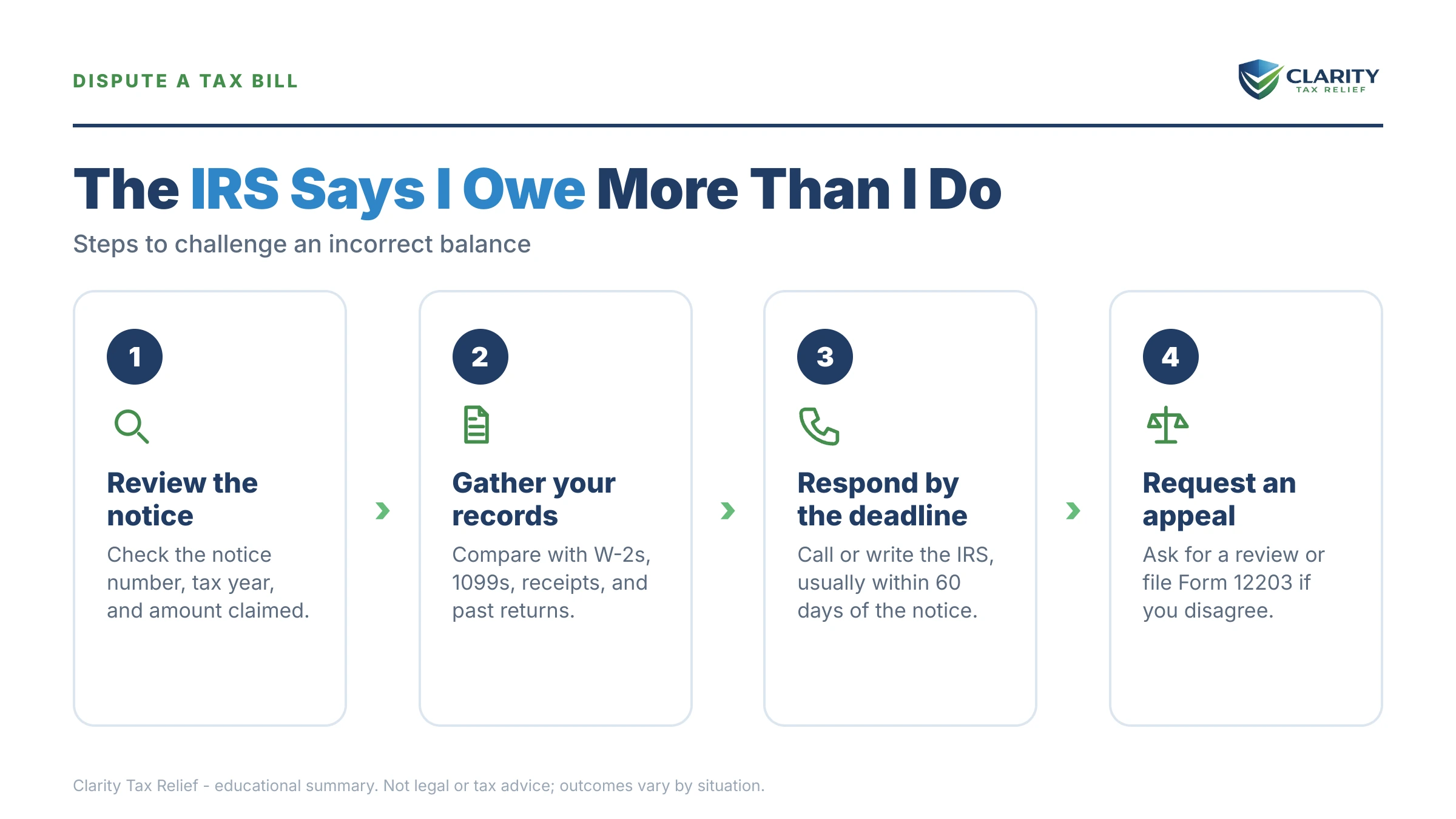
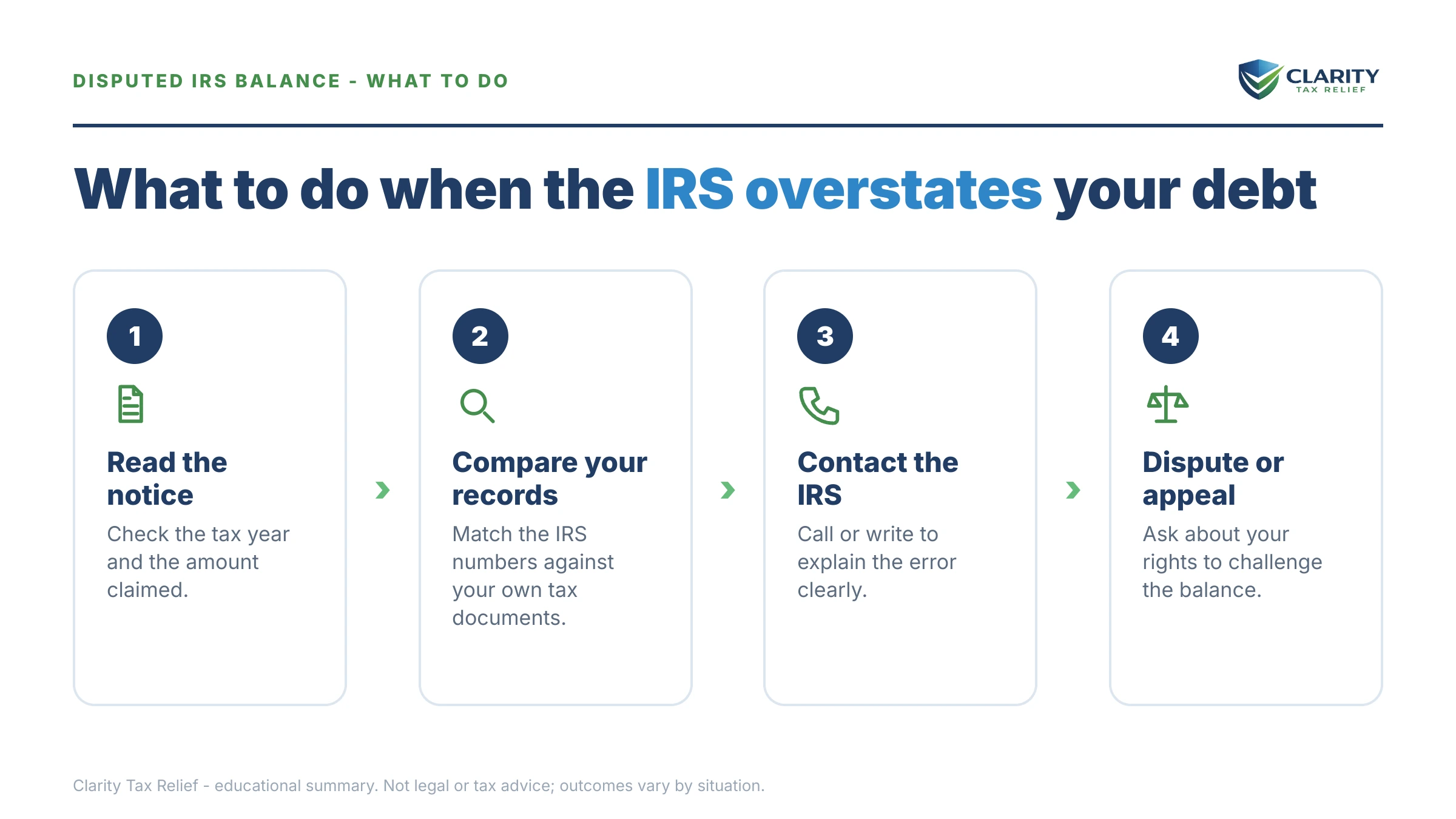
- Identify the notice. Find the notice or letter number in the top or bottom corner (CP2000, CP11, CP3219A, CP3219N). That one code tells you your deadline and your dispute channel.
- Pull your account transcript. Compare the IRS's numbers to your records and confirm which year, income item, or credit is driving the balance.
- Gather your proof. Cost-basis statements, receipts, corrected schedules, payment confirmations, or the actual unfiled return — whatever shows the real number.
- Respond in writing before the printed deadline. Use the response form or address on the notice, state clearly that you disagree, and attach your documentation. Keep a copy and proof of mailing.
- If it's already assessed, switch tools. File audit reconsideration with your documents, file the real return for a substitute-return year, or amend with Form 1040-X.
- Get a professional review for high-dollar or 90-day notices. A Notice of Deficiency, multiple disputed years, or a business balance is where an experienced tax professional changes the outcome, because the petition and the sequence have to be exactly right.
When you can handle this yourself, and when help changes the outcome
You can often handle a clean, single-issue dispute on your own. If a CP2000 counted a 1099 you can fully explain, or a math-error notice removed a credit you can prove, a well-documented written response within the deadline is frequently enough — no professional required. The same is true when the IRS simply applied a payment to the wrong year and you have the confirmation.
Experienced help earns its cost when the stakes or the complexity climb. Get a professional review if:
- You're holding a CP3219A Notice of Deficiency and the 90-day Tax Court petition clock is running — a missed filing there is permanent.
- Multiple years are wrong at once, or a substitute return sits on top of unfiled years.
- The dispute involves a business, self-employment, or the balance is large enough that the wrong sequence costs thousands.
- You genuinely dispute whether you owe the debt at all and are weighing an Offer in Compromise for doubt as to liability.
If the IRS says you owe more than you do and enforcement has already started, a free case review can tell you which lever still works before the next notice lands.
Terms on your notice, decoded
- Proposed vs. assessed: a proposed amount (CP2000, Notice of Deficiency) isn't a debt yet; an assessed amount is legally owed and collectible.
- Notice of Deficiency: the "90-day letter". Your last chance to dispute in Tax Court before paying.
- Substitute for return (SFR): a return the IRS files for you using only reported income, with none of your deductions.
- Audit reconsideration: the process to reopen an assessment after the fact when you have documents the IRS never reviewed.
- Doubt as to liability: an Offer in Compromise argument that the assessed tax itself is wrong — as opposed to doubt as to collectibility, which is about ability to pay.
The IRS says I owe more than I do: questions, answered
What do I do if the IRS says I owe more than I actually do?
Don't pay it — dispute it through the channel the notice sets. First identify which notice created the balance, because each has its own deadline: a CP2000 gives you 30 days to respond, a math-error notice like a CP11 gives you 60 days to request a reversal. A Notice of Deficiency gives you 90 days to petition Tax Court. Respond in writing with proof before that date and the assessment can be reduced or reversed.
Can I dispute an IRS bill I think is wrong?
Yes. You have the right to disagree with any proposed adjustment, and the IRS is required to consider documentation you send. The key is using the correct channel for your notice — a written CP2000 response, a math-error abatement request, a Tax Court petition, or after assessment, audit reconsideration. Sending proof to the wrong office or after the deadline can cost you the easiest path.
How long do I have to dispute an incorrect IRS amount?
It depends entirely on the notice, and the date is printed on your letter. A CP2000 sets roughly 30 days, a math-error notice sets 60 days to force a reversal. A Notice of Deficiency (CP3219A or Letter 3219) sets a hard 90 days to file in Tax Court. The 90-day clock cannot be extended — miss it and the amount becomes a legally assessed debt.
What if it's too late and the amount is already assessed?
You still have options after assessment. Audit reconsideration lets you reopen an assessment when you have documents the IRS never saw. It has no strict deadline as long as the debt is unpaid. If the tax was based on a substitute return the IRS filed for you, filing the real return usually replaces the inflated numbers. As a last resort, an Offer in Compromise based on doubt as to liability disputes whether the debt is correct at all.
Will disputing the balance stop penalties and interest?
Interest and penalties keep accruing on the disputed amount while you fight it, so speed matters. But if you win the dispute and the balance is reduced, the penalties and interest tied to the removed portion come off too — you're not charged interest on tax you never actually owed. If you lose, you owe the accrued additions, which is why a fast, documented response beats a slow one.
Do I have to pay the amount while I dispute it?
No. You can dispute a CP2000, a math-error notice, or a Notice of Deficiency without paying first, and filing a Tax Court petition within 90 days actually stops collection while the case is open. The one exception is audit reconsideration, where the IRS may still pursue collection unless you also request a hold. If money is tight, you can dispute and request currently not collectible status at the same time.
What if the IRS says I owe for a year I never filed?
That balance almost always comes from a substitute for return the IRS filed using only the income reported to it, with no deductions, no dependents. The worst filing status. The fix is to file the actual return for that year, which usually lowers the number dramatically. If the IRS has already issued a Notice of Deficiency for the SFR, file quickly, because the 90-day Tax Court clock still applies.
Should I amend my return to lower what the IRS says I owe?
Sometimes, but not always, and rarely as the first move on a live notice. If a CP2000 is open, respond to the CP2000 directly rather than filing a Form 1040-X, because a duplicate amended return can confuse the process. Amending is the right tool when you find a genuine error the IRS hasn't flagged, such as a missed cost basis, credit, or deduction on an already-assessed year.
Your next 24 hours
- Find the notice number and the deadline. Look in the top or bottom corner for the code (CP2000, CP11, CP3219A) and the "respond by" date. That one date controls everything.
- Gather your proof. Pull the return in question, your account transcript, and any documents that show the real number: cost-basis statements, receipts, payment confirmations, or the unfiled return.
- Get a free case review. Before your window closes, use the 2-minute form or call (888) 825-7779. An experienced tax professional will confirm your dispute channel and deadline — interest is accruing on a number that may be wrong, so don't let the clock decide for you.
This guide is general information, not tax or legal advice for your specific situation. Eligibility for IRS programs depends on individual facts and circumstances; no outcome is guaranteed.