
Federal & State Tax Debt
Do I Owe State Taxes Too? How to Know If You Owe Both the IRS and Your State in 2026
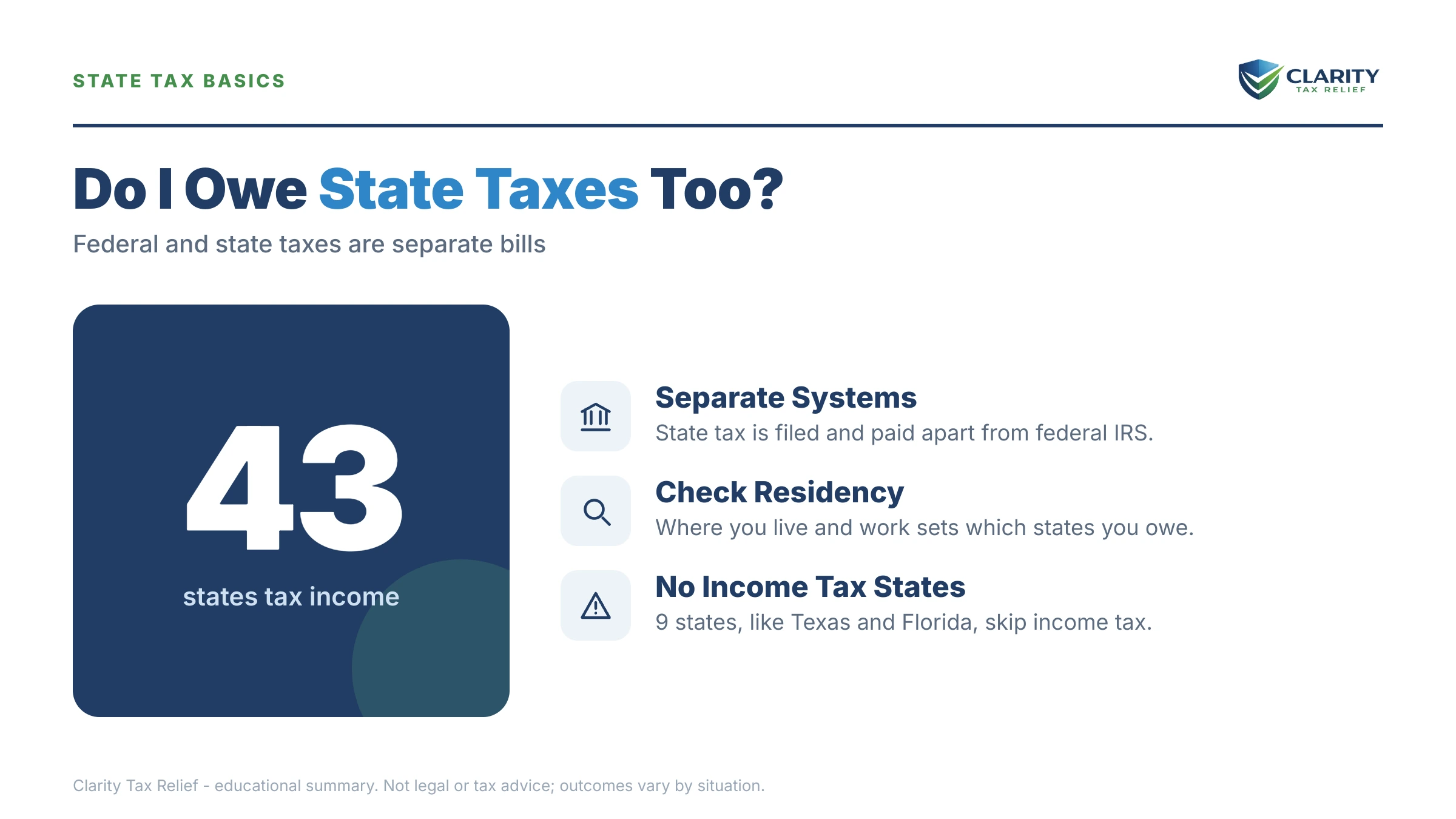
The short answer: if you owe the IRS and live in one of the 41 states with a broad income tax, you probably owe state taxes too, because most states start from your federal numbers. Nine states don't tax wage income. Either way, federal and state debts are separate: paying one never clears the other.
You've been dealing with the IRS — maybe a balance-due notice, maybe a bigger bill than you expected — and a new worry just surfaced: is your state coming for money too? For most people, the honest answer is yes, and it usually arrives as a completely separate letter from a completely different agency.
Here's why: your state return isn't a second, independent calculation. In almost every income-tax state, it begins with your federal adjusted gross income. So the same income that drove your IRS bill flows straight onto the state form. The image below shows what a typical state balance-due notice looks like and where to find the agency name and the amount.
The good news is that both debts are fixable, and the two agencies don't share a wallet — a plan with one has nothing to do with the other. The trap is treating them as one problem, or ignoring the state because the IRS felt more urgent.
⏱ The clock that's already running: state penalties and interest accrue from your state's own due date, at rates set by each state, not the IRS's. There is no single national deadline here. Many states can record a lien or start a levy faster than the IRS does, so a quiet state balance can turn into enforcement before you've finished dealing with the federal one.
Why owing the IRS usually means you owe state tax too
In 41 states, your state income tax is calculated from your federal figures, so a federal balance almost always has a state twin. Most states copy your federal adjusted gross income onto line one of the state return, apply their own rate, and go from there. If your federal income was understated, your state income was too.
That link is exactly why a federal change follows you home. When the IRS issues a CP2000 notice adding unreported income, or an audit raises your tax, the state usually finds out through data-sharing agreements and sends its own bill — frequently a year or more later, when you thought the matter was closed.
It also cuts the other way. If you never filed a state return for a year you filed federally, the state can build a balance from your federal data alone, sometimes creating a return for you the way the IRS files a substitute return. A missing state return is one of the most common reasons a surprise state balance appears.
The nine states where you may not owe state income tax
Nine states don't tax wages or salary at all, but that never erases your IRS debt, and it doesn't mean zero state tax in every situation.
| State group | States | What it means for you |
|---|---|---|
| No income tax on wages | Alaska, Florida, Nevada, South Dakota, Tennessee, Texas, Wyoming | No state income-tax bill on wage or salary income. You still owe the IRS in full. |
| Special cases | Washington, New Hampshire | Washington taxes certain high capital gains; New Hampshire phased out its old interest-and-dividends tax. |
| Still possible in any state | All of the above | State sales tax, business/franchise tax, or local tax can still apply, and federal tax always does. |
If you live in a no-income-tax state, your worry is almost entirely the IRS. See our guides for Florida residents and IRS debt and Tennessee residents and IRS debt for how that plays out where there's no state income tax to complicate things.
How federal and state tax debt actually differ
The two debts run on separate statutes, separate agencies, and separate collection tools — which is why the "which do I pay first" question has a real answer. The IRS is one national agency with a 10-year collection statute. Your state has its own agency, its own rules, and sometimes a much longer reach.
| Issue | IRS (federal) | State (varies by state) |
|---|---|---|
| Collection statute | 10 years from assessment (pausable) | Varies — California FTB runs 20 years; others differ |
| Refund seizure | Can take your state refund (SITLP) | Can take your federal refund (Treasury Offset) |
| Lien / judgment | Files a Notice of Federal Tax Lien | May file a tax warrant or lien that becomes public record |
| License actions | Passport certification over $66,000 | Some states suspend driver's or professional licenses |
| Settlement options | Offer in Compromise, CNC, plans | Own programs, often stricter, sometimes none |
Two states show how much harsher the state side can be. California's Franchise Tax Board can collect for 20 years under its California's 20-year collection statute — double the IRS window. In New York, an unpaid balance becomes a New York tax warrant, which is a public-record judgment and lien, not a private letter.
What happens if you ignore the state side
A state balance doesn't wait politely while you deal with the IRS — most state agencies escalate on their own automated track, and several move faster than the federal one. Left alone, a state debt generally climbs this ladder:
- Balance-due notice — the state's first bill, with its own penalties and interest already added.
- Demand / final notice — a warning that collection is about to begin. Some states allow very little time here.
- Lien or tax warrant — the state records a claim against your property; in states like New York this is a public judgment.
- Refund offset — your federal refund is intercepted through the Treasury Offset Program to pay the state.
- Levy or garnishment — the state seizes bank funds or garnishes wages, sometimes at rates that differ from the IRS's.
- License action — a handful of states suspend a driver's or professional license for large unpaid tax debt.
Because both governments can offset the other's refund, ignoring the state often costs you money you were counting on from the IRS, and vice versa. Our guide on when a state refund is taken for IRS debt walks through how those interceptions work in both directions.
Owe both the IRS and your state?
Send us your federal notice and any state letter. An experienced tax professional will map both timelines together, free and confidential, so one plan doesn't quietly default the other while interest keeps accruing on both.
Your options when you owe both
You resolve state debt and IRS debt through separate programs. But the strategy is the same: get each account into a plan or hardship status before enforcement starts. Here's how the main options line up.
| Option | IRS | State (varies) |
|---|---|---|
| Pay in full | Stops penalties and the notice sequence | Stops state penalties; may release a lien or warrant |
| Payment plan | Streamlined plans up to 72 months under $50,000 | Most states offer plans; terms and length differ |
| Hardship status | Currently Not Collectible pauses collection | Some states have a hardship/deferral status; others don't |
| Settlement | Offer in Compromise (roughly 1 in 5 accepted in FY2024) | Some states run an OIC program with stricter rules |
| Penalty relief | First-Time Abate / reasonable cause | Reasonable-cause relief exists in many states |
The single most useful decision is which balance to attack first. That depends on which agency collects faster and which has the longer statute — our guide on state tax debt vs. IRS: which to resolve first lays out the framework. As a rule, the agency that can levy soonest, or that has the longest reach (like California's FTB), usually gets priority.
A worked example: how one federal change becomes two bills
Say a CP2000 adds $12,000 of unreported 1099 income to your 2024 return. At a 22% federal rate, your IRS tax rises about $2,640, plus failure-to-pay penalty and interest.
Now watch it flow to the state. Your state starts from the same corrected income and applies its own 5% rate: roughly $600 more in state tax, plus the state's own penalties and interest. The state may not send its version until a year later, but it's the same $12,000, taxed twice by two governments. You didn't get two audits; you got one federal change and two bills.
If the extra income came from gig or contract work, you may also owe self-employment tax federally — a reason travel and multi-state workers get hit hardest. See travel nurse multi-state tax debt for how income split across states multiplies the problem.
How to find out and respond if you owe state taxes too
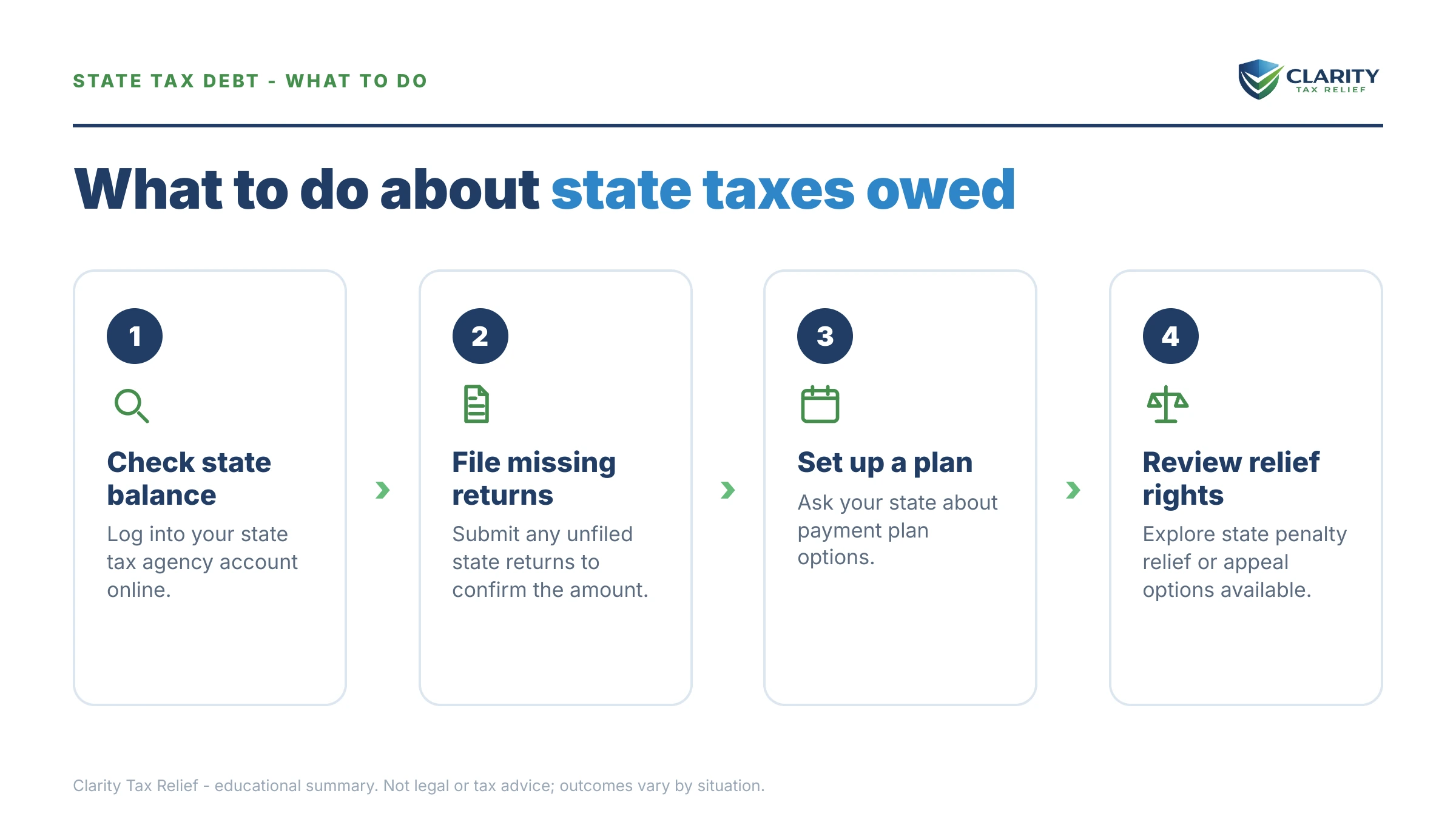
- Check your state account — log into your state tax agency's online account and look for a balance due, an unfiled year, or a collection notice.
- Compare federal and state years — match each year you filed federally against your state returns. A federally filed year with no matching state return is a common cause of a surprise state balance.
- Trace any federal change forward, if a CP2000 or audit raised your federal income, expect a matching state bill later and confirm whether your state has already adjusted your return.
- Decide which debt to address first — prioritize the agency that collects faster or has the longer statute, and set up a plan or hardship status with each before enforcement starts.
- Get a combined review if you owe both — when you owe both the IRS and your state, have an experienced tax professional map both timelines together so one plan doesn't default the other.
When you can handle this yourself, and when help changes the outcome
You can often handle a small, clear-cut state balance on your own. If you filed both returns, agree with the numbers, and can pay within a few months or set up a simple state payment plan online, do it directly through your state's website — there's no reason to pay anyone to click those buttons.
Where experienced help genuinely changes the result is when the two debts collide. If a state levy or wage garnishment is already in motion, if you have unfiled state or federal returns for multiple years, if a business or payroll tax is involved, or if you're weighing an Offer in Compromise, the sequencing matters — fixing them in the wrong order can cost you money or default one plan while you're setting up the other. That's judgment, not data entry.
If you owe both and either balance is significant, a review of how to settle tax debt yourself is a fair first read — then decide honestly whether it's within your reach.
Terms on your notices, decoded
Tax warrant: a state's version of a court judgment for unpaid tax — in states like New York it's public record and acts as a lien on your property.
Treasury Offset Program: the federal system that lets your state intercept your federal tax refund to pay unpaid state income tax.
State Income Tax Levy Program (SITLP): the reverse — how the IRS seizes your state tax refund to pay a federal balance.
Part-year resident return: the return you file in each state for the year you moved, so each state taxes only the income earned while you lived there.
Collection statute: the number of years an agency has to collect — 10 years for the IRS, but 20 for California's FTB and different in every state.
State tax debt questions, answered
If I owe federal taxes, do I owe state taxes too?
Usually yes, if you live in one of the 41 states with a broad income tax, because most states start from your federal adjusted gross income, so the same income that created your IRS bill usually creates a state bill too. Nine states don't tax wage and salary income at all. The two debts are always separate: paying the IRS never clears your state balance, and vice versa.
Which states have no income tax?
Nine states don't tax wages or salary: Alaska, Florida, Nevada, South Dakota, Tennessee, Texas, Wyoming, New Hampshire, and Washington. Washington still taxes certain high capital gains, and New Hampshire phased out its old interest-and-dividends tax. Even in these states you may still owe state sales tax, business tax, or a local tax, and you always still owe the IRS.
Does the IRS tell the state that I owe?
Yes — the IRS and most state tax agencies share audit results and return data. If the IRS changes your income through a CP2000 or an audit, your state usually learns of it and can bill you for the matching state tax, often a year or two later. That is why a federal bill so often turns into a second, separate state bill you weren't expecting.
Can the state take my federal refund, or the IRS take my state refund?
Both happen. Through the Treasury Offset Program, states can intercept your federal refund for unpaid state income tax. The IRS can seize your state refund through the State Income Tax Levy Program. So a refund from one government can quietly disappear to pay a debt owed to the other. Checking both your IRS account and your state account tells you where you actually stand.
I moved to a different state — do I owe taxes in both?
Possibly. In the year you move you generally file a part-year return in each state, and income earned in each state is taxed by that state. If you worked in one state while living in another, or worked remotely across state lines, two states may each claim part of your income. A credit for taxes paid to another state usually prevents true double taxation. But you can still end up owing a balance in a state you no longer live in.
How do I find out if I owe state taxes?
Log into your state tax agency's online account, every state with an income tax has one, and look for a balance due or an intent-to-collect notice. Then compare it to your filed state return. If you never filed a state return for a year you filed federally, that missing return is itself a common reason a state balance appears. Your state agency's website is the only accurate source; do not rely on a third-party estimate.
Is state tax debt worse than IRS debt?
In some states it can be harder to escape. California's Franchise Tax Board has a 20-year collection statute versus the IRS's 10 years, and New York files a tax warrant that becomes a public-record judgment and lien. Many states also move to levy or garnish faster than the IRS and offer fewer settlement options. That is why, when you owe both, the order you tackle them in matters.
Your next 24 hours
- Find the agency and amount: pull out any letter and confirm whether it's from the IRS or your state — the agency name and balance are printed at the top. If you only have a federal notice, that doesn't rule out a state balance.
- Gather your last returns: your most recent federal and state returns, plus login access to both your IRS online account and your state tax account, so you can see both balances side by side.
- Get a free case review: if you owe both, or you're not sure — use the 2-minute form or call (888) 825-7779. Penalties and interest keep accruing on both debts every month, so the sooner both are in a plan, the less you pay.
This guide is general information, not tax or legal advice for your specific situation. Eligibility for IRS programs depends on individual facts and circumstances; no outcome is guaranteed.