
Offer in Compromise
How Long Does an Offer in Compromise Take? The Real 2026 Timeline
What this episode covers
- How long does an IRS offer in compromise take from start to finish?
- What happens to IRS collections while an offer in compromise is pending?
- How much does it cost to submit an IRS offer in compromise?
- How do I appeal a rejected IRS offer in compromise?
How long does an offer in compromise take? Most offers take roughly 7 to 12 months from submission to an IRS decision in 2026, and 12 to 24 months start to finish once you add preparation time and post-acceptance payments. By law, an offer the IRS fails to decide within 2 years is automatically accepted.
You've done the math on your balance, you know a settlement might be possible, and now you're staring at the one question every IRS page dodges: how many months of your life is this going to take? For a married couple carrying an $11,300 balance, the honest answer — about a year, most of it silence — changes which option actually makes sense.
This guide walks the whole clock: every stage, how long each one typically runs, what's protected (and what isn't) while you wait, and when a faster path beats waiting a year. The image below maps the full offer timeline so you can see exactly where a case sits the longest.
⏱ The clock that matters: the IRS has 2 years from the day it receives your offer to decide it — under IRC §7122(f), an offer left undecided that long is deemed accepted automatically. Meanwhile, penalties and interest keep accruing on your full balance the entire time your offer is pending, and the 10-year collection statute is paused.
Why an offer in compromise takes so long in 2026
An offer in compromise takes months because it is one of the few IRS processes where a human being reviews your entire financial life by hand. Payment plans are approved by software in minutes. An offer asks the government to accept less than it's legally owed, so an offer examiner verifies every asset, every income line, and every expense on your Form 433-A (OIC) before anyone says yes.
Two 2026 realities stretch the clock further. First, the IRS workforce was cut roughly 27% in 2025. The centralized offer units weren't spared — fewer examiners are working the same national queue. Second, scrutiny is real: the IRS accepted roughly 1 in 5 offers in FY2024, which means examiners are checking, not rubber-stamping.
If you're still deciding whether an offer fits your situation at all, start with how an offer in compromise actually works. This guide assumes you're weighing the clock — the part of the decision most people underestimate.
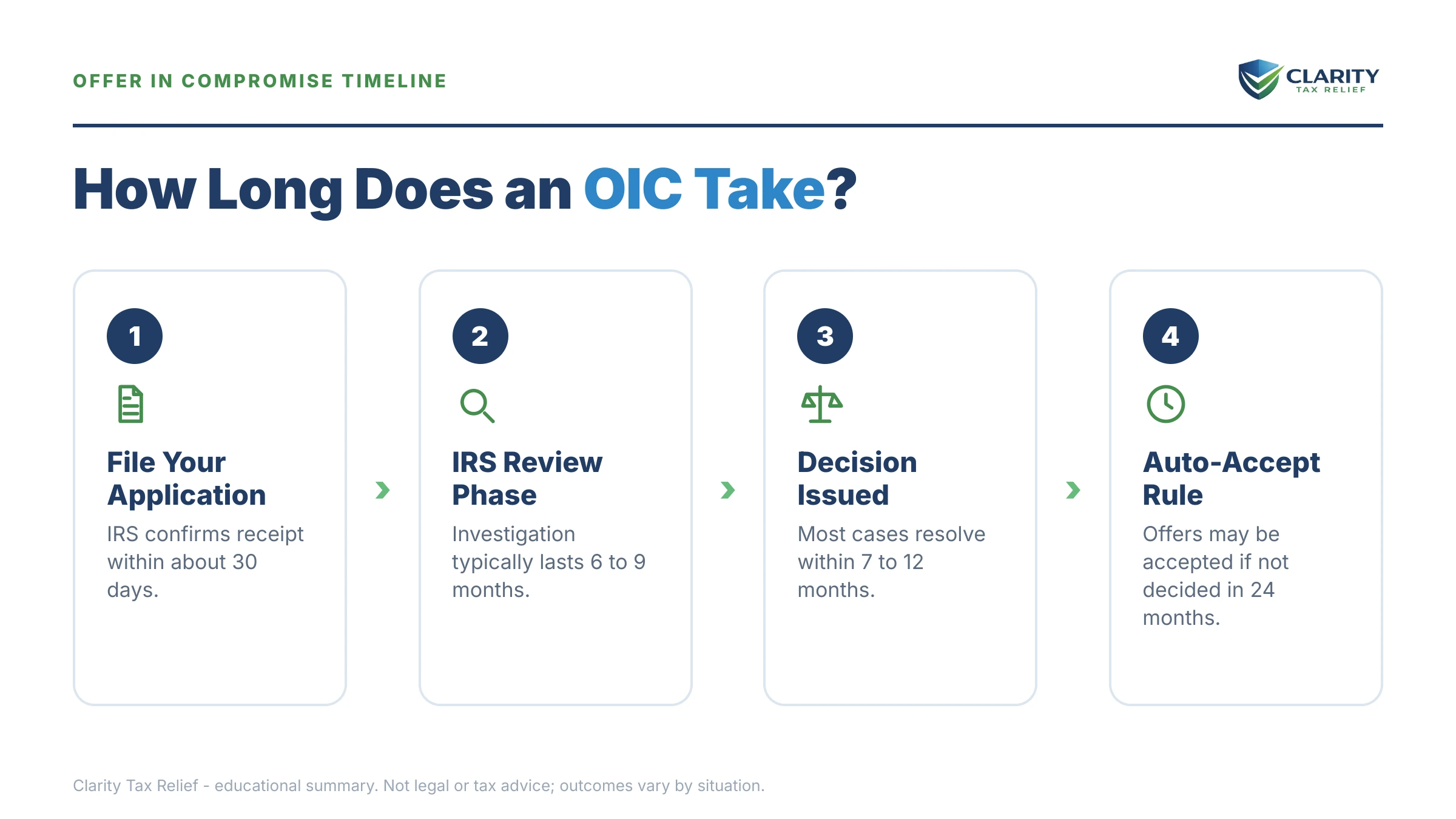
The offer in compromise timeline, stage by stage
An offer in compromise moves through six stages, and the longest one is usually the silent wait for an examiner to be assigned. Here's the sequence from the day you start gathering paperwork to the day the debt is genuinely settled:
- Preparation (typically 3–8 weeks). You gather three months of pay stubs, bank statements, and bills, then complete Form 433-A (OIC) and Form 656. Rushing this stage is how offers get mailed back at stage two.
- Processability screen (roughly the first 4–8 weeks after mailing). The IRS checks that every form is signed, the $205 fee or low-income certification is attached, and all your required returns are filed. Fail any check and the entire package comes back. You lose weeks and start over.
- Queue for assignment (often 3–6 months). Your offer sits in a national inventory waiting for an offer examiner. Nothing is wrong; nobody is ignoring you. This is simply the deepest part of the backlog, and in 2026 it's the stage most likely to stretch.
- Examination (typically 2–6 months). The examiner verifies your figures, requests updated documents, and may argue your reasonable collection potential is higher than you calculated, or propose a counteroffer. How fast you respond here directly moves your total timeline.
- Decision. You receive an acceptance letter, a rejection letter with 30-day appeal rights, or a "returned" offer (no appeal rights, but you can refile).
- Payment and probation. A lump-sum offer requires the remaining balance within 5 months of acceptance. A periodic offer runs on its schedule of up to 24 months. Then comes a 5-year compliance period: file and pay everything on time, or the IRS can reinstate the original debt.
| Stage | What happens | Typical time |
|---|---|---|
| Preparation | Gather financial records; complete Forms 433-A (OIC) and 656 | 3–8 weeks |
| Processability screen | IRS checks fee, signatures, and filed returns; incomplete offers are mailed back | 4–8 weeks |
| Queue for assignment | File waits for an offer examiner — the longest silent stretch | 3–6 months |
| Examination | Examiner verifies finances, requests documents, may counter | 2–6 months |
| Post-acceptance payment | Lump sum: balance due within 5 months; periodic: up to 24 months | Up to 5 or 24 months |
| Compliance period | File and pay on time or the IRS can reinstate the debt | 5 years |
Two edge cases run longer than these ranges. Offers involving self-employment or business income take extra examination time because there's more to verify. And note the timeline above is federal only — California's FTB runs its own separate offer program on its own clock, so a state balance needs its own plan.
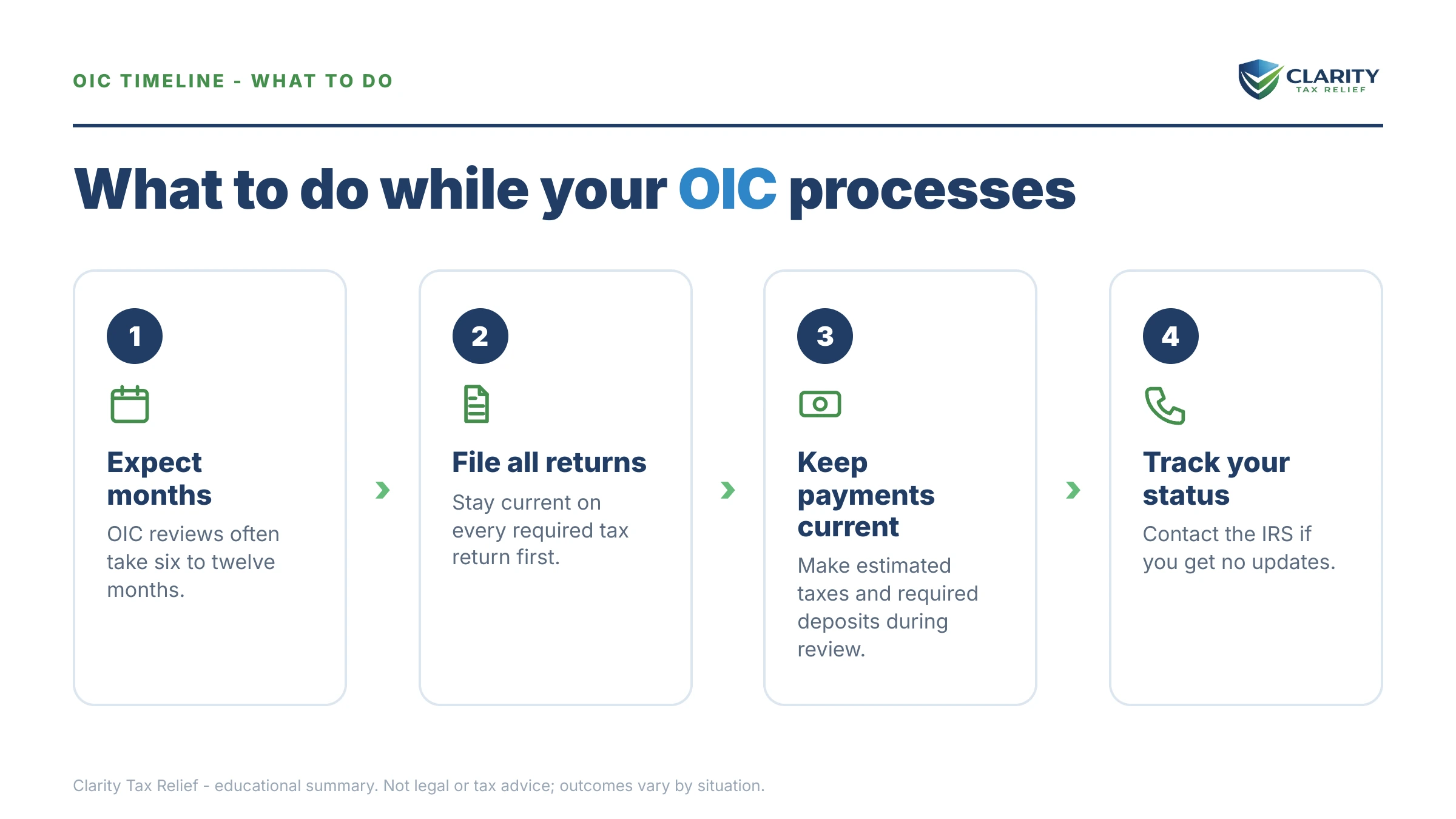
What happens while your offer is pending
While an offer in compromise is pending, the IRS generally suspends levy action on the tax years the offer covers. Your account transcript will show transaction code 480, which is the system's marker that collection is on hold pending the decision.
But "pending" is not a free pause. Four things keep moving while you wait:
- Interest and penalties keep accruing on the full balance. If the offer is accepted, the accruals die with the debt. If it's rejected, you owe the original balance plus everything that built up during the wait.
- A federal tax lien can still be filed. Levy action pauses; lien filing doesn't have to.
- The 10-year collection statute stops running. An offer is one of the events that pauses the 10-year collection clock — a 15-month offer process pushes your debt's expiration date out by roughly 15 months. If your CSED is close, that trade can matter more than the settlement itself.
- Your tax refunds are in play. The rules on refunds around a pending and accepted offer have their own wrinkles — see will the IRS keep my refund after an offer in compromise before you count on that money.
If you chose a periodic-payment offer, you must also keep making the monthly offer payments during the entire review. Stop paying and the IRS can return the offer — months of waiting, erased.
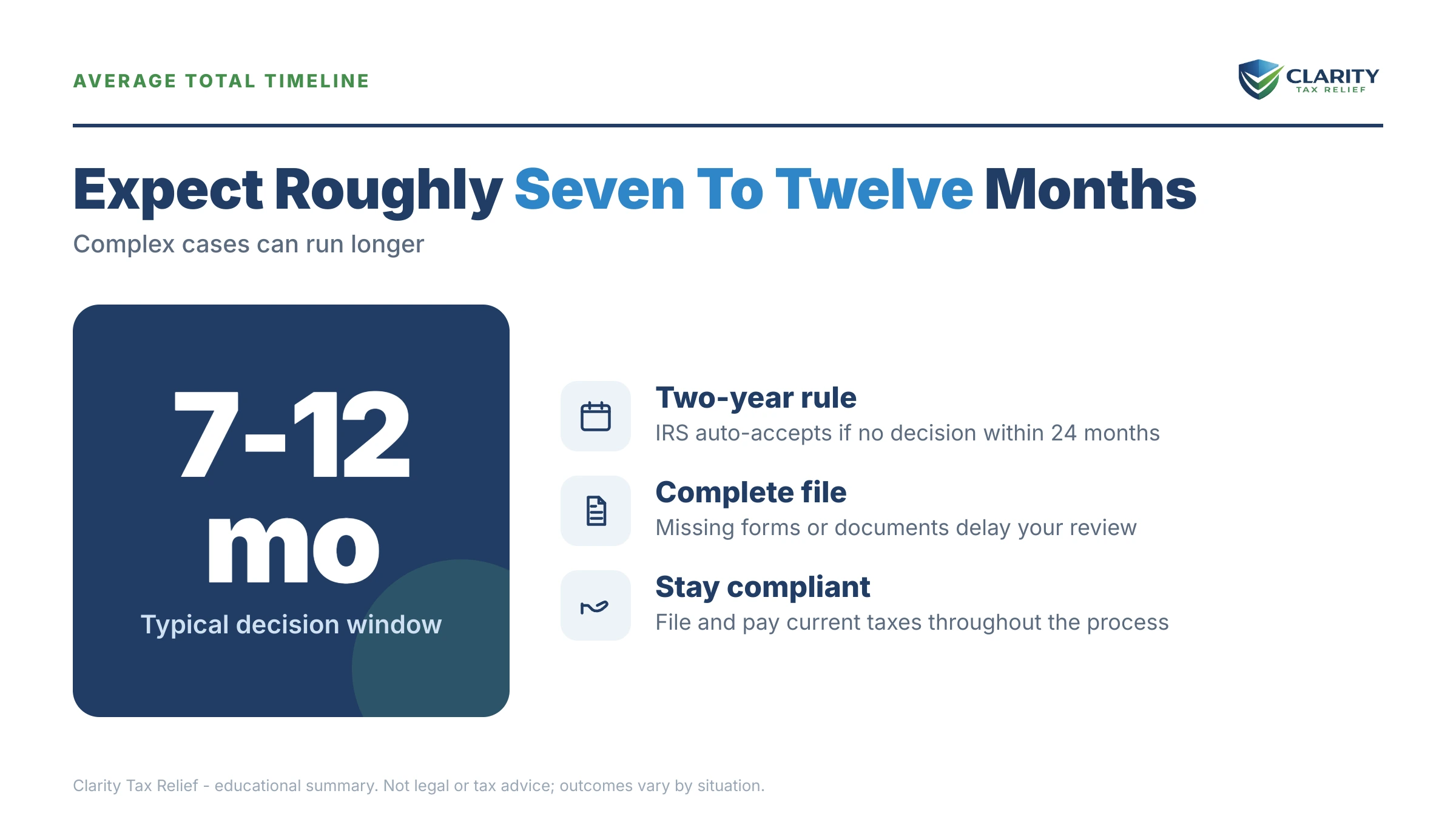
Thinking about a year-long offer process?
A returned or rejected offer doesn't just cost the fee. It costs months while penalties and interest keep growing on your full balance. Before you file, let an experienced tax professional pressure-test your offer numbers free, so the time you invest is time toward an acceptance.
Is a year of waiting worth it? The OIC vs. faster options
Every other IRS resolution path resolves faster than an offer in compromise — most in a single afternoon. The question isn't just "can I settle for less," it's "is the discount worth 12 to 24 months of process, accruing interest. A paused collection statute?" Here's the comparison:
| Option | Upfront cost | Time to resolution | Fits when |
|---|---|---|---|
| OIC — lump sum | $205 fee + 20% of the offer (both waived with low-income certification) | ~12–24 months to a settled debt | Your RCP math lands well below your balance |
| OIC — periodic | $205 fee + monthly offer payments that continue during review | 12–24+ months | You can't fund the 20% down payment |
| Short-term payment plan | $0 setup | Set up same day online; paid within 180 days | You can pay in full within six months |
| Streamlined installment agreement | Modest setup fee (lower with direct debit) | Same day online; up to 72 months to pay | Balance ≤ $50,000 with steady income |
| Currently Not Collectible | $0 | Weeks, after a financial review | Paying anything would create genuine hardship |
Your balance changes the calculus too. The smaller the debt, the more the fixed costs of the offer process — the fee, the down payment. A year of accruals — eat into whatever the settlement saves:
| You owe | Fastest realistic path | Is the 12+ month OIC wait usually worth it? |
|---|---|---|
| Under $10,000 | Guaranteed installment agreement or 180-day plan, set up online | Rarely — payment options are near-automatic at this level, and hardship cases usually fit CNC faster |
| $10,000–$25,000 | Streamlined installment agreement, same day | Sometimes — when RCP lands far below the balance, as in the $11,300 example below |
| $25,000–$50,000 | Streamlined agreement with direct debit | More often — the dollar gap between RCP and balance can justify the wait |
| Over $50,000 | Installment agreement with financial disclosure | Frequently worth evaluating — but expect deeper scrutiny and a longer examination stage |
| Any amount, true hardship | Currently Not Collectible status in weeks | Compare first — see CNC vs offer in compromise |
One more fork worth naming: if you dispute that you owe the amount at all, that's a doubt-as-to-liability offer — a different track with no application fee and no financial disclosure, decided on the merits of the tax itself rather than your ability to pay.
How long does an offer in compromise take when you owe $11,300? A worked example
Say you and your spouse file jointly and owe $11,300 from a prior year. Here's the hypothetical math and the hypothetical clock, side by side.
The offer math. Your reasonable collection potential is what the IRS believes it could ever collect: your net asset equity plus a multiple of your monthly disposable income. Suppose your assets net $1,400 after the IRS's quick-sale discounts, and your income minus IRS-allowable living expenses leaves $190 a month. For a lump-sum offer, the future-income multiplier is 12 months:
$1,400 + ($190 × 12) = $1,400 + $2,280 = $3,680 offer
You can run your own rough numbers with our Offer in Compromise Calculator — it estimates an offer range from the same inputs an examiner will scrutinize.
The cost at filing. $205 application fee plus 20% down ($736) — $941 out the door on day one. If your household AGI is at or below 250% of the federal poverty level for your family size, the low-income certification waives the fee, the down payment, and payments during review entirely.
The clock. Six weeks of preparation, six weeks in the processability screen, four months in the queue, three months of examination, then, if accepted, the remaining $2,944 within 5 months (about $589/month). Total: roughly 15 months from first pay stub to settled debt, then five years of on-time filing to keep it settled.
The alternative. A streamlined installment agreement on $11,300 over 72 months is about $157 a month before accruals — set up online the same afternoon, no examiner, no disclosure of every bank statement. The offer saves this couple thousands if accepted. But with roughly 1 in 5 offers accepted, the RCP math has to be genuinely strong before the 15-month bet beats the same-day plan. That's exactly the judgment call worth getting a second set of eyes on.
How to file an offer that gets decided faster, step by step
You can't make the IRS work faster, but you can stop adding your own months to the timeline. Almost every controllable delay happens at your end of the process:
- File every missing return. The IRS will not treat your offer as processable with unfiled years on record — catching up on returns first prevents the most common weeks-long bounce-back.
- Gather three full months of financial records. Collect pay stubs, bank statements, and household bills before you start Form 433-A (OIC) — assembling documents mid-form is the top cause of preparation delay and examiner follow-up requests.
- Set your offer amount from the RCP math. Calculate your reasonable collection potential honestly and offer that number — lowball offers trigger counteroffers and months of extra negotiation, or outright rejection.
- Submit a complete, signed package. Include Form 656, Form 433-A (OIC) with attachments, and the $205 fee plus any required down payment, or the low-income certification, so the offer clears the processability screen the first time.
- Respond to the examiner within days, not weeks. Stay current on this year's taxes while you wait, keep making periodic payments if you chose that route, and turn around every document request fast — slow responses stall files at the bottom of the pile.
When you can handle the offer process yourself
Plenty of people complete an offer in compromise without professional help, and you may be one of them. You're a good DIY candidate if your income is W-2 wages, your assets are simple (a car, a modest bank account, maybe a retirement account), all your returns are filed. Your RCP math clearly lands below your balance. The IRS's own pre-qualifier and forms are free, and patience is the main skill required.
Experienced help changes outcomes in specific situations: self-employment or business income (where examiners dig hardest and the future-income math gets contested), multiple unfiled years that must be cleaned up first, an examiner counteroffer you don't know whether to accept, a CSED close enough that pausing it is risky, or a prior offer that was returned or rejected. In those cases the professional's job isn't paperwork — it's defending your expense figures and your valuation so the examiner's number stays close to yours.
The honest test: if you can't explain why your offer amount equals your RCP, you're not ready to defend it to an examiner. A defense is exactly what the examination stage is.
Terms on your offer paperwork, decoded
- Reasonable collection potential (RCP): the IRS's calculation of the most it could ever collect from you — net asset equity plus a multiple of monthly disposable income — and the floor for any acceptable offer.
- Processable: the IRS's threshold ruling that your package is complete enough to review; a "non-processable" offer is mailed back without a decision.
- Offer examiner: the IRS employee assigned to verify your finances and recommend acceptance, rejection, or a counteroffer.
- Transaction code 480: the transcript marker showing your offer is pending and collection is suspended.
- Deemed acceptance: the IRC §7122(f) rule that an offer not decided within 2 years of receipt is accepted automatically by operation of law.
- Five-year compliance period: the post-acceptance probation — file and pay everything on time for 5 years, or the IRS can reinstate the original debt minus what you paid.
Not sure whether your household's numbers make you a strong candidate or a 15-month long shot? An experienced tax professional can run your RCP in one free call — (888) 825-7779 or the 2-minute form — before you commit a year to the process.
If your offer is rejected: how long the appeal adds
A rejected offer gives you exactly 30 days from the rejection letter to appeal, and the appeal typically adds several more months. You file Form 13711, the IRS Independent Office of Appeals schedules a conference, and collection stays paused while it's considered. Appeals officers take a fresh look — offers do get accepted at this stage after an examiner said no.
Know the difference between rejected and returned. A rejection comes with appeal rights and a stated reason (usually that your RCP supports a higher amount). A return — for missing documents, unfiled returns, or missed periodic payments — carries no appeal rights. Your only path is fixing the defect and refiling from the back of the queue.
If you do nothing after a rejection, the sequence is predictable: the collection hold lifts, the CSED clock restarts, the accrued penalties and interest fold into your balance, and IRS collection notices resume where they left off — eventually escalating toward levy authority if the balance stays unaddressed. Don't let a rejection become abandonment; the same finances that supported an offer usually support a payment plan or hardship status instead. Start with OIC rejected — now what to pick the next move within your 30-day window.
For the IRS's own program terms, see the official Offer in Compromise page at IRS.gov. Faster alternatives live on the IRS payment plans page. And if your offer has been pending far beyond normal timeframes with no examiner contact, the Taxpayer Advocate Service exists for exactly that kind of stall.
Offer in compromise timeline questions, answered
How long does the IRS take to review an offer in compromise?
Most offers take roughly 7 to 12 months from the date the IRS receives them to a decision letter. The first month or two is a processability screen; the longest stretch is usually the silent wait for an offer examiner to be assigned. Simple wage-earner offers can close faster, while self-employed and business-connected offers often run longer.
Can I speed up an offer in compromise?
You can't jump the IRS's queue, but you can eliminate the delays applicants cause themselves. File a complete package — every form signed, all returns filed, the fee or low-income certification attached — so it isn't mailed back weeks later. Then answer examiner document requests within days instead of weeks; slow responses are the most common self-inflicted delay during examination.
What happens if the IRS takes more than 2 years to decide my offer?
It is automatically accepted. Under IRC §7122(f), an offer the IRS does not decide within two years of receipt is deemed accepted by law. In practice this is rare because the IRS tracks that deadline closely. But it is a real backstop — a pending offer is never simply lost in the system forever.
Can the IRS levy me while my offer in compromise is pending?
Generally no. Levy action on the tax years covered by your offer is suspended while it is pending, and your transcript will show transaction code 480. Two exceptions matter: the IRS can reject an offer quickly if it believes you filed solely to delay collection. A federal tax lien can still be filed even while levies are paused.
Does interest keep accruing while my offer is under review?
Yes. Penalties and interest continue to build on your full balance the entire time your offer is pending. If the offer is accepted, those accruals are wiped out with the rest of the unpaid debt. If it is rejected, you owe the original balance plus everything that accumulated during the wait — which is why filing a weak offer has a real cost.
How do I check the status of my offer in compromise?
Call the number on the acknowledgment letter the IRS sends after your offer passes the processability screen, or contact the examiner directly once one is assigned. You can also watch your IRS account transcript: code 480 confirms the offer is pending, code 481 means it was rejected, and code 482 means it was withdrawn.
How long after acceptance is my tax debt actually settled?
Not until you finish paying and complete the compliance period. After acceptance, a lump-sum offer requires the remaining balance within 5 months; a periodic offer runs on your 24-month schedule. Then you must file and pay every tax on time for the next 5 years. Default on either and the IRS can reinstate the original debt, less what you paid.
How long does an offer in compromise appeal take?
Plan on several more months. You have 30 days from the rejection letter to file Form 13711. The IRS Independent Office of Appeals then schedules a conference — commonly adding roughly three to nine months to the total timeline. Collection stays paused during the appeal, and Appeals can and does accept offers that examiners rejected.
Does applying for an offer in compromise pause the 10-year collection statute?
Yes. The collection statute expiration date (CSED) stops running while your offer is pending and for a short period afterward, including any appeal. A 15-month offer process pushes your debt's expiration date out by roughly 15 months — worth weighing carefully if your CSED is already within a couple of years.
Your next 24 hours
- Pull your IRS account transcript (or your most recent balance-due notice) and confirm the total you owe and every tax year it covers — an offer must include all of them. An unfiled year anywhere blocks the whole thing.
- Gather your last three months of pay stubs, bank statements, and household bills. This stack is the raw material of Form 433-A (OIC), and having it ready collapses the preparation stage from two months to two weeks.
- Get a free case review before you file — the 2-minute form or (888) 825-7779. An experienced tax professional will run your RCP math and tell you straight whether the year-long offer path fits your numbers or whether a same-day option serves you better, while penalties and interest are still accruing on the full balance either way.
This guide is general information, not tax or legal advice for your specific situation. Eligibility for IRS programs depends on individual facts and circumstances; no outcome is guaranteed.