
State & Local Tax Relief
Tax Relief New York: Every Real IRS and NYS Option in 2026
The short answer: tax relief in New York means dealing with two separate collectors — the IRS and the New York State Department of Taxation and Finance. Both offer payment plans, hardship status, and offer-in-compromise settlements, but the state moves faster, files public tax warrants that work like judgments, and can suspend your driver's license over larger debts.
Maybe the divorce is final but the tax bill it left behind isn't. You filed single for the first time, the withholding was set for two incomes, and now both Albany and the IRS say you owe. This is the complete map of tax relief New York residents can actually use in 2026, with the real thresholds, costs, and traps on each side.
⏱ The clock that's actually running: there's no single printed deadline on a general tax debt, but the IRS adds a 0.5% failure-to-pay penalty every month plus compounding interest, and New York adds its own penalties and interest in parallel. Every month you wait, both balances grow, and the state can docket a warrant while you're still deciding.
Why New York tax debt is a two-front problem
New Yorkers who fall behind on taxes almost always owe two agencies at once: the IRS and the New York State Department of Taxation and Finance. The same underpayment that creates a federal balance usually creates a state one, because both are calculated from the same income.
Three New York-specific wrinkles make it worse. First, if you live in New York City, city income tax rides on your state return, so a NYS balance often already includes a city portion you didn't budget for. Second, the state's collection machinery is faster and more public than the IRS's. Third, a divorce scrambles everything: withholding set for married-filing-jointly, a filing status change, and joint-return debt that follows both ex-spouses.
On that last point — a divorce decree that assigns the tax debt to your ex does not bind the IRS or the state. Both can pursue either spouse for 100% of a joint-return balance. Our guide to divorce and who pays IRS debt covers that trap in depth, and innocent spouse relief and how to qualify covers the main way out. For the full state-side playbook, start with our New York State back taxes help hub.
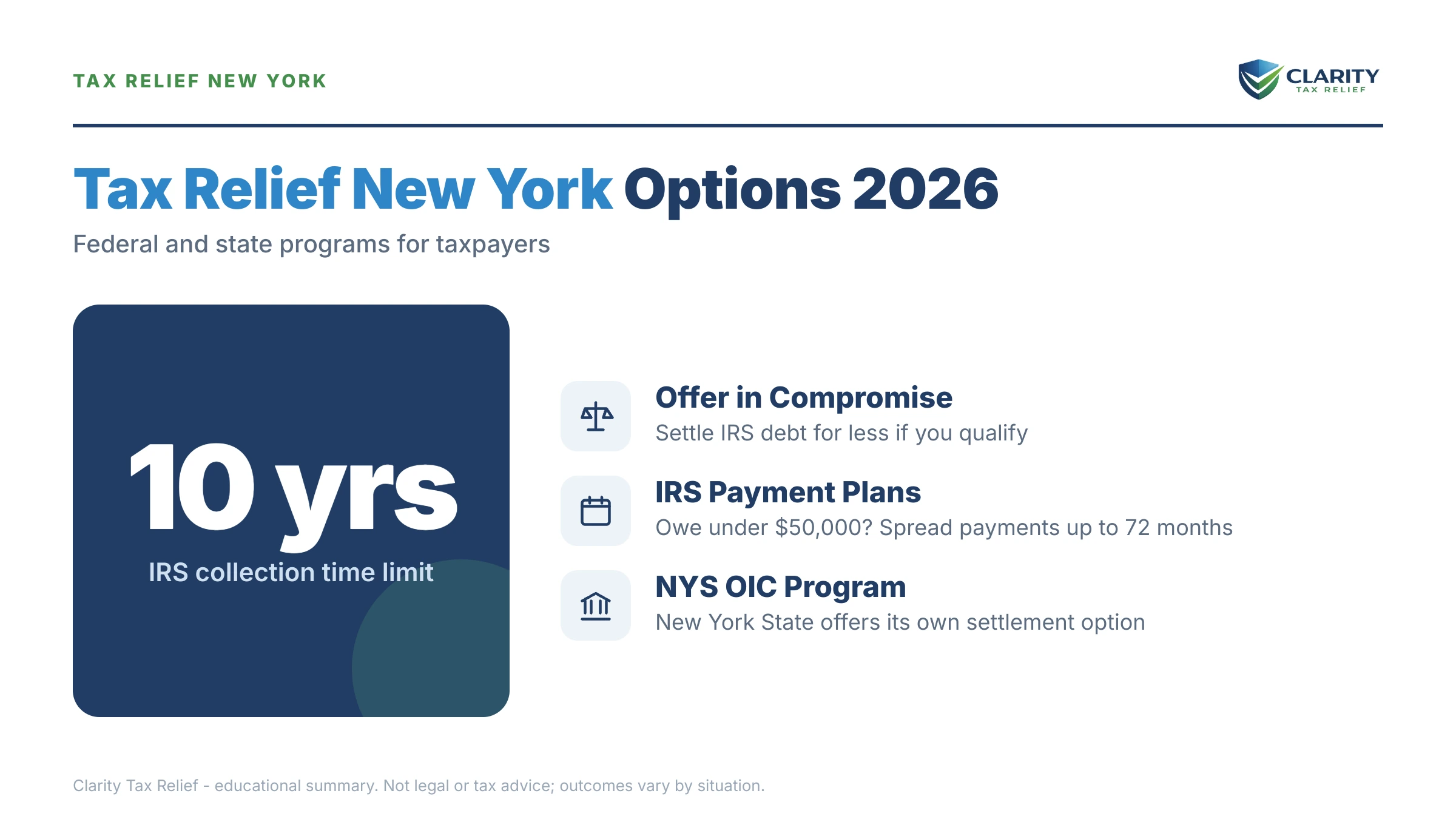
“An offer in compromise allows you to settle your tax debt for less than the full amount you owe. It may be a legitimate option if you can't pay your full tax liability or doing so creates a financial hardship.”
— Offer in compromise (IRS.gov)
What happens if you ignore IRS and NYS tax debt
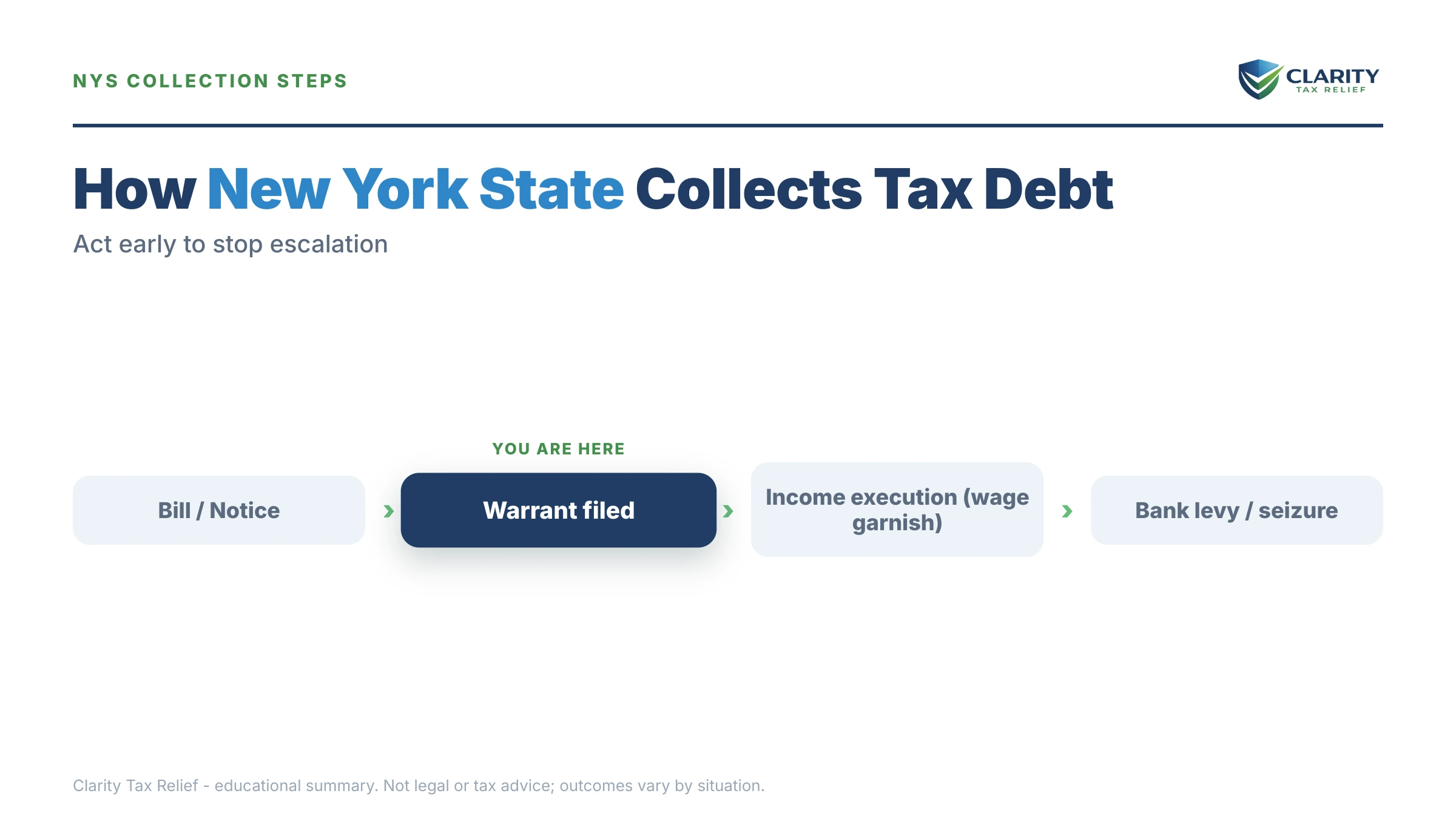
Ignoring tax debt in New York triggers two escalation tracks at once, and the state's track usually reaches enforcement first. Here's the sequence on each side:
- First bills. The IRS mails a CP14 with roughly 21 days to respond; New York sends its own assessment and demand notices. No enforcement yet on either side. This is the cheapest moment to act.
- Automated reminders. IRS CP501 and CP503 notices arrive while interest and the monthly late-payment penalty compound; the state's demand letters escalate in parallel.
- IRS CP504. The IRS can now seize your New York State tax refund — one collector literally intercepting money from the other.
- NYS tax warrant docketed. The state files a NYS tax warrant with the county clerk and the Department of State. It functions as a civil judgment and lien, it's a public record. It unlocks income executions (wage garnishment), bank levies, and — generally at $10,000 or more of debt — a referral for NYS driver's license suspension for tax debt.
- IRS final notice (LT11 / Letter 1058). This starts a 30-day window to request a Collection Due Process hearing. After it closes, the IRS can garnish wages continuously and levy bank accounts (funds are held 21 days before they leave).
- Sustained enforcement. Both agencies keep collecting on autopilot. In 2026 the IRS workforce is down roughly 27% from 2025 cuts — humans are harder to reach. But the automated levies never stopped, and New York's systems never slowed at all.
Facing the IRS and New York State at the same time?
A plan that satisfies one collector while ignoring the other usually fails, and interest is compounding on both balances every month. Get both sides reviewed free by an experienced tax professional before the state dockets a warrant.
Tax relief New York options: every IRS and NYS program compared
Every legitimate tax relief path in New York falls into four families: pay over time, pause collection, settle for less, or remove penalties. The table below shows what each program requires in 2026 — note that the federal and state versions of each are separate applications with separate math.
| Program | Who typically qualifies | Cost and key terms |
|---|---|---|
| IRS short-term plan | Can pay in full within 180 days | $0 setup; interest + 0.5%/month penalty continue until paid |
| IRS guaranteed installment agreement | Owe $10,000 or less, returns filed | IRS must accept a plan that pays within 3 years |
| IRS long-term installment agreement | Owe $50,000 or less (combined) | Up to 72 months, set up online; interest keeps accruing |
| IRS Offer in Compromise | Collection potential below the balance | $205 fee + 20% down on lump-sum offers (both waived at low income); ~1 in 5 accepted in FY2024 |
| IRS Currently Not Collectible | Financials show paying anything is a hardship | $0; collection pauses, debt and interest remain |
| IRS penalty abatement (FTA / AEP) | Clean compliance for the prior 3 years | Free; AEP makes this automatic starting summer 2026 |
| NYS Installment Payment Agreement | All state returns filed; balance-based review | Terms generally shorter than the IRS's 72 months; larger balances need financial disclosure |
| NYS offer in compromise | Insolvency or undue economic hardship | State runs its own financial analysis, separate from any IRS offer |
A few of these deserve a closer look for New Yorkers:
Payment plans. The IRS side is well-mapped: under $10,000 you're in guaranteed installment agreement territory, and up to $50,000 a streamlined installment agreement can be set up online without detailed financials. The state side is stingier — see our NYS tax payment plan guide for how Albany's Installment Payment Agreements actually work and what the state demands for larger balances.
Settling for less. The IRS Offer in Compromise turns on your Reasonable Collection Potential — what your assets plus future income could realistically pay before the collection statute runs out. If that number is below your balance, an offer is worth exploring. You can estimate your own range with our Offer in Compromise Calculator. New York's offer program exists too, but it centers on insolvency or undue economic hardship, and a federal acceptance carries zero weight in Albany.
Pausing collection. IRS Currently Not Collectible status stops federal levies when your budget genuinely can't support a payment — common in the first year after a divorce when alimony, child support. A single income collide. New York has its own hardship review, but a docketed warrant stays on record even while collection pauses.
Removing penalties. If this is your first slip in years, first-time penalty abatement can strip IRS failure-to-pay penalties, and starting summer 2026, the new Automatic Exemption from Penalty (AEP) applies this relief automatically, no request needed. New York abates penalties only for reasonable cause, so the state request needs a documented story, not just a clean history.
A worked example: owing $8,900 after a New York divorce
An $8,900 IRS balance sits below every major enforcement threshold — which means nearly every option is still open. Say your divorce finalized last spring, your withholding stayed at married rates all year, and filing single left you $8,900 short. Here's the actual math (hypothetical figures, rounded):
- Pay within 180 days: about $1,484/month for six months ($8,900 ÷ 6). $0 setup fee — the cheapest route if a settlement payout or house-sale proceeds are coming.
- Guaranteed installment agreement: because the balance is under $10,000, the IRS must accept a plan that pays it within three years — roughly $247/month ($8,900 ÷ 36) plus interest, plus the 0.5% monthly penalty, which starts around $44/month and shrinks as the balance falls.
- If the budget truly can't support a payment: child support, rent on one income, and legal bills can qualify you for Currently Not Collectible — the debt waits while you rebuild.
- Penalty relief: a clean prior three years means first-time abatement (or the 2026 AEP) can remove the failure-to-pay penalties already stacked on top.
Two reassurances specific to this size of debt: $8,900 is far below the $66,000 passport-certification threshold for 2026, and if it's IRS-only, no state warrant is coming. But if a matching NYS balance exists — say $2,400 — size both plans together: $247 to the IRS plus a state payment is very different from $247 alone.
IRS vs. New York State: how collection actually differs
The IRS generally has 10 years from assessment to collect; New York's docketed warrant follows you far longer. That single difference — plus the warrant's public, judgment-like nature — is why the state side often deserves first attention even when the federal balance is bigger. Our guide to state tax debt vs IRS — which to resolve first walks through the sequencing logic; here's the side-by-side:
| Collection question | IRS | New York State |
|---|---|---|
| Public filing | Notice of Federal Tax Lien | Tax warrant — a docketed judgment, public record |
| Wage action | Continuous levy until released | Income execution after a warrant |
| Collection time limit | Generally 10 years from assessment (CSED) | Far longer on a docketed warrant — waiting it out isn't realistic |
| License consequences | Passport certification at $66,000+ (2026) | Driver's license suspension referral, generally $10,000+ |
| Online payment plan | Up to 72 months if you owe $50,000 or less | Shorter terms; bigger balances require financial disclosure |
| Settlement program | Offer in Compromise (Form 656) | NYS offer in compromise (insolvency / hardship standard) |
How to respond, step by step
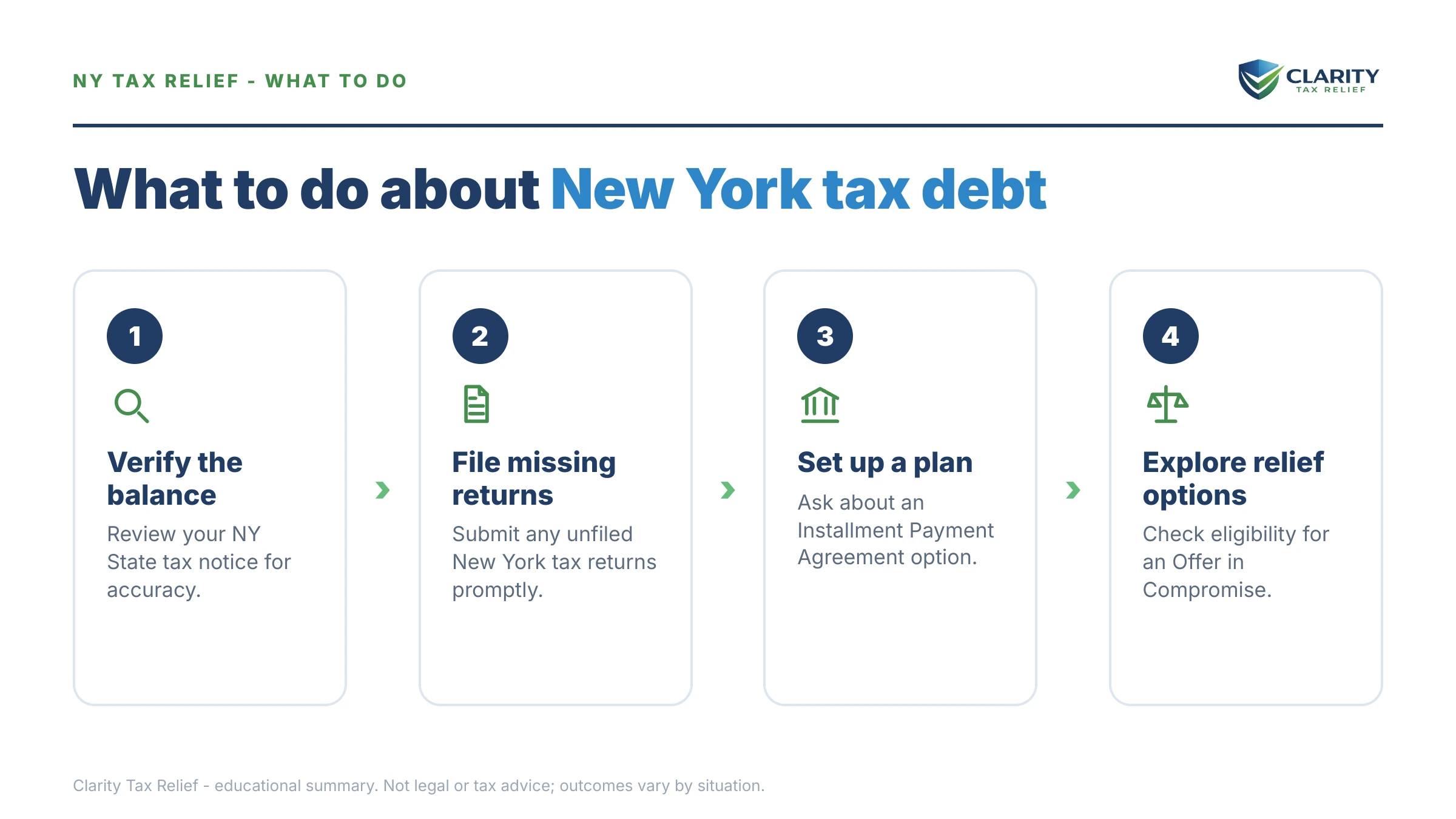
- Pull both balances — log into your IRS online account and your NYS Tax Department Online Services account so you're working from real numbers, not fear.
- Check for a docketed warrant — search your name with your county clerk or ask the Tax Department. A warrant on record changes which agency you stabilize first.
- File anything unfiled — neither agency approves a payment plan or offer with missing returns. The failure-to-file penalty is 10 times the failure-to-pay penalty — though in months where both apply, the failure-to-file portion drops to 4.5% (5% combined).
- Set up an arrangement with each agency — choose from the options table above and lock in both plans before enforcement starts, sized so the combined payment fits your budget.
- Request penalty relief — ask the IRS about first-time abatement (the automatic AEP replacement begins summer 2026) and ask New York about reasonable-cause abatement.
When you can handle this yourself, and when help changes the outcome
You can resolve a balance under $10,000 that you agree with, federal or state, without paying anyone for help. The IRS online payment-plan tool and the state's Online Services both handle straightforward cases: one tax year, returns filed, a bill you don't dispute. Set up the plan, request penalty abatement, done.
Experienced help changes outcomes in a different set of situations: a warrant already docketed or a license-suspension notice in hand. An income execution or bank levy in motion. Joint-return debt from a marriage that ended (innocent spouse cases are evidence-heavy and deadline-bound). Multiple unfiled years on either side. Or offer-in-compromise math on two agencies at once, where the order you resolve things in changes what you ultimately pay. Both agencies negotiate from your documented finances — presenting them correctly the first time is most of the job.
Terms on your New York tax notices, decoded
- Tax warrant — New York's public collection filing; it works like a court judgment plus a lien, without the state ever suing you.
- Docketed — the warrant has been recorded with the county clerk and Department of State, making it enforceable and searchable.
- Income execution — the state's wage garnishment, served on you or your employer after a warrant.
- Installment Payment Agreement (IPA) — New York's name for a monthly payment plan.
- CSED — the Collection Statute Expiration Date, when the IRS's 10-year right to collect a given assessment ends. It can be paused by appeals, offers, or bankruptcy.
- Joint and several liability — on a joint return, each spouse owes 100% of the balance, regardless of what the divorce decree says.
For deeper reading, the primary sources are the New York State Department of Taxation and Finance, the IRS's official payment plans and installment agreements page, and, if you're stuck between systems, the Taxpayer Advocate Service.
New York tax relief questions, answered
Does New York State have a tax relief program like the IRS Fresh Start?
New York State doesn't use the "Fresh Start" name. But it runs parallel programs: Installment Payment Agreements, an offer in compromise for taxpayers who are insolvent or facing undue economic hardship, and penalty abatement for reasonable cause. The eligibility math is its own — the state performs a separate financial review. Its payment terms generally run shorter than the IRS's 72-month plans. Qualifying for an IRS program never guarantees the state will match it.
Can New York State suspend my driver's license for back taxes?
Yes. New York can refer past-due tax debt — generally $10,000 or more — for driver's license suspension, one of the most aggressive state collection tools in the country. You receive a notice first with a window to respond, and entering a payment agreement typically stops the suspension. If you drive for work, treat that notice as an emergency and act inside the window.
What is a New York tax warrant?
A New York tax warrant is a public filing that operates like a civil judgment against you: it creates a lien on your property and clears the legal path for wage garnishment and bank levies. Because it's docketed with the county clerk and the Department of State, lenders and landlords can find it. It hits faster and more publicly than the IRS's federal tax lien process.
If I owe both the IRS and New York State, which do I pay first?
Usually the agency closest to enforcement, and in New York that's often the state, because a tax warrant can be docketed while the IRS is still mailing reminder notices. Ignoring either one lets interest compound on both balances. Most successful plans run in parallel: an arrangement with each agency, sized so the combined monthly payment is actually sustainable.
Am I responsible for my ex-spouse's tax debt after our divorce?
If the debt comes from a jointly filed return, yes — both spouses are jointly and severally liable for the full amount, and neither the IRS nor New York State is bound by your divorce decree. Your escape routes are innocent spouse relief (Form 8857 federally; New York runs its own version) or separation-of-liability relief after divorce. Debt from your ex's separately filed return is not yours.
Does New York State accept offers in compromise?
Yes — New York State runs its own offer in compromise program, entirely separate from the IRS's, for taxpayers who are insolvent or for whom full payment would create undue economic hardship. Acceptance is never automatic; the state performs its own financial analysis. A federal OIC acceptance does not obligate New York to settle, so treat the two applications as separate cases.
How long can New York State collect a tax debt?
Far longer than the IRS can. The federal collection statute generally expires 10 years after assessment, but New York's window on a docketed tax warrant runs for decades — waiting out the state is not a realistic strategy. An approaching federal CSED can reshape your IRS strategy, but it does nothing to a state warrant.
Do I owe separate New York City income tax on top of state tax?
Not separately billed, if you live in New York City, city income tax is calculated on your state return and collected by the Tax Department, so a NYS balance usually already includes the city portion. Yonkers residents have a similar surcharge. This is one reason state balances surprise people who moved into the city mid-year with withholding set for a suburb.
Your next 24 hours
- Pull both numbers. Log into your IRS online account and your NYS Tax Department Online Services account, and write down exactly what each says you owe and for which years.
- Gather three things: your most recent tax return, every IRS and New York notice you've received. A rough monthly picture of your income and expenses on your current (single) budget.
- Get a free case review — call (888) 825-7779 or use the 2-minute form. Both balances are growing with interest and penalties every month, and a New York warrant is far easier to prevent than to remove.
This guide is general information, not tax or legal advice for your specific situation. Eligibility for IRS programs depends on individual facts and circumstances; no outcome is guaranteed.