
City Guides
Tax Relief Orlando: How to Resolve IRS Tax Debt in Central Florida (2026)
The short answer: tax relief in Orlando means resolving IRS debt through federal programs — payment plans up to 72 months, Offers in Compromise, hardship status, and penalty abatement — because Florida has no state income tax. Most Orlando cases are handled online or by phone; eligibility depends on your balance, income, and filing compliance.
If you're searching for tax relief in Orlando, you probably didn't get here by accident — a bill from the IRS did it. Maybe the divorce is final but the joint tax years aren't, and a balance you thought your ex was handling just showed up in your mailbox with your name on it. That debt is real, but so is the map out of it, and every option runs through a handful of IRS programs with clear rules you can check against your own numbers.
⏱ The real clock: there's no single deadline on "tax relief" itself, but the failure-to-pay penalty adds 0.5% of your unpaid balance every month, interest compounds daily on top of it, and each IRS notice you don't answer moves your account one step closer to a levy. Waiting is the only option that always costs more.
Why Orlando taxpayers end up owing the IRS
Orange County's tourism-driven economy runs on tips, 1099 gigs, and second jobs — three of the most common ways under-withholding turns into IRS debt. The people who serve 70-plus million annual visitors are exactly the people the withholding system serves worst.
The patterns we see most from Orlando readers:
- Tipped hospitality income. Servers, bartenders, and resort staff whose reported tips outran their paycheck withholding — the W-2 looks fine until the return is filed.
- Two W-2 jobs. A theme-park job plus a second gig each withholds as if it's your only income, and the shortfall lands in April.
- Gig and rideshare work along the I-Drive and airport corridors — 1099 income with no withholding and no quarterly payments made.
- Vacation-rental income. Short-term rentals near the parks generate 1099-K income many hosts never planned taxes around, if that's you, our guide for the Airbnb host who owes taxes goes deeper.
- Divorce. Joint returns signed during the marriage leave both spouses fully liable for the whole balance, no matter what the decree says — more on that below, and in our guide to divorce and who pays IRS debt.
- Small business debt. Restaurants, contractors, and service businesses juggling payroll deposits and Florida sales tax — a different animal, covered in our tax relief for small business guide.
Whatever produced the balance, the resolution options are the same federal menu, and knowing which door you fit through is most of the battle.
“An offer in compromise allows you to settle your tax debt for less than the full amount you owe. It may be a legitimate option if you can't pay your full tax liability or doing so creates a financial hardship.”
— Offer in compromise (IRS.gov)
Florida has no state income tax: here's what that changes
Florida has no personal state income tax, so every dollar of back income tax an Orlando resident owes is federal. That's genuinely good news: you're fighting on one front, not two, and there's no state revenue department stacking a second collection case on top of your IRS one. Our guide for Florida residents with IRS debt covers this dynamic in full.
Three Florida-specific wrinkles still matter for your case:
1. Your homestead won't stop a federal lien. Florida's famous homestead exemption shields your home from most creditors, but federal tax liens override state homestead protection. If the IRS files a Notice of Federal Tax Lien, it attaches to your Orlando home regardless of state law. Actual seizure of a primary residence is rare and requires court approval, but the lien clouds your title and complicates any sale or refinance.
2. Business taxes go through Tallahassee, not the IRS. If your debt involves sales tax or reemployment tax from a business, the Florida Department of Revenue is a separate, and aggressive — collector with its own rules and timelines. Don't apply anything in this article's IRS thresholds to a state sales-tax balance; contact the Department directly or get the debt reviewed.
3. Hurricane declarations can move your deadlines. When FEMA declares a disaster for Central Florida counties, the IRS typically postpones filing and payment deadlines automatically for affected taxpayers. Postponement isn't forgiveness, interest keeps accruing on existing balances, but it can buy real breathing room. See how disaster-relief deadline extensions work before assuming your date moved.
What happens if you ignore IRS debt in Orlando
IRS collection runs on an automated notice sequence, and in 2026 the automation is doing more of the work than ever — the IRS workforce shrank roughly 27% in 2025. But the systems that issue liens and levies never stopped. Nobody in Orlando gets skipped because the phone lines are jammed.
Here's the sequence, in order:
- CP14 — the first bill. You typically have about 21 days from the notice date before the sequence advances (10 business days when the balance is $100,000 or more). This is the cheapest moment to act.
- CP501 / CP503 — reminders. Still just bills, but the balance grows monthly and the file keeps moving.
- CP504 — intent to levy your state refund. Florida has no state income tax refund to take, so for most Orlando wage earners this notice's real message is what comes next. A federal tax lien becomes a live possibility here.
- LT11 / Letter 1058 — final notice of intent to levy. This starts a 30-day clock and your Collection Due Process rights (requested on Form 12153). After it expires, the IRS can levy without further warning.
- Levy. A bank levy freezes funds with a 21-day hold before the money leaves. A wage levy is continuous until released; Social Security can be levied up to 15% through the Federal Payment Levy Program.
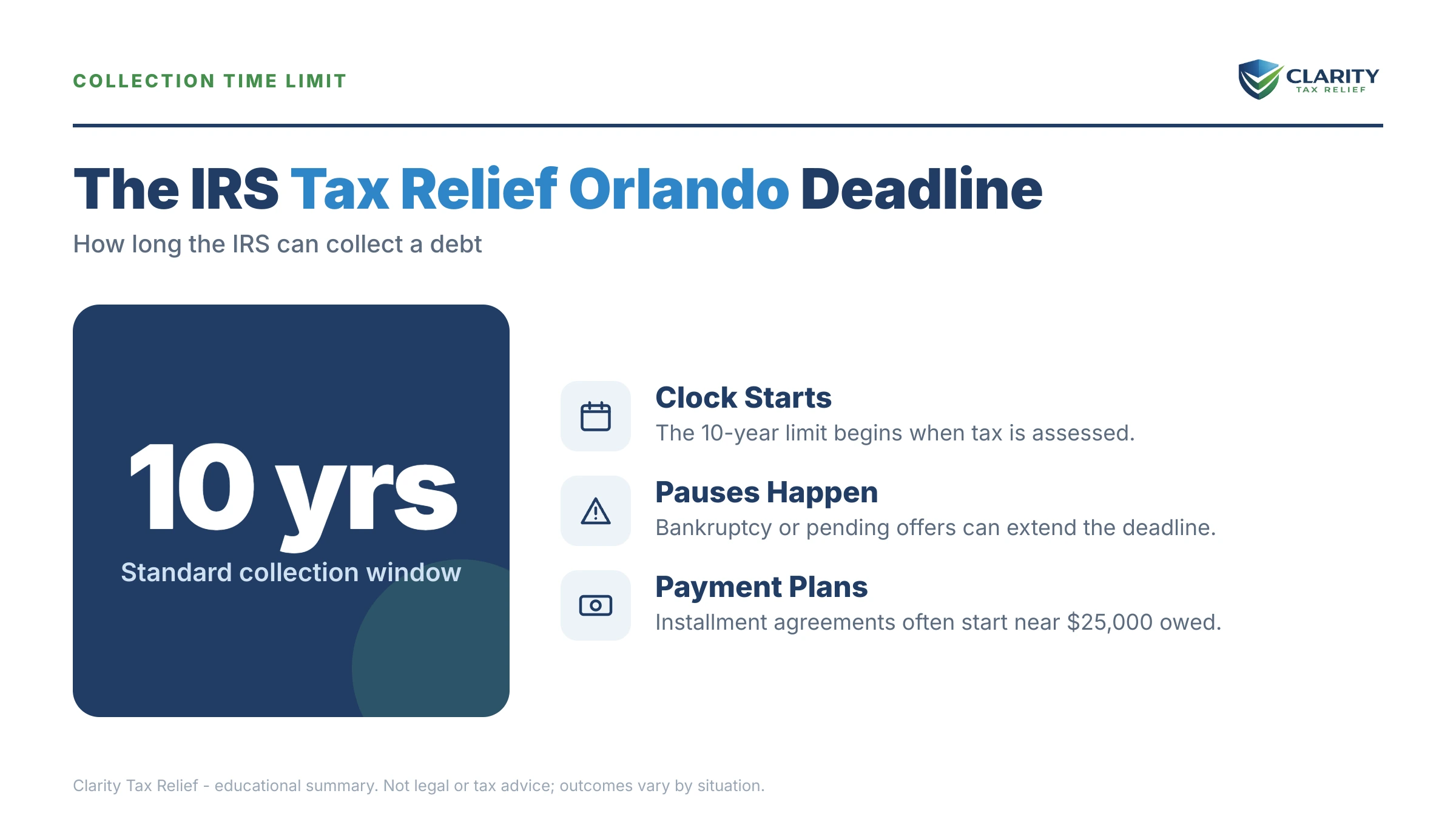
Two more consequences run alongside the notices. Once your assessed debt crosses $66,000 (the 2026 threshold), the IRS can certify it to the State Department, which can deny or revoke your passport — a real problem in a town where hospitality and travel careers depend on one. And the 10-year collection statute (CSED) keeps running the whole time. But it pauses during offers, appeals, and bankruptcy, so "waiting it out" almost never works the way people hope.
Owe the IRS in Orlando and not sure which program fits?
Interest and penalties are accruing on your balance every day, and the collection sequence advances on autopilot. Send us your notice or your rough numbers — an experienced tax professional will map your realistic options free, in plain English, before anything escalates.
Tax relief options in Orlando: what you may qualify for in 2026
Every IRS resolution program is means-tested. Your balance, income, and equity decide which doors are open, not any company's marketing. Here's the full menu with the 2026 thresholds:
| Option | Who it fits | Key 2026 threshold |
|---|---|---|
| Short-term payment plan | You can pay in full within 180 days | $0 setup fee; interest and penalties continue |
| Guaranteed installment agreement | Small balances, clean recent history | Balance of $10,000 or less |
| Streamlined installment agreement | Monthly payments, no financial disclosure | ≤ $25,000, or ≤ $50,000 with direct debit; up to 72 months online |
| Offer in Compromise | Assets + future income can't cover the debt | Reasonable Collection Potential below your balance; ~1 in 5 accepted (FY2024) |
| Currently Not Collectible | Paying anything would cause genuine hardship | Allowable living expenses meet or exceed income |
| First-Time Penalty Abatement / AEP | First slip after a clean record | Clean compliance for the prior 3 years; AEP becomes automatic starting summer 2026 |
| Innocent spouse relief | Joint-return debt caused by a spouse or ex | Filed on Form 8857; facts-and-circumstances test |
A few notes the table can't hold. The Offer in Compromise carries a $205 application fee plus a 20% down payment on lump-sum offers, but low-income certification (AGI at or below 250% of the federal poverty level) waives the fee, the down payment, and payments during review. Currently Not Collectible pauses collection but not the debt: interest keeps accruing, and the IRS revisits your finances periodically. And penalty relief stacks with everything else — first-time penalty abatement can strip penalties off a balance you're already putting on a payment plan.
Here's what each path actually costs and how long it takes:
| Option | Upfront IRS cost | Typical timeline |
|---|---|---|
| Short-term plan (180 days) | $0 | Set up online in minutes |
| Long-term installment agreement | Setup fee (lower with direct debit; reduced or waived for low income) | Same-day online approval for most balances ≤ $50,000 |
| Offer in Compromise | $205 + 20% down on lump-sum offers (both waived with low-income certification) | Many months of review; auto-accepted if the IRS doesn't decide within 2 years, counted from the date you submit the offer, and a rejection or return of the offer within that window stops the clock (it restarts if you resubmit) |
| Currently Not Collectible | $0 (financial statement required) | Weeks to place; reviewed periodically afterward |
| Penalty abatement (FTA/AEP) | $0 | Often resolved in one phone call or letter; AEP is automatic from summer 2026 |
| Innocent spouse relief (Form 8857) | $0 | Several months of IRS review |
If you want the full do-it-yourself walkthrough of these programs — forms, phone scripts, and sequencing — our pillar guide on how to settle tax debt yourself covers it end to end.
A worked example: $31,200 after a divorce
Say you owe $31,200 — two joint tax years from a marriage that ended last spring, when your ex handled the finances and the estimated payments that never got made. Here's how the real math plays out. (This is a hypothetical illustration, not a client story or a promised result.)
Option 1: streamlined installment agreement. At $31,200 you're over the $25,000 line, so the streamlined plan requires direct debit. But you can still set it up online without handing over a full financial statement. Spread over the maximum 72 months, the baseline is $31,200 ÷ 72 ≈ $434 per month. Interest and the 0.5% monthly failure-to-pay penalty keep accruing, so the true payoff is higher. Paying more than the minimum, say $600–$650, shortens the plan and cuts the total interest meaningfully.
Option 2: Offer in Compromise. Suppose your take-home is $4,300 a month and your IRS-allowable expenses total $4,100, leaving $200 of monthly disposable income. A lump-sum offer values future income at 12 months: $200 × 12 = $2,400, plus reachable asset equity — say $5,500 across a car and savings — for a Reasonable Collection Potential around $7,900. Because that's far below $31,200, you'd be a plausible candidate. Whether the IRS agrees depends on how your actual expenses hold up against its standards. You can estimate your own offer with our Offer in Compromise Calculator before deciding whether the paperwork is worth it.
Option 3: innocent spouse relief. If, say, $19,000 of the balance traces to income your ex earned and hid from you on those joint returns, Form 8857 could shift that share off your account entirely — separately from any payment plan on the rest. The bar is real (you generally must show you didn't know and had no reason to know), so read how to qualify for innocent spouse relief before filing. Your divorce decree, whatever it says, does not decide this — the IRS applies its own test.
Layer on penalty relief either way. If your compliance history before these two years was clean, first-time abatement (or the new Automatic Exemption from Penalty rolling out in summer 2026) can remove penalties from the first year, often four figures on a balance this size.
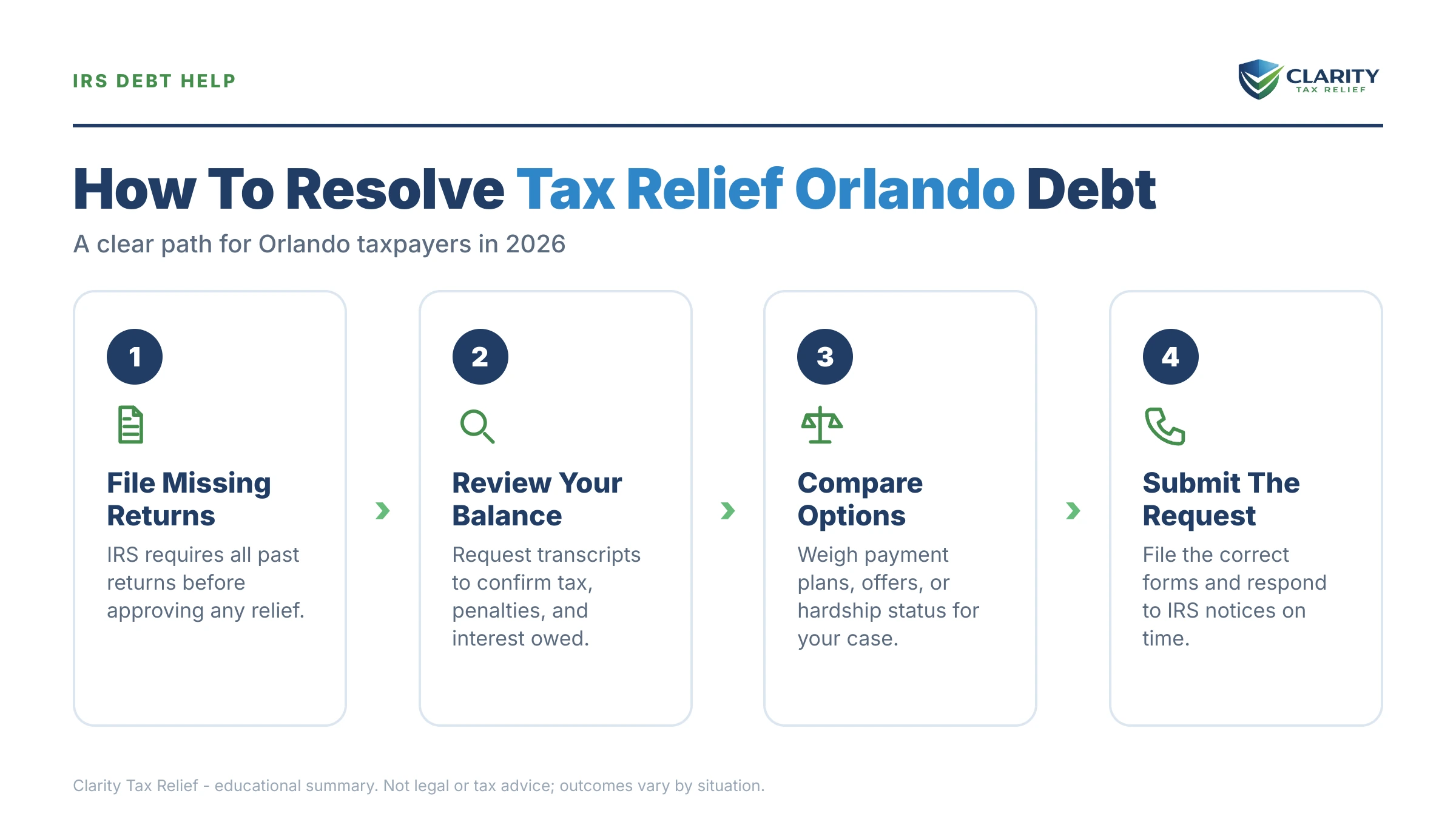
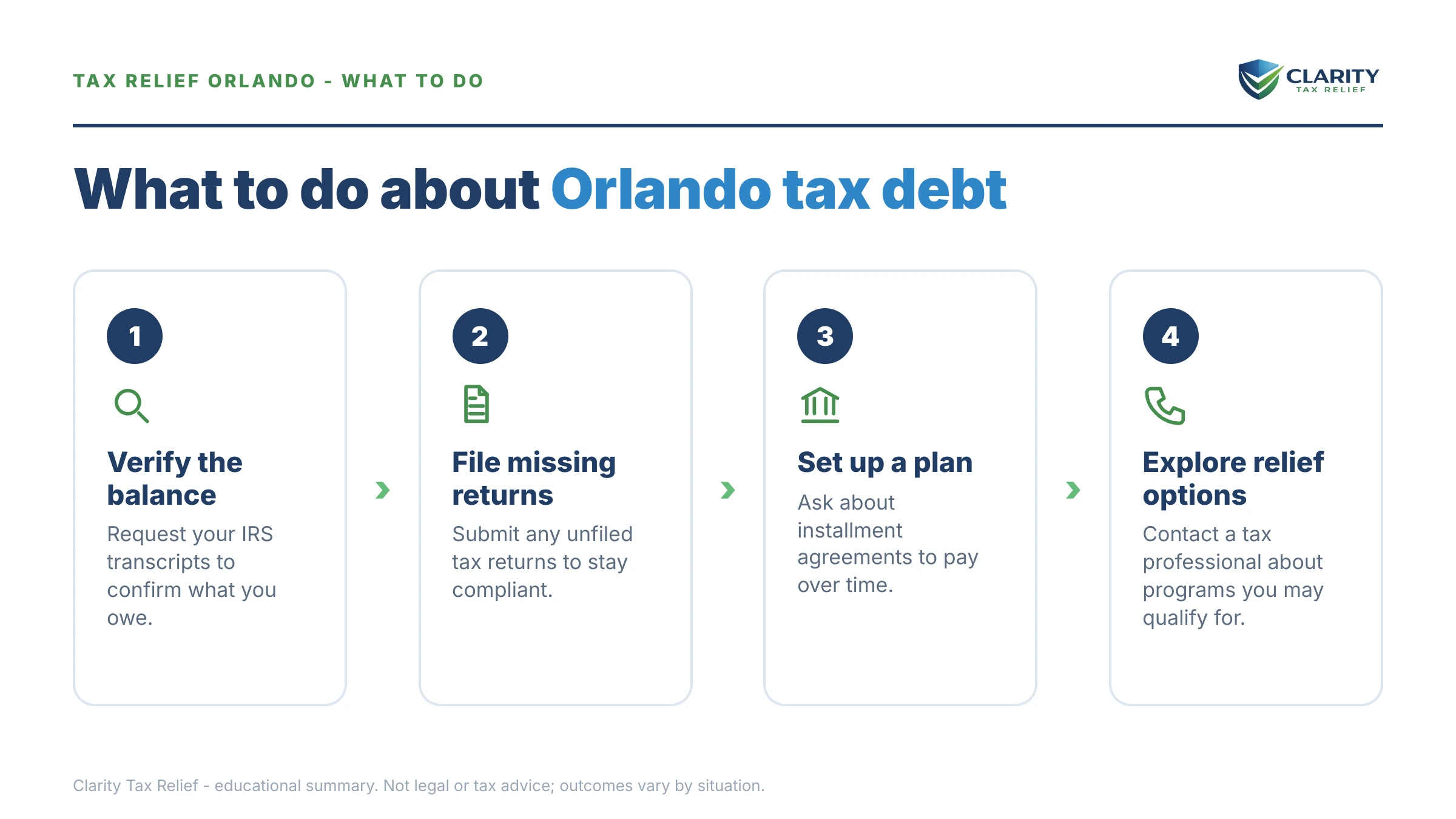
How to start resolving your tax debt in Orlando, step by step
- Pull your IRS records. Create or log in to your IRS online account to see every year you owe, how the balance splits between tax, penalties, and interest, and which notice the IRS sent last.
- File any unfiled returns. Every IRS resolution program requires filing compliance first — a payment plan or offer will be rejected while returns are missing.
- Match your balance to a program. Under $10,000, a guaranteed installment agreement. Under $50,000, a streamlined plan set up online. Genuine hardship, Currently Not Collectible. A balance you can never realistically pay, an Offer in Compromise.
- Set the resolution up before the next notice lands. Each notice in the collection sequence removes options — arranging a plan at the CP14 stage costs far less than fighting a levy at LT11.
- Get a second set of eyes on anything complex. Joint-liability debt from a divorce, business payroll tax, or a threatened levy is where an experienced tax professional changes the outcome — start with a free case review.
When you can handle this yourself, and when help changes the outcome
Most Orlando taxpayers with a balance under $25,000 and current filings can resolve it themselves in an afternoon at IRS.gov/payments. If you agree with the amount, can afford the monthly payment, and it's a single tax year, you don't need to pay anyone — set up the plan online and be done.
Experienced help earns its cost in specific situations:
- Joint-liability debt after a divorce — innocent spouse and separation-of-liability claims are fact-intensive, and a weak first filing can sink a strong case.
- A levy already in motion — the LT11's 30-day window and a bank levy's 21-day hold are short, technical clocks where sequencing mistakes are expensive.
- Offer in Compromise math — the difference between an accepted and rejected offer often comes down to how allowable expenses are documented.
- Business debt — payroll tax and Florida sales tax carry personal-liability exposure that a consumer payment plan doesn't address.
- Multiple unfiled years — the order you file and resolve them in changes what you ultimately pay.
Honest rule of thumb: if your situation fits in one sentence, you can probably do it yourself. If it takes a paragraph, get it reviewed — the review is free either way.
Choosing tax relief help in Orlando: what actually matters
The best predictor of a good outcome isn't a firm's zip code — it's credentials, flat-fee pricing, and a written scope of work. IRS collection cases are resolved by phone, mail, and online portals, so a Form 2848 power of attorney lets a qualified representative anywhere in the country work your case. Billboards on I-4 don't make a firm better at Form 656 math.
Screen anyone you're considering, local or national, against these tests:
- Who signs the POA? It should be an enrolled agent, CPA, or attorney, not a "consultant" who disappears after the sales call.
- Fee structure. A flat fee quoted after reviewing your facts. Percentage-of-savings pricing and big upfront retainers before any investigation are warning signs.
- Promises. Anyone guaranteeing a settlement amount before pulling your transcripts is selling, not advising. Eligibility is means-tested — nobody can promise the result first.
Our full how to choose a tax relief company checklist walks through every question to ask. And if you're comparing the big national brands you've heard advertised, start with our Optima Tax Relief alternatives breakdown — the comparison criteria apply to any firm pitching Orlando taxpayers.
Terms you'll hear, decoded
- Lien vs. levy: a lien is a legal claim against your property (it clouds your title); a levy is the actual taking of money or wages.
- CSED: the Collection Statute Expiration Date — the IRS generally has 10 years from assessment to collect, though offers, appeals, and bankruptcy pause the clock.
- Reasonable Collection Potential (RCP): the IRS's calculation of the most it could ever collect from you — the number an Offer in Compromise must meet or beat.
- Currently Not Collectible (CNC): a hardship status that pauses collection while your finances can't support any payment; the debt and interest remain.
- Streamlined installment agreement: a monthly plan approved without a full financial statement — up to $25,000, or $50,000 with direct debit.
- Homestead exemption: Florida's shield against most creditors reaching your primary home — which federal tax liens legally bypass.
Tax relief in Orlando: your questions, answered
Does Florida have a state income tax I could owe back taxes on?
No — Florida has no personal state income tax, so for wages, self-employment, and investment income, the IRS is the only agency that can bill you. Business owners are a different story: the Florida Department of Revenue collects sales tax and reemployment tax, and it pursues those debts aggressively. If your debt is business-related, you may be dealing with both agencies at once.
Can the IRS take my house in Orlando even with Florida's homestead exemption?
Florida's homestead exemption does not stop a federal tax lien — federal law overrides state creditor protections, so an IRS lien attaches to your Orlando home. Actual seizure of a primary residence is rare and requires court approval. But the lien clouds your title and complicates selling or refinancing until the debt is resolved.
Is there an IRS office in Orlando I can walk into?
The IRS operates a Taxpayer Assistance Center serving the Orlando area, but it is appointment-only — call 844-545-5640 to schedule. Most resolutions never require an in-person visit: payment plans, hardship status, and Offers in Compromise are handled online, by mail, or by phone, which matters in 2026 with IRS staffing down roughly 27%.
How much does tax relief cost in Orlando?
The IRS's own fees are modest: $0 for a short-term plan, a setup fee for long-term installment agreements (reduced with direct debit or low income), and $205 for an Offer in Compromise application. Professional representation is a separate cost that varies with case complexity — reputable firms quote a flat fee after reviewing your facts, never a percentage of 'savings.'
Do I need a local Orlando tax attorney, or can a national firm handle my case?
Geography rarely matters — IRS collection cases are worked by phone, mail, and online. A Form 2848 power of attorney lets an experienced tax professional anywhere in the country represent you. What matters is the credential (enrolled agent, CPA, or attorney), flat-fee pricing, and a written scope of work — not the office address.
My divorce decree says my ex-spouse pays our tax debt — why is the IRS billing me?
Because a divorce decree binds you and your ex, not the IRS — every joint return you signed leaves you 100% liable for the full balance. Your real remedies are innocent spouse relief or separation of liability under Form 8857, which can shift the debt to the spouse who caused it if you qualify. Pursue those with the IRS; enforcement of the decree happens in state court.
Does hurricane disaster relief extend my IRS payment deadline in Florida?
When FEMA declares a disaster for Central Florida counties, the IRS typically postpones filing and payment deadlines for affected taxpayers automatically. But postponement is not forgiveness — existing balances keep accruing interest, and collection resumes when the relief window closes. Check the current declarations on IRS.gov before assuming your deadline moved.
Can I really settle my IRS debt for less than I owe?
Sometimes — the Offer in Compromise program is real, but it is means-tested math, not a discount. The IRS accepted roughly 1 in 5 offers in FY2024, and acceptance depends on your Reasonable Collection Potential being less than your balance. Any Orlando ad promising to settle for 'pennies on the dollar' before seeing your finances is a red flag, not an offer.
Your next 24 hours
- Find your last IRS notice and note two things: the notice code in the corner (CP14, CP504, LT11) and the total balance. Those two facts determine how urgent your situation actually is.
- Gather your numbers: your most recent tax return, the notice. A rough monthly income-and-expenses picture — everything above (plan, offer, hardship, innocent spouse) gets decided from those figures.
- Get your Orlando case reviewed free. Interest and penalties are compounding on your balance whether or not you act — send your notice through the 2-minute form or call (888) 825-7779 and an experienced tax professional will map your realistic options before the next notice arrives.
If you want to go deeper on the underlying rules first, the primary sources are the IRS's payment plans page, the Taxpayer Advocate Service for cases stuck in the system, and the Florida Department of Revenue for any state sales-tax or reemployment-tax balance.
This guide is general information, not tax or legal advice for your specific situation. Eligibility for IRS programs depends on individual facts and circumstances; no outcome is guaranteed.