
Tax Relief by City
Tax Relief Portland: Every Real Option for IRS, Oregon, and City Tax Debt (2026)
Read the transcript
Host: So you filed your Schedule C in April, saw what self-employment tax did to the bottom line, couldn't pay it, and now letters are stacking up on the counter. And here's the part that's specific to Portland: they might not all be from the IRS.
Tax specialist: Right. That's the thing national ad copy never mentions. In Portland you can be dealing with three separate agencies at the same time. The IRS, the Oregon Department of Revenue, and the City of Portland Revenue Division.
Host: Three.
Tax specialist: Three. And no single program fixes all three. That's the sentence I'd want tattooed on this episode. An IRS installment agreement, an Offer in Compromise, hardship status — none of them resolve a single dollar of Oregon or city debt.
Host: Okay, hold on, because I think that's where people get burned. They set up an IRS plan, they feel relief, and then—
Tax specialist: And then Oregon garnishes. Yeah. Oregon runs its own collection track. Own notices, own garnishment authority, own timelines, own settlement-offer process. Their collection clock is its own set of rules too — it's not the same as the federal one.
Host: Let's do the federal side first, since that's usually the loudest. The article lays out the notice sequence. Walk me through it.
Tax specialist: It's automated and it escalates in a fixed order whether or not a human ever looks at your file. Starts with CP14 — that's just the first bill. You typically have about twenty-one days from the notice date before the system queues the next letter. No enforcement yet, and it's the cheapest moment to act.
Host: Then?
Tax specialist: CP501 and CP503. Automated reminders, still just bills, but penalties and interest have been added each time. Then CP504. That one's intent to levy your state refund, under section 6331(d). At that point the IRS can take your Oregon refund and a federal lien becomes a live possibility.
Host: CP504. And that's the final notice, right?
Tax specialist: No, and that's exactly the trap. It reads like the final notice. It isn't. The final notice is LT11, or Letter 1058.
Host: LT11 or Letter 1058. Say what that one starts.
Tax specialist: A thirty-day clock. That's when your Collection Due Process rights kick in, and you request the hearing on Form 12153. After those thirty days, the IRS can levy without further warning. Bank levy holds funds twenty-one days before the money actually leaves. A wage levy is continuous until it's released.
Host: Form 12153, thirty days. Okay. And I saw something about passports.
Tax specialist: Balances that grow past $66,000 trigger passport certification under the 2026 threshold. So yeah, the number growing isn't just abstract.
Host: One more thing on that — the article says IRS staffing fell about 27% in 2025. Doesn't that mean less pressure?
Tax specialist: It means the agency's harder to reach by phone. The computers issuing notices and levies never stopped. Those two things are unrelated.
Host: Hm. Okay. So the menu. What are people actually working with?
Tax specialist: Every legitimate program is means-tested. It depends on your balance, your budget, and whether your returns are filed. If you can pay in full within 180 days, there's a short-term plan, zero setup fee. Penalties and interest keep running until it's paid, but nothing else.
Host: And above that?
Tax specialist: Balances up to $50,000 with all returns filed can go on a long-term installment agreement online, up to seventy-two months. Setup fee applies, interest keeps accruing. You don't have to submit financials at that level, which is a real advantage.
Host: No financials. That's the part that scares people, handing over their whole budget.
Tax specialist: Right. And then under $10,000 there's a specific program in the statute — it's called the Guaranteed Installment Agreement, IRC 6159(c). If you meet the conditions, clean recent filing and payment compliance, the IRS must accept it.
Host: Wait. Say that again more simply, because "must accept" sounds like a promise and you're always telling me nothing's a promise.
Tax specialist: Fair. It's the name of the program, not a prediction about you. The conditions are the whole thing. Balance at or under $10,000, recent returns filed on time, recent payments made on time. If any of that isn't true for you, you're not in that lane. That's the hard part and I'm not going to soften it.
Host: Got it. Offer in Compromise — everybody's asking about that one.
Tax specialist: It's real, and it's narrow. The mechanism is arithmetic: your assets plus your future income have to genuinely come out below the balance. The IRS does that math, not you. There's a $205 application fee plus 20% down on lump-sum offers, both waived with low-income certification. Roughly one in five offers were accepted in FY2024.
Host: One in five.
Tax specialist: In FY2024, yes. And on a small balance it usually doesn't pencil out at all. The article runs a hypothetical — a sole proprietor in Southeast Portland owing $4,800. If you've got any equity or steady monthly cash flow, the collection math shows the IRS can collect the full amount. So the realistic path there is a plan plus penalty relief.
Host: Let's stay in that hypothetical, because the numbers are useful. $4,800.
Tax specialist: Failure-to-pay penalty is 0.5% a month. On $4,800 that's twenty-four dollars a month, plus compounding interest, until the combined penalty hits its statutory cap. Slow bleed. Six-month short-term plan is eight hundred a month. The Guaranteed Installment Agreement route at thirty-six months is about a hundred thirty-three a month. A seventy-two-month plan floors out around sixty-seven a month, but at that pace a big share of every payment is just feeding penalties and interest.
Host: So the low payment costs more.
Tax specialist: Costs more overall, yes. Around two hundred a month clears it in a bit over two years and saves meaningfully on accrual. That's a choice you control.
Host: And if the return's still unfiled?
Tax specialist: Then the failure-to-file penalty is 5% a month. On that same balance that's two hundred forty a month instead of twenty-four. Ten times. Which is why the article's first instruction is file, even broke. Filing alone cuts the fastest-growing cost by roughly ninety percent.
Host: File even if you can't send a dollar. Okay. What about penalty relief — the abatement thing?
Tax specialist: Free to request. First-time abatement can remove the failure-to-pay penalty if your prior three years are clean, and there's a new Automatic Exemption from Penalty rolling out summer 2026 that applies without you asking. Important caveat. It removes penalties, not the underlying tax.
Host: Not the tax. Right. And hardship status?
Tax specialist: Currently Not Collectible. Zero cost, and it's for when paying would leave you unable to cover basic living costs. Collection pauses. But the debt is still there and interest keeps accruing. It's a pause, not an exit.
Host: Then the city layer. Arts Tax, Metro Supportive Housing Services, Preschool for All.
Tax specialist: Collected by the City of Portland Revenue Division. No federal or state program touches them. Balances are usually small next to income tax debt, but the city does pursue them and adds penalties. Contact the Revenue Division directly about arrangements. And self-employed folks inside the transit district owe TriMet self-employment tax through the state. Rates and thresholds change — verify with the agency, not a blog post.
Host: So what does someone do tonight?
Tax specialist: Find every notice — most recent letter from each of the three agencies, write down the balance and the date printed on each. Pull your actual balances from your IRS online account and Oregon's Revenue Online. Then gather three things: last filed return, records for any unfiled year, and a rough picture of monthly income and expenses. That's everything a resolution plan gets built from.
Host: And if it's just one filed year, small balance?
Tax specialist: Honestly, a lot of that is doable yourself online in under an hour. Set up the plan, request first-time abatement, start quarterlies. And if money's tight, the Taxpayer Advocate Service and low-income taxpayer clinics offer free help.
Host: When does help actually change something?
Tax specialist: Levy or garnishment already in motion. Multiple unfiled years. IRS and Oregon and city tangled together. Business or payroll tax exposure. Offer in Compromise math on a larger balance. If that's your file, Clarity's Enrolled Agents can review where each agency stands — the review's free, and you'd hear what the eligibility conditions are, not what the outcome will be.
Host: Number's (888) 825-7779. And if you're weighing something outside tax resolution — bankruptcy, say — that sits outside what Clarity handles, so talk to your own counsel about it. But get the notices in one pile first.
Tax specialist: Because that order is fixable. And every month you wait, both ledgers grow.
The short answer: tax relief in Portland can mean resolving debt with three agencies at once — the IRS, the Oregon Department of Revenue, and the City of Portland Revenue Division. Your main tools are IRS payment plans (balances up to $50,000 qualify online), an Offer in Compromise, hardship status, penalty abatement, plus Oregon's separate state programs.
You filed your Schedule C in April, saw what self-employment tax did to the bottom line, and couldn't pay all of it, and now the letters are stacking up. Most of what you'll find searching tax relief Portland is national ad copy that never mentions the thing that makes Portland different: you may owe federal, Oregon, and city taxes simultaneously, and no single program fixes all three. This guide maps every legitimate option, what each costs, and the order to work them in, because that order is fixable, and starting today is cheaper than starting next month.
⏱ The clock that's actually running: there's no single deadline on "tax relief" itself, but the IRS failure-to-pay penalty adds 0.5% of your balance every month, interest compounds on top, and the Oregon Department of Revenue charges its own penalties and interest in parallel. Every month you wait, the payoff number grows on both ledgers.
Why Portland taxpayers end up owing
Portland's tax debt problem is disproportionately a self-employment problem: no employer withholds tax from 1099 income, so the bill lands all at once in April. Portland runs on freelancers, contractors, creatives, food-cart owners, and small studios, and a first profitable year without quarterly payments routinely produces a four-figure balance. If that's your story, our guide to self employment tax owe irs explains exactly where the number came from.
The second driver is Portland's layered tax map. Oregon has no sales tax. But its personal income tax rates are among the higher in the country, and inside the metro area, the Arts Tax, the Metro Supportive Housing Services tax, the Multnomah County Preschool for All tax. The TriMet self-employment tax can each generate a separate bill from a separate agency. Plenty of Portlanders first learn a local tax exists when the penalty notice arrives.
The third driver is missed quarterlies. Self-employed taxpayers who skip estimated payments don't just owe the tax. They owe an underpayment penalty on top, every year the pattern repeats. Breaking that cycle is half of any real resolution, and our walkthrough of the didn't pay estimated taxes penalty shows the math.
“An offer in compromise allows you to settle your tax debt for less than the full amount you owe. It may be a legitimate option if you can't pay your full tax liability or doing so creates a financial hardship.”
— Offer in compromise (IRS.gov)
What happens if you ignore tax debt in Portland
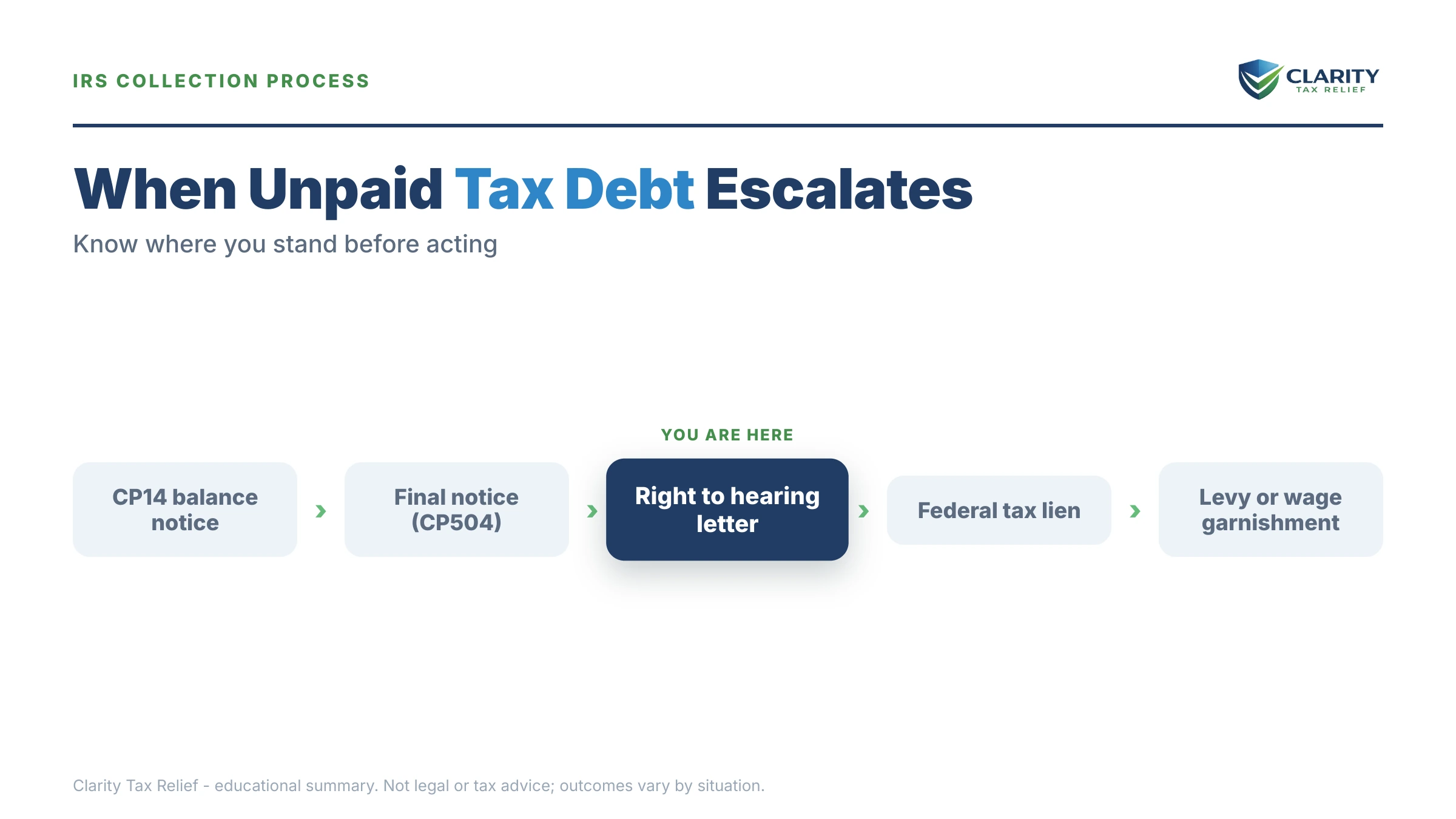
IRS collection runs on an automated notice sequence that escalates in a fixed order whether or not a human ever reviews your file. IRS staffing fell roughly 27% in 2025, which makes the agency harder to reach by phone. But the computers issuing notices and levies never stopped. Here's the sequence:
- CP14 — the first bill. You typically have about 21 days from the notice date before the system queues the next letter. No enforcement yet; cheapest moment to act.
- CP501 and CP503 — automated reminders. Still just bills, but penalties and interest have been added to each one.
- CP504 — intent to levy your state refund. Under IRC §6331(d), the IRS can now take your Oregon state tax refund. A federal tax lien becomes a live possibility. This is not the final notice, though it reads like one.
- LT11 or Letter 1058 — the final notice. This starts a 30-day clock and your Collection Due Process rights (requested on Form 12153). After 30 days, the IRS can levy without further warning.
- Levy and garnishment. A bank levy freezes funds for 21 days before the money leaves; a wage levy is continuous until released. Balances that grow past $66,000 also trigger passport certification under the 2026 threshold.
The Oregon Department of Revenue runs its own, separate collection track with its own notices, garnishment authority, and timelines — resolving the IRS side does nothing to stop the state side. And don't assume the debt quietly ages out: the IRS collection statute is 10 years from assessment. But it pauses during offers, appeals, and bankruptcy, and Oregon's collection timeline is its own set of rules entirely.
| Notice | What it means | Your window |
|---|---|---|
| CP14 | First bill for a balance due | Typically 21 days from the notice date |
| CP501 / CP503 | Automated reminders; balance growing | Pay-by date printed on each notice |
| CP504 | Intent to levy your Oregon state refund (§6331(d)) | Date printed on the notice; not yet the final notice |
| LT11 / Letter 1058 | Final notice of intent to levy | 30 days to request a CDP hearing (Form 12153) |
| Levy / garnishment | Bank accounts, wages, state refund | Bank levies hold funds 21 days; wage levies continue until released |
Owe the IRS or Oregon from Portland?
Get your IRS and Oregon balances reviewed free before the notice sequence reaches the levy stage. An experienced tax professional will map exactly where each agency stands and which program fits — no pressure, no obligation.
Tax relief Portland taxpayers actually qualify for
Every legitimate relief program is means-tested — the right one depends on your balance, your budget, and whether your returns are filed. Under $10,000, the IRS must accept a guaranteed installment agreement if you meet its conditions. Under $50,000, you can set up a plan online without submitting financials. A settlement is real but reserved for people whose numbers genuinely can't cover the debt. Here's the full menu:
| Option | Who typically qualifies | Cost & terms |
|---|---|---|
| Short-term IRS payment plan | Can pay in full within 180 days | $0 setup; penalties and interest continue until paid |
| Guaranteed installment agreement | Balance ≤ $10,000 with clean recent filing and payment compliance | IRS must accept if conditions are met; official program name, not an outcome promise |
| Long-term installment agreement (online or Form 9465) | Balance ≤ $50,000, all returns filed | Up to 72 months; setup fee applies; interest keeps accruing |
| Offer in Compromise (Form 656) | Assets plus future income genuinely below the balance | $205 fee + 20% down on lump-sum offers (both waived with low-income certification); roughly 1 in 5 offers accepted in FY2024 |
| Currently Not Collectible | Paying would leave you unable to cover basic living costs | $0; collection pauses but the debt remains and interest accrues |
| Penalty abatement (FTA / AEP) | Clean prior three years, or reasonable cause | Free to request; removes penalties, not the tax itself |
| Oregon DOR payment plan / settlement offer | Oregon balances — separate rules from the IRS | Set up through Revenue Online; confirm current terms with DOR |
Two notes on that table. First, the choice between a plan and a settlement is a math question, not a preference — our comparison of irs payment plan vs offer in compromise walks the decision. Second, don't overlook penalty relief: first time penalty abatement can wipe the failure-to-pay penalty if your prior three years are clean, and starting summer 2026 the new Automatic Exemption from Penalty (AEP) applies without you even asking.
Portland's extra layer: Oregon DOR and the city taxes
No IRS program — no installment agreement, no Offer in Compromise, no hardship status — resolves a single dollar of Oregon or City of Portland tax debt. The Oregon Department of Revenue collects state income tax on its own track, with its own payment plans, its own settlement-offer process. Its own garnishment authority. You can manage a state balance through Revenue Online, and our Oregon back taxes guide covers the state side in full.
Then there's the city layer, unusual even among big metros. Depending on where you live and what you earn, the City of Portland Revenue Division may be billing you for the Arts Tax, the Metro Supportive Housing Services tax, or the Multnomah County Preschool for All tax, and self-employed Portlanders inside the transit district owe the TriMet self-employment tax through the state. Rates and thresholds change, so verify your specific liability with the Revenue Division rather than a blog.
The practical rule: resolve each agency where the money does the most good. The IRS balance usually carries the most enforcement power. The Oregon balance grows in parallel and needs its own plan. The city balances are typically smallest. But they don't disappear, so put them on arrangements too rather than letting penalties stack.
What $4,800 in tax debt actually costs a self-employed Portlander
A hypothetical, with the math shown. Say you're a sole-proprietor designer in Southeast Portland who filed on time in April and owes the IRS $4,800 in tax you couldn't pay.
- The bleed: the failure-to-pay penalty is 0.5% per month — $24 a month on $4,800 — plus compounding interest, until the combined penalty reaches its statutory cap. Slow, but relentless.
- Short-term plan: $4,800 ÷ 6 months = $800/month, $0 setup fee, done inside 180 days with only a few more months of accrual. Cheapest total cost if your cash flow can carry it.
- Guaranteed installment agreement: because the balance is under $10,000, a plan paying it off within three years — about $4,800 ÷ 36 = $133/month — must be accepted if you meet the compliance conditions.
- 72-month online plan: the floor payment is roughly $4,800 ÷ 72 ≈ $67/month, but at that pace a large share of each payment feeds ongoing penalties and interest. Paying around $200/month instead clears the balance in a bit over two years and saves meaningfully on accrual.
- Offer in Compromise: at $4,800, an offer rarely pencils out. The $205 fee and 20% down payment aside, if you have any equity or steady monthly cash flow, the IRS's collection math will usually show it can collect the full $4,800 — most balances this size resolve through a plan plus penalty abatement, not a settlement.
- The scary counterfactual: if that return were still unfiled, the failure-to-file penalty would run 5% per month — $240 a month instead of $24. Filing, even broke, cuts the fastest-growing cost by roughly 90%.
Want to see your own accrual numbers? You can estimate them with our Penalty & Interest Calculator before choosing a payoff pace, and remember the same clock is running separately on any Oregon balance.
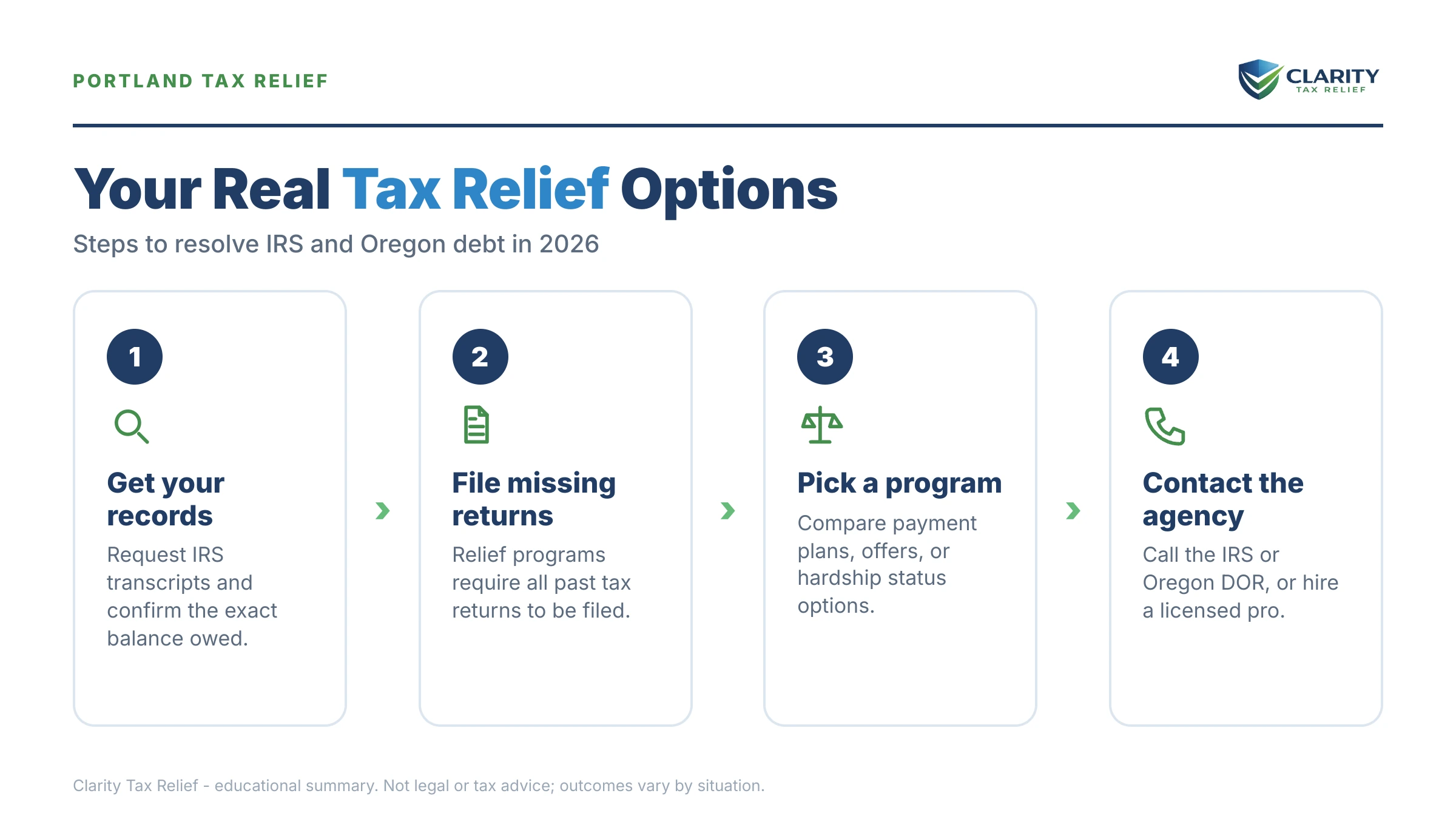
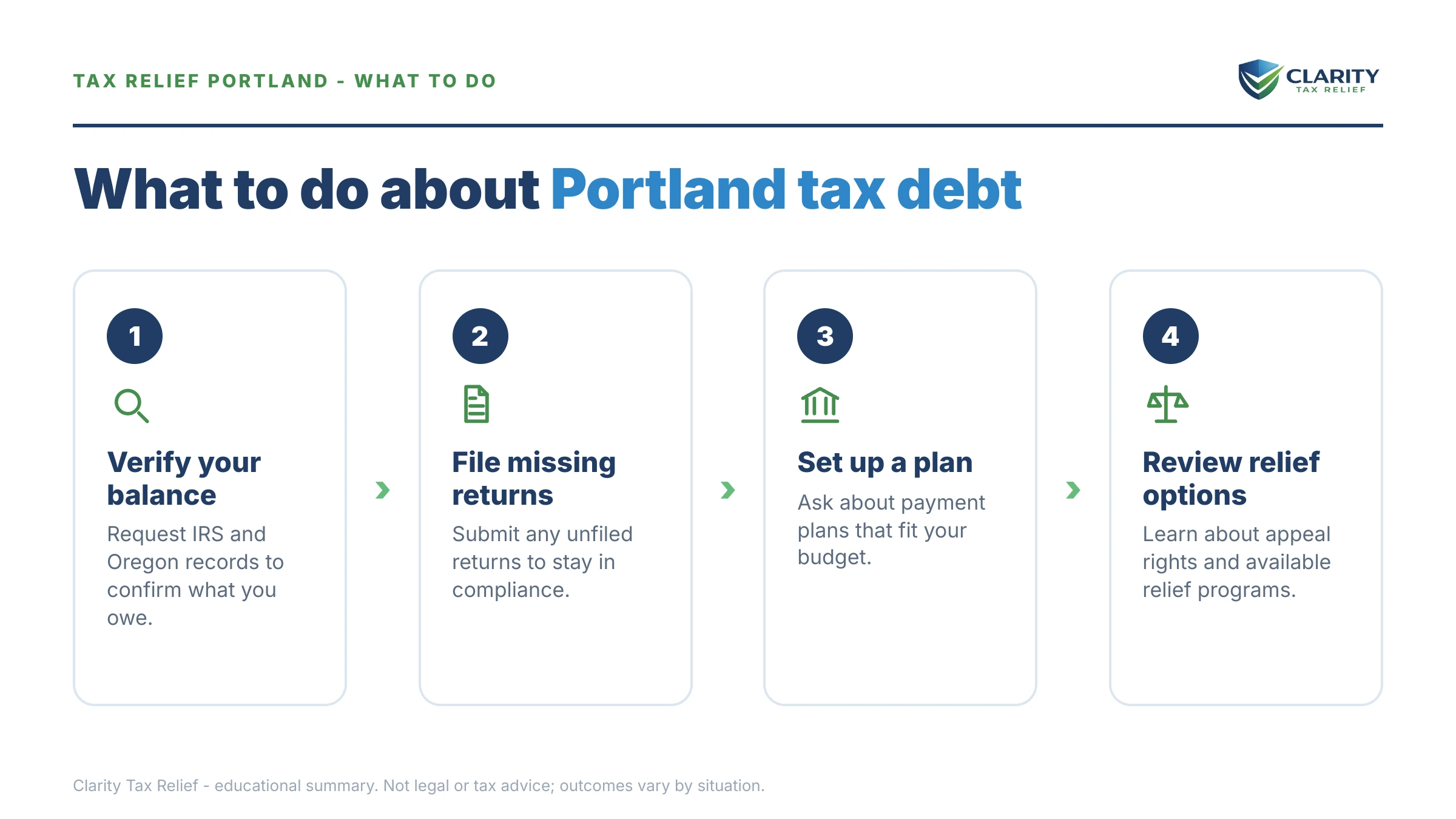
How to start tax relief in Portland, step by step
- Pull your balances. Log in to your IRS online account and Oregon's Revenue Online to confirm exactly what each agency says you owe, year by year.
- File anything unfiled. The failure-to-file penalty runs ten times the failure-to-pay penalty, so filing stops the fastest-growing cost even if you can't pay.
- Pick the program that fits. Match your balance and budget to the eligibility table above — short-term plan, installment agreement, hardship status, or a settlement offer.
- Set it up before enforcement starts. Apply online at IRS.gov/payments for the federal debt and through Revenue Online for the Oregon side.
- Request penalty relief. First-time abatement, or the automatic exemption rolling out in summer 2026 — can remove penalties if your prior three years are clean.
- Get a free review if it's layered. Multiple years, multiple agencies, or business payroll debt is where experienced help changes the outcome.
When you can handle this yourself, and when help changes the outcome
Most Portland taxpayers with a single filed year and a balance under $10,000 can resolve it themselves in under an hour online. The hypothetical $4,800 case above is exactly that: set up the plan at IRS.gov, request first-time abatement, start quarterlies. Our hub on how to settle tax debt yourself walks the whole DIY playbook, and if money is tight, the Taxpayer Advocate Service and low-income taxpayer clinics offer free help.
Experienced help earns its fee in specific situations: a levy or garnishment already in motion, multiple unfiled years, IRS and Oregon and city debt tangled together, business or payroll tax exposure, or Offer in Compromise math on a larger balance. Business owners weighing representation should start with our tax relief for small business guide.
If you do hire, hire carefully. Portland gets the same national radio and TV pitches as everywhere else, and some of them are settlement mills. Use the how to choose a tax relief company checklist, watch for the warning signs in our tax relief company red flags list, and compare fee structures — our breakdown of how much does tax relief cost shows what fair pricing looks like. If you've already had a bad experience with a big national brand, our optima tax relief alternative comparison covers what to look for the second time around.
Tax relief in Portland: your questions, answered
Do tax relief companies help with Oregon state tax debt too?
Reputable firms handle Oregon Department of Revenue debt alongside IRS debt, but ask before signing — some national firms quietly quote IRS-only work. Oregon runs its own payment plans and its own settlement-offer process with rules that differ from the IRS's. If you owe both, the order you resolve them in matters, so make sure whoever you hire addresses both balances in one plan.
How much does tax relief cost in Portland?
Professional representation typically runs from several hundred dollars for a simple payment-plan setup to several thousand for an Offer in Compromise or a multi-year case. The IRS's own fees are small by comparison: $0 for a short-term plan, a modest setup fee for installment agreements, and a $205 Offer in Compromise application fee. On a small balance like $4,800, doing it yourself often beats paying for help.
Can I settle Oregon back taxes like an IRS offer in compromise?
Oregon has its own settlement-offer process through the Department of Revenue, separate from the federal Offer in Compromise, with its own eligibility rules. Like the IRS version, it turns on your genuine ability to pay, not on how persuasively the application is written. An accepted IRS offer does not settle your Oregon balance, and vice versa; each agency must be resolved on its own.
What about Portland's local taxes — the Arts Tax, Metro SHS, and Preschool for All?
Those are collected by the City of Portland Revenue Division, not the IRS or Oregon DOR, and no federal or state relief program touches them. The balances are usually small next to income tax debt, but the city does pursue them and adds penalties. Contact the Revenue Division directly about payment arrangements, and handle the larger IRS and Oregon balances through their own programs.
Do I need a tax relief company with a Portland office?
No — IRS and Oregon DOR cases are resolved by phone, mail, and online systems, not in person, so a local storefront matters far less than credentials. What matters is that an experienced tax professional — an enrolled agent, CPA, or attorney — is authorized to represent you. Judge any firm, local or national, on transparent flat fees and on who actually works your case.
How long can the IRS collect a tax debt from me in Portland?
Generally 10 years from the date the tax was assessed — the Collection Statute Expiration Date, or CSED. That clock pauses during an Offer in Compromise, bankruptcy, and certain appeals, so it often runs longer than 10 calendar years. Oregon's collection rules are separate, so don't assume a state balance expires on the same schedule — confirm your state timeline with the Department of Revenue.
I'm self-employed in Portland and owe for the first time — what should I do first?
File any unfiled return immediately, even if you can't pay a dime. The failure-to-file penalty runs 5% per month, ten times the 0.5% failure-to-pay penalty, so filing alone cuts the fastest-growing cost by roughly 90%. Then set up a payment plan and start quarterly estimated payments so next April doesn't repeat this year.
Your next 24 hours
- Find every notice. Pull the most recent letter from each agency — IRS, Oregon Department of Revenue, City of Portland Revenue Division — and note the balance and the date printed on each one.
- Gather three things: your last filed return, records for any unfiled year, and a rough picture of your monthly income and expenses. That's everything a resolution plan is built from.
- Get your free case review. Call (888) 825-7779 or use the 2-minute form. Penalties and interest compound monthly on every balance you leave unaddressed — the review costs nothing, and knowing your options stops the guessing tonight.
For the Oregon side of your file, the Oregon Department of Revenue publishes current payment-plan and settlement-offer requirements, and federal plan details live on the IRS payment plans page.
This guide is general information, not tax or legal advice for your specific situation. Eligibility for IRS programs depends on individual facts and circumstances; no outcome is guaranteed.