
City Tax Relief Guides
Tax Relief Philadelphia: How to Resolve IRS, Pennsylvania & City Tax Debt (2026)
The short answer: tax relief in Philadelphia means resolving tax debt with up to three separate agencies — the IRS, the Pennsylvania Department of Revenue, and the City of Philadelphia — through payment plans, hardship status, penalty abatement, or an Offer in Compromise. The right program depends on which agency is collecting, your balance, and your income.
You're searching for tax relief in Philadelphia because a balance you can't pay finally has a piece of paper attached to it — maybe an IRS notice, maybe a letter from Harrisburg, maybe a city Wage Tax bill you didn't know existed. That knot in your stomach is normal. The situation itself is fixable, and the fix follows a map: figure out who is collecting, match your balance to the right program, and set it up before the next notice raises the stakes.
What makes Philadelphia different from most cities: even suburban commuters who never lived in the city can owe Philadelphia's Wage Tax, on top of anything owed to the IRS or the state. This guide covers all three layers, and works through a real-numbers example of resolving $48,300 as a single W-2 employee.
⏱ The clock that matters: there is no single deadline on "tax relief" itself — the controlling date is the one printed on your most recent notice. But the IRS failure-to-pay penalty adds 0.5% of your balance every month, plus daily-compounding interest, from the day you fell behind until the day the debt is resolved. Waiting has a price even when no letter is in the mail.
Why tax debt in Philadelphia is a three-agency problem
A Philadelphia taxpayer can owe three different governments at the same time: the IRS, the Pennsylvania Department of Revenue. The City of Philadelphia's own Department of Revenue. Each one bills separately, enforces separately, and runs its own relief programs — resolving one does nothing about the other two.
The federal layer is the biggest for most people: income tax you filed but couldn't pay, a balance from a corrected return, or years that were never filed at all. The state layer is Pennsylvania personal income tax, collected from Harrisburg with its own notices and its own lien process.
The city layer trips people up most. Philadelphia taxes salaries and wages through the Wage Tax — normally withheld by employers, but owed personally when withholding fails or when you're self-employed and subject to the city's Earnings Tax, Net Profits Tax, or Business Income & Receipts Tax (BIRT) instead. The city also bills the School Income Tax on certain unearned income and, of course, real estate tax on your rowhouse.
| Agency | What it collects | What your first move looks like |
|---|---|---|
| IRS (federal) | Federal income tax, penalties, interest; self-employment tax | Check your IRS online account, then match your balance to a payment plan, hardship status, or offer (details below) |
| Pennsylvania Department of Revenue | PA personal income tax and related penalties | Respond to the state notice directly; see Pennsylvania back taxes payment plan options |
| Philadelphia Department of Revenue | Wage Tax, Earnings Tax, Net Profits Tax, BIRT, School Income Tax, real estate tax | Contact the city about its own payment agreements — IRS programs do not apply here |
The order you tackle them in matters. Interest, enforcement speed, and available programs differ by agency, so a plan that drains your budget paying one collector can leave you defenseless against another. Map all three balances before committing to any single payment.
What happens if you ignore your tax debt
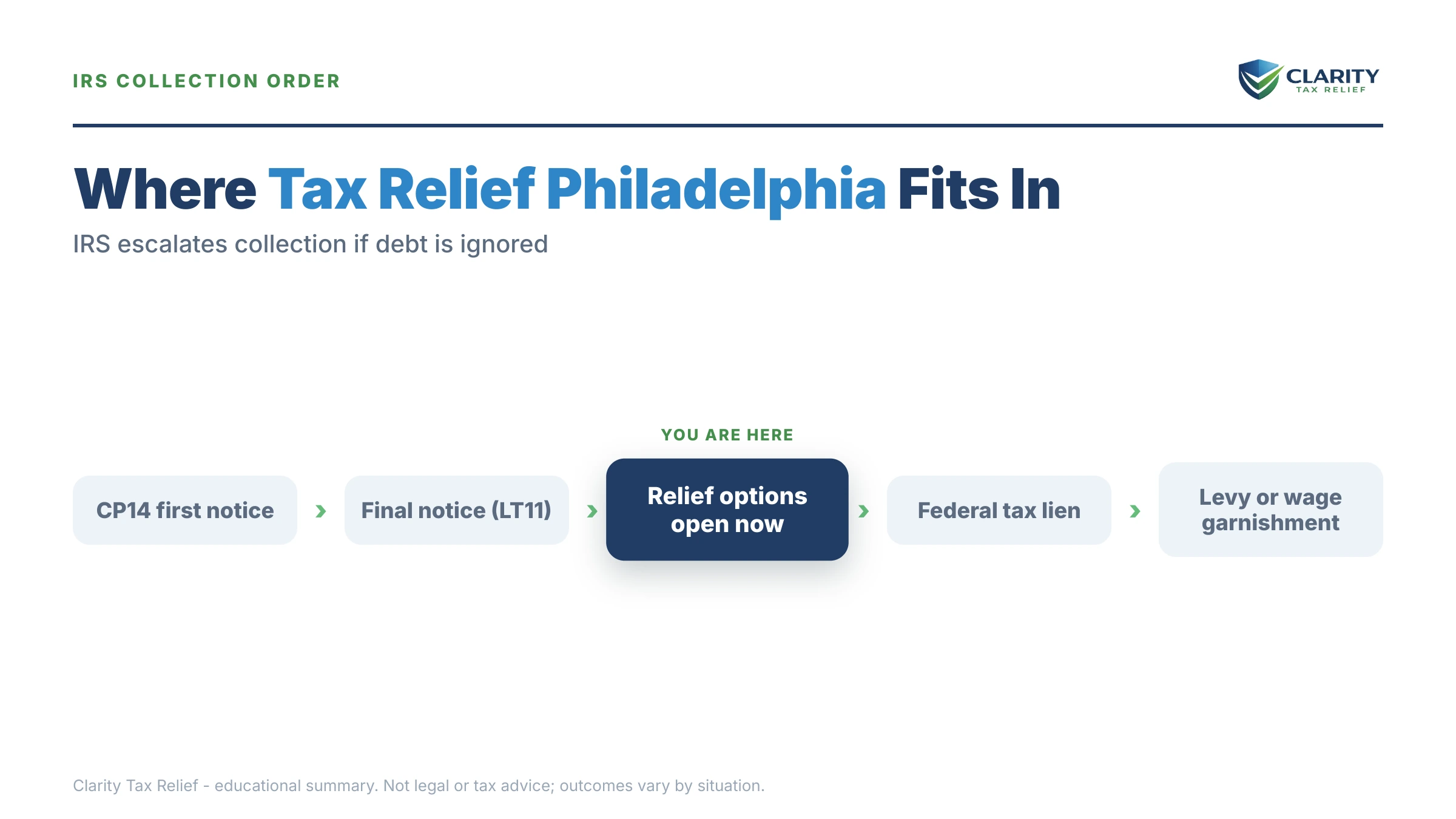
Federal tax debt escalates through an automated notice sequence that ends in wage garnishment and bank levies, and the 2025 IRS workforce cuts of roughly 27% did not slow that machine down. Humans are harder to reach; the computers that issue levies never stopped.
- CP14 — the first bill. Typically about 21 days to pay before the sequence advances. No enforcement yet; this is the cheapest moment to act. (Full guide: CP504 notice readers usually wish they'd acted here.)
- CP501 / CP503 — reminder notices. Still just bills, but penalties and interest are compounding on the balance every month.
- CP504 — Notice of Intent to Levy under IRC §6331(d). The IRS can now seize your Pennsylvania state tax refund. Despite the alarming title, it is not the final notice.
- LT11 / Letter 1058 — the true final notice. A 30-day clock starts, along with your Collection Due Process rights (requested on Form 12153). Miss the window and the strongest appeal right you have disappears. (Full guide: LT11 notice.)
- Enforcement — a bank levy freezes funds for 21 days before they're sent to the Treasury. A wage levy is continuous until released; Social Security can be levied up to 15% through the Federal Payment Levy Program. A federal tax lien can attach to your home, and once your balance passes $66,000 (the 2026 threshold), the IRS can certify your debt to the State Department and block your passport.
Pennsylvania and the city run their own tracks in parallel. The state can file a lien against you, see how a Pennsylvania tax lien works, and refer accounts out for collection. The city adds its own penalties and pursues delinquent accounts, including through outside collection counsel on real estate taxes. None of these collectors waits for the others to finish.
| Notice | Your window | What's at stake if it passes |
|---|---|---|
| CP14 (first bill) | Typically 21 days from the notice date | Sequence advances; penalties and interest keep compounding |
| CP501 / CP503 (reminders) | The "pay by" date printed on each notice | Balance grows; CP504 is queued automatically |
| CP504 (intent to levy) | The date printed on the notice | Your Pennsylvania state refund can be seized; lien filing becomes likely |
| LT11 / Letter 1058 (final notice) | 30 days | Collection Due Process appeal rights (Form 12153), after 30 days, wages and bank accounts are fair game |
| Bank levy served | 21-day hold before funds leave | Your last realistic chance to get the levy released before the money is gone |
Facing IRS, state, or city tax debt in Philadelphia?
Every month you wait, penalties and interest add to the balance, and the notice sequence keeps advancing on its own. Get your notices reviewed free by an experienced tax professional and find out exactly which programs your numbers fit.
Tax relief Philadelphia options: what fits your balance in 2026
Most Philadelphia taxpayers who owe the IRS under $50,000 can set up a payment plan online with no financial disclosure at all. The table below maps every major IRS program to its eligibility threshold — the marketing name "Fresh Start" is just an umbrella for these same programs.
| Option | Who qualifies | Cost and key terms |
|---|---|---|
| Short-term payment plan | Anyone who can pay in full within 180 days | $0 setup fee; interest and penalties continue until paid |
| Streamlined installment agreement | Balances ≤ $25,000 (or ≤ $50,000 with direct debit); ≤ $10,000 balances fit the guaranteed installment agreement | Up to 72 months online for balances ≤ $50,000; no detailed financial statement required |
| Offer in Compromise | Means-tested: only when income and assets genuinely can't cover the debt | $205 application fee + 20% down on lump-sum offers (both waived with low-income certification, AGI ≤ 250% of poverty); roughly 1 in 5 offers accepted in FY2024 |
| Currently Not Collectible | Paying anything would leave you unable to cover basic living expenses | Collection pauses; the debt remains and interest accrues; the IRS reviews your income periodically |
| First-time penalty abatement | Clean compliance history for the prior 3 years | Removes eligible penalties for one period; being replaced by the automatic AEP starting summer 2026 — no request needed |
Two honest caveats. First, every plan accrues interest until the balance is gone — a payment agreement stops enforcement, not the meter. Second, ignore any pitch promising to settle for "pennies on the dollar": that phrase is the signature of the offer-mill scam, not a program. The IRS runs offer math on your actual finances, and most steady wage earners don't qualify.
Pennsylvania and Philadelphia each run their own versions of payment agreements and hardship review, with different rules and different math. Don't apply an IRS threshold to a state or city balance — start from the agency's own process, or the state guide linked above.
What resolving $48,300 looks like: a worked example
Say you're a W-2 employee in Philadelphia, filing single, and you owe the IRS $48,300 across two tax years. Because the total is under the $50,000 line, you can typically set up a long-term plan online with direct debit — no Form 433 financial statement, no negotiation.
The floor payment on a 72-month plan is $48,300 ÷ 72 ≈ $671 a month. Interest and the failure-to-pay penalty keep running, so the true payoff takes more than the raw division suggests, though the monthly failure-to-pay rate is cut in half while an installment agreement is in effect, and paying more than the minimum shortens everything. You can estimate your own accruals with our Penalty & Interest Calculator.
The cost of doing nothing instead: at 0.5% a month, the failure-to-pay penalty alone starts around $242 a month on $48,300, before interest. And while $48,300 sits below the $66,000 passport-certification threshold today, a growing balance plus a new unpaid year can cross that line — at which point the State Department can deny or revoke your passport.
Could this person settle for less through an Offer in Compromise? Only if the math works. The IRS totals what it could realistically collect — roughly a year's worth of whatever monthly income exceeds allowable living expenses (for a lump-sum offer), plus the equity in assets. A steady Philadelphia paycheck with, say, $900 a month left over after allowable expenses plus $15,000 in home equity produces a collection potential well into five figures, and if that figure meets or exceeds $48,300, the offer fails on paper before it's filed. This is why an honest review of the numbers should come before anyone charges you to pursue a settlement.
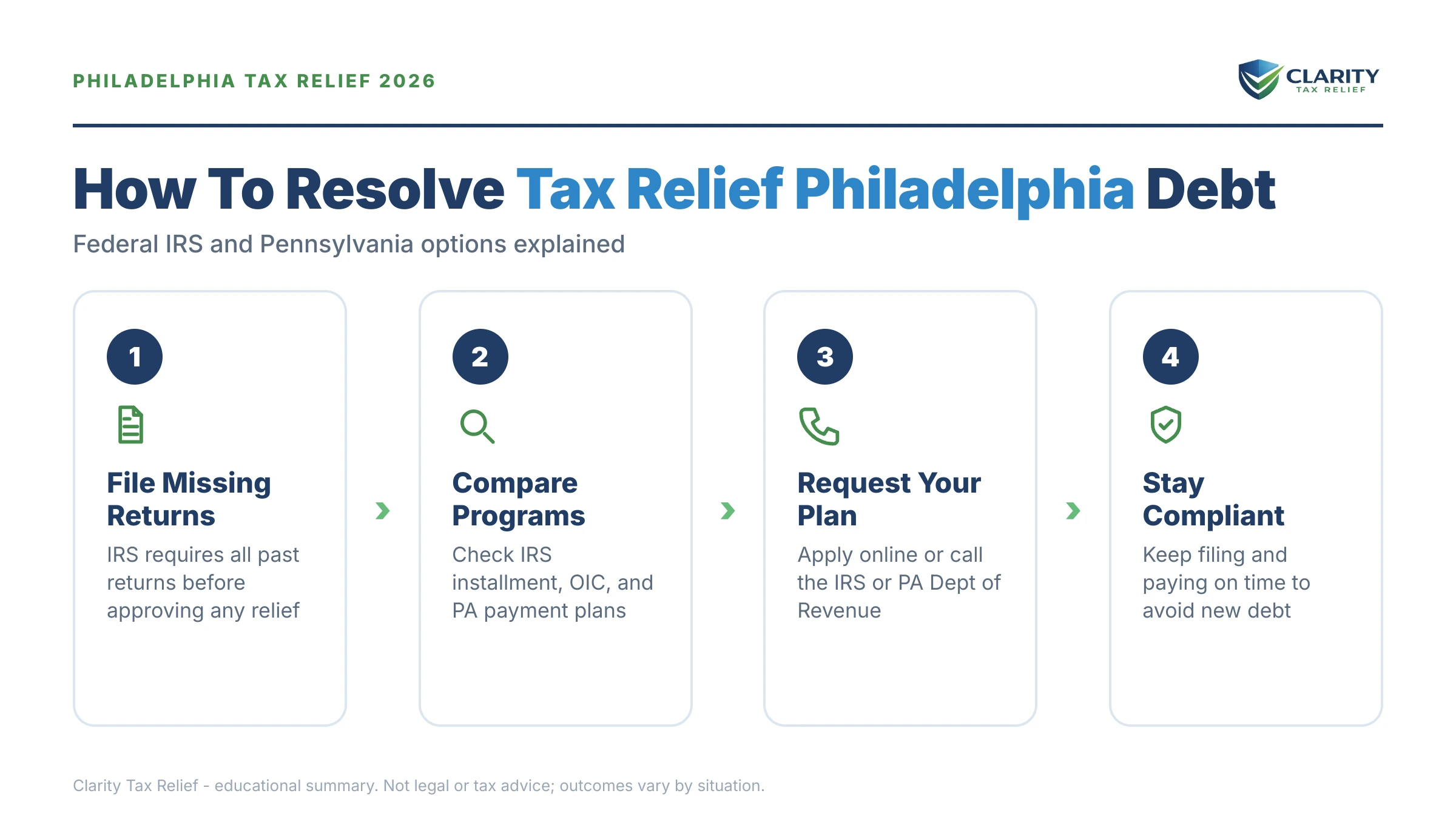
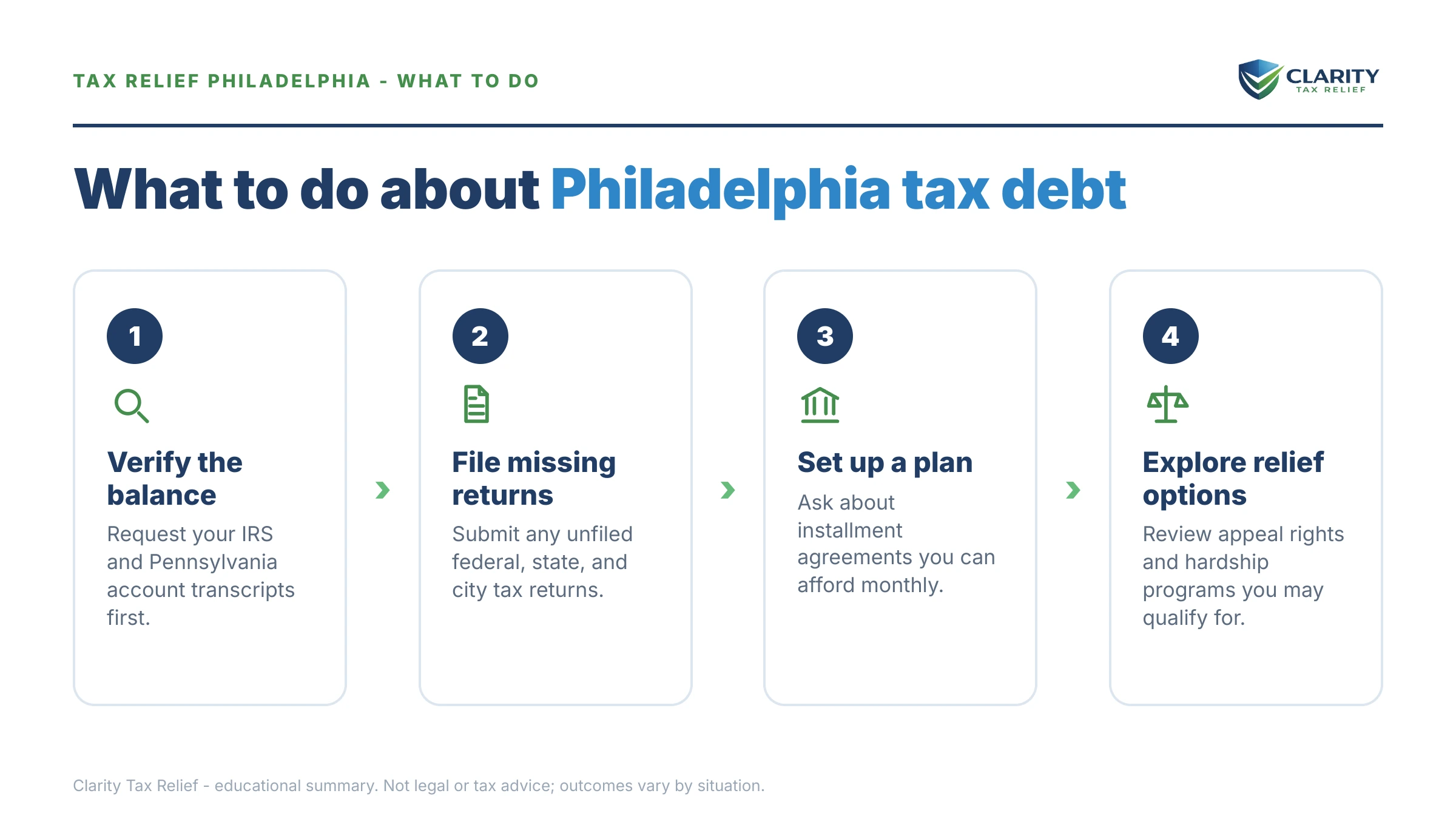
How to respond, step by step
- Pull your balances. Log in to your IRS online account and gather every IRS, Pennsylvania, and Philadelphia notice so you know exactly who is collecting and how much.
- File any missing returns. The IRS won't approve a payment plan or an offer while returns are unfiled — missing years block every relief program before you start.
- Match your balance to a program. Under $50,000 usually means a streamlined installment agreement. Genuine hardship points to Currently Not Collectible. A balance your income and assets truly can't cover may fit an Offer in Compromise.
- Set it up before the next notice lands. Pay or apply at IRS.gov/payments — an agreement in place stops the escalation sequence even though interest continues.
- Request penalty relief. Ask about first-time penalty abatement (or the new Automatic Exemption from Penalty starting summer 2026) — removing penalties shrinks the balance every other option is built on.
When you can handle this yourself, and when help changes the outcome
Plenty of Philadelphia tax problems don't need professional help. If you owe under $10,000, agree with the balance, and have filed everything, the guaranteed installment agreement is close to a formality — set it up online in an evening. The same goes for a balance you can clear within 180 days, or a single first notice you know is correct. Our step-by-step guide to how to settle tax debt yourself walks the whole DIY path.
Experienced help changes outcomes in specific situations: a levy already in motion (the 21-day bank-hold window is short and unforgiving), multiple unfiled years that must be reconstructed before any program opens, debt spread across all three agencies where payment order matters, Offer in Compromise math worth double-checking before you pay to file, and business or payroll balances — where the rules turn personal fast. If that's your situation, start with the buyer's checklist in how to choose a tax relief company. Business owners should read our guide to tax relief for small business first.
Terms on your notices, decoded
- Levy vs. lien: a lien is a legal claim against your property that protects the government's position. A levy is the actual taking — wages, bank funds, or your state refund.
- CSED: the Collection Statute Expiration Date — generally 10 years after assessment, after which the IRS can no longer collect (though appeals, offers, and bankruptcy pause the clock).
- CDP rights: Collection Due Process. Your right to an independent appeals hearing, requested on Form 12153 within 30 days of a final levy notice.
- Streamlined installment agreement: a payment plan approved without a full financial statement when your balance is under the IRS's threshold.
- Wage Tax: Philadelphia's city tax on salaries and wages — a tax you owe, not to be confused with a wage levy, which is the IRS taking part of your paycheck.
Primary sources worth bookmarking: the IRS payment options hub at IRS.gov/payments, the Pennsylvania Department of Revenue for state balances, the City of Philadelphia for Wage Tax and city accounts. The independent Taxpayer Advocate Service if the IRS process itself is causing you harm.
Tax relief in Philadelphia: your questions answered
Do I need a Philadelphia tax attorney, or can tax relief be handled remotely?
Most IRS tax relief work is handled remotely: a Form 2848 power of attorney lets an experienced tax professional anywhere in the country represent you before the IRS by phone, mail, and fax. A local attorney matters mainly for Philadelphia court matters, such as a real estate tax foreclosure or a criminal referral. For payment plans, offers, and levy releases, geography is irrelevant — credentials and experience are what count.
Can a tax relief company settle my Pennsylvania or Philadelphia city taxes too?
Only if they actually work state and local cases — many national firms handle IRS debt only. The Pennsylvania Department of Revenue and the Philadelphia Department of Revenue each run their own payment and settlement processes with rules that differ from the IRS's. Before hiring anyone, ask specifically whether they will represent you before all three agencies, and get the answer in the engagement letter.
Does the IRS have an office in Philadelphia?
Yes, the IRS operates a Taxpayer Assistance Center in Philadelphia, but it works by appointment only. You can't walk in and negotiate a settlement. Most resolutions happen by phone, mail, or online, not in person. With the IRS workforce down roughly 27% after the 2025 cuts, appointments and phone lines are slower than ever. But the automated collection notices never paused.
How much does tax relief cost in Philadelphia?
Fees depend on the case, not the city: a simple installment agreement costs far less to set up than an Offer in Compromise or a multi-year unfiled-return cleanup. The IRS's own charges range from $0 for a short-term payment plan to a $205 Offer in Compromise application fee. Reputable firms quote a flat fee after reviewing your transcripts — be wary of anyone quoting a price before seeing your file.
Can the IRS garnish wages in Philadelphia?
Yes. After the IRS sends a final notice of intent to levy (LT11 or Letter 1058) and 30 days pass, it can order your employer to withhold part of every paycheck. A wage levy is continuous until it is released. Your employer must comply or become liable itself. Requesting a Collection Due Process hearing on Form 12153 within the 30-day window generally pauses levy action while your case is heard.
What is the Philadelphia Wage Tax, and can I owe back taxes on it?
The Wage Tax is the city's tax on salaries and wages, normally withheld by your employer. It applies to anyone who works in Philadelphia, including suburban commuters. You can fall behind if an employer failed to withhold it, or if you're self-employed and owe the city's Earnings Tax or Net Profits Tax instead. Those balances are collected by the Philadelphia Department of Revenue, a completely separate process from any IRS debt.
Will the IRS take my Pennsylvania state tax refund?
It can. Once the IRS issues a CP504 notice, it has authority under IRC §6331(d) to levy your state tax refund, often the first asset it actually takes. Your federal refund can also be offset and applied to back taxes every year until the balance is resolved, even while you're making payments on an installment agreement.
Does IRS tax debt ever expire?
Yes — the IRS generally has 10 years from the date a tax is assessed to collect it, a deadline called the CSED. But the clock pauses during bankruptcy, a pending Offer in Compromise, certain appeals, and other events, so the real expiration date is often later than the 10-year mark. Waiting out the statute is rarely a plan; the IRS tends to escalate enforcement as the deadline approaches.
Your next 24 hours
- Find the sender, date, and amount on your most recent letter — IRS letterhead, Pennsylvania Department of Revenue, or City of Philadelphia. That one detail decides which playbook applies.
- Gather three things: your last filed tax return, every notice you've received from any agency, and a recent pay stub. That's the entire file needed to price your options.
- Get a free case review — call (888) 825-7779 or use the 2-minute form at the consultation page. Penalties and interest are compounding monthly either way; a review turns a growing balance into a fixed plan.
This guide is general information, not tax or legal advice for your specific situation. Eligibility for IRS programs depends on individual facts and circumstances; no outcome is guaranteed.