
IRS Notices
IRS LT38 Notice: What It Means and What to Do in 2026
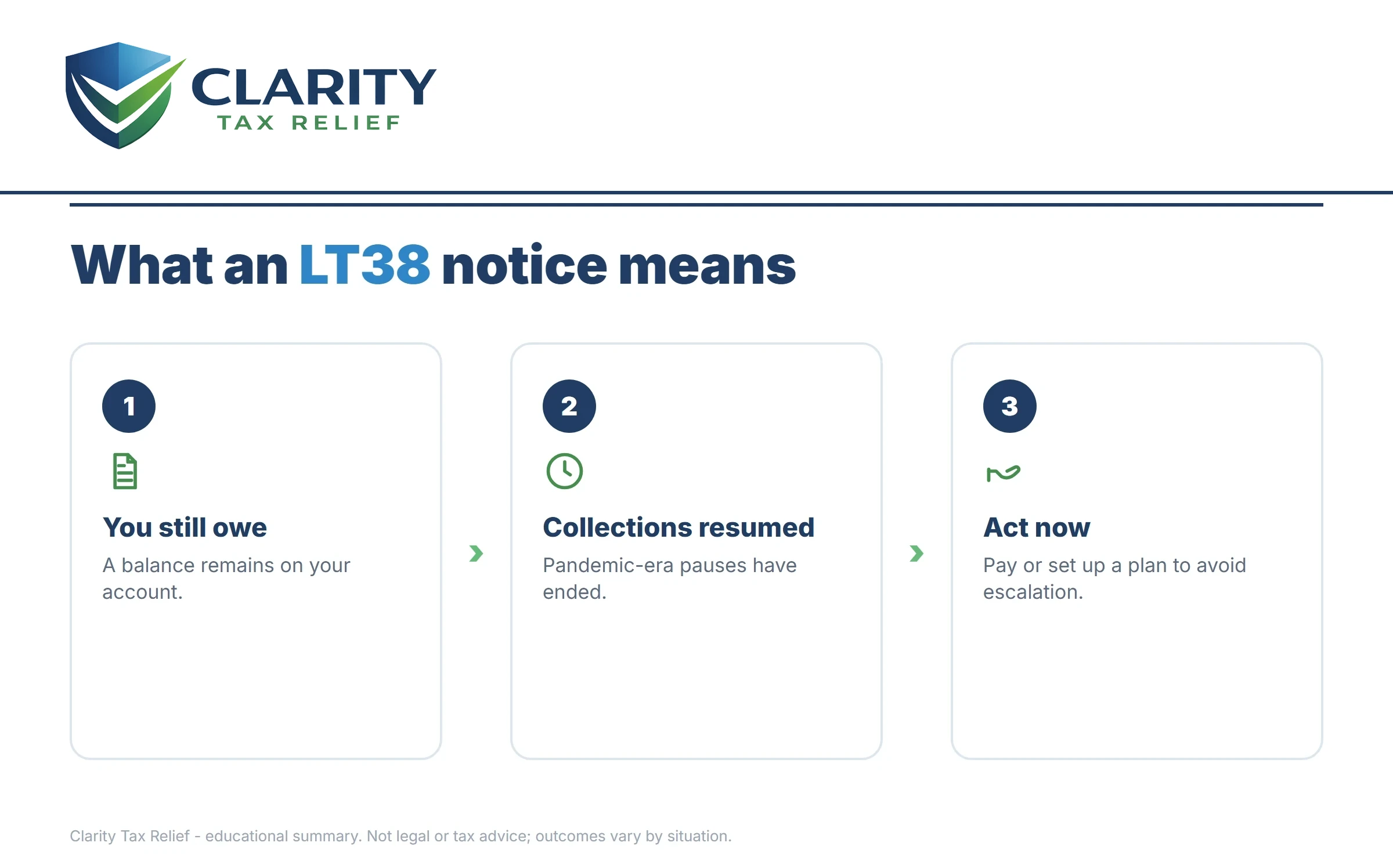
The short answer: an LT38 notice — titled "Reminder, Notice Resumption" — means the IRS paused collection letters on your unpaid balance, often for years, and is now restarting them. It is not a levy notice, but interest and penalties grew the entire time, and the regular collection sequence resumes after the date printed on it.
The IRS went quiet on you — no bills, no letters, maybe long enough that you started to hope the balance had somehow gone away. Then an LT38 shows up naming a tax year you'd half forgotten and a total that's larger than you remember. That silence wasn't forgiveness; it was a paused mail queue. The good news: you're catching this at the single cheapest moment to fix it.
Two numbers on the LT38 control everything — the total balance and the respond-by date. The image below shows exactly what this notice looks like and where to find both before you read another word.
⏱ Your deadline: the respond-by date printed on your LT38. The LT38 itself carries no levy power, but once that date passes the automated collection notice stream restarts, and interest plus the 0.5% monthly failure-to-pay penalty keep accruing either way.
Why you got an LT38 notice
An LT38 — "Reminder, Notice Resumption" — is the IRS restarting automated collection letters on a balance it stopped writing to you about. In early 2022 the IRS suspended most automated reminder notices while it dug out of its pandemic backlog. It began switching them back on in 2024, and accounts have continued cycling back into the stream in waves ever since — which is why LT38s are still landing in 2026.
Getting one means three things are true: the IRS shows an unpaid balance under your Social Security number, your account sat outside the normal notice stream during the pause. The Automated Collection System has now reconnected it. The debt on an LT38 is old — the enforcement behind it is about to become current again.
What an LT38 is not: it's not an audit, it's not a new assessment, and it's not an intent-to-levy notice. It doesn't start any appeal clock and it doesn't trigger Collection Due Process rights — compare that to an LT11 notice, which does both. It's also gentler than its LT-series cousins: an LT16 notice demands contact about an overdue account. An LT19 notice is a straight demand for payment. The LT38 is closer to a courtesy heads-up — the last one you'll get.
If you're still not sure what the IRS is even billing you for, start with our broader guide to why did I get a letter from the IRS, then come back here for the LT38-specific playbook.
“An IRS levy permits the legal seizure of your property to satisfy a tax debt. It can garnish wages, take money in your bank or other financial account, seize and sell your vehicle(s), real estate and other personal property.”
— Levy (IRS.gov)
Why the balance on your LT38 is bigger than you remember
Interest and the failure-to-pay penalty kept accruing every month the IRS stayed silent — the pause stopped the mail, not the meter. The failure-to-pay penalty runs at 0.5% of the unpaid tax per month, up to a 25% cap, and interest compounds daily on top of it at a rate the IRS resets quarterly. A balance that sat untouched for three or four years can come back thousands of dollars heavier than the original tax.
There's one bright spot. When the IRS restarted these notices, it granted automatic failure-to-pay penalty relief to many taxpayers with 2020 and 2021 balances under $100,000 in assessed tax. If that's you, the relief was applied without any request. It shows on your account transcript as a penalty adjustment. The relief covered only part of the pause period, though; the penalty resumed accruing afterward.
Before you accept the LT38's total, run your own numbers with our Penalty & Interest Calculator. It estimates how much of your balance is tax versus penalties and interest, which matters because penalties can sometimes be removed and the underlying tax usually can't be.
Relief already applied is not relief still available
Where automatic penalty relief was granted, it has already been credited to the account, so it is not something to ask for again. What it did not touch is the tax itself or the interest on it, which is why a balance can look untouched after relief was applied.
Failure to file penalties on a year you still have not filed are a separate matter entirely, and they keep accruing. If that describes one of your years, file a tax return for it before anything else, then set up a payment plan for whatever the corrected balance turns out to be.
What happens if you ignore an LT38
Ignoring an LT38 restarts the full IRS collection sequence — the one that ends in levies on bank accounts and paychecks. The LT38 is the on-ramp, not the destination. Here's the order of what follows:
- LT38 — notice resumption. You are here. A bill plus a warning that the stream is restarting. No enforcement power yet.
- CP501 / CP503 — reminder bills. Still no enforcement, but the balance grows monthly. Depending on your account history, the IRS may compress or skip this stage.
- CP504 notice — Notice of Intent to Levy under IRC §6331(d). The IRS can now seize your state tax refund, and a federal tax lien filing becomes a realistic next move.
- LT11 / Letter 1058 — final notice of intent to levy. This starts a 30-day clock and your right to a Collection Due Process hearing via Form 12153. After it expires, the IRS can levy bank accounts (funds are held 21 days before they leave) and garnish wages continuously until the debt is resolved.
Two more consequences kick in for larger debts as the balance compounds: the IRS can take up to 15% of Social Security benefits through the Federal Payment Levy Program, and once a debt crosses $66,000 (the 2026 threshold) it can be certified to the State Department, blocking passport renewal.
A 2026 reality check: the IRS workforce shrank roughly 27% in 2025, so reaching a human is harder than ever, but every notice in the table below is generated and escalated by computers that never got laid off. Silence from the IRS has never meant safety, and it especially doesn't now.
| Notice | What it tells you | Enforcement power at that stage |
|---|---|---|
| LT38 | Collection notices are resuming on your paused balance | None — a bill with a respond-by date |
| CP501 / CP503 | Reminder bills for the growing balance | None — but penalties and interest accrue monthly |
| CP504 | Notice of Intent to Levy (IRC §6331(d)) | IRS can seize your state tax refund; lien filing likely |
| LT11 / Letter 1058 | Final notice of intent to levy; 30-day CDP window (Form 12153) | After 30 days: bank levies (21-day hold) and continuous wage garnishment |
One counterintuitive fact worth checking before you pick a strategy: the notice pause did not pause the 10-year collection statute (CSED). The IRS generally has 10 years from assessment to collect, and that clock ran the whole time your account sat quiet. If your LT38 covers an older year, the remaining collection window may be shorter than you think. That changes which resolution makes financial sense.
Holding an LT38 you can't pay in full?
Send us a photo of it before the respond-by date on the notice passes. An experienced tax professional will decode which years it covers, how much of the balance is removable penalty. Your cheapest way out — free, confidential, no pressure.
Your options if you can't pay the LT38 balance
Every IRS payment option is still on the table at the LT38 stage — your menu will never be wider than it is right now. Which one fits depends on your balance, your income, and how fast you can realistically pay:
- Pay in full — stops the failure-to-pay penalty and future interest the day it posts. Same-day at IRS.gov.
- Short-term payment plan — up to 180 extra days, $0 setup fee. Best when a few strong months of income can clear the balance.
- Installment agreement — a monthly plan requested online or on Form 9465. Balances of $50,000 or less qualify for a streamlined installment agreement of up to 72 months with no detailed financial disclosure. Under $10,000, the IRS's guaranteed installment agreement rules apply. A setup fee applies (lowest online with direct debit), and interest plus penalties keep accruing while you pay.
- Currently Not Collectible status, if paying anything would leave you unable to cover basic living expenses, collection can be paused after a financial disclosure (usually Form 433-F). The balance keeps growing, but levies stop, and the CSED keeps running.
- Offer in Compromise — settling for less than the full balance. It's real but strictly means-tested: the IRS accepted roughly 1 in 5 offers in FY2024, and approval turns entirely on what your assets and income show the IRS could ever collect. The $205 application fee and the 20% down payment on lump-sum offers are both waived if your AGI is at or below 250% of the federal poverty level.
- Penalty abatement — first-time penalty abatement can remove failure-to-pay penalties if your prior three years were clean, and reasonable cause covers illness, disaster, and similar events. Starting summer 2026, the IRS's Automatic Exemption from Penalty (AEP) begins applying qualifying relief automatically, with no request needed, so check your transcript before paying penalties you might not owe.
| Option | Upfront cost | Timeline | Watch out for |
|---|---|---|---|
| Pay in full | $0 | Same day at IRS.gov | Nothing — accrual stops when it posts |
| Short-term plan | $0 setup | Up to 180 days | Interest + 0.5%/mo penalty continue |
| Installment agreement (≤$50,000) | Setup fee (lowest with online direct debit) | Up to 72 months | Defaults if you miss payments or fall behind on current-year taxes |
| Currently Not Collectible | $0 (Form 433-F disclosure) | Weeks to set up; reviewed periodically | Balance keeps growing; status ends if income rises |
| Offer in Compromise | $205 fee + 20% of the offer (both waived with low-income certification) | Months, up to 2 years | Means-tested; roughly 1 in 5 accepted |
| Penalty abatement / AEP | $0 | Weeks to months | Removes penalties only, not tax or most interest |
Say you owe $23,800: what each option actually costs
Here's a clearly hypothetical example. Say you're a self-employed sole proprietor whose 2021 Schedule C balance sat quiet through the notice pause, and the LT38 now shows $23,800. The math on each path:
- The cost of waiting: the failure-to-pay penalty alone is 0.5% × $23,800 = about $119 every month (until it hits its cap), plus daily-compounding interest at the IRS's quarterly rate. Doing nothing costs real money every 30 days.
- Short-term plan: six payments of roughly $3,970 clears it inside 180 days with a $0 setup fee — realistic only if you have strong invoicing months ahead.
- 72-month streamlined plan: $23,800 ÷ 72 ≈ $331/month minimum. Because interest and a reduced penalty keep accruing on the shrinking balance, paying more, say $500/month, finishes years earlier and costs meaningfully less overall.
- Offer in Compromise: viable only if the IRS's math says it could never collect $23,800 from you. Roughly: your asset equity plus 12 months of monthly surplus income (for a lump-sum offer). If you had $2,000 in reachable equity and $150/month of surplus after allowable expenses, that's $2,000 + ($150 × 12) = $3,800 — an offer near that figure could be worth pursuing. With business income, the IRS also looks at business assets and receivables, which is where self-employed offers get complicated.
One sole-proprietor trap to avoid: any agreement you set up requires you to stay current going forward, which means making your 2026 quarterly estimated taxes. Miss the quarterlies and a perfectly good installment agreement defaults — putting you right back into the notice stream you just escaped.
How to respond to an LT38, step by step
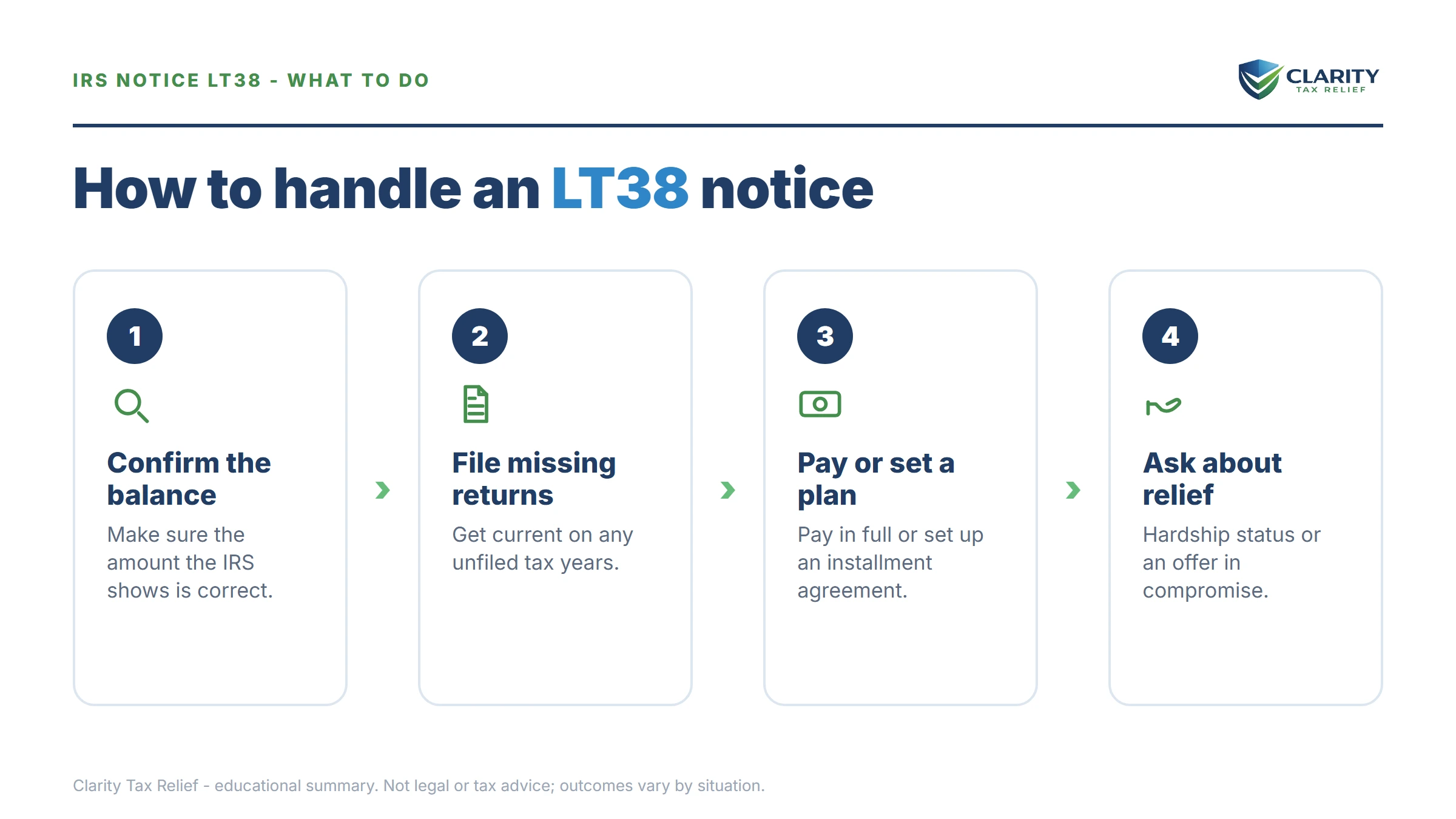
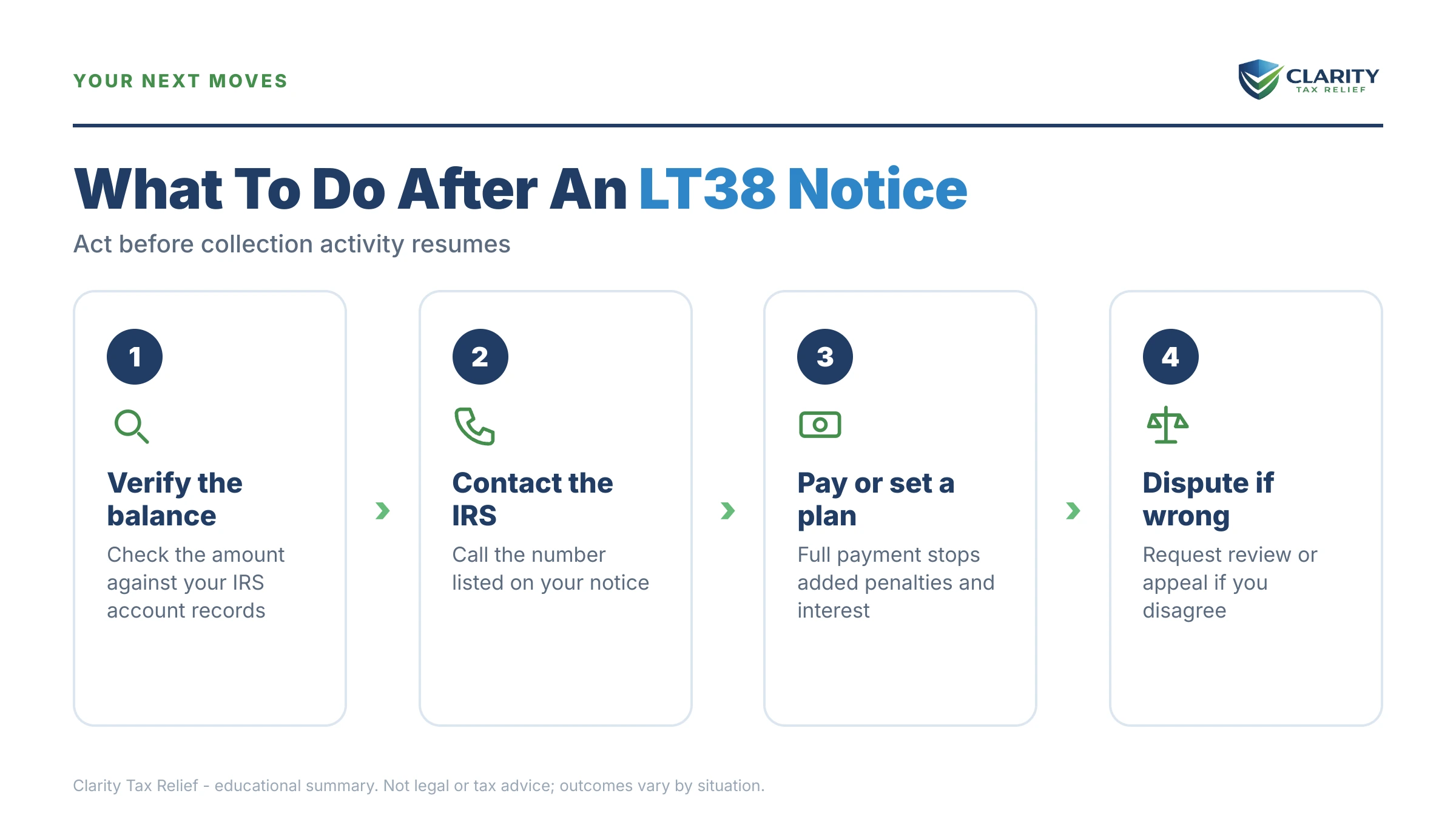
- Verify the balance. Log into your IRS online account and pull your account transcript. Confirm the tax years, the assessment dates. That every payment you made actually posted.
- Check the collection clock. Note when each year was assessed — the IRS has 10 years from assessment to collect. The notice pause did not stop that clock.
- Choose your resolution before the respond-by date. Pay in full at IRS.gov/payments, or set up a short-term plan, an installment agreement, Currently Not Collectible status, or an Offer in Compromise if your finances qualify.
- Get current on this year's taxes. File any unfiled returns and start your 2026 quarterly estimated payments — every IRS agreement requires current compliance to stay in force.
- Get experienced help if it's complicated. Multiple balance-due years, business debt, or genuine hardship changes which option is cheapest — have an experienced tax professional run the numbers before you commit.
When you can handle an LT38 yourself
Most people with a single balance-due year under $50,000 can resolve an LT38 on their own, online, in under an hour. If you agree with the amount, your other years are filed. You can either pay within 180 days or afford the streamlined monthly payment, just set up an IRS payment plan online before the respond-by date and you're done — no firm required, including ours.
Experienced help changes the outcome in a narrower set of situations: multiple balance-due years where the order you resolve them matters. An assessment close enough to its CSED that a long payment plan makes no sense. A genuine hardship where the CNC-versus-installment choice is worth thousands. Unfiled returns tangled up with the balance. Or Offer in Compromise math complicated by self-employment income and business assets. In those cases, a review before you commit to anything usually pays for itself. A free consultation will tell you honestly which camp you're in.
Terms on your LT38, decoded
- Notice resumption — the IRS's term for restarting the automated collection letters it suspended in 2022; it's the entire reason the LT38 exists.
- Automated Collection System (ACS) — the computer-driven arm of IRS collections that mails LT-series notices and escalates accounts without a specific employee assigned to your case.
- Failure-to-pay penalty — 0.5% of the unpaid tax per month, capped at 25%; it accrues even when the IRS isn't sending letters.
- CSED — the Collection Statute Expiration Date: the day the IRS's 10-year window to collect an assessed tax runs out.
- Intent to levy — the warning the IRS must give before seizing anything. A CP504 covers your state refund. The LT11 covers everything else.
- CDP rights — your right to a Collection Due Process hearing (requested on Form 12153) after a final notice. A timely request pauses levy action while your case is heard.
The IRS's own summary of this notice is at Understanding your LT38 notice. Its full menu of arrangements lives on the IRS payment plans page.
LT38 questions, answered
What is an IRS LT38 notice?
An LT38 notice — titled "Reminder, Notice Resumption" — means the IRS paused collection letters on your unpaid balance, often for years, and is now restarting them. It is not a levy notice, but interest and penalties grew the entire time. The regular collection sequence resumes after the date printed on it.
Is an LT38 notice serious?
It's a genuine bill. But it is the least dangerous letter in the IRS collection sequence — no levy, lien, or garnishment can happen at this stage. Its purpose is to warn you the automated collection stream is restarting. Treat it as your cheapest exit: every notice that follows carries more enforcement power and a larger balance, since interest and penalties accrue monthly.
Why did I get an LT38 if I haven't heard from the IRS in years?
Because the IRS suspended most automated collection reminders in early 2022 and has been restarting them in waves ever since. Your balance never went away during the silence — the LT38 is the IRS formally reconnecting your account to its notice stream. If you genuinely don't recognize the debt, pull your account transcript before paying anything; occasionally a payment was misapplied to the wrong year.
Can the IRS levy my bank account after an LT38?
Not based on the LT38 alone. Before levying wages or bank accounts, the IRS must send a final notice of intent to levy, the LT11 or Letter 1058, and give you 30 days to request a Collection Due Process hearing on Form 12153. The exception is your state tax refund, which can be taken after a CP504. Ignoring the LT38 is what puts those notices in motion.
Why is the balance on my LT38 higher than what I originally owed?
Interest compounds daily and the failure-to-pay penalty adds 0.5% of the unpaid tax every month, up to a 25% cap, and both kept running through the years the IRS wasn't mailing notices. On a balance that sat for three or four years, penalties and interest can add thousands. Penalty abatement can claw some of that back if you qualify; interest on the tax itself almost never gets waived.
Did the IRS notice pause stop the 10-year collection clock?
No — the pause stopped the mail, not the collection statute. The IRS generally has 10 years from the date a tax was assessed to collect it. That clock kept running the whole time your account was quiet. Only specific events — a pending Offer in Compromise, bankruptcy, or a Collection Due Process appeal — pause it. If your LT38 covers an older year, check the assessment date before choosing a resolution; the remaining window changes the math.
Do I still get the penalty relief the LT38 mentioned for 2020 and 2021?
If you qualified, you already have it. The IRS applied automatic failure-to-pay penalty relief to eligible taxpayers with assessed balances under $100,000 for tax years 2020 and 2021 — no request was needed. The relief shows on your account transcript as a penalty adjustment. The relief covered only part of the pause period; the penalty resumed accruing afterward, which is why your balance is still growing.
What is the difference between an LT38 and an LT11?
An LT38 restarts the collection notice stream; an LT11 ends it. The LT11 (or Letter 1058) is the final notice of intent to levy. It starts a 30-day clock and your right to a Collection Due Process hearing, after which the IRS can garnish wages and levy bank accounts. An LT38 carries no levy authority at all. Ignoring the LT38, though, is exactly how an LT11 ends up in your mailbox.
Your next 24 hours
- Find two things on your LT38: the respond-by date and the total balance near the top of page one, and note which tax year (or years) it lists.
- Gather three things: the notice itself, your last filed return for that year. A rough picture of your monthly income and expenses (self-employed: a recent profit-and-loss works).
- Act before the respond-by date: either set up your plan directly at IRS.gov, or get a free LT38 case review first at the 2-minute form or (888) 825-7779, so you pick the cheapest path instead of the first one.
This guide is general information, not tax or legal advice for your specific situation. Eligibility for IRS programs depends on individual facts and circumstances; no outcome is guaranteed.