
Back Taxes & Filing
Filing Taxes While Incarcerated: How to File From Prison in 2026
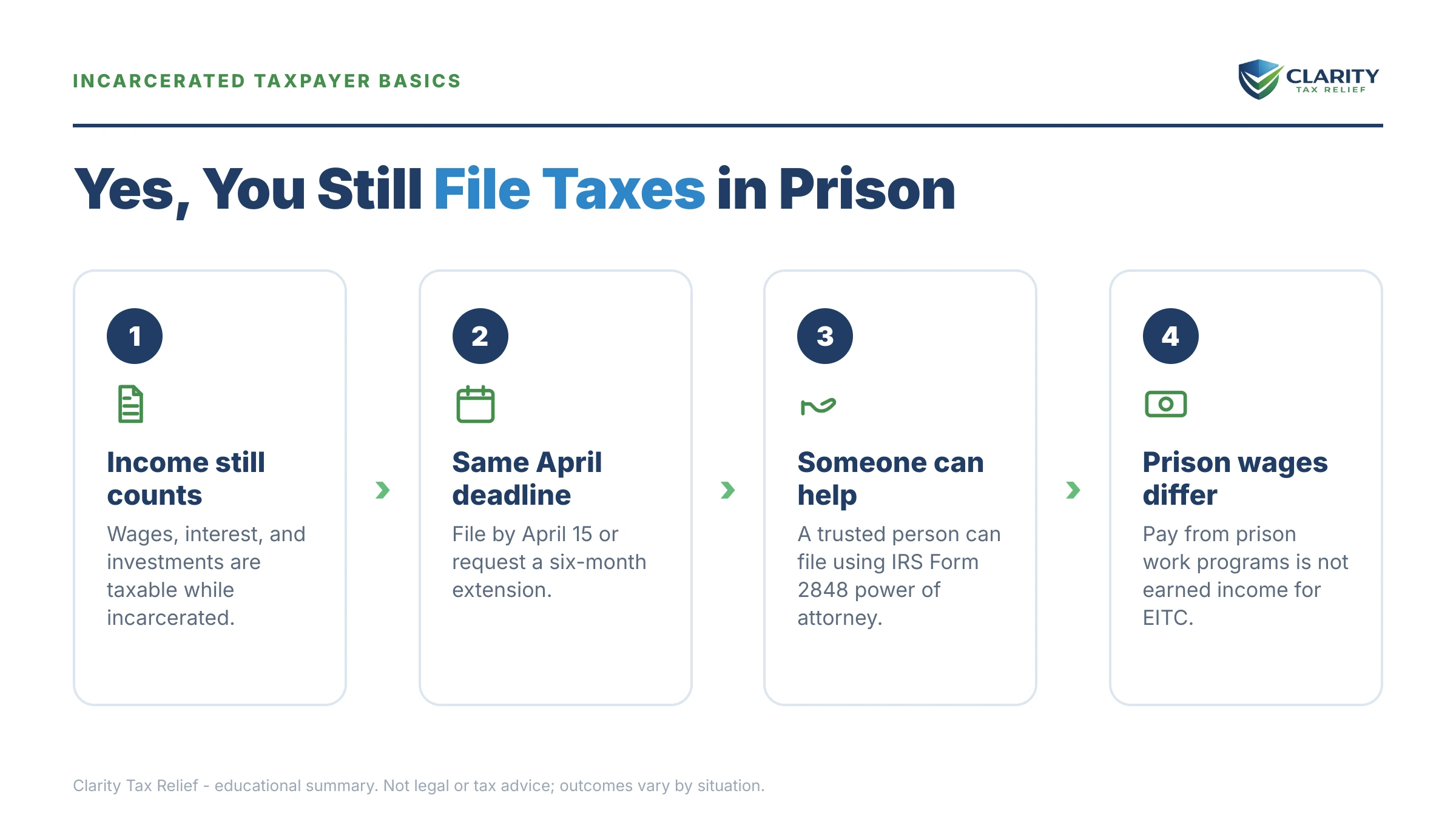
The short answer: yes. You must still file taxes while incarcerated if your income is above the filing threshold. Prison doesn't pause IRS deadlines, penalties, or the 3-year refund window. You can file by mail from your facility, or authorize a spouse, family member, or experienced tax professional to file for you using Form 2848.
Filing taxes while incarcerated is mostly a paperwork problem, not a legal dead end. Maybe you drove for the apps until the day you went in and the 1099s kept coming after the work stopped — three tax seasons gone, IRS mail stacking up at an address you no longer live at. Every piece of it can be fixed by mail and a few signed forms, and this guide walks the whole path.
The image below lays out the process at a glance and shows you exactly what to focus on first — worth flagging for whoever is helping you from the outside.
⏱ The clock that matters: the IRS pays a refund only if the return is filed within 3 years of its original due date, and incarceration does not pause that window. On any year where you owe, penalties and interest accrue every month you don't file. Each filing season you wait, one more refund year quietly expires.
Why filing taxes while incarcerated still matters
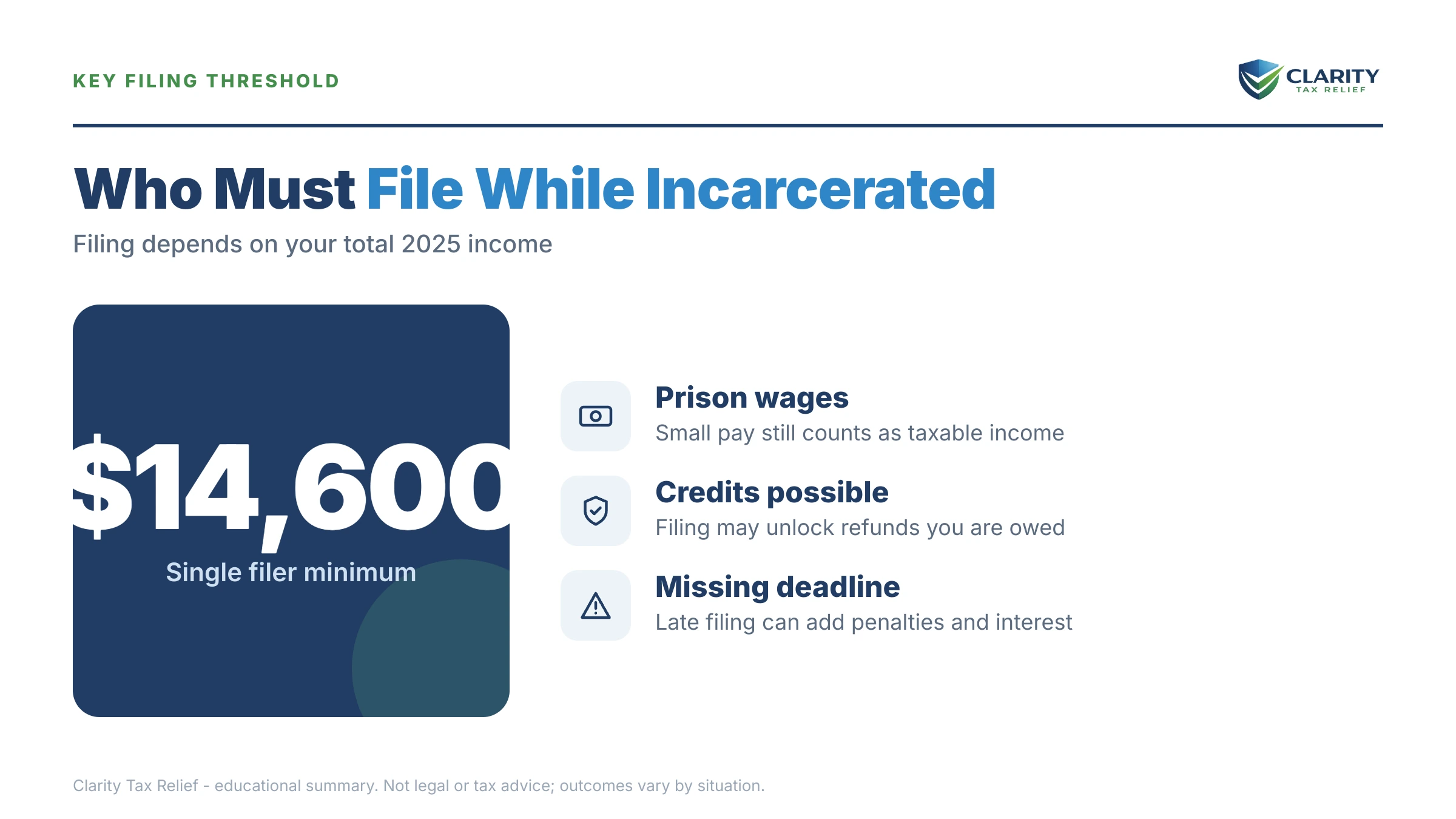
You must still file a federal return from prison if your gross income exceeds the filing threshold for your filing status — incarceration does not suspend the requirement. The wages most facilities pay are far too small to trigger it on their own. What triggers it is everything else: the gig income you earned before going in, rental income still flowing, interest, retirement distributions, or a spouse's joint return.
Three rules unique to incarcerated filers change the math. First, wages earned while an inmate at a penal institution do not count as earned income for the Earned Income Tax Credit, though income earned before incarceration in the same year still can. Second, a full year inside usually fails the Child Tax Credit's residency test, so someone else caring for your child may be the one entitled to claim them. Third, incarcerated people are a favorite target for refund identity theft, because thieves assume no one is watching the account.
If you're worried the unfiled years themselves are a criminal problem, they almost never are — see can you go to jail for not filing taxes. Prosecution is reserved for willful evasion. Voluntarily filing late is exactly what the IRS wants you to do. It closes that exposure rather than opening it.
If you're married: your spouse can still file jointly — the return just needs your signature, which means mailing it to the facility and building in extra weeks. If your spouse has their own refund coming and you carry old IRS debt, a joint refund can be offset against your balance, so run the married-filing-separately comparison before signing.
If you ran a business with employees: payroll tax debt does not stay behind with the business. Unpaid withholding can be assessed against you personally, and the assessment process continues while you're inside. Start with 941 back taxes and personally liable payroll taxes. Those cases need a representative moving immediately, not after release.
“Use Form 2848 to authorize an individual to represent you before the IRS. The individual you authorize must be a person eligible to practice before the IRS.”
— About Form 2848, Power of Attorney and Declaration of Representative (IRS.gov)
What happens if you don't file from inside
If you don't file, the IRS eventually files for you — a substitute for return built from your gross 1099 and W-2 totals with zero deductions, zero business expenses, and zero credits. The sequence is automated, and in 2026, with the IRS workforce cut roughly 27%, the automation runs whether or not a human ever reviews your file. The stages, in order:
- CP59 notice — "we have no record of your return." Sent to your last known address, which is why unfiled years often go unnoticed for years.
- CP516 / CP518 — escalating reminders, ending in a final request to file.
- Substitute for return (SFR) — the IRS drafts a return from your income documents at the worst possible numbers. For a gig worker, that means gross app payouts taxed as pure profit — no mileage, no phone, no supplies. See the IRS filed a substitute return for me.
- CP3219N, the deficiency notice — a 90-day window to file your own return or petition Tax Court. Miss it (easy to do when mail goes to an old address) and the inflated tax is legally assessed.
- Collection notices — CP14 bill, then escalating letters up to a final notice of intent to levy with a 30-day clock.
- Enforcement — a federal tax lien on anything you own, bank levies (funds are held 21 days before they're sent), and, relevant after release, wage levies that run continuously and a levy of up to 15% of Social Security benefits.
There's a quieter loss running alongside the enforcement track: any year where you were owed a refund is forfeited forever once its 3-year window closes. Non-filers lose real money to that clock far more often than to levies.
Inside, or helping someone who is, with unfiled years piling up?
Send us what you have: the notice numbers, the years, the 1099s. An experienced tax professional will map exactly where the account stands and the cheapest way out — free, confidential, and built to work by mail and power of attorney. Penalties and interest are accruing monthly, and refund windows only close one way.
Your options if you owe and can't pay from prison
Every IRS resolution program remains open to you while incarcerated — what changes is the paperwork path, since nearly everything must move by mail or through a representative. The general playbook lives in our guide to how to settle tax debt yourself; here's how each option maps onto life inside:
| Option | Typical eligibility | How it works from inside |
|---|---|---|
| Short-term payment plan | Can pay in full within 180 days; $0 setup fee | Requested by mail or by your representative; interest and penalties continue but enforcement stops |
| Streamlined installment agreement | Balance ≤ $50,000; up to 72 months; no financial disclosure | Your Form 2848 representative can set it up online or by phone in one call |
| Installment agreement over $50,000 | Requires Form 433-F financial disclosure | Your representative negotiates terms; filing accurate returns often drops the balance under $50,000 first |
| Currently Not Collectible | No meaningful ability to pay after basic living costs — common during incarceration | Requested with Form 433-F; collection pauses, though the debt and interest remain |
| Offer in Compromise | Assets plus realistic future income are less than the balance; $205 fee and 20% down waived with low-income certification (AGI ≤ 250% of poverty), which many incarcerated filers may meet | Representative prepares Forms 656/433-A(OIC); the IRS accepted roughly 1 in 5 offers in FY2024 — real, not guaranteed |
| Penalty relief | First-Time Abate if the prior 3 years were clean; Automatic Exemption from Penalty (AEP) begins summer 2026 with no request needed; reasonable cause with documentation | Requested in writing or by your representative once the returns are filed |
One timing note on the Offer in Compromise: the IRS looks at your future earning ability. An offer filed while you have near-zero income can look very different from one filed after release. Whether to move now or wait is a genuine strategy call, the kind that changes the number by thousands, so get the math run before committing the fee and months of review time.
A worked example: $61,200 across three unfiled gig years
Say, hypothetically, you drove delivery apps through 2022, went in early 2023, and never filed 2022, 2023, or 2024. The IRS built substitute returns off your gross 1099 totals and assessed $61,200 across the three years. Here's what that number is actually made of, and how it moves:
- The SFRs used gross payouts as pure profit. No mileage, no phone, no hot bags. If your real business expenses ran, say, $12,000–$15,000 a year, filing accurate returns replaces each SFR and shrinks both the tax and every penalty calculated on it.
- The failure-to-file penalty is the expensive one: 5% of the unpaid tax per month, capped at 25% — ten times the 0.5%-per-month failure-to-pay penalty. If roughly $46,000 of that $61,200 is underlying tax, the file penalty alone can reach about $11,500. Run your own numbers with our Penalty & Interest Calculator — it estimates, it doesn't promise.
- $61,200 is above the $50,000 streamlined line. As assessed, a payment plan needs Form 433-F financials — $61,200 spread over 72 months is roughly $850/month before continuing interest. But if filing real returns drops the balance under $50,000, your representative can set up a streamlined plan online: $50,000 over 72 months is about $695/month, no financial disclosure.
- Watch the passport line. $61,200 sits below the 2026 seriously-delinquent threshold of $66,000, but accruing penalties and interest can push it across — which matters the day you're released and want travel documents.
- Or the balance may not be the answer at all. With no assets and prison wages, Currently Not Collectible or an Offer may fit better than any payment plan — that's a facts-and-circumstances test, not a promise.
The order of operations matters: returns first, penalties second, balance last. Fixing them out of order means negotiating a payment plan on a number that was never right.
How to file taxes from prison, step by step
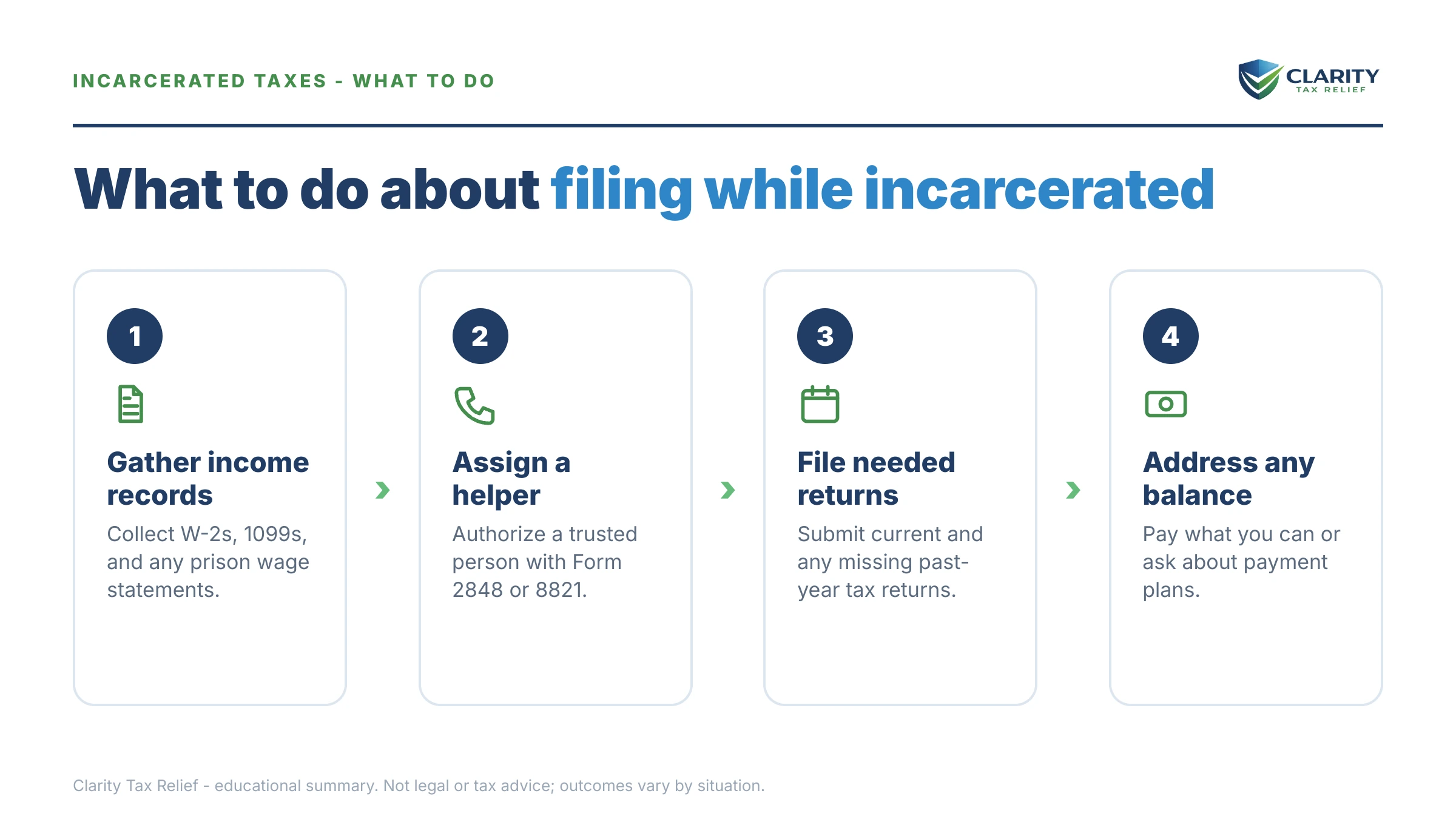
Filing from inside takes six moves, and four of them can be done entirely by someone you trust on the outside.
- Update your address — mail Form 8822 so IRS notices reach you at the facility, or a trusted outside address, instead of piling up unread at your old one.
- Authorize a helper — sign Form 2848 (representation) or Form 8821 (information access) so someone on the outside can pull records, receive copies of notices, and act quickly.
- Pull your income records — request wage and income transcripts with Form 4506-T for every unfiled year — they list every W-2 and 1099 the IRS has under your Social Security number.
- File the oldest year first, on paper — prepare each return with your real deductions and business expenses, sign it, and mail it — the IRS generally wants the last 6 years of unfiled returns to consider you compliant.
- Resolve any balance before it escalates — once the returns are in, set up a payment plan, request Currently Not Collectible status, or evaluate an Offer in Compromise based on what you can actually pay.
- Protect your identity — request an IP PIN, or file Form 14039 if a return was already filed in your name — incarcerated taxpayers are a known identity-theft target.
Two practical notes. Prison mail rooms add days or weeks on both ends — treat every IRS deadline as arriving earlier than it says, and keep photocopies of everything you sign. And our Form 2848 walkthrough covers the exact boxes that get these forms rejected. A bounced power of attorney can cost a month you don't have.
Getting your records when you can't get online
The IRS keeps a copy of every W-2 and 1099 filed under your Social Security number, so you can rebuild three unfiled years without a single original document. Facilities don't allow the identity verification the IRS online account requires, which leaves two paths: Form 4506-T by mail from inside, or a designee outside pulling your wage and income transcripts under Form 8821 or 2848.
Once your helper has account transcripts, a handful of codes tell the whole story of where each year stands:
| Code | What it means | What to do |
|---|---|---|
| 150 | A return posted for that year — either yours or an IRS substitute return | Check whether you actually filed it; an SFR posting means the inflated assessment track has started |
| 971 | A notice was issued | Have your designee get the notice copy — it names the deadline that controls that year |
| 290 | Additional tax assessed — often the SFR balance becoming official | File your own accurate return for that year; it usually replaces the SFR figure with a lower one |
| 599 | Return secured. Your late-filed return was received | Confirm the numbers posted match what you mailed, then move to resolving the balance |
| 530 | Account placed in Currently Not Collectible status | Collection is paused — keep future returns filed on time so the status holds |
| 846 | Refund issued | Verify where it went — an unexpected 846 on a year you didn't file is an identity-theft flag |
If a transcript shows a filed return or a refund on a year you know you didn't file, treat it as identity theft on day one: Form 14039 plus an IP PIN request, before you mail your own return for that year.
When you can handle this yourself, and when help changes the outcome
A single unfiled year with a refund coming is a do-it-yourself job, even from a cell. If your only income was prison wages plus a few months of gig work, one paper return and a stamped envelope may be the entire fix, and if it shows a refund, there's no penalty for filing it late, just the 3-year deadline to beat. The same goes if family can pay a small balance within 180 days: a short-term plan costs nothing to set up.
Experienced help earns its cost when the file gets layered: multiple SFR years where accurate returns have to displace inflated assessments, a balance above the $50,000 streamlined line, an Offer in Compromise where the timing question (file now at zero income, or after release?) swings the result, payroll or business debt with personal-liability exposure, or a levy already in motion against outside assets or a spouse's joint account. In those cases the professional isn't filling out forms you couldn't — they're sequencing returns, penalty relief. The resolution so each step makes the next one cheaper. Our guide to haven't filed taxes in 3 years covers the multi-year catch-up sequence in detail.
Terms on your IRS mail, decoded
- Substitute for return (SFR): a return the IRS files for you from gross income documents — no deductions, no expenses, the highest defensible tax.
- CSED: the collection statute expiration date — the end of the IRS's 10-year window to collect an assessed tax, though certain events pause the clock.
- Currently Not Collectible (CNC): an account status that pauses active collection because you can't pay; the debt and interest stay on the books. Full details in Currently Not Collectible status.
- Form 2848 vs. Form 8821: 2848 lets someone act and speak for you before the IRS; 8821 only lets them see your information and receive copies of notices.
- Wage and income transcript: the IRS's own list of every W-2 and 1099 filed under your SSN for a year — the raw material for rebuilding unfiled returns.
- RSED: the refund statute expiration date — generally 3 years from a return's due date, after which an unclaimed refund is gone for good. More at the 3-year refund deadline.
Filing taxes from prison: your questions answered
Do you have to file taxes while incarcerated?
Yes, if your gross income is above the filing threshold for your filing status — incarceration does not suspend the filing requirement. Most prison wages are far too small to trigger it, but pre-incarceration income like gig work, regular wages, or investment income usually does. Even below the threshold, filing can be worth it to claim a refund of withheld tax before the 3-year window closes.
Can someone file my taxes for me while I'm in prison?
Yes. A spouse can file a joint return that includes your signature, and Form 2848 lets an immediate family member or an experienced tax professional act for you before the IRS. For information-only access, Form 8821 lets anyone you name receive your transcripts and copies of notices. Mail the forms to your facility for signature and allow extra weeks for processing.
Can you get a tax refund while incarcerated?
Yes — being incarcerated doesn't forfeit a refund you're legally owed, and it can be direct-deposited or mailed as a paper check. Two catches: refunds are generally paid only on returns filed within 3 years of the original due date, and any refund is first offset against back taxes, child support, or other federal and state debts you owe.
Does income earned in prison count for the Earned Income Tax Credit?
No. Wages earned while an inmate at a penal institution are specifically excluded from earned income for EITC purposes. Income earned before incarceration in the same tax year can still count, so a gig worker locked up mid-year may still qualify based on the pre-incarceration months. The Child Tax Credit has its own residency test that a full year inside usually fails.
Does the IRS stop collections while you're in prison?
No — collection notices, liens, and levies continue automatically, and the 10-year collection statute generally keeps running. What you can do is request Currently Not Collectible status, which pauses active collection when you have no real ability to pay. The debt and interest remain on the books, but levies stop while CNC is in place.
What happens if you don't file taxes while incarcerated?
The IRS will eventually file a substitute for return (SFR) using your 1099s and W-2s — with no deductions, expenses, or credits — producing the highest possible tax. It then assesses that balance, adds a failure-to-file penalty of 5% per month up to 25%, and starts the collection sequence. Filing your own accurate return, even years late, usually replaces the SFR with a lower number.
Is being in prison reasonable cause to remove IRS penalties?
Not automatically — the IRS and courts have generally held that incarceration alone doesn't excuse filing or paying, because you can act through a representative. It can support a reasonable-cause request when combined with other facts, like no access to records or extended facility lockdowns. First-Time Abate, and the Automatic Exemption from Penalty rolling out in summer 2026 — may remove penalties regardless of the reason.
How do I get my W-2s and 1099s while incarcerated?
Request a wage and income transcript, which lists every W-2 and 1099 filed under your Social Security number for a given year. From inside, mail Form 4506-T. From outside, a family member with Form 8821 or a professional with Form 2848 can pull the same records much faster. You don't need the original documents to file — the transcript figures are enough.
Your next 24 hours
- Find the most recent IRS letter, or have someone check the old mailbox and your facility mail log. Note the notice number in the top corner and every tax year it lists; that tells you which stage of the sequence you're in.
- Gather the raw material: a list of every unfiled year, who paid you those years (apps, employers, clients). A blank Form 2848 or 8821 ready for your signature so your helper can pull the rest by transcript.
- Get the free case review — the form at claritytaxrelief.com/#consult or (888) 825-7779. Family can start the call on your behalf. Every month of waiting adds penalty and interest to the years you owe, and moves the years you're owed closer to the 3-year cutoff.
Primary sources if you want to verify anything yourself: transcript requests at IRS.gov Get Transcript, payment and plan options at IRS.gov/payments, and free independent help through the Taxpayer Advocate Service, which can step in when facility logistics stall a case.
This guide is general information, not tax or legal advice for your specific situation. Eligibility for IRS programs depends on individual facts and circumstances; no outcome is guaranteed.