
City Guides
Tax Relief Chicago: How to Resolve IRS and Illinois Back Taxes in 2026
The short answer: tax relief in Chicago means resolving debt with two separate agencies — the IRS and the Illinois Department of Revenue (IDOR). Real options include payment plans, hardship status, penalty relief, and (for some) a settlement offer. Most Chicago households can at least set up an IRS payment plan online today.
If you typed "tax relief Chicago" into your phone, chances are you're looking at two different envelopes, one from the IRS and one from Springfield, and neither letter mentions the other. That double-billing feeling is the defining feature of owing taxes in Illinois, and it's fixable. This guide maps every real program for both agencies, what each costs, and the order to fix things in.
⏱ The real clock: neither the IRS nor IDOR pauses while you decide. The IRS failure-to-pay penalty adds 0.5% of the balance every month, interest compounds daily on top, and Illinois adds its own penalties and interest to the state balance. Every month of delay makes any resolution, federal or state, more expensive to start.
Why tax relief in Chicago means dealing with two collectors
Chicago taxpayers with back taxes answer to two separate agencies — the IRS and the Illinois Department of Revenue — and resolving one balance does nothing to the other. There is no city income tax on wages in Chicago, so for most households the problem is exactly two-sided: a federal balance and an Illinois balance for the same tax years.
The two debts usually share one cause. Both spouses' employers withhold at the "married" rate, a side 1099 or bonus gets stacked on top, and at filing time both the federal return and the Illinois return show a balance due at once. Self-employed Chicagoans — rideshare drivers, contractors, consultants in the Loop — hit the same double bill when quarterly estimates get skipped.
The agencies also behave differently. The IRS is a slow, automated escalator with well-published relief programs. IDOR is often faster to enforce than the IRS. It can file a lien in the statewide Illinois State Tax Lien Registry and pursue wages without the long federal notice sequence. If you're deciding which letter to answer first, our guide to state tax debt vs IRS priorities breaks down the tradeoffs. The short version is that you need a formal arrangement with each.
“An IRS levy permits the legal seizure of your property to satisfy a tax debt. It can garnish wages, take money in your bank or other financial account, seize and sell your vehicle(s), real estate and other personal property.”
— Levy (IRS.gov)
What happens if you ignore IRS and Illinois tax debt
The IRS collection sequence runs CP14 → CP501/CP503 → CP504 → LT11, and only the final notice (LT11 or Letter 1058) starts the 30-day clock before wages and bank accounts can be levied. Each stage arrives automatically whether or not a human at the IRS ever reads your file:
- CP14 — the first bill. Typically about 21 days to pay before the reminder cycle begins. No enforcement yet; this is the cheapest moment to act.
- CP501 / CP503 — reminders. Still just bills, but penalties and interest are compounding the whole time.
- CP504 — intent to levy your state refund. At this stage the IRS can seize your Illinois income tax refund. A federal tax lien becomes a real possibility.
- LT11 / Letter 1058 — final notice. A 30-day window opens in which you can demand a Collection Due Process hearing with Form 12153. After it closes, levies are authorized.
- Levy. A bank levy freezes funds with a 21-day hold before the money leaves; a wage levy hits every paycheck continuously until it's released.
Illinois runs its own parallel track. IDOR sends its own bills, can record a lien in the public, searchable Illinois State Tax Lien Registry, can intercept your state refund, and can garnish wages or levy accounts — all without waiting to see what the IRS does. Our Illinois tax lien guide covers how a registry filing affects your credit applications, home sale, or refinance.
One 2026 reality worth knowing: the IRS cut roughly 27% of its workforce in 2025, so reaching a human is harder than ever. But the notices, liens, and levies are generated by automated systems that never stopped. Slow phones do not mean slow enforcement.
Two agencies collecting on your Chicago household?
Send us your IRS and IDOR notices. An experienced tax professional will pull your records, decode where each agency is in its sequence, and map your options — free and confidential, while penalties and interest are still small.
Tax relief options for Chicago taxpayers, compared
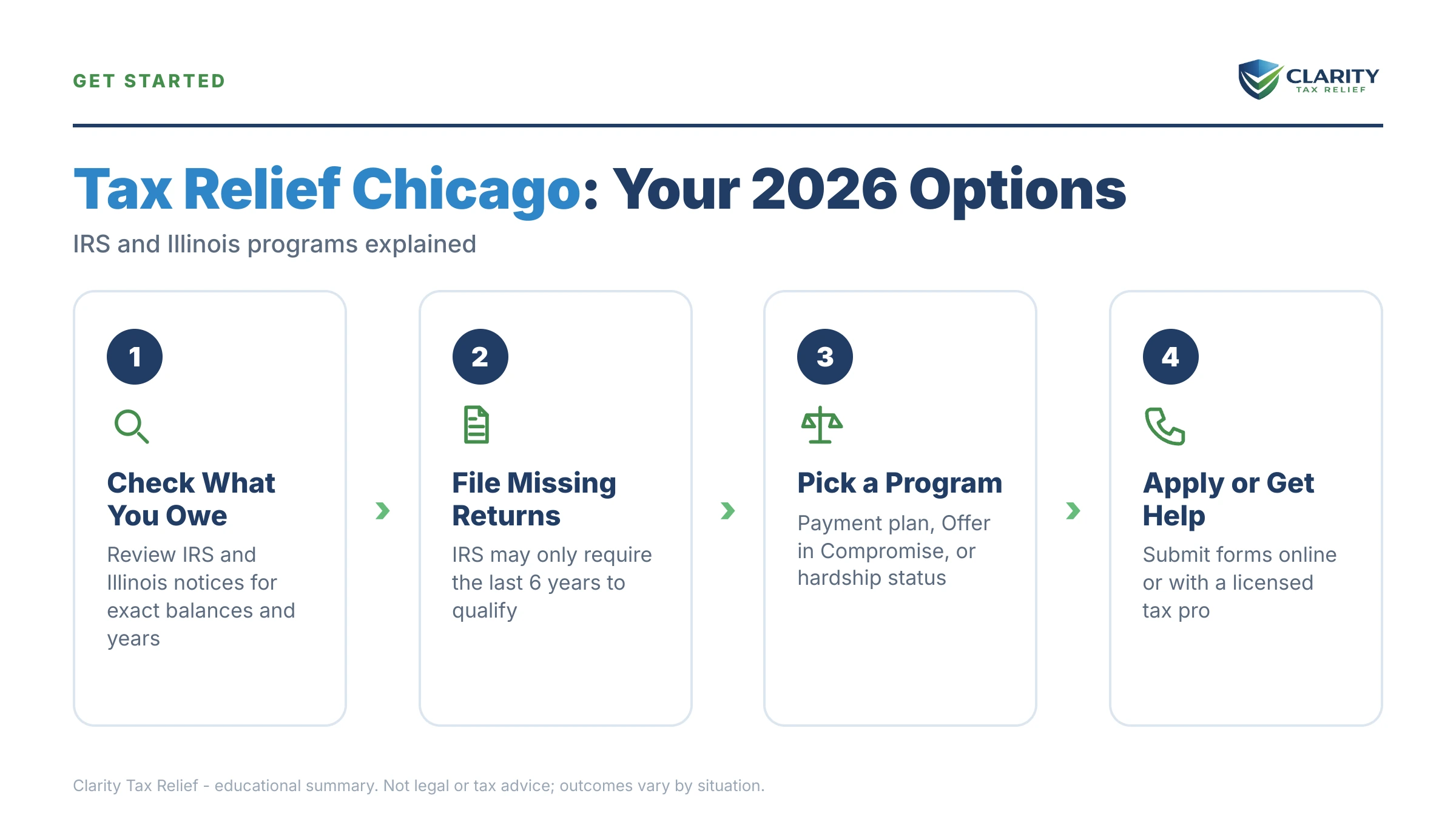
Most Chicago households with a federal balance under $50,000 can set up an IRS payment plan online without submitting any financial disclosure. The harder question is which program actually fits your numbers — each one has a real eligibility threshold, and each has tradeoffs:
| Option | Who qualifies | Cost & key facts |
|---|---|---|
| Short-term payment plan | Can pay in full within 180 days | $0 setup fee; penalties and interest continue, enforcement stops |
| Guaranteed installment agreement | Owe $10,000 or less, compliant filer | IRS must accept if conditions are met; up to 3 years to pay |
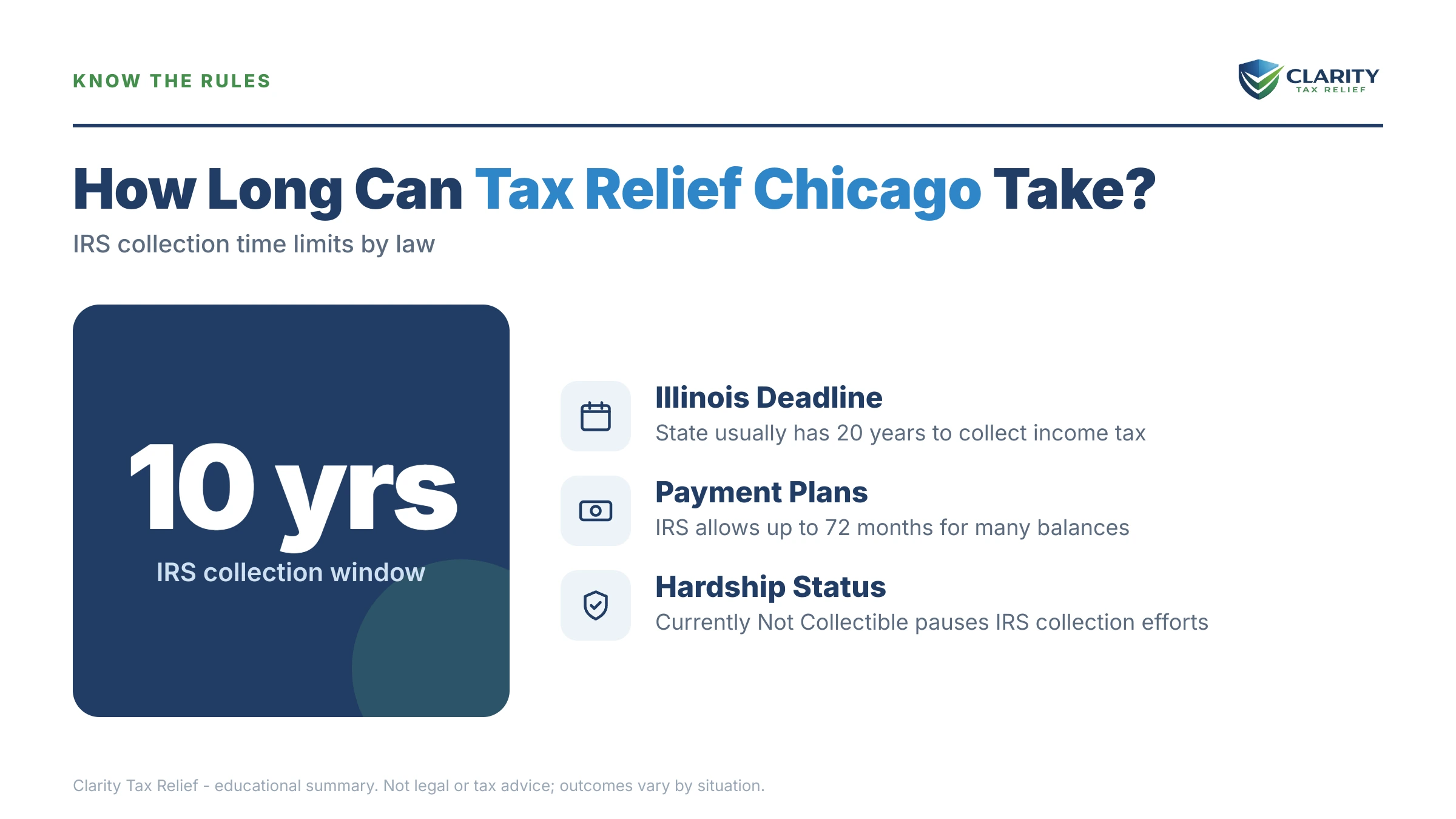
| Streamlined installment agreement | Owe $50,000 or less (or $25,000 without direct debit) | Up to 72 months, set up online, no financial statement required |
| Non-streamlined / partial-pay plan | Owe over $50,000, or can't afford the full-pay payment | Requires Form 433-F financial disclosure; IRS reviews assets |
| Currently Not Collectible | Paying anything would create genuine hardship | Collection pauses; debt and interest remain; periodic review |
| Offer in Compromise | Assets + future income genuinely can't cover the debt | $205 fee + 20% down on lump-sum offers (both waived with low-income certification); roughly 1 in 5 accepted in FY2024 |
| Penalty relief (FTA / AEP) | Clean 3-year compliance history, or reasonable cause | Free to request; AEP becomes automatic starting summer 2026 |
Two options deserve a plain-English warning. An IRS payment plan vs offer in compromise decision is a math question, not a preference: the IRS accepted roughly one in five offers in FY2024. It rejects any offer where its formula says it can collect more over time. And penalty relief is the most under-used option on the list — first time penalty abatement can erase an entire year's failure-to-pay penalty if your prior three years are clean, and starting summer 2026 the new Automatic Exemption from Penalty (AEP) applies similar relief automatically, with no request needed.
A worked example: a Chicago couple owing $23,800
Say you and your spouse file jointly from your bungalow on the Northwest Side and owe the IRS $23,800 — both W-2 jobs withheld at the married rate, and a $19,000 consulting 1099 pushed you into a balance due. Here's how the real options price out:
- Streamlined plan: $23,800 ÷ 72 months ≈ $331/month minimum, set up online in under an hour. Interest keeps compounding, but on an approved agreement the failure-to-pay penalty typically drops from 0.5% to 0.25% per month.
- Pay it faster: at $500/month, the balance clears in roughly four and a half years instead of six, cutting the total interest meaningfully. You can estimate what your own balance costs per month with our IRS Penalty & Interest Calculator.
- Penalty relief: if, say, $1,600 of the $23,800 is failure-to-pay penalty and your prior three years are clean, first-time abatement could remove that piece entirely.
- OIC reality check: with two salaries and equity in a Chicago home, the IRS's collection-potential math will usually show it can collect the full $23,800 over time, so an offer would likely be rejected at this balance and income. The honest path here is the plan plus penalty relief, not a settlement pitch.
- Passport note: $23,800 sits well below the $66,000 seriously-delinquent threshold for 2026, so passport certification isn't a concern at this level. But it becomes one if multiple years stack up.
The only detail that changes the arithmetic: the IRS payment plan setup fee varies by how you apply and pay — online with direct debit is the cheapest route, and low-income taxpayers can have it reduced or waived.
The Illinois side: resolving with IDOR
Your Illinois balance needs its own agreement, and IDOR's programs don't mirror the IRS's. Payment plans are requested through the MyTax Illinois portal. Settlement runs through a separate petition to IDOR's Board of Appeals. And lien filings appear in the statewide registry rather than county-by-county recording. Because Illinois' collection rules, timelines, and thresholds differ from federal ones, don't assume any IRS figure applies to the state — our Illinois back taxes payment plan guide covers the state side in full.
| Question | IRS (federal) | IDOR (Illinois) |
|---|---|---|
| Payment plans | Online up to 72 months for balances ≤ $50,000 | Requested through MyTax Illinois; terms set case-by-case |
| Settling for less | Offer in Compromise (Form 656), formula-driven | Separate petition to IDOR's Board of Appeals |
| Liens | Federal tax lien attached to all your property | Filing in the public Illinois State Tax Lien Registry |
| Hardship pause | Currently Not Collectible status (Form 433-F review) | Handled directly with IDOR; no published equivalent program |
| Penalty relief | First-time abatement, AEP (summer 2026), reasonable cause | Reasonable-cause abatement requested from IDOR |
| Refund offsets | Keeps your federal refund; can take your state refund after CP504 | Intercepts your Illinois refund toward state debt |
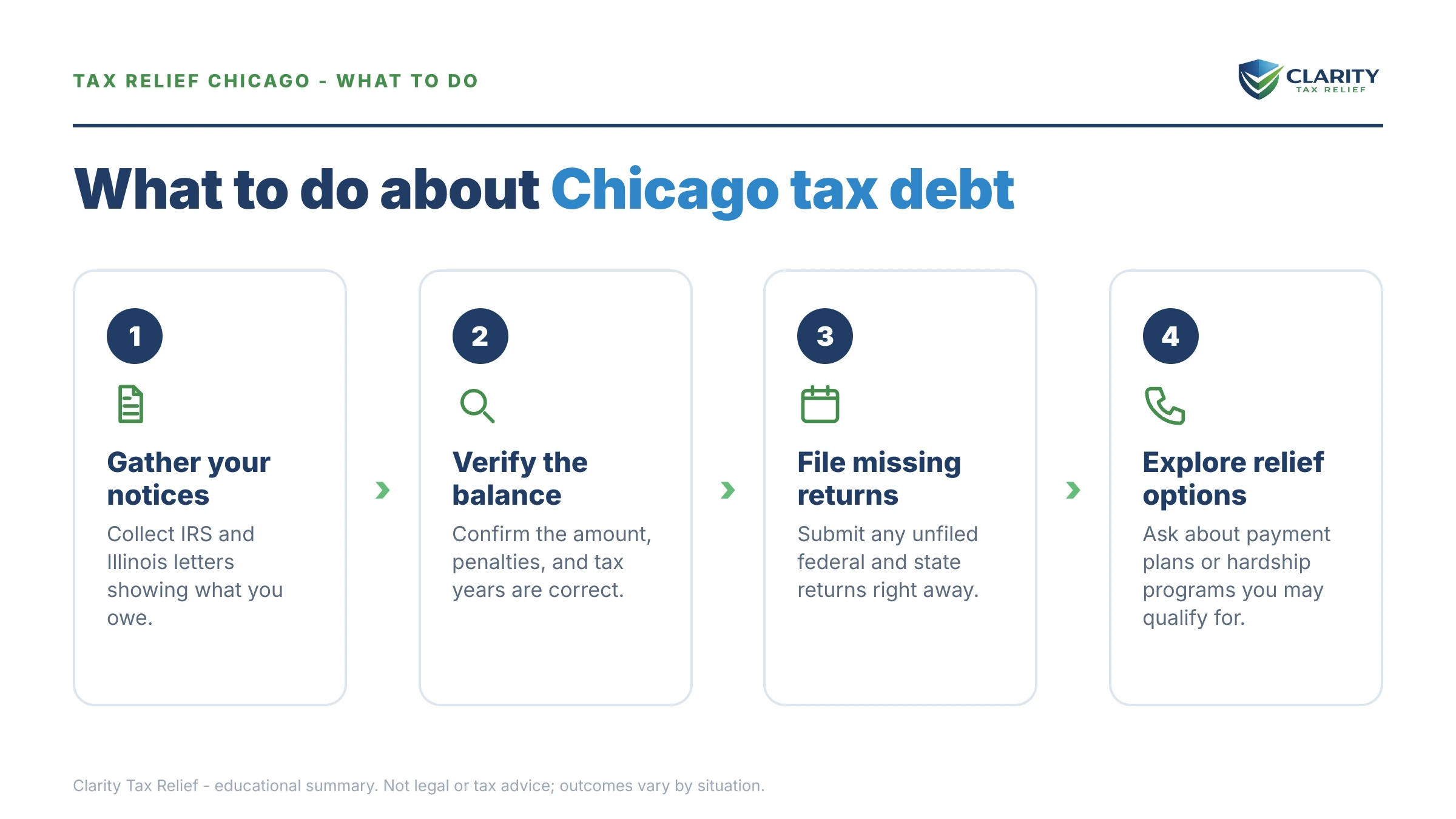
How to get tax relief in Chicago, step by step
Every successful resolution, federal or Illinois, starts the same way: know exactly what each agency's records say you owe, then match each balance to a program before the next notice arrives.
- Pull your records from both agencies. Create or log into your IRS online account for transcripts and exact balances, and check MyTax Illinois for your state account. You can't pick a program until you know what each agency's records show.
- File every missing return. The IRS won't approve a payment plan or an offer while returns are unfiled, and Illinois enforces filing compliance too. File first, even if you can't pay a dollar.
- Match each balance to a program. Under $50,000 federal usually means an online streamlined plan. Genuine hardship points to Currently Not Collectible. Low collection potential points to an Offer in Compromise. Handle the Illinois balance through MyTax Illinois or IDOR directly.
- Set up both agreements before the next notice lands. Apply online where possible, save every confirmation, and calendar the first payment — a defaulted agreement is worse than none.
- Request penalty relief after the balance is under agreement. First-time abatement. The new automatic AEP relief starting summer 2026 — can strip penalties off the top once you're compliant.
Filing first matters more than most people realize: the failure-to-file penalty runs 5% per month — ten times the 0.5% failure-to-pay penalty — so an unfiled return is always the most expensive item on the list.
When you can handle this yourself, and when help changes the outcome
You do not need to hire anyone to set up a simple IRS payment plan — the online tool exists precisely so taxpayers can do it themselves. If you owe one year, agree with the amount. The balance fits the streamlined thresholds, our how to settle tax debt yourself guide walks the whole DIY path, and Chicago-area low income taxpayer clinic programs offer free representation if your income qualifies.
Experienced help earns its fee in specific situations: a levy or garnishment already in motion, multiple unfiled years across both agencies, an IDOR lien complicating a home sale or refinance, business or payroll tax debt, or Offer in Compromise math where one wrong number on the financial statement sinks the application. Business owners have their own playbook — see our guide to tax relief for small business.
If you do hire a firm, hire carefully. Chicago is heavily marketed by national tax-relief advertisers, and the "settle for pennies on the dollar" pitch is the classic red flag. That phrasing sells a formula-driven government program as if it were a negotiation. Our checklist on how to choose a tax relief company covers what to verify before paying anyone, our breakdown of how much does tax relief cost shows what fair pricing looks like, and if you're comparing the big names, start with our Optima Tax Relief alternatives comparison.
Primary sources worth bookmarking: the IRS's official payment plans and installment agreements page, the Illinois Department of Revenue site (home of MyTax Illinois), and the Taxpayer Advocate Service if an IRS action is causing hardship the normal channels won't fix.
Tax relief in Chicago: your questions, answered
Does Chicago have a city income tax I could owe back taxes on?
No — Chicago does not levy its own income tax on wages, so back-tax problems for most Chicago residents involve exactly two agencies: the IRS and the Illinois Department of Revenue. Business owners can also owe city-level items like licensing fees or Cook County obligations, but for a household's income taxes, the IRS and IDOR are the only collectors you need to resolve with.
Can the Illinois Department of Revenue garnish wages for back taxes?
Yes. IDOR can garnish wages, levy bank accounts, and file a lien in the Illinois State Tax Lien Registry without going to court first. It sends warning notices before enforcing, so the letter in your hand tells you where you are in that sequence. If you set up an IDOR payment plan through MyTax Illinois before enforcement starts, garnishment is generally avoidable.
Is the IRS Fresh Start program available in Chicago?
Yes — Fresh Start isn't a Chicago or Illinois program. It's the IRS's nationwide umbrella of collection policies, including streamlined payment plans up to $50,000, lien-filing thresholds. The Offer in Compromise rules. Every Chicago taxpayer has access to it. Be cautious of ads implying Fresh Start is a special enrollment program with a deadline — it's a set of standing IRS rules, not a sign-up window.
How much does tax relief cost in Chicago?
Doing it yourself costs almost nothing: a short-term IRS plan has no setup fee. A long-term plan carries a modest setup fee that's lower with direct debit. Professional representation is typically a flat fee that scales with case complexity — a single-year payment plan costs far less than a multi-year Offer in Compromise with unfiled returns. Any firm quoting a price before reviewing your IRS records is guessing.
Can I settle Illinois state taxes the way an IRS Offer in Compromise works?
Illinois has its own separate settlement process through the Department of Revenue's Board of Appeals — an IRS offer acceptance does not reduce your Illinois balance, and vice versa. The two applications use different forms and different financial standards. Many Chicago taxpayers resolve the IRS side first because its rules are better defined, then use the accepted federal resolution as part of the Illinois petition.
Will the IRS take my house in Chicago?
Home seizure is extremely rare and requires federal court approval. It is the IRS's last resort, not an early move. What's far more common is a federal tax lien, which attaches to your home's title and complicates selling or refinancing until the debt is resolved. Getting into a payment plan or other formal agreement is what keeps a lien from turning into anything worse.
We owe both the IRS and Illinois — which do we pay first?
Resolve with both, but prioritize whichever agency is further along its enforcement sequence — a final notice of intent to levy outranks a first bill from the other agency. Interest accrues on both balances the whole time, so the goal is a formal arrangement with each, not paying one down while ignoring the other. IDOR is often quicker to enforce than the understaffed IRS, so don't assume the state letter can wait.
Your next 24 hours
- Find the notice number, date, and amount on every letter, IRS and IDOR both, so you know exactly where each agency is in its sequence.
- Gather your last filed federal and Illinois returns, all notices, and a rough monthly income-and-expense picture for your household.
- Get a free case review of both balances — use the 2-minute form or call (888) 825-7779. Penalties and interest accrue on both debts every month; the sooner both agreements are in place, the less this costs to fix.
This guide is general information, not tax or legal advice for your specific situation. Eligibility for IRS programs depends on individual facts and circumstances; no outcome is guaranteed.