
City Guides
Tax Relief Dallas: Your 2026 Guide to Resolving IRS and Texas Tax Debt
The short answer: tax relief in Dallas is almost always federal — Texas has no state income tax, so your debt is with the IRS or, for business owners, the Texas Comptroller. Real options include payment plans up to 72 months, hardship status, penalty abatement, and, when the math supports it, an Offer in Compromise.
You searched "tax relief Dallas" because the letters have started arriving — maybe at the house, maybe at the shop, maybe both. You've kept the crew paid every Friday, but a few 941 deposits slipped, a couple of personal returns landed with balances, and now the total has a comma in it. That's a fixable problem, and the order you fix it in changes what you end up paying.
This guide covers every real resolution program the IRS offers in 2026, the parts of Texas law that surprise Dallas taxpayers (the homestead exemption and the wage-garnishment ban do not stop the IRS), what to do about a Texas Comptroller balance on top, and how to judge the firms bidding for your case.
⏱ The real clock: there's no deadline printed on a Google search, but IRS penalties and interest accrue every month you wait. The failure-to-pay penalty runs 0.5% per month, and interest compounds daily on top of it — on a $54,600 balance, that penalty alone is roughly $273 a month. Waiting also moves you one notice closer to a levy.
Why tax debt in Dallas is almost always an IRS problem
Dallas has no state income tax, so a personal tax debt in Dallas is nearly always a federal IRS debt. There's no Texas equivalent of California's FTB or New York's tax department sending you income-tax bills. That simplifies things in one way, one creditor for personal income tax, and complicates them in another.
The complication is on the business side. If you run a company in Dallas, you can owe two separate governments under two separate sets of rules: the IRS for income tax and Form 941 payroll tax. The Texas Comptroller for sales tax and franchise tax. A firm that resolves your federal debt without checking your Comptroller standing has fixed half your problem.
The most common Dallas patterns we see: contractors and trades businesses that fell behind on 941 deposits during a slow stretch; 1099-heavy earners — real estate agents, consultants, owner-operators — who never made quarterly estimated payments. And S-corp owners whose K-1 income created a personal bill nobody withheld for. Each has a different best-fit resolution, which is why the options table below is organized by balance and situation, not by program name.
“An offer in compromise allows you to settle your tax debt for less than the full amount you owe. It may be a legitimate option if you can't pay your full tax liability or doing so creates a financial hardship.”
— Offer in compromise (IRS.gov)
What happens if you ignore IRS collection in Dallas
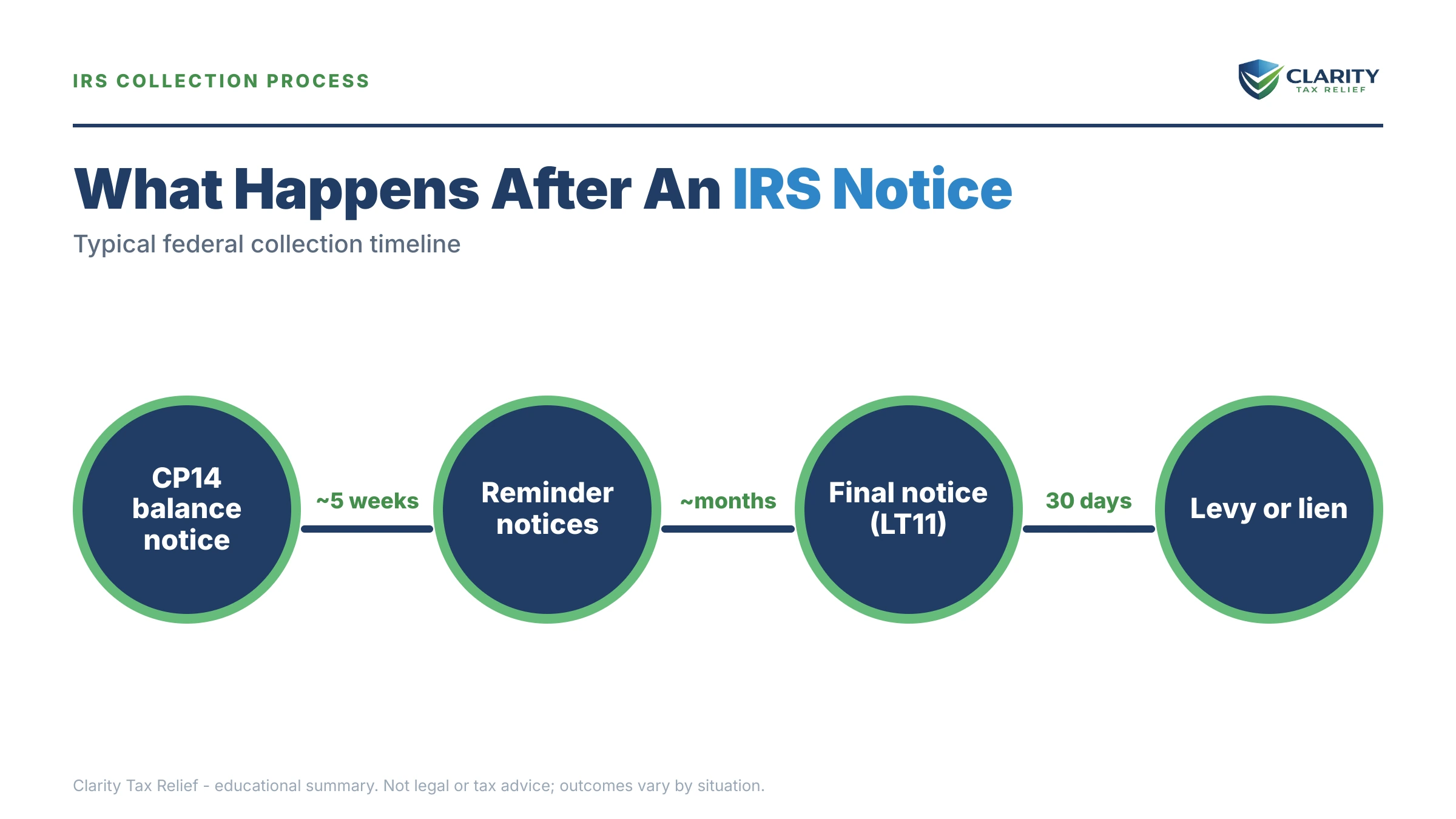
The IRS collection sequence is fully automated: a first bill, escalating reminders, an intent-to-levy notice, a final notice, then levy, and in 2026 the automation runs even though the IRS workforce was cut roughly 27% in 2025. The humans are harder to reach; the computer that issues levies never took a day off.
- CP14 (or CP161 for a business) — the first bill. No enforcement power yet; the cheapest moment to act.
- CP501 / CP503 — reminder notices. Still just bills, but the balance grows monthly and the file keeps moving.
- CP504 / CP504B — Notice of Intent to Levy. This notice authorizes seizure of your state tax refund — which, in Texas, you don't have. Its real bite in Dallas is what it signals: a federal tax lien is now realistic, and the final notice is next.
- LT11 / Letter 1058 — the Final Notice of Intent to Levy. This starts a 30-day clock and your Collection Due Process rights, requested on Form 12153. After 30 days, the IRS can levy without further warning.
- Levy and lien — a bank levy freezes funds for 21 days before the bank sends them. A wage levy is continuous until released. A business can face levies on its accounts receivable and merchant deposits. A federal tax lien recorded in Dallas County becomes public record — a serious problem if your business needs bonding or financing.
Two pieces of Texas law give Dallas taxpayers false comfort here. Texas bans most creditor wage garnishment — but that ban does not bind the IRS, whose levy authority is federal. And the Texas homestead exemption does not stop a federal tax lien from attaching to your home. Seizure of a residence is rare and requires court approval, but the lien itself clouds title the day it's filed.
One more threshold worth knowing: once a certified balance passes $66,000 in 2026, the IRS can certify your debt to the State Department, which can deny or revoke your passport. A $54,600 balance compounding untreated is on a path to cross that line — see passport revoked for tax debt for how certification works.
Behind on 941s or holding a five-figure IRS balance in Dallas?
Interest and penalties are accruing monthly whether or not you've opened the letters. Get your Dallas case reviewed free by an experienced tax professional — every balance, every year, every option — before the next notice moves your file forward.
Every real tax relief option for Dallas taxpayers in 2026
The IRS has seven core resolution paths, and eligibility for each is set by your balance, your compliance status. Your financials, not by what a salesperson promises. The step-by-step mechanics of setting these up yourself are in our guide to how to settle tax debt yourself. Here's how they map to eligibility:
| Option | Who typically qualifies | Cost & key terms |
|---|---|---|
| Short-term payment plan | Can pay in full within 180 days | $0 setup fee; penalties and interest continue, enforcement stops |
| Guaranteed installment agreement | Owe $10,000 or less, returns filed, no recent plan defaults | Approval is automatic by statute; pay within the required window |
| Streamlined installment agreement | Owe $50,000 or less (individuals) | Up to 72 months, set up online, no detailed financial disclosure |
| Non-streamlined installment agreement | Owe more than $50,000 | Requires financial disclosure (Form 433 series; 433-B for a business); terms negotiated |
| Business payroll tax agreement | Operating business behind on 941s, current on this quarter's deposits | Express terms generally limited to smaller balances paid within about two years; larger cases get a revenue officer |
| Currently Not Collectible (CNC) | Paying anything would prevent basic living or operating expenses | $0; collection pauses, debt and interest remain, liens still possible |
| Offer in Compromise (OIC) | Assets plus future income genuinely can't cover the debt | $205 fee + 20% down on lump-sum offers (both waived with low-income certification, AGI ≤ 250% of poverty); IRS accepted roughly 1 in 5 offers in FY2024 |
| Penalty abatement (FTA / AEP) | Clean compliance the prior 3 years, or reasonable cause | $0; starting summer 2026, Automatic Exemption from Penalty (AEP) begins applying first-time relief automatically |
Two eligibility notes that matter in practice. First, every one of these programs requires filed returns — the IRS will not approve a plan or an offer while 1040s or 941s are missing. Second, an installment agreement doesn't stop interest; it stops enforcement. Paying faster than the minimum is almost always cheaper.
A worked example: a Dallas business owner who owes $54,600
Say you run a small Dallas contracting company and owe $54,600 total — clearly hypothetical, but built the way these cases actually arrive: $31,200 on your personal 1040s from two years of under-withheld K-1 income, and $23,400 in unpaid 941 payroll tax across three quarters.
Here's what the numbers say:
- The cost of waiting: at 0.5% per month, the failure-to-pay penalty adds about $273 every month on $54,600, and interest compounds daily on top. You can estimate your own accrual with our IRS Penalty & Interest Calculator.
- The $50,000 line: the personal balance alone ($31,200) is under the streamlined threshold, so it qualifies for an online agreement of up to 72 months — roughly $434 a month ($31,200 ÷ 72) plus accruing interest, with no financial disclosure required.
- The payroll side is different: the $23,400 in 941 debt belongs to the business account. The trust-fund portion — the tax withheld from employees' checks plus their FICA share, perhaps $15,000 of it in this example — can be assessed against you personally through the Trust Fund Recovery Penalty even if the company folds.
- The sequencing: before the IRS will negotiate anything on the business side, this quarter's deposits must be on time. Continuing to accrue new payroll debt while owing old payroll debt, "pyramiding", is what turns an automated case into a revenue officer case.
Could this owner settle instead? Probably not easily. An Offer in Compromise is priced off what the IRS could collect from equity (trucks, equipment, receivables) plus future income. An operating business with steady revenue usually shows collection potential near or above $54,600. The realistic play here is penalty abatement plus structured agreements, not a settlement pitch. That honest math is exactly what a good consultation should walk you through, and it's covered in depth in 941 back taxes and the Trust Fund Recovery Penalty guide.
IRS vs. Texas Comptroller vs. Dallas County: who's collecting what
Dallas taxpayers can owe three different collectors at once, and each follows its own rulebook — never assume an IRS figure or deadline applies to a Texas agency.
| Agency | What it collects | Key enforcement powers | Your first move |
|---|---|---|---|
| IRS | Personal income tax, self-employment tax, 941/940 payroll tax | Liens, bank and wage levies, receivable levies, passport certification, Trust Fund Recovery Penalty | File everything, then match your balance to a program (table above) |
| Texas Comptroller | Sales & use tax, franchise tax | State liens, permit suspension, personal liability for collected-but-unremitted sales tax, forfeiture of an entity's right to do business for franchise non-compliance | Get delinquent state returns filed and contact the Comptroller about a payment arrangement before enforcement starts |
| Dallas County Tax Office | Property tax | Automatic lien on the property; steep delinquency penalties; taxing units can ultimately foreclose | Contact the county tax office about installment options before penalties stack |
Sales tax deserves special respect: like 941 withholding, it's money you collected on the state's behalf, and Texas can pursue responsible individuals personally for collected-but-unremitted sales tax. If you owe both governments, the sequencing questions — who first, which dollars where — are covered in Texas Comptroller tax debt and our broader Texas back taxes guide.
How to choose a tax relief company in Dallas
IRS representation is federal, so a "Dallas office" matters far less than the credentials of whoever signs your Form 2848 power of attorney. Any enrolled agent, CPA, or tax attorney can represent you before the IRS from anywhere in the country. Nothing about your case gets negotiated in person in Dallas. (The downtown IRS Taxpayer Assistance Center handles payments, transcripts, and identity verification by appointment. It does not negotiate settlements at the counter.)
What should drive the decision instead:
- Payroll and Comptroller experience. If your debt includes 941s or Texas sales tax, ask specifically how many trust-fund cases the firm has defended and whether it handles state accounts at all. Our tax relief for small business guide lists the questions that separate real business-debt experience from a call center script.
- Who does the work. Ask for the name and credential of the person assigned to your case, not the closer on the sales call. The full vetting checklist is in how to choose a tax relief company.
- Fee structure in writing. A defined scope and a flat fee before you pay anything. Fee models and typical ranges are broken down in how much does tax relief cost.
- No settlement quotes before financial review. "Pennies on the dollar" is a sales phrase, not a program. Settlement eligibility is calculated from your assets and income; anyone quoting a number before seeing them is guessing at best. If you've already had a bad experience with a national brand's sales process, our Optima Tax Relief alternatives comparison shows what to look for instead.
- Conditional language only. A trustworthy firm says "you may qualify if" — never "you qualify" before running your numbers.
How to start resolving your Dallas tax debt, step by step
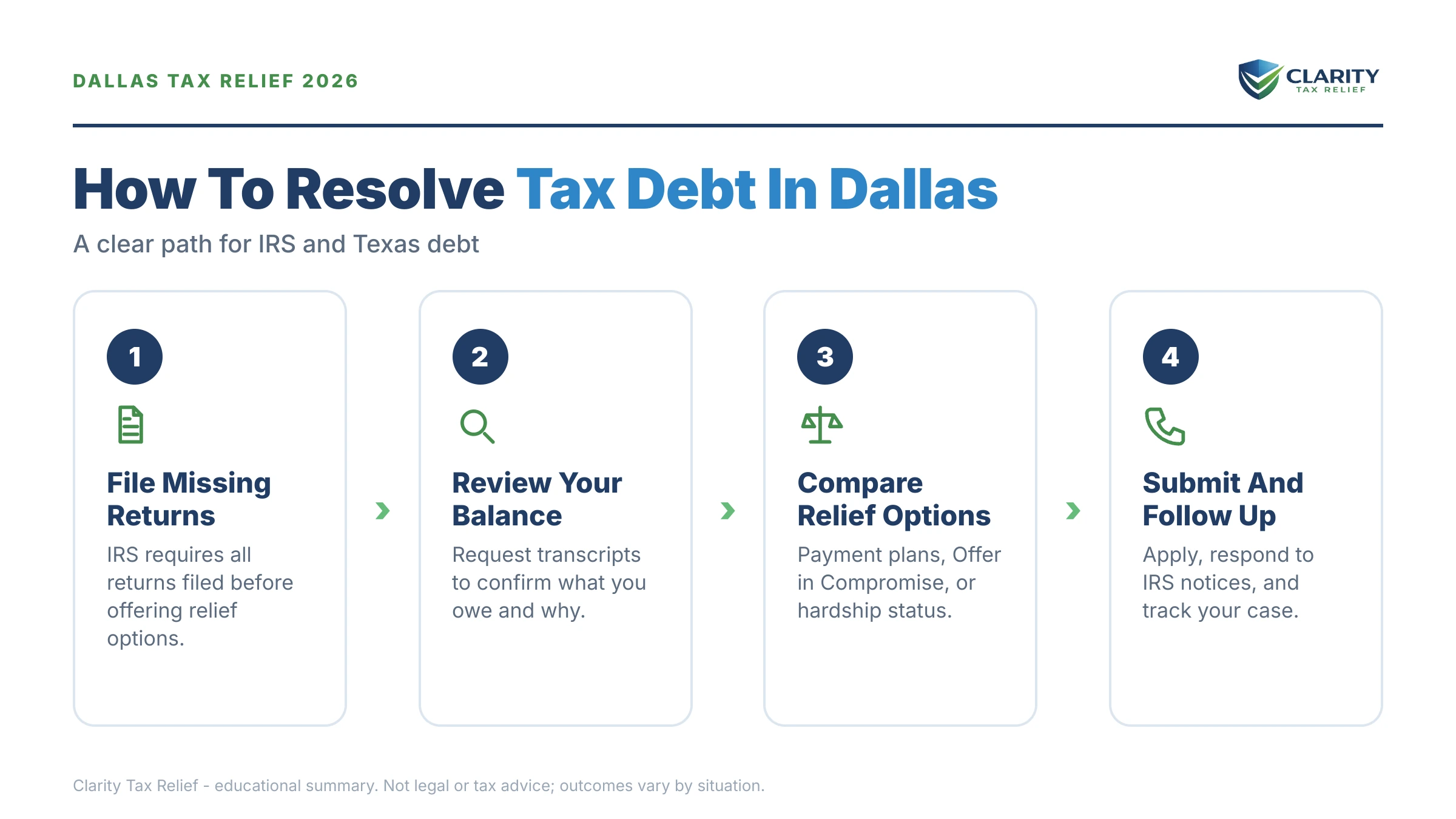
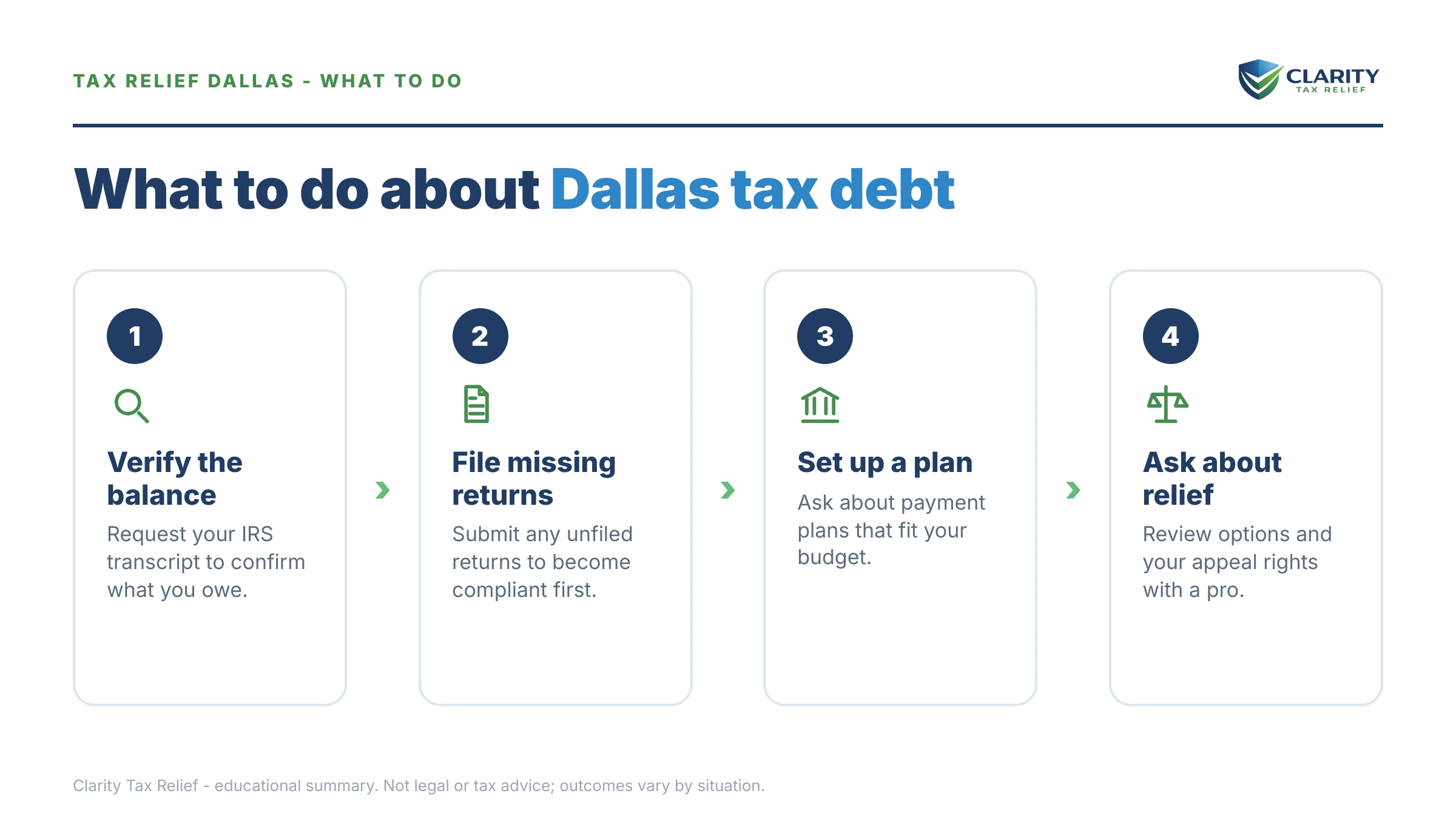
- Pull your IRS balances. Log into your IRS online account and list every year and amount owed, personal and business, so you're negotiating from the real numbers.
- File anything unfiled. Submit any missing 1040s and 941s first — the IRS won't approve a payment plan or an offer while returns are outstanding.
- Get current on this quarter. Start making this quarter's federal tax deposits and estimated payments on time; every IRS resolution requires current compliance.
- Match your balance to a program. Use the options table above to pick your track — a 180-day plan, an installment agreement, hardship status, or an Offer in Compromise if the math supports it.
- Check your Texas accounts. Confirm your sales tax and franchise tax standing with the Texas Comptroller so a state problem doesn't blindside your federal fix.
- Get help if enforcement has started. If you've received an LT11, a levy notice, or Letter 1153, have an experienced tax professional review the case before you sign anything.
When you can handle Dallas tax relief yourself
Plenty of Dallas tax debts don't need professional help, and you should know which kind yours is before you pay anyone. You can likely handle it yourself if: you owe under $50,000 in personal tax only, you agree with the balance. Your returns are filed — the streamlined agreement takes about twenty minutes to set up online at the IRS payment plans page. The same goes for a balance you can clear within 180 days, or a single penalty on an otherwise clean three-year record, which first-time abatement (and, from summer 2026, automatic AEP relief) usually resolves.
Experienced help changes outcomes in a different set of cases: 941 payroll debt with a Trust Fund Recovery Penalty investigation underway (a Form 4180 interview is not a casual conversation), a levy already in motion, multiple unfiled years, combined IRS-and-Comptroller debt, or Offer in Compromise math on a business with assets — see our guide to a business payroll tax payment plan for why payroll cases follow stricter rules. If money is the barrier, Low Income Taxpayer Clinics and the Taxpayer Advocate Service exist for exactly that. The Comptroller's site is at comptroller.texas.gov.
One Texas-specific wrinkle worth flagging before you DIY a married case: Texas is a community property state, so a spouse's income can enter the IRS's collection math even on a debt that isn't theirs. If that's your situation, read community property tax relief before submitting any financial statement.
Terms Dallas tax relief ads use, decoded
- Fresh Start: a marketing umbrella for the standard IRS collection programs above, not a special or expiring Dallas program.
- Offer in Compromise (OIC): a settlement for less than the full balance, priced by the IRS's own calculation of what it could collect from you, not by negotiation skill.
- Trust Fund Recovery Penalty (TFRP): the mechanism that moves a business's withheld payroll taxes onto a responsible person's personal account.
- CSED: the Collection Statute Expiration Date — the IRS generally has 10 years from assessment to collect, though appeals, offers, and bankruptcy pause the clock.
- Lien vs. levy: a lien is a recorded claim against your property (filed in Dallas County records). A levy is the actual taking of wages, bank funds, or receivables.
Tax relief Dallas: your questions, answered
Is tax relief in Dallas different from tax relief anywhere else?
The IRS side is identical nationwide — payment plans, offers in compromise, penalty abatement, and hardship status are federal programs, and any enrolled agent, CPA, or attorney can represent you before the IRS with Form 2848 regardless of office location. What is different in Dallas: there's no state income tax, but business owners can owe the Texas Comptroller sales or franchise tax, which follows separate state rules and timelines.
Can the IRS garnish my wages in Texas?
Yes. Texas law blocks most private creditors from garnishing wages, but that protection does not apply to a federal tax levy. An IRS wage levy is continuous until it's released and leaves you only an exempt amount based on your filing status and dependents. Entering a payment plan, hardship status, or other resolution is what gets a wage levy released.
Can the IRS take my house in Dallas even with the Texas homestead exemption?
A federal tax lien attaches to your homestead despite the Texas exemption — state protections don't bind the IRS. Actual seizure of a primary residence is rare and requires court approval. But the lien clouds your title, complicates refinancing, and gets paid from the proceeds if you sell. Resolving the balance, or requesting lien discharge or subordination, is how you clear it.
Am I personally liable if my Dallas business owes payroll taxes?
If you're a 'responsible person' — an owner, officer, or anyone who decided which bills got paid — the IRS can assess the Trust Fund Recovery Penalty against you personally for the withheld income tax and the employee share of FICA. That liability survives even if the LLC or corporation closes. Letter 1153 proposes the assessment and gives you 60 days to protest it.
How much does tax relief cost in Dallas?
Fees track case complexity, not your ZIP code. Setting up a straightforward installment agreement costs far less than an Offer in Compromise or a payroll-tax defense with a Trust Fund Recovery Penalty fight. Get the scope and the flat fee in writing before paying anything, and treat any firm that quotes you a settlement amount before reviewing your financials as a red flag.
Does my spouse's income matter for my tax debt in Texas?
Often, yes. Texas is a community property state, which means the IRS can generally reach community income and community assets to collect one spouse's tax debt, even a debt from before you married. Relief exists — including innocent spouse rules adapted for community property states — but it has to be requested and proven, not assumed.
Is there an IRS office in Dallas I can visit?
Yes — the Dallas Taxpayer Assistance Center is in the Earle Cabell Federal Building downtown at 1100 Commerce Street, by appointment only (call 844-545-5640 to schedule). Staff there can take payments, pull transcripts, and verify identity. But they will not negotiate an Offer in Compromise or a complex payment plan at the counter. Bring photo ID and your notices.
Will a Dallas tax relief company settle my IRS debt for pennies on the dollar?
Treat that phrase as a warning sign, not a promise. The Offer in Compromise program is real, but it's means-tested — the IRS accepted roughly 1 in 5 offers in FY2024, and acceptance turns on what the IRS calculates it could collect from your income and assets. No honest firm can quote your settlement before running that math.
Your next 24 hours
- Find your real numbers. Log into your IRS online account tonight and write down each year's balance — federal decisions start from the total, not the scariest letter.
- Gather your paper. Pull your last filed personal return, any business 941s, every IRS notice you've received, and a rough monthly income-and-expense picture. That stack is what any resolution is built from.
- Get the free review. Interest and penalties are compounding monthly on whatever you owe. Call (888) 825-7779 or use the 2-minute form and an experienced tax professional will map your Dallas case, IRS and Texas sides both, at no cost.
This guide is general information, not tax or legal advice for your specific situation. Eligibility for IRS programs depends on individual facts and circumstances; no outcome is guaranteed.