
Local Tax Relief
Tax Relief Detroit: How to Resolve IRS, Michigan, and City Tax Debt in 2026
Read the transcript
Host: So you've got an IRS letter on the table, and then a second envelope shows up from Lansing, and now you're not even sure who you owe. That's Detroit. Let's map it.
Tax specialist: Right, and the mapping part matters more here than in most cities, because a Detroit filer can owe three separate governments at the same time. The IRS. The Michigan Department of Treasury. And the City of Detroit.
Host: Three.
Tax specialist: Three. Except, and this is the piece people get wrong, since tax year 2015 the state collects the city's income tax. So the city balance and the state balance both run through Michigan Treasury. One agency, two balances.
Host: Okay, so if I fix the IRS side—
Tax specialist: Nothing happens to Michigan. Nothing. And it goes the other way too. Resolving the state doesn't touch the federal. They're parallel tracks with their own clocks.
Host: Let's do the rates, because I think that's where the surprise balance comes from.
Tax specialist: It is. Michigan's flat state tax is 4.25%. On top of that, Detroit residents owe 2.4% city income tax, and nonresidents who work in the city owe 1.2%.
Host: 2.4 if you live there, 1.2 if you just work there.
Tax specialist: Correct. And here's the Detroit-specific trap. If you live in the city but your employer is out in the suburbs, that employer may not withhold your Detroit resident tax at all. Not a penny. So you're accruing a city balance for years and you find out at filing.
Host: Hm. That's not the taxpayer doing anything wrong.
Tax specialist: No. And the other triggers in the article are the same flavor — a divorce year where your W-4 still said married all twelve months, gig or 1099 income with no quarterlies, a layoff followed by a 401(k) withdrawal that turned out to be taxable, a small business that slipped behind.
Host: Wait, one more on the three layers. Property tax?
Tax specialist: Separate track entirely. Delinquent Detroit property taxes go through the Wayne County Treasurer, and that's a forfeiture-and-foreclosure process on its own timeline. Do not assume an IRS resolution touches it. It needs its own attention.
Host: Good. So the federal side — walk me through the notices, because I think people freeze when they can't tell a bill from a threat.
Tax specialist: It's a sequence, and each step carries more power than the last. CP14 is the first bill, roughly 21 days to pay or arrange something. CP501 and CP503 are reminders — still just bills, but penalties and interest are compounding the whole time. Then CP504, which is intent to levy your state refund.
Host: CP504. And for a Detroit filer that means the Michigan refund specifically.
Tax specialist: Yes. Your Michigan refund can be seized, and a federal tax lien becomes a live risk at that point. Then LT11, or Letter 1058 — that's the final notice. A 30-day clock starts, and it carries your Collection Due Process appeal rights, which you request on Form 12153.
Host: Form 12153. And after the 30 days?
Tax specialist: Levies are authorized. Bank levy comes with a 21-day hold before funds actually leave. Wage garnishment continues paycheck after paycheck until it's released. Social Security can lose up to 15%. And at $66,000 or more owed, your passport can be certified for denial.
Host: And the article makes a point that the IRS being short-staffed doesn't slow that down.
Tax specialist: Workforce down roughly 27% in 2026, which mostly means humans are harder to reach. The notice-and-levy machine is automated. It never stopped.
Host: Okay. Options. And say them plainly, not in program names.
Tax specialist: Sure. Short-term plan — up to 180 extra days to pay in full, no setup fee. Interest and penalties keep running but the escalation sequence stops. Then the Guaranteed Installment Agreement, which is a real statutory program under IRC 6159(c) — that's for balances of $10,000 or less, paid within three years, with your last five years of returns filed and paid on time. Requested online or on Form 9465.
Host: Say the conditions again, slower.
Tax specialist: Ten thousand or under. Paid off inside three years. Last five years filed and paid on time, no defaults. If all of that is true, the statute directs the IRS to accept it. The IRS verifies those conditions — that's the part you control, the compliance history and the filing.
Host: Right. Next?
Tax specialist: Streamlined installment agreement. Balances up to $25,000, or up to $50,000 if you use direct debit, generally without detailed financial disclosure, spread over as long as 72 months, set up online.
Host: Same day, in some cases.
Tax specialist: Often the same day, yes. Then Currently Not Collectible — that's hardship status. If paying anything would leave you unable to cover basic living costs, collection pauses. You document income and expenses, typically on Form 433-F. The debt stays, interest still accrues, but levies stop.
Host: And the one everybody's heard the radio ads about.
Tax specialist: Offer in Compromise, Form 656. It's real. It's also means-tested — the IRS accepted roughly 1 in 5 offers in FY2024. It works when your income and assets genuinely can't cover the debt before the collection statute ends. The IRS runs that math. Fee is $205 plus 20% down on lump-sum offers, and both are waived with low-income certification at or below 250% of the federal poverty level.
Host: Penalty relief, quickly?
Tax specialist: First-time abatement if your prior three years are clean. And starting summer 2026 there's the Automatic Exemption from Penalty, AEP, which applies similar relief automatically — no request needed. Reasonable-cause relief is separate, that covers illness, disaster, things outside your control.
Host: The article does this hypothetical with $6,200 that I found useful. Can you run it?
Tax specialist: Sure — hypothetically. Divorce finalized, withholding never got updated, first solo return leaves you owing $6,200. Doing nothing costs about $31 a month in failure-to-pay penalty alone, that's 0.5% of the balance, plus interest compounding daily. A 180-day plan is roughly $1,035 a month for six months — cheapest overall if the budget can take it. The Guaranteed Installment Agreement route is around $175 a month, a bit more as interest accrues. A 72-month streamlined plan is around $87 a month — easiest on a single income, longest accrual, highest total cost.
Host: And an offer at that size?
Tax specialist: Usually a poor fit. With steady wages the IRS's own math typically shows it can collect $6,200 in full, so the offer gets rejected. That's the honest answer regardless of what the ads say.
Host: One thing on divorce, because I know somebody's listening to this in that exact spot. The decree said the ex pays it.
Tax specialist: A divorce decree does not bind the IRS. If the debt is from a jointly filed return, the IRS can collect the full 100% from either ex-spouse. Your remedies run through the tax system — innocent spouse relief on Form 8857 when your ex hid income or inflated deductions without your knowledge — and separately, enforcing the decree in Wayne County Circuit Court, which is its own matter and not something Clarity handles. Talk to your own counsel about that side.
Host: And if it's your first solo return, the withholding-shock case?
Tax specialist: Then spousal relief doesn't apply, because it's your own tax. It's a plan sized to your new budget, a penalty abatement request, and a corrected W-4 so next April isn't a repeat.
Host: Before we land this — the hard part. Name it.
Tax specialist: Unfiled returns. No IRS resolution program gets approved while required returns are outstanding, and in Detroit that's three sets: federal, Michigan, and City of Detroit. That's the gate. Everything else waits behind it.
Host: So what does the listener actually do this week?
Tax specialist: Log into your IRS online account, write down the balance and the tax years, and download your account transcripts so you're working from the IRS's numbers instead of memory. Then check Michigan Treasury for the state and city balances. Then file whatever's missing. And if you agree with the number, your returns are filed, and no levy is running — a single-year balance under $10,000 is often an evening of work at IRS.gov/payments. You don't need a middleman just to pay.
Host: And when does help actually change something?
Tax specialist: When a garnishment or levy is already running. Multiple unfiled years across all three layers. IRS and Michigan competing for the same paycheck. Payroll or business exposure. Offer math. Innocent spouse cases with deadlines. In those, the sequencing — which return first, which agency first — changes what you end up paying. There's also free help: Detroit-area Low Income Taxpayer Clinics, and the Taxpayer Advocate Service has a Michigan office.
Host: And if you want the three layers mapped in one sitting, the number's (888) 825-7779. Bring the notices, the last returns you filed, and your current income info. Nothing we said here is a prediction about your case — it's how the machinery works, and where you have leverage in it.
The short answer: tax relief in Detroit covers up to three debts at once: IRS balances (payment plans, Offer in Compromise, hardship status, penalty relief), Michigan state tax, and Detroit city income tax — which the state now collects. Most filers owing the IRS under $50,000 can set up a payment plan online, often the same day.
Maybe the divorce is final, the first return you filed alone came back with a balance you never budgeted for, and now a second envelope, this one from Lansing, is sitting next to the IRS one. That's the moment most "tax relief Detroit" searches start. Both debts are fixable, and the order you fix them in matters. Here's the full map: who's collecting, what each option costs, and what to do this week.
⏱ The running clock: there's no letter-printed deadline on a search, but the meter never stops. The IRS failure-to-pay penalty adds 0.5% of your balance every month, interest compounds daily on top of it, and Michigan charges its own penalties and interest in parallel. Every month of waiting makes every option below cost more.
Why Detroit tax debt comes in three layers
A Detroit taxpayer can owe three separate governments at once: the IRS, the Michigan Department of Treasury. The City of Detroit, and since tax year 2015, the state collects the city's income tax too. Detroit residents pay a 2.4% city income tax; nonresidents who work in the city pay 1.2%, on top of Michigan's flat 4.25% state tax.
That layering creates a Detroit-specific trap: if you live in the city but work for a suburban employer, that employer may not withhold your Detroit resident tax at all. Many first-time city-tax debts are discovered at filing — years after they started accruing.
The other common triggers we see from Detroit filers: a divorce-year withholding shock (your W-4 still said "married" all year), gig and 1099 income with no quarterlies paid, a layoff followed by a taxable 401(k) withdrawal, or a small business that fell behind. Each layer has its own collector, its own rules, and its own fix.
| Agency | What it collects | Main enforcement tools |
|---|---|---|
| IRS | Federal income and self-employment tax | Federal tax liens; bank levies (21-day hold); continuous wage garnishment; up to 15% of Social Security; state-refund intercepts; passport certification at $66,000+ |
| Michigan Department of Treasury | Michigan income tax (4.25%) AND Detroit city income tax for tax years 2015+ | State refund offsets; wage garnishment; bank levies; state tax liens |
| Wayne County Treasurer | Delinquent Detroit property taxes | Forfeiture-and-foreclosure process — a separate track from income tax relief |
This guide covers the first two rows — income tax debt. If your problem is delinquent property taxes, that runs through the Wayne County Treasurer on its own timeline and needs its own attention. Don't assume an IRS resolution touches it.
What happens if you ignore tax debt in Detroit
IRS collection runs on an automated sequence, and each notice in it carries more power than the last. In 2026, with the IRS workforce down roughly 27%, humans are harder to reach, but the notice-and-levy machine never stopped running. Here's the federal track:
- CP14 — the first bill. Roughly 21 days to pay or arrange something before the sequence advances. Cheapest moment to act.
- CP501 / CP503 — reminders. Still just bills, but penalties and interest have been compounding the whole time.
- CP504 — intent to levy your state refund. For a Detroit filer, that means your Michigan refund can be seized. A federal tax lien becomes a live risk.
- LT11 / Letter 1058 — final notice. A 30-day clock starts, along with your Collection Due Process appeal rights (requested on Form 12153). After it runs, levies are authorized.
- Enforcement. Bank levies come with a 21-day hold before funds leave. Wage garnishments continue paycheck after paycheck until released; Social Security can lose up to 15%. And at $66,000+ owed, your passport can be certified for denial.
The Michigan track runs in parallel and independently. Treasury sends its own assessments and demands, then can offset your state refund, garnish wages, levy accounts, and file liens for state or Detroit city balances. Resolving your IRS debt does nothing to stop Michigan, and vice versa. Ignoring either one just means the first collector to move picks your paycheck.
Owe the IRS, Michigan, or the city, or all three?
Send us what you've received. An experienced tax professional will pull your balances, map all three layers, and lay out your realistic options — free, confidential, and before penalties add another month.
Tax relief Detroit: every option and who qualifies in 2026
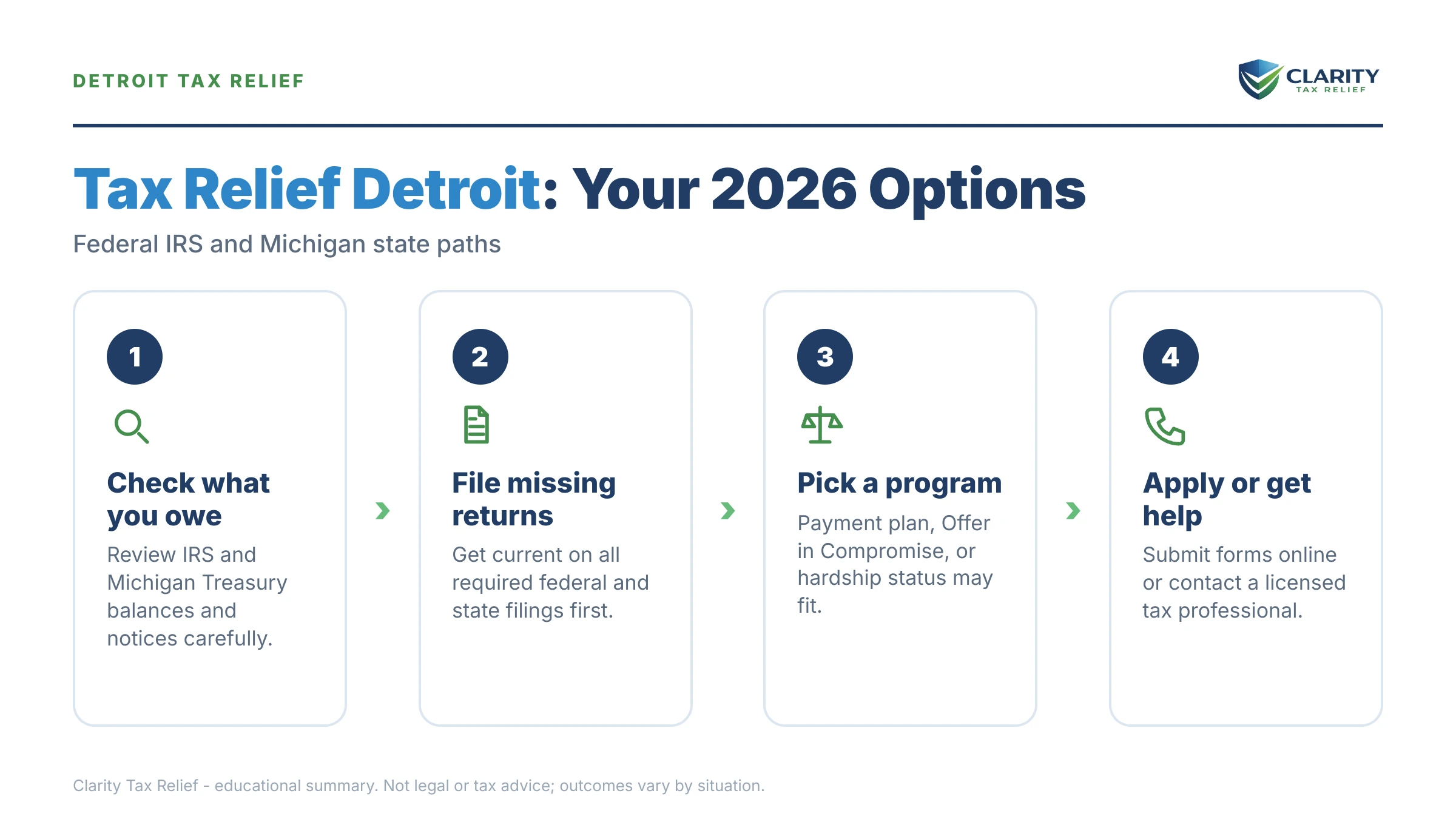
Every federal resolution program available to a Detroit taxpayer is national — the same rules apply here as anywhere. What changes locally is the state and city layer, covered below. The full DIY playbook lives in our guide to how to settle tax debt yourself. Here's the short version of each option and its threshold:
- Short-term payment plan — up to 180 extra days to pay in full, $0 setup fee. Interest and penalties continue, but the escalation sequence stops.
- Guaranteed installment agreement — for balances of $10,000 or less, paid within 3 years, with the last 5 years of returns filed and paid on time. The IRS must accept it. Requested online or on Form 9465.
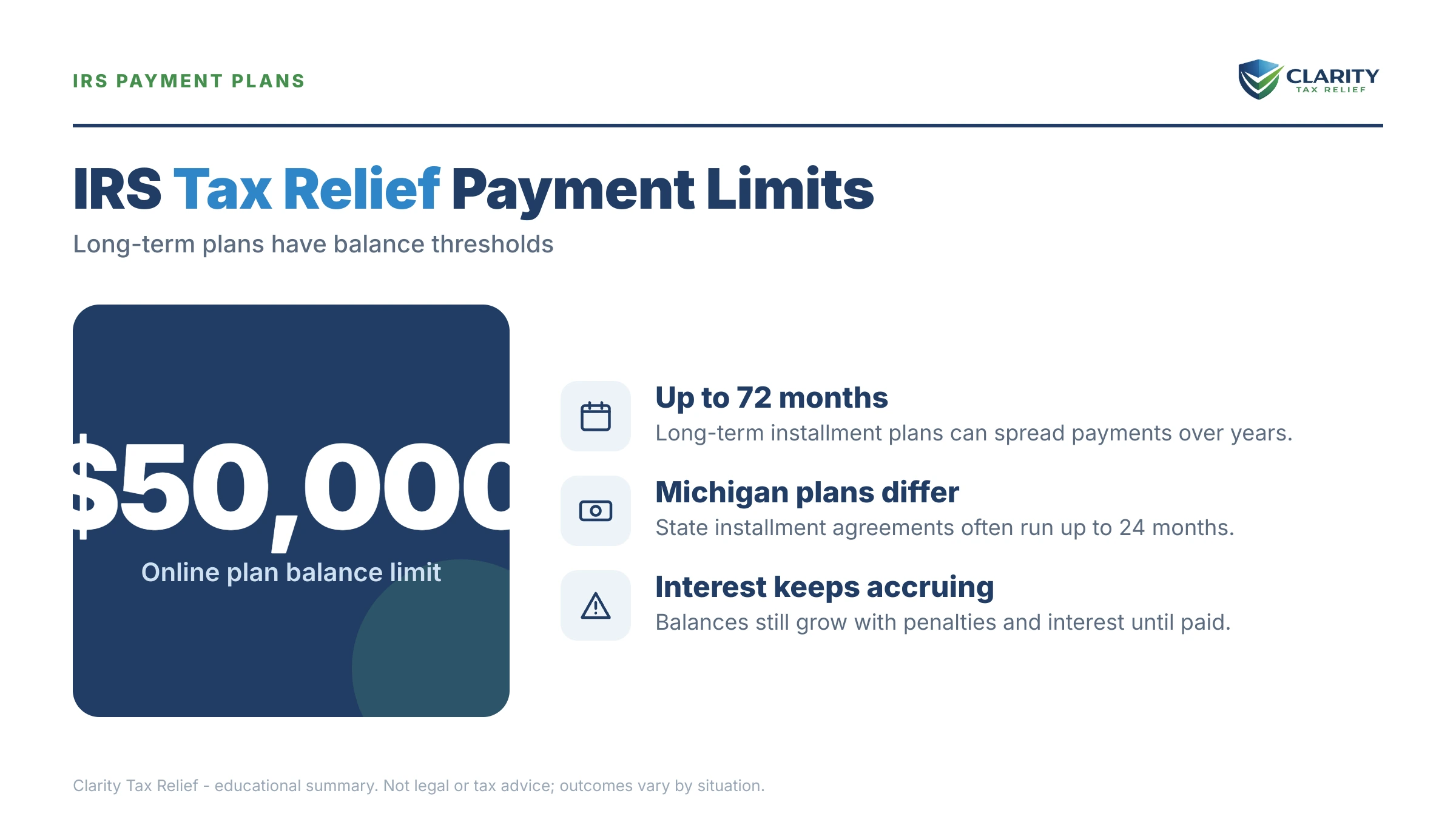
- Streamlined installment agreement — balances up to $25,000 (or up to $50,000 with direct debit) generally qualify without detailed financial disclosure, spread over up to 72 months, set up online.
- Currently Not Collectible status, if paying anything would leave you unable to cover basic living costs, collection pauses. You'll document income and expenses (typically on Form 433-F). The debt remains and interest accrues, but levies stop.
- Offer in Compromise — settling for less than the full balance via Form 656. Real, but means-tested: the IRS accepted roughly 1 in 5 offers in FY2024. It works when your income and assets genuinely can't cover the debt — the IRS runs that math, not the marketing.
- Penalty relief — first-time penalty abatement removes penalties if your prior 3 years are clean. Starting summer 2026, the Automatic Exemption from Penalty (AEP) begins applying similar relief automatically, no request needed. Reasonable-cause relief covers illness, disaster, and events beyond your control.
| Option | Typical eligibility threshold | What disqualifies you |
|---|---|---|
| Short-term plan (180 days) | Can pay in full within 180 days | Balance you genuinely can't clear in 6 months |
| Guaranteed installment agreement | ≤ $10,000; payoff within 3 years | Unfiled returns or defaults in the prior 5 years |
| Streamlined installment agreement | ≤ $25,000 (≤ $50,000 with direct debit); up to 72 months | Unfiled required returns; balance above the cap |
| Currently Not Collectible | Documented hardship — necessary expenses meet or exceed income | Income or assets that could fund a payment plan |
| Offer in Compromise | Assets + future income genuinely below the balance owed | Equity or steady income that could full-pay before the collection statute ends |
| First-Time Abatement / AEP | Clean compliance in the prior 3 years | Penalties in the lookback period; unfiled returns |
| Option | Upfront cost | Typical timeline |
|---|---|---|
| Short-term plan | $0 setup fee | Set up online the same day |
| Installment agreement | Setup fee applies — lowest online with direct debit; reduced or waived for low-income filers | Same day online for qualifying balances |
| Currently Not Collectible | $0, but requires full financial disclosure | Weeks to establish; the IRS re-reviews periodically |
| Offer in Compromise | $205 fee + 20% down on lump-sum offers — both waived with low-income certification (AGI ≤ 250% of poverty) | Often many months; auto-accepted if the IRS doesn't decide within 2 years |
| Penalty abatement | $0 — phone or letter request | Days to weeks; AEP applies automatically starting summer 2026 |
| Michigan payment arrangement / state offer | Varies — separate from every IRS program | Through Michigan Treasury; state timelines differ |
What a $6,200 IRS balance actually costs a Detroit filer
Say your divorce finalized last year, your withholding stayed set for a joint return. Your first single filing left you owing the IRS $6,200. Here's the honest math, hypothetically:
Doing nothing costs about $31 a month in failure-to-pay penalty alone (0.5% × $6,200), plus daily-compounding interest, before Michigan adds anything on a state balance. Meanwhile the options stack up like this:
- 180-day plan: roughly $1,035/month for six months. No setup fee, least total interest — the cheapest path if the budget can take it.
- Guaranteed installment agreement: $6,200 is under $10,000, so if your last five years are clean and you can pay within 3 years, the IRS must accept roughly $175/month (a bit more in practice as interest accrues).
- 72-month streamlined plan: around $87/month — easiest on a post-divorce budget, but the longest accrual and the highest total cost.
- Offer in Compromise: usually a poor fit at this size. With steady wages, the IRS's own math typically shows it can collect $6,200 in full, so an offer would likely be rejected — despite what ads promise.
- Penalty relief: if your prior three years were clean, first-time abatement could strip hundreds of dollars of penalty off the account before you even start paying.
You can estimate your own accrual with our IRS penalty and interest calculator. It estimates how fast a balance like this grows month over month.
Divorced in Detroit: what changes when taxes and marriage mix
A divorce decree does not bind the IRS, if a debt comes from a jointly filed return, the IRS can collect 100% of it from either ex-spouse, regardless of what the judgment says. Your protections run through the tax system, not family court: innocent spouse relief on Form 8857 when your ex hid income or inflated deductions without your knowledge, and decree enforcement back in Wayne County Circuit Court if your ex simply won't pay what the judge ordered. The full breakdown is in our guide to divorce and IRS debt: who pays.
If the balance is from your first solo return, the withholding-shock scenario above, spousal relief programs don't apply, because it's your own tax. The fix there is threefold: a payment plan sized to your new single-income budget, a penalty abatement request. A corrected W-4 so next April doesn't repeat this one.
The Michigan and Detroit city side of your debt
The Michigan Department of Treasury collects both your state income tax and, for tax years 2015 and later, Detroit's city income tax — one agency, two balances. Treasury offers its own installment arrangements, and Michigan has operated its own offer-in-compromise program since 2015. One route to a state offer is showing the IRS already accepted a federal offer on the same debt. Penalty waivers for reasonable cause exist on the state side too.
Two cautions. First, no IRS figure or deadline applies to Michigan — the state has its own collection statutes, thresholds, and windows, and Treasury's enforcement often moves on a different clock than the IRS's. Second, if both governments are collecting, prioritize whichever has active enforcement in motion. A professional review weighs both sides before you commit a limited budget to either. For state-specific detail, see our guide to Michigan back taxes, and verify any state or city balance directly at the Michigan Department of Treasury.
How to respond, step by step
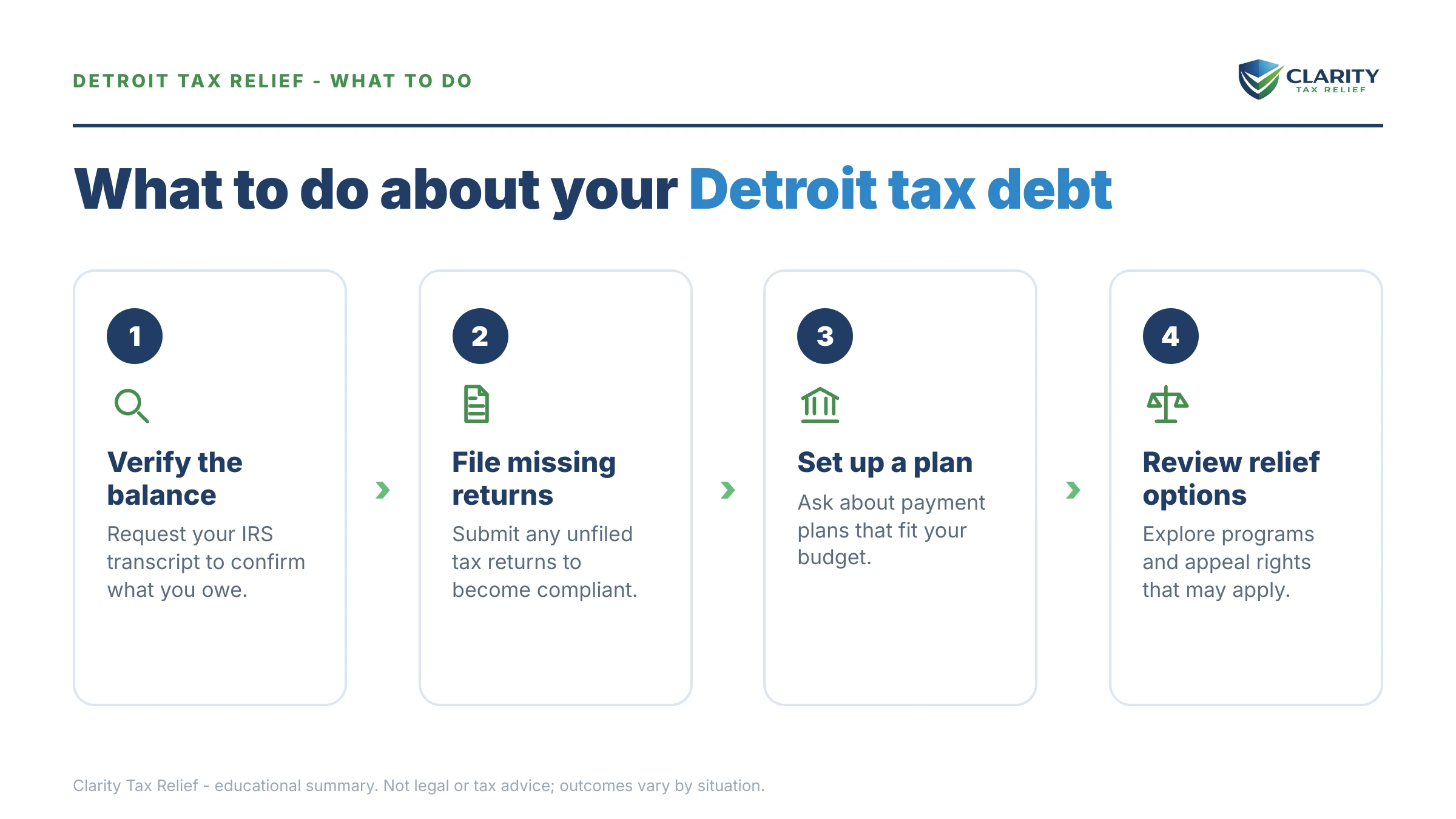
- Pull your federal balance. Log into your IRS online account, note the amount and tax years owed, and download your account transcripts so you're working from the IRS's numbers, not memory.
- Check your Michigan and Detroit city balances. Contact the Michigan Department of Treasury or use its online services to confirm any state or Detroit city income tax owed — Treasury handles both.
- File every missing return. File any unfiled federal, Michigan, or City of Detroit returns first. No IRS resolution program will be approved while required returns are outstanding.
- Set up your resolution before enforcement starts. Choose the option that fits your numbers — a 180-day plan, an installment agreement, hardship status, or an offer — and submit it before a levy or garnishment begins.
- Request penalty relief. Ask for first-time abatement if your prior three years are clean, and watch for the Automatic Exemption from Penalty rolling out in summer 2026 — it applies without a request.
Payments and plan setup happen directly at IRS.gov/payments — you never need a middleman just to pay.
When you can handle this yourself, and when help changes the outcome
Most single-year IRS balances under $10,000 can be resolved without paying anyone. If you agree with the number, your returns are filed, and no levy is in motion, an online payment plan takes one evening — our $6,200 filer above is squarely in DIY territory, and the DIY settlement guide walks through every screen.
Experienced help changes outcomes in specific situations: a garnishment or bank levy already running, multiple unfiled years across federal, state, and city returns, IRS-plus-Michigan debt competing for the same paycheck, business or payroll tax exposure, offer-in-compromise math, and innocent spouse cases with deadlines. In those cases the sequencing — which returns first, which agency first, which relief request first — routinely changes what you end up paying.
Choosing tax relief help in Detroit: local vs. national
IRS representation is federal, so a credentialed professional anywhere in the country can represent a Detroit taxpayer — what matters is who does the work, what it costs in writing, and whether they'll tell you when you don't need them. Our how to choose a tax relief company checklist covers the vetting questions, and our breakdown of how much does tax relief cost, see the full pricing guide, shows what fair fees look like. If you're comparing the big national brands you've heard on Detroit radio, start with our Optima Tax Relief alternatives comparison. Business owners with payroll or sales-tax layers should read tax relief for small business first.
One firm rule: anyone promising to settle your debt for "pennies on the dollar" before seeing a single financial document is running a sales script, not an assessment. The FTC has shut down operators for exactly those claims. Eligibility for every program above is means-tested — a real professional tells you which programs your numbers fit, including "none, just set up the plan yourself."
Free help exists too. Detroit-area Low Income Taxpayer Clinics represent income-qualifying taxpayers in IRS disputes at no charge, and the Taxpayer Advocate Service, which maintains a Michigan office, can intervene when IRS delays or enforcement cause genuine hardship.
Detroit tax relief questions, answered
Is there a special IRS tax relief program just for Detroit residents?
No — IRS programs are national, so a Detroit filer uses the same payment plans, Offer in Compromise, hardship status, and penalty relief as anyone else. What is local: the Michigan Department of Treasury runs separate programs for state and Detroit city tax, and Detroit-area Low Income Taxpayer Clinics represent qualifying taxpayers for free. Be skeptical of any ad implying a city-specific amnesty; none exists.
Who collects unpaid Detroit city income tax?
The Michigan Department of Treasury administers Detroit's city income tax for tax years 2015 and later, so city-tax bills, refunds, and enforcement all run through the state. The resident rate is 2.4% and the nonresident rate is 1.2%. If someone calls demanding city tax by phone, verify the balance directly with Treasury before paying anything.
Can the State of Michigan garnish my wages for back taxes?
Yes. Michigan Treasury can garnish wages, levy bank accounts, intercept your state refund, and file liens for unpaid state or Detroit city income tax. Its procedures and timelines are different from the IRS's, so don't assume federal rules carry over. Getting into a state payment arrangement is usually the fastest way to head off a garnishment.
Will the IRS take my Michigan state tax refund for federal debt?
Yes — through the State Income Tax Levy Program, the IRS can intercept state refunds to cover federal tax debt. A CP504 notice specifically announces intent to do it. Michigan also applies its own refunds against unpaid state and Detroit city balances. Until your debts are resolved, plan on refunds being applied to the balance, even while you're on a payment plan.
Can I settle my IRS debt for less than I owe in Detroit?
Sometimes, through an Offer in Compromise. But the IRS accepted roughly 1 in 5 offers in FY2024, and approval depends on your income, expenses, and assets, not on how you feel about the debt. The application fee is $205, with a 20% down payment on lump-sum offers. Both are waived if your income is at or below 250% of the federal poverty level. Michigan runs a separate offer program for state debt.
My divorce decree says my ex pays the tax debt — am I still liable to the IRS?
If the debt is from a jointly filed return, yes — a divorce decree binds your ex, not the IRS. The IRS can collect the full amount from either spouse. Your remedies are enforcing the decree in family court and, when your ex understated income or overstated deductions without your knowledge, requesting innocent spouse relief on Form 8857. Deadlines apply, so raise it early.
Is there free tax debt help in Detroit?
Yes. Low Income Taxpayer Clinics in the Detroit area represent income-qualifying taxpayers in IRS disputes at no charge, the Taxpayer Advocate Service can step in when IRS delays or actions cause hardship, and VITA sites prepare returns free for qualifying filers. These are real options for smaller balances; complex cases with liens, levies, or business debt usually need more sustained representation.
Do I need a Detroit-based tax professional, or can a national firm handle IRS debt?
IRS representation is federal — an enrolled agent, CPA, or attorney can represent you before the IRS from anywhere in the country, so credentials and transparent pricing matter more than a Detroit zip code. Local help matters most for Michigan court matters or Wayne County property-tax issues. Whoever you consider, vet them against a written buyer's checklist before signing.
Your next 24 hours
- Find your real numbers. Log into your IRS online account and note the balance and tax years. Pull out any IRS or Michigan Treasury letters and note each notice number and amount.
- Gather three things: your last filed federal and Michigan/Detroit returns, every notice you've received, and your current income info (pay stubs or 1099s).
- Get your layered situation reviewed free. Use the 2-minute form or call (888) 825-7779 — an experienced tax professional will map your IRS, state, and city balances into one plan while the meter is still small.
This guide is general information, not tax or legal advice for your specific situation. Eligibility for IRS programs depends on individual facts and circumstances; no outcome is guaranteed.