
Local Tax Relief Guides
Tax Relief Houston: Your IRS and Texas Help Guide (2026)
The short answer: tax relief in Houston is almost always about the IRS, not the state — Texas has no personal income tax. Houston residents who owe can use IRS payment plans, hardship status, penalty relief, or an Offer in Compromise. Business owners may also face Texas franchise or sales tax through the Comptroller.

Owe the IRS and live in the Houston area?
Tell us what your notice says. An experienced tax professional will walk through your options — payment plan, hardship status, penalty relief, or settlement — free, confidential, and with zero pressure.
⏱ Why timing matters: after the IRS sends its final notice of intent to levy, you generally have 30 days to act before wages or bank accounts can be seized. A bank levy freezes funds for 21 days before the money leaves. The earlier you respond, the more options you keep.
What tax relief in Houston actually means
From the Energy Corridor to the Medical Center, Houston runs on independent contractors, small businesses, oil-and-gas consultants, and gig workers — people whose income often arrives without tax withheld. That's a big reason so many Houstonians end up owing the IRS. When you 1099 your way through a busy year and don't set money aside, an unexpected bill in April is common, not rare.
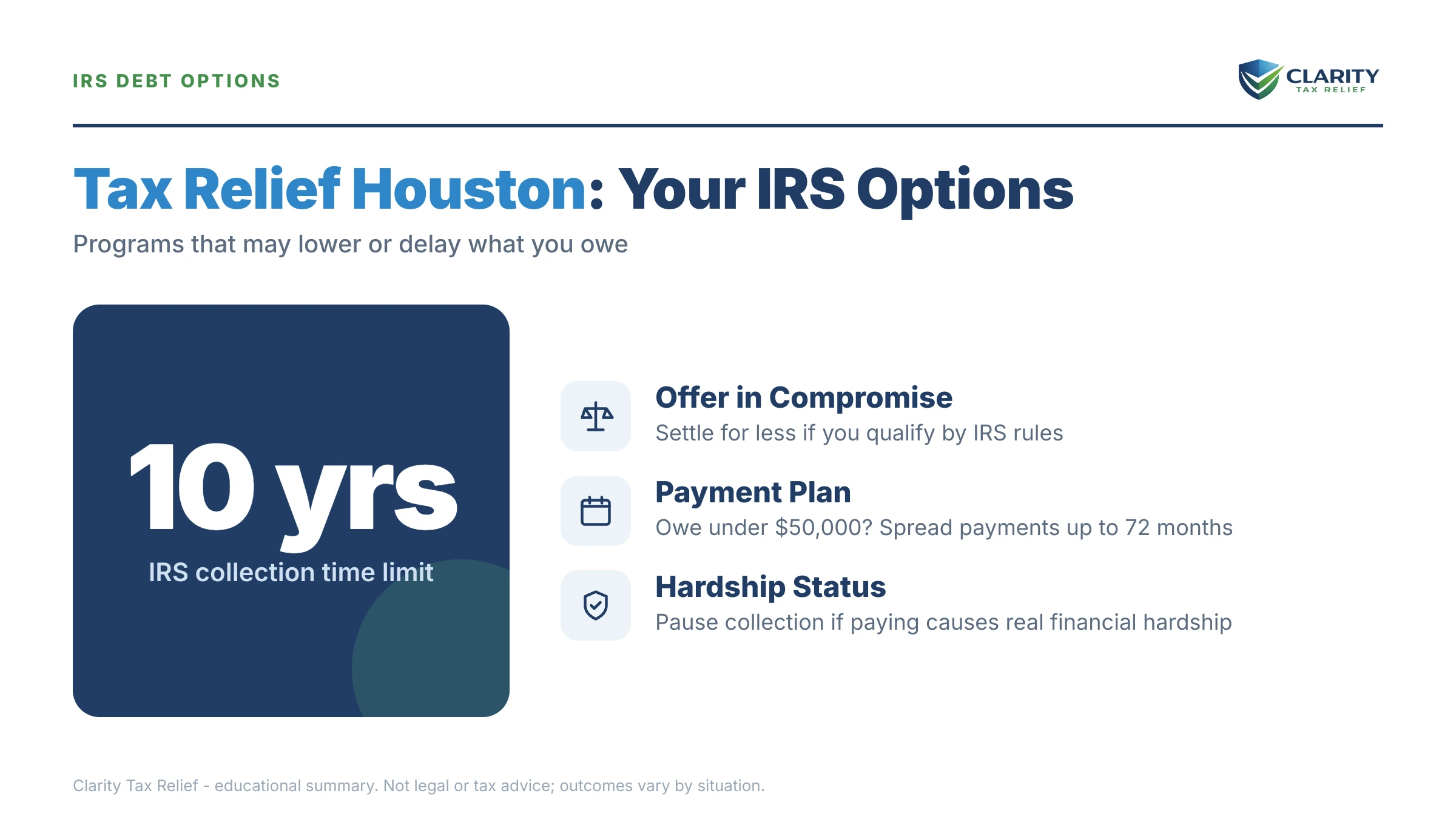
"Tax relief" doesn't mean a magic eraser. It means using the legal programs the IRS already offers to make a debt manageable — a monthly payment plan you can afford, a pause on collection if you're in real hardship, removal of certain penalties, or settling for less than the full balance when your finances genuinely qualify. Tax relief in Houston starts with one honest question: how much can you actually pay, and over what time?
The Houston and Texas tax landscape
Here's the good news for most individuals: Texas has no state personal income tax, and Houston has no city income tax. If you're a wage earner or a sole proprietor, your tax problem is almost certainly federal — owed only to the IRS. There is no Texas version of the IRS chasing your paycheck.
The state agency that does collect taxes is the Texas Comptroller of Public Accounts. The Comptroller handles business taxes, mainly the franchise tax (sometimes called the "margin tax") that applies to many Texas entities, and sales and use tax that retailers and service businesses collect from customers. If you own a Houston restaurant, a shop, or an LLC, those are the state bills that can come due. For more on resolving a state balance, see our guide to Texas Comptroller tax debt and our overview of Texas back taxes help.
For federal matters, Houston is served by local IRS Taxpayer Assistance Centers that handle in-person help by appointment. We won't print a street address or phone number here, because locations and hours change — use the official IRS local office locator to find the nearest center and schedule a visit. Honestly, most issues can be resolved by mail, by phone, or through your IRS online account without setting foot in an office.
Owing both the IRS and Texas: which to handle first
If you're a Houston individual, this is simple. Your debt is federal, so the IRS is the whole game. If you run a business, you may owe the IRS and the Texas Comptroller, and the order matters.
As a rule, deal with the IRS first. Federal collection tools move fast and reach far: the IRS can garnish wages, levy bank accounts, and file a federal tax lien that follows you. Sales tax can be especially serious because it's "trust fund" money — tax you collected from customers on the state's behalf — and the Comptroller treats unpaid sales tax aggressively, including the possibility of suspending or losing your sales-tax permit, which can shut a business down.
So the practical strategy for a Houston business owner is rarely "one then the other." It's looking at both together: stabilize the IRS side so nothing gets levied, then negotiate a workable arrangement with the Comptroller before your permit or your right to operate is at risk. A short payment plan with the IRS and a separate agreement with the state can run at the same time.
Texas is a community-property state: what that means if your spouse owes
This is one rule that makes Houston different from cities in most other states. Texas is a community-property state. In plain terms, income earned and many debts taken on during a marriage are generally treated as shared, even if only one spouse's name is on the paycheck or the return. That changes what the IRS can reach when one spouse owes back taxes.
Two different forms of relief come up here, and people mix them up constantly:
- Innocent-spouse relief applies when a joint return understated tax because of your spouse's income or errors that you didn't know about. If approved, you may be relieved of that part of the debt. The IRS explains it on its innocent spouse relief page.
- Injured-spouse relief applies when your share of a joint refund was taken to pay your spouse's separate past debt — like back taxes from before the marriage. You file to claim back your portion.
Because of community-property rules, the IRS evaluates these claims differently in Texas than it would in a state like New York. If your spouse owes and you're worried about your own wages or refund, this is exactly the kind of situation worth reviewing with an experienced tax professional before you assume you're trapped. You can compare how other states approach it in our guides for cities like tax relief in Los Angeles and tax relief in New York City.
Common situations Clarity helps Houston residents with
Most people who call us are holding a notice and feeling stuck. These are the situations we see most often across the Houston area:
- 1099 and self-employment debt. Consultants, rideshare drivers, and contractors who didn't make quarterly payments and now owe a large balance. An IRS payment plan often spreads it over up to 72 months.
- Can't pay anything right now. If a layoff, medical bill, or hurricane-related setback means paying the IRS would leave you unable to cover rent or groceries, Currently Not Collectible status can pause collection.
- Wage garnishment or a bank levy already started. These need fast action. There are tight windows to stop them.
- Unfiled returns. You can't get most relief until your returns are filed. We help reconstruct and file missing years first.
- Genuinely unaffordable balances. When your income and assets truly can't cover the debt, an Offer in Compromise may settle it for less.
- Texas business tax trouble. Franchise or sales tax issues with the Comptroller, often alongside an IRS balance.
One caution that matters in a big market like Houston: be skeptical of any company promising to wipe out your debt for "pennies on the dollar" before they've even looked at your finances. The IRS decides what it accepts based on real numbers, not marketing. A genuine review tells you what you actually qualify for, with no guarantees attached.
How to start resolving a Houston tax debt, step by step
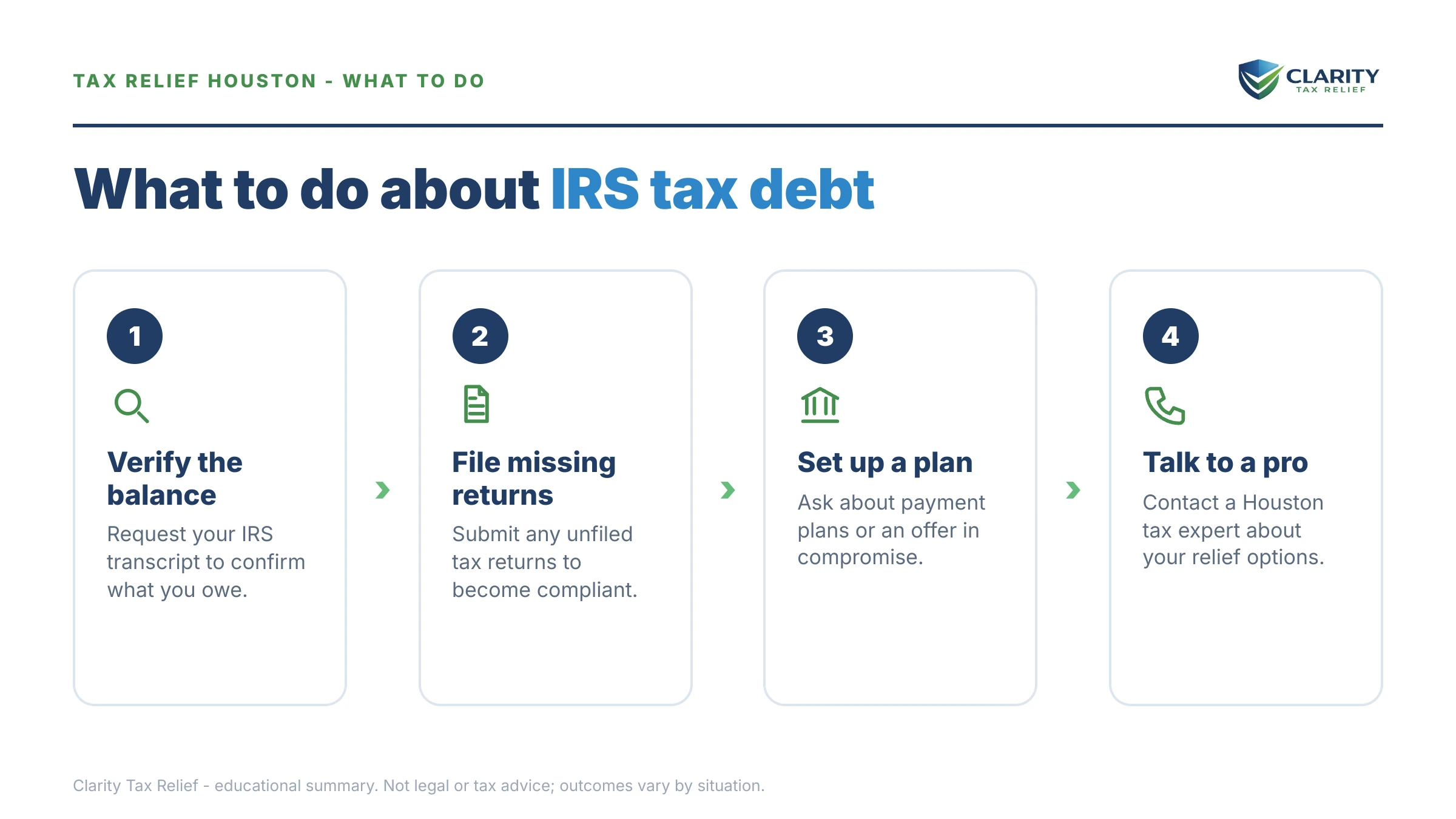
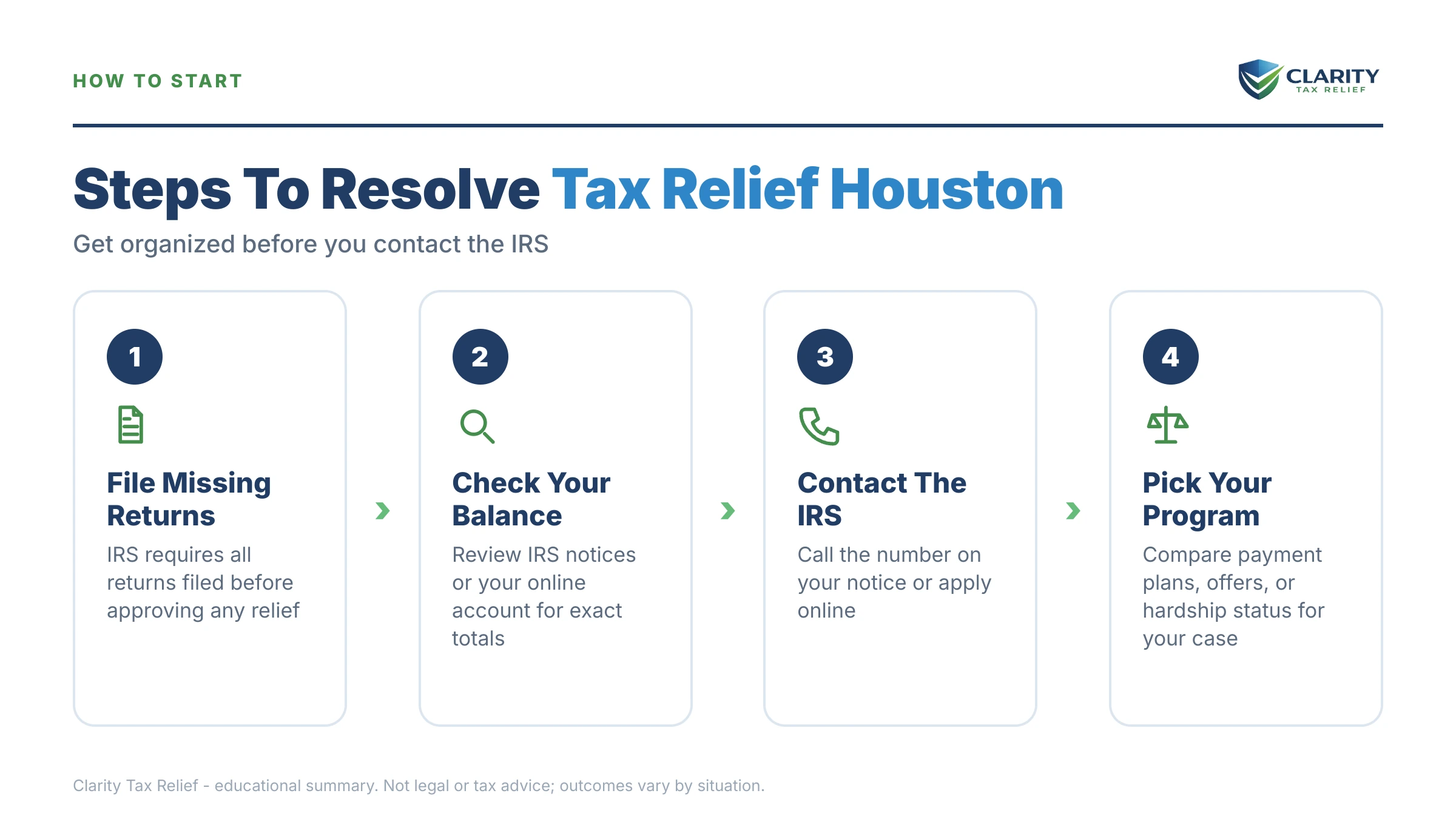
- Pull the facts. Log into your IRS online account to confirm exactly what you owe and for which years. Numbers beat guesses.
- File any missing returns. You generally can't qualify for relief programs with unfiled years hanging over you.
- Stop the bleeding. If a levy or garnishment is active or threatened, act inside the deadline on your notice — that's where time is most precious.
- Pick the right program. Match your real budget to a payment plan, hardship status, penalty relief, or an offer.
- Handle the state separately if you're a business. Set up an arrangement with the Texas Comptroller before your sales-tax permit is at risk.
- Get a professional read if you owe over $10,000. The order you fix things in — returns, penalties, then the balance — changes what you end up paying.
Houston tax relief questions, answered
Does Houston have a city or Texas state income tax I could owe?
No. Texas has no state personal income tax and Houston has no city income tax. For most Houston individuals, a tax debt is purely federal — owed to the IRS. State tax issues here usually involve business franchise tax or sales tax handled by the Texas Comptroller of Public Accounts, not your personal paycheck.
If I owe both the IRS and the Texas Comptroller, which do I deal with first?
Generally handle the IRS first, because federal collection tools — wage garnishment, bank levies, and federal tax liens — tend to move fastest and reach the most. But don't ignore the Comptroller: unpaid Texas franchise or sales tax can cost your business its right to operate. The best move is to look at both together and sequence them.
I live in Houston and my spouse owes back taxes. Am I on the hook?
Possibly. Texas is a community-property state, so income and many debts during marriage can be treated as shared, which affects what the IRS can collect. If the debt came from your spouse's actions on a joint return, you may qualify for innocent-spouse relief. If your refund was taken for your spouse's separate debt, injured-spouse relief may apply.
Is there a local IRS office in Houston I can visit?
Yes. Houston is served by IRS Taxpayer Assistance Centers that handle in-person help by appointment. Use the official IRS office locator at irs.gov/help/contact-your-local-irs-office to find the nearest location, hours, and the phone number to schedule. Most issues, though, can be resolved by mail, phone, or your online account without visiting.
Can a Houston resident really settle IRS debt for less than they owe?
Sometimes, through an Offer in Compromise, but only when your income and assets genuinely can't cover the full balance. The IRS runs the math; it is not automatic. Anyone promising to settle for pennies on the dollar before reviewing your finances is selling you something. A review tells you whether you actually qualify.
This guide is general information, not tax or legal advice for your specific situation. Eligibility for IRS programs depends on individual facts and circumstances; no outcome is guaranteed.